
CHE 2060 Topic 1 Atoms orbitals bonding sp
CHE 2060 Topic 1: Atoms, orbitals & bonding sp 3 hybridization of carbon
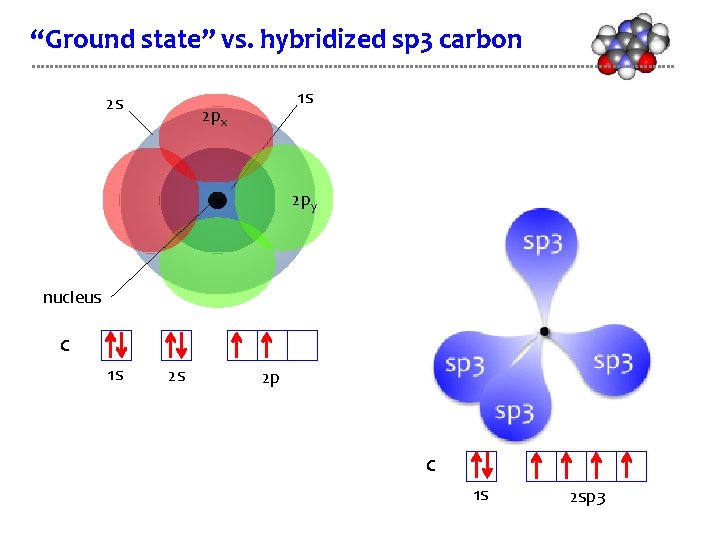
“Ground state” vs. hybridized sp 3 carbon 2 s 1 s 2 px 2 py nucleus C 1 s 2 s 2 p C 1 s 2 sp 3
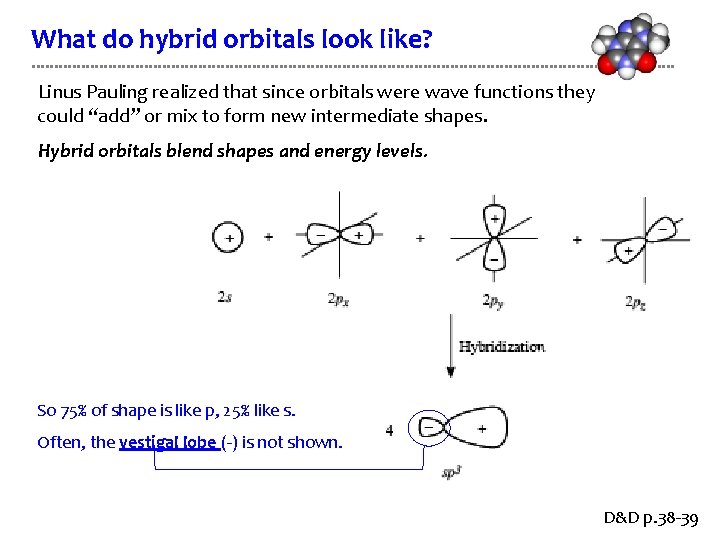
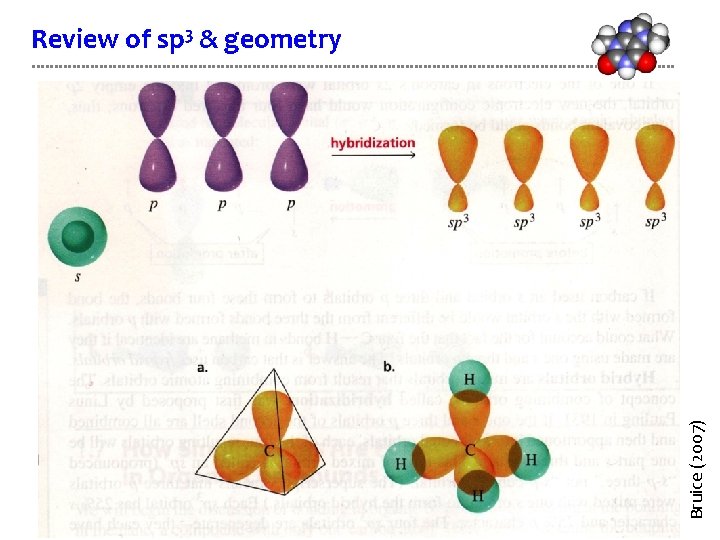
What do hybrid orbitals look like? Linus Pauling realized that since orbitals were wave functions they could “add” or mix to form new intermediate shapes. Hybrid orbitals blend shapes and energy levels. So 75% of shape is like p, 25% like s. Often, the vestigal lobe (-) is not shown. D&D p. 38 -39
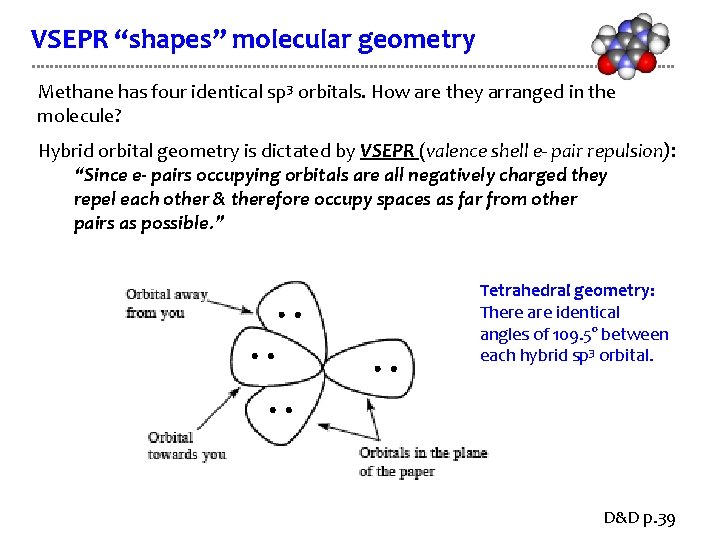
VSEPR “shapes” molecular geometry Methane has four identical sp 3 orbitals. How are they arranged in the molecule? Hybrid orbital geometry is dictated by VSEPR (valence shell e- pair repulsion): “Since e- pairs occupying orbitals are all negatively charged they repel each other & therefore occupy spaces as far from other pairs as possible. ” Tetrahedral geometry: There are identical angles of 109. 5° between each hybrid sp 3 orbital. D&D p. 39
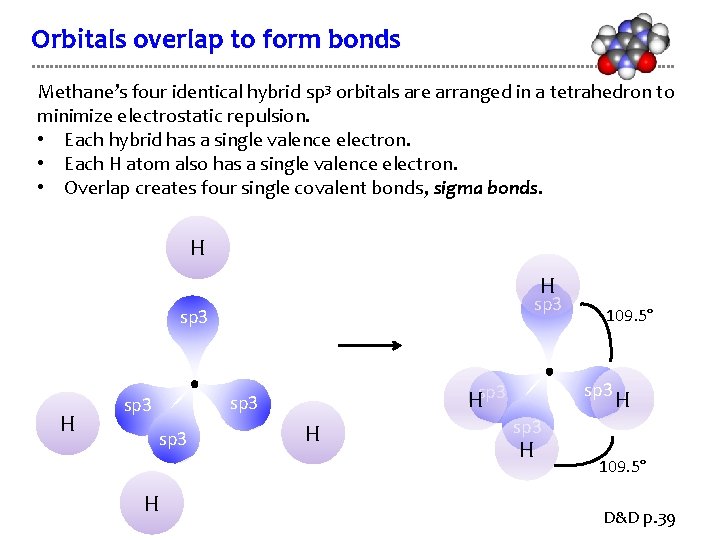
Orbitals overlap to form bonds Methane’s four identical hybrid sp 3 orbitals are arranged in a tetrahedron to minimize electrostatic repulsion. • Each hybrid has a single valence electron. • Each H atom also has a single valence electron. • Overlap creates four single covalent bonds, sigma bonds. H H sp 3 Hsp 3 H 109. 5° H sp 3 H 109. 5° D&D p. 39
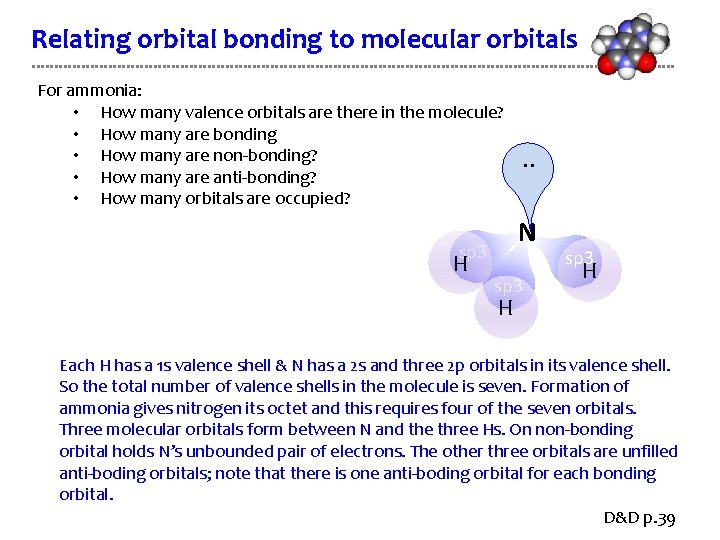
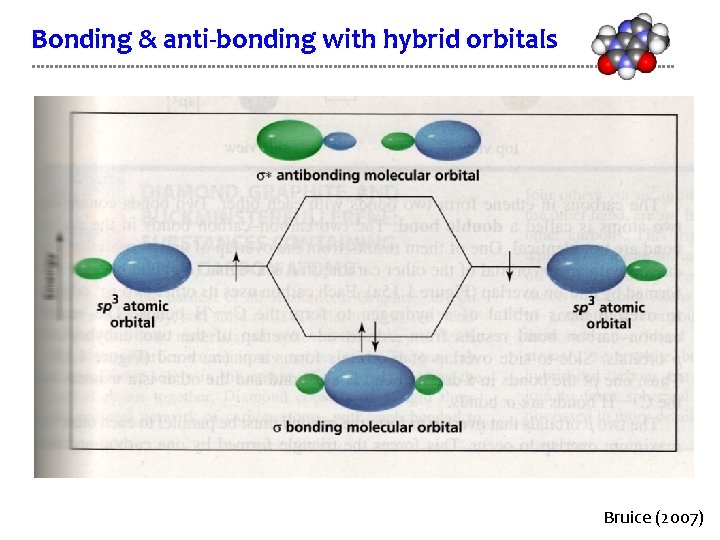
Relating orbital bonding to molecular orbitals For ammonia: • How many valence orbitals are there in the molecule? • How many are bonding • How many are non-bonding? • How many are anti-bonding? • How many orbitals are occupied? N sp 3 H . . sp 3 H H Each H has a 1 s valence shell & N has a 2 s and three 2 p orbitals in its valence shell. So the total number of valence shells in the molecule is seven. Formation of ammonia gives nitrogen its octet and this requires four of the seven orbitals. Three molecular orbitals form between N and the three Hs. On non-bonding orbital holds N’s unbounded pair of electrons. The other three orbitals are unfilled anti-boding orbitals; note that there is one anti-boding orbital for each bonding orbital. D&D p. 39
Bruice (2007) Review of sp 3 & geometry
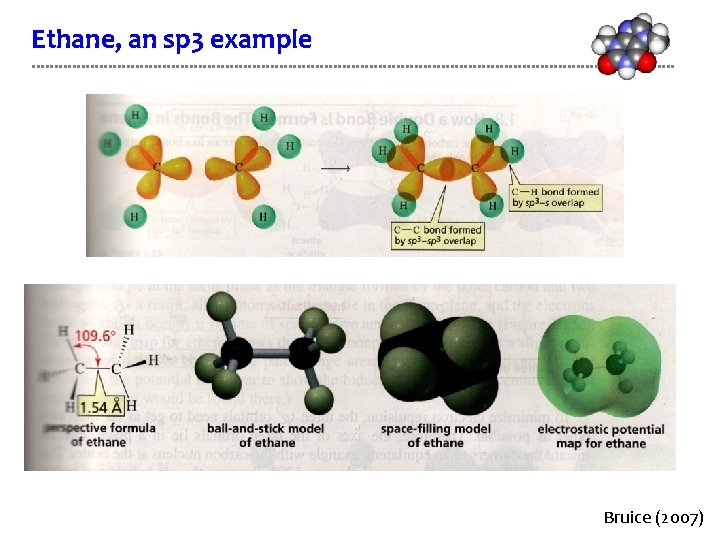
Ethane, an sp 3 example Bruice (2007)
Bonding & anti-bonding with hybrid orbitals Bruice (2007)
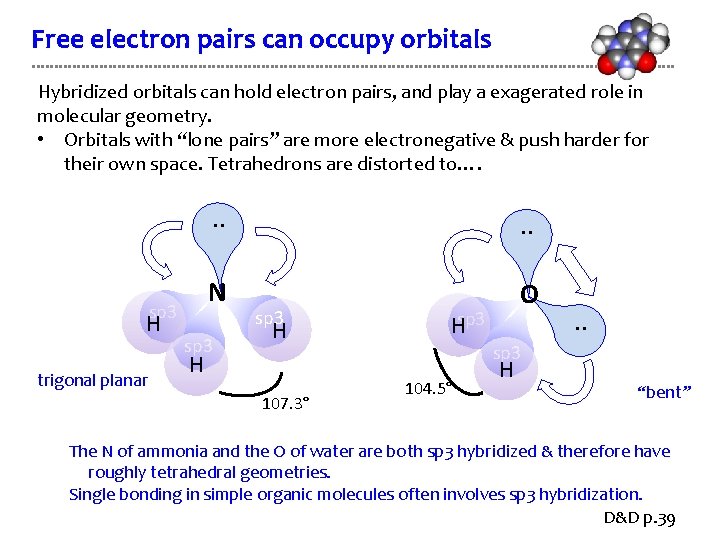
Free electron pairs can occupy orbitals Hybridized orbitals can hold electron pairs, and play a exagerated role in molecular geometry. • Orbitals with “lone pairs” are more electronegative & push harder for their own space. Tetrahedrons are distorted to…. sp 3 H trigonal planar . . N O sp 3 H H 107. 3° Hsp 3 . . sp 3 104. 5° H “bent” The N of ammonia and the O of water are both sp 3 hybridized & therefore have roughly tetrahedral geometries. Single bonding in simple organic molecules often involves sp 3 hybridization. D&D p. 39
Can you? (1) Draw sp 3 hybridized orbitals? (2) Draw slot diagrams to explain sp 3 orbital hybridization? (3) Explain how VSEPR explains the spatial orientation of carbon’s four sp 3 orbitals? (4) Describe covalent bonds as overlapping orbitals (hybridized on not)? (5) Understand that a pair of free (unbonded) electrons will occupy a hybridized Aristotle orbital? (6) Identify bonds formed by sp 3 orbitals in ball & stick or space-filling models? 1700’s gas pump experiment
- Slides: 11