
CHE 2060 Topic 1 Atoms orbitals bonding sp
CHE 2060 Topic 1: Atoms, orbitals & bonding sp hybridization of carbon
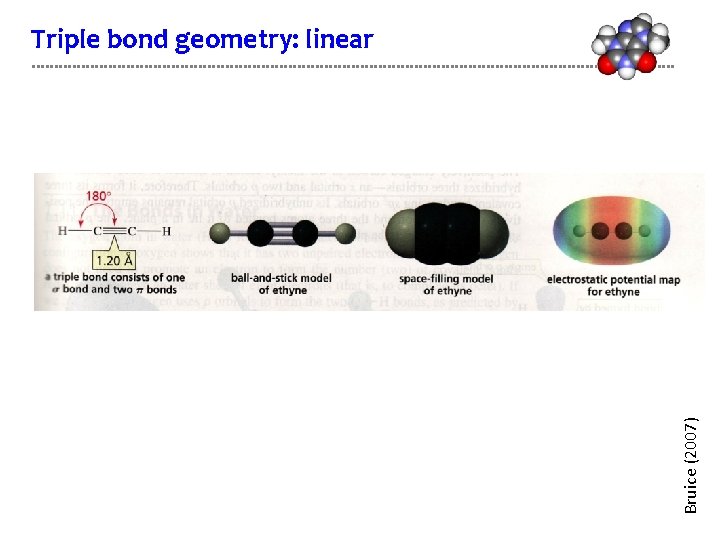
Bruice (2007) Triple bond geometry: linear
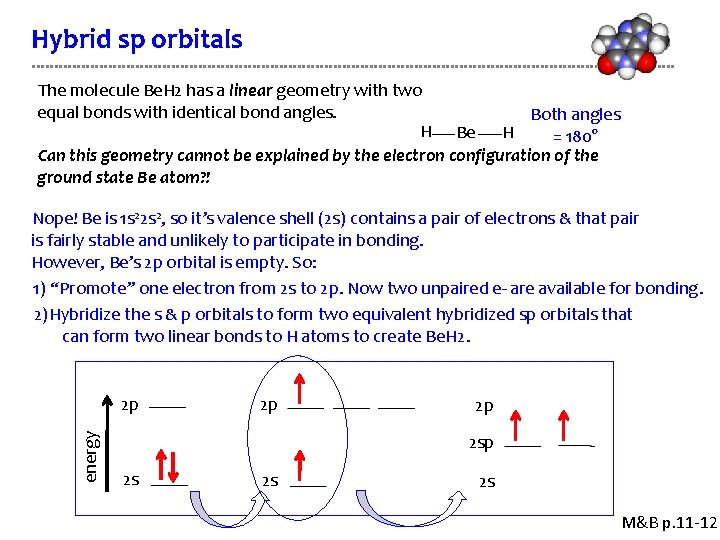
Hybrid sp orbitals The molecule Be. H 2 has a linear geometry with two equal bonds with identical bond angles. Both angles H Be H = 180° Can this geometry cannot be explained by the electron configuration of the ground state Be atom? ! Nope! Be is 1 s 22 s 2, so it’s valence shell (2 s) contains a pair of electrons & that pair is fairly stable and unlikely to participate in bonding. However, Be’s 2 p orbital is empty. So: 1) “Promote” one electron from 2 s to 2 p. Now two unpaired e- are available for bonding. 2)Hybridize the s & p orbitals to form two equivalent hybridized sp orbitals that can form two linear bonds to H atoms to create Be. H 2. energy 2 p 2 p 2 p 2 s 2 s 2 s M&B p. 11 -12
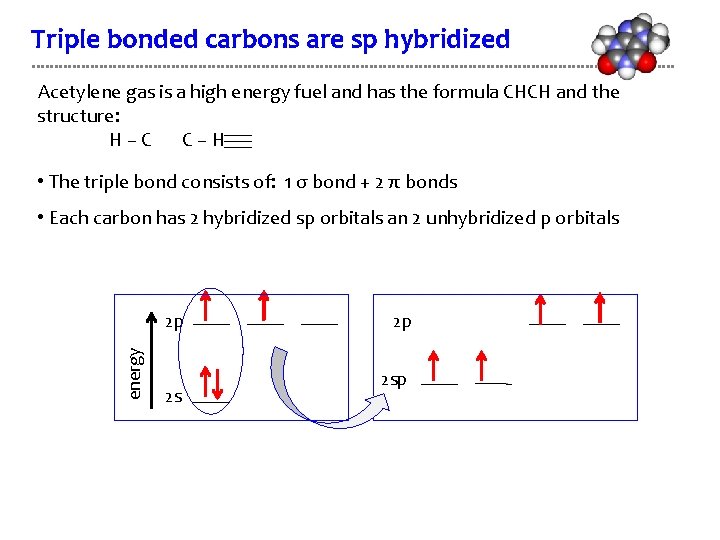
Triple bonded carbons are sp hybridized Acetylene gas is a high energy fuel and has the formula CHCH and the structure: H–C C–H • The triple bond consists of: 1 σ bond + 2 π bonds • Each carbon has 2 hybridized sp orbitals an 2 unhybridized p orbitals energy 2 p 2 sp
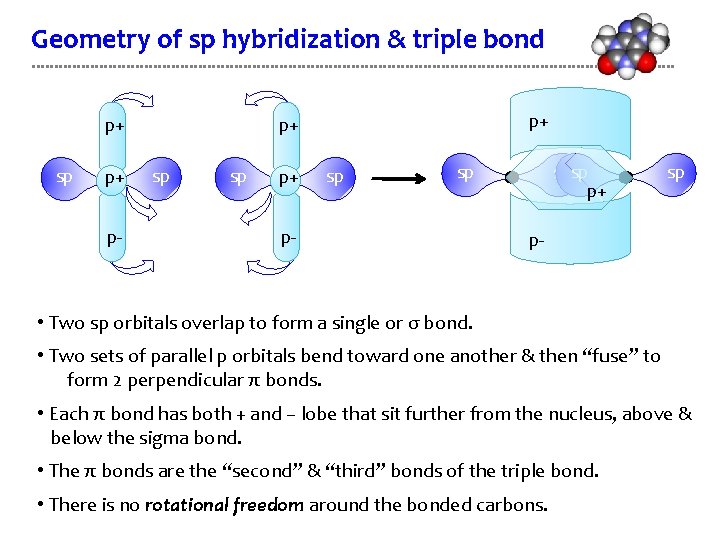
Geometry of sp hybridization & triple bond p+ sp p+ p- p+ p+ sp spsp p+ sp p- • Two sp orbitals overlap to form a single or σ bond. • Two sets of parallel p orbitals bend toward one another & then “fuse” to form 2 perpendicular π bonds. • Each π bond has both + and – lobe that sit further from the nucleus, above & below the sigma bond. • The π bonds are the “second” & “third” bonds of the triple bond. • There is no rotational freedom around the bonded carbons.

Bruice (2007) Hybrid sp & triple bonding
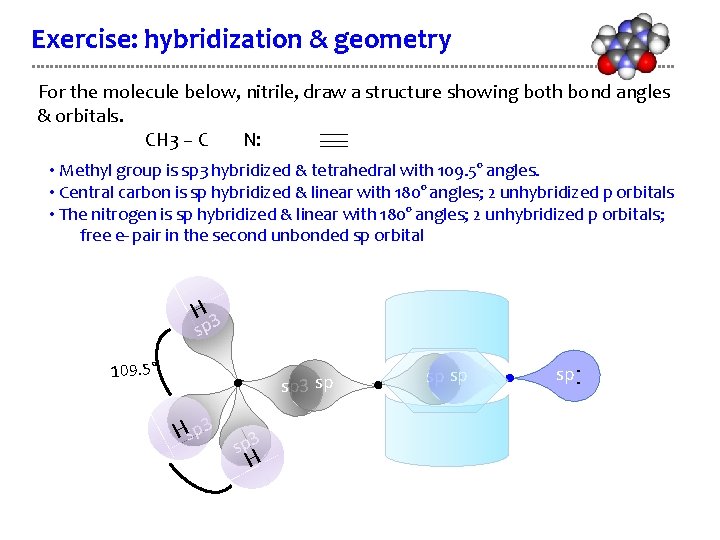
Exercise: hybridization & geometry For the molecule below, nitrile, draw a structure showing both bond angles & orbitals. CH 3 – C N: • Methyl group is sp 3 hybridized & tetrahedral with 109. 5° angles. • Central carbon is sp hybridized & linear with 180° angles; 2 unhybridized p orbitals • The nitrogen is sp hybridized & linear with 180° angles; 2 unhybridized p orbitals; free e- pair in the second unbonded sp orbital H 3 sp sp 3 sp Hsp 3 H sp sp sp . . 109. 5°
Bottom line for orbital hybridization? Explanations range from the simple to the complex; we’ll focus on the former. 1) Hybridization is a quantum mechanical approach that combines wave functions to give new wave functions. This definition is based on sound mathematics. 2) Hybrid orbitals are possible states of an e- in an atom, especially when that atom is bonded to other atoms in a molecule. 3) The concept of hybridization is a story made up to explain how bonding explains the observed shapes (or geometries) and behaviors of molecules.
Can you? (1) Draw sp hybridized orbitals? (2) Draw slot diagrams to explain sp orbital hybridization? (3) Explain how VSEPR explains the spatial orientation of sp orbitals? (4) Describe how overlapping sp and unhybridized p orbitals form triple bonds (sigma + 2 pi bonds)? (2) Describe and explain the relative reactivities of sigma and pi bonds in triple bonds 1700’s gas pump experiment
- Slides: 9