
CHE 112 Spring 2021 Lecture 11 b Solubility
CHE 112 Spring 2021 Lecture 11 b – Solubility Overview/Topics 1. Terminology a. Unsaturated (U) b. Saturated (S) c. Supersaturated (SS) 2. Measuring Solubility a. Charts (aq), (s) b. Tables – g/100 g H 2 O c. Ratios/Proportions d. Interpolation and Extrapolation e. Equations 3. Effect of Temperature on Solubility 4. Effect of Pressure on Solubility 5. 4 Factors effecting the rate of dissolving OER 11. 3 Read 1. HW 11 b Skills to Master
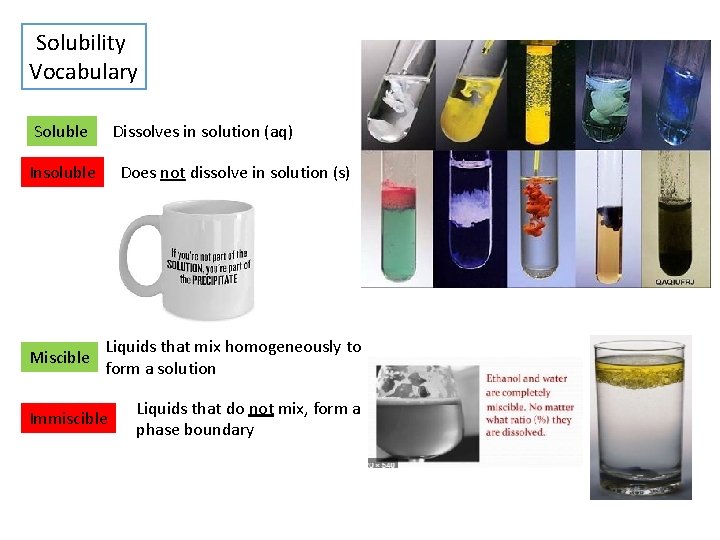
Solubility Vocabulary Soluble Dissolves in solution (aq) Insoluble Does not dissolve in solution (s) Miscible Liquids that mix homogeneously to form a solution Immiscible Liquids that do not mix, form a phase boundary
![Solubility Vocabulary Unsaturated (U) Saturated (S) Supersaturated (SS) o [Solute] < Max o Clear](http://slidetodoc.com/presentation_image_h2/16251a305006748f087a86ea289d0500/image-3.jpg "Solubility Vocabulary Unsaturated (U) Saturated (S) Supersaturated (SS) o [Solute] < Max o Clear")
Solubility Vocabulary Unsaturated (U) Saturated (S) Supersaturated (SS) o [Solute] < Max o Clear Solution o [Solute] = Max o Clear Solution + tiny amount solid o Equilibrium o [Solute] > Max o Clear Solution o Inherently unstable or
![Supersaturated (SS) o [Solute] > Max o Clear Solution o Inherently unstable or](http://slidetodoc.com/presentation_image_h2/16251a305006748f087a86ea289d0500/image-4.jpg "Supersaturated (SS) o [Solute] > Max o Clear Solution o Inherently unstable or")
Supersaturated (SS) o [Solute] > Max o Clear Solution o Inherently unstable or
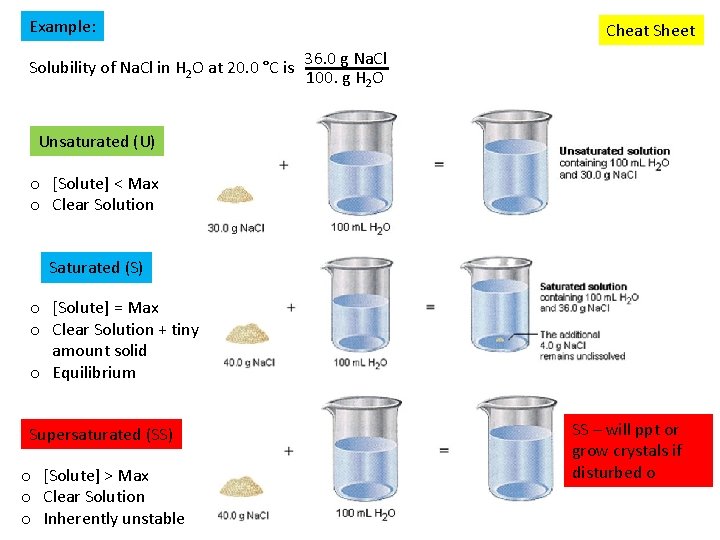
Example: Solubility of Na. Cl in H 2 O at 20. 0 °C is Cheat Sheet 36. 0 g Na. Cl 100. g H 2 O Unsaturated (U) o [Solute] < Max o Clear Solution Saturated (S) o [Solute] = Max o Clear Solution + tiny amount solid o Equilibrium Supersaturated (SS) o [Solute] > Max o Clear Solution o Inherently unstable SS – will ppt or grow crystals if disturbed o
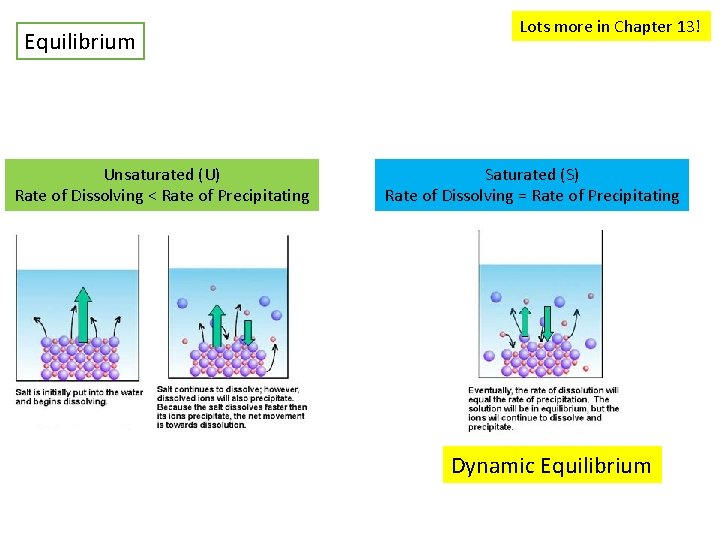
Equilibrium Unsaturated (U) Rate of Dissolving < Rate of Precipitating Lots more in Chapter 13! Saturated (S) Rate of Dissolving = Rate of Precipitating Dynamic Equilibrium
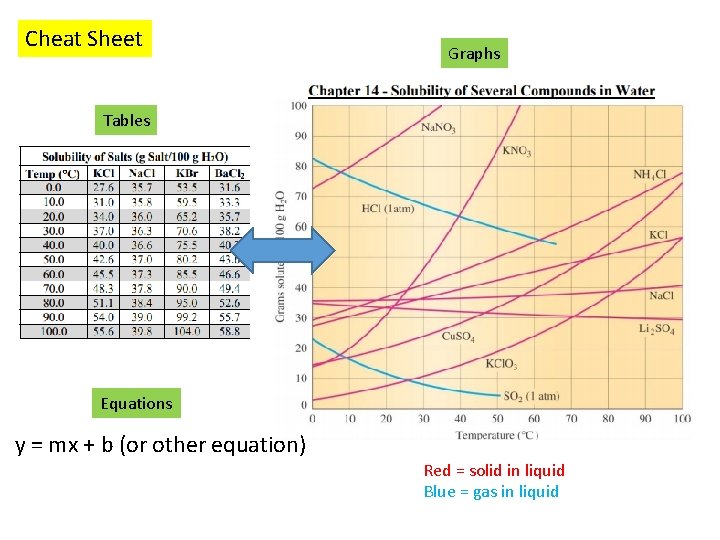
Cheat Sheet Graphs Tables Equations y = mx + b (or other equation) Red = solid in liquid Blue = gas in liquid
![Supersaturated (SS) o [Solute] > Max o ABOVE LINE Saturated (S) o [Solute] =](http://slidetodoc.com/presentation_image_h2/16251a305006748f087a86ea289d0500/image-8.jpg "Supersaturated (SS) o [Solute] > Max o ABOVE LINE Saturated (S) o [Solute] =")
Supersaturated (SS) o [Solute] > Max o ABOVE LINE Saturated (S) o [Solute] = Max o Equilibrium o ON LINE Unsaturated (U) o [Solute] < Max o BELOW LINE
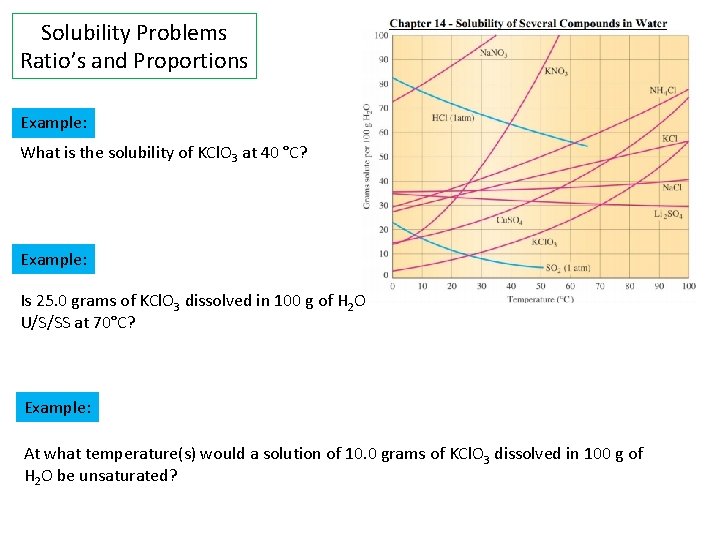
Solubility Problems Ratio’s and Proportions Example: What is the solubility of KCl. O 3 at 40 °C? Example: Is 25. 0 grams of KCl. O 3 dissolved in 100 g of H 2 O U/S/SS at 70°C? Example: At what temperature(s) would a solution of 10. 0 grams of KCl. O 3 dissolved in 100 g of H 2 O be unsaturated?
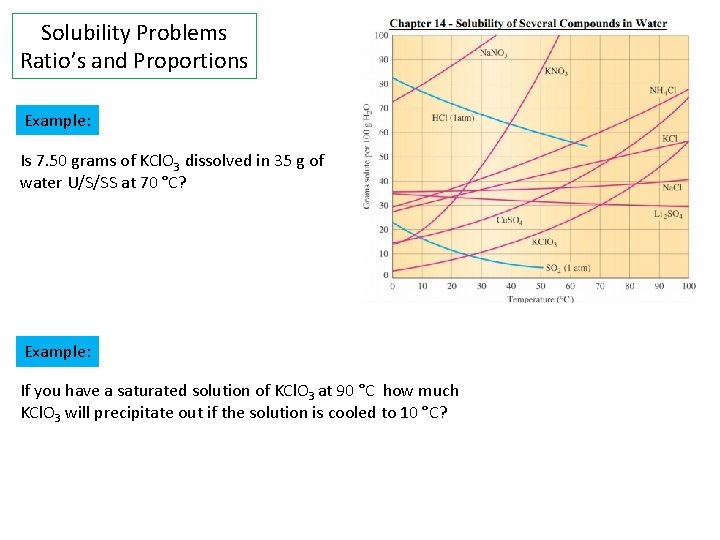
Solubility Problems Ratio’s and Proportions Example: Is 7. 50 grams of KCl. O 3 dissolved in 35 g of water U/S/SS at 70 °C? Example: If you have a saturated solution of KCl. O 3 at 90 °C how much KCl. O 3 will precipitate out if the solution is cooled to 10 °C?
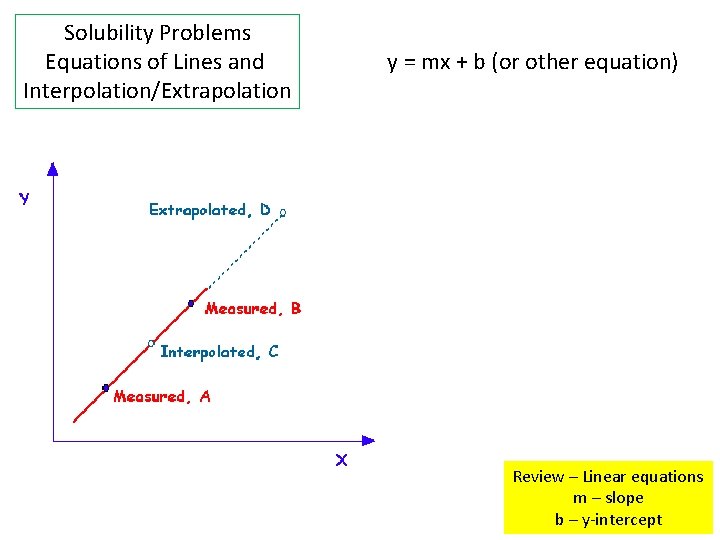
Solubility Problems Equations of Lines and Interpolation/Extrapolation y = mx + b (or other equation) Review – Linear equations m – slope b – y-intercept
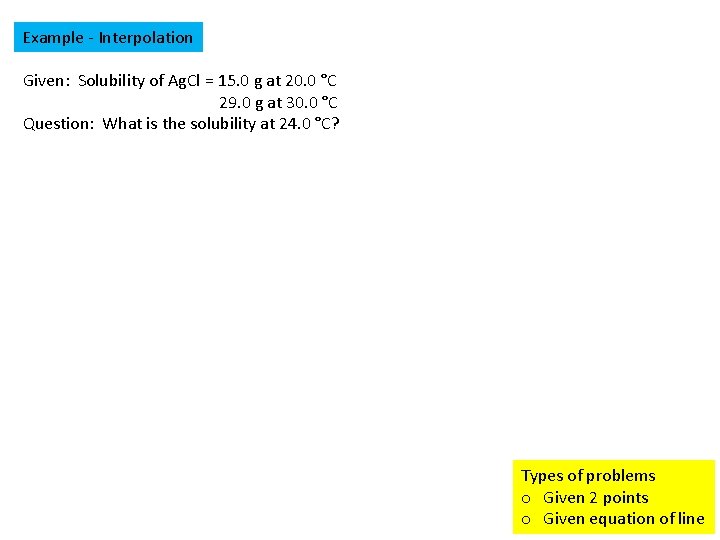
Example - Interpolation Given: Solubility of Ag. Cl = 15. 0 g at 20. 0 °C 29. 0 g at 30. 0 °C Question: What is the solubility at 24. 0 °C? Types of problems o Given 2 points o Given equation of line
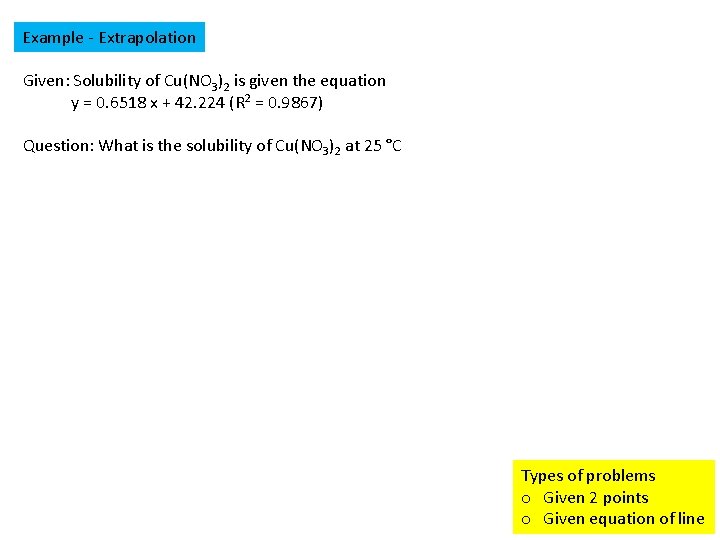
Example - Extrapolation Given: Solubility of Cu(NO 3)2 is given the equation y = 0. 6518 x + 42. 224 (R 2 = 0. 9867) Question: What is the solubility of Cu(NO 3)2 at 25 °C Types of problems o Given 2 points o Given equation of line
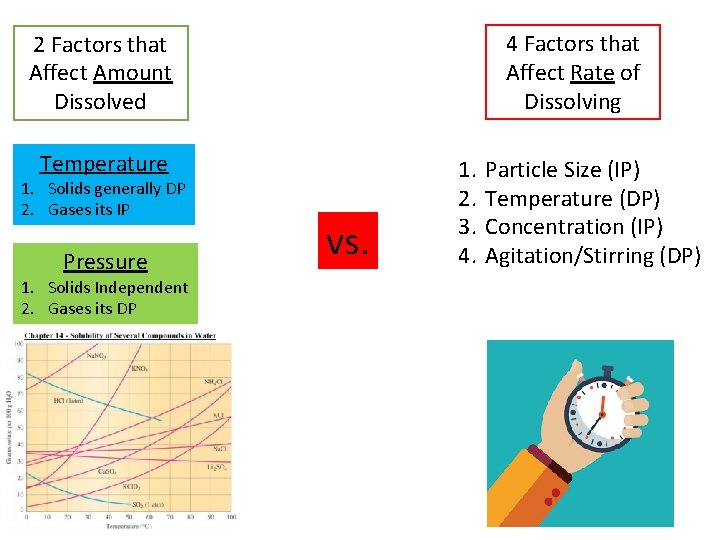
4 Factors that Affect Rate of Dissolving 2 Factors that Affect Amount Dissolved Temperature 1. Solids generally DP 2. Gases its IP Pressure 1. Solids Independent 2. Gases its DP vs. 1. 2. 3. 4. Particle Size (IP) Temperature (DP) Concentration (IP) Agitation/Stirring (DP)
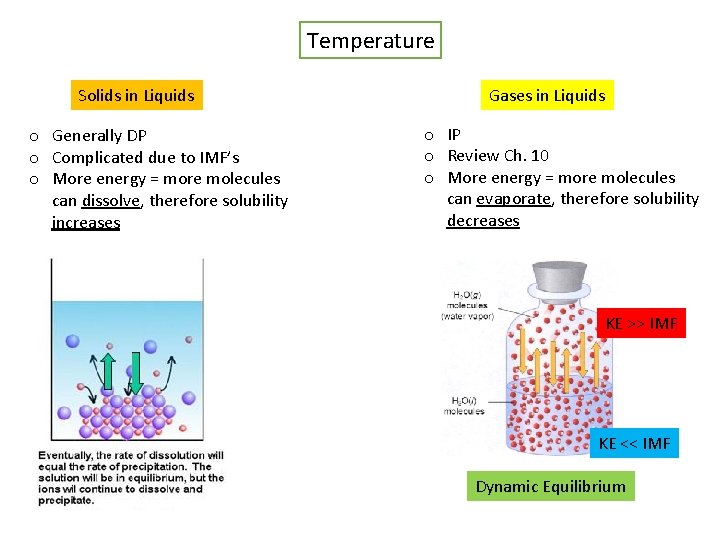
Temperature Solids in Liquids o Generally DP o Complicated due to IMF’s o More energy = more molecules can dissolve, therefore solubility increases Gases in Liquids o IP o Review Ch. 10 o More energy = more molecules can evaporate, therefore solubility decreases KE >> IMF KE << IMF Dynamic Equilibrium
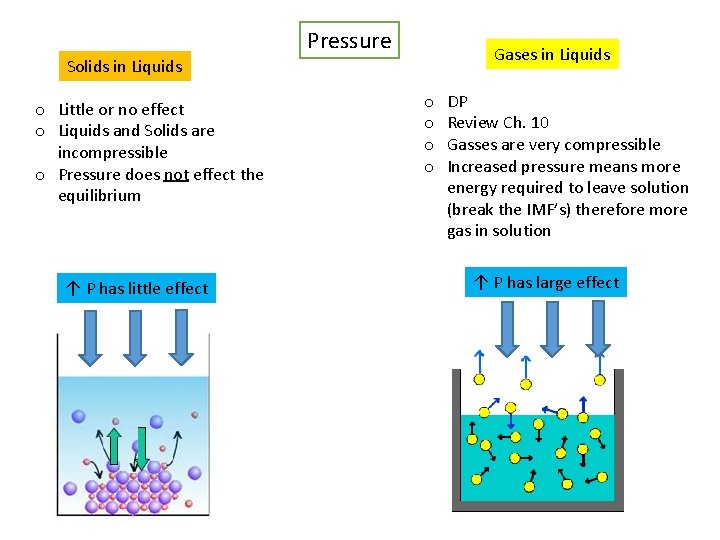
Pressure Gases in Liquids Solids in Liquids o Little or no effect o Liquids and Solids are incompressible o Pressure does not effect the equilibrium ↑ P has little effect o o DP Review Ch. 10 Gasses are very compressible Increased pressure means more energy required to leave solution (break the IMF’s) therefore more gas in solution ↑ P has large effect
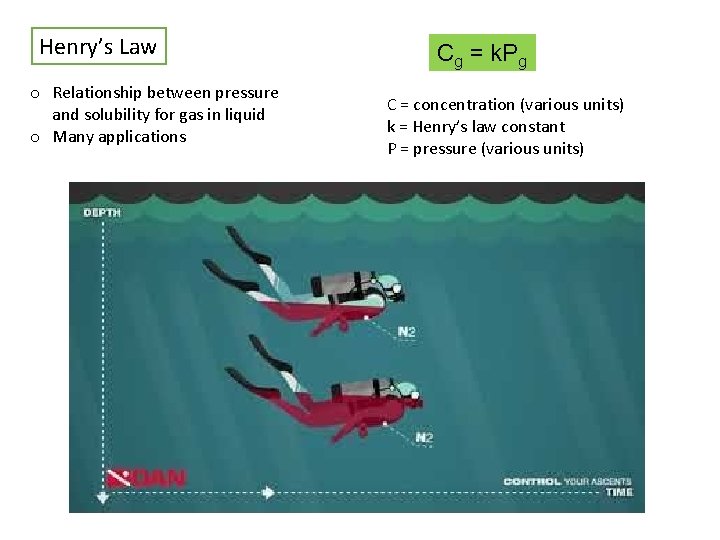
Henry’s Law o Relationship between pressure and solubility for gas in liquid o Many applications Cg = k. Pg C = concentration (various units) k = Henry’s law constant P = pressure (various units)
Example Bromomethane (CH 3 Br) is an antifungal compound with k = 0. 159 mol/L·atm at 25 °C. If the partial pressure is 125 mm. Hg what is the solubility of Bromomethane in M?
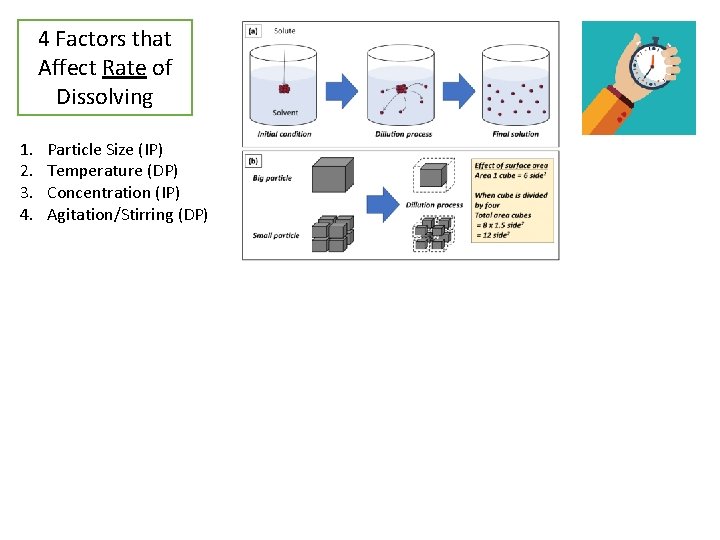
4 Factors that Affect Rate of Dissolving 1. 2. 3. 4. Particle Size (IP) Temperature (DP) Concentration (IP) Agitation/Stirring (DP)
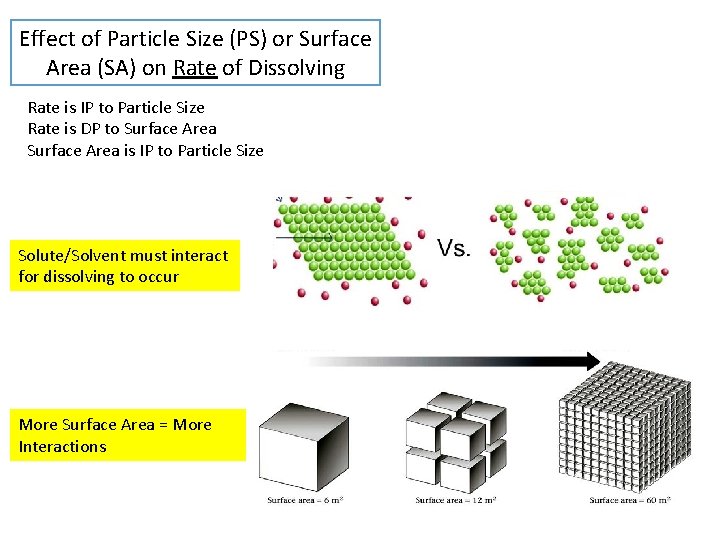
Effect of Particle Size (PS) or Surface Area (SA) on Rate of Dissolving Rate is IP to Particle Size Rate is DP to Surface Area is IP to Particle Size Solute/Solvent must interact for dissolving to occur More Surface Area = More Interactions
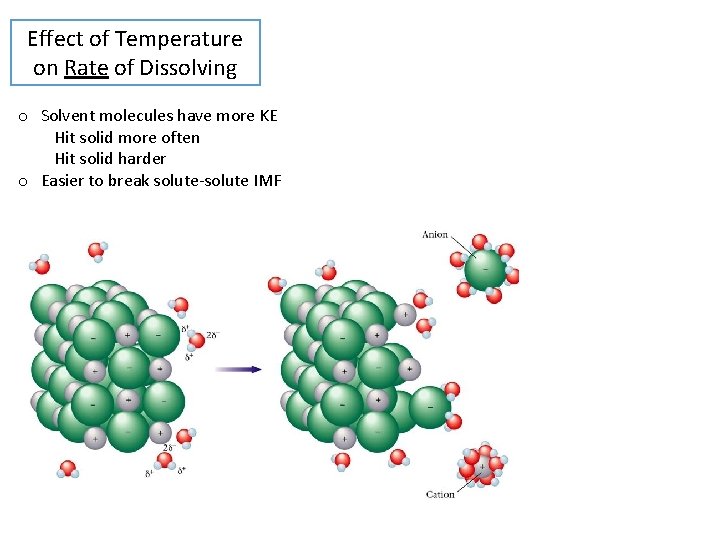
Effect of Temperature on Rate of Dissolving o Solvent molecules have more KE Hit solid more often Hit solid harder o Easier to break solute-solute IMF
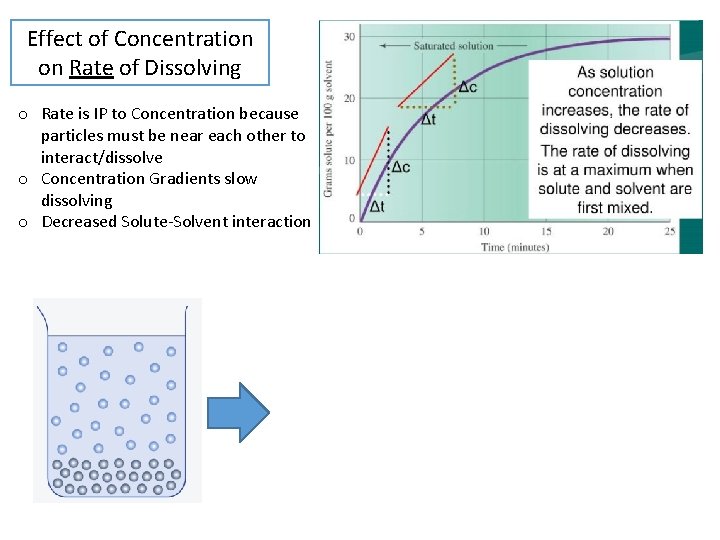
Effect of Concentration on Rate of Dissolving o Rate is IP to Concentration because particles must be near each other to interact/dissolve o Concentration Gradients slow dissolving o Decreased Solute-Solvent interaction
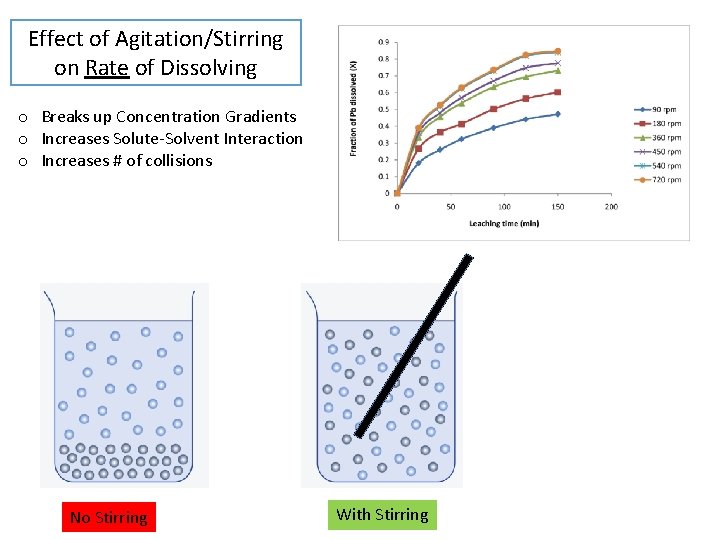
Effect of Agitation/Stirring on Rate of Dissolving o Breaks up Concentration Gradients o Increases Solute-Solvent Interaction o Increases # of collisions No Stirring With Stirring

- Slides: 24