
CHE 111 Fall 2020 Lecture 9 b Enthalpy
CHE 111 Fall 2020 Lecture 9 b – Enthalpy and Chemical Reactions Overview/Topics 1. Endothermic/Exothermic Reactions a. Sign conventions b. Side of Reaction c. High/Low Energy d. Diagram 2. Energy (ΔE) vs Enthalpy (ΔH) OER 9. 3 -9. 4 Read 1. 9 b Skills to Master
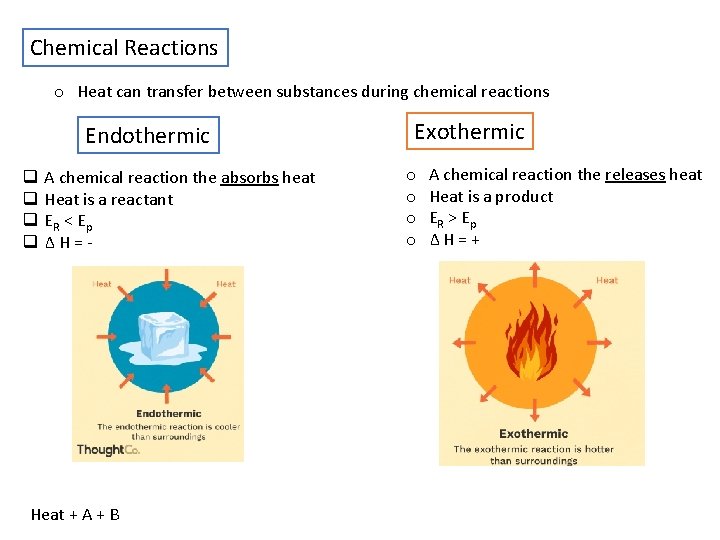
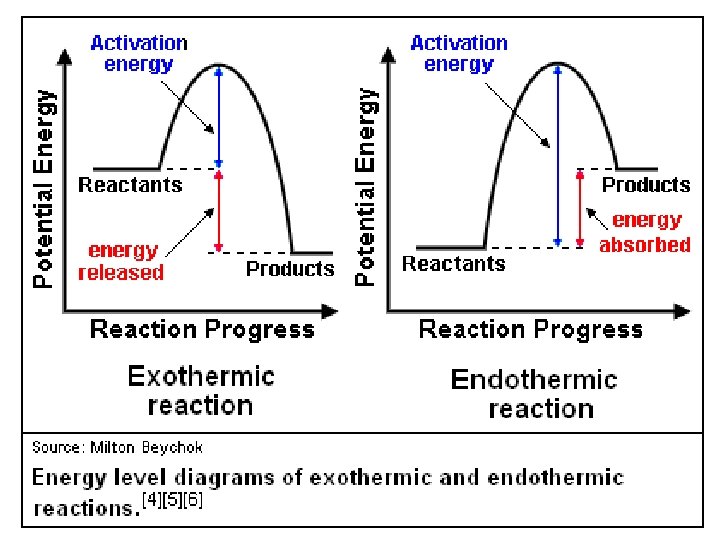
Chemical Reactions o Heat can transfer between substances during chemical reactions Endothermic q q A chemical reaction the absorbs heat Heat is a reactant ER < E p ΔH=- Heat + A + B Exothermic o o A chemical reaction the releases heat Heat is a product ER > E p ΔH=+
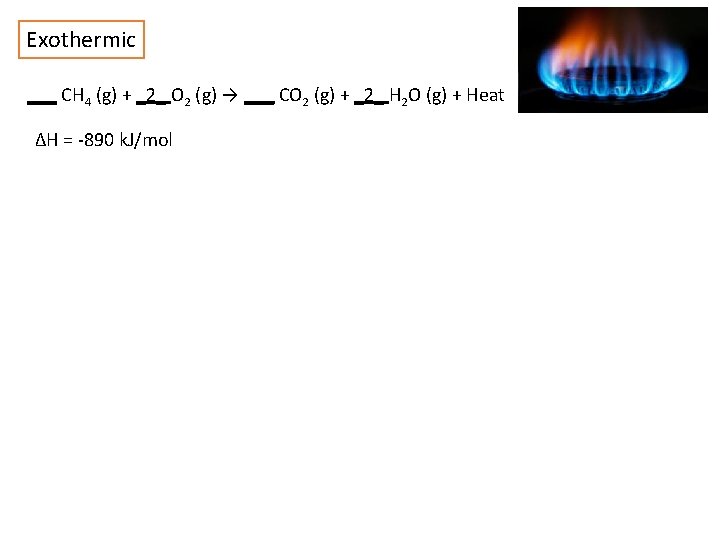
Exothermic ___ CH 4 (g) + _2_ O 2 (g) → ___ CO 2 (g) + _2_ H 2 O (g) + Heat ΔH = -890 k. J/mol
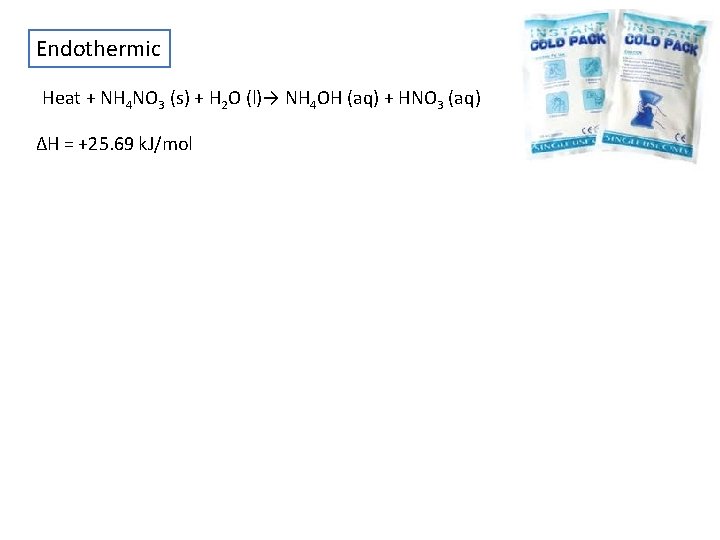
Endothermic Heat + NH 4 NO 3 (s) + H 2 O (l)→ NH 4 OH (aq) + HNO 3 (aq) ΔH = +25. 69 k. J/mol
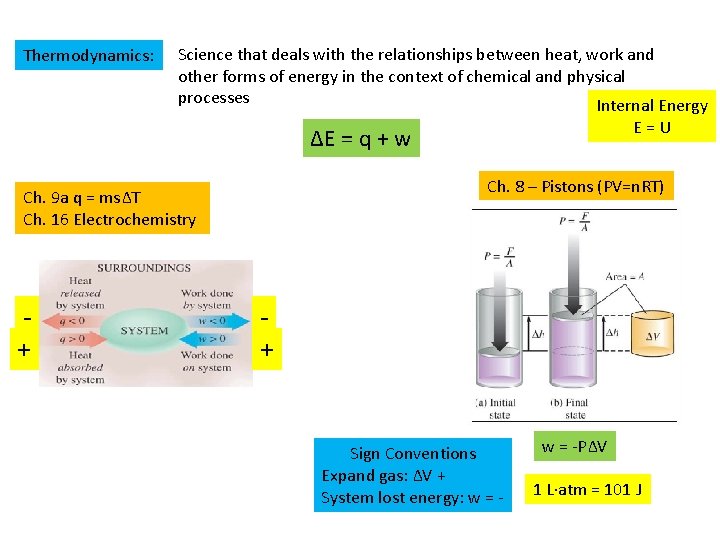
Thermodynamics: Science that deals with the relationships between heat, work and other forms of energy in the context of chemical and physical processes Internal Energy E=U ΔE = q + w Ch. 8 – Pistons (PV=n. RT) Ch. 9 a q = msΔT Ch. 16 Electrochemistry + + Sign Conventions Expand gas: ΔV + System lost energy: w = -PΔV 1 L·atm = 101 J
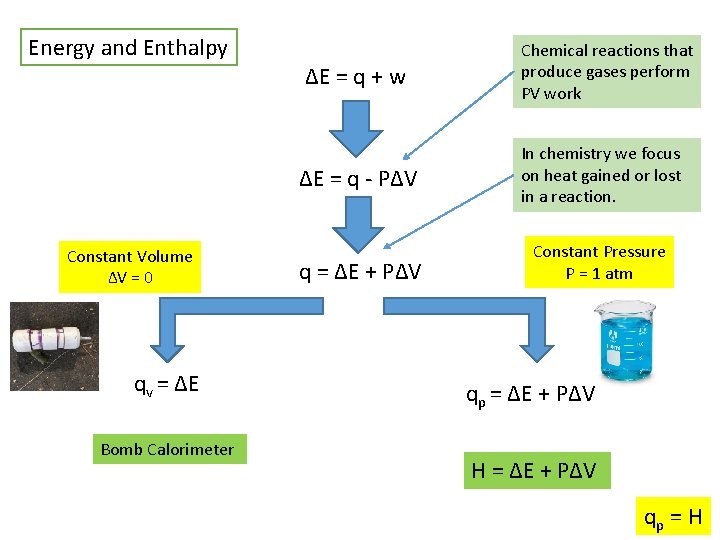
Energy and Enthalpy Constant Volume ΔV = 0 qv = ΔE Bomb Calorimeter ΔE = q + w Chemical reactions that produce gases perform PV work ΔE = q - PΔV In chemistry we focus on heat gained or lost in a reaction. q = ΔE + PΔV Constant Pressure P = 1 atm qp = ΔE + PΔV H = ΔE + PΔV qp = H
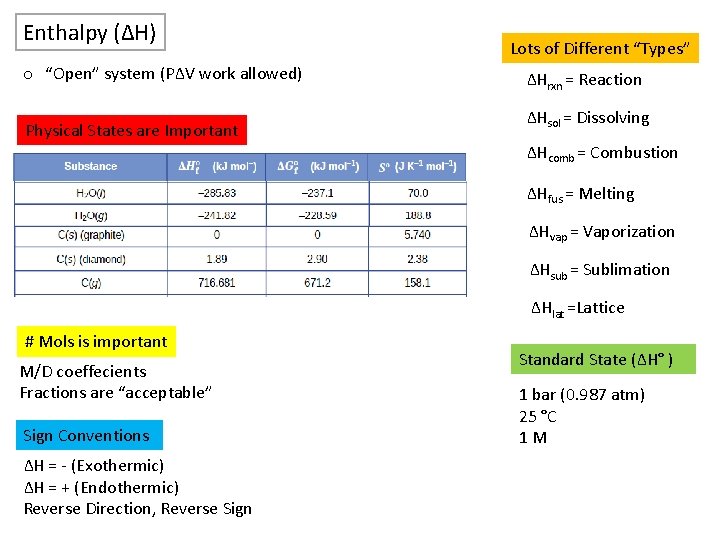
Enthalpy (ΔH) o “Open” system (PΔV work allowed) Physical States are Important Lots of Different “Types” ΔHrxn = Reaction ΔHsol = Dissolving ΔHcomb = Combustion ΔHfus = Melting ΔHvap = Vaporization ΔHsub = Sublimation ΔHlat =Lattice # Mols is important M/D coeffecients Fractions are “acceptable” Sign Conventions ΔH = - (Exothermic) ΔH = + (Endothermic) Reverse Direction, Reverse Sign Standard State (ΔH° ) 1 bar (0. 987 atm) 25 °C 1 M
Applications of Enthalpy 1. ΔH reaction a. Heat released b. Determine ΔH 2. Enthalpy of Formation (ΔHf°) 3. Hess’s Law 4. Bond Dissociation Energies (BDE) (9. 4) 5. Ionic Bonds/Lattice Energy (9. 4) 6. Born-Haber Cycle (9. 4)
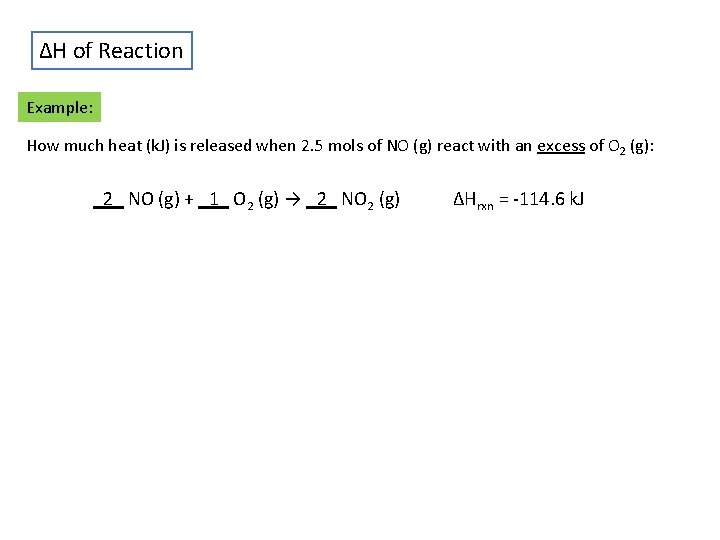
ΔH of Reaction Example: How much heat (k. J) is released when 2. 5 mols of NO (g) react with an excess of O 2 (g): _2_ NO (g) + _1_ O 2 (g) → _2_ NO 2 (g) ΔHrxn = -114. 6 k. J
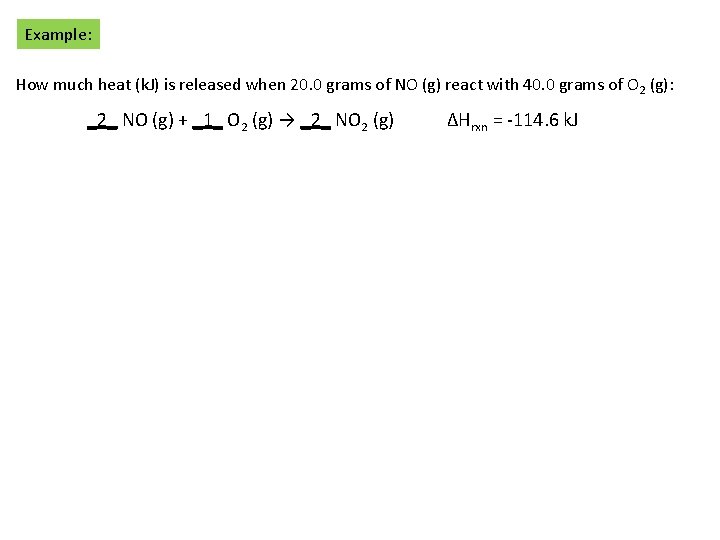
Example: How much heat (k. J) is released when 20. 0 grams of NO (g) react with 40. 0 grams of O 2 (g): _2_ NO (g) + _1_ O 2 (g) → _2_ NO 2 (g) ΔHrxn = -114. 6 k. J
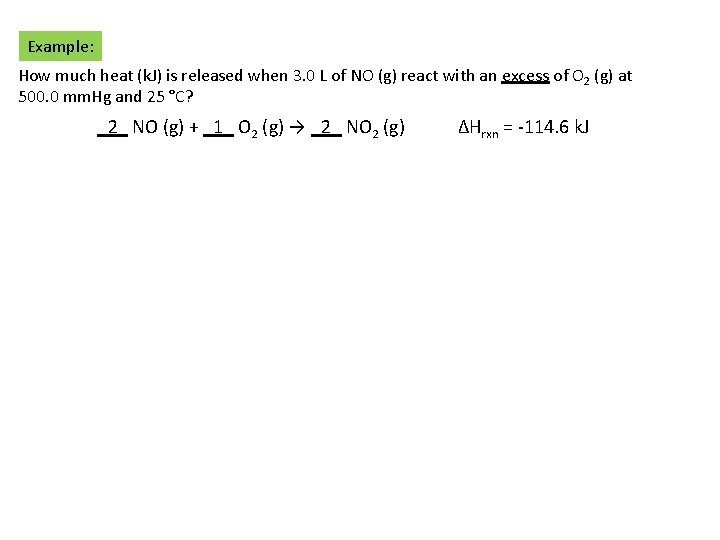
Example: How much heat (k. J) is released when 3. 0 L of NO (g) react with an excess of O 2 (g) at 500. 0 mm. Hg and 25 °C? _2_ NO (g) + _1_ O 2 (g) → _2_ NO 2 (g) ΔHrxn = -114. 6 k. J
Example: In lab you reacted 1. 50 grams of Mg (s) with excess HCl (aq) and produced -28. 8 k. J of heat. What is the ΔH of reaction? http: //chemistry-reference. com/reaction. asp? rxnnum=697
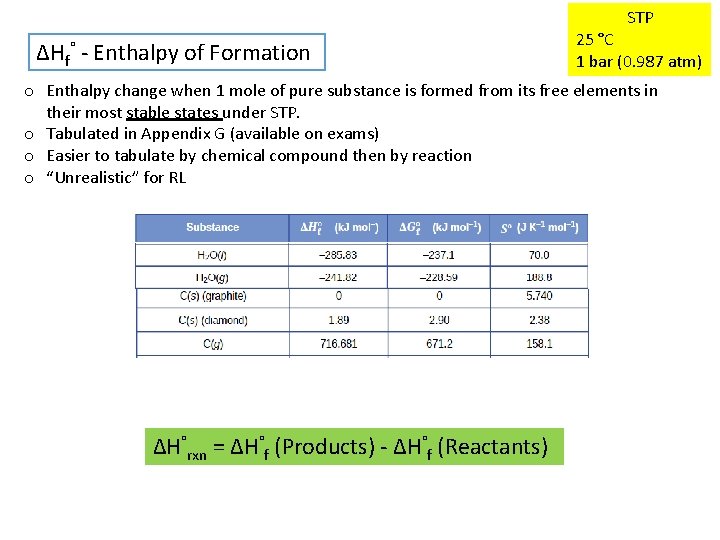
STP ΔHf° - Enthalpy of Formation 25 °C 1 bar (0. 987 atm) o Enthalpy change when 1 mole of pure substance is formed from its free elements in their most stable states under STP. o Tabulated in Appendix G (available on exams) o Easier to tabulate by chemical compound then by reaction o “Unrealistic” for RL ΔH°rxn = ΔH°f (Products) - ΔH°f (Reactants)
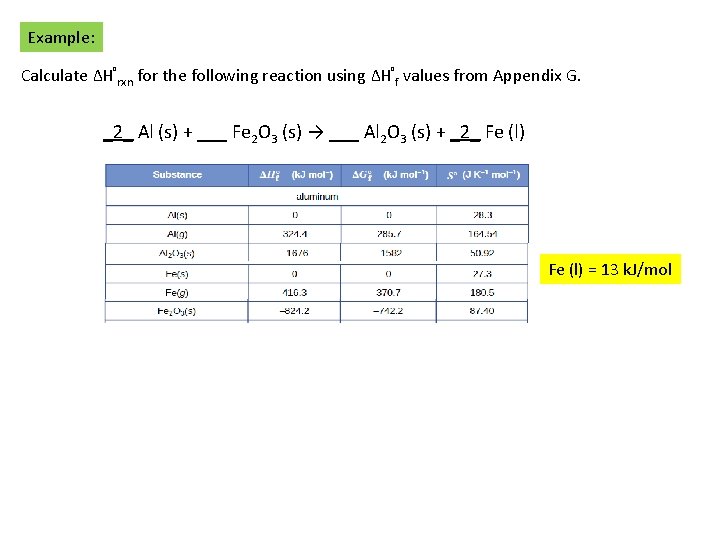
Example: Calculate ΔH°rxn for the following reaction using ΔH°f values from Appendix G. _2_ Al (s) + ___ Fe 2 O 3 (s) → ___ Al 2 O 3 (s) + _2_ Fe (l) = 13 k. J/mol
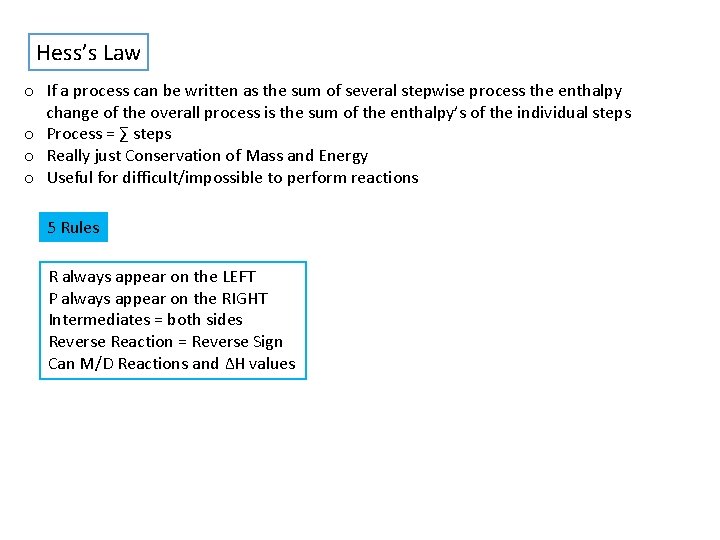
Hess’s Law o If a process can be written as the sum of several stepwise process the enthalpy change of the overall process is the sum of the enthalpy’s of the individual steps o Process = ∑ steps o Really just Conservation of Mass and Energy o Useful for difficult/impossible to perform reactions 5 Rules R always appear on the LEFT P always appear on the RIGHT Intermediates = both sides Reverse Reaction = Reverse Sign Can M/D Reactions and ΔH values
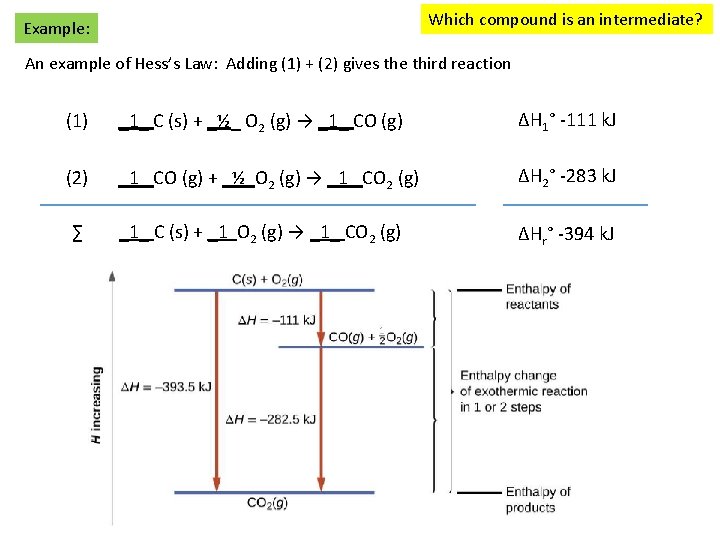
Which compound is an intermediate? Example: An example of Hess’s Law: Adding (1) + (2) gives the third reaction (1) _1_ C (s) + _½_ O 2 (g) → _1_ CO (g) ΔH 1° -111 k. J (2) _1_ CO (g) + _½ O 2 (g) → _1_ CO 2 (g) ΔH 2° -283 k. J ∑ _1_ C (s) + _1 O 2 (g) → _1_ CO 2 (g) ΔHr° -394 k. J
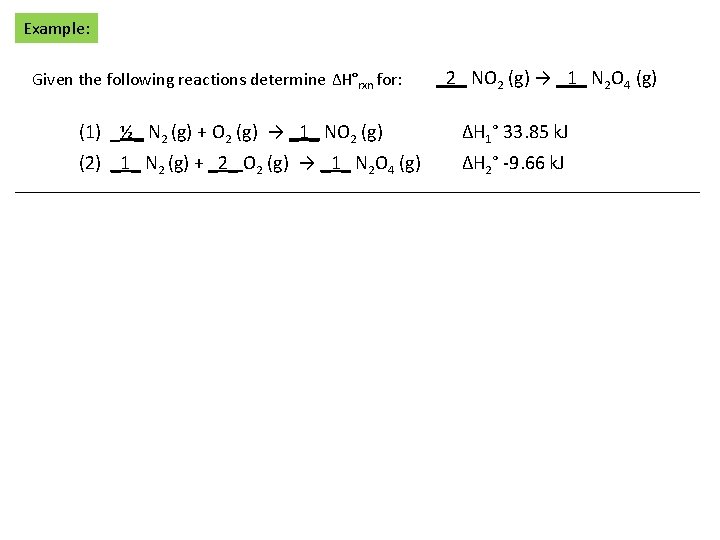
Example: Given the following reactions determine ΔH°rxn for: _2_ NO 2 (g) → _1_ N 2 O 4 (g) (1) _½_ N 2 (g) + O 2 (g) → _1_ NO 2 (g) ΔH 1° 33. 85 k. J (2) _1_ N 2 (g) + _2_ O 2 (g) → _1_ N 2 O 4 (g) ΔH 2° -9. 66 k. J
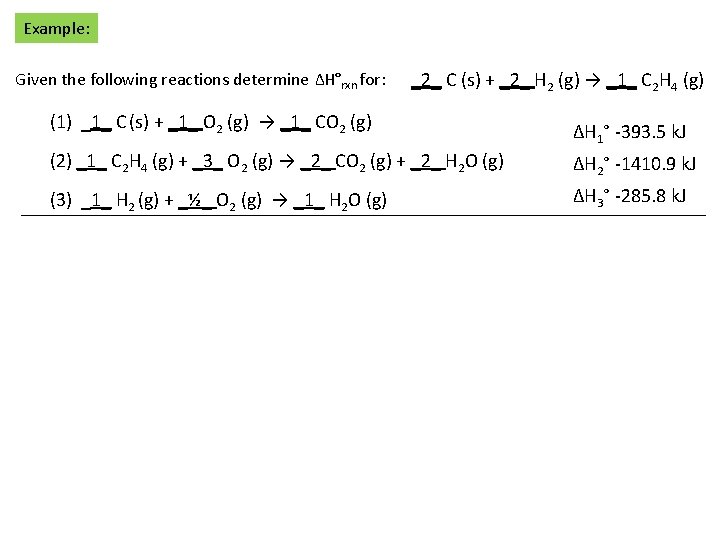
Example: Given the following reactions determine ΔH°rxn for: _2_ C (s) + _2_ H 2 (g) → _1_ C 2 H 4 (g) (1) _1_ C (s) + _1_ O 2 (g) → _1_ CO 2 (g) ΔH 1° -393. 5 k. J (2) _1_ C 2 H 4 (g) + _3_ O 2 (g) → _2_ CO 2 (g) + _2_ H 2 O (g) ΔH 2° -1410. 9 k. J (3) _1_ H 2 (g) + _½_ O 2 (g) → _1_ H 2 O (g) ΔH 3° -285. 8 k. J
Extra Practice o This is not a required assignment. o If after completing the homework (and/or) to help study for the exam, these additional problems might prove helpful. o Don’t do all the problems, select ones that you feel you might struggle with on the exam o Answer’s/Answer key available on request. o www. chemhaven. org/che 111 doesn’t have EP for these topics OER Textbook Examples: 9. 8 -9. 15 Problems: 45 -50, 52, 56 -59, 63 -73 75, 77, 78, 80 -83

- Slides: 21