
Chasing Carbon The Elusive Environmental Footprint of Computing
Chasing Carbon: The Elusive Environmental Footprint of Computing Udit Gupta, Young Geun Kim, Sylvia Lee, Jordan Tse, Hsien-Hsin S. Lee, Gu-Yeon Wei, David Brooks, Carole-Jean Wu IEEE International Symposium on High-Performance Computer Architecture (HPCA) 1
Over the last 20 years, hardware and software advancements have drastically optimized for performance and energy efficiency 2
Over the last 20 years, hardware and software advancements have drastically optimized for performance and energy efficiency But how have these advances affected computing’s environmental sustainability (e. g. , carbon footprint)? 3
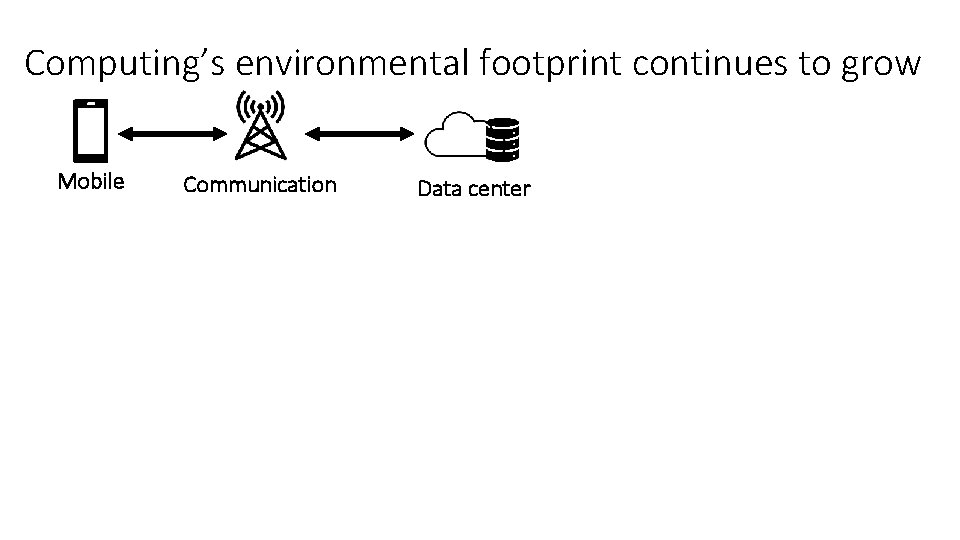
Computing’s environmental footprint continues to grow Mobile Communication Data center
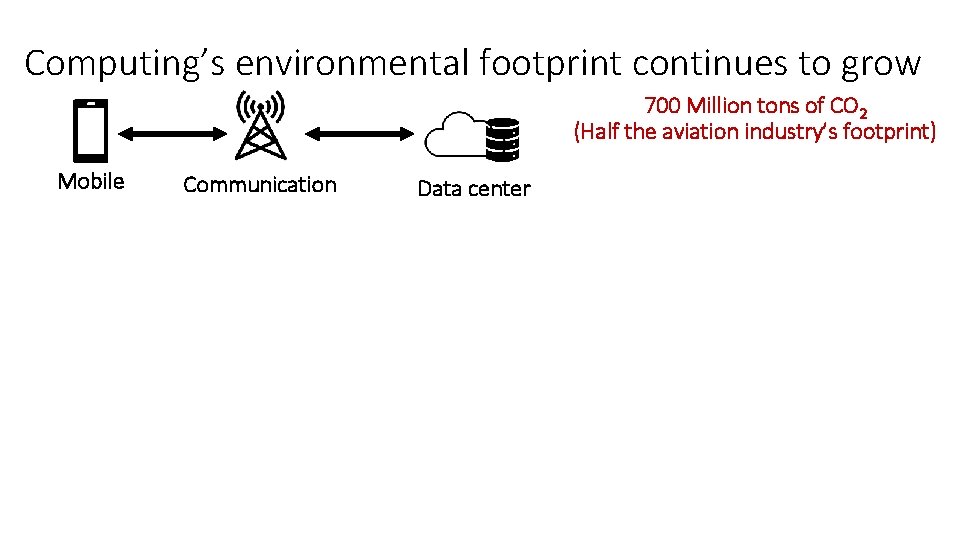
Computing’s environmental footprint continues to grow 700 Million tons of CO 2 (Half the aviation industry’s footprint) Mobile Communication Data center
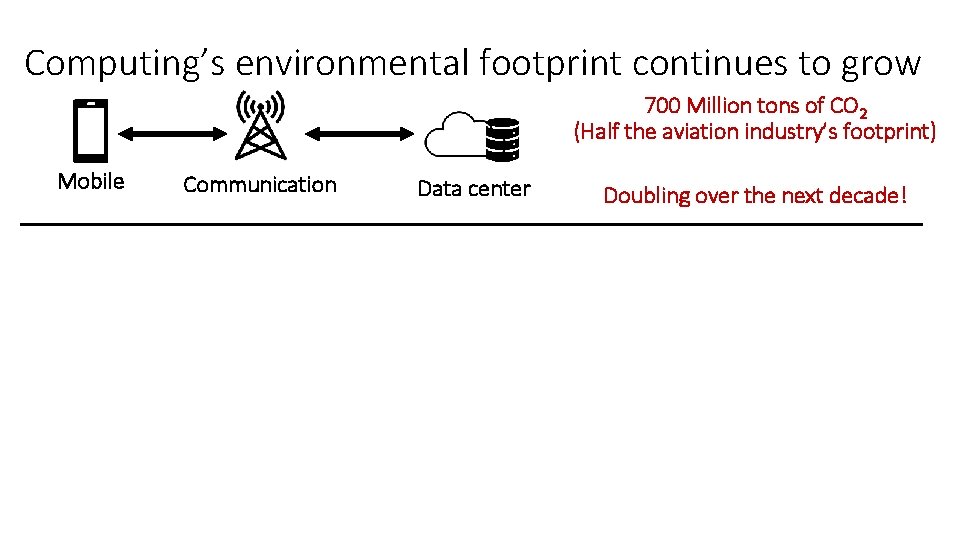
Computing’s environmental footprint continues to grow 700 Million tons of CO 2 (Half the aviation industry’s footprint) Mobile Communication Data center Doubling over the next decade!
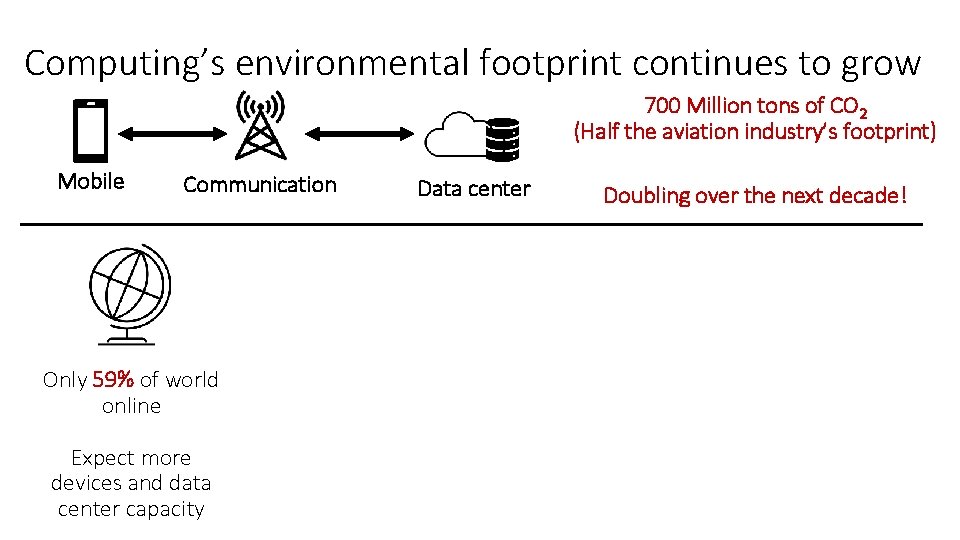
Computing’s environmental footprint continues to grow 700 Million tons of CO 2 (Half the aviation industry’s footprint) Mobile Communication Only 59% of world online Expect more devices and data center capacity Data center Doubling over the next decade!
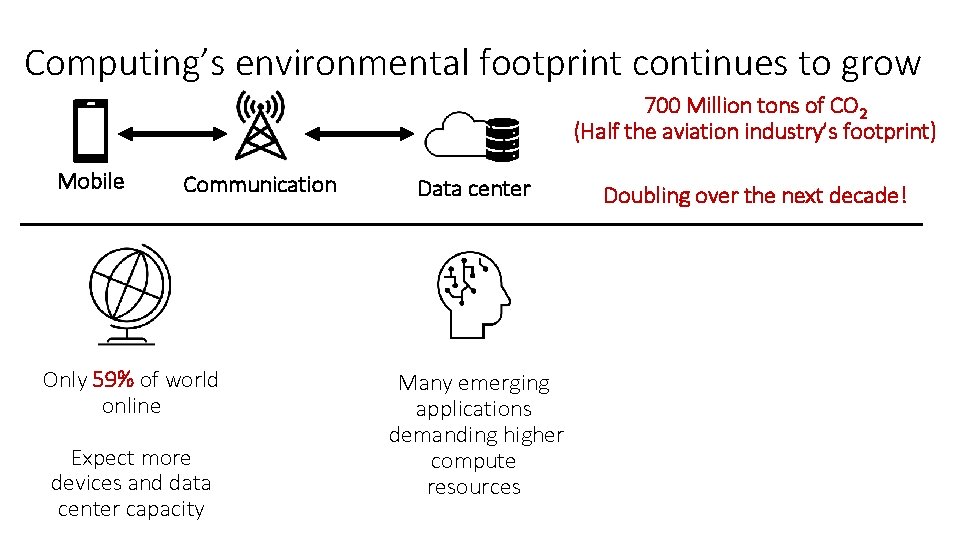
Computing’s environmental footprint continues to grow 700 Million tons of CO 2 (Half the aviation industry’s footprint) Mobile Communication Only 59% of world online Expect more devices and data center capacity Data center Many emerging applications demanding higher compute resources Doubling over the next decade!
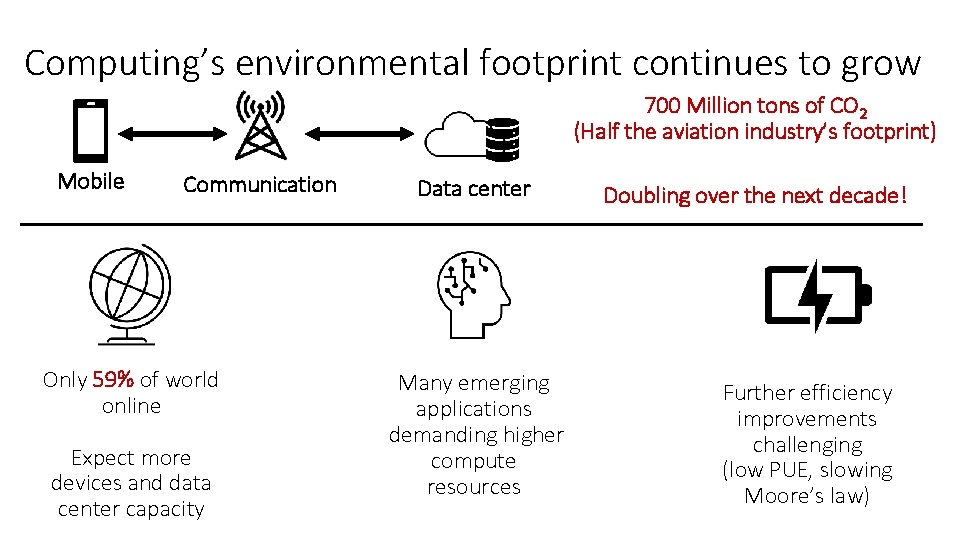
Computing’s environmental footprint continues to grow 700 Million tons of CO 2 (Half the aviation industry’s footprint) Mobile Communication Only 59% of world online Expect more devices and data center capacity Data center Many emerging applications demanding higher compute resources Doubling over the next decade! Further efficiency improvements challenging (low PUE, slowing Moore’s law)
Growing role of sustainable computing in research 10
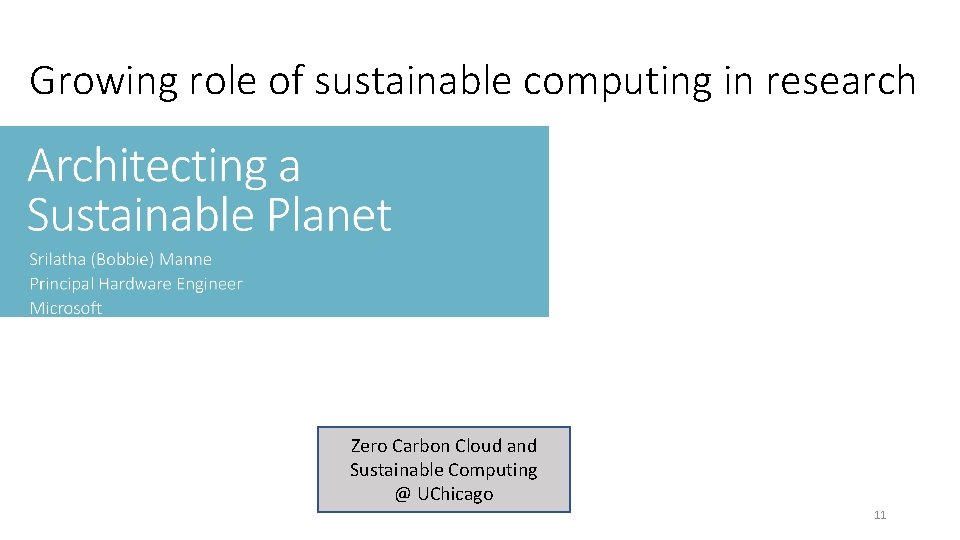
Growing role of sustainable computing in research Zero Carbon Cloud and Sustainable Computing @ UChicago 11
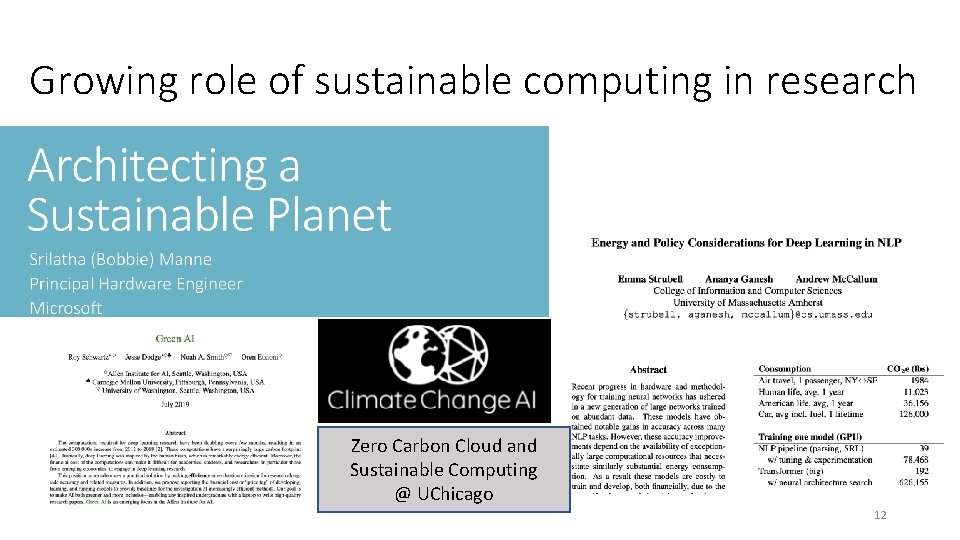
Growing role of sustainable computing in research Zero Carbon Cloud and Sustainable Computing @ UChicago 12
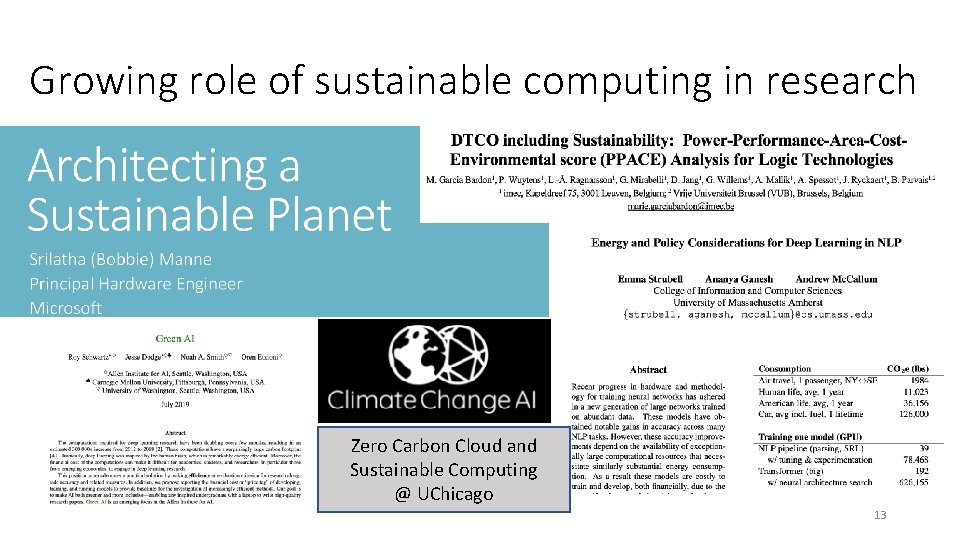
Growing role of sustainable computing in research Zero Carbon Cloud and Sustainable Computing @ UChicago 13
Technology companies are pledging carbon neutrality 14
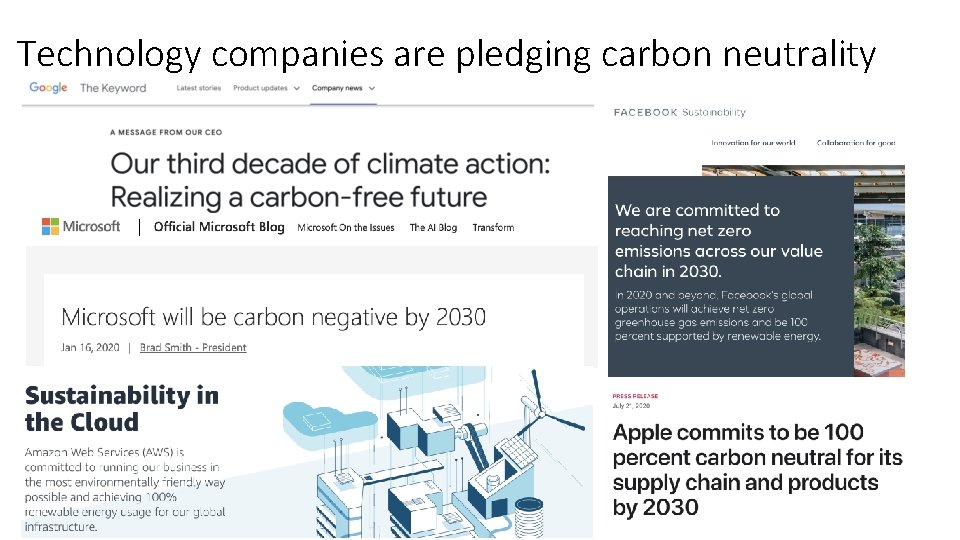
Technology companies are pledging carbon neutrality 15
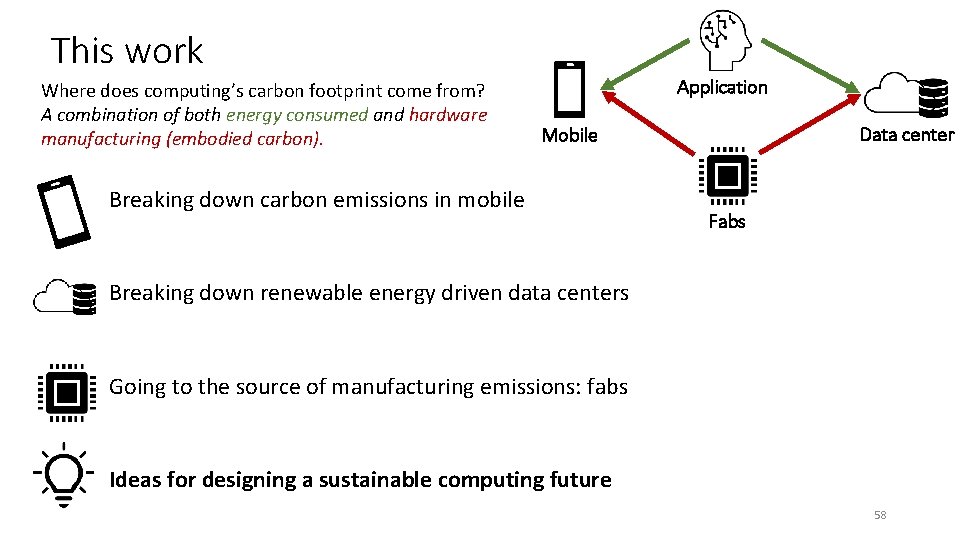
This work Where does computing’s carbon footprint come from? 16
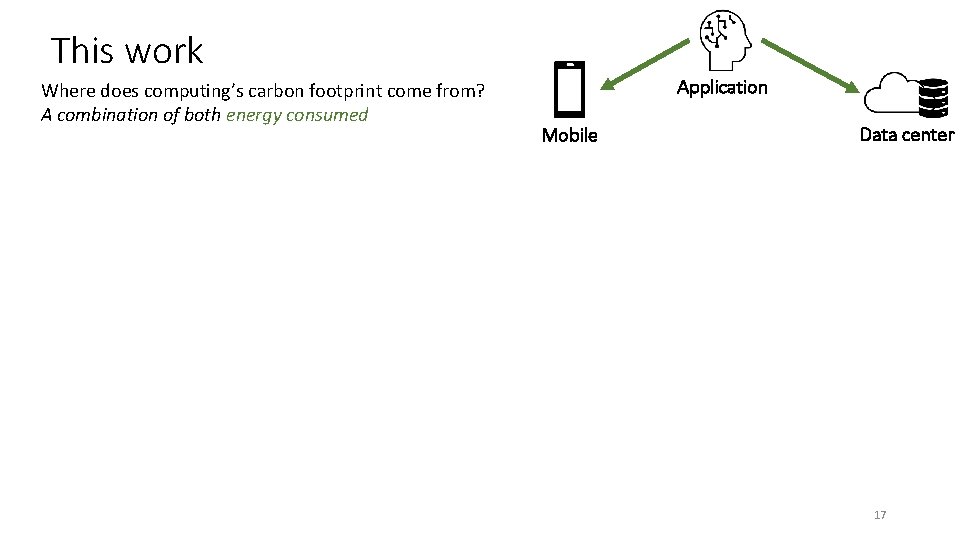
This work Where does computing’s carbon footprint come from? A combination of both energy consumed Application Mobile Data center 17
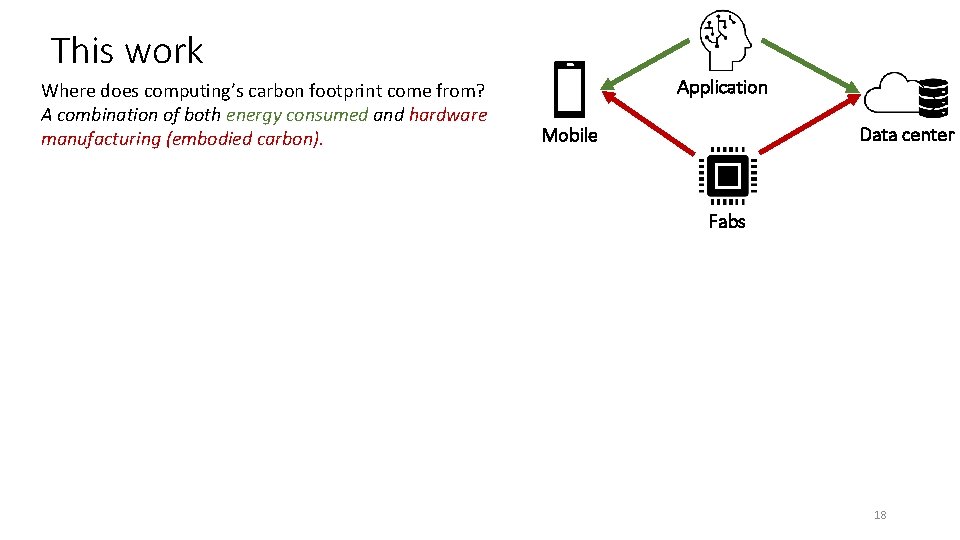
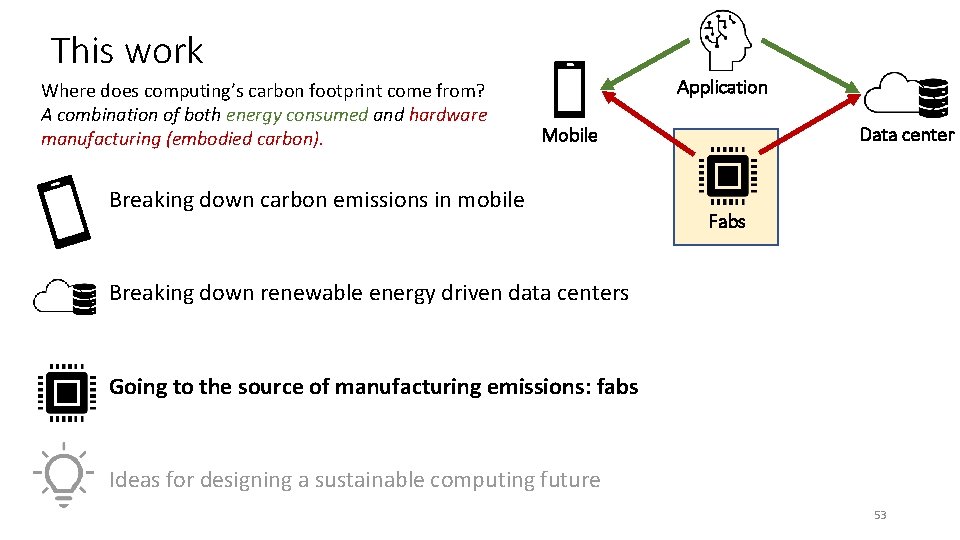
This work Where does computing’s carbon footprint come from? A combination of both energy consumed and hardware manufacturing (embodied carbon). Application Data center Mobile Fabs 18
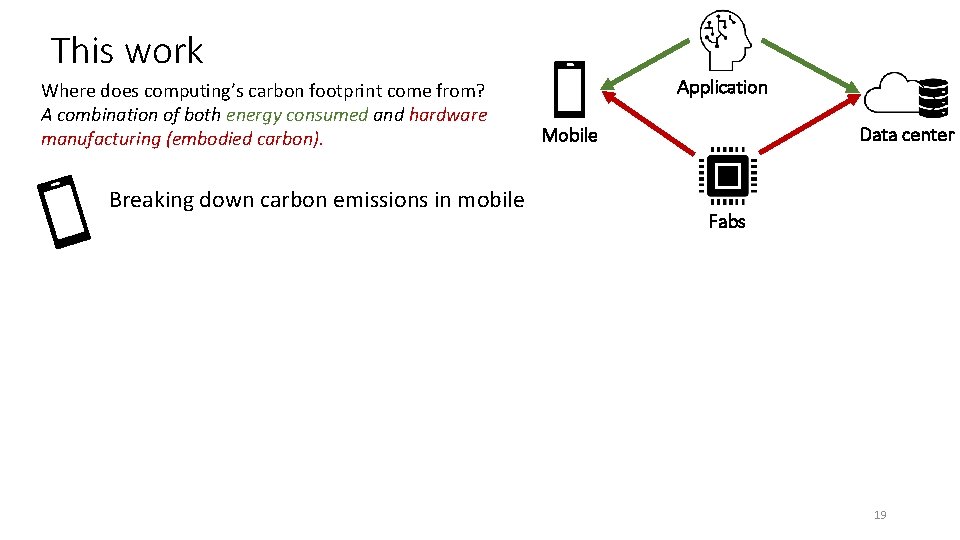
This work Where does computing’s carbon footprint come from? A combination of both energy consumed and hardware manufacturing (embodied carbon). Breaking down carbon emissions in mobile Application Data center Mobile Fabs 19
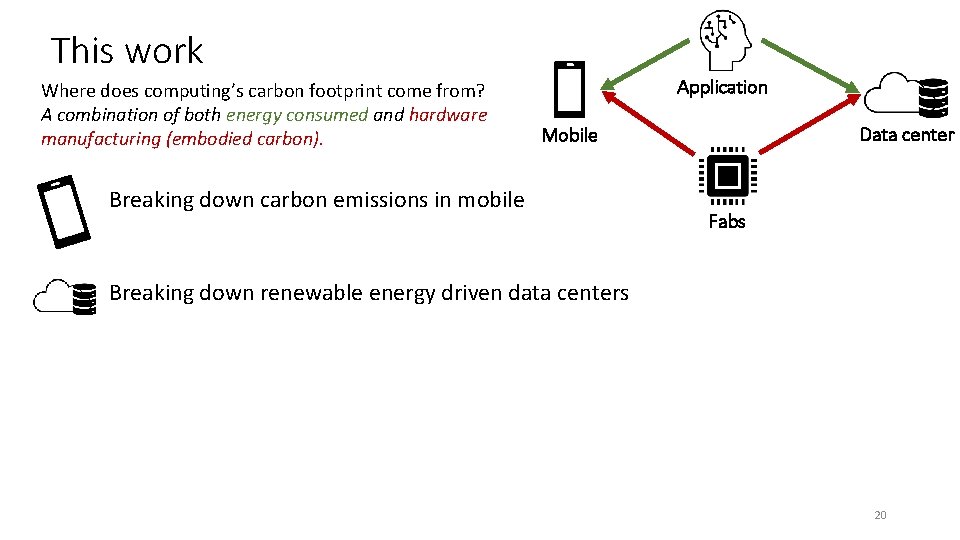
This work Where does computing’s carbon footprint come from? A combination of both energy consumed and hardware manufacturing (embodied carbon). Application Data center Mobile Breaking down carbon emissions in mobile Fabs Breaking down renewable energy driven data centers 20
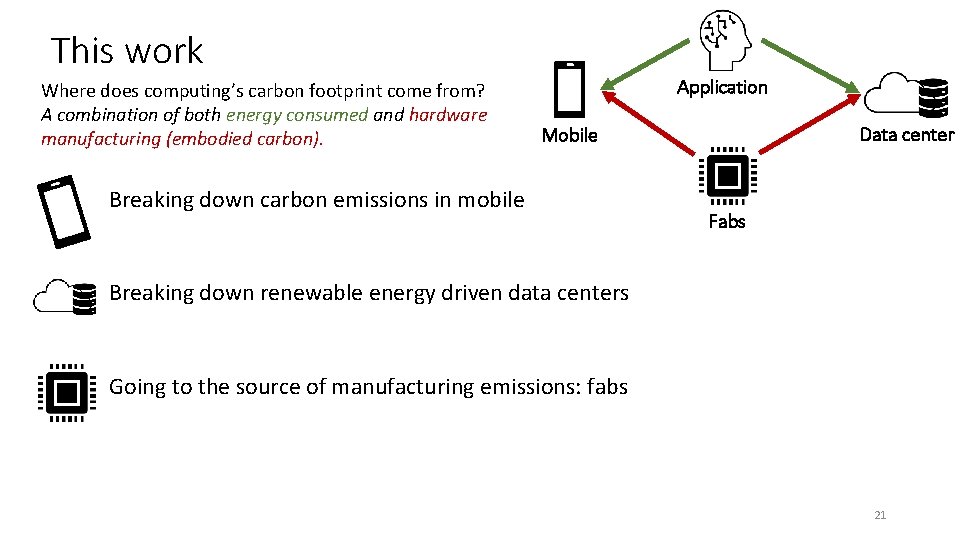
This work Where does computing’s carbon footprint come from? A combination of both energy consumed and hardware manufacturing (embodied carbon). Application Data center Mobile Breaking down carbon emissions in mobile Fabs Breaking down renewable energy driven data centers Going to the source of manufacturing emissions: fabs 21
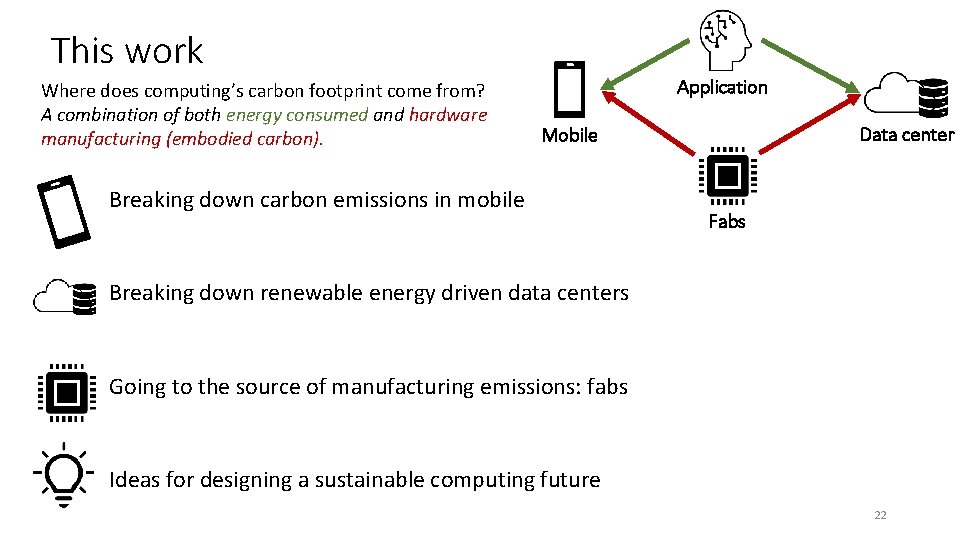
This work Where does computing’s carbon footprint come from? A combination of both energy consumed and hardware manufacturing (embodied carbon). Application Data center Mobile Breaking down carbon emissions in mobile Fabs Breaking down renewable energy driven data centers Going to the source of manufacturing emissions: fabs Ideas for designing a sustainable computing future 22
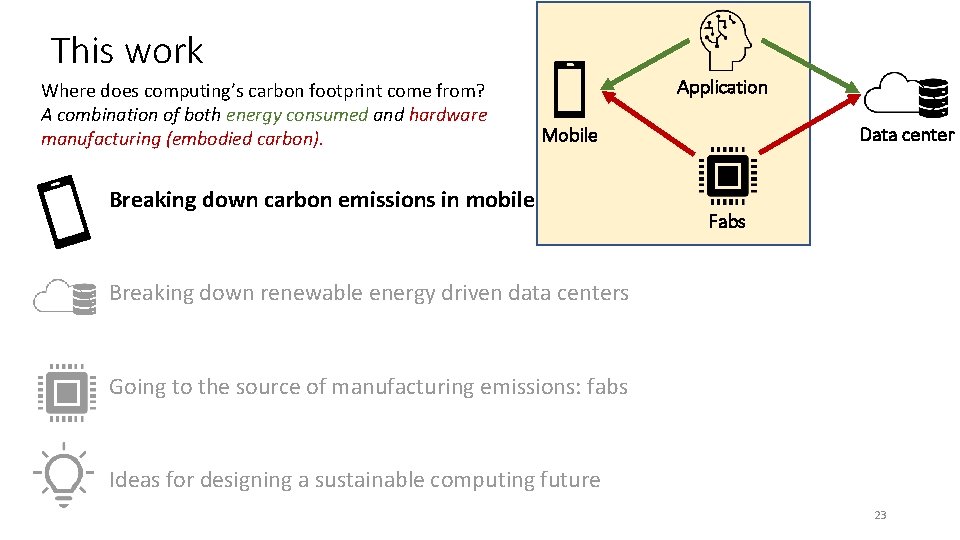
This work Where does computing’s carbon footprint come from? A combination of both energy consumed and hardware manufacturing (embodied carbon). Application Data center Mobile Breaking down carbon emissions in mobile Fabs Breaking down renewable energy driven data centers Going to the source of manufacturing emissions: fabs Ideas for designing a sustainable computing future 23
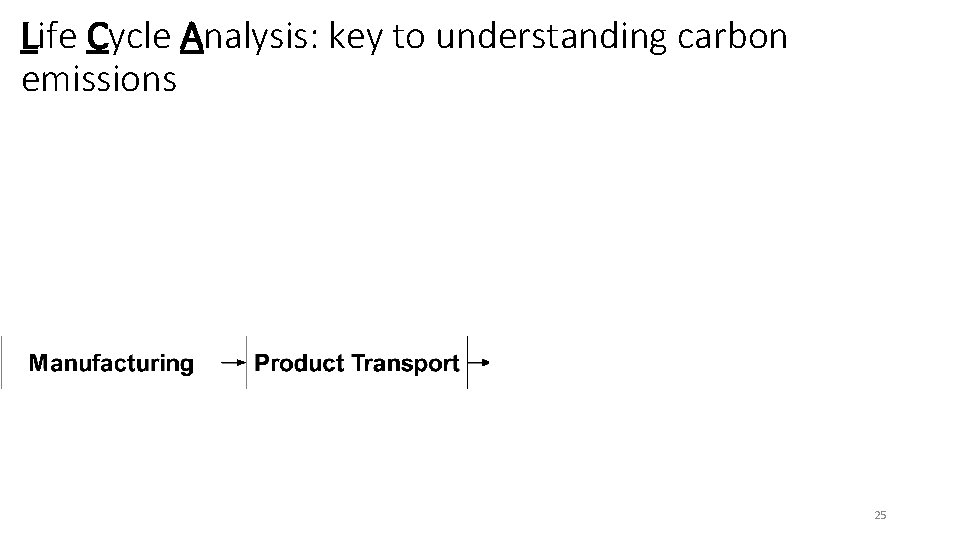
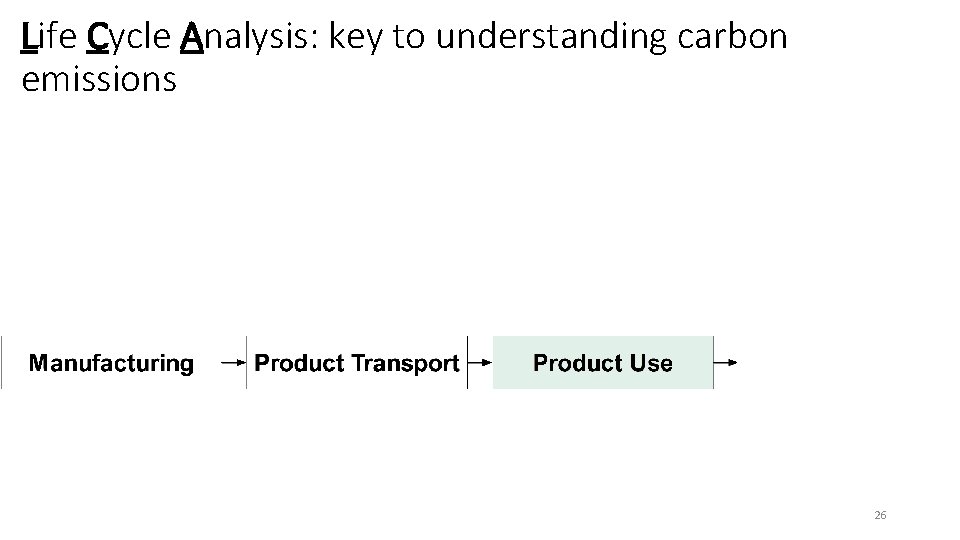
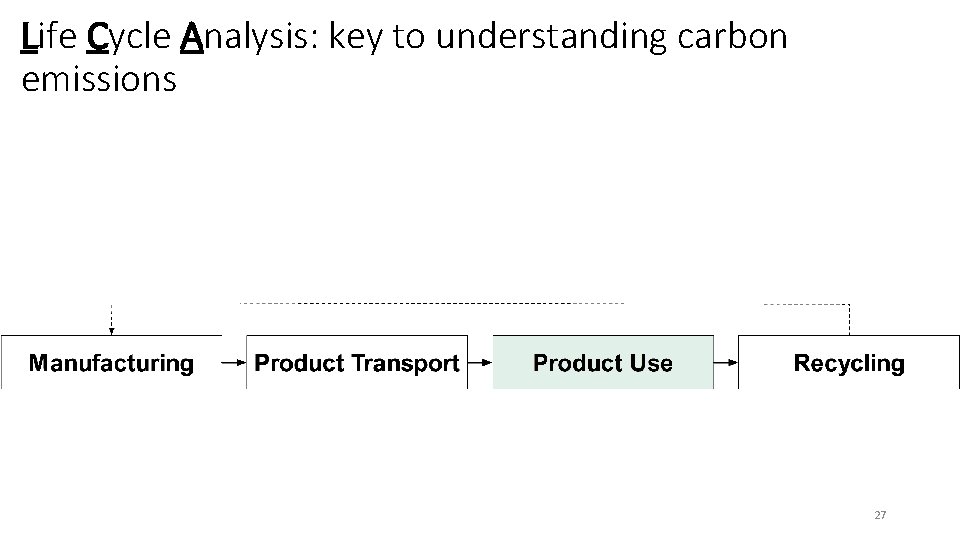
Life Cycle Analysis: key to understanding carbon emissions 24
Life Cycle Analysis: key to understanding carbon emissions 25
Life Cycle Analysis: key to understanding carbon emissions 26
Life Cycle Analysis: key to understanding carbon emissions 27
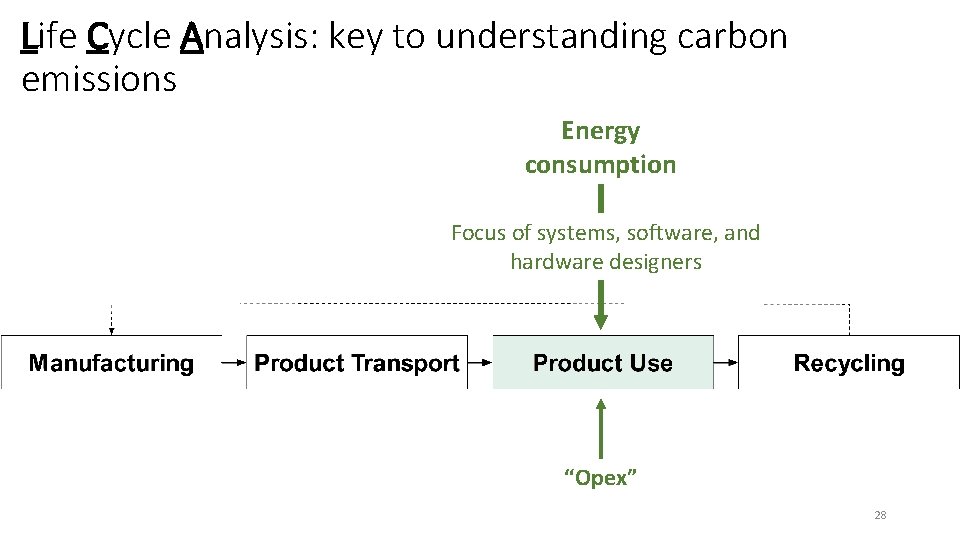
Life Cycle Analysis: key to understanding carbon emissions Energy consumption Focus of systems, software, and hardware designers “Opex” 28
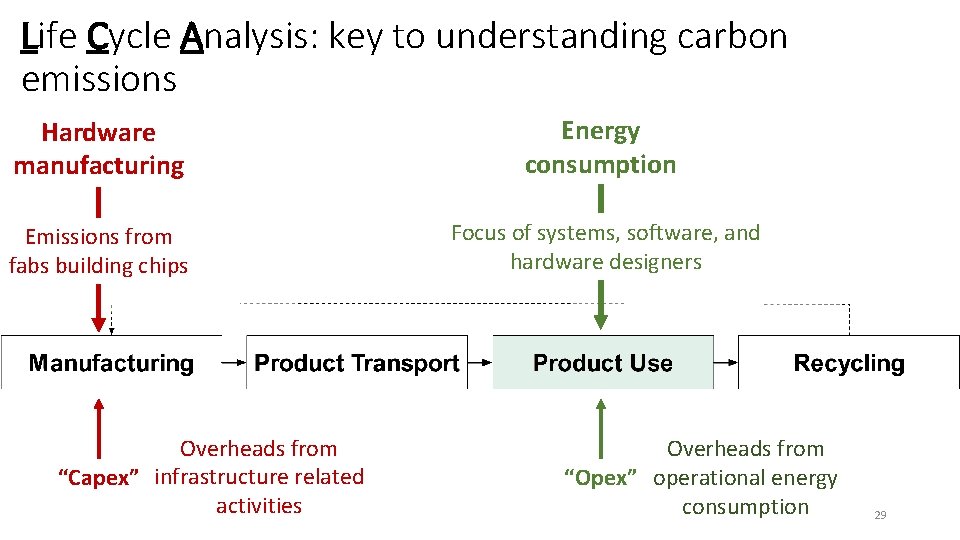
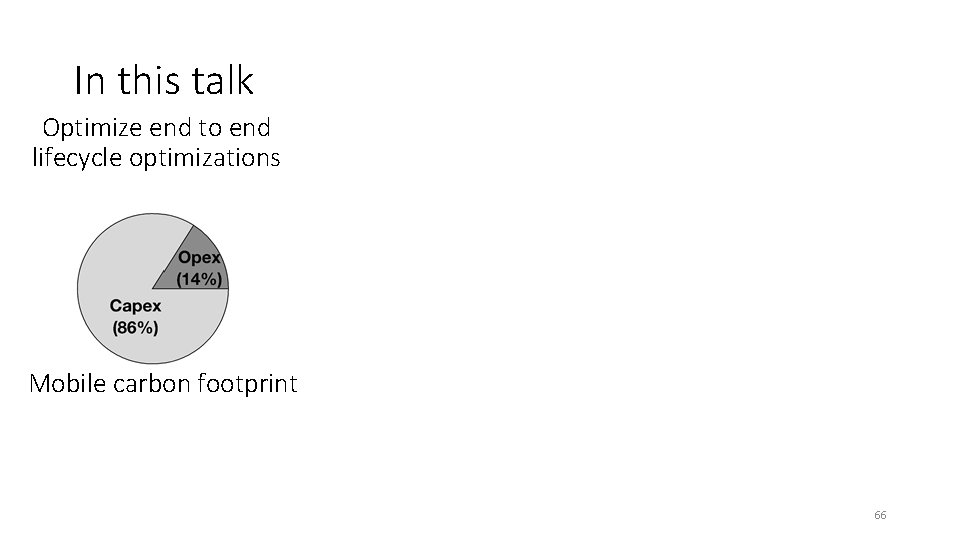
Life Cycle Analysis: key to understanding carbon emissions Hardware manufacturing Energy consumption Emissions from fabs building chips Focus of systems, software, and hardware designers Overheads from “Capex” infrastructure related activities Overheads from “Opex” operational energy consumption 29
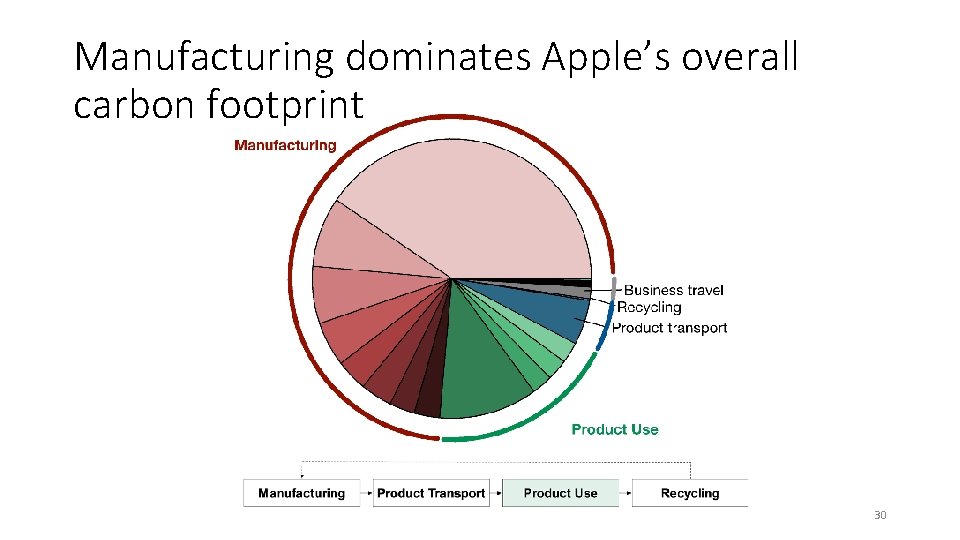
Manufacturing dominates Apple’s overall carbon footprint 30
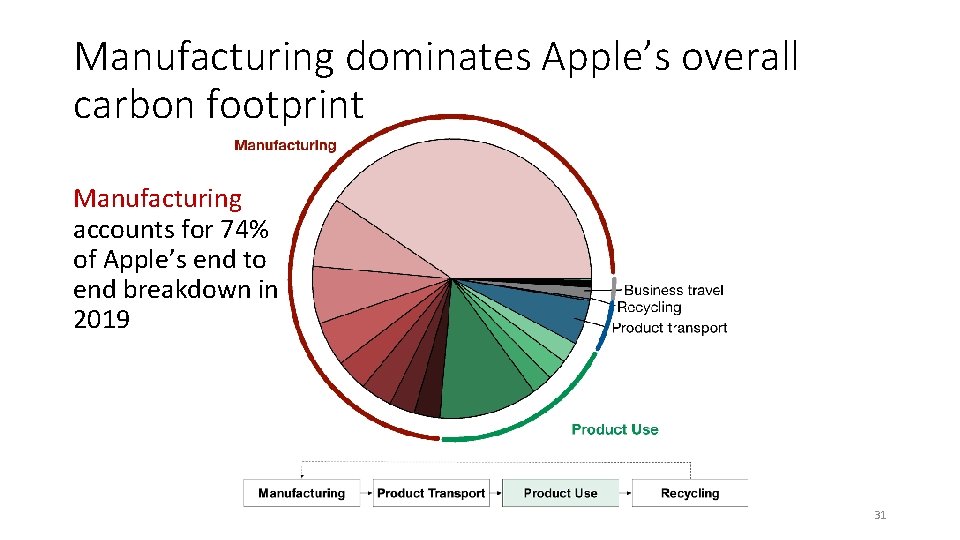
Manufacturing dominates Apple’s overall carbon footprint Manufacturing accounts for 74% of Apple’s end to end breakdown in 2019 31
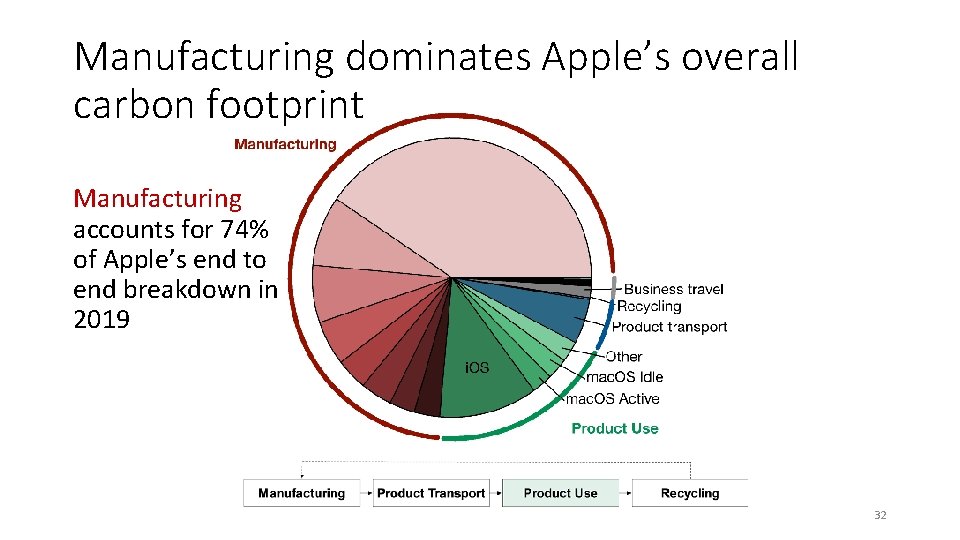
Manufacturing dominates Apple’s overall carbon footprint Manufacturing accounts for 74% of Apple’s end to end breakdown in 2019 32
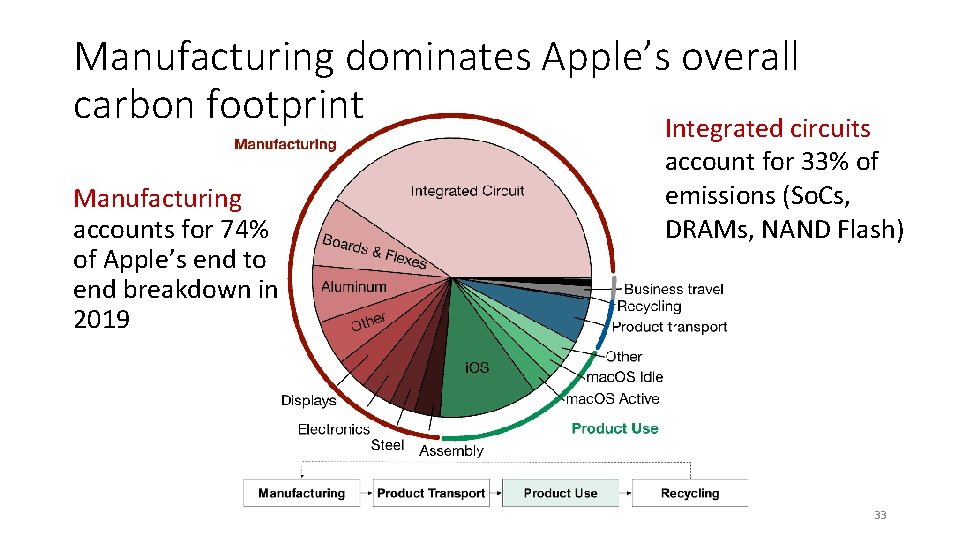
Manufacturing dominates Apple’s overall carbon footprint Integrated circuits Manufacturing accounts for 74% of Apple’s end to end breakdown in 2019 account for 33% of emissions (So. Cs, DRAMs, NAND Flash) 33
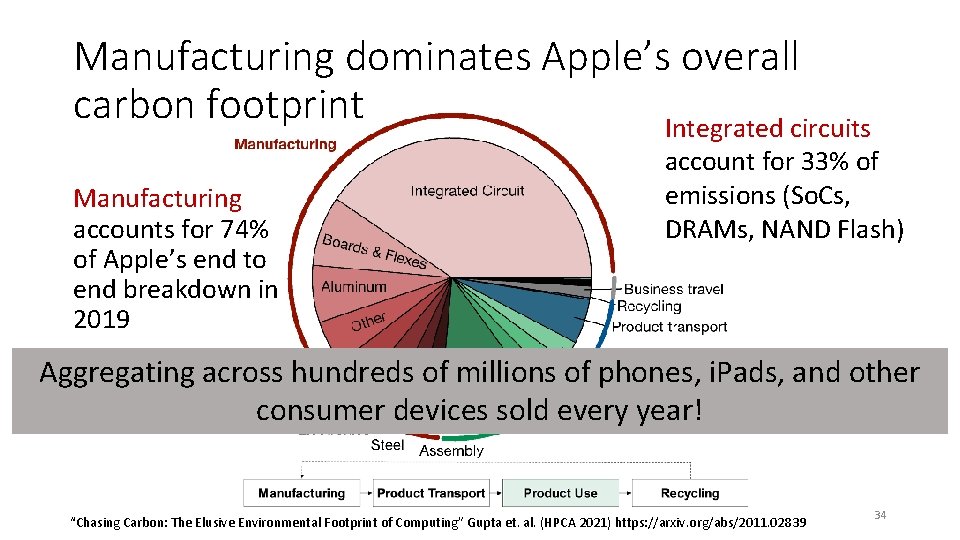
Manufacturing dominates Apple’s overall carbon footprint Integrated circuits Manufacturing accounts for 74% of Apple’s end to end breakdown in 2019 account for 33% of emissions (So. Cs, DRAMs, NAND Flash) Aggregating across hundreds of millions of phones, i. Pads, and other consumer devices sold every year! “Chasing Carbon: The Elusive Environmental Footprint of Computing” Gupta et. al. (HPCA 2021) https: //arxiv. org/abs/2011. 02839 34
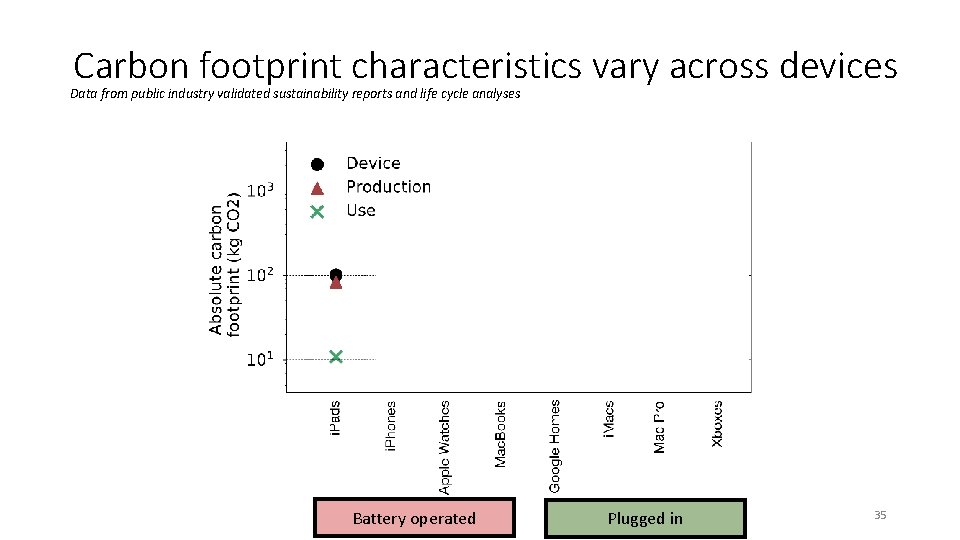
Carbon footprint characteristics vary across devices Data from public industry validated sustainability reports and life cycle analyses Battery operated Plugged in 35
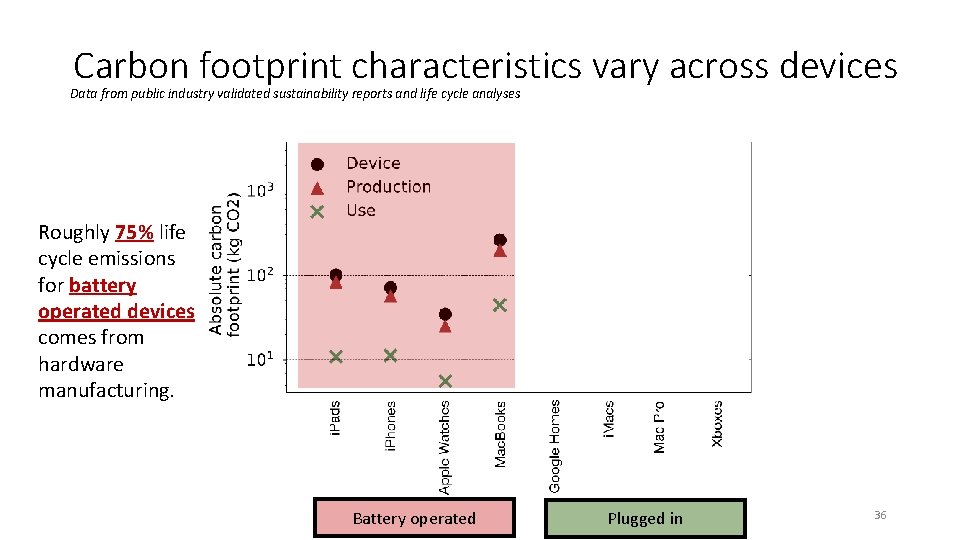
Carbon footprint characteristics vary across devices Data from public industry validated sustainability reports and life cycle analyses Roughly 75% life cycle emissions for battery operated devices comes from hardware manufacturing. Battery operated Plugged in 36
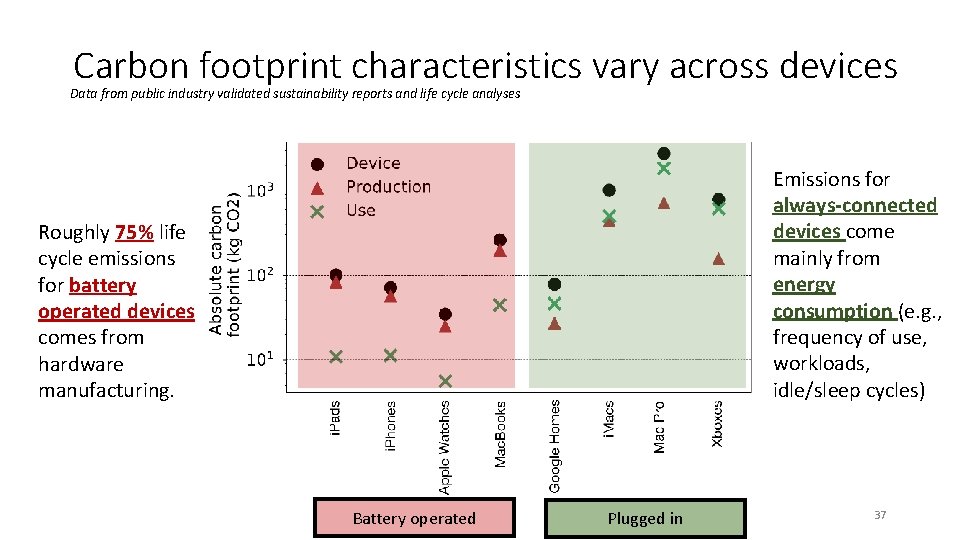
Carbon footprint characteristics vary across devices Data from public industry validated sustainability reports and life cycle analyses Emissions for always-connected devices come mainly from energy consumption (e. g. , frequency of use, workloads, idle/sleep cycles) Roughly 75% life cycle emissions for battery operated devices comes from hardware manufacturing. Battery operated Plugged in 37
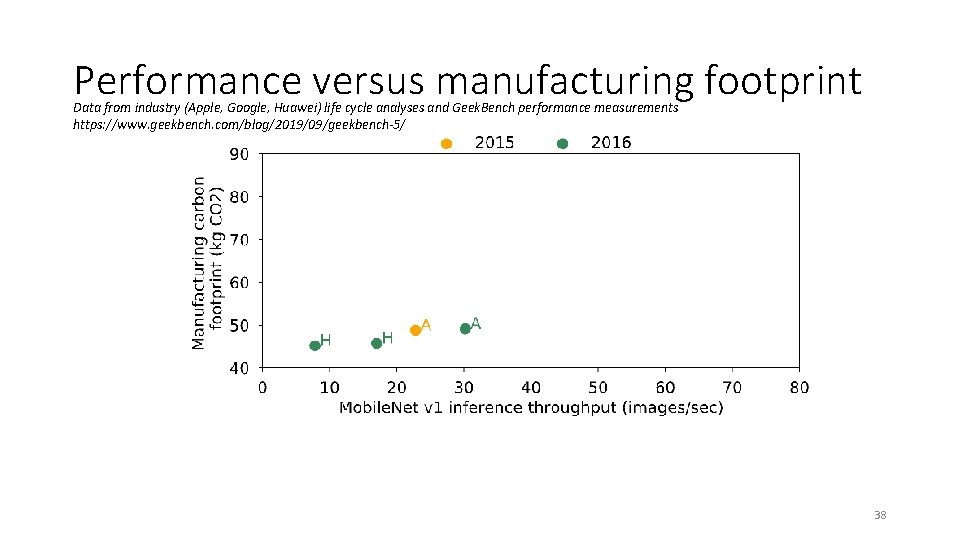
Performance versus manufacturing footprint Data from industry (Apple, Google, Huawei) life cycle analyses and Geek. Bench performance measurements https: //www. geekbench. com/blog/2019/09/geekbench-5/ 38
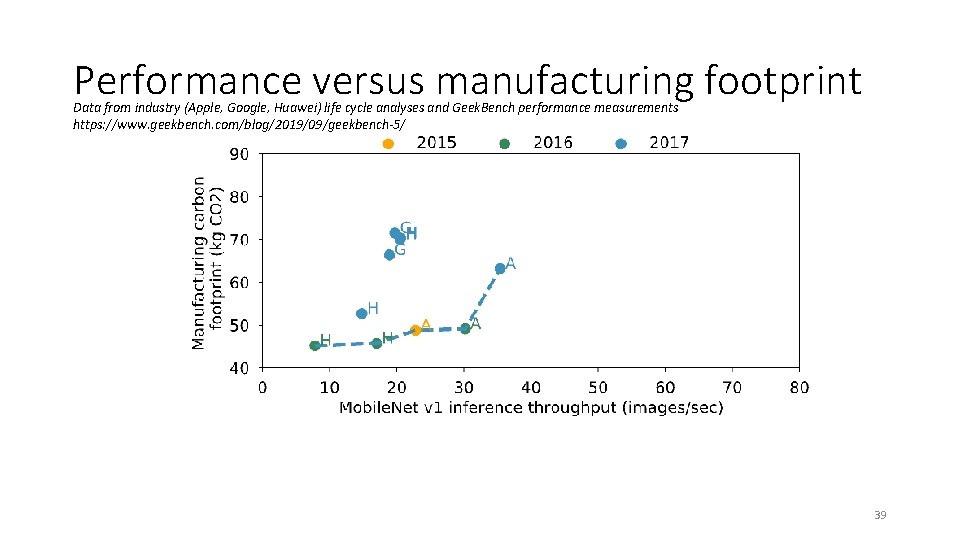
Performance versus manufacturing footprint Data from industry (Apple, Google, Huawei) life cycle analyses and Geek. Bench performance measurements https: //www. geekbench. com/blog/2019/09/geekbench-5/ 39
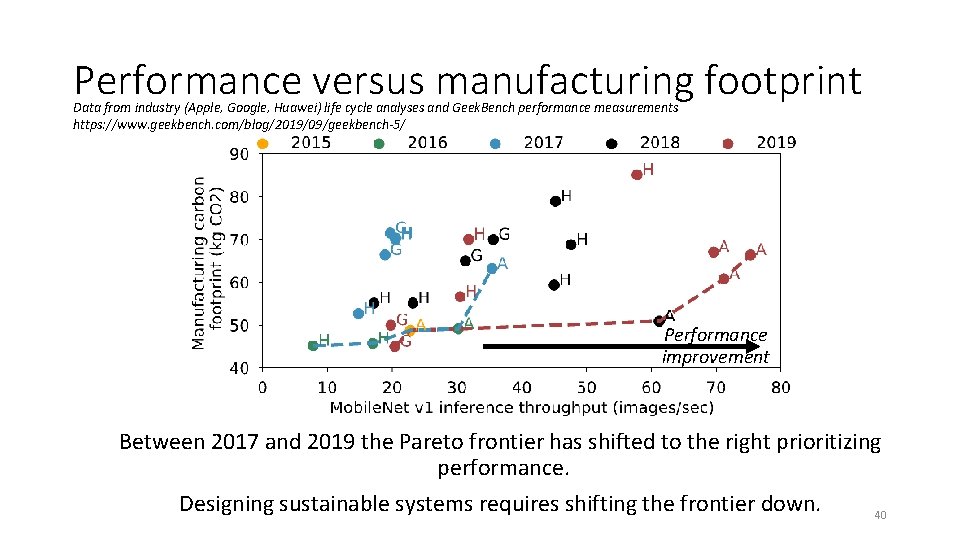
Performance versus manufacturing footprint Data from industry (Apple, Google, Huawei) life cycle analyses and Geek. Bench performance measurements https: //www. geekbench. com/blog/2019/09/geekbench-5/ Performance improvement Between 2017 and 2019 the Pareto frontier has shifted to the right prioritizing performance. Designing sustainable systems requires shifting the frontier down. 40
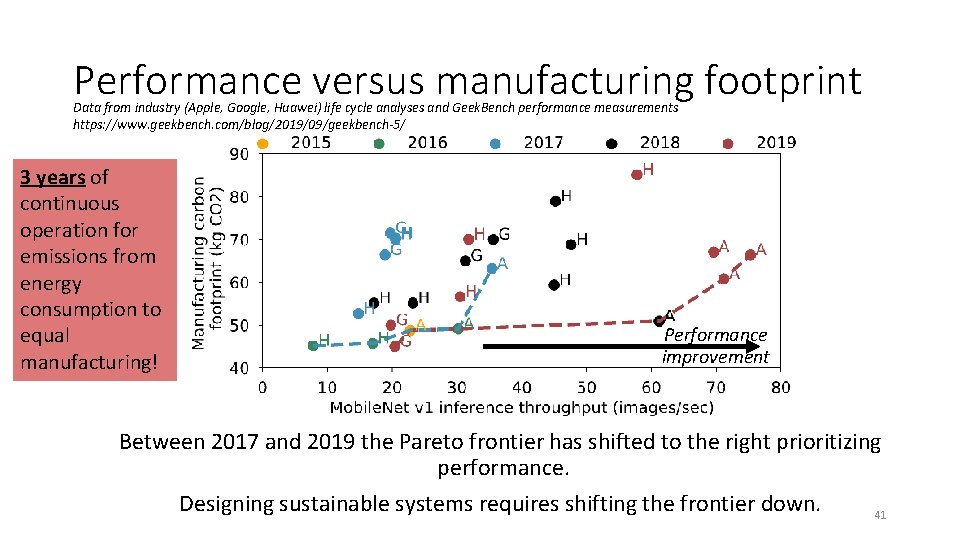
Performance versus manufacturing footprint Data from industry (Apple, Google, Huawei) life cycle analyses and Geek. Bench performance measurements https: //www. geekbench. com/blog/2019/09/geekbench-5/ 3 years of continuous operation for emissions from energy consumption to equal manufacturing! Performance improvement Between 2017 and 2019 the Pareto frontier has shifted to the right prioritizing performance. Designing sustainable systems requires shifting the frontier down. 41
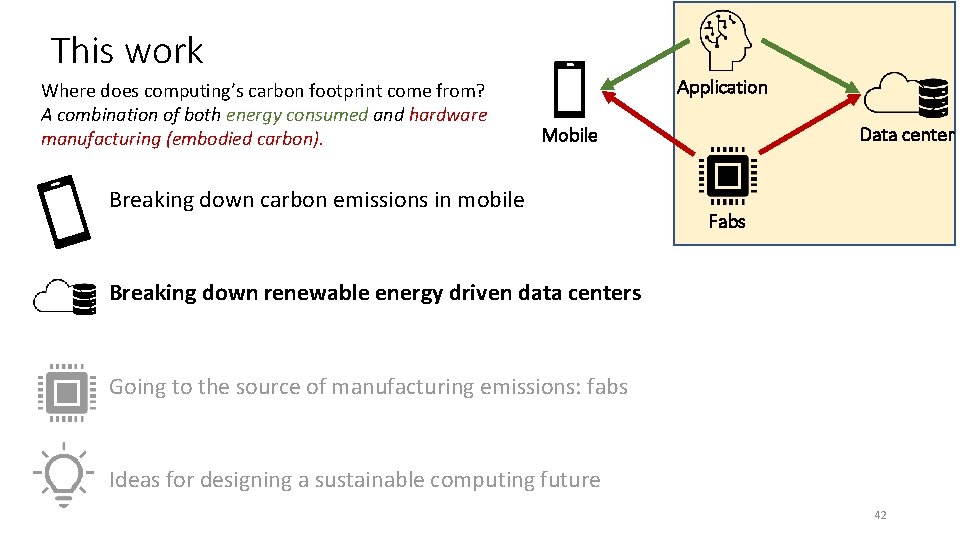
This work Where does computing’s carbon footprint come from? A combination of both energy consumed and hardware manufacturing (embodied carbon). Application Data center Mobile Breaking down carbon emissions in mobile Fabs Breaking down renewable energy driven data centers Going to the source of manufacturing emissions: fabs Ideas for designing a sustainable computing future 42
Greenhouse gas (GHG) Protocol Technology company (e. g. , Facebook) 43
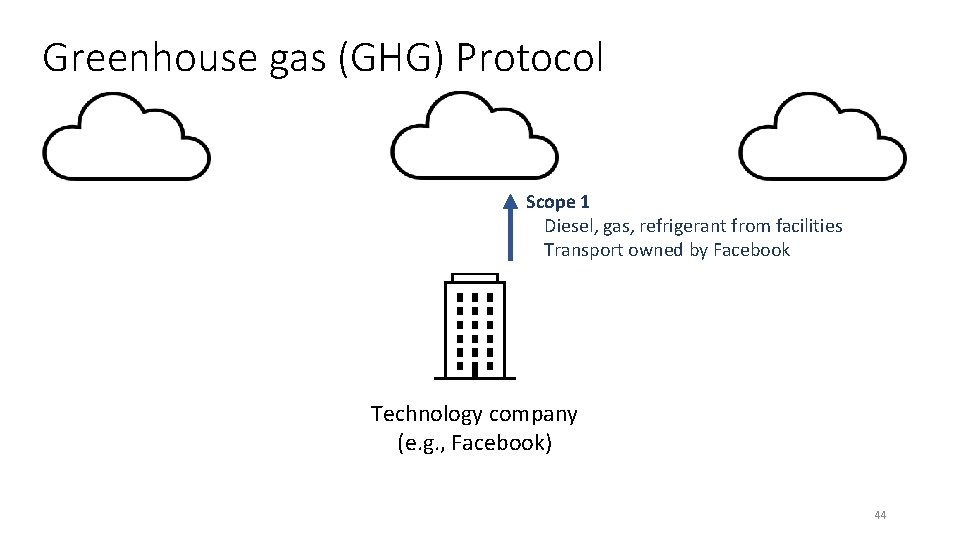
Greenhouse gas (GHG) Protocol Scope 1 Diesel, gas, refrigerant from facilities Transport owned by Facebook Technology company (e. g. , Facebook) 44
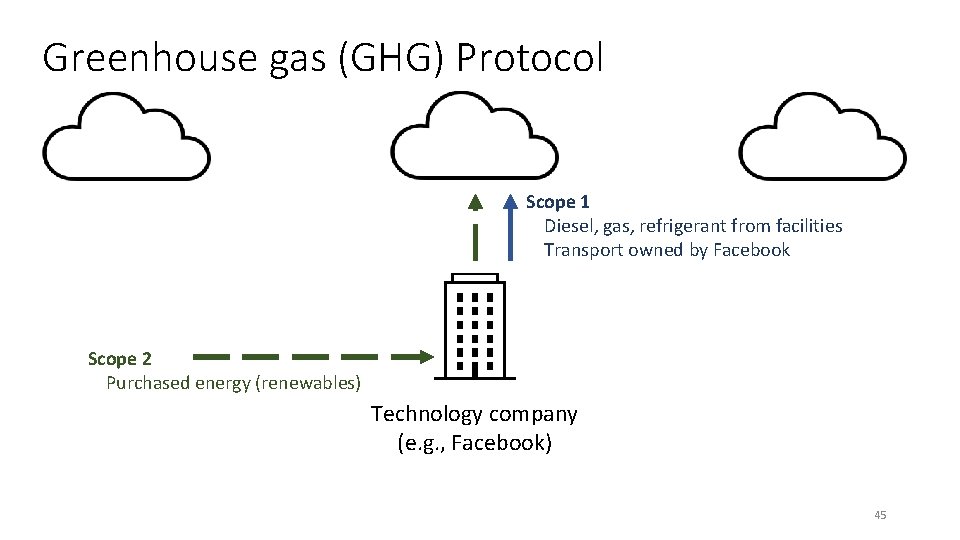
Greenhouse gas (GHG) Protocol Scope 1 Diesel, gas, refrigerant from facilities Transport owned by Facebook Scope 2 Purchased energy (renewables) Technology company (e. g. , Facebook) 45
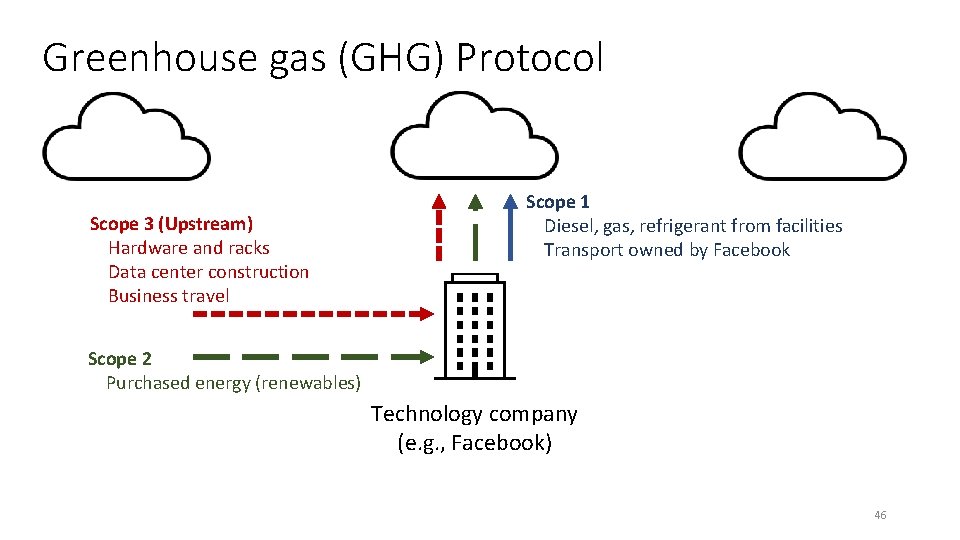
Greenhouse gas (GHG) Protocol Scope 3 (Upstream) Hardware and racks Data center construction Business travel Scope 1 Diesel, gas, refrigerant from facilities Transport owned by Facebook Scope 2 Purchased energy (renewables) Technology company (e. g. , Facebook) 46
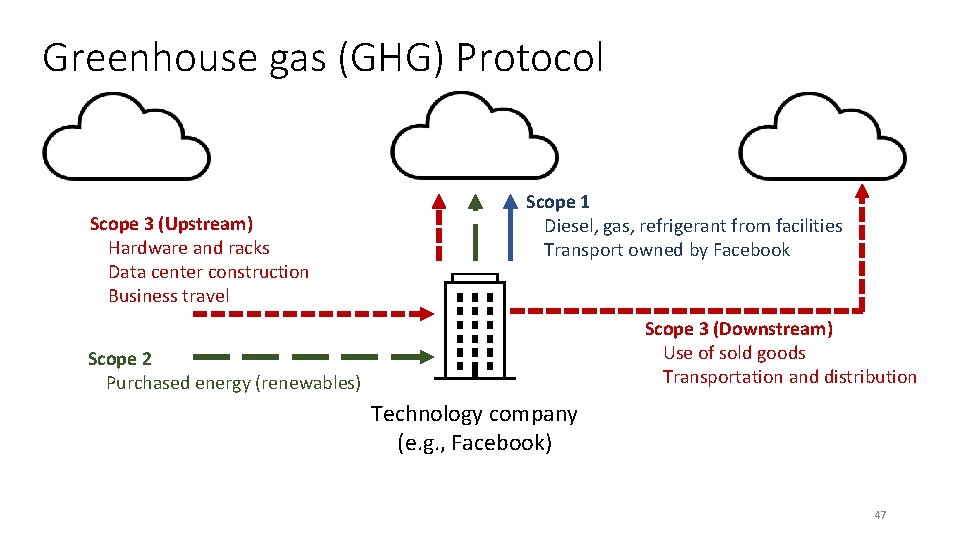
Greenhouse gas (GHG) Protocol Scope 3 (Upstream) Hardware and racks Data center construction Business travel Scope 1 Diesel, gas, refrigerant from facilities Transport owned by Facebook Scope 3 (Downstream) Use of sold goods Transportation and distribution Scope 2 Purchased energy (renewables) Technology company (e. g. , Facebook) 47
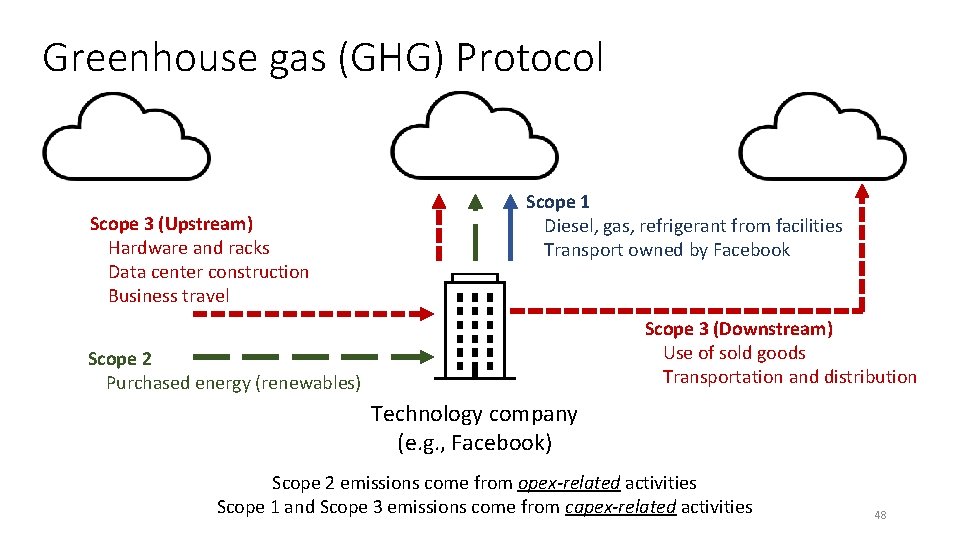
Greenhouse gas (GHG) Protocol Scope 3 (Upstream) Hardware and racks Data center construction Business travel Scope 1 Diesel, gas, refrigerant from facilities Transport owned by Facebook Scope 3 (Downstream) Use of sold goods Transportation and distribution Scope 2 Purchased energy (renewables) Technology company (e. g. , Facebook) Scope 2 emissions come from opex-related activities Scope 1 and Scope 3 emissions come from capex-related activities 48
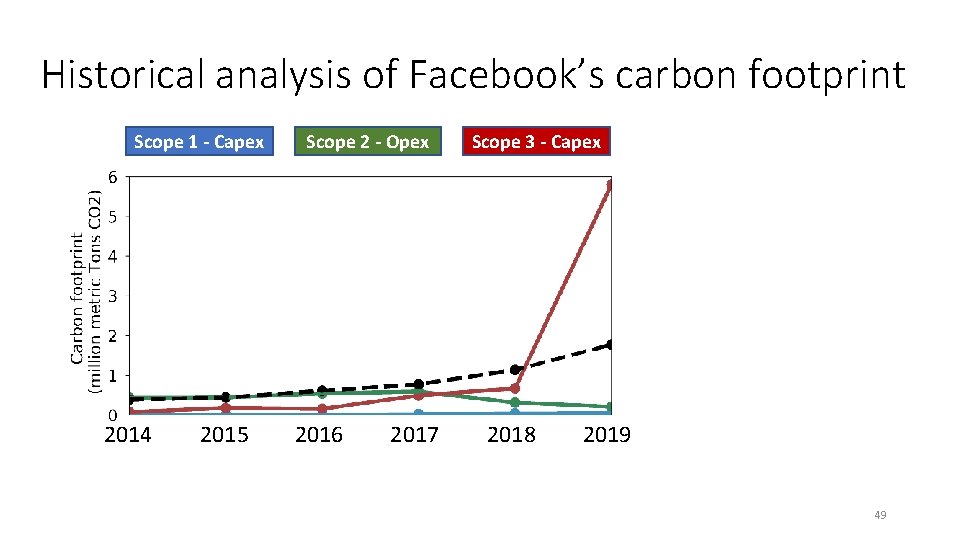
Historical analysis of Facebook’s carbon footprint Scope 1 - Capex 2014 2015 Scope 2 - Opex 2016 2017 Scope 3 - Capex 2018 2019 49
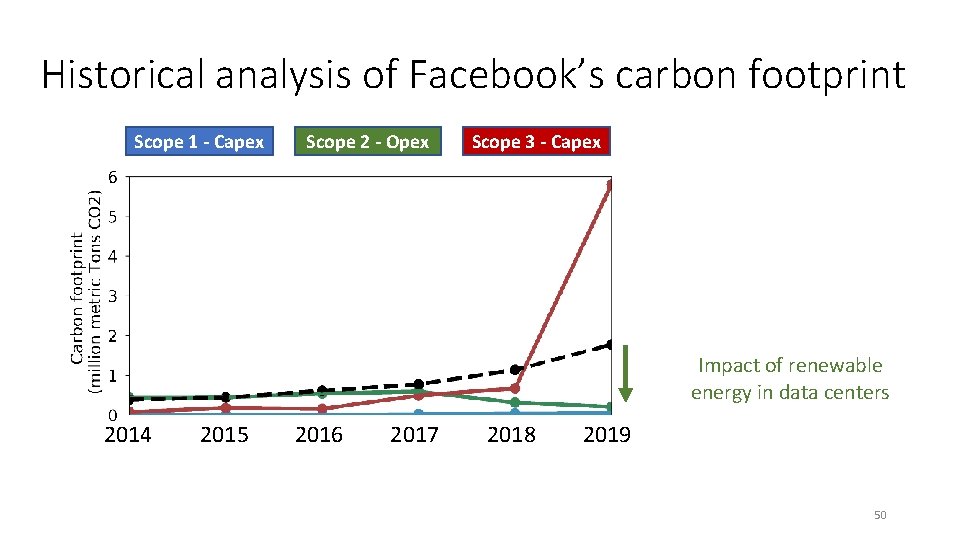
Historical analysis of Facebook’s carbon footprint Scope 1 - Capex Scope 2 - Opex Scope 3 - Capex Impact of renewable energy in data centers 2014 2015 2016 2017 2018 2019 50
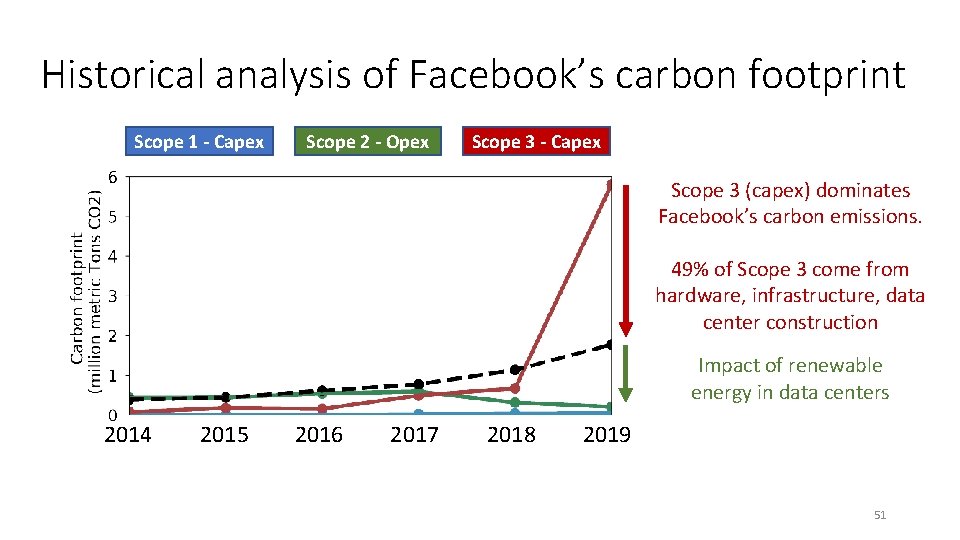
Historical analysis of Facebook’s carbon footprint Scope 1 - Capex Scope 2 - Opex Scope 3 - Capex Scope 3 (capex) dominates Facebook’s carbon emissions. 49% of Scope 3 come from hardware, infrastructure, data center construction Impact of renewable energy in data centers 2014 2015 2016 2017 2018 2019 51
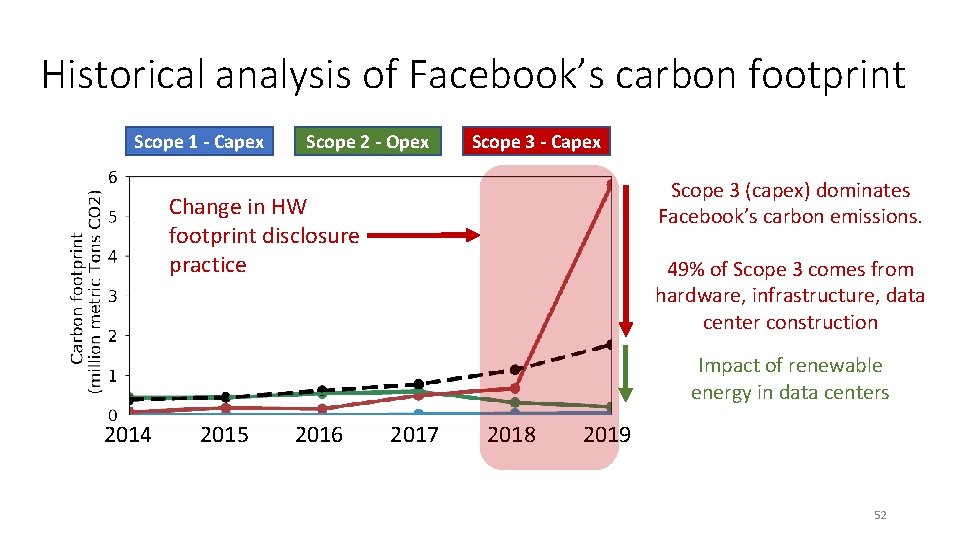
Historical analysis of Facebook’s carbon footprint Scope 1 - Capex Scope 2 - Opex Scope 3 - Capex Scope 3 (capex) dominates Facebook’s carbon emissions. Change in HW footprint disclosure practice 49% of Scope 3 comes from hardware, infrastructure, data center construction Impact of renewable energy in data centers 2014 2015 2016 2017 2018 2019 52
This work Where does computing’s carbon footprint come from? A combination of both energy consumed and hardware manufacturing (embodied carbon). Application Data center Mobile Breaking down carbon emissions in mobile Fabs Breaking down renewable energy driven data centers Going to the source of manufacturing emissions: fabs Ideas for designing a sustainable computing future 53
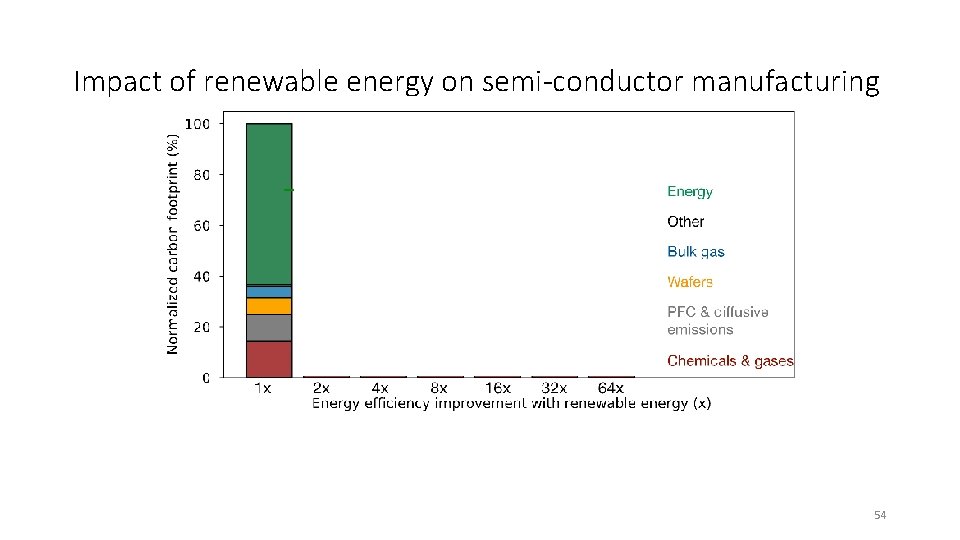
Impact of renewable energy on semi-conductor manufacturing 54
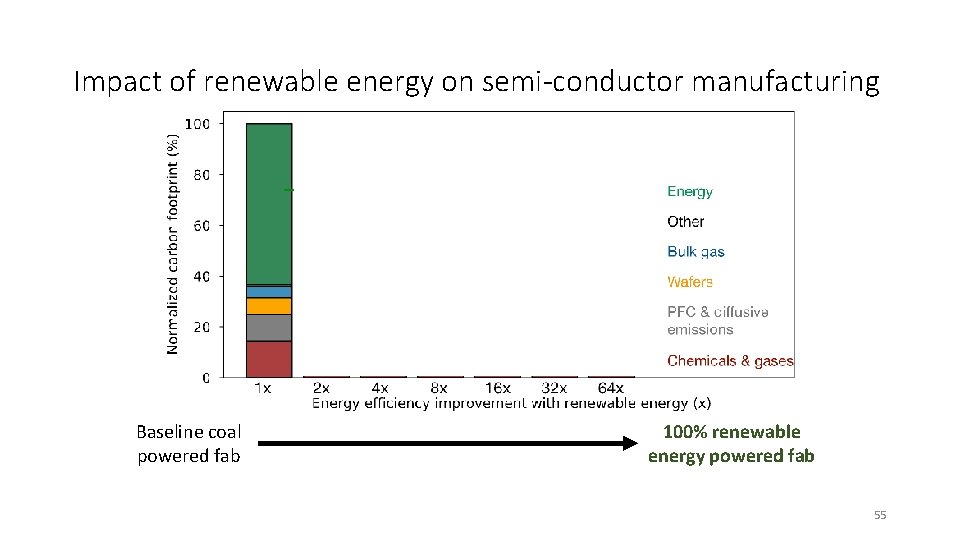
Impact of renewable energy on semi-conductor manufacturing Baseline coal powered fab 100% renewable energy powered fab 55
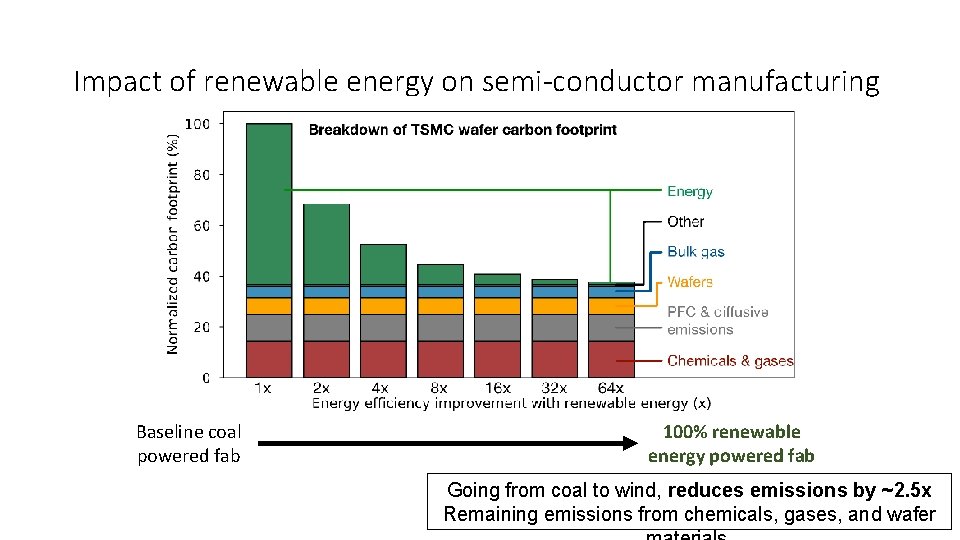
Impact of renewable energy on semi-conductor manufacturing Baseline coal powered fab 100% renewable energy powered fab Going from coal to wind, reduces emissions by ~2. 5 x Remaining emissions from chemicals, gases, and 56 wafer
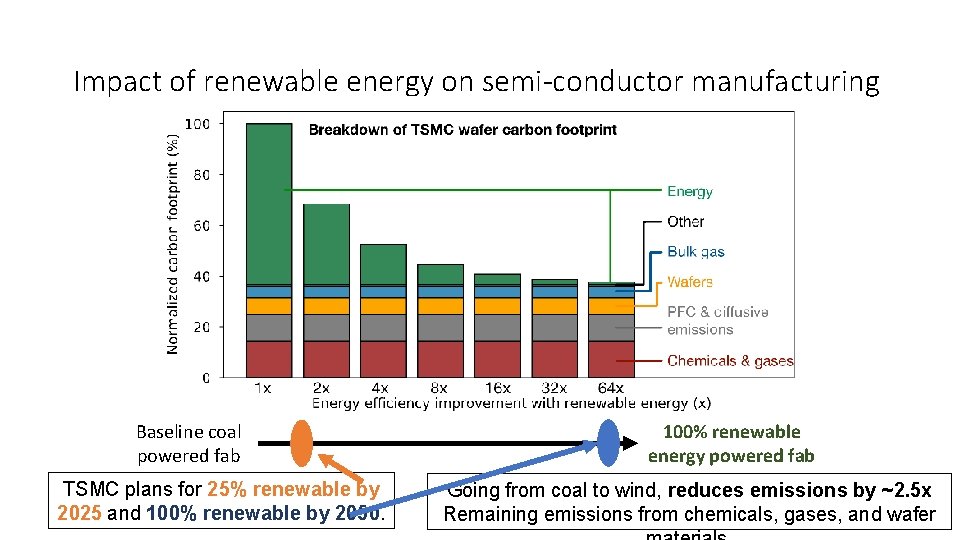
Impact of renewable energy on semi-conductor manufacturing Baseline coal powered fab TSMC plans for 25% renewable by 2025 and 100% renewable by 2050. 100% renewable energy powered fab Going from coal to wind, reduces emissions by ~2. 5 x Remaining emissions from chemicals, gases, and 57 wafer
This work Where does computing’s carbon footprint come from? A combination of both energy consumed and hardware manufacturing (embodied carbon). Application Data center Mobile Breaking down carbon emissions in mobile Fabs Breaking down renewable energy driven data centers Going to the source of manufacturing emissions: fabs Ideas for designing a sustainable computing future 58
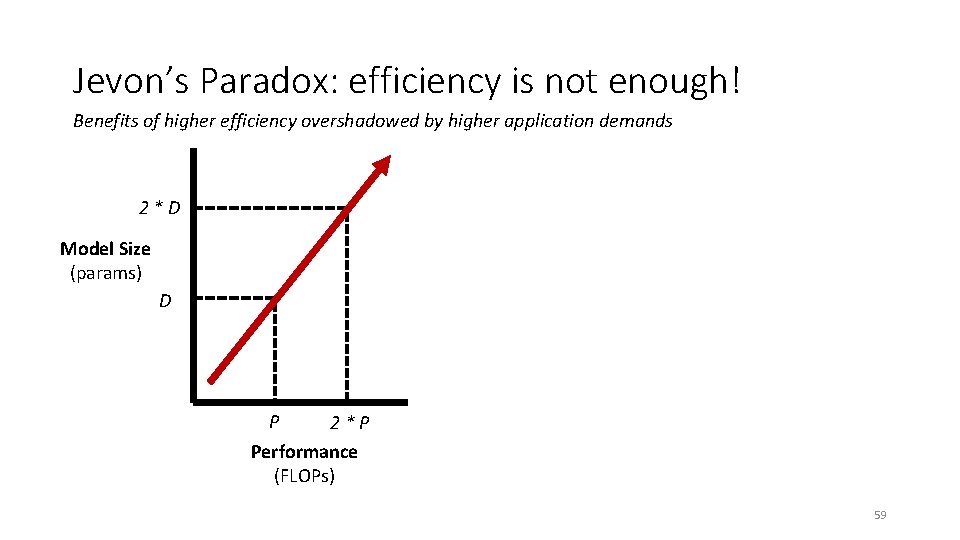
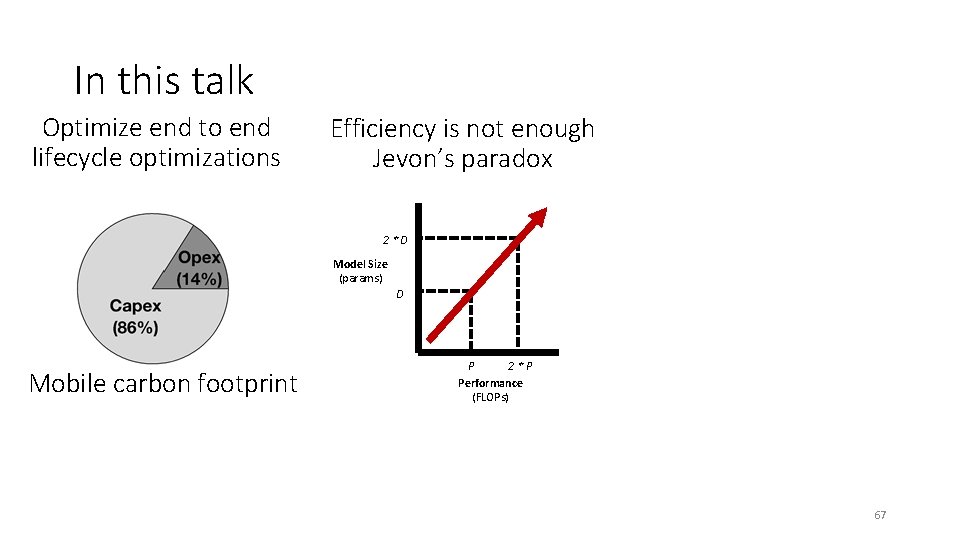
Jevon’s Paradox: efficiency is not enough! Benefits of higher efficiency overshadowed by higher application demands 2*D Model Size (params) D P 2*P Performance (FLOPs) 59
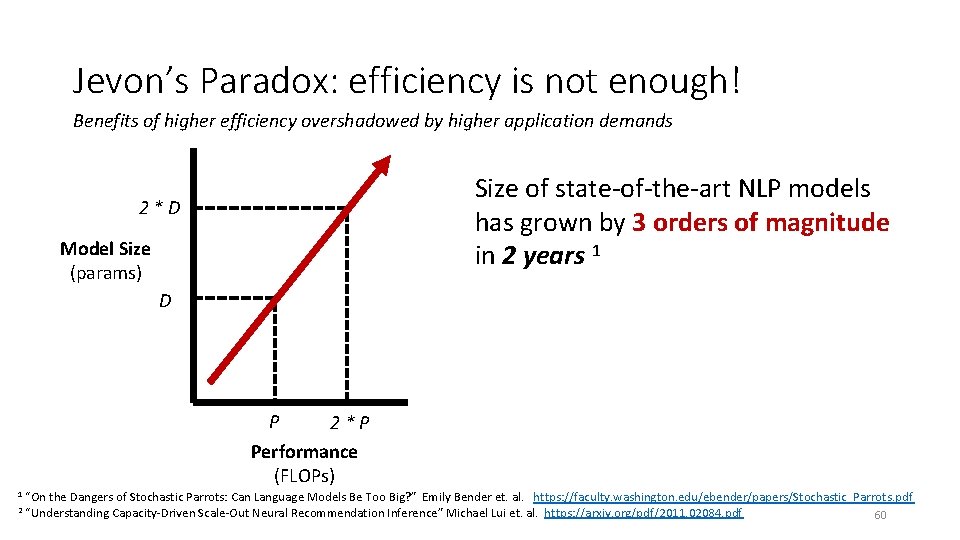
Jevon’s Paradox: efficiency is not enough! Benefits of higher efficiency overshadowed by higher application demands Size of state-of-the-art NLP models has grown by 3 orders of magnitude in 2 years 1 2*D Model Size (params) D P 2*P Performance (FLOPs) 1 2 “On the Dangers of Stochastic Parrots: Can Language Models Be Too Big? ” Emily Bender et. al. https: //faculty. washington. edu/ebender/papers/Stochastic_Parrots. pdf “Understanding Capacity-Driven Scale-Out Neural Recommendation Inference” Michael Lui et. al. https: //arxiv. org/pdf/2011. 02084. pdf 60
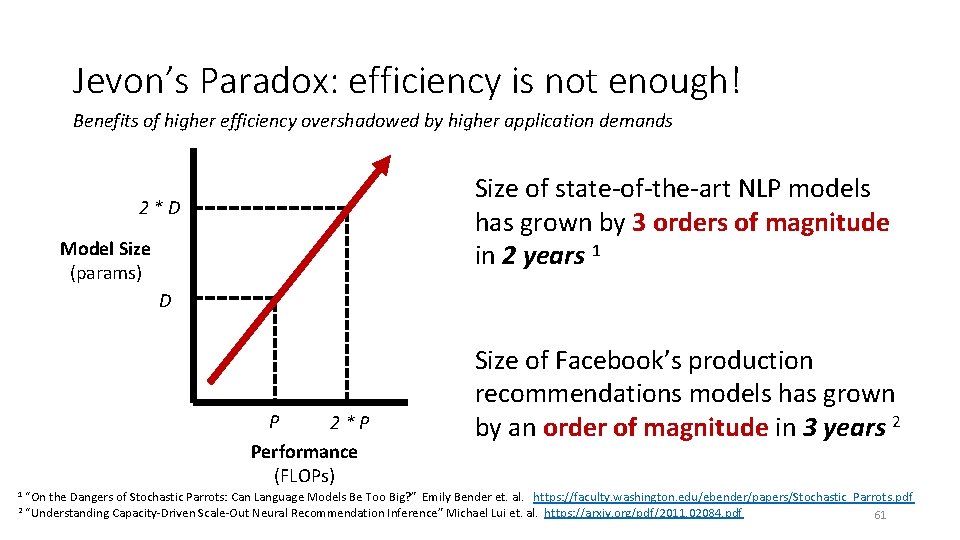
Jevon’s Paradox: efficiency is not enough! Benefits of higher efficiency overshadowed by higher application demands Size of state-of-the-art NLP models has grown by 3 orders of magnitude in 2 years 1 2*D Model Size (params) D P 2*P Performance (FLOPs) 1 2 Size of Facebook’s production recommendations models has grown by an order of magnitude in 3 years 2 “On the Dangers of Stochastic Parrots: Can Language Models Be Too Big? ” Emily Bender et. al. https: //faculty. washington. edu/ebender/papers/Stochastic_Parrots. pdf “Understanding Capacity-Driven Scale-Out Neural Recommendation Inference” Michael Lui et. al. https: //arxiv. org/pdf/2011. 02084. pdf 61
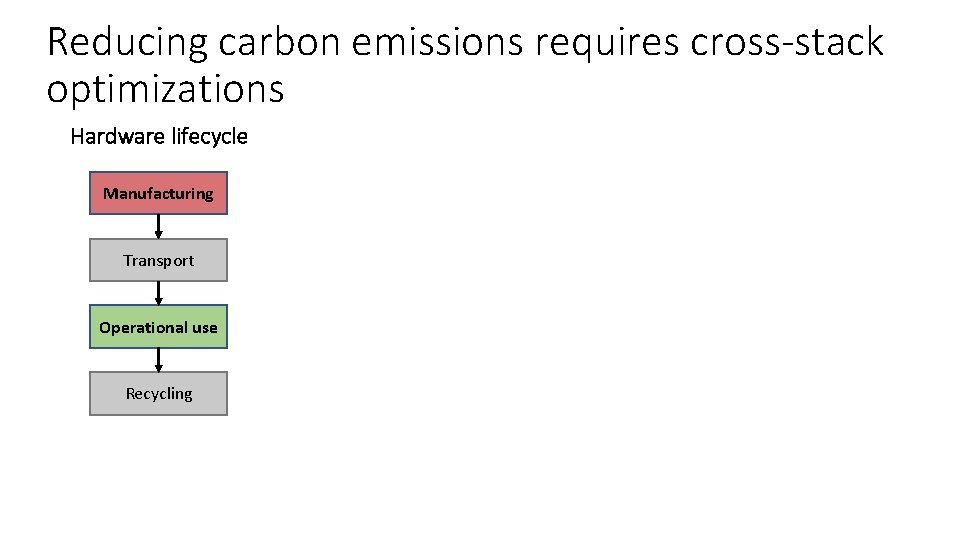
Reducing carbon emissions requires cross-stack optimizations Hardware lifecycle Manufacturing Transport Operational use Recycling
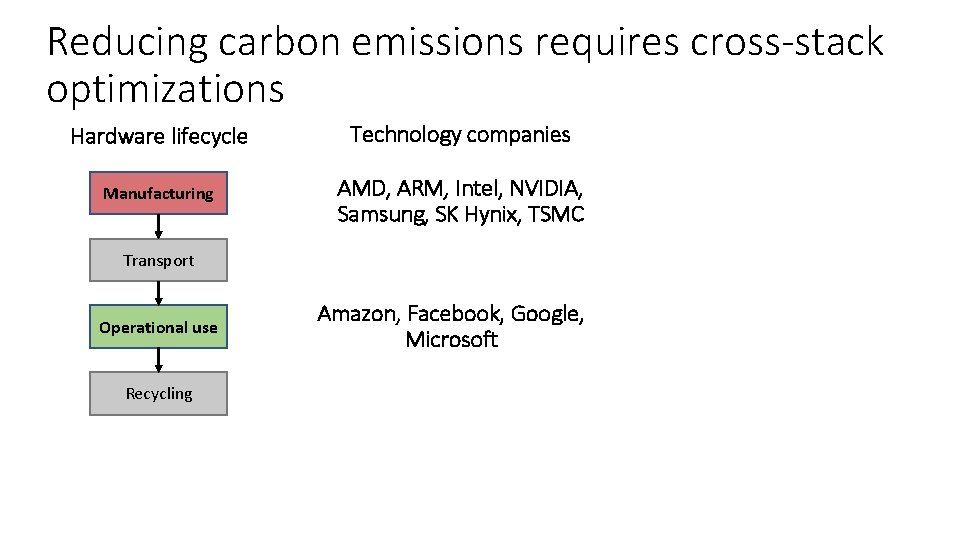
Reducing carbon emissions requires cross-stack optimizations Hardware lifecycle Technology companies Manufacturing AMD, ARM, Intel, NVIDIA, Samsung, SK Hynix, TSMC Transport Operational use Recycling Amazon, Facebook, Google, Microsoft
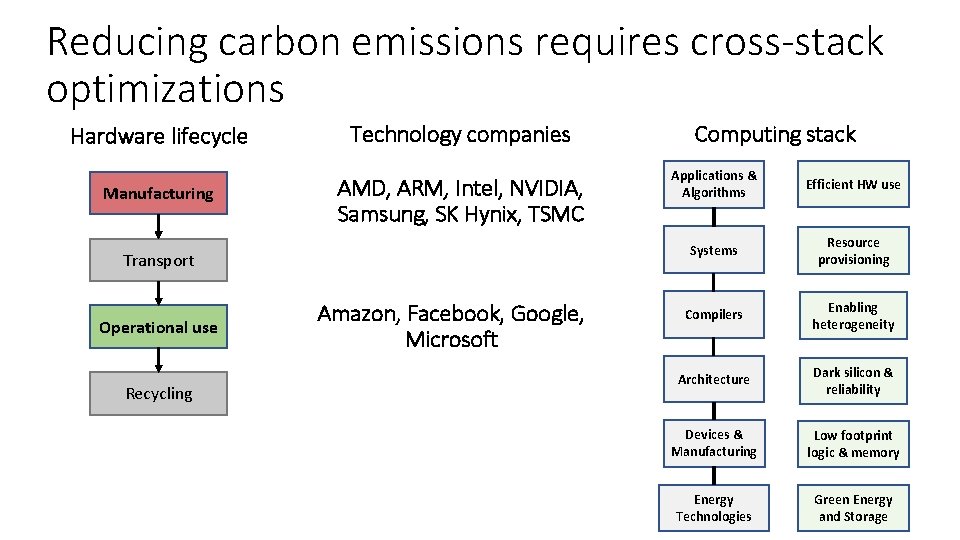
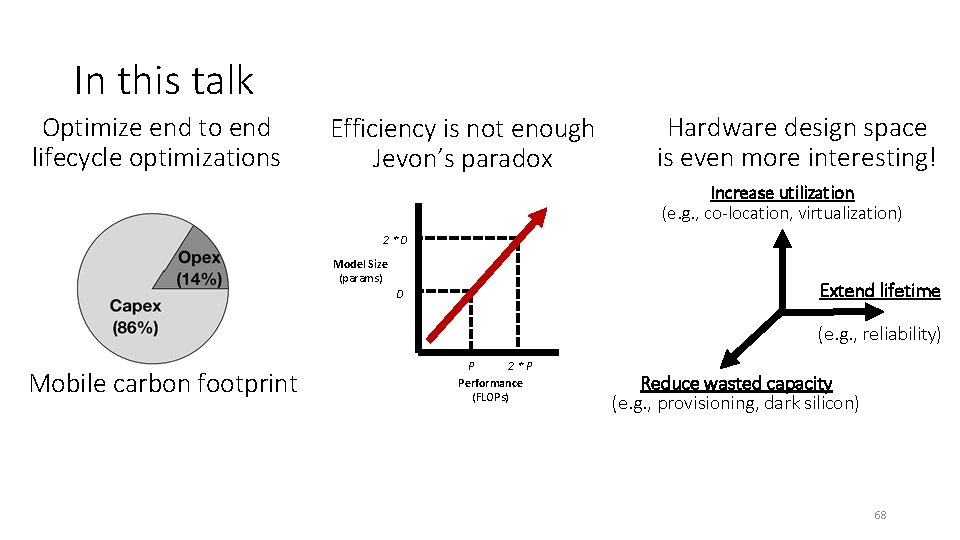
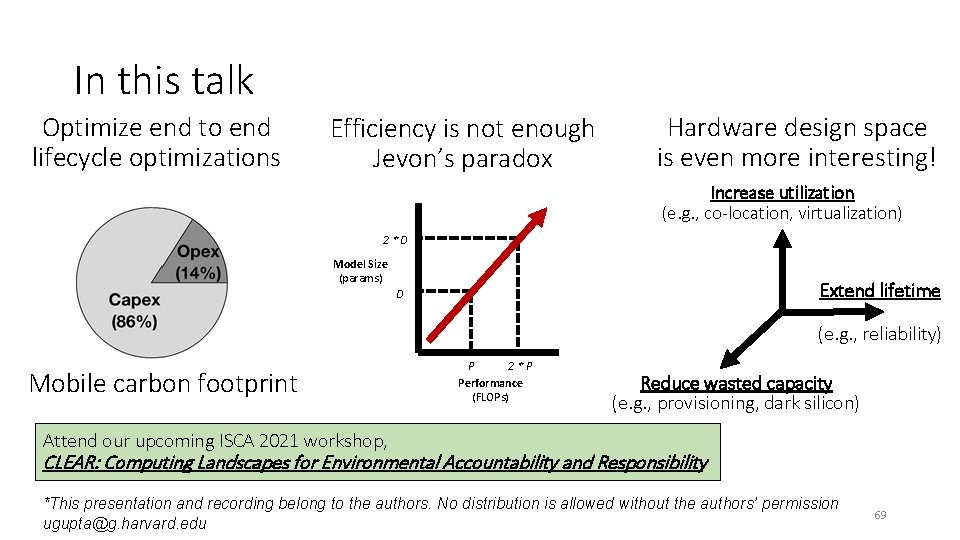
Reducing carbon emissions requires cross-stack optimizations Hardware lifecycle Technology companies Manufacturing AMD, ARM, Intel, NVIDIA, Samsung, SK Hynix, TSMC Transport Operational use Recycling Amazon, Facebook, Google, Microsoft Computing stack Applications & Algorithms Efficient HW use Systems Resource provisioning Compilers Enabling heterogeneity Architecture Dark silicon & reliability Devices & Manufacturing Low footprint logic & memory Energy Technologies Green Energy and Storage

Discussion points 65
In this talk Optimize end to end lifecycle optimizations Mobile carbon footprint 66
In this talk Optimize end to end lifecycle optimizations Efficiency is not enough Jevon’s paradox 2*D Model Size (params) D Mobile carbon footprint P 2*P Performance (FLOPs) 67
In this talk Optimize end to end lifecycle optimizations Efficiency is not enough Jevon’s paradox Hardware design space is even more interesting! Increase utilization (e. g. , co-location, virtualization) 2*D Model Size (params) Extend lifetime D (e. g. , reliability) Mobile carbon footprint P 2*P Performance (FLOPs) Reduce wasted capacity (e. g. , provisioning, dark silicon) 68
In this talk Optimize end to end lifecycle optimizations Efficiency is not enough Jevon’s paradox Hardware design space is even more interesting! Increase utilization (e. g. , co-location, virtualization) 2*D Model Size (params) Extend lifetime D (e. g. , reliability) Mobile carbon footprint P 2*P Performance (FLOPs) Reduce wasted capacity (e. g. , provisioning, dark silicon) Attend our upcoming ISCA 2021 workshop, CLEAR: Computing Landscapes for Environmental Accountability and Responsibility *This presentation and recording belong to the authors. No distribution is allowed without the authors’ permission ugupta@g. harvard. edu 69
- Slides: 69