
CHASE AQUILANO JACOBS 1 Operations Management For Competitive
CHASE AQUILANO JACOBS 1 Operations Management For Competitive Advantage Chapter 1 Introduction to the Field ninth edition
2 Chapter 1 Overview: Introduction to the Field · · · · Operations Management Why Study Operations Management? Production System Defined Operations as a Service Plan of This Book Historical Development of OM Current Issues in OM
3 What is Operations Management? Defined Operations management (OM) is defined as the design, operation, and improvement of the systems that create and deliver the firm’s primary products and services.
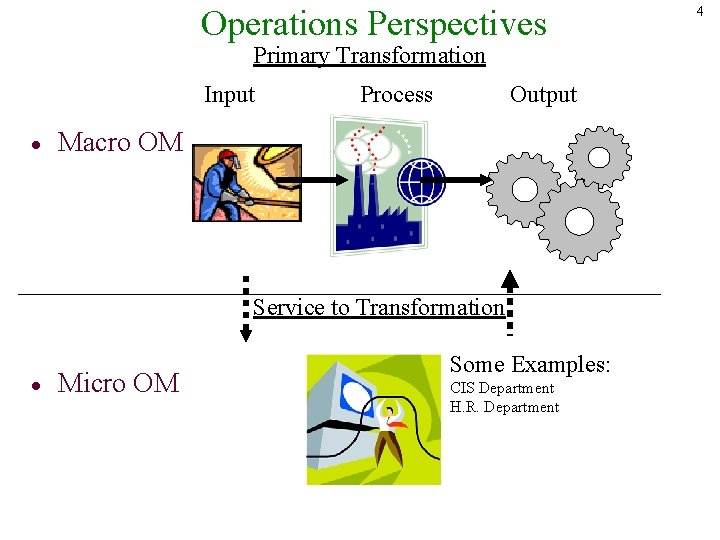
Operations Perspectives Primary Transformation Input · Process Output Macro OM Service to Transformation · Micro OM Some Examples: CIS Department H. R. Department 4

5 Why Study Operations Management? Systematic Approach to Org. Processes Business Education Operations Management Cross-Functional Applications Career Opportunities
6 What is a Production System? Defined A production system is defined as a user of resources to transform inputs into some desired outputs.
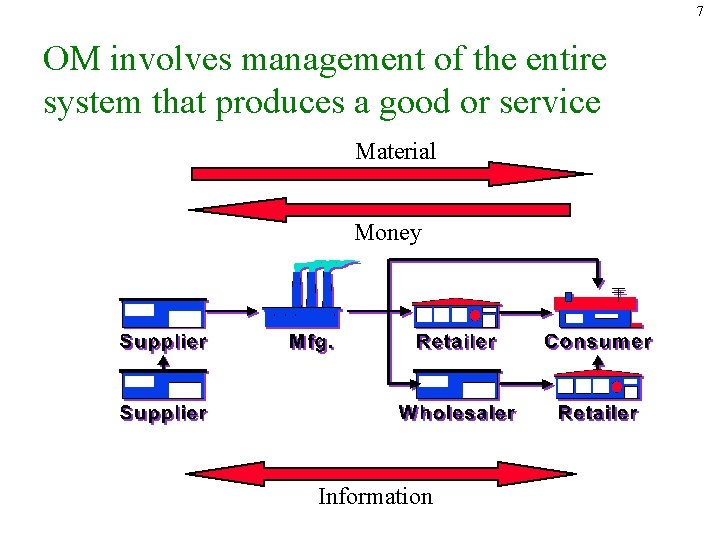
7 OM involves management of the entire system that produces a good or service Material Money Information
8 Transformations · Physical--manufacturing · Locational--transportation · Exchange--retailing · Storage--warehousing · Physiological--health care · Informational--telecommunications
9 What is a Service and What is a Good? · “If you drop it on your foot, it won’t hurt you. ” (Good or service? ) · “Services never include goods and goods never include services. ” (True or false? )
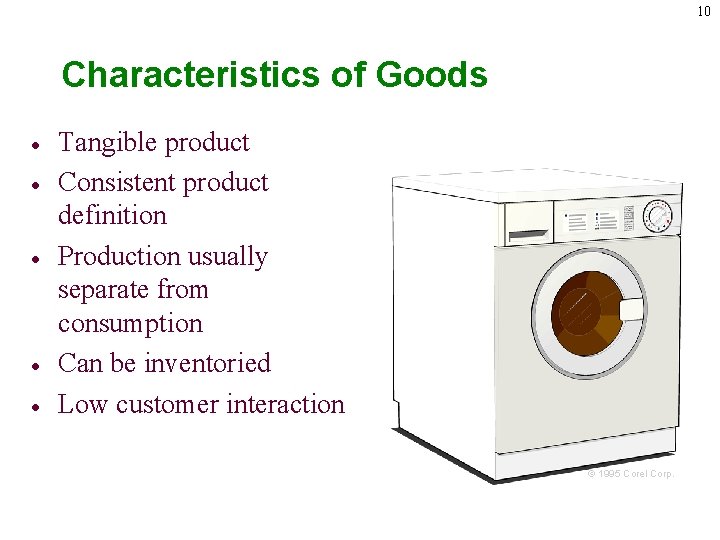
10 Characteristics of Goods · · · Tangible product Consistent product definition Production usually separate from consumption Can be inventoried Low customer interaction © 1995 Corel Corp.
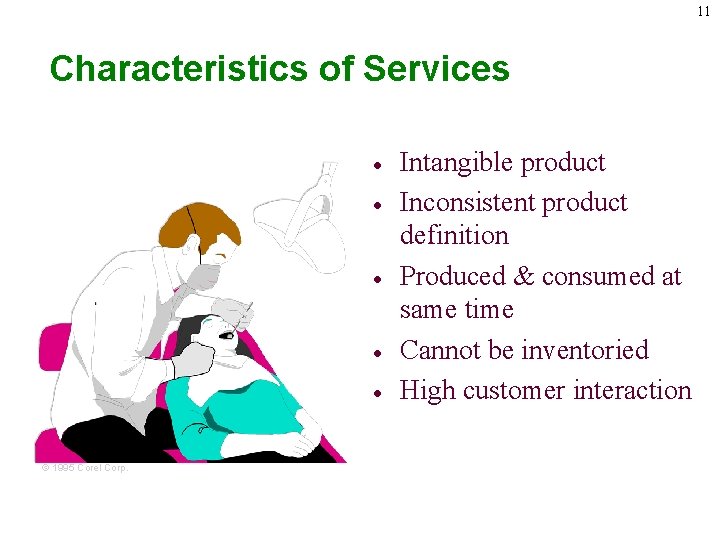
11 Characteristics of Services · · · © 1995 Corel Corp. Intangible product Inconsistent product definition Produced & consumed at same time Cannot be inventoried High customer interaction
12 Core Services Definition Core services are basic things that customers want from products they purchase.

13 Core Services Performance Objectives Quality Flexibility Operations Management Price (or cost Reduction) Speed
14 Value-Added Services Defined Value-added services differentiate the organization from competitors and build relationships that bind customers to the firm in a positive way.
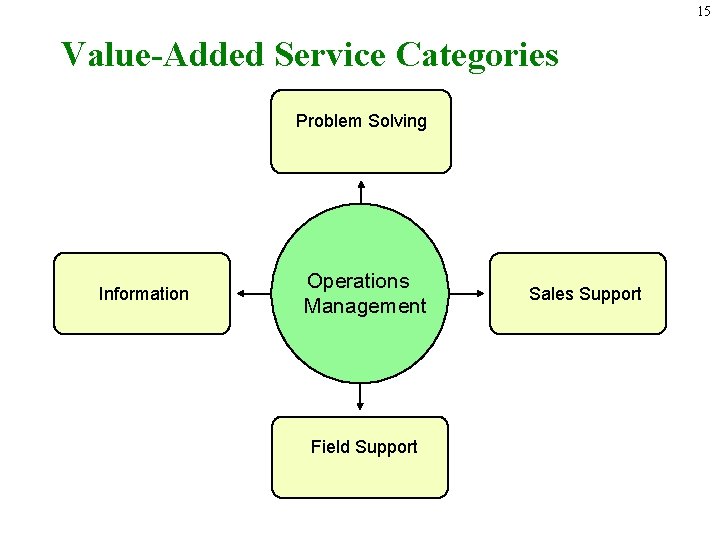
15 Value-Added Service Categories Problem Solving Information Operations Management Field Support Sales Support
16 Historical Development of OM Carefully read this section in the Text · Carefully read this section in the Text for Exam Review
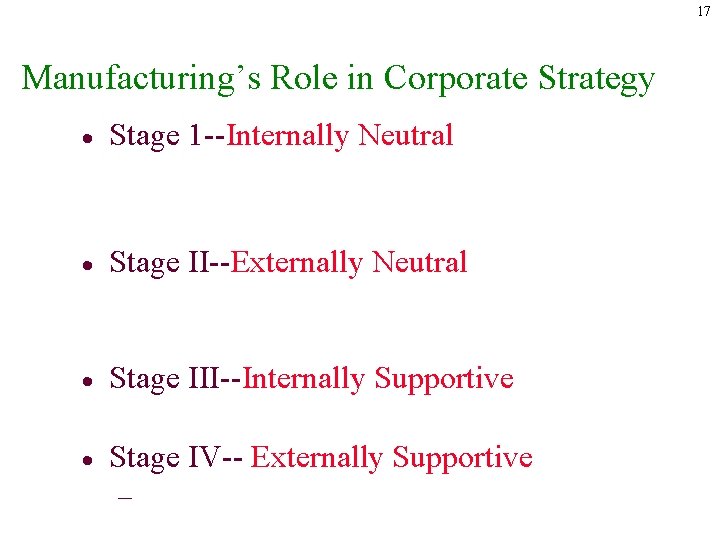
17 Manufacturing’s Role in Corporate Strategy · Stage 1 --Internally Neutral · Stage II--Externally Neutral · Stage III--Internally Supportive · Stage IV-- Externally Supportive –
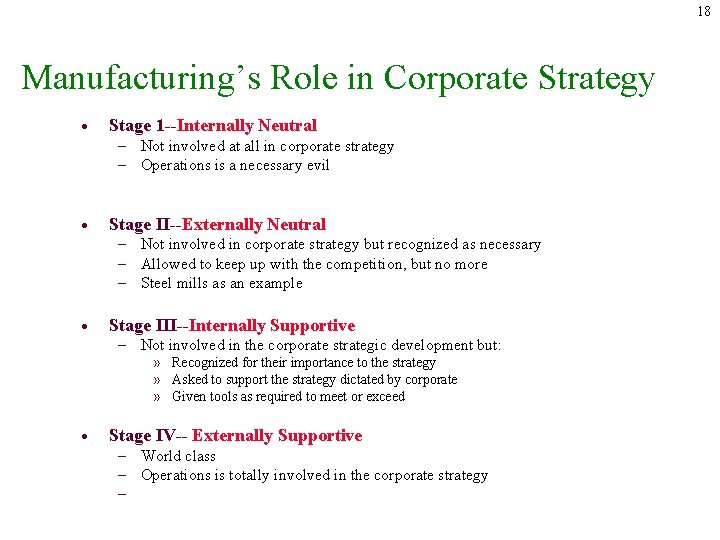
18 Manufacturing’s Role in Corporate Strategy · Stage 1 --Internally Neutral – Not involved at all in corporate strategy – Operations is a necessary evil · Stage II--Externally Neutral – Not involved in corporate strategy but recognized as necessary – Allowed to keep up with the competition, but no more – Steel mills as an example · Stage III--Internally Supportive – Not involved in the corporate strategic development but: » Recognized for their importance to the strategy » Asked to support the strategy dictated by corporate » Given tools as required to meet or exceed · Stage IV-- Externally Supportive – World class – Operations is totally involved in the corporate strategy –
19 Four Stages of Service Firm Competitiveness · Stage I. Available for Service · Stage II. Journeyman · Stage III. Distinctive Competence Achieved · Stage IV. World Class Service Delivery
20 Current Issues in OM · Effectively consolidating the operations resulting from mergers (with cultural and technology differences) · Developing flexible supply chains to enable mass customization of products and services (variety and delivery worldwide) · Managing global supplier, production and distribution networks (ERP systems)
21 Current Issues in OM (cont’d) · Increased “commiditization” of suppliers – use of standard internet connections · Achieving the “Service Factory” – providing personalized service to each customer · Achieving good service from service firms – use of information
- Slides: 21