
Chartism By Mike Allen The Whig reforms 1832
Chartism By Mike Allen
The Whig reforms 1832 -41 (1) • The most important of the Whig reforms were: • The abolition of slavery in the British Empire, 1833. • The Factory Act of 1833 restricted child labour in textile factories (except for silk mills). Children under 9 were not permitted to work. Those aged between 9 and 13 were only allowed to work for eight hours a day and they had to receive two hours’ schooling. Young people aged 14 to 18 were limited to twelve hours a day. For the first time inspectors were appointed to enforce the law but there were only four of them. Nevertheless, this was the first effective Factory Act. There had been previous Factory Acts but they had not been enforced. • The first government grant for education (1833) provided £ 20 000, divided between two religious societies which provided elementary schools (the National Society and the British and Foreign Society). The grant was increased to £ 30 000 in 1839. It is the beginnings of the state education system.
The Whig reforms 1832 -41 (2) • The Poor Law Amendment Act of 1834 (see later). • The Municipal Corporations Act of 1835 reformed local government in the boroughs. Councils were to be elected by ratepayers. They were obliged to set up a police force and were allowed to provide other services such as drainage and street cleaning. • The Act laid the foundations for later improvements in the administration of urban areas. • Registration of births, marriages and deaths (1836). This helped the inspectors enforcing the Factory Act. • Church reforms: the Marriage Act and the Tithe Commutation Act. • These reforms were intended to satisfy the demands of the new middleclass electors and to tackle the problems of an emerging industrial society. They were much influenced by pressure from radicals. But they were limited and the most important of them, the Poor Law Amendment Act, was immensely unpopular with the working classes.
The Whig reforms 1832 -41 (3) • The Poor Law Amendment Act, 1834 The Poor Law of 1601 made each parish responsible for its own poor. • Poor relief was paid for by a parish rate levied by Overseers of the Poor. In much of the South of England the Poor Law operated on the Speenhamland System, which began in 1795 in Berkshire. Poorly paid agricultural labourers had their wages supplemented according to the size of their families and the price of bread. It kept wages low, so that labourers were unable to earn a living wage and never escaped dependence on the Poor Law. Agricultural employers did not need to pay proper wages and were being subsidised by other ratepayers. • The cost of the Poor Law escalated: by 1830 it was over £ 7 million a year. The cost was probably the main spur to reform.
The Whig reforms 1832 -41 (4) • • • In 1832 a Poor Law Commission was appointed to investigate the problem. It was dominated by Edwin Chadwick was a Utilitarian who followed the ideas of Jeremy Bentham. His aim was to set up a system which would be both efficient and economical. The Commission’s report led to the Poor Law Amendment Act. Utilitarianism aimed for ‘the great happiness of the greatest number’. It influenced many reforms at this time. Outdoor relief, i. e. the payment of money to the poor, was abolished, except for the sick and aged. This meant the end of the Speenhamland system. For the able-bodied poor, relief was to be provided in workhouses. The workhouses were to be run on the principle of ‘less eligibility’. This meant that life in the workhouse should be as unattractive as possible – less attractive than the condition of the poorest labourer outside it. This would ensure that the poor would only come to the workhouse as a last resort. Administration of the Poor Law was completely reformed. Parishes were grouped into Poor Law Unions run by elected Boards of Guardians. A central Board of Commissioners was appointed to supervise the whole system. Chadwick was its secretary.
The Whig reforms 1832 -41 (5) • • • The new Poor Law was successful in reducing costs and was therefore popular with ratepayers. In the late 1830 s the annual cost was about £ 4. 5 million. But it was very unpopular with the working classes and the humanitarians criticised it as harsh and cruel. Dickens attacked it in Oliver Twist. Conditions in the new workhouses were harsh. The original intention of the Act was that there should be separate workhouses for different classes of the poor but this proved too expensive. Instead, families were separated within the workhouses. Conditions improved slightly in the 1840 s. From 1842 the separation of husbands and wives was ended and parents were allowed to see their children. The Commissioners were replaced by a Poor Law Board under a government minister in 1847 and after this there was a slow improvement in the treatment of children, the sick and the old. In the industrial north it proved impossible to implement the new system in full because periodic trade recessions caused more widespread unemployment than the workhouses could cope with. There was a recession in 1837– 38 and there were attacks on the Guardians and the workhouses. An Anti-Poor Law Movement developed in the North of England. Hostility to the new Poor Law was one of the causes of the rise of the Chartist movement, into which the Anti-Poor Law Movement was absorbed. The new Poor Law was designed to cope with the rural poor of southern England. 1 1 The previous 4 pages are adapted from http: //revisionworld. com/a 2 -levelrevision/history-0/19 th-century-britain/whigs-1830– 41
Working class Organisation • The Combination laws 1799 and 1800 had precluded the setting up of associations of workers. • These had been to some extent outflanked by setting up Friendly Societies. • The Combination Laws were repealed in 1824 and 1825 and a number of trade Unions were created (mainly the previous Friendly Societies) • Attempts to set up large scale TUs were unsuccessful.
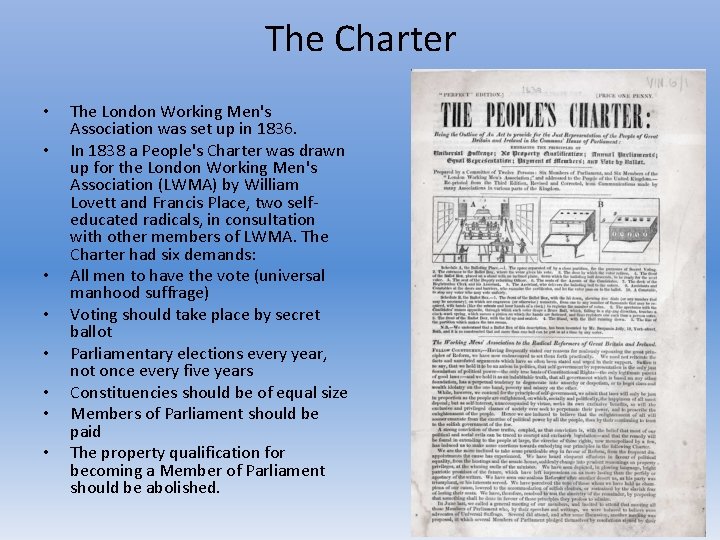
The Charter • • The London Working Men's Association was set up in 1836. In 1838 a People's Charter was drawn up for the London Working Men's Association (LWMA) by William Lovett and Francis Place, two selfeducated radicals, in consultation with other members of LWMA. The Charter had six demands: All men to have the vote (universal manhood suffrage) Voting should take place by secret ballot Parliamentary elections every year, not once every five years Constituencies should be of equal size Members of Parliament should be paid The property qualification for becoming a Member of Parliament should be abolished.
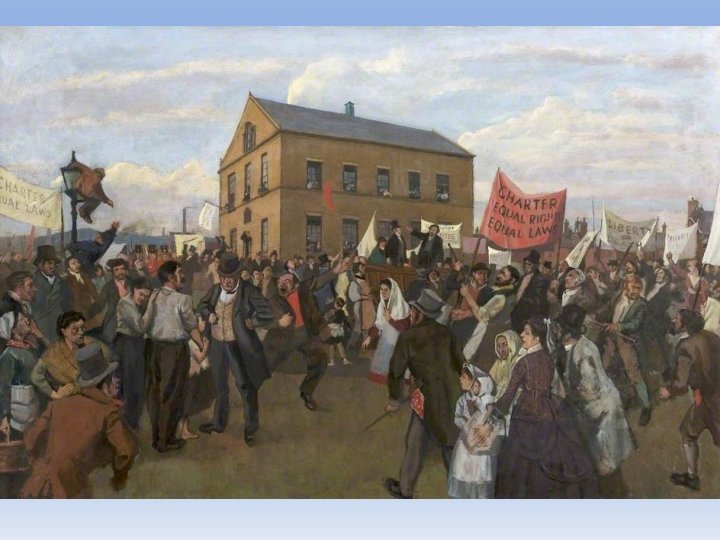
Chartism 1 • Chartism was launched in 1838 by a series of enormous meetings in Birmingham, Glasgow and the north of England. • The movement organised a National Convention in London in early 1839 to facilitate the presentation of the first petition. • In June 1839, the petition, signed by 1. 3 million working people, was presented to the House of Commons, but MPs voted, by a large majority, not to hear the petitioners. • This provoked unrest which was swiftly crushed by the authorities. Only South Wales staged an uprising. On 4 November 1839, 50 Chartists were seriously wounded and 22 killed in a confrontation with troops in Newport. 1 1 http: //www. parliament. uk/about/living- heritage/transformingsociety/electionsvoting/chartists/overview/chartistmovement
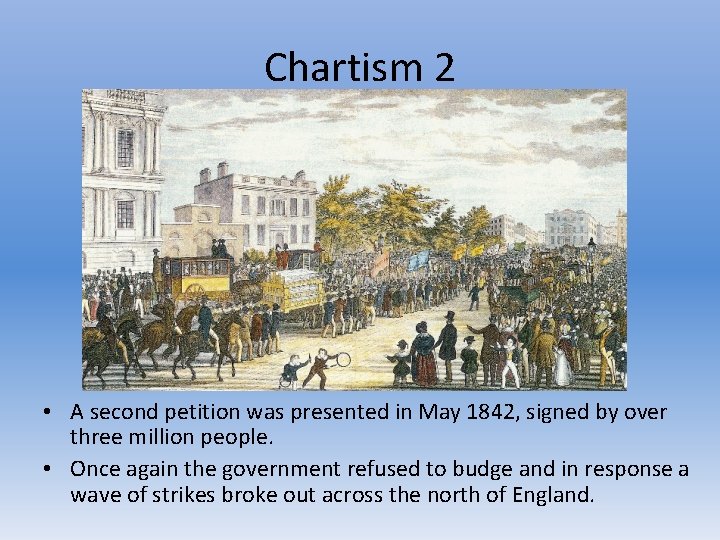
Chartism 2 • A second petition was presented in May 1842, signed by over three million people. • Once again the government refused to budge and in response a wave of strikes broke out across the north of England.
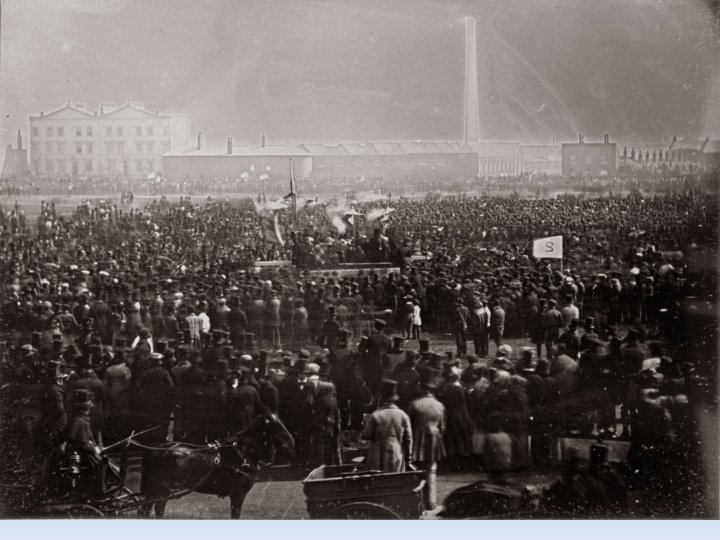
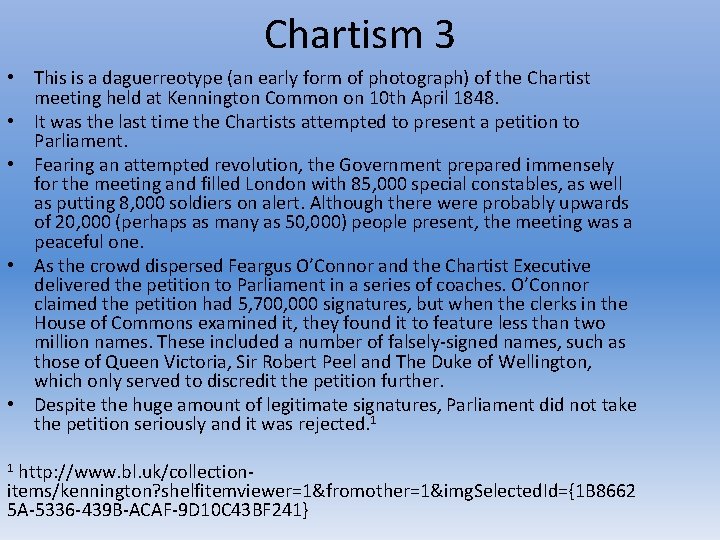
Chartism 3 • This is a daguerreotype (an early form of photograph) of the Chartist meeting held at Kennington Common on 10 th April 1848. • It was the last time the Chartists attempted to present a petition to Parliament. • Fearing an attempted revolution, the Government prepared immensely for the meeting and filled London with 85, 000 special constables, as well as putting 8, 000 soldiers on alert. Although there were probably upwards of 20, 000 (perhaps as many as 50, 000) people present, the meeting was a peaceful one. • As the crowd dispersed Feargus O’Connor and the Chartist Executive delivered the petition to Parliament in a series of coaches. O’Connor claimed the petition had 5, 700, 000 signatures, but when the clerks in the House of Commons examined it, they found it to feature less than two million names. These included a number of falsely-signed names, such as those of Queen Victoria, Sir Robert Peel and The Duke of Wellington, which only served to discredit the petition further. • Despite the huge amount of legitimate signatures, Parliament did not take the petition seriously and it was rejected. 1 http: //www. bl. uk/collectionitems/kennington? shelfitemviewer=1&fromother=1&img. Selected. Id={1 B 8662 5 A-5336 -439 B-ACAF-9 D 10 C 43 BF 241} 1
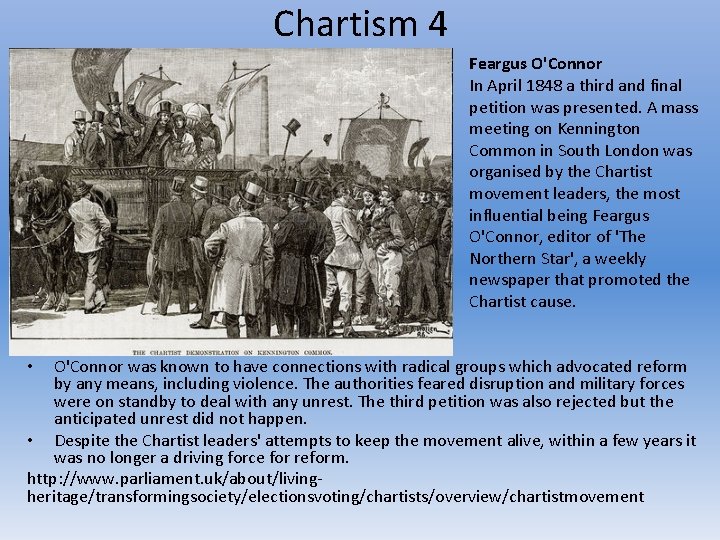
Chartism 4 Feargus O'Connor In April 1848 a third and final petition was presented. A mass meeting on Kennington Common in South London was organised by the Chartist movement leaders, the most influential being Feargus O'Connor, editor of 'The Northern Star', a weekly newspaper that promoted the Chartist cause. O'Connor was known to have connections with radical groups which advocated reform by any means, including violence. The authorities feared disruption and military forces were on standby to deal with any unrest. The third petition was also rejected but the anticipated unrest did not happen. • Despite the Chartist leaders' attempts to keep the movement alive, within a few years it was no longer a driving force for reform. http: //www. parliament. uk/about/livingheritage/transformingsociety/electionsvoting/chartists/overview/chartistmovement •
Chartism 5 • Moderate reforms by Sir Robert Peel 1841 -6 may have reduced some of the agitation. • These included: • The Mines Act (1842) prohibited the employment of women, girls and boys under the age of ten underground. This resulted from the report of a Royal Commission which shocked public opinion. • The Factory Act (1844) lowered the age at which children could be employed in textile factories to eight but also reduced hours of work to 6 for children aged up to 13.
Chartists' legacy • However, the Chartists' legacy was strong. By the 1850 s Members of Parliament accepted that further reform was inevitable. Further Reform Acts were passed in 1867 and 1884. • By 1918, five of the Chartists' six demands had been achieved - only the stipulation that parliamentary elections be held every year was unfulfilled. 1 1 http: //www. parliament. uk/about/living- heritage/transformingsociety/electionsvoting/chartists/overview/chartistmovement
Anti-Corn Law League • In contrast to the Chartists, the Anti-Corn Law League was a British organization founded in 1839, devoted to fighting England’s Corn Laws, regulations governing the import and export of grain and was successful. • It was led by Richard Cobden, who saw the laws as both morally wrong and economically damaging. • The league mobilized the industrial middle classes and some of the working classes against the landlords, and Cobden won over the prime minister, Sir Robert Peel. The Corn Laws were repealed in 1846. Adapted from http: //www. britannica. com/topic/Anti-Corn-Law-League
Bibliography • • • The Age of Improvement Sir Llewellyn Woodward 1938 The Age of Reform Sir Llewellyn Woodward 1962 Democracy and Reform 1815 -1885 D. G. Wright 1970 Party & Politics 1830 -1852 Robert Stewart 1989 http: //revisionworld. com/a 2 -level-revision/history-0/19 th-centurybritain/whigs-1830– 41 http: //www. parliament. uk/about/livingheritage/transformingsociety/electionsvoting/chartists/overview/chartist movement http: //www. bl. uk/collectionitems/kennington? shelfitemviewer=1&fromother=1&img. Selected. Id={1 B 8 6625 A-5336 -439 B-ACAF-9 D 10 C 43 BF 241} http: //www. parliament. uk/about/livingheritage/transformingsociety/electionsvoting/chartists/overview/chartist movement http: //www. britannica. com/topic/Anti-Corn-Law-League
- Slides: 18