
Chart Review Common ICU Equipment Abbreviations Blood pressure

Chart Review
Common ICU Equipment & Abbreviations • • • Blood pressure (BP) cuff Nasogastric suction (NG) suction Nasogastric tube (NG) tube Electrocardiogram electrodes Urine catheter and Foley bag- Foley or Foley catheter Sequential compression device (SCD) Central line Intracranial pressure (ICP) monitor Endotracheal tube (ET) Ventilator (vent) Pulse oximeter (pulse ox)

https: //s-media-cache-ak 0. pinimg. com/736 x/06/6 b/b 6/066 bb 6 bf 0166 d 26 bdb 7248 d 76 b 3 dfcf 4. jpg
Hospital Bed Features • Air overlay or air mattress-used to prevent development of decubitus ulcers (bed sores). • Rotation and percussion-used to improve respiratory status. • “Chair position”- head of the bed up right and feet in dependent position (hanging downward). • Trendelenburg- foot of the bed is higher than the head of the bed to promote elevation and blood flow. • Reverse Trendelenburg-head of the bed is higher than the foot of the bed.
Basic Vitals • Heart Rate (HR)- 60 -100 beat/min • Bradycardia (slow HR): <60 • Tachycardia (fast HR): >100 Blood Pressure (BP)- Systolic: 90 -120 mm. Hg; Diastolic: 60 -80 mm. Hg Pulse Oximeter oxygen saturation- 95 -100% (typically in therapeutic setting, activity is ceased at 85% saturation or below) Respiratory Rate-12 -20 breaths per minute

Medication Dosing Abbreviations • • • a. c. (ante cibum)-before meals p. c. (post cibum)-after meals PRN (pro re nata)- as needed q. d. , qd-once a day b. i. d. bid- twice a day t. i. d, tid, -three times a day q. i. d, qid-four times a day q. h. s, qhs- before bed q 4 h-every 4 hours q 6 h-every 6 hours qod-every other day
Amputations • Upper Limb • Wrist, elbow, or shoulder disarticulation (removal of whole joint) • BEA (below elbow amputationtransradial) • AEA( above elbow ambutationtranshumeral) • Lower Limb • Ankle or hip disarticulation • BKA (below knee amputationtranstibial) • AKA (above knee amputationtransfemoral)
Weight bearing Precautions • Weight bearing as tolerated (WBAT)- patient bears as much weight as can be tolerated within pain limits. • Partial weight bearing (PWB)- 50% of weight through affected extremity. • Touchdown weight bearing (TDWB)-not allowed to use extremity to bear weight but to touch down to maintain balance. • Non-weight bearing (NWB)-not allowed to bear any weight on affected extremity.
Levels of Assist • Dependent (D)-all needs provided for by others • Max A-75% of needs provided for by others • Mod A-50% of needs provided for by others • Min A-25% of needs provided for by others • Contact Guard Assist (CGA)- hand on patient for safety • Supervision (S)- nearby in case of need. • Modified Independent (Mod I)- use of adaptive equipment (AE) and/or requiring extra time. • Independent- without assist or extra time.
Chart Terminology • • • • • CC: chief complaint ROS: review of systems HEENT: head, ears, eyes, nose, throat PMH: Past medical history PSH-Past surgical history S/p: status post CV: cardiovascular BMI: Body mass index NKDA: no known drug allergies Tx: treatment Dx: diagnosis D/C: discharge PEERL: pupils equal round and reactive to light Eval: evaluate/evaluation MVA: motor vehicle accident GSW: gun shot wound GCS: Glasgow coma scale
Common Medical Symptoms • • • Myalgia: muscle aches Arthralgia: joint aches Erythema: redness Syncope: drop in BP resulting in fainting Dyspnea: labored breathing Diaphoresis: unusual degree of sweating Pneumothorax: collapsed lung HTN: hypertension A-fib (atrial fibrillation): abnormal heart rhythm DTR’s (deep tendon reflexes): absence indicated problem Pleural effusion: excessive fluid accumulation in lungs
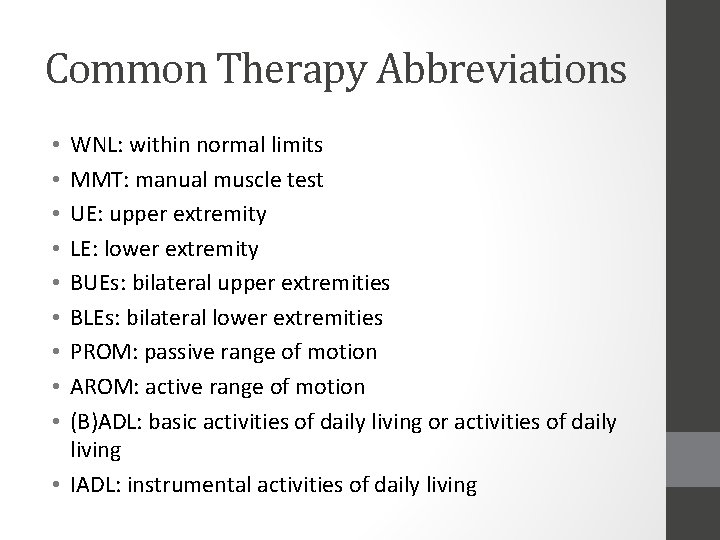
Common Therapy Abbreviations WNL: within normal limits MMT: manual muscle test UE: upper extremity LE: lower extremity BUEs: bilateral upper extremities BLEs: bilateral lower extremities PROM: passive range of motion AROM: active range of motion (B)ADL: basic activities of daily living or activities of daily living • IADL: instrumental activities of daily living • • •
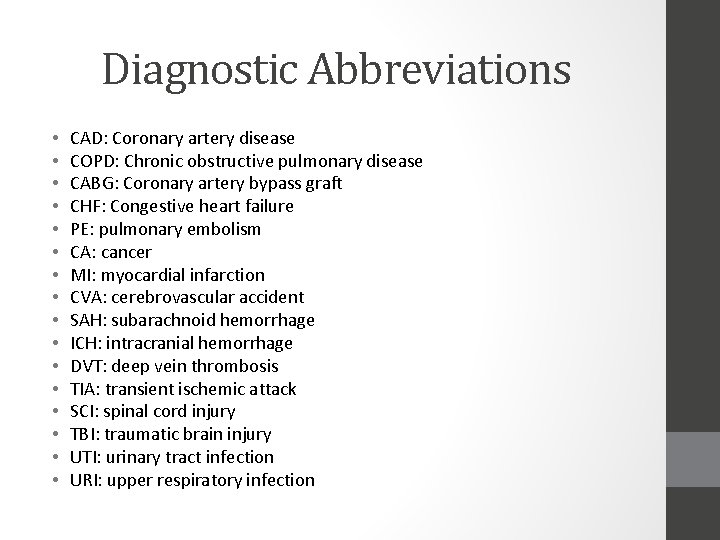
Diagnostic Abbreviations • • • • CAD: Coronary artery disease COPD: Chronic obstructive pulmonary disease CABG: Coronary artery bypass graft CHF: Congestive heart failure PE: pulmonary embolism CA: cancer MI: myocardial infarction CVA: cerebrovascular accident SAH: subarachnoid hemorrhage ICH: intracranial hemorrhage DVT: deep vein thrombosis TIA: transient ischemic attack SCI: spinal cord injury TBI: traumatic brain injury UTI: urinary tract infection URI: upper respiratory infection
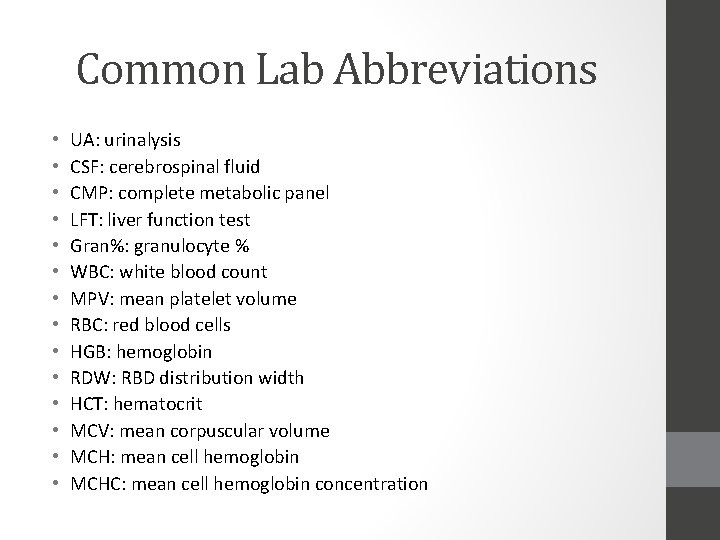
Common Lab Abbreviations • • • • UA: urinalysis CSF: cerebrospinal fluid CMP: complete metabolic panel LFT: liver function test Gran%: granulocyte % WBC: white blood count MPV: mean platelet volume RBC: red blood cells HGB: hemoglobin RDW: RBD distribution width HCT: hematocrit MCV: mean corpuscular volume MCH: mean cell hemoglobin MCHC: mean cell hemoglobin concentration
References • Smith-Gabia, H. (2011). Occupational Therapy in Acute Care. Bethesda, MD: AOTA Press.
- Slides: 15