
Charmonium production in heavyion collisions status and prespectives
- Slides: 39
Charmonium production in heavy-ion collisions: status and prespectives E. Scomparin INFN Torino (Italy) XLVIII International Winter meeting on Nuclear Physics, Bormio (Italy) 25 -29 January 2010 in Memoriam of Ileana Iori
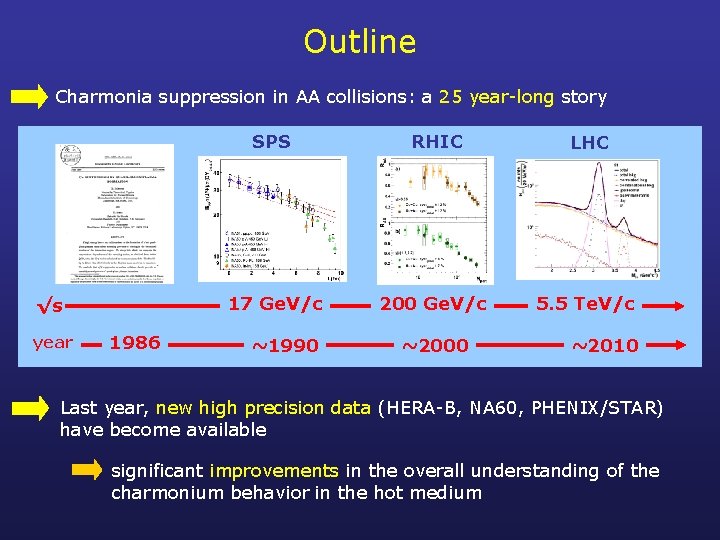
Outline Charmonia suppression in AA collisions: a 25 year-long story √s year 1986 SPS RHIC LHC 17 Ge. V/c 200 Ge. V/c 5. 5 Te. V/c ~1990 ~2000 ~2010 Last year, new high precision data (HERA-B, NA 60, PHENIX/STAR) have become available significant improvements in the overall understanding of the charmonium behavior in the hot medium
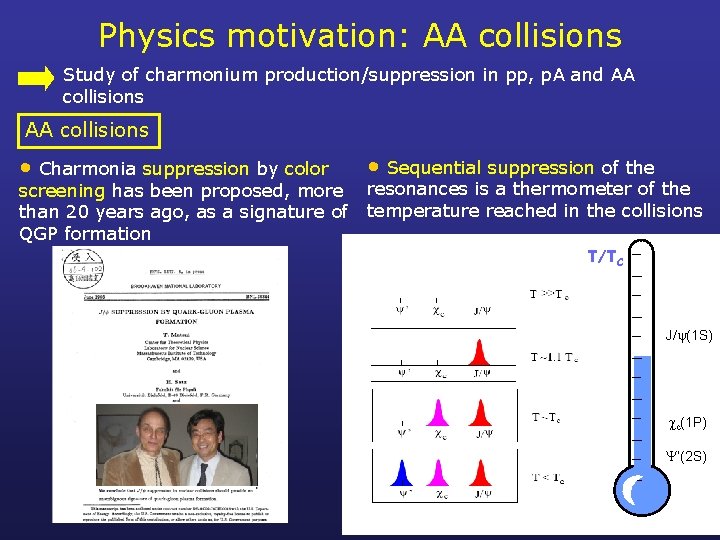
Physics motivation: AA collisions Study of charmonium production/suppression in pp, p. A and AA collisions • Charmonia suppression by color screening has been proposed, more than 20 years ago, as a signature of QGP formation • Sequential suppression of the resonances is a thermometer of the temperature reached in the collisions T/TC J/ (1 S) c(1 P) ’(2 S)
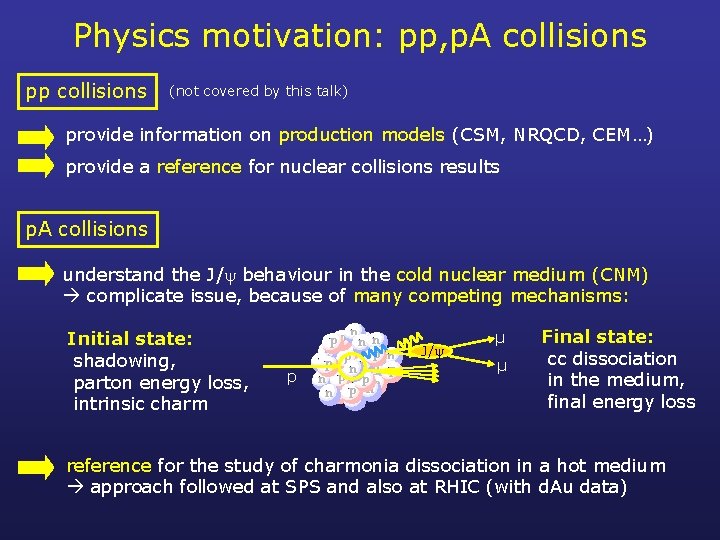
Physics motivation: pp, p. A collisions pp collisions (not covered by this talk) provide information on production models (CSM, NRQCD, CEM…) provide a reference for nuclear collisions results p. A collisions understand the J/ behaviour in the cold nuclear medium (CNM) complicate issue, because of many competing mechanisms: Initial state: shadowing, parton energy loss, intrinsic charm J/ p μ μ Final state: cc dissociation in the medium, final energy loss reference for the study of charmonia dissociation in a hot medium approach followed at SPS and also at RHIC (with d. Au data)
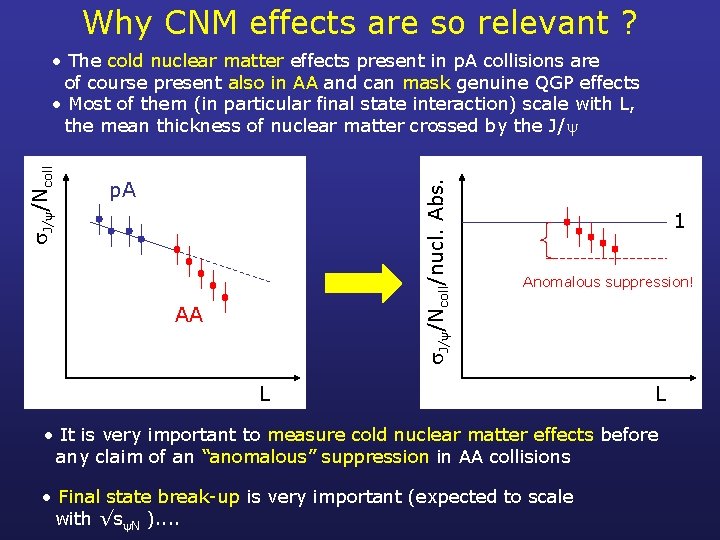
Why CNM effects are so relevant ? J/ /Ncoll/nucl. Abs. J/ /Ncoll • The cold nuclear matter effects present in p. A collisions are of course present also in AA and can mask genuine QGP effects • Most of them (in particular final state interaction) scale with L, the mean thickness of nuclear matter crossed by the J/ p. A AA 1 Anomalous suppression! L L • It is very important to measure cold nuclear matter effects before any claim of an “anomalous” suppression in AA collisions • Final state break-up is very important (expected to scale with √s N ). .
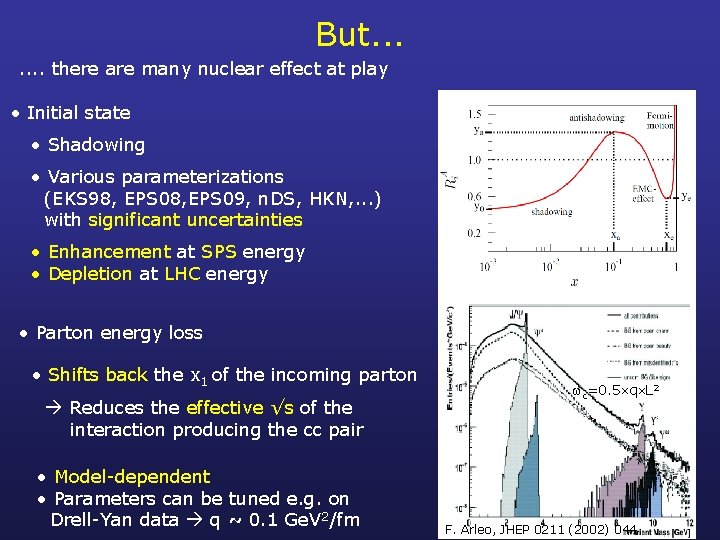
But. . . . there are many nuclear effect at play • Initial state • Shadowing • Various parameterizations (EKS 98, EPS 09, n. DS, HKN, . . . ) with significant uncertainties • Enhancement at SPS energy • Depletion at LHC energy • Parton energy loss • Shifts back the x 1 of the incoming parton Reduces the effective √s of the interaction producing the cc pair • Model-dependent • Parameters can be tuned e. g. on Drell-Yan data q ~ 0. 1 Ge. V 2/fm c=0. 5 q L 2 F. Arleo, JHEP 0211 (2002) 044
Fixed target experiments
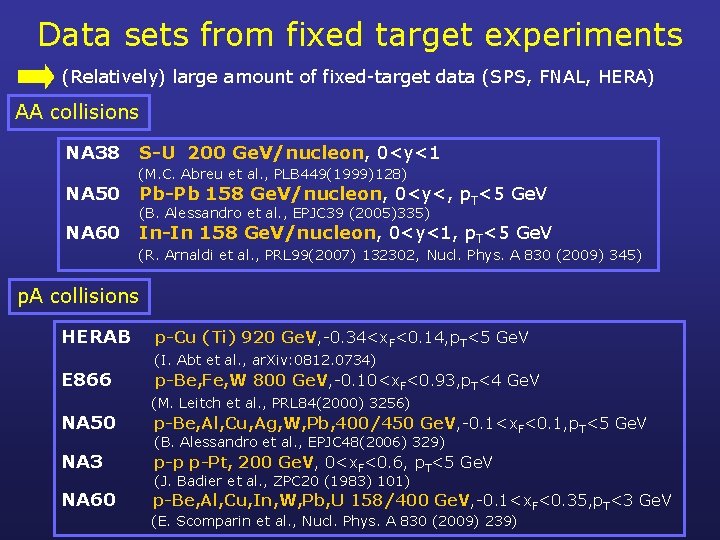
Data sets from fixed target experiments (Relatively) large amount of fixed-target data (SPS, FNAL, HERA) AA collisions NA 38 S-U 200 Ge. V/nucleon, 0<y<1 (M. C. Abreu et al. , PLB 449(1999)128) NA 50 NA 60 Pb-Pb 158 Ge. V/nucleon, 0<y<, p. T<5 Ge. V (B. Alessandro et al. , EPJC 39 (2005)335) In-In 158 Ge. V/nucleon, 0<y<1, p. T<5 Ge. V (R. Arnaldi et al. , PRL 99(2007) 132302, Nucl. Phys. A 830 (2009) 345) p. A collisions HERAB p-Cu (Ti) 920 Ge. V, -0. 34<x. F<0. 14, p. T<5 Ge. V (I. Abt et al. , ar. Xiv: 0812. 0734) E 866 p-Be, Fe, W 800 Ge. V, -0. 10<x. F<0. 93, p. T<4 Ge. V (M. Leitch et al. , PRL 84(2000) 3256) NA 50 p-Be, Al, Cu, Ag, W, Pb, 400/450 Ge. V, -0. 1<x. F<0. 1, p. T<5 Ge. V NA 3 p-p p-Pt, 200 Ge. V, 0<x. F<0. 6, p. T<5 Ge. V NA 60 p-Be, Al, Cu, In, W, Pb, U 158/400 Ge. V, -0. 1<x. F<0. 35, p. T<3 Ge. V (B. Alessandro et al. , EPJC 48(2006) 329) (J. Badier et al. , ZPC 20 (1983) 101) (E. Scomparin et al. , Nucl. Phys. A 830 (2009) 239)
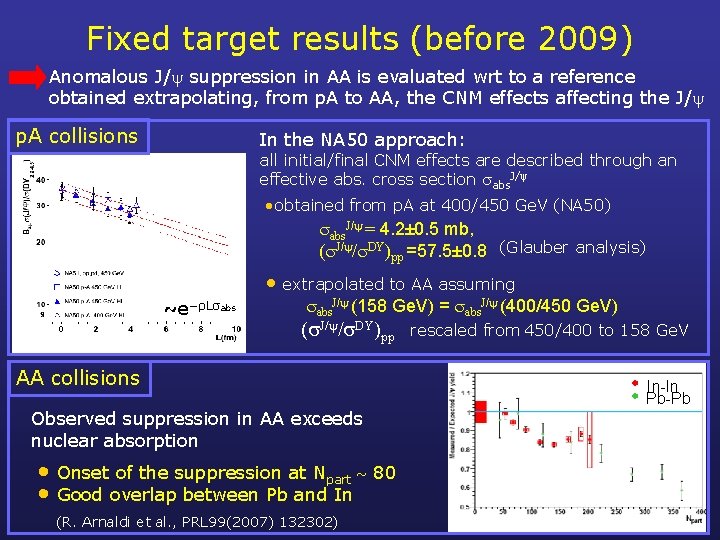
Fixed target results (before 2009) Anomalous J/ suppression in AA is evaluated wrt to a reference obtained extrapolating, from p. A to AA, the CNM effects affecting the J/ p. A collisions In the NA 50 approach: all initial/final CNM effects are described through an effective abs. cross section abs. J/ • obtained from p. A at 400/450 Ge. V (NA 50) abs. J/ = 4. 2± 0. 5 mb, ( J/ / DY)pp =57. 5± 0. 8 (Glauber analysis) • extrapolated to AA assuming ~e−ρLσabs abs. J/ (158 Ge. V) = abs. J/ (400/450 Ge. V) ( J/ / DY)pp AA collisions Observed suppression in AA exceeds nuclear absorption • Onset of the suppression at Npart 80 • Good overlap between Pb and In (R. Arnaldi et al. , PRL 99(2007) 132302) rescaled from 450/400 to 158 Ge. V In-In Pb-Pb
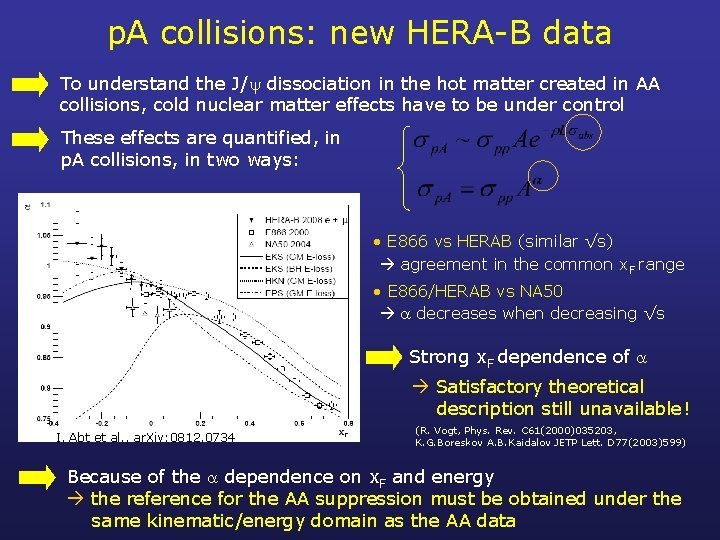
p. A collisions: new HERA-B data To understand the J/ dissociation in the hot matter created in AA collisions, cold nuclear matter effects have to be under control These effects are quantified, in p. A collisions, in two ways: • E 866 vs HERAB (similar √s) agreement in the common x. F range • E 866/HERAB vs NA 50 decreases when decreasing √s Strong x. F dependence of Satisfactory theoretical description still unavailable! I. Abt et al. , ar. Xiv: 0812. 0734 (R. Vogt, Phys. Rev. C 61(2000)035203, K. G. Boreskov A. B. Kaidalov JETP Lett. D 77(2003)599) Because of the dependence on x. F and energy the reference for the AA suppression must be obtained under the same kinematic/energy domain as the AA data
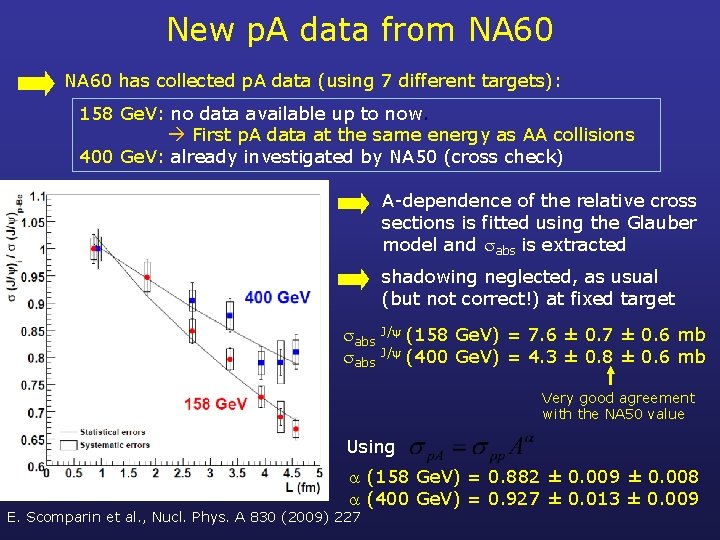
New p. A data from NA 60 has collected p. A data (using 7 different targets): 158 Ge. V: no data available up to now. First p. A data at the same energy as AA collisions 400 Ge. V: already investigated by NA 50 (cross check) A-dependence of the relative cross sections is fitted using the Glauber model and abs is extracted shadowing neglected, as usual (but not correct!) at fixed target abs J/ J/ (158 Ge. V) = 7. 6 ± 0. 7 ± 0. 6 mb (400 Ge. V) = 4. 3 ± 0. 8 ± 0. 6 mb Very good agreement with the NA 50 value Using (158 Ge. V) = 0. 882 ± 0. 009 ± 0. 008 (400 Ge. V) = 0. 927 ± 0. 013 ± 0. 009 E. Scomparin et al. , Nucl. Phys. A 830 (2009) 227
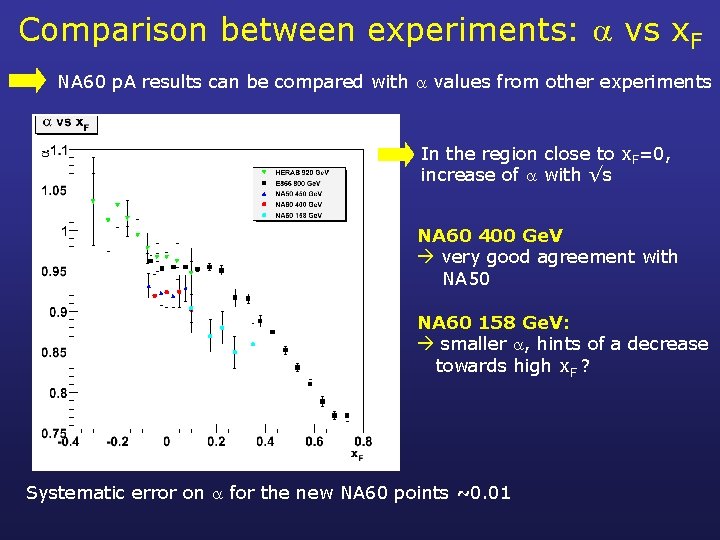
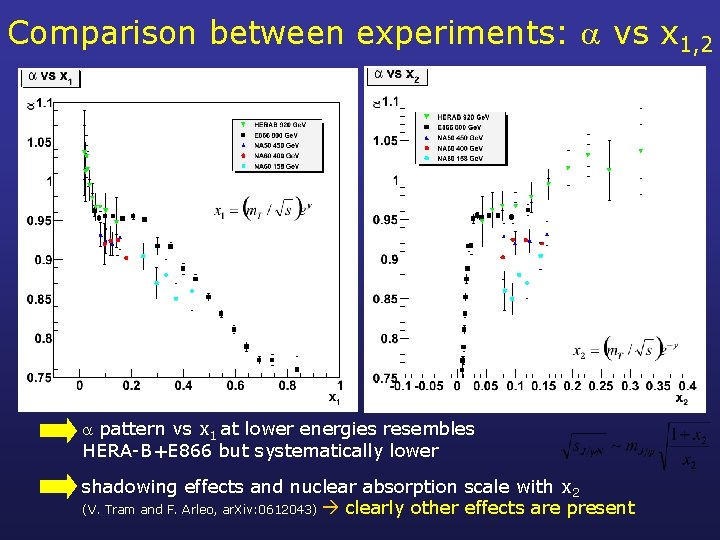
Comparison between experiments: vs x. F NA 60 p. A results can be compared with values from other experiments In the region close to x. F=0, increase of with √s NA 60 400 Ge. V very good agreement with NA 50 NA 60 158 Ge. V: smaller , hints of a decrease towards high x. F ? Systematic error on for the new NA 60 points ~0. 01
Comparison between experiments: vs x 1, 2 pattern vs x 1 at lower energies resembles HERA-B+E 866 but systematically lower shadowing effects and nuclear absorption scale with x 2 (V. Tram and F. Arleo, ar. Xiv: 0612043) clearly other effects are present
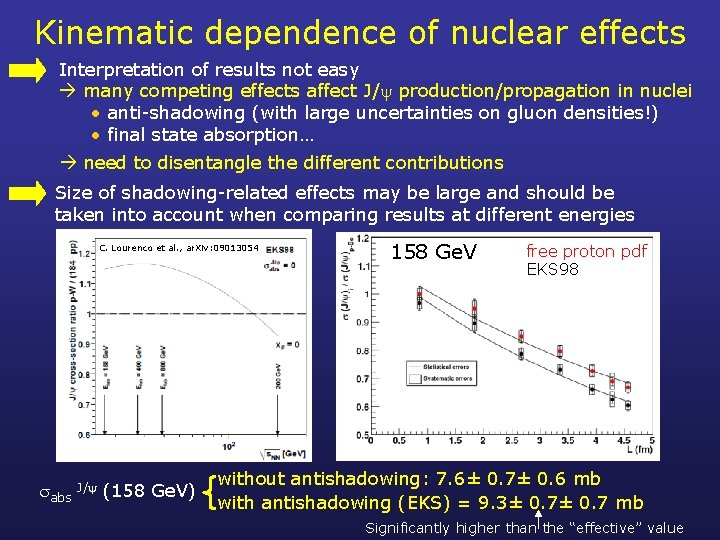
Kinematic dependence of nuclear effects Interpretation of results not easy many competing effects affect J/ production/propagation in nuclei • anti-shadowing (with large uncertainties on gluon densities!) • final state absorption… need to disentangle the different contributions Size of shadowing-related effects may be large and should be taken into account when comparing results at different energies C. Lourenco et al. , ar. Xiv: 09013054 abs J/ (158 Ge. V) 158 Ge. V free proton pdf EKS 98 without antishadowing: 7. 6± 0. 7± 0. 6 mb with antishadowing (EKS) = 9. 3± 0. 7 mb Significantly higher than the “effective” value
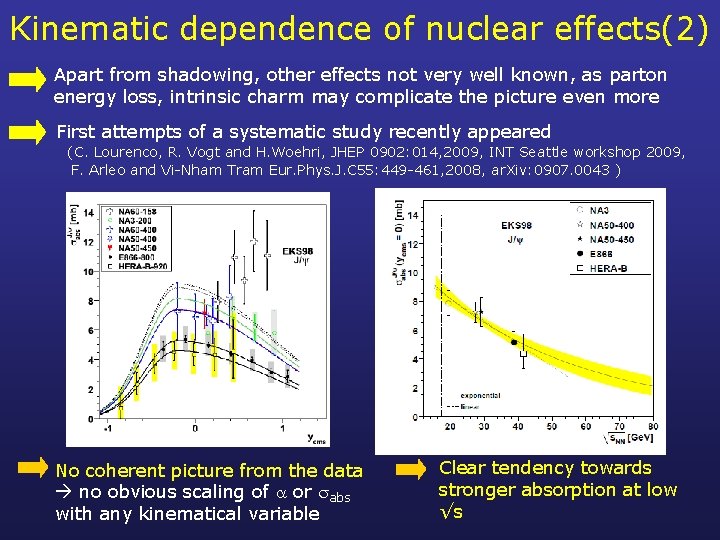
Kinematic dependence of nuclear effects(2) Apart from shadowing, other effects not very well known, as parton energy loss, intrinsic charm may complicate the picture even more First attempts of a systematic study recently appeared (C. Lourenco, R. Vogt and H. Woehri, JHEP 0902: 014, 2009, INT Seattle workshop 2009, F. Arleo and Vi-Nham Tram Eur. Phys. J. C 55: 449 -461, 2008, ar. Xiv: 0907. 0043 ) No coherent picture from the data no obvious scaling of or abs with any kinematical variable Clear tendency towards stronger absorption at low √s
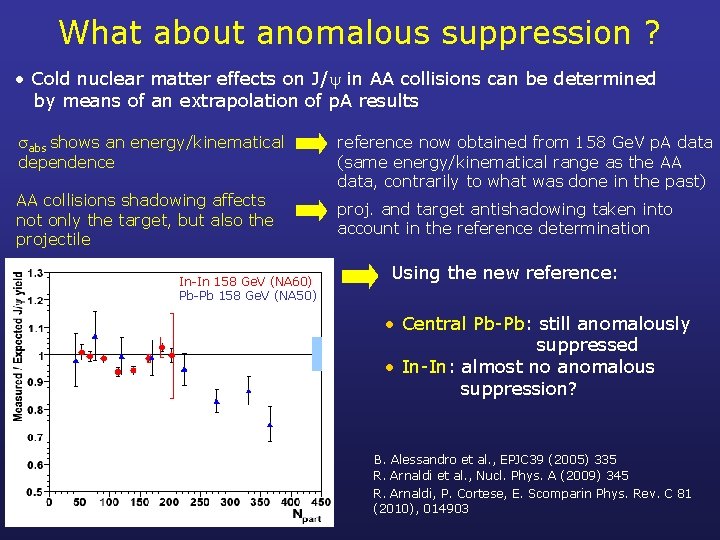
What about anomalous suppression ? • Cold nuclear matter effects on J/ in AA collisions can be determined by means of an extrapolation of p. A results abs shows an energy/kinematical dependence AA collisions shadowing affects not only the target, but also the projectile In-In 158 Ge. V (NA 60) Pb-Pb 158 Ge. V (NA 50) reference now obtained from 158 Ge. V p. A data (same energy/kinematical range as the AA data, contrarily to what was done in the past) proj. and target antishadowing taken into account in the reference determination Using the new reference: • Central Pb-Pb: still anomalously suppressed • In-In: almost no anomalous suppression? B. Alessandro et al. , EPJC 39 (2005) 335 R. Arnaldi et al. , Nucl. Phys. A (2009) 345 R. Arnaldi, P. Cortese, E. Scomparin Phys. Rev. C 81 (2010), 014903
Collider experiments: RHIC
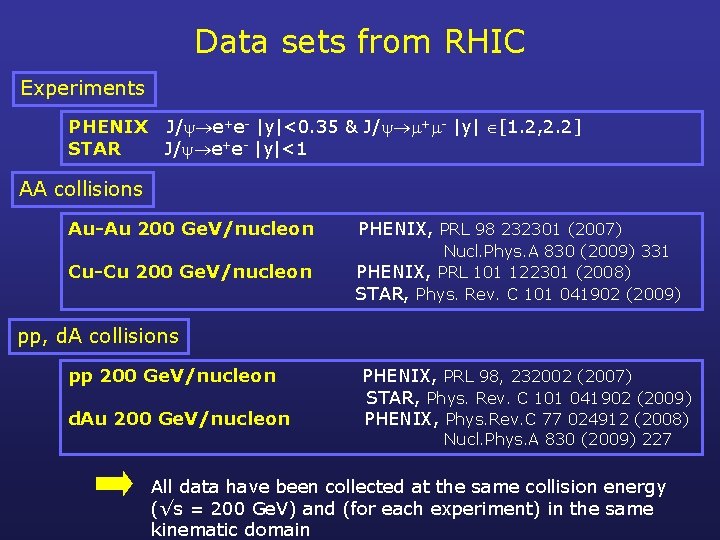
Data sets from RHIC Experiments PHENIX J/ e+e- |y|<0. 35 & J/ + - |y| [1. 2, 2. 2] STAR J/ e+e- |y|<1 AA collisions Au-Au 200 Ge. V/nucleon PHENIX, PRL 98 232301 (2007) Cu-Cu 200 Ge. V/nucleon Nucl. Phys. A 830 (2009) 331 PHENIX, PRL 101 122301 (2008) STAR, Phys. Rev. C 101 041902 (2009) pp, d. A collisions pp 200 Ge. V/nucleon d. Au 200 Ge. V/nucleon PHENIX, PRL 98, 232002 (2007) STAR, Phys. Rev. C 101 041902 (2009) PHENIX, Phys. Rev. C 77 024912 (2008) Nucl. Phys. A 830 (2009) 227 All data have been collected at the same collision energy (√s = 200 Ge. V) and (for each experiment) in the same kinematic domain
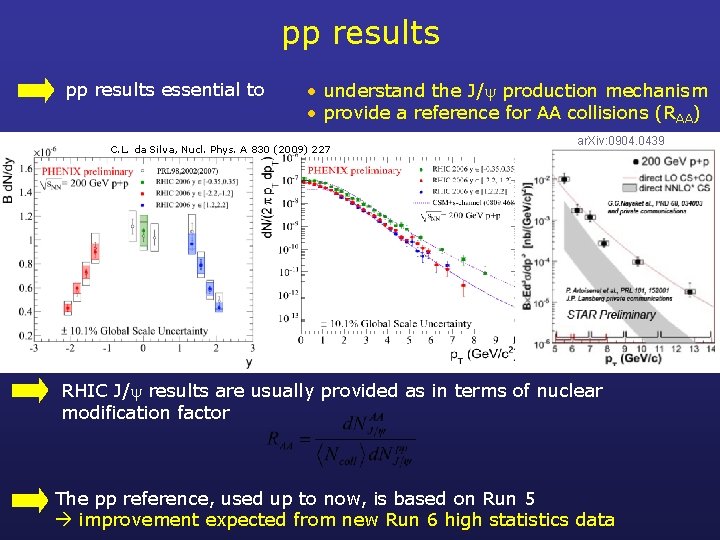
pp results essential to • understand the J/ production mechanism • provide a reference for AA collisions (RAA) C. L. da Silva, Nucl. Phys. A 830 (2009) 227 ar. Xiv: 0904. 0439 RHIC J/ results are usually provided as in terms of nuclear modification factor The pp reference, used up to now, is based on Run 5 improvement expected from new Run 6 high statistics data
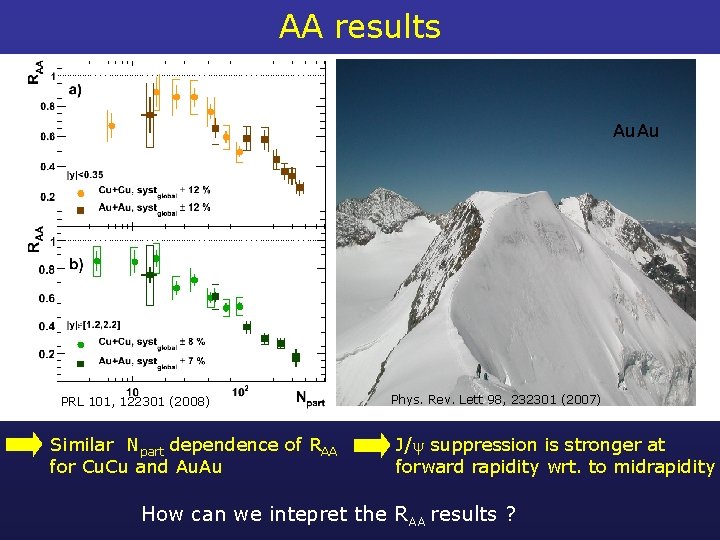
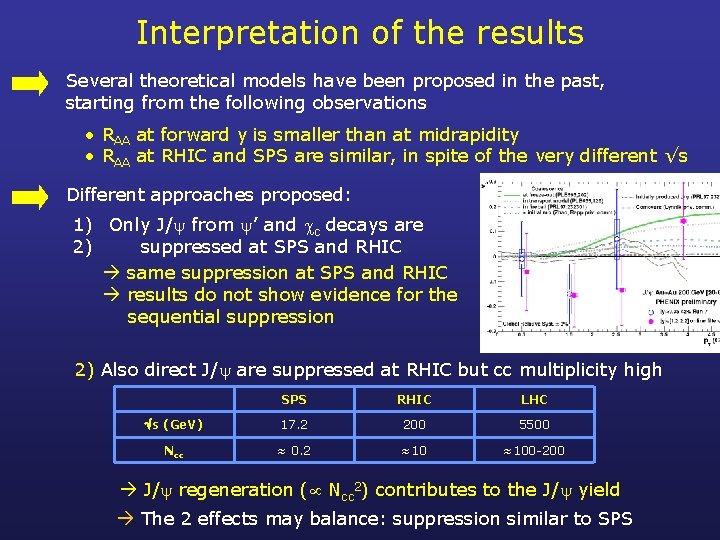
AA results Au. Au PRL 101, 122301 (2008) Similar Npart dependence of RAA for Cu. Cu and Au. Au Phys. Rev. Lett 98, 232301 (2007) J/ suppression is stronger at forward rapidity wrt. to midrapidity How can we intepret the RAA results ?
Interpretation of the results Several theoretical models have been proposed in the past, starting from the following observations • RAA at forward y is smaller than at midrapidity • RAA at RHIC and SPS are similar, in spite of the very different √s Different approaches proposed: 1) Only J/ from ’ and c decays are 2) suppressed at SPS and RHIC same suppression at SPS and RHIC results do not show evidence for the sequential suppression 2) Also direct J/ are suppressed at RHIC but cc multiplicity high SPS RHIC LHC s (Ge. V) 17. 2 200 5500 Ncc ≈ 0. 2 ≈100 -200 J/ regeneration ( Ncc 2) contributes to the J/ yield The 2 effects may balance: suppression similar to SPS
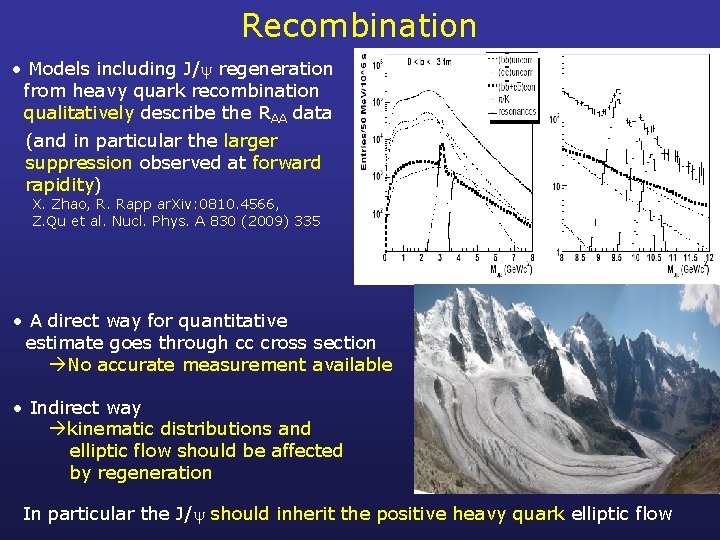
Recombination • Models including J/ regeneration from heavy quark recombination qualitatively describe the RAA data (and in particular the larger suppression observed at forward rapidity) X. Zhao, R. Rapp ar. Xiv: 0810. 4566, Z. Qu et al. Nucl. Phys. A 830 (2009) 335 • A direct way for quantitative estimate goes through cc cross section No accurate measurement available • Indirect way kinematic distributions and elliptic flow should be affected by regeneration In particular the J/ should inherit the positive heavy quark elliptic flow
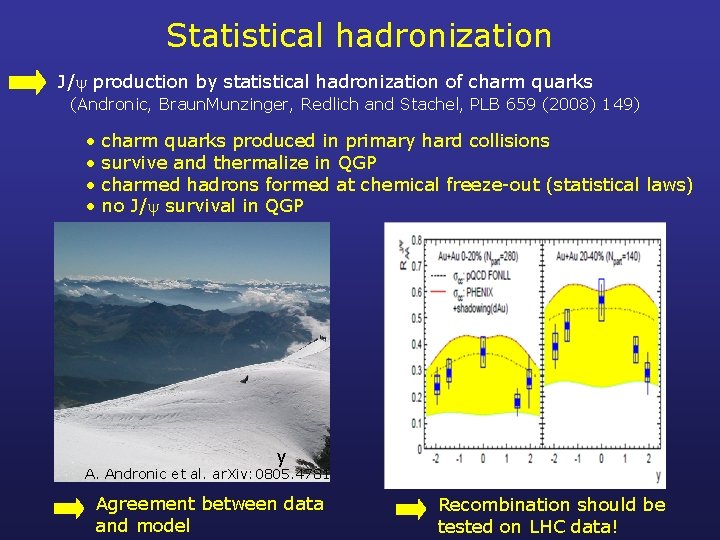
Statistical hadronization J/ production by statistical hadronization of charm quarks (Andronic, Braun. Munzinger, Redlich and Stachel, PLB 659 (2008) 149) • • charm quarks produced in primary hard collisions survive and thermalize in QGP charmed hadrons formed at chemical freeze-out (statistical laws) no J/ survival in QGP y A. Andronic et al. ar. Xiv: 0805. 4781 Agreement between data and model Recombination should be tested on LHC data!
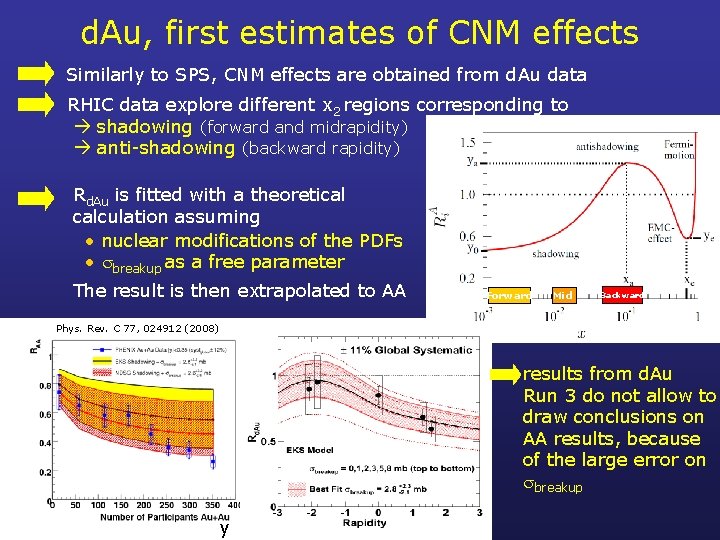
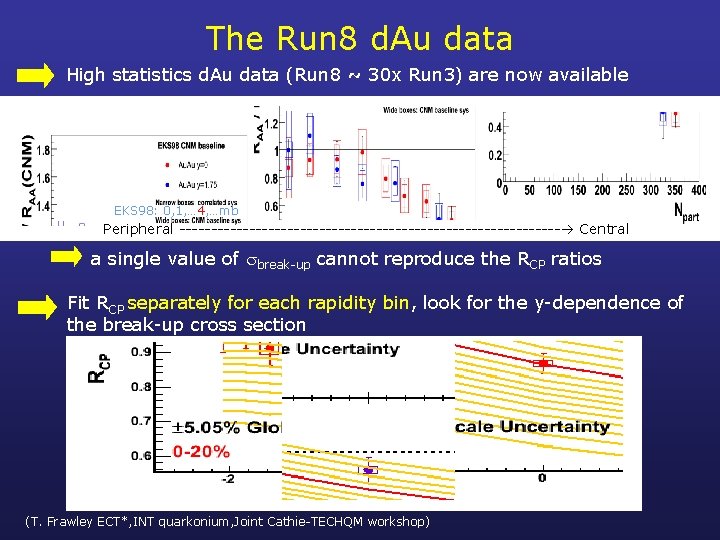
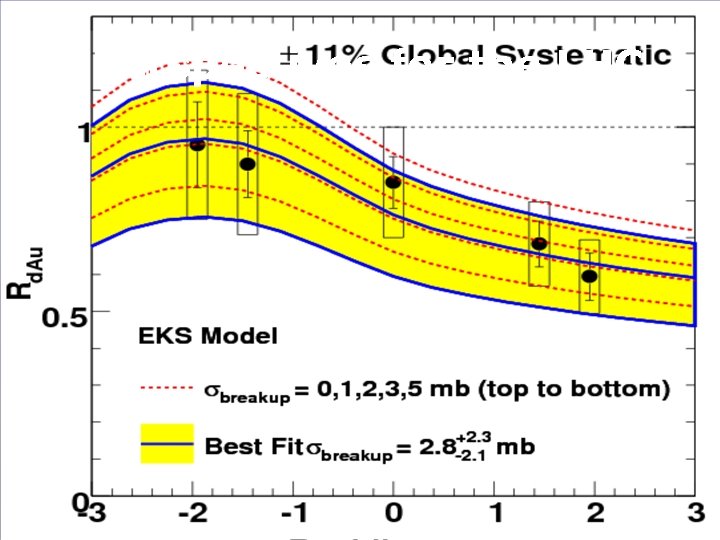
d. Au, first estimates of CNM effects Similarly to SPS, CNM effects are obtained from d. Au data RHIC data explore different x 2 regions corresponding to shadowing (forward and midrapidity) anti-shadowing (backward rapidity) Rd. Au is fitted with a theoretical calculation assuming • nuclear modifications of the PDFs • breakup as a free parameter The result is then extrapolated to AA Forward Mid Backward Phys. Rev. C 77, 024912 (2008) results from d. Au Run 3 do not allow to draw conclusions on AA results, because of the large error on breakup y
The Run 8 d. Au data High statistics d. Au data (Run 8 ~ 30 x Run 3) are now available EKS 98: 0, 1, … 4, …mb Peripheral ------------------------------ Central a single value of break-up cannot reproduce the RCP ratios Fit RCP separately for each rapidity bin, look for the y-dependence of the break-up cross section (T. Frawley ECT*, INT quarkonium, Joint Cathie-TECHQM workshop)
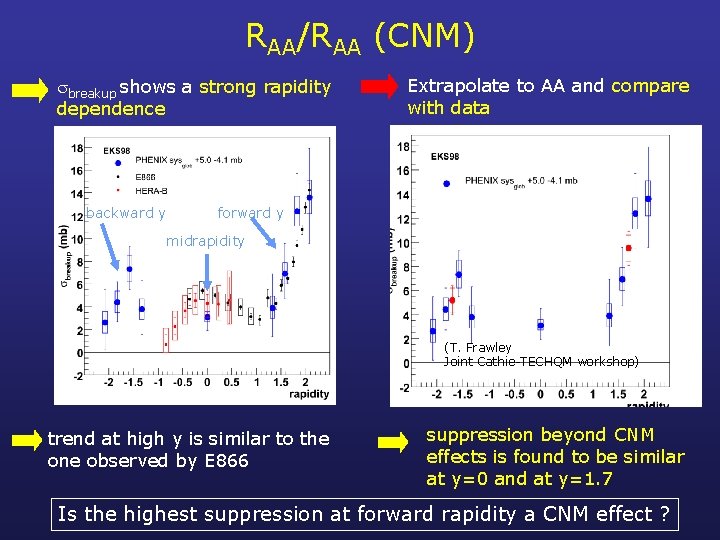
RAA/RAA (CNM) breakup shows a strong rapidity dependence backward y Extrapolate to AA and compare with data forward y midrapidity (T. Frawley Joint Cathie-TECHQM workshop) trend at high y is similar to the one observed by E 866 suppression beyond CNM effects is found to be similar at y=0 and at y=1. 7 Is the highest suppression at forward rapidity a CNM effect ?
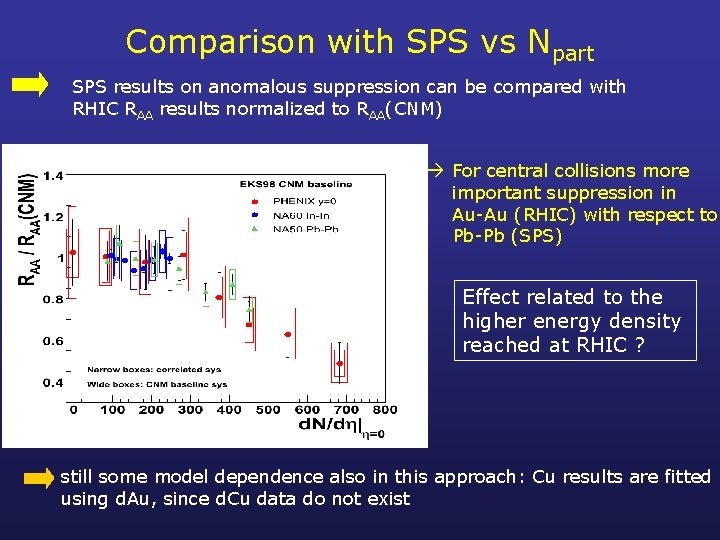
Comparison with SPS vs Npart SPS results on anomalous suppression can be compared with RHIC RAA results normalized to RAA(CNM) For central collisions more important suppression in Au-Au (RHIC) with respect to Pb-Pb (SPS) Effect related to the higher energy density reached at RHIC ? still some model dependence also in this approach: Cu results are fitted using d. Au, since d. Cu data do not exist
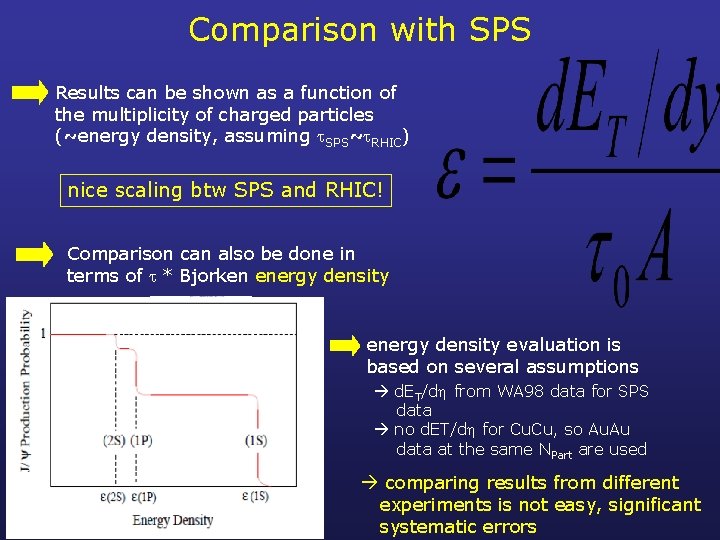
Comparison with SPS Results can be shown as a function of the multiplicity of charged particles (~energy density, assuming SPS~ RHIC) nice scaling btw SPS and RHIC! Comparison can also be done in terms of * Bjorken energy density evaluation is based on several assumptions d. ET/d from WA 98 data for SPS data no d. ET/d for Cu. Cu, so Au. Au data at the same NPart are used comparing results from different experiments is not easy, significant systematic errors
Perspectives for the LHC
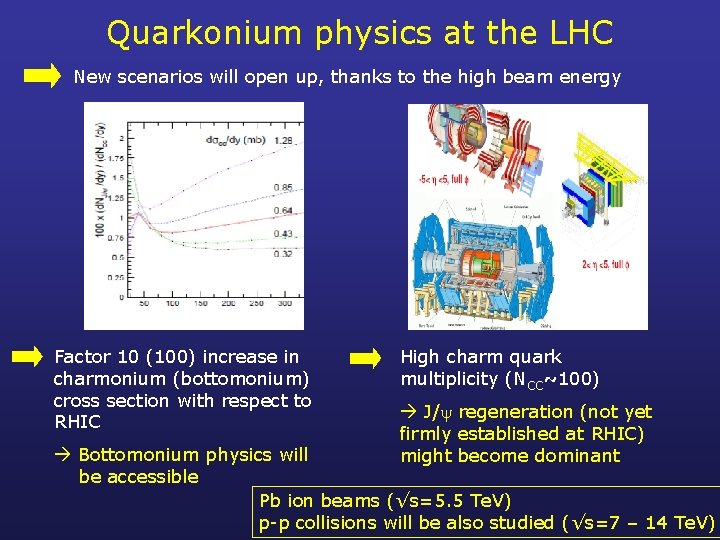
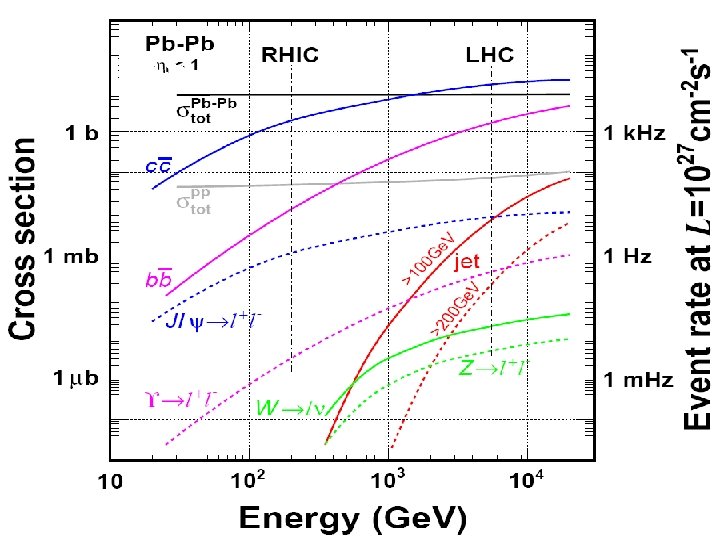
Quarkonium physics at the LHC New scenarios will open up, thanks to the high beam energy Factor 10 (100) increase in charmonium (bottomonium) cross section with respect to RHIC High charm quark multiplicity (NCC~100) J/ regeneration (not yet firmly established at RHIC) might become dominant Bottomonium physics will be accessible Pb ion beams (√s=5. 5 Te. V) p-p collisions will be also studied (√s=7 – 14 Te. V)
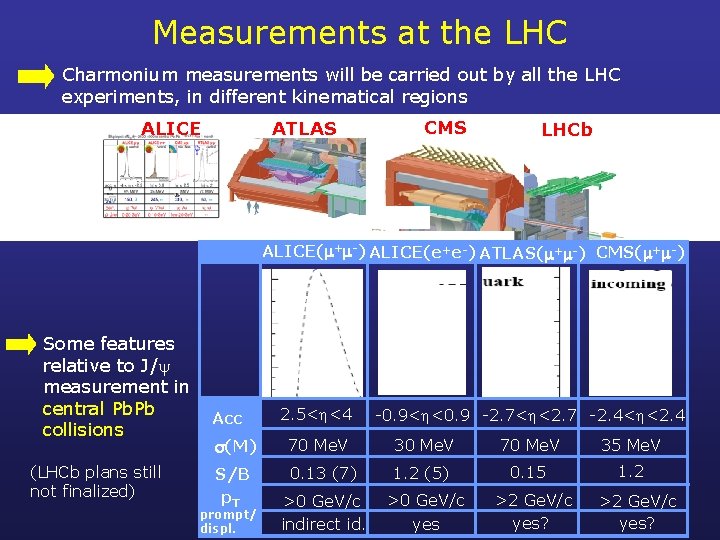
Measurements at the LHC Charmonium measurements will be carried out by all the LHC experiments, in different kinematical regions ATLAS ALICE CMS LHCb ALICE( + -) ALICE(e+e-) ATLAS( + -) CMS( + -) Some features relative to J/ measurement in central Pb. Pb collisions (LHCb plans still not finalized) Acc 2. 5< <4 -0. 9< <0. 9 -2. 7< <2. 7 -2. 4< <2. 4 (M) 70 Me. V 30 Me. V 70 Me. V 35 Me. V S/B p. T 0. 13 (7) 1. 2 (5) 0. 15 1. 2 prompt/ displ. >0 Ge. V/c indirect id. >0 Ge. V/c yes >2 Ge. V/c yes?
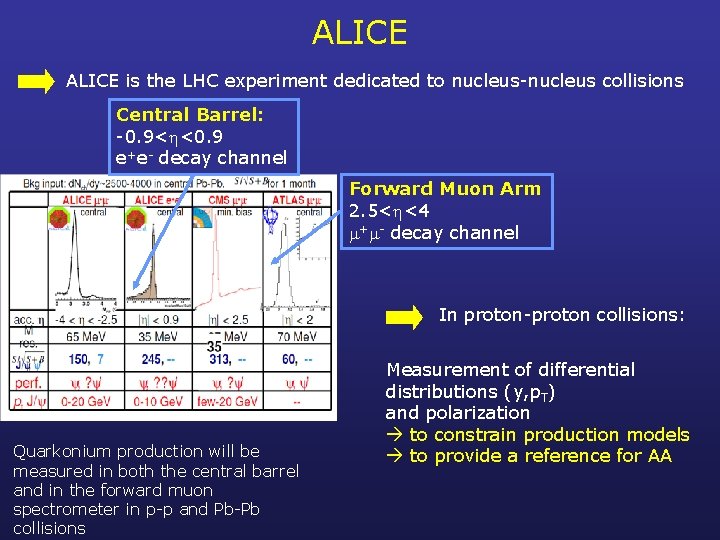
ALICE is the LHC experiment dedicated to nucleus-nucleus collisions Central Barrel: -0. 9< <0. 9 e+e- decay channel Forward Muon Arm 2. 5< <4 + - decay channel In proton-proton collisions: Quarkonium production will be measured in both the central barrel and in the forward muon spectrometer in p-p and Pb-Pb collisions Measurement of differential distributions (y, p. T) and polarization to constrain production models to provide a reference for AA
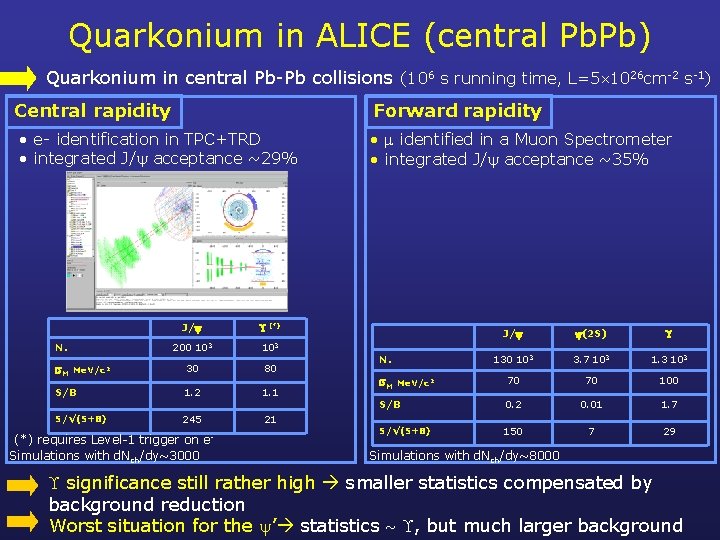
Quarkonium in ALICE (central Pb. Pb) Quarkonium in central Pb-Pb collisions (106 s running time, L=5 1026 cm-2 s-1) Central rapidity Forward rapidity • e- identification in TPC+TRD • integrated J/ acceptance ~29% J/ N. (*) 200 103 M Me. V/c 2 30 80 S/B 1. 2 1. 1 S/√(S+B) 245 21 (*) requires Level-1 trigger on e. Simulations with d. Nch/dy~3000 • identified in a Muon Spectrometer • integrated J/ acceptance ~35% J/ (2 S) 130 103 3. 7 103 1. 3 103 M Me. V/c 2 70 70 100 S/B 0. 2 0. 01 1. 7 S/√(S+B) 150 7 29 N. Simulations with d. Nch/dy~8000 significance still rather high smaller statistics compensated by background reduction Worst situation for the ’ statistics , but much larger background
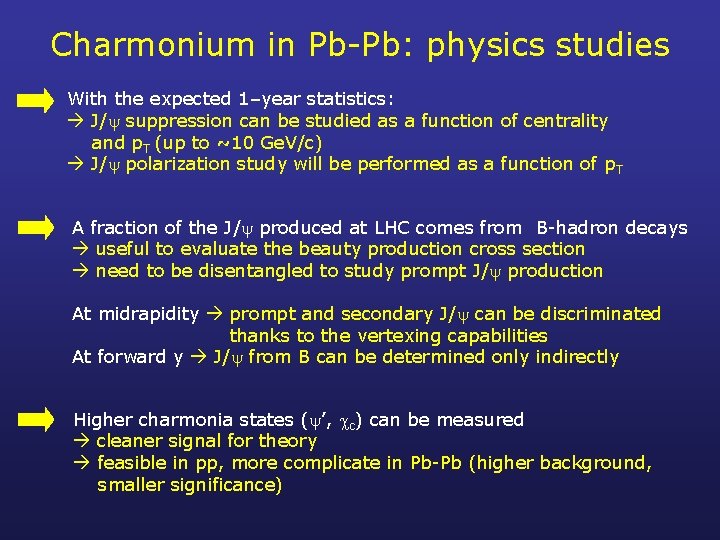
Charmonium in Pb-Pb: physics studies With the expected 1–year statistics: J/ suppression can be studied as a function of centrality and p. T (up to ~10 Ge. V/c) J/ polarization study will be performed as a function of p. T A fraction of the J/ produced at LHC comes from B-hadron decays useful to evaluate the beauty production cross section need to be disentangled to study prompt J/ production At midrapidity prompt and secondary J/ can be discriminated thanks to the vertexing capabilities At forward y J/ from B can be determined only indirectly Higher charmonia states ( ’, c) can be measured cleaner signal for theory feasible in pp, more complicate in Pb-Pb (higher background, smaller significance)
First dimuons in ALICE! First dimuons have been seen in ALICE in pp collisions at √s=900 Ge. V, even if … not yet a J/ !
Conclusions • J/ suppression is a good observable for QGP studies but for a correct evaluation of anomalous effects, cold nuclear matter effects have to be under control J/ behaviour in cold nuclear matter is already a complicate issue: many competing initial/final state effects Many steps forward thanks to new high precision data • An anomalous J/ suppression has been observed at both SPS and RHIC Important to understand J/ behaviour from lower to higher energy in a coherent scenario • New data at LHC energy will soon be available! They will help to discriminate among the different processes (suppression, regeneration…) affecting the J/ • In the future, the “J/ picture” will be further sharpened by the results from CBM, exploring high baryon-density matter, and (hopefully) also from an NA 60 -like experiment filling the gap between FAIR and top SPS energy
Thanks !!!
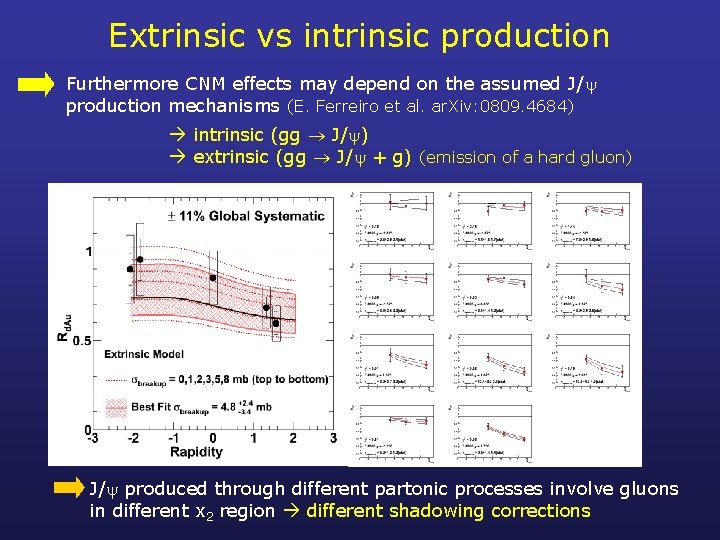
Extrinsic vs intrinsic production Furthermore CNM effects may depend on the assumed J/ production mechanisms (E. Ferreiro et al. ar. Xiv: 0809. 4684) intrinsic (gg J/ ) extrinsic (gg J/ + g) (emission of a hard gluon) J/ produced through different partonic processes involve gluons in different x 2 region different shadowing corrections
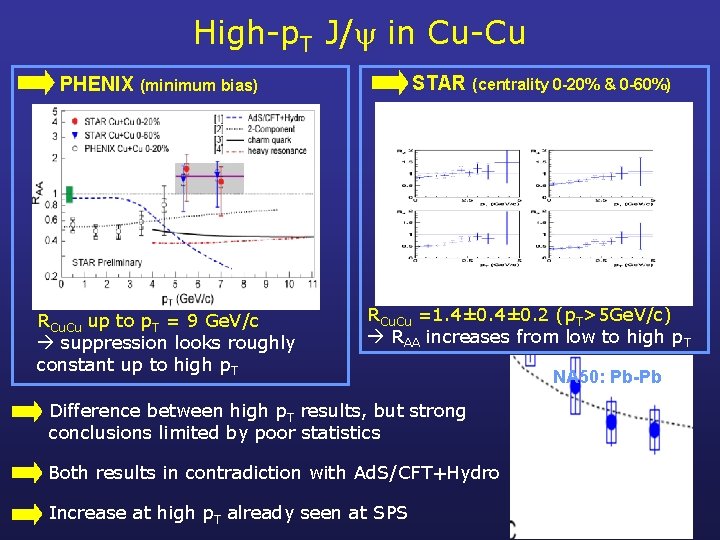
High-p. T J/ in Cu-Cu STAR (centrality 0 -20% & 0 -60%) PHENIX (minimum bias) RCu. Cu up to p. T = 9 Ge. V/c suppression looks roughly constant up to high p. T RCu. Cu =1. 4± 0. 2 (p. T>5 Ge. V/c) RAA increases from low to high p. T Difference between high p. T results, but strong conclusions limited by poor statistics Both results in contradiction with Ad. S/CFT+Hydro Increase at high p. T already seen at SPS NA 50: Pb-Pb