
Charm baryon spectroscopy at Belle and possibilities in
Charm baryon spectroscopy at Belle and possibilities in future e+e- colliders Kiyoshi Tanida (Advanced Science Research Center, Japan Atomic Energy Agency) ECT* Workshop on The Charm and Beauty of Strong Interactions 18 July 2017

Contents •

Introduction – Heavy quark baryons • Heavy quark in Baryon – Bare quark ≒ constituent quark – Makes a “static core”, light quarks play around Diquark correlation enhanced? – New symmetry – heavy quark symmetry Hyperfine doublet for heavy quark spin. Nucleon Charmed baryon HQS: spin Approximately conserved Indistinguishable pairs Light di-quark with inert charm?
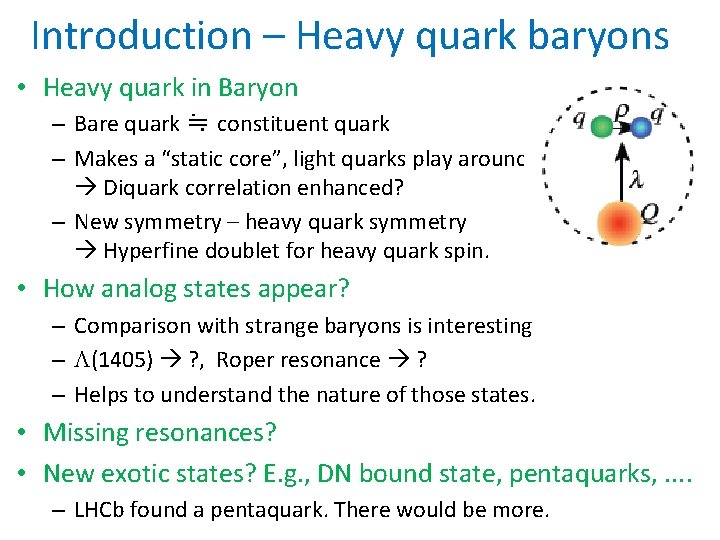
Introduction – Heavy quark baryons • Heavy quark in Baryon – Bare quark ≒ constituent quark – Makes a “static core”, light quarks play around Diquark correlation enhanced? – New symmetry – heavy quark symmetry Hyperfine doublet for heavy quark spin. • How analog states appear? – Comparison with strange baryons is interesting – (1405) ? , Roper resonance ? – Helps to understand the nature of those states. • Missing resonances? • New exotic states? E. g. , DN bound state, pentaquarks, . . – LHCb found a pentaquark. There would be more.

Belle experiment • √s~10. 6 Ge. V • Integrated Luminosity > 1 ab-1 Almost 4 , good momentum resolution (Dp/p~ 0. 1%), EM calorimeter, PID & Si Vertex detector

Charm production in B factory Production is flavor blind, only q 2 matters B is efficiently produced via U(4 s) C produced via fragmentation Once bottom is produced, it favorably decays into charm. BR(B CX)~ 5%
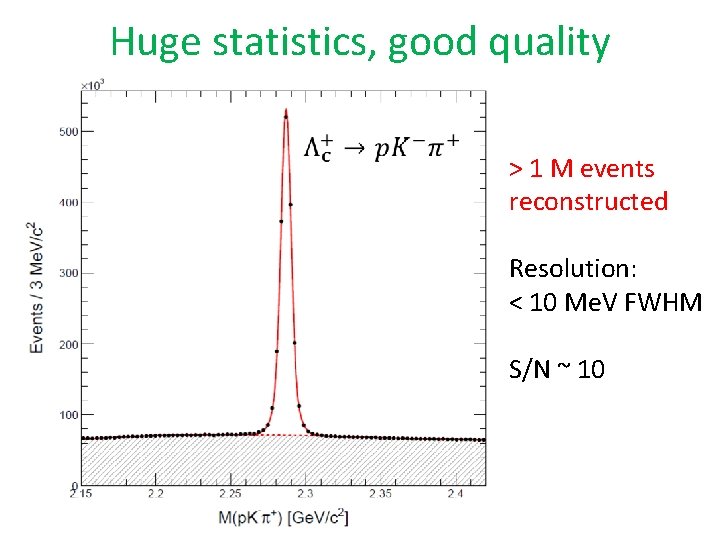
Huge statistics, good quality > 1 M events reconstructed Resolution: < 10 Me. V FWHM S/N ~ 10
I. Spectroscopy of c
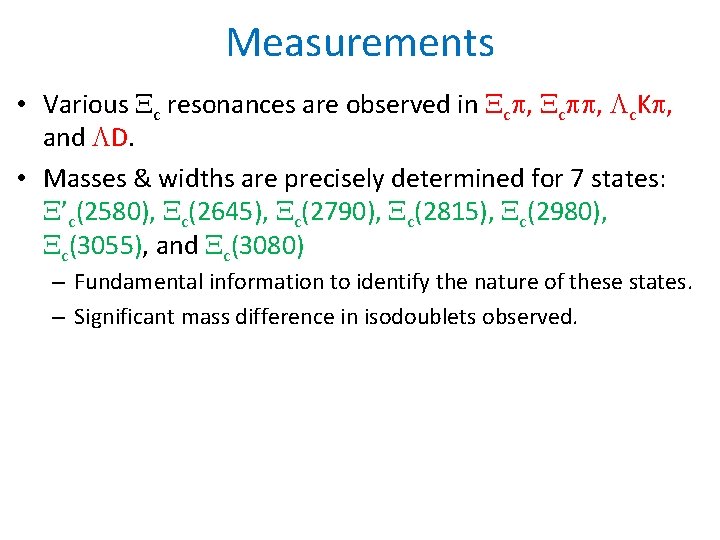
Measurements • Various c resonances are observed in c , c. K , and D. • Masses & widths are precisely determined for 7 states: ’c(2580), c(2645), c(2790), c(2815), c(2980), c(3055), and c(3080) – Fundamental information to identify the nature of these states. – Significant mass difference in isodoublets observed.
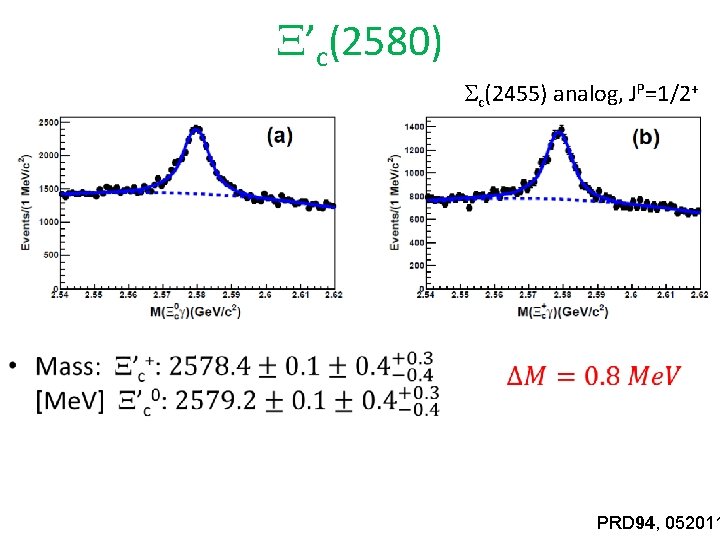
’c(2580) c(2455) analog, JP=1/2+ • PRD 94, 052011
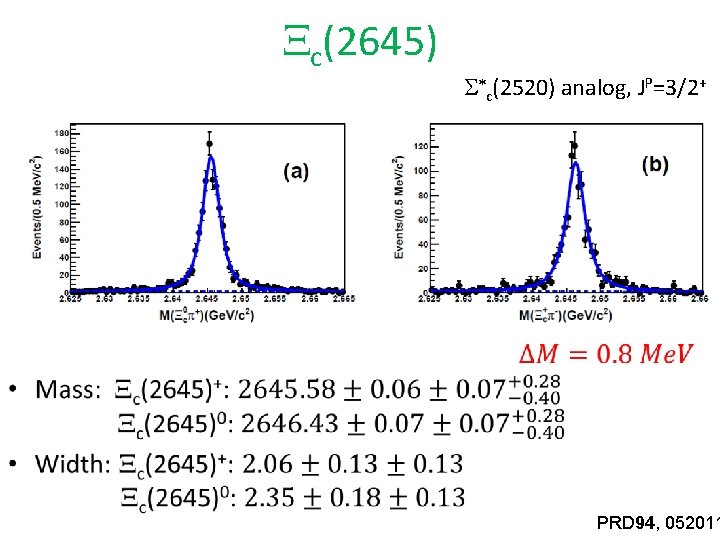
c(2645) *c(2520) analog, JP=3/2+ • PRD 94, 052011
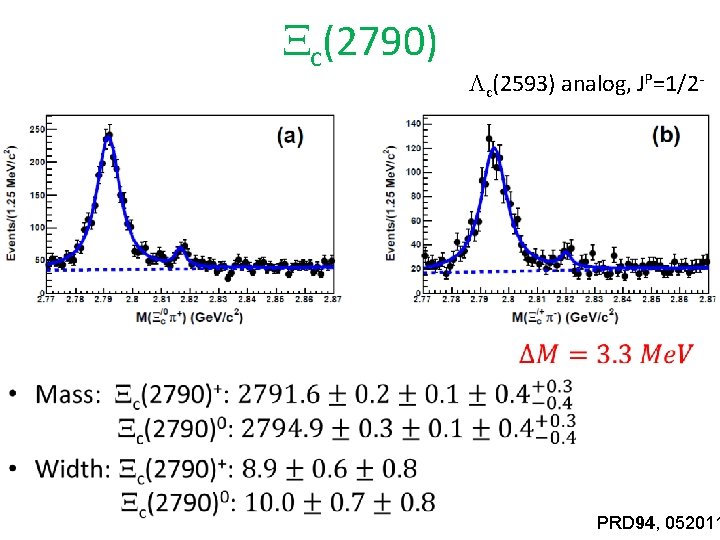
c(2790) c(2593) analog, JP=1/2 - • PRD 94, 052011
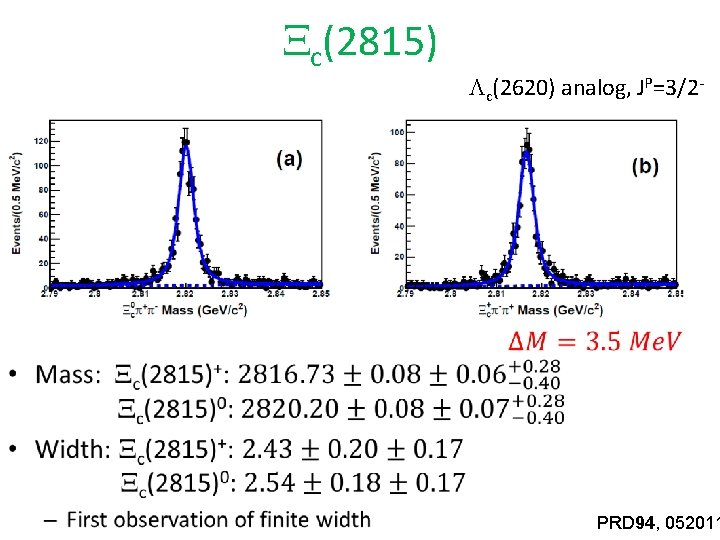
c(2815) c(2620) analog, JP=3/2 - • PRD 94, 052011
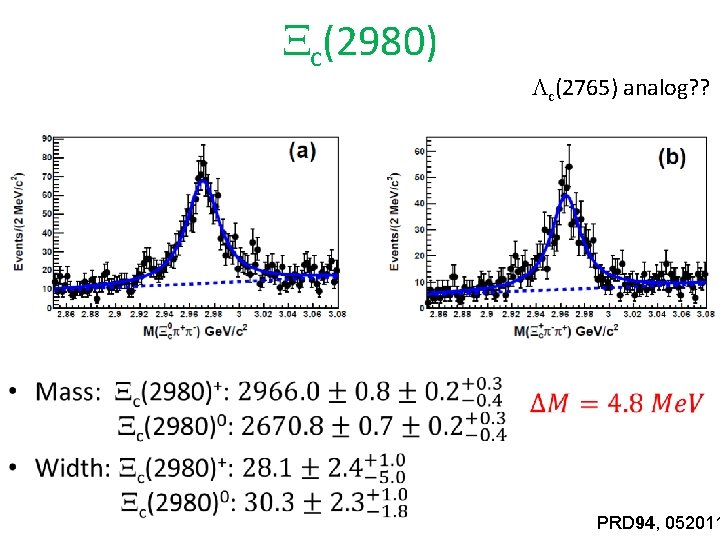
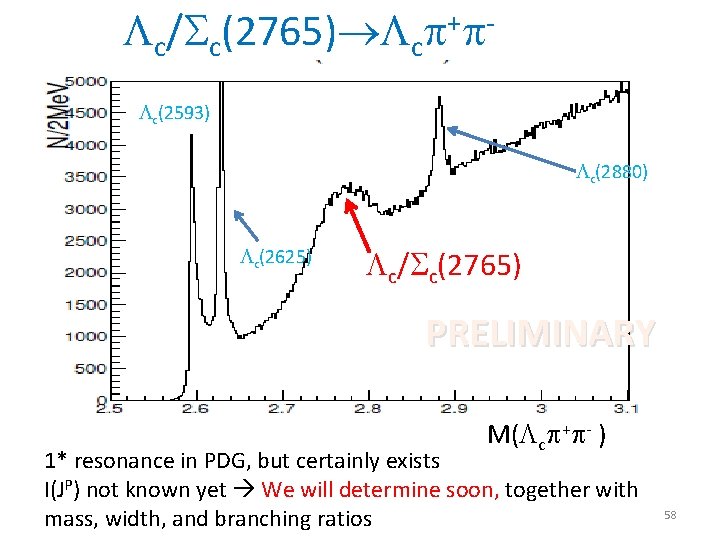
c(2980) • c(2765) analog? ? PRD 94, 052011
Measurements • Various c resonances are observed in c , c. K , and D. • Masses & widths are precisely determined for 7 states: ’c(2580), c(2645), c(2790), c(2815), c(2980), c(3055), and c(3080) • New observations in D mode: – c(3055)0 is newly discovered D modes are firstly observed for c(3055)+ and c(3080)+
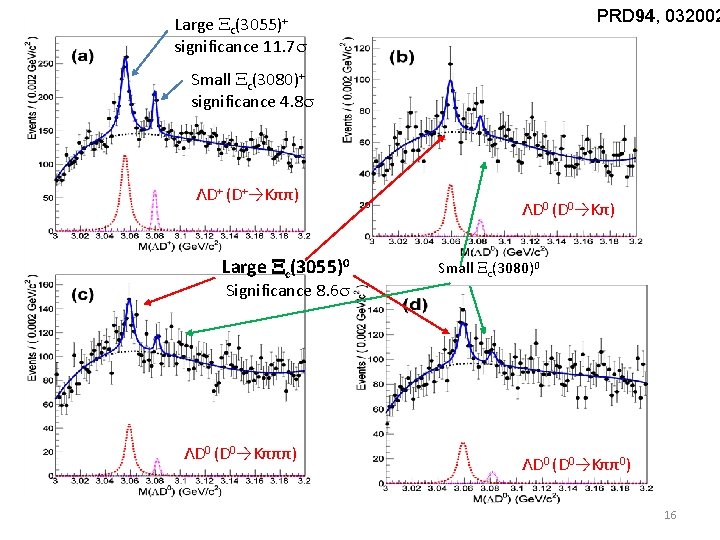
PRD 94, 032002 Large c(3055)+ significance 11. 7 s Small c(3080)+ significance 4. 8 s ΛD+ (D+→Kππ) Large c(3055)0 Significance 8. 6 s ΛD 0 (D 0→Kπππ) ΛD 0 (D 0→Kπ) Small c(3080)0 ΛD 0 (D 0→Kππ0) 16
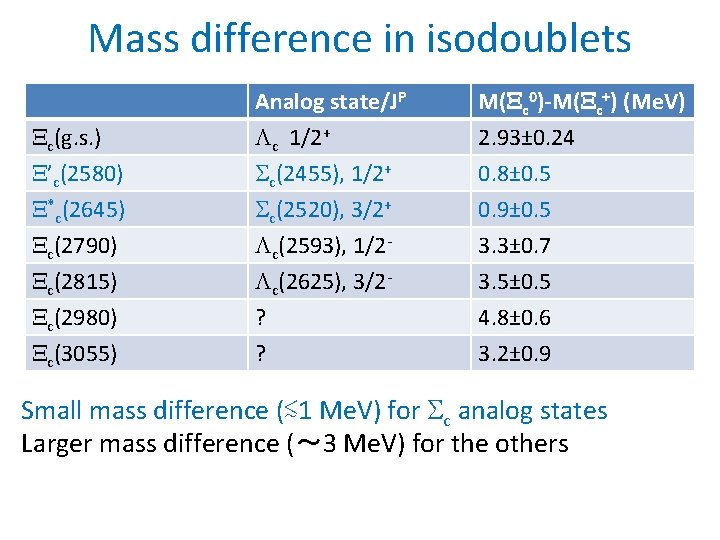
Mass difference in isodoublets c(g. s. ) ’c(2580) *c(2645) Analog state/JP c 1/2+ c(2455), 1/2+ c(2520), 3/2+ M( c 0)-M( c+) (Me. V) 2. 93± 0. 24 0. 8± 0. 5 0. 9± 0. 5 c(2790) c(2815) c(2980) c(3055) c(2593), 1/2 c(2625), 3/2? ? 3. 3± 0. 7 3. 5± 0. 5 4. 8± 0. 6 3. 2± 0. 9 Small mass difference (≲ 1 Me. V) for c analog states Larger mass difference (~ 3 Me. V) for the others
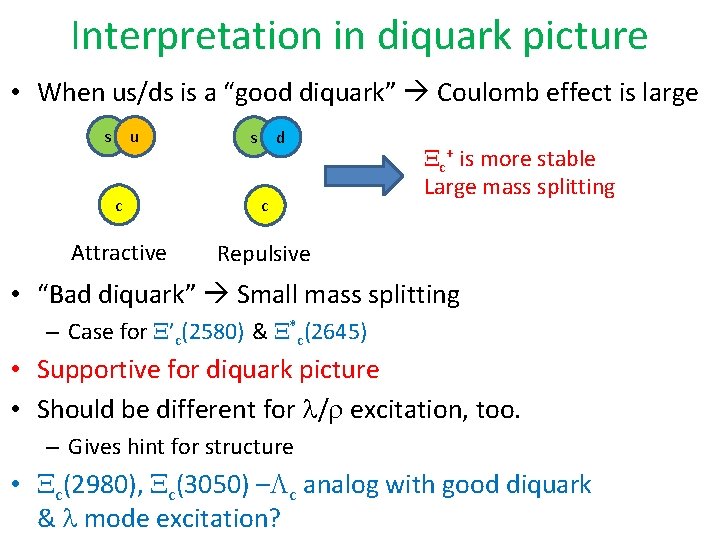
Interpretation in diquark picture • When us/ds is a “good diquark” Coulomb effect is large s u s d c c Attractive Repulsive c+ is more stable Large mass splitting • “Bad diquark” Small mass splitting – Case for ’c(2580) & *c(2645) • Supportive for diquark picture • Should be different for l/r excitation, too. – Gives hint for structure • c(2980), c(3050) – c analog with good diquark & l mode excitation?
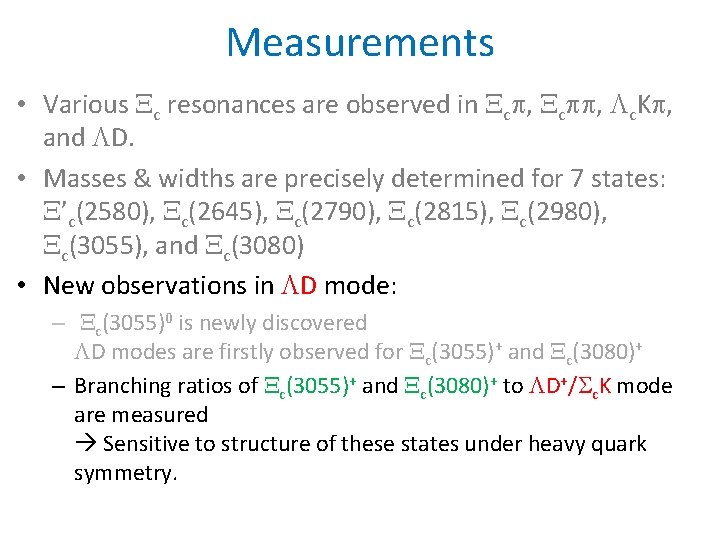
Measurements • Various c resonances are observed in c , c. K , and D. • Masses & widths are precisely determined for 7 states: ’c(2580), c(2645), c(2790), c(2815), c(2980), c(3055), and c(3080) • New observations in D mode: – c(3055)0 is newly discovered D modes are firstly observed for c(3055)+ and c(3080)+ – Branching ratios of c(3055)+ and c(3080)+ to D+/ c. K mode are measured Sensitive to structure of these states under heavy quark symmetry.
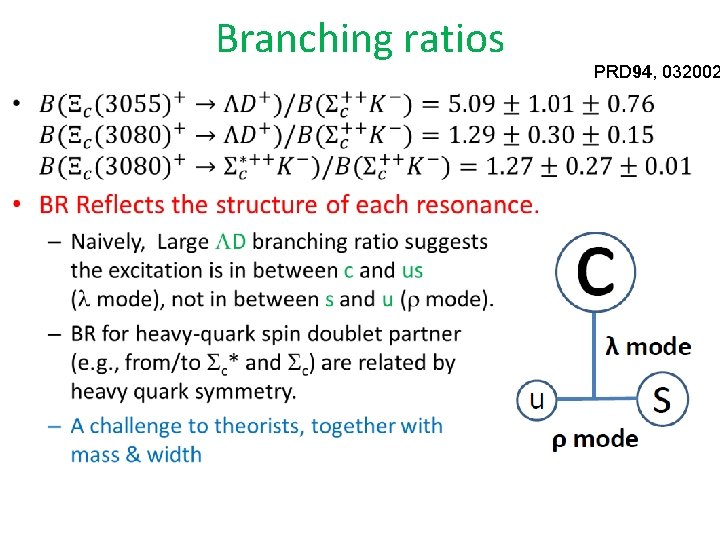
Branching ratios • PRD 94, 032002
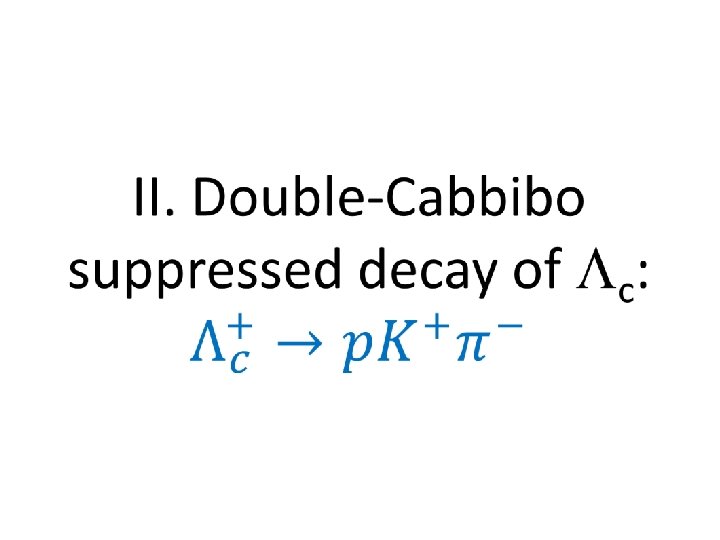
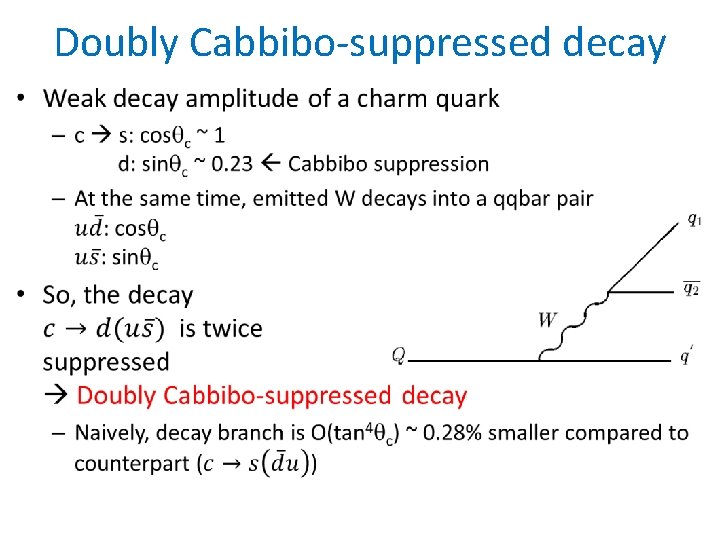
Doubly Cabbibo-suppressed decay •
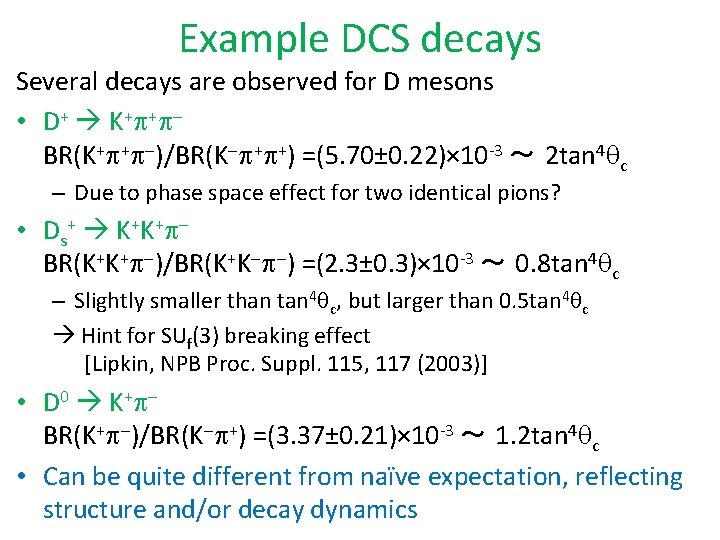
Example DCS decays Several decays are observed for D mesons • D + K + + BR(K+ + -)/BR(K- + +) =(5. 70± 0. 22)× 10 -3 ~ 2 tan 4 qc – Due to phase space effect for two identical pions? • D s + K +K + BR(K+K+ -)/BR(K+K- -) =(2. 3± 0. 3)× 10 -3 ~ 0. 8 tan 4 qc – Slightly smaller than tan 4 qc, but larger than 0. 5 tan 4 qc Hint for SUf(3) breaking effect [Lipkin, NPB Proc. Suppl. 115, 117 (2003)] • D 0 K + BR(K+ -)/BR(K- +) =(3. 37± 0. 21)× 10 -3 ~ 1. 2 tan 4 qc • Can be quite different from naïve expectation, reflecting structure and/or decay dynamics
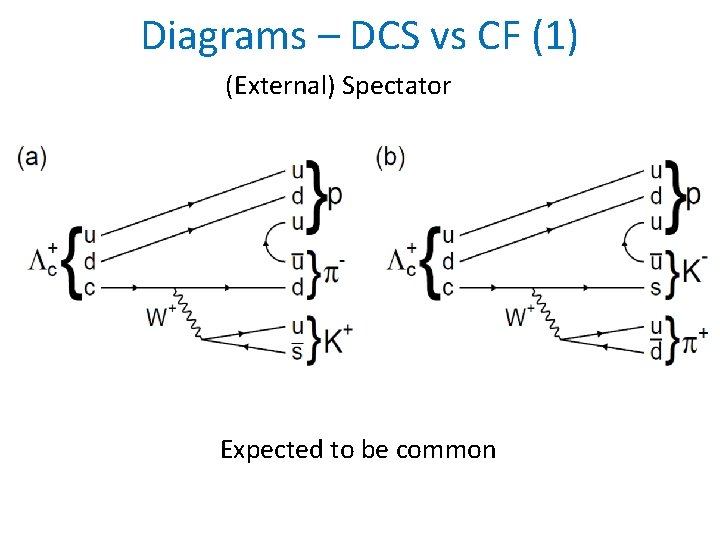
Diagrams – DCS vs CF (1) (External) Spectator Expected to be common
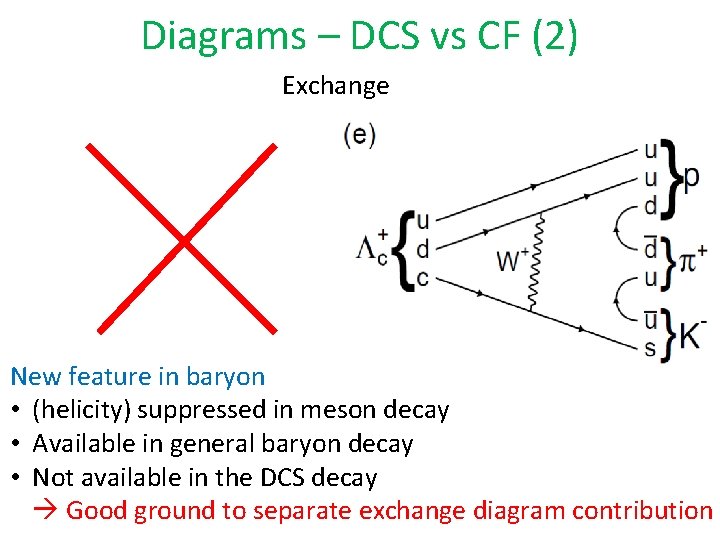
Diagrams – DCS vs CF (2) Exchange New feature in baryon • (helicity) suppressed in meson decay • Available in general baryon decay • Not available in the DCS decay Good ground to separate exchange diagram contribution
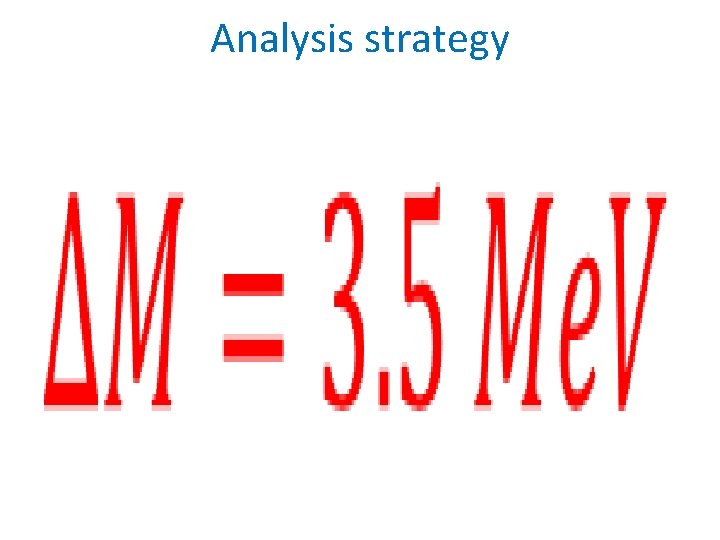
Analysis strategy •
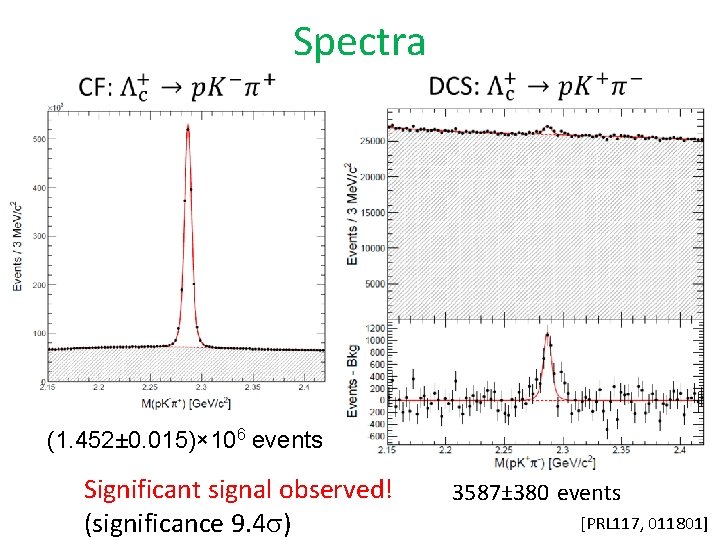
Spectra (1. 452± 0. 015)× 106 events Significant signal observed! (significance 9. 4 s) 3587± 380 events [PRL 117, 011801]
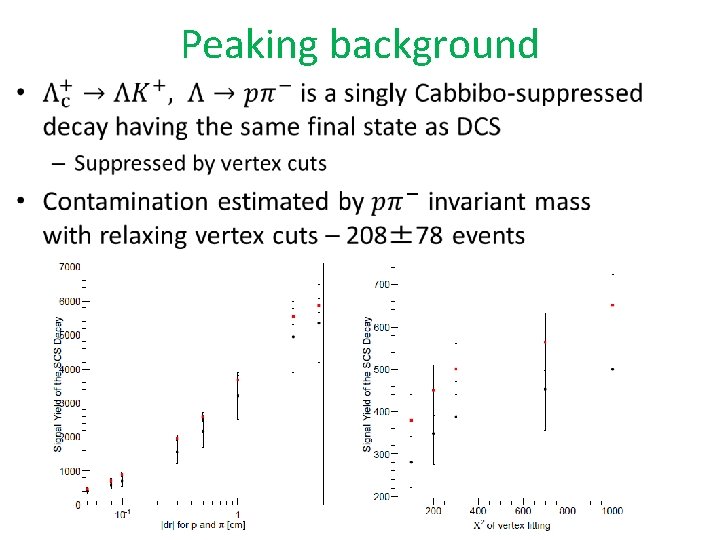
Peaking background •
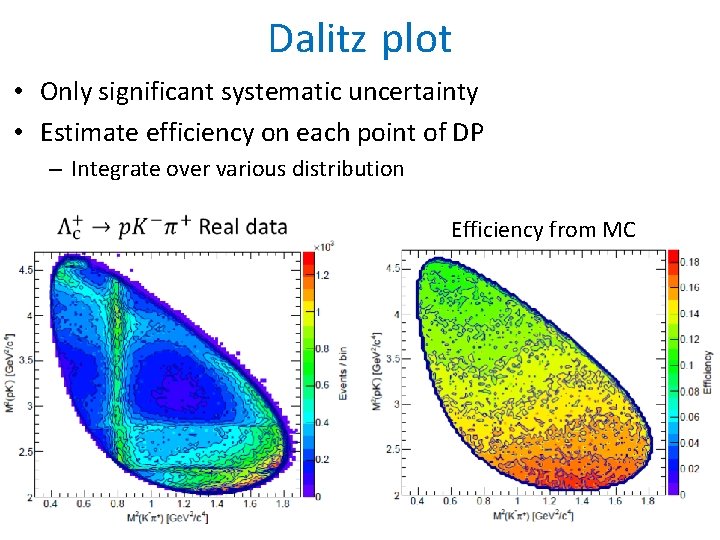
Dalitz plot • Only significant systematic uncertainty • Estimate efficiency on each point of DP – Integrate over various distribution Efficiency from MC
![Result • [PRL 117, 011801]](http://slidetodoc.com/presentation_image/df365aa527194ac8d86cab5c64bef880/image-30.jpg "Result • [PRL 117, 011801]")
Result • [PRL 117, 011801]
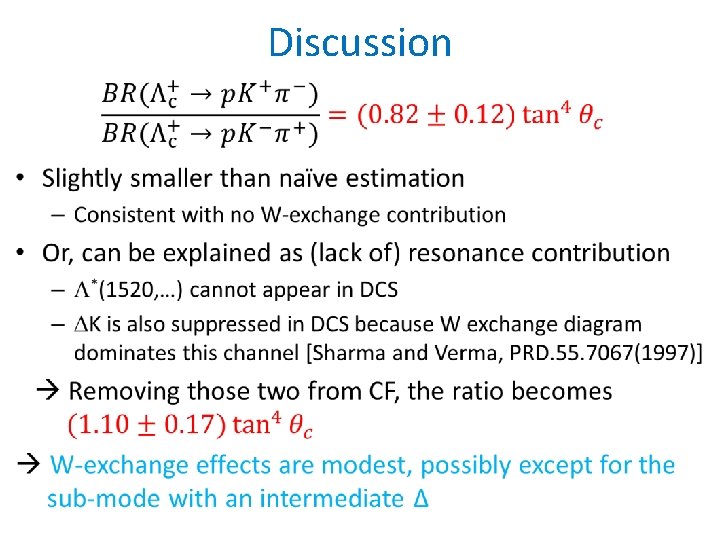
Discussion •
III. Production rates of charm baryons and hyperons
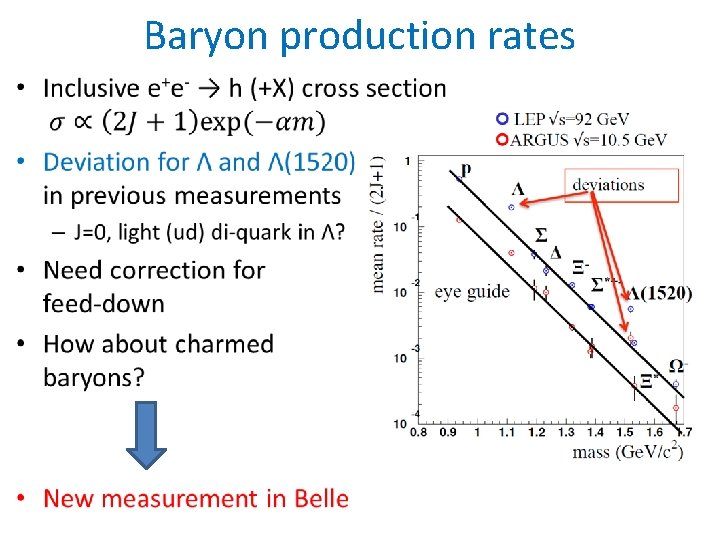
Baryon production rates •
![Result 1 -- hyperons • [ar. Xiv: 1706. 06791]](http://slidetodoc.com/presentation_image/df365aa527194ac8d86cab5c64bef880/image-34.jpg "Result 1 -- hyperons • [ar. Xiv: 1706. 06791]")
Result 1 -- hyperons • [ar. Xiv: 1706. 06791]
![• Result 2 – charm baryons [ar. Xiv: 1706. 06791]](http://slidetodoc.com/presentation_image/df365aa527194ac8d86cab5c64bef880/image-35.jpg "• Result 2 – charm baryons [ar. Xiv: 1706. 06791]")
• Result 2 – charm baryons [ar. Xiv: 1706. 06791]
IV. possibilities in future + e e colliders
Future e+e- colliders • Super B factory (Belle II): – Same energy as B factory, but much higher luminosity (~x 40) • Linear collider (ILC) – Much higher energy (√s > 200 Ge. V), L=O(1034) cm 2 – Higgs, Top, SUSY, … • Higgs collider (CEPC in China) – Dedicated for Higgs production by e+e- h. Z – √s=240 Ge. V, L=O(1034) cm 2 • What can be done in these colliders?
I. Belle II •
II. Higher energies • Necessary for beauty baryons – Comparison with charm baryons – Finding heavy quark symmetry partners • Statistics is the first issue – High luminosity x high cross section • Best energy? – On Z mass – Large cross section
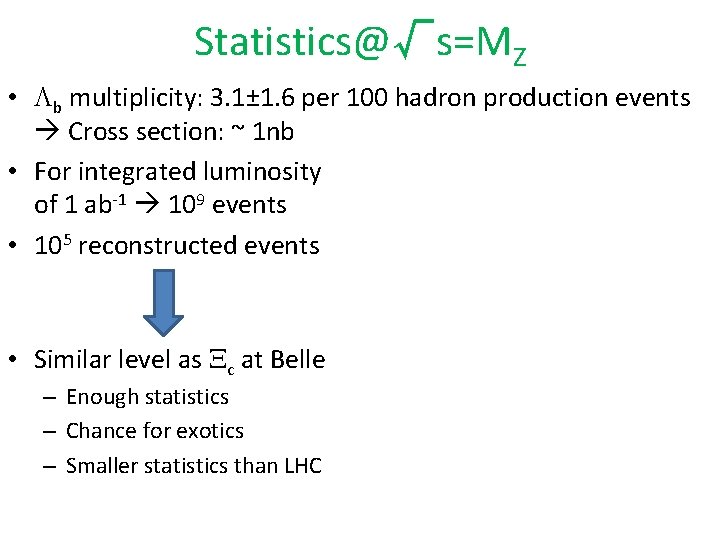
Statistics@√s=MZ • b multiplicity: 3. 1± 1. 6 per 100 hadron production events Cross section: ~ 1 nb • For integrated luminosity of 1 ab-1 109 events • 105 reconstructed events • Similar level as c at Belle – Enough statistics – Chance for exotics – Smaller statistics than LHC
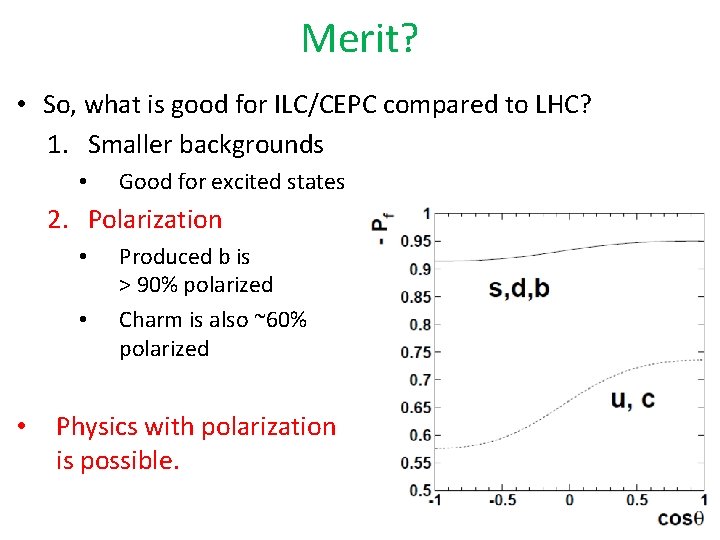
Merit? • So, what is good for ILC/CEPC compared to LHC? 1. Smaller backgrounds • Good for excited states 2. Polarization • • • Produced b is > 90% polarized Charm is also ~60% polarized Physics with polarization is possible.
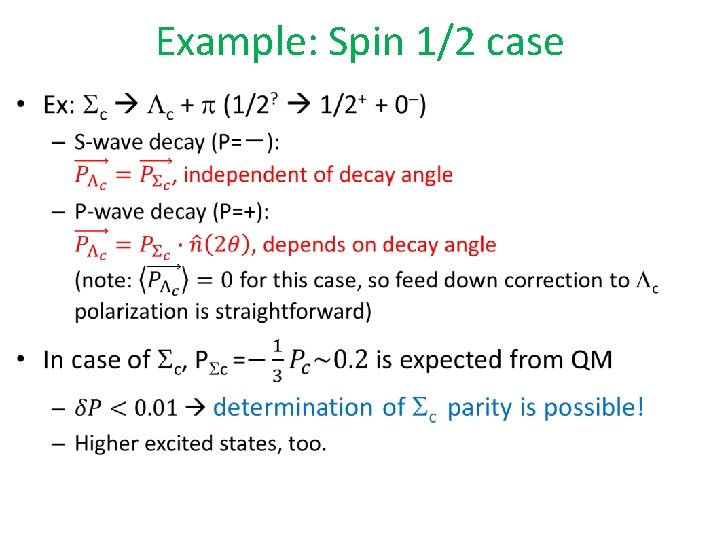
Determination of parity • Spin is rather easy to determine from e. g. , decay angle distribution, but parity is difficult • Why? – For the case J 1/2 + 0 (e. g. , Y + ), different parity gives exactly the same decay distribution – E. g. , for J=3/2, the decay is either P-wave (l=1) or D-wave (l=2) (for parity conserving case), so the problem is to determine l. – However…

Determination of parity • Spin is rather easy to determine from e. g. , decay angle distribution, but parity is difficult • Why? – For the case J 1/2 + 0 (e. g. , Y + ), different parity gives exactly the same decay distribution – E. g. , for J=3/2, the decay is either P-wave (l=1) or D-wave (l=2) (for parity conserving case), so the problem is to determine l. • One more information is necessary Polarization is most powerful – Model independent
Example: Spin 1/2 case •
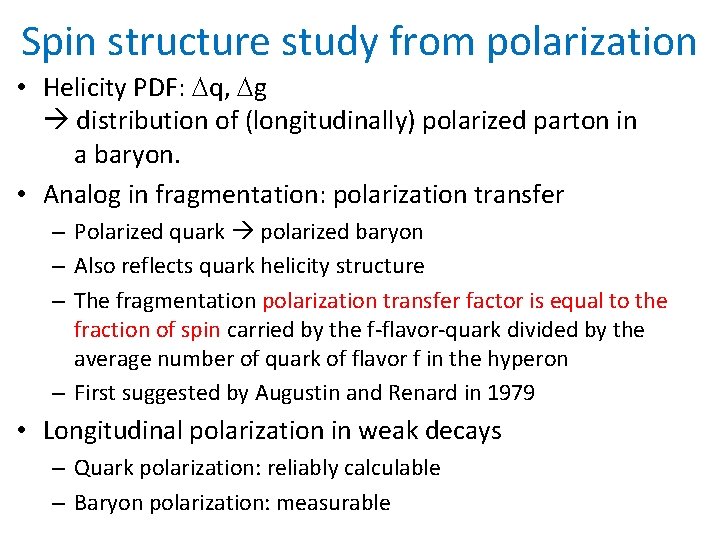
Spin structure study from polarization • Helicity PDF: Dq, Dg distribution of (longitudinally) polarized parton in a baryon. • Analog in fragmentation: polarization transfer – Polarized quark polarized baryon – Also reflects quark helicity structure – The fragmentation polarization transfer factor is equal to the fraction of spin carried by the f-flavor-quark divided by the average number of quark of flavor f in the hyperon – First suggested by Augustin and Renard in 1979 • Longitudinal polarization in weak decays – Quark polarization: reliably calculable – Baryon polarization: measurable
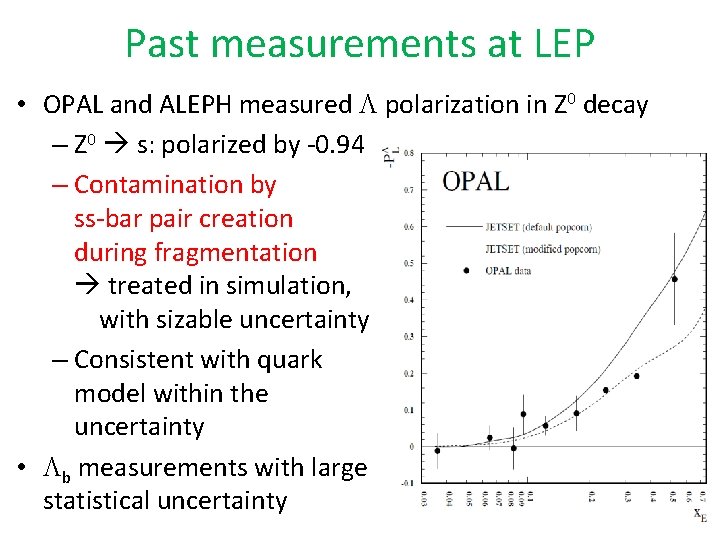
Past measurements at LEP • OPAL and ALEPH measured polarization in Z 0 decay – Z 0 s: polarized by -0. 94 – Contamination by ss-bar pair creation during fragmentation treated in simulation, with sizable uncertainty – Consistent with quark model within the uncertainty • b measurements with large statistical uncertainty
So, what can we do? • Problem: can be produced from u/d quark Uncertainty for dilution • This problem does not appear in heavier quarks Proposed measurement: Polarization of charmed/bottom baryons, especially c/ b
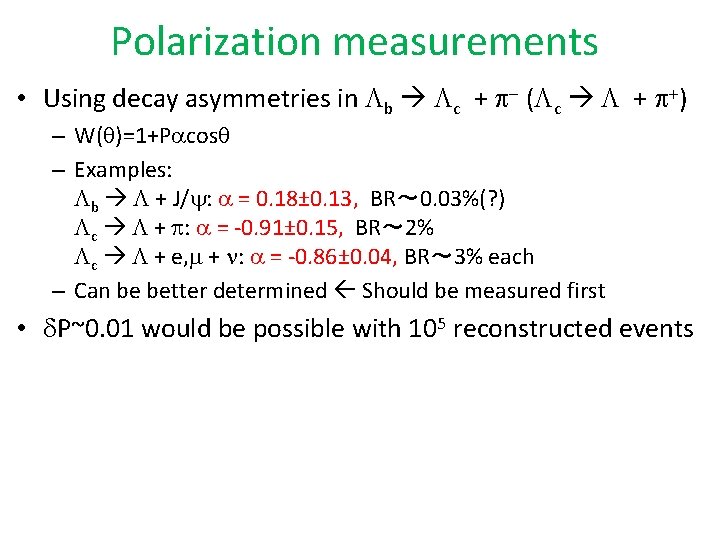
Polarization measurements • Using decay asymmetries in b c + - ( c + +) – W(q)=1+Pacosq – Examples: b + J/y: a = 0. 18± 0. 13, BR~ 0. 03%(? ) c + : a = -0. 91± 0. 15, BR~ 2% c + e, m + n: a = -0. 86± 0. 04, BR~ 3% each – Can be better determined Should be measured first • d. P~0. 01 would be possible with 105 reconstructed events
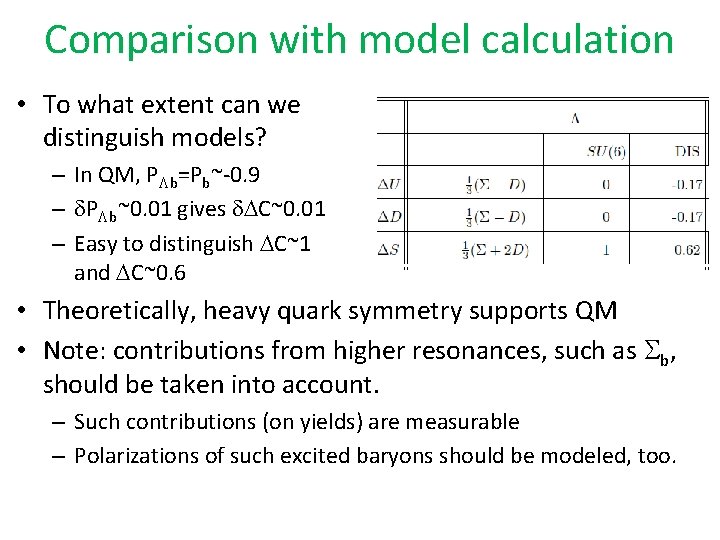
Comparison with model calculation • To what extent can we distinguish models? – In QM, P b=Pb~-0. 9 – d. P b~0. 01 gives d. DC~0. 01 – Easy to distinguish DC~1 and DC~0. 6 • Theoretically, heavy quark symmetry supports QM • Note: contributions from higher resonances, such as b, should be taken into account. – Such contributions (on yields) are measurable – Polarizations of such excited baryons should be modeled, too.
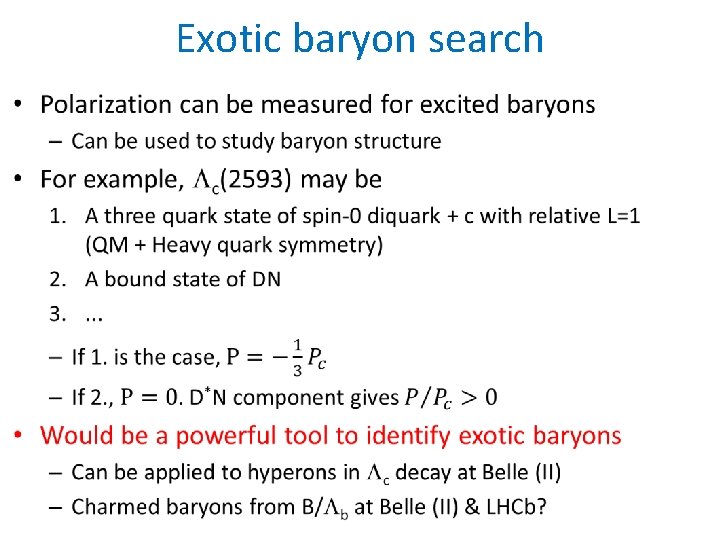
Exotic baryon search •
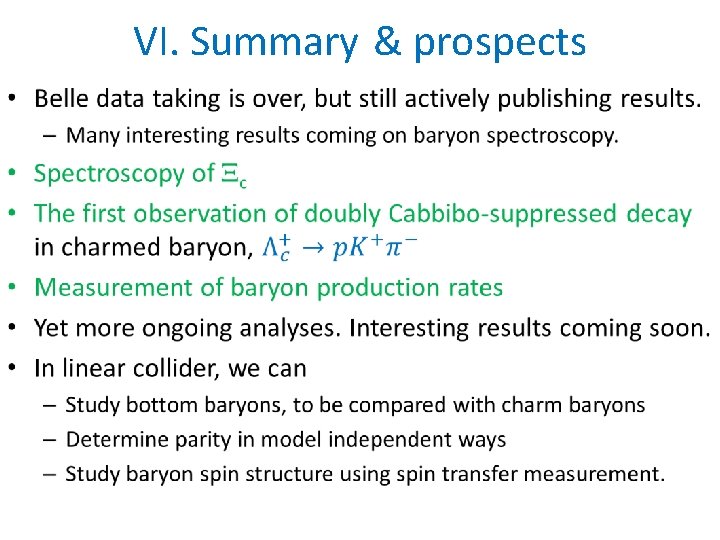
VI. Summary & prospects •

Backup



IV. (Some of ) Ongoing analysis
c/ c(2765) c + c(2593) c(2880) c(2625) c/ c(2765) PRELIMINARY M( c + - ) 1* resonance in PDG, but certainly exists I(JP) not known yet We will determine soon, together with mass, width, and branching ratios 58
What is the nature? • Roper resonance analog? – Predict JP=1/2+
What is the nature? • Roper resonance analog? – Predict JP=1/2+ Prof. Hosaka’s slide
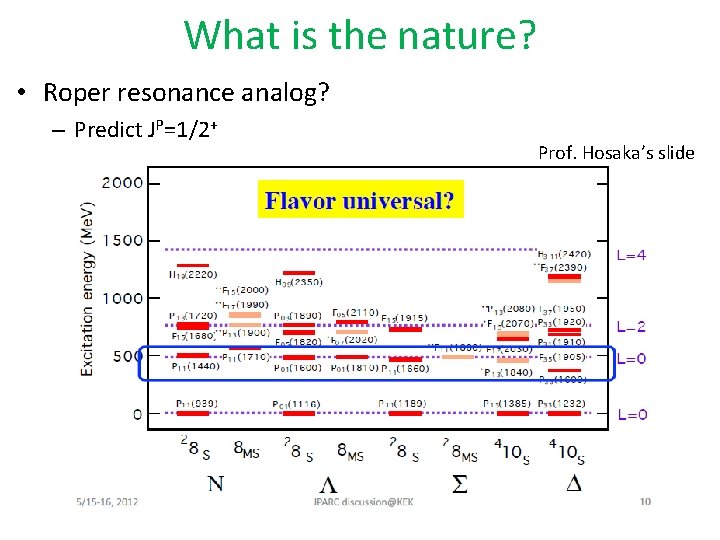
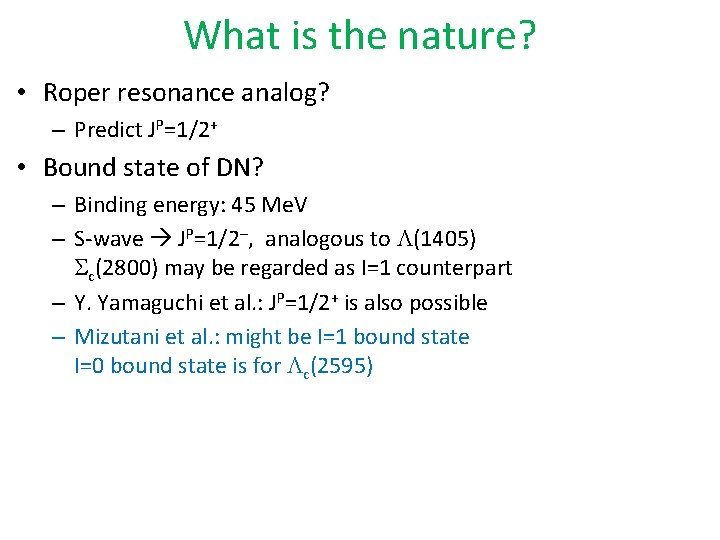
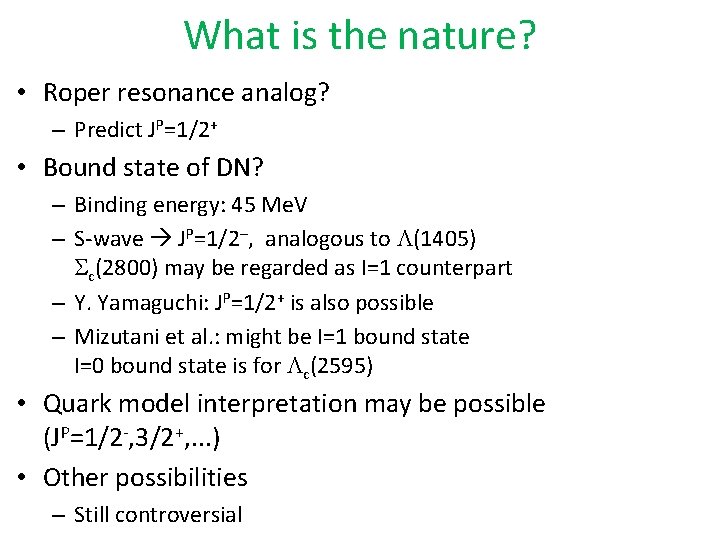
What is the nature? • Roper resonance analog? – Predict JP=1/2+ • Bound state of DN? – Binding energy: 45 Me. V
What is the nature? • Roper resonance analog? – Predict JP=1/2+ • Bound state of DN? – Binding energy: 45 Me. V – S-wave JP=1/2 -, analogous to (1405) c(2800) may be regarded as I=1 counterpart
What is the nature? • Roper resonance analog? – Predict JP=1/2+ • Bound state of DN? – Binding energy: 45 Me. V – S-wave JP=1/2 -, analogous to (1405) c(2800) may be regarded as I=1 counterpart – Y. Yamaguchi: JP=1/2+ is also possible
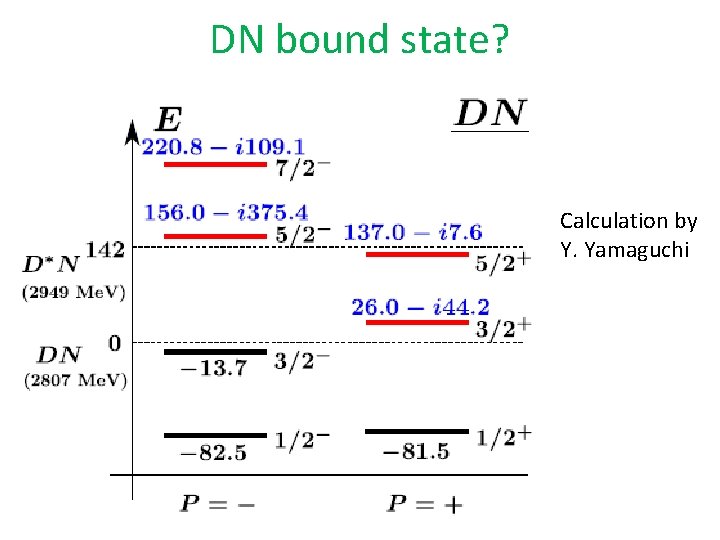
DN bound state? Calculation by Y. Yamaguchi
What is the nature? • Roper resonance analog? – Predict JP=1/2+ • Bound state of DN? – Binding energy: 45 Me. V – S-wave JP=1/2 -, analogous to (1405) c(2800) may be regarded as I=1 counterpart – Y. Yamaguchi et al. : JP=1/2+ is also possible – Mizutani et al. : might be I=1 bound state I=0 bound state is for c(2595)
What is the nature? • Roper resonance analog? – Predict JP=1/2+ • Bound state of DN? – Binding energy: 45 Me. V – S-wave JP=1/2 -, analogous to (1405) c(2800) may be regarded as I=1 counterpart – Y. Yamaguchi: JP=1/2+ is also possible – Mizutani et al. : might be I=1 bound state I=0 bound state is for c(2595) • Quark model interpretation may be possible (JP=1/2 -, 3/2+, . . . ) • Other possibilities – Still controversial
Hyperon polarization in c decay Kiyoshi Tanida (JAEA)
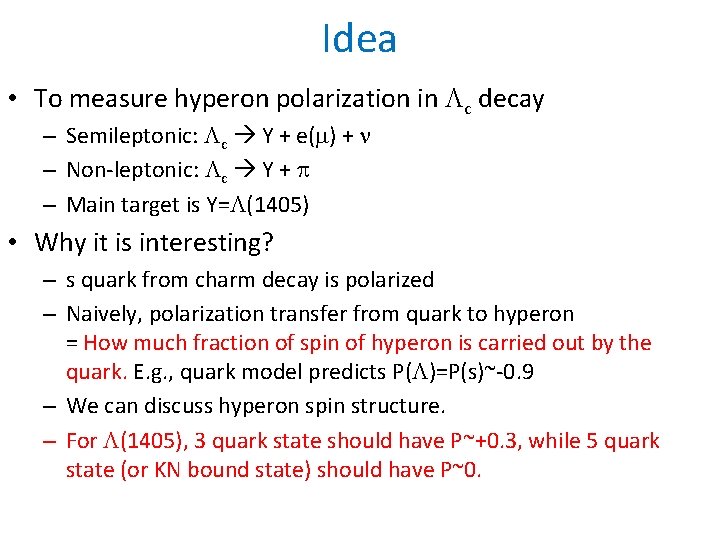
Idea • To measure hyperon polarization in c decay – Semileptonic: c Y + e(m) + n – Non-leptonic: c Y + – Main target is Y= (1405) • Why it is interesting? – s quark from charm decay is polarized – Naively, polarization transfer from quark to hyperon = How much fraction of spin of hyperon is carried out by the quark. E. g. , quark model predicts P( )=P(s)~-0. 9 – We can discuss hyperon spin structure. – For (1405), 3 quark state should have P~+0. 3, while 5 quark state (or KN bound state) should have P~0.
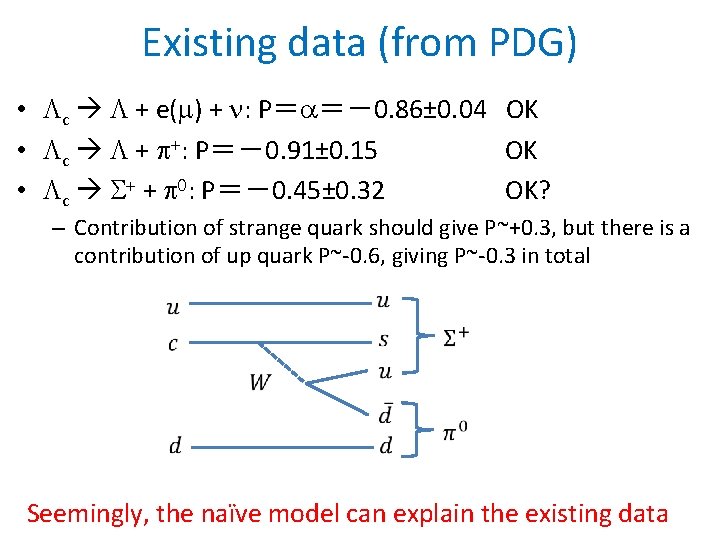
Existing data (from PDG) • c + e(m) + n: P=a=-0. 86± 0. 04 OK • c + +: P=-0. 91± 0. 15 OK • c + + 0: P=-0. 45± 0. 32 OK? – Contribution of strange quark should give P~+0. 3, but there is a contribution of up quark P~-0. 6, giving P~-0. 3 in total Seemingly, the naïve model can explain the existing data
Semileptonic modes • Theoretically clean, but experimentally difficult. • No peak in invariant mass because of missing n. – BG may be severe – Very complicated analysis for c + e(m) + n • Tagging c in missing mass? (Niiyama-san’s idea) – 36 k tagged c – If BR to (1405) + e(m) + n is 3% 1000 decays – Acceptance & efficiency: 10%? 100 counts? Detection may be possible with existing data, but need Belle 2 statistics to measure polarization
Nonleptonic modes • Opposite pros and cons – Experimentally easier, but interpretation is difficult. – But existing data is encouraging. • Can (1405) be seen in c decay? – Yes! – In c + + By Manfred Berger – (1520) is also seen, which is important as a reference (or “control data”) Sorry, the plot cannot be shown.
- Slides: 71