
Charlotte Smith The Emigrants 1793 1791 September 13
Charlotte Smith, The Emigrants (1793)
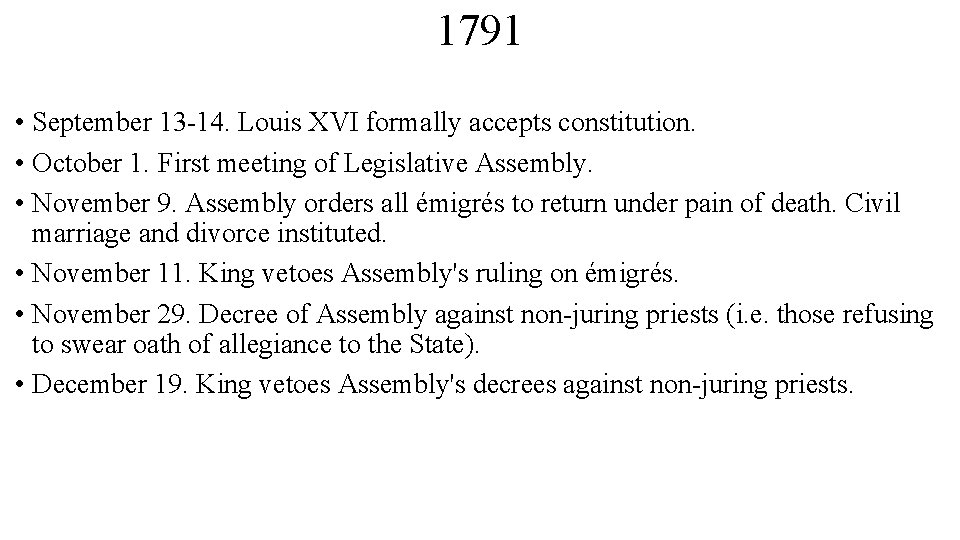
1791 • September 13 -14. Louis XVI formally accepts constitution. • October 1. First meeting of Legislative Assembly. • November 9. Assembly orders all émigrés to return under pain of death. Civil marriage and divorce instituted. • November 11. King vetoes Assembly's ruling on émigrés. • November 29. Decree of Assembly against non-juring priests (i. e. those refusing to swear oath of allegiance to the State). • December 19. King vetoes Assembly's decrees against non-juring priests.
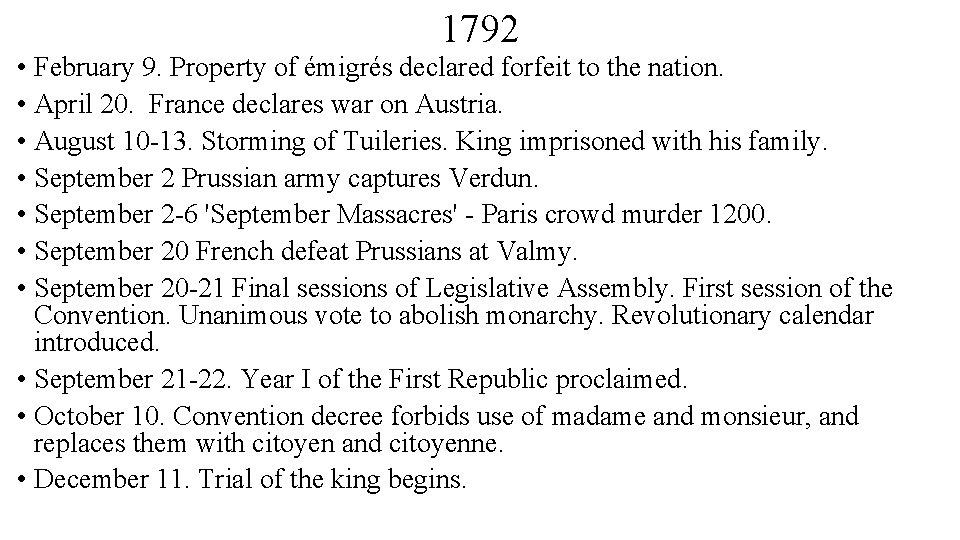
1792 • February 9. Property of émigrés declared forfeit to the nation. • April 20. France declares war on Austria. • August 10 -13. Storming of Tuileries. King imprisoned with his family. • September 2 Prussian army captures Verdun. • September 2 -6 'September Massacres' - Paris crowd murder 1200. • September 20 French defeat Prussians at Valmy. • September 20 -21 Final sessions of Legislative Assembly. First session of the Convention. Unanimous vote to abolish monarchy. Revolutionary calendar introduced. • September 21 -22. Year I of the First Republic proclaimed. • October 10. Convention decree forbids use of madame and monsieur, and replaces them with citoyen and citoyenne. • December 11. Trial of the king begins.
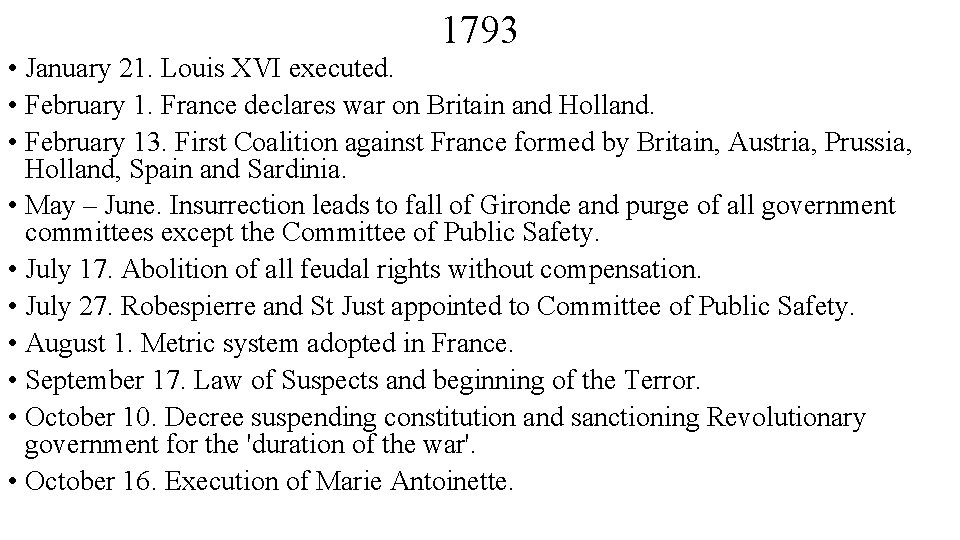
1793 • January 21. Louis XVI executed. • February 1. France declares war on Britain and Holland. • February 13. First Coalition against France formed by Britain, Austria, Prussia, Holland, Spain and Sardinia. • May – June. Insurrection leads to fall of Gironde and purge of all government committees except the Committee of Public Safety. • July 17. Abolition of all feudal rights without compensation. • July 27. Robespierre and St Just appointed to Committee of Public Safety. • August 1. Metric system adopted in France. • September 17. Law of Suspects and beginning of the Terror. • October 10. Decree suspending constitution and sanctioning Revolutionary government for the 'duration of the war'. • October 16. Execution of Marie Antoinette.
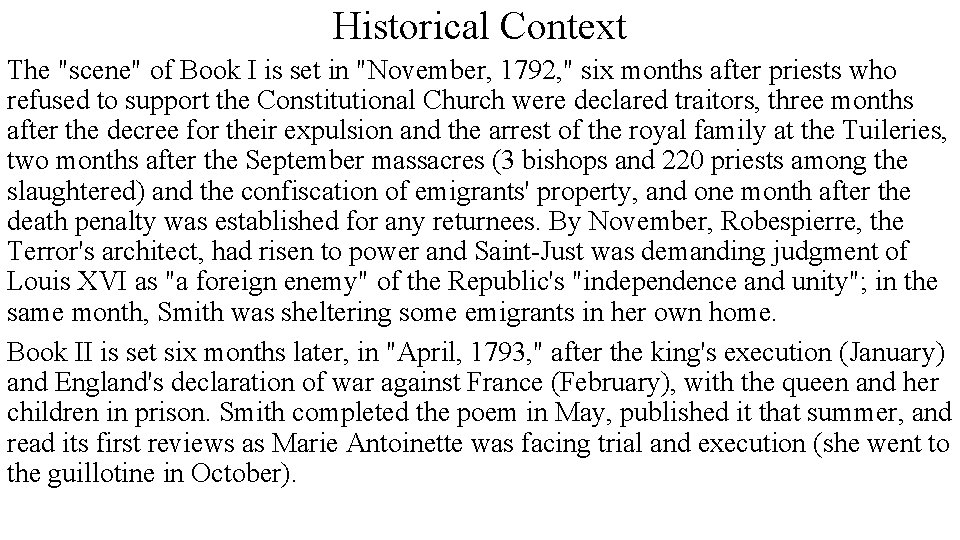
Historical Context The "scene" of Book I is set in "November, 1792, " six months after priests who refused to support the Constitutional Church were declared traitors, three months after the decree for their expulsion and the arrest of the royal family at the Tuileries, two months after the September massacres (3 bishops and 220 priests among the slaughtered) and the confiscation of emigrants' property, and one month after the death penalty was established for any returnees. By November, Robespierre, the Terror's architect, had risen to power and Saint-Just was demanding judgment of Louis XVI as "a foreign enemy" of the Republic's "independence and unity"; in the same month, Smith was sheltering some emigrants in her own home. Book II is set six months later, in "April, 1793, " after the king's execution (January) and England's declaration of war against France (February), with the queen and her children in prison. Smith completed the poem in May, published it that summer, and read its first reviews as Marie Antoinette was facing trial and execution (she went to the guillotine in October).
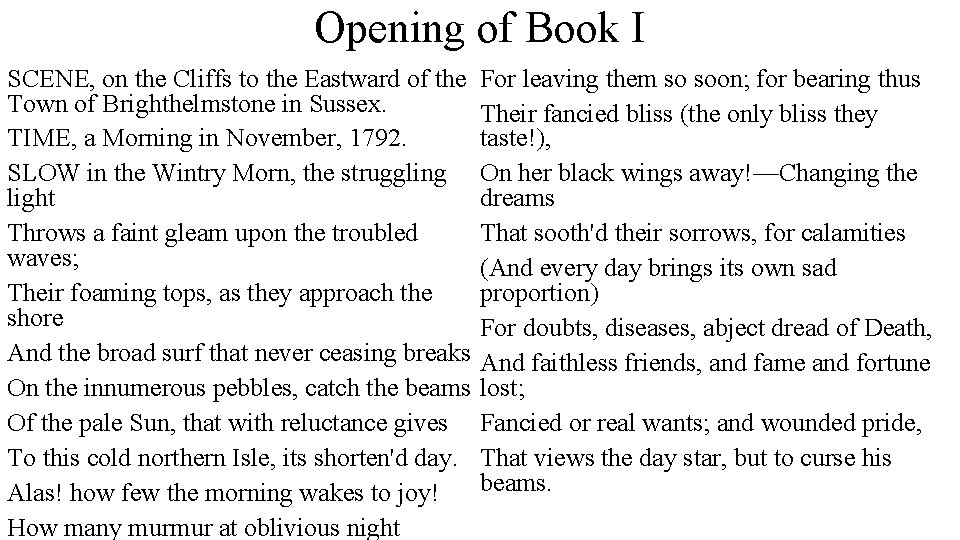
Opening of Book I SCENE, on the Cliffs to the Eastward of the For leaving them so soon; for bearing thus Town of Brighthelmstone in Sussex. Their fancied bliss (the only bliss they taste!), TIME, a Morning in November, 1792. SLOW in the Wintry Morn, the struggling On her black wings away!—Changing the light dreams Throws a faint gleam upon the troubled That sooth'd their sorrows, for calamities waves; (And every day brings its own sad Their foaming tops, as they approach the proportion) shore For doubts, diseases, abject dread of Death, And the broad surf that never ceasing breaks And faithless friends, and fame and fortune On the innumerous pebbles, catch the beams lost; Of the pale Sun, that with reluctance gives Fancied or real wants; and wounded pride, To this cold northern Isle, its shorten'd day. That views the day star, but to curse his beams. Alas! how few the morning wakes to joy! How many murmur at oblivious night
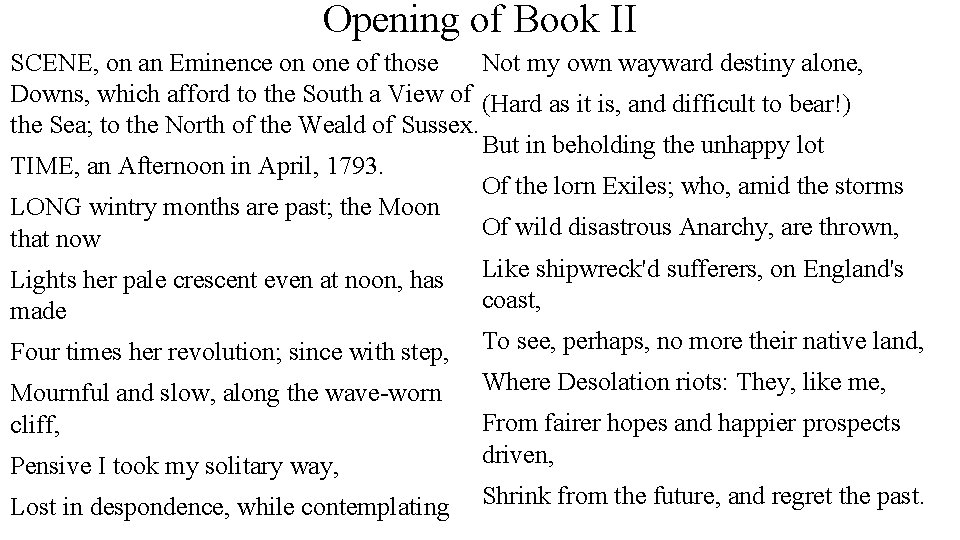
Opening of Book II SCENE, on an Eminence on one of those Not my own wayward destiny alone, Downs, which afford to the South a View of (Hard as it is, and difficult to bear!) the Sea; to the North of the Weald of Sussex. But in beholding the unhappy lot TIME, an Afternoon in April, 1793. Of the lorn Exiles; who, amid the storms LONG wintry months are past; the Moon Of wild disastrous Anarchy, are thrown, that now Lights her pale crescent even at noon, has Like shipwreck'd sufferers, on England's coast, made Four times her revolution; since with step, To see, perhaps, no more their native land, Mournful and slow, along the wave-worn cliff, Where Desolation riots: They, like me, Pensive I took my solitary way, From fairer hopes and happier prospects driven, Lost in despondence, while contemplating Shrink from the future, and regret the past.
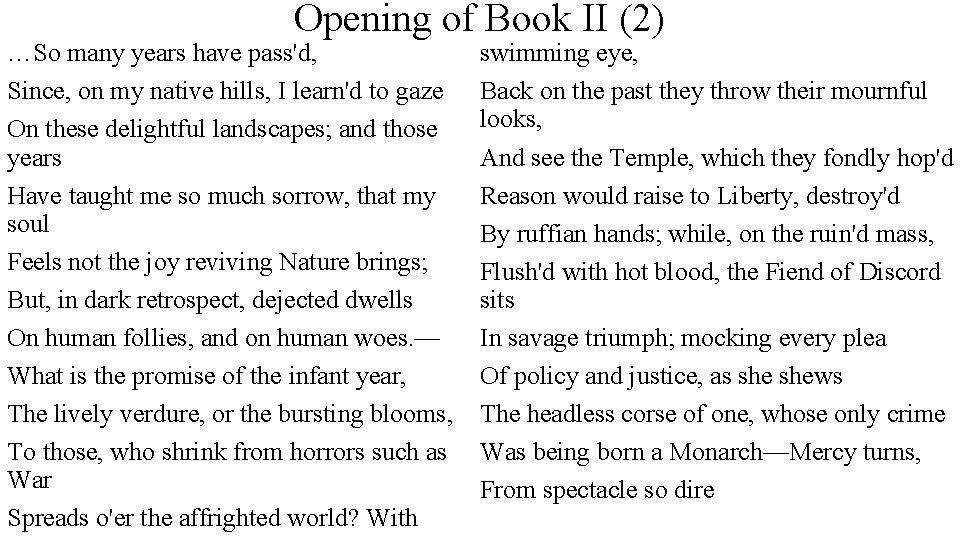
Opening of Book II (2) …So many years have pass'd, Since, on my native hills, I learn'd to gaze On these delightful landscapes; and those years Have taught me so much sorrow, that my soul Feels not the joy reviving Nature brings; But, in dark retrospect, dejected dwells On human follies, and on human woes. — What is the promise of the infant year, The lively verdure, or the bursting blooms, To those, who shrink from horrors such as War Spreads o'er the affrighted world? With swimming eye, Back on the past they throw their mournful looks, And see the Temple, which they fondly hop'd Reason would raise to Liberty, destroy'd By ruffian hands; while, on the ruin'd mass, Flush'd with hot blood, the Fiend of Discord sits In savage triumph; mocking every plea Of policy and justice, as shews The headless corse of one, whose only crime Was being born a Monarch—Mercy turns, From spectacle so dire
Women on Politics Preface to Desmond: But women it is said have no business with politics. — Why not? — Have they no interest in the scenes that are acting around them, in which they have fathers, brothers, husbands, sons, or friends engaged! — Even in the commonest course of female education, they are expected to acquire some knowledge of history; and yet, if they are to have no opinion of what is passing, it avails little that they should be informed of what has passed, in a world where they are subject to such mental degradation; where they are censured as affecting masculine knowledge if they happen to have any understanding; or despised as insignificant triflers if they have none. Knowledge, which qualifies women to speak or to write on any other than the most common and trivial subjects, is supposed to be of so difficult attainment, that it cannot be acquired but by the sacrifice of domestic virtues, or the neglect of domestic duties. — I however, may safely say, that it was in the observance, not in the breach of duty, I became an Author; and it has happened, that the circumstances which have compelled me to write, have introduced me to those scenes of life, and those varieties of character which I should otherwise never have seen: Tho' alas! it is from thence, that I am too well enabled to describe from immediate observation, 'The proud mans contumely, th'oppressors wrong; The laws delay, the insolence of office. ’ But, while in consequence of the affairs of my family being most unhappily in the power of men who seem to exercise all these with impunity', I am become an Author by profession, Preface to The Emigrants: I am perfectly sensible that it belongs not to a feeble and feminine hand to draw the Bow of Ulysses. • Example of unsought for liminality: in-between male and female, English and French, literally on the borders – very difficult and painful situation, revealing some basic humanity
Expertise I mourn your sorrows; for I too have known Involuntary exile; and while yet England had charms for me, have felt how sad It is to look across the dim cold sea, That melancholy rolls its refluent tides Between us and the dear regretted land We call our own…
Imperfect Sympathies 1 Whate'er your errors, I lament your fate: From his hard pallet with the midnight bell, And, as disconsolate and sad ye hang Upon the barrier of the rock, and seem To live on eleemosynary bread, To murmur your despondence, waiting And to renounce God's works, would please that God. long Some fortunate reverse that never comes; And now the poor pale wretch receives, amaz'd, Methinks in each expressive face, I see The pity, strangers give to his distress, Discriminated anguish; there droops one, Because these strangers are, by his dark Who in a moping cloister long consum'd creed, This life inactive, to obtain a better, Condemn'd as Heretics—and with sick And thought that meagre abstinence, to heart wake Regrets his pious prison, and his beads. —
Imperfect Sympathies 2 Another, of more haughty port, declines The aid he needs not; while in mute despair His high indignant thoughts go back to France, Dwelling on all he lost—the Gothic dome, That vied with splendid palaces; the beds Of silk and down, the silver chalices, Vestments with gold enwrought for blazing altars; Where, amid clouds of incense, he held forth To kneeling crowds the imaginary bones Of Saints suppos'd, in pearl and gold enchas'd, And still with more than living Monarchs' pomp Surrounded; was believ'd by mumbling bigots To hold the keys of Heaven, and to admit Whom he thought good to share it—Now alas! He, to whose daring soul and high ambition The World seem'd circumscrib'd; who, wont to dream Of Fleuri, Richelieu, Alberoni, men Who trod on Empire, and whose politics Were not beyond the grasp of his vast mind, Is, in a Land once hostile, still prophan'd By disbelief, and rites un-orthodox, The object of compassion—At his side, Lighter of heart than these, but heavier far Than he was wont, another victim comes, An Abbé—who with less contracted brow Still smiles and flatters, and still talks of Hope; Which, sanguine as he is, he does not feel, And so he cheats the sad and weighty pressure Of evils present; —Still, as Men misled By early prejudice (so hard to break), I mourn your sorrows…
Anti-Nationalism Ah! rather Fortune's worthless favourites! With wonder, not with envy; for they know Who feed on England's vitals— The means, by which ye reach'd it, have Pensioners Of base corruption, who, in quick ascent been such As, in all honest eyes, degrade ye far To opulence unmerited, become Beneath the poor dependent, whose fad Giddy with pride, and as ye rise, heart forgetting The dust ye lately left, with scorn look Reluctant pleads for what your pride denies); down Ye venal, worthless hirelings of a Court! On those beneath ye (tho' your equals once Ye pamper'd Parasites! whom Britons pay In fortune, and in worth superior still, For forging fetters for them; rather here They view the eminence, on which ye Study a lesson that concerns ye much; stand,
Anti-Nationalism 2 And, trembling, learn, that if oppress'd throne; — too long, As now in Gallia; where Confusion, born The raging multitude, to madness stung, Of party rage and selfish love of rule, Will turn on their oppressors; and, no Sully the noblest cause that ever warm'd more The heart of Patriot Virtue 8—There arise By sounding titles and parading forms The infernal passions; Vengeance, Bound like tame victims, will redress seeking blood, themselves! And Avarice; and Envy's harpy fangs Then swept away by the resistless torrent, Pollute the immortal shrine of Liberty, Not only all your pomp may disappear, Dismay her votaries, and disgrace her But, in the tempest lost, fair Order sink name. Her decent head, and lawless Anarchy O'erturn celestial Freedom's radiant
Victimized Women To a wild mountain, whose bare summit seeks hides A temporary shelter—clasping close Its broken eminence in clouds; whose To her hard-heaving heart her sleeping steeps child, Are dark with woods; where the receding All she could rescue of the innocent rocks groupe Are worn by torrents of dissolving snow, That yesterday surrounded her—Escap'd A wretched Woman, pale and breathless, Almost by miracle! Fear, frantic Fear, flies! Wing'd her weak feet: yet, half repentant And, gazing round her, listens to the now sound Her headlong haste, she wishes she had Of hostile footsteps—No! it dies away: staid Nor noise remains, but of the cataract, To die with those affrighted Fancy paints Or surly breeze of night, that mutters low The lawless soldier's victims—Hark! Among the thickets, where she trembling again
Victimized Women 2 The driving tempest bears the cry of True to maternal tenderness, she tries Death, To save the unconscious infant from the And, with deep sullen thunder, the dread storm sound In which she perishes; and to protect Of cannon vibrates on the tremulous This last dear object of her ruin'd hopes earth; From prowling monsters, that from other While, bursting in the air, the murderous hills, bomb More inaccessible, and wilder wastes, Glares o'er her mansion. Where the Lur'd by the scent of slaughter, follow splinters fall, fierce Like scatter'd comets, its destructive path Contending hosts, and to polluted fields Is mark'd by wreaths of flame!—Then, Add dire increase of horrors—But alas! overwhelm'd The Mother and the Infant perish both! Beneath accumulated horror, sinks The desolate mourner; yet, in Death itself
The grieving mother Where the cliff, hollow'd by the wintry storm, Affords a seat with matted sea-weed strewn, A softer form reclines; around her run, On the rough shingles, or the chalky bourn, Her gay unconscious children, soon amus'd; Who pick the fretted stone, or glossy shell, Or crimson plant marine: or they contrive The fairy vessel, with its ribband sail And gilded paper pennant: in the pool, Left by the salt wave on the yielding sands, They launch the mimic navy—Happy age! Unmindful of the miseries of Man!— Alas! too long a victim to distress, Their Mother, lost in melancholy thought, Lull'd for a moment by the murmurs low Of sullen billows, wearied by the task Of having here, with swol'n and aching eyes Fix'd on the grey horizon, since the dawn Solicitously watch'd the weekly sail From her dear native land, now yields awhile To kind forgetfulness, while Fancy brings, In waking dreams, that native land again!
The grieving mother 2 Versailles appears—its painted galleries, Urg'd by the rising wind, unheeded foam And rooms of regal splendour; rich with Near her cold rugged seat: —To call her thence gold, Where, by long mirrors multiply'd, the A fellow-sufferer comes: dejection deep crowd Checks, but conceals not quite, the Paid willing homage—and, united there, martial air, Beauty gave charms to empire—Ah! too And that high consciousness of noble soon blood, From the gay visionary pageant rous'd, Which he has learn'd from infancy to think See the sad mourner start!—and, drooping, look Exalts him o'er the race of common men: With tearful eyes and heaving bosom Nurs'd in the velvet lap of luxury, round And fed by adulation—could he learn, On drear reality—where dark'ning waves, That worth alone is true Nobility?
from Keats’s Hyperion …tell me, if this wrinkling brow, sit Here on this spot of earth. Search, Thea, Naked and bare of its great diadem, Peers like the front of Saturn. Who had search! power Open thine eyes eterne, and sphere them To make me desolate? whence came the round strength? Upon all space: space starr'd, and lorn of How was it nurtur'd to such bursting forth, light; While Fate seem'd strangled in my nervous Space region'd with life-air; and barren void; grasp? Spaces of fire, and all the yawn of hell. — But it is so, and I am smother'd up, Search, Thea, search! and tell me, if thou And buried from all godlike exercise seest Of influence benign on planets pale, A certain shape or shadow, making way Of admonitions to the winds and seas, With wings or chariot fierce to repossess Of peaceful sway above man's harvesting, A heaven he lost erewhile: it must—it must And all those acts which Deity supreme Be of ripe progress—Saturn must be King. Doth ease its heart of love in. —I am gone Away from my own bosom: I have left My strong identity, my real self, Somewhere between the throne, and where I
From Milton’s Paradise Lost, Book I …O how fall'n! how chang'd From him, who in the happy Realms of Light Cloth'd with transcendent brightness didst out-shine Myriads though bright: If he whom mutual league, United thoughts and counsels, equal hope And hazard in the Glorious Enterprize, Joynd with me once, now misery hath joynd In equal ruin…
From Lord Byron’s ’Ode to Napoleon Buonaparte’ ’TIS done—but yesterday a King! And arm’d with Kings to strive— And now thou art a nameless thing: So abject—yet alive! Is this the man of thousand thrones, Who strew’d our earth with hostile bones, And can he thus survive? Since he, miscalled the Morning Star, Nor man nor fiend hath fallen so far.
From King Lear (in the storm) • Lear [to Poor Tom]: Thou art the thing itself: unaccommodated man is no more but such a poor bare, forked animal as thou art… • …Take physic, pomp; Expose thyself to feel what wretches feel,
Recommended Literature • Andrews, Kerri. "‘Herself [. . . ] Fills The Foreground’: Negotiating Autobiography in the Elegiac Sonnets and The Emigrants. Charlotte Smith in English Romanticism, ed. Jacqueline M. Labbe. Pickering & Chatto, 2008. 13 -28. • Blank, Antje. "Things as They Were: The Gothic of Real Life in Charlotte Smith’s The Emigrants and The Banished Man”, Women's Writing 16: 1 (2009) 78 -93. • Craciun, Adriana. British Women Writers and the French Revolution. Palgrave Macmillan, 2005. 138 -178. • Labbe, Jacqueline M. Charlotte Smith: Romanticism, poetry and the culture of gender. Manchester UP, 2003. 116 -141. • Özdemir, Erinç. "Charlotte Smith's Poetry as Sentimental Discourse” Studies in Romanticism 50. 3 (2011) 437 -473. • Rennhak, Katharina. "Tropes of Exile in the 1790 s: English Women Writers and French Emigrants”, European Romantic Review 17: 5 (2006) 575 -592. • Smith Hart, Monica. "Charlotte Smith’s Exilic Persona”, Partial Answers 8. 2 (2010) 305 -323. • Wiley, Michael. "The Geography of Displacement and Replacement in Charlotte Smith’s The Emigrants”, European Romantic Review 17: 1 (2006) 55 -68. • Wolfson, Susan J. "Charlotte Smith's "Emigrants": Forging Connections at the Borders of a Female Tradition” Huntington Library Quarterly 63. 4 (2000) 509 -546.
- Slides: 23