
CHARLOTTE DANIELSONS FRAMEWORK FOR TEACHING Domain 3 Instruction

- Slides: 18
CHARLOTTE DANIELSON’S FRAMEWORK FOR TEACHING Domain #3 - Instruction
3 A. COMMUNICATING WITH STUDENTS
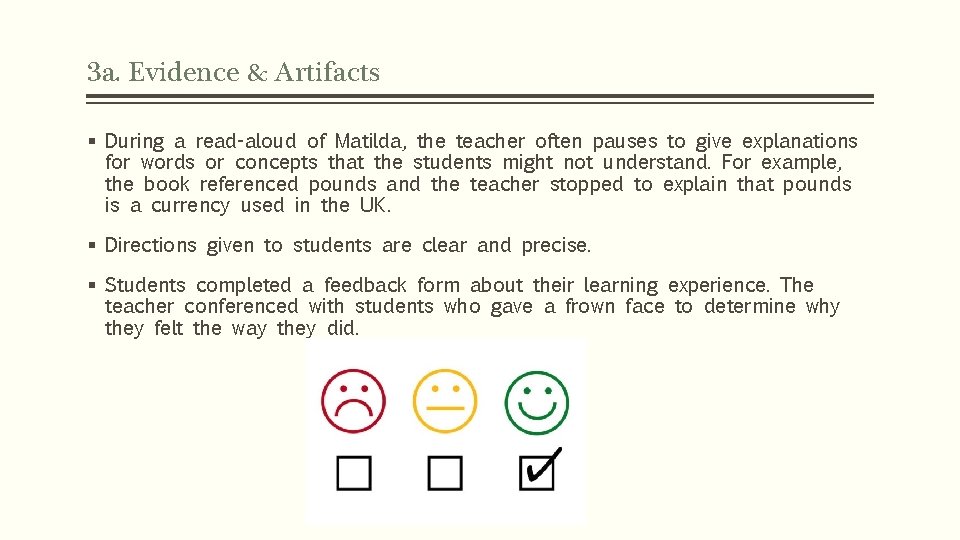
3 a. Evidence & Artifacts § During a read-aloud of Matilda, the teacher often pauses to give explanations for words or concepts that the students might not understand. For example, the book referenced pounds and the teacher stopped to explain that pounds is a currency used in the UK. § Directions given to students are clear and precise. § Students completed a feedback form about their learning experience. The teacher conferenced with students who gave a frown face to determine why they felt the way they did.
3 a. Evidence & Artifacts § Assignments are graded quickly and often handed back to the students on the same day. § During down time, I help my co-op by grading quizzes and papers. She then records the grades in the gradebook and I place the graded papers in the students’ cubby holes. § Grade books are updated on a regular basis. § Students know the purpose of assignments and little clarification is needed. § If the teacher does receive a lot of questions from students, she will stop the class and give an explanation.
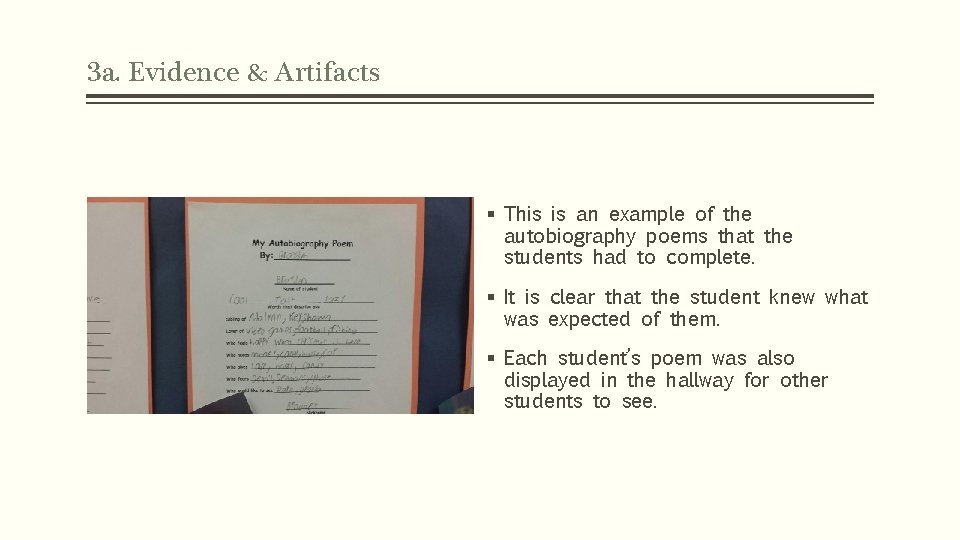
3 a. Evidence & Artifacts § This is an example of the autobiography poems that the students had to complete. § It is clear that the student knew what was expected of them. § Each student’s poem was also displayed in the hallway for other students to see.
3 a. Justification § I included the read-aloud example because it shows that explanation is given to students when they need it and when it will enhance their understanding. There are many instances where the teacher stops to clarify something that the students do not understand. § Directions are always given to students in a clear and precise way, so much so that there is little confusion. I included this as an example because it shows that communication is clear and effective. § Students recently completed a feedback rubric about their learning experience in the classroom. This was done so that we could gain feedback from the students on how they feel. § Students receive prompt feedback on their work. We try to grade items as quick as possible so that the students can see how well they did. § For this domain, I think the level of performance would be proficient. I think that it is proficient because communication with students is clear and effective. Students understand what is expected of them and they understand how to complete tasks.
3 B. USING QUESTIONING AND DISCUSSION TECHNIQUES
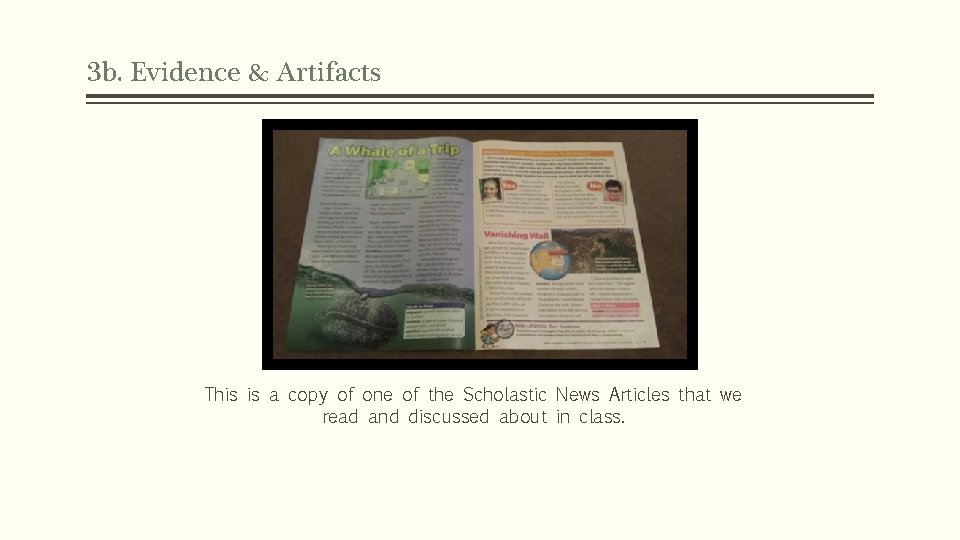
3 b. Evidence & Artifacts § Questioning is used to cause students to think and reflect and to deepen their understanding. § For example, we did a Scholastic News article last week on solar-powered race cars. The cover of the article said that the cars zoom across the track without using a single drop of fuel. I then asked the students how they think the cars are able to run without fuel. § Discussion techniques are used to engage students. § For example, another article that we read in class was about cellphone usage in schools. There was an argument presented for both side and after reading the arguments, I asked the students what their views were and why. All of the students were very eager to contribute their ideas. § Most students are participating throughout discussions.
3 b. Evidence & Artifacts This is a copy of one of the Scholastic News Articles that we read and discussed about in class.
3 b. Justification § A lot of discussion happens during social studies because students are reading articles and discussing topics. I included the cell phone debate example because it got the students excited and every student had an opinion on the topic. They really were engaged throughout the discussion and they enjoyed discussing it. § Before I teach the scholastic news articles to the students, I look over the article and start thinking about different questions that I might ask the students in order to engage their thinking. § For this section, I think the level of performance is basic. I think it is basic because although I am asking questions throughout the lesson, not all of the questions are higher-order and not all of the students want to discuss. I am still new at this so there is a lot of room for improvement.
3 C. ENGAGING STUDENTS IN LEARNING
3 c. Evidence & Artifacts § Most activities and assignments promote student thinking and learning and encourage students to explain their thinking. § For example, asking students to explain how they think a race car can move without fuel. § Most of the time students are grouped together as a whole class. Sometimes students work in pairs or small groups. Small groups are usually based on where the students are sitting. § When students finish a task early, students are given a follow-up activity to complete. § Students are almost always actively working on a task.
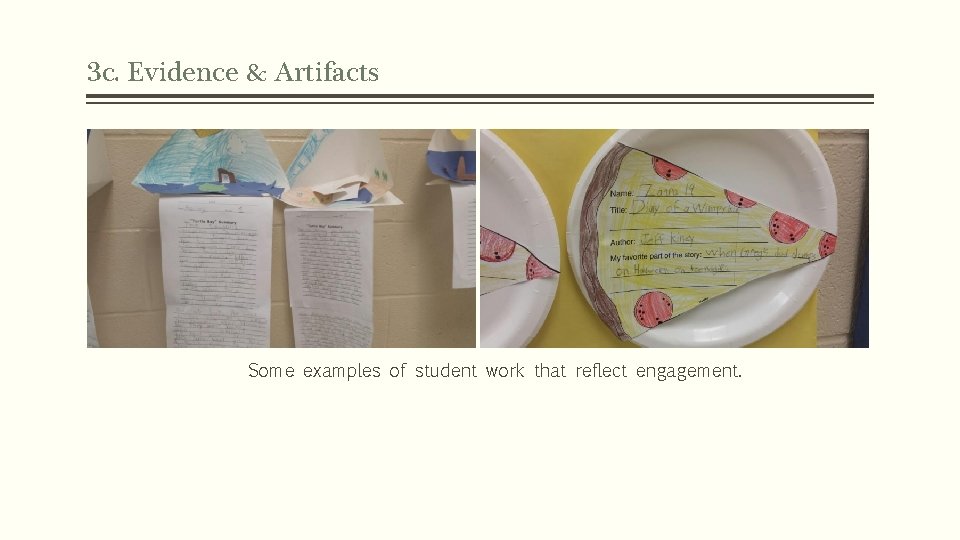
3 c. Evidence & Artifacts Some examples of student work that reflect engagement.
3 c. Justification § I included the pizza slice activity because the students were really excited to talk and write about their favorite parts of the story. October is national pizza month, so incorporating the pizza slices into the story review was a great way to motivate the students. § Students are often grouped together as a whole class or in small groups at their tables. Often times the students will ask if they can work together and the teacher usually allows them to. If students are not engaged in the task then the teacher has them move to another group or has them work independently. § Students are almost constantly working on something. If a student finishes early, then there are numerous activities that the students can complete as they wait for everyone else to finish. § For this section, I would say that they level of performance is proficient. I think that it is proficient because almost all of the students are always engaged in some sort of task. If a student gets off task, the teacher is quick to bring them back. Grouping is varied and so are the activities and assignments.
3 D. USING ASSESSMENT IN INSTRUCTION
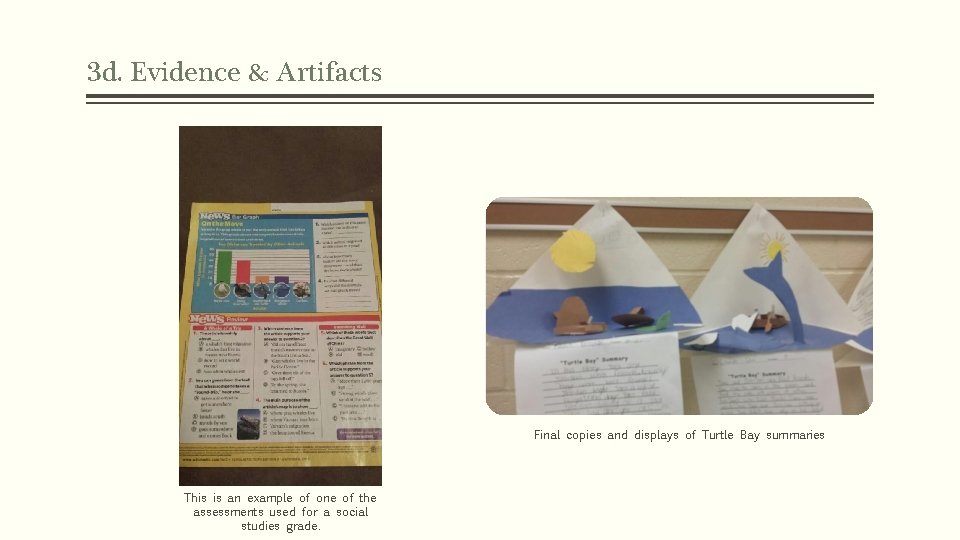
3 d. Evidence & Artifacts § When my co-op is teaching, I often circulate around the room and check for understanding, and when I am teaching, my co-op is circulating around the room. § The teacher often instructs the students to look over their work and make corrections as needed. Most of the students do so. § For the Turtle Bay summaries, the students had to evaluate their own writing and conference with the teacher about how they could improve it. The students then made improvements to their papers as needed. They created final copies and displayed them in the hallway. § Both summative and formative assessments are used in the classroom.
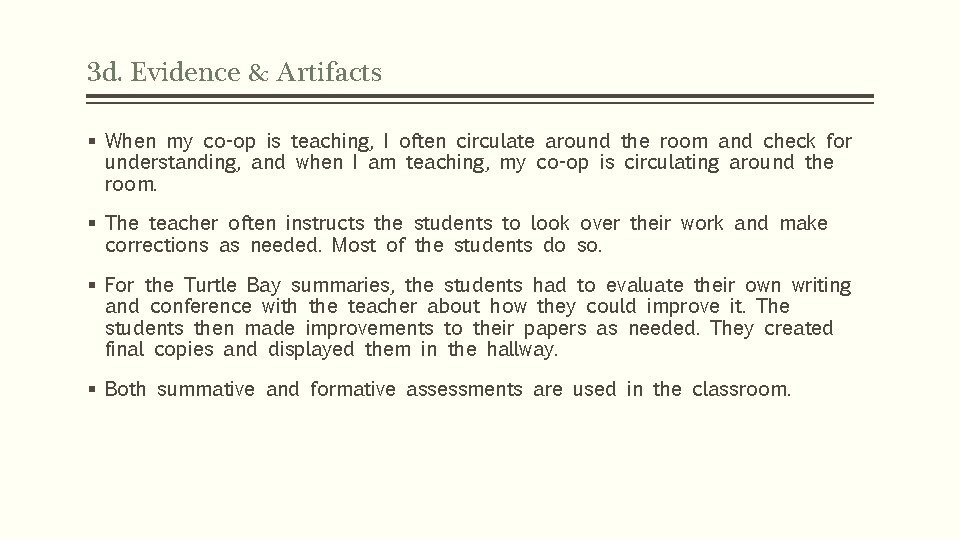
3 d. Evidence & Artifacts Final copies and displays of Turtle Bay summaries This is an example of one of the assessments used for a social studies grade.
3 d. Justification § For this section, I included that my co-op teacher and I often circulate around the room to check for understanding. This is a great way for both of us to assess how the students are doing while one of us is teaching. If a student is not getting it, then one of us jumps in to help that student out. § The students are always being asked to look over their work. This is great because the students are assessing themselves and checking their work before they hand it in. Also, if a student rushed through their work, this forces them to check their work and correct it. § I included the Turtle Bay summaries because this was a great example of the students monitoring their own work. They had to correct their work and some of the students conferenced with the teacher to improve it. § I also included a social studies assessment example for this section because it shows a variety of questions that students have to respond to for understanding. They also had to use the chart to analyze and answer questions. § For this section, I think the level of performance would be proficient. I think that it is proficient because there a variety of assessments being used to check for student understanding. Both formative assessments and summative assessments are used throughout. The students monitor their own learning when appropriate. Finally, appropriate feedback is often given to students.