
Charlie Chaplin Modern Times http www youtube comwatch
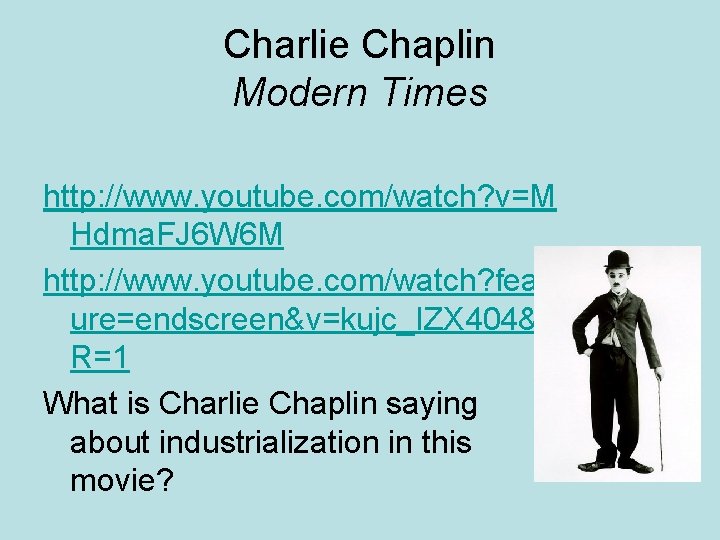
Charlie Chaplin Modern Times http: //www. youtube. com/watch? v=M Hdma. FJ 6 W 6 M http: //www. youtube. com/watch? feat ure=endscreen&v=kujc_IZX 404&N R=1 What is Charlie Chaplin saying about industrialization in this movie?
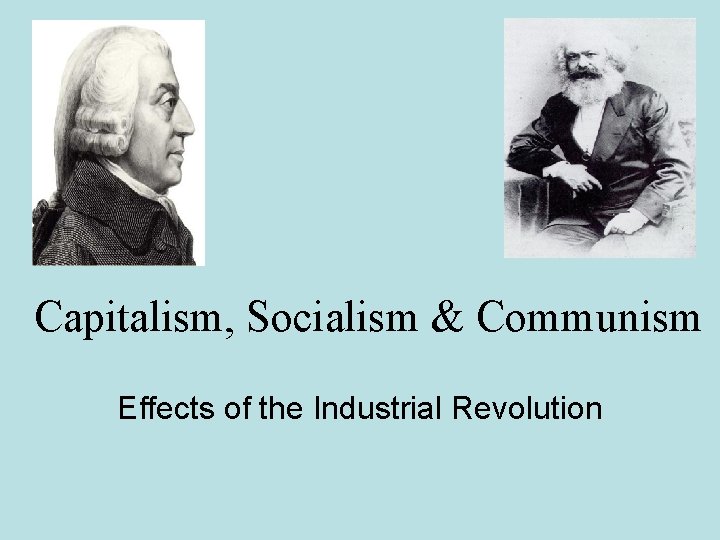
Capitalism, Socialism & Communism Effects of the Industrial Revolution
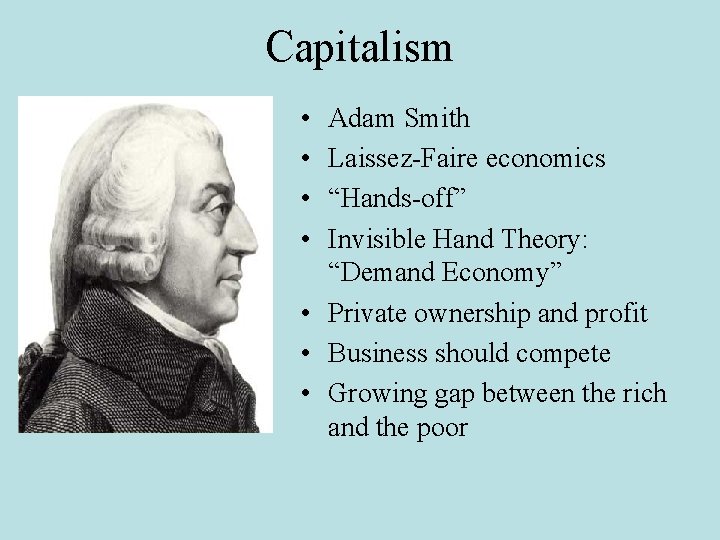
Capitalism • • Adam Smith Laissez-Faire economics “Hands-off” Invisible Hand Theory: “Demand Economy” • Private ownership and profit • Business should compete • Growing gap between the rich and the poor
Drawbacks of capitalism
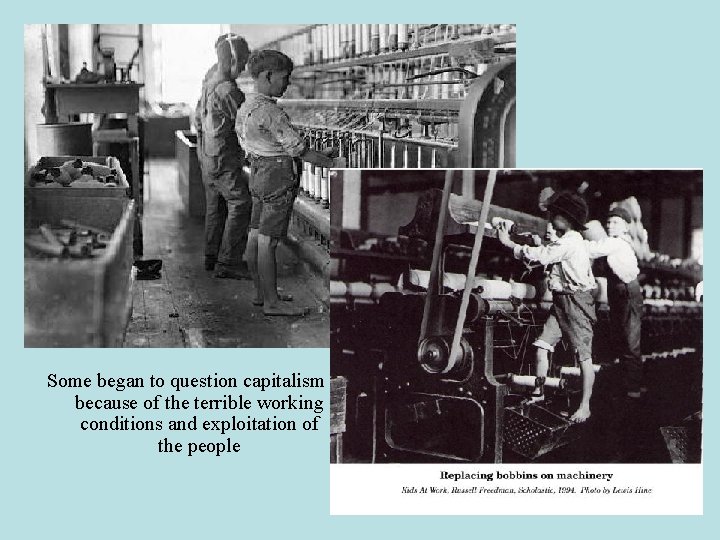
Some began to question capitalism because of the terrible working conditions and exploitation of the people
• • Class tension Rich vs. Poor ncome gap Exploitation of the workers • Poor working conditions • ong hours, little pay • Greed and corruption?
Charles Fourier • • Command economy: No private ownership Government controls production overnment controls distribution and costs Goal: Eliminate the income gap Government takes action to create equality ll are workers, none are owners Popular among the poor, working class Saint Simon SOCIALISM

Drawbacks of socialism Effort is not rewarded • Lazy workers earn as much as hard-workers. Personal freedom is limited • Gov’t determines how much is made, how much it costs, & how much one can have. • Socialism usually leads to harsh dictatorship Bad economic planning by the gov’t supply often does not meet demand
https: //www. youtube. com/watch? v=Qra 0 hl. O 6 h. Zk&list=PLFA 18 FA 326 D 9 C 9018 An extreme reaction to Capitalism
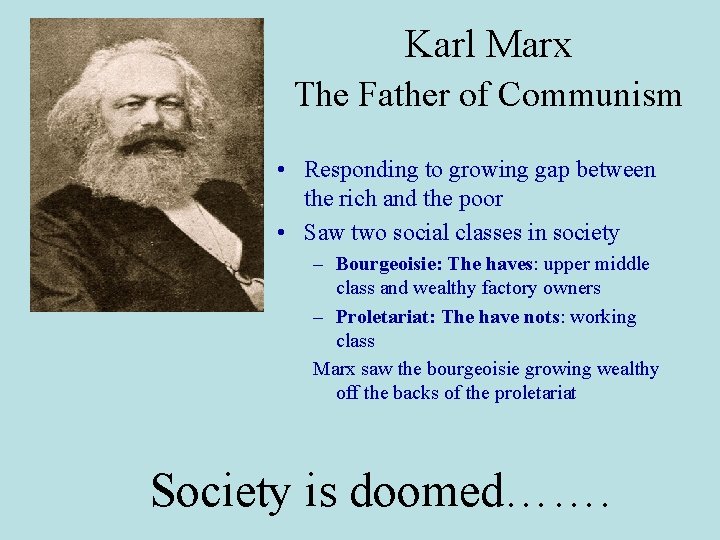
Karl Marx The Father of Communism • Responding to growing gap between the rich and the poor • Saw two social classes in society – Bourgeoisie: The haves: upper middle class and wealthy factory owners – Proletariat: The have nots: working class Marx saw the bourgeoisie growing wealthy off the backs of the proletariat Society is doomed…….
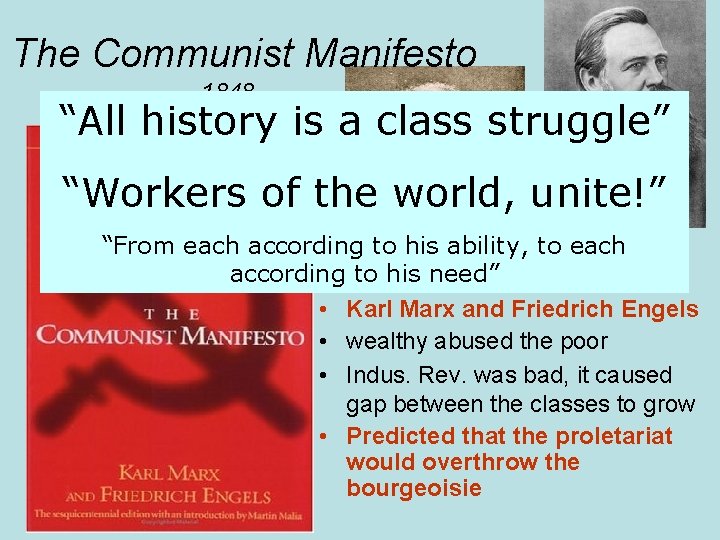
The Communist Manifesto 1848 “All history is a class struggle” “Workers of the world, unite!” “From each according to his ability, to each according to his need” • Karl Marx and Friedrich Engels • wealthy abused the poor • Indus. Rev. was bad, it caused gap between the classes to grow • Predicted that the proletariat would overthrow the bourgeoisie
A revolution to a Classless Society • • Common ownership of wealth. Common ownership of business. Everything is shared. Proletariat would take control of the means of production (capital, factories, etc. ) • Set up a classless society • No reason for government- the government would eventually wither away – Class conflict will not exist; no need for regulation – Communism begins with socialism. – A true communist state has never existed.
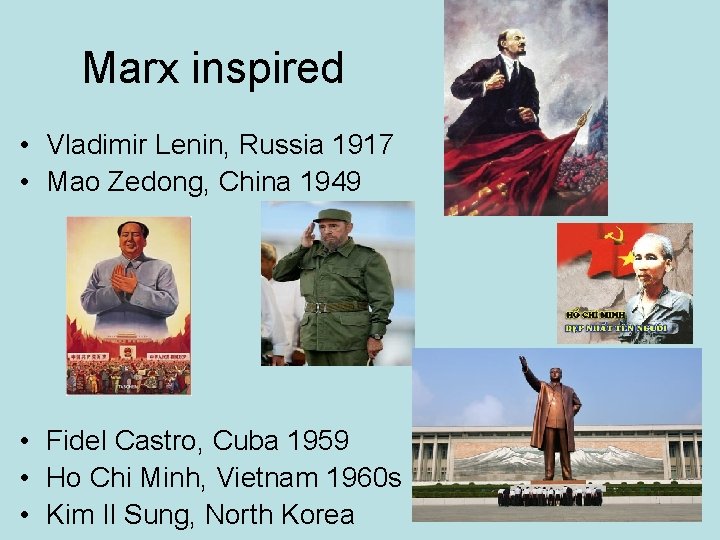
Marx inspired • Vladimir Lenin, Russia 1917 • Mao Zedong, China 1949 • Fidel Castro, Cuba 1959 • Ho Chi Minh, Vietnam 1960 s • Kim Il Sung, North Korea

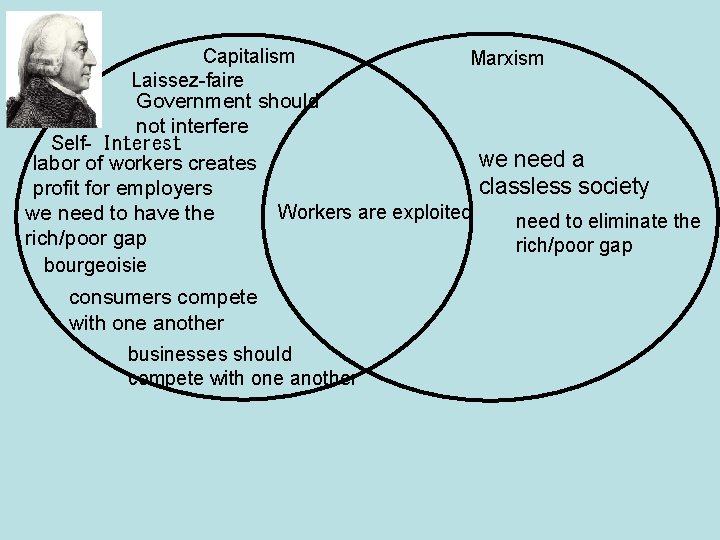
Capitalism Laissez-faire Marxism Government should not interfere Self- Interest we need a labor of workers creates classless society profit for employers Workers are exploited we need to have the need to eliminate the rich/poor gap bourgeoisie consumers compete with one another businesses should compete with one another
- Slides: 16