
Charles Prereading Vocabulary PREREAD Kindergarten Tough Spanked Recess
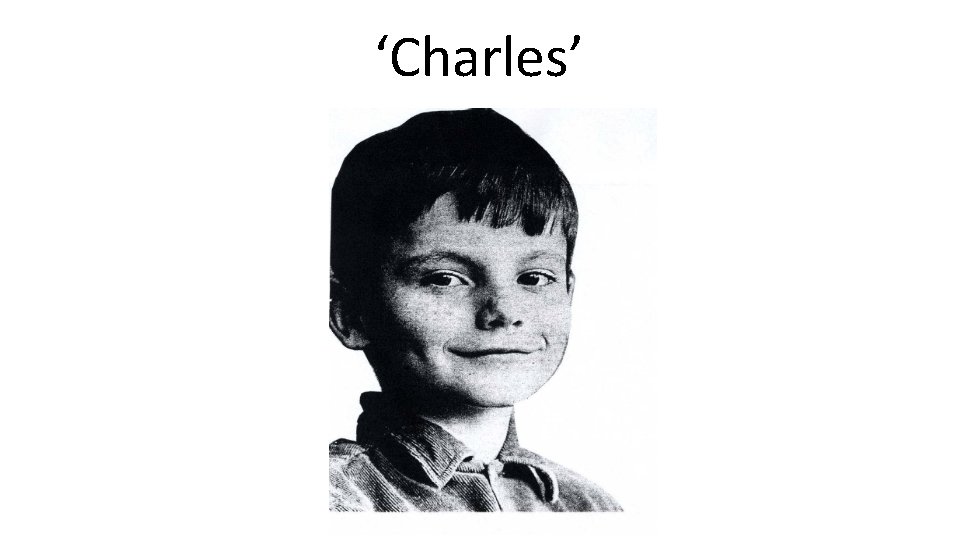
‘Charles’

Pre-reading
Vocabulary PRE-READ • Kindergarten • Tough • Spanked • Recess • Influence • PTA IDIOMS & EXPRESSIONS • Being fresh • Full of news • Throw him out • Set out • Have your hands full COMPREHENSION • Transformed • Insolent • Remark • Anxiously • Incredulously • Plotting • Abandoned • Adjust

Vocabulary PRE-READ • Kindergarten • Tough • Spanked • Recess • Influence • PTA IDIOMS & EXPRESSIONS • Being fresh • Full of news • Throw him out • Set out • Have your hands full COMPREHENSION • Transformed • Insolent • Remark • Anxiously • Incredulously • Plotting • Abandoned • Adjust


Reading

1 st reading • Narratıon https: //www. youtube. com/watch? v=ap 5 OE 0 LHAd. M https: //www. youtube. com/watch? v=fyv 9 Wb 4 wua 4 2 nd reading • Plot graphs https: //prezi. com/niqin 1 fzy_qd/charles-short-story-assignment/ https: //prezi. com/-q 3 z 0 dcaqlbe/charles-by-shirley-jackson/ https: //prezi. com/ehiwxhgvn 4 m 0/charles/
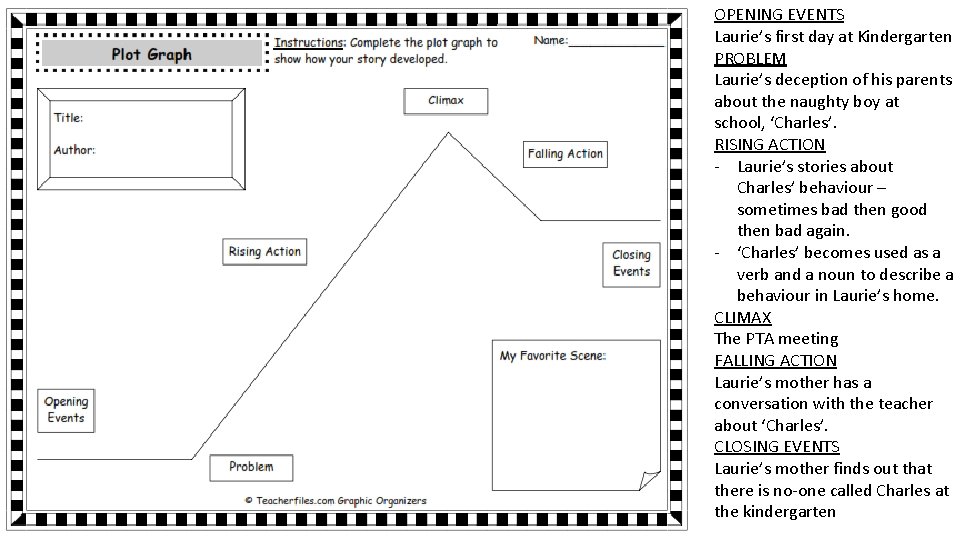
OPENING EVENTS Laurie’s first day at Kindergarten PROBLEM Laurie’s deception of his parents about the naughty boy at school, ‘Charles’. RISING ACTION - Laurie’s stories about Charles’ behaviour – sometimes bad then good then bad again. - ‘Charles’ becomes used as a verb and a noun to describe a behaviour in Laurie’s home. CLIMAX The PTA meeting FALLING ACTION Laurie’s mother has a conversation with the teacher about ‘Charles’. CLOSING EVENTS Laurie’s mother finds out that there is no-one called Charles at the kindergarten

ANIMATED SCHOOL PROJECT https: //www. youtube. com/watch? v=MIBDZw. Pjceg CHARLES THE MOVIE https: //www. youtube. com/watch? v=k. Ulnyh. Jj 6 e. E • Story map https: //prezi. com/-q 3 z 0 dcaqlbe/charles-by-shirley-jackson/
Plot transcript of Charles by Shirley Jackson [Plot Graph] Summary/Idea/Plot Laurie is a small boy who causes trouble at his school, he tells his parents that there is a boy named Charles who is bad when it is actually him. Setting This short story takes place at Laurie's school and house, at any era in time. Characters Protagonist: Laurie Antagonist: Charles Secondary Characters: Mom Dad, and Teacher Theme The theme of the short story is deception of children. Not all children say who they really are. "Do you know what Charles did today? " (Jackson) Conflict The conflict would be man vs man considering that Laurie's parents have a problem with "Charles". Point of view The point of view of "Charles" is this story is written in third person considering it was a narration. Literary Device One literary device that is used in this short story is allusion. The author, Shirley Jackson, wanted the readers think that Charles was an actual kid in Laurie’s class when in fact Charles is Laurie.
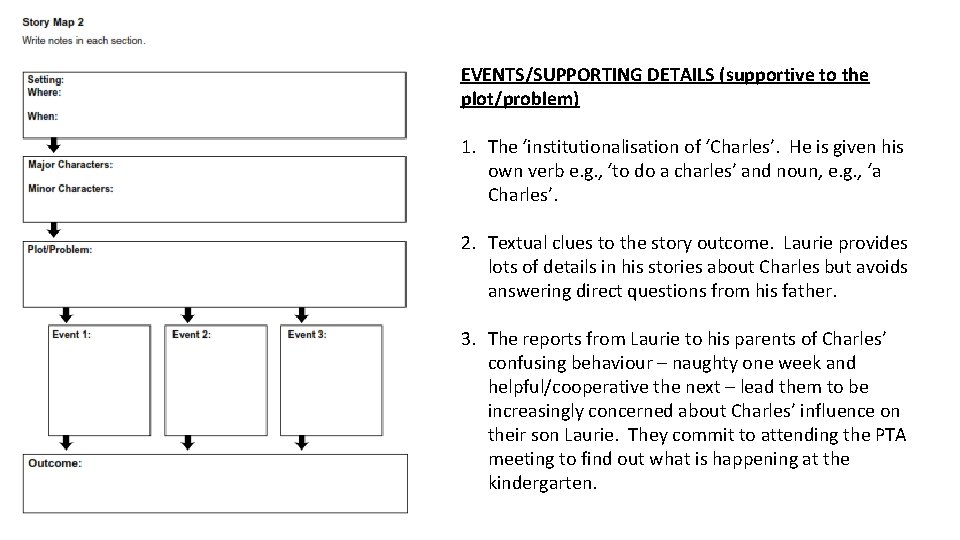
EVENTS/SUPPORTING DETAILS (supportive to the plot/problem) 1. The ‘institutionalisation of ‘Charles’. He is given his own verb e. g. , ‘to do a charles’ and noun, e. g. , ‘a Charles’. 2. Textual clues to the story outcome. Laurie provides lots of details in his stories about Charles but avoids answering direct questions from his father. 3. The reports from Laurie to his parents of Charles’ confusing behaviour – naughty one week and helpful/cooperative the next – lead them to be increasingly concerned about Charles’ influence on their son Laurie. They commit to attending the PTA meeting to find out what is happening at the kindergarten.

Comprehension

For discussion "Have you ever blamed someone for something that you've done? On the other hand, has someone ever blamed you for something that you haven't done? Explain what happened and how you felt in each situation. '
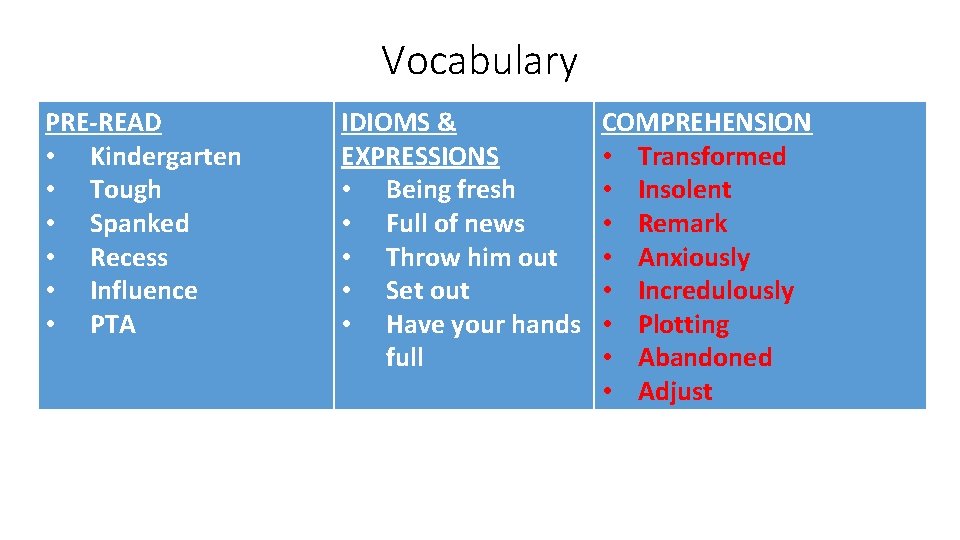
Vocabulary PRE-READ • Kindergarten • Tough • Spanked • Recess • Influence • PTA IDIOMS & EXPRESSIONS • Being fresh • Full of news • Throw him out • Set out • Have your hands full COMPREHENSION • Transformed • Insolent • Remark • Anxiously • Incredulously • Plotting • Abandoned • Adjust

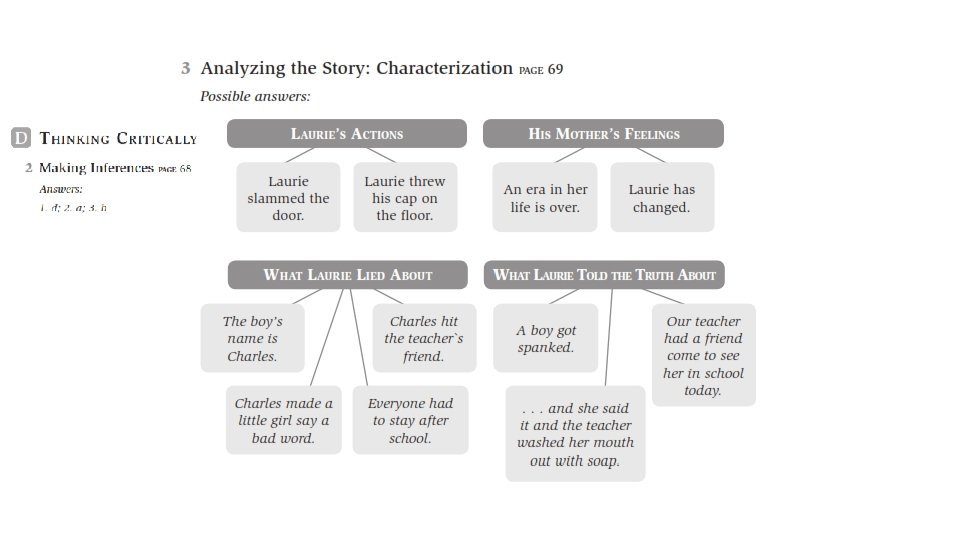
CHARACTER LIST Charles—a little boy (revealed at the end of the story to be imaginary) who causes all sorts of trouble in Laurie’s kindergarten class Laurie—a young boy just beginning kindergarten Mother —Laurie’s kind but unobservant mother Father—Laurie’s equally unobservant father Baby sister—Laurie’s younger sister and merely referred to in passing Laurie’s teacher—a teacher at Laurie’s kindergarten
CHARACTER ANALYSIS As indicated by the swagger with which he leaves home for the first day of kindergarten, Laurie is eager to start school and break away from his childhood. His rejection of his childish “corduroy bibs” for the more manly “blue jeans and a belt” signify his desire to grow up, and the fact that he “forgets” to wave good-bye to his mother at the corner represents the abruptness with which he turns his back on his childhood and maternal nurturance. His mother calls him a “sweet-voiced nursery-school tot” as the story opens, which is an unusual description for a child, whom one would generally characterize by his nature rather than by his voice. However, it is indeed his voice that does characterize him, because readers learn about Laurie by hearing the stories he tells rather than by viewing what he does. And while he says he is telling stories about Charles, a boy who causes all variety of problems at school, he is in fact using Charles to tell stories about himself, a bad part he splits from the rest of him to retain the harmony of home and the safety it represents. Indeed, separation from the mother is an important aspect of growing up, but so is negotiating in a socially acceptable way unconscious desires that conflict with accepted rules of behaviour. Here little Laurie has problems, for rather than behave according to the rules, he breaks them without taking responsibility for doing so, instead attributing his transgressions to a shadow figure of himself, a doppelganger, an alter ego who is he and yet not he. Significantly, it is in front of his parents that he splits himself into the good child and bad child, projecting all of the latter on the make-believe Charles. At school he is simply the kid who gets into trouble. The father comes home to eat lunch with the family but is ineffectual as an authority figure. Although his father says, “See here young man” to keep him at the. . .

Summarisıng
OVERVIEW In many ways, Shirley Jackson’s story “Charles” seems like a humorous sitcom about a naughty child. The mother’s voice in telling this story about the experiences of her little boy, Laurie (a rather unusual name for a boy), in kindergarten could be that of any mother. Children often come home with tales about the “bad kid” at school who always gets into trouble, and Laurie is no exception. Day after day, he reports the naughty things a boy named Charles does—from hitting the teacher, to bouncing a seesaw off a girl’s head, to saying bad words. Laurie’s parents are mildly concerned about their son learning in such an environment, but they do not intervene at all. Rather, Laurie’s stories about Charles become part of the household lore. Because they love their son, his parents believe all he has to say, and this belief prevents them from noticing that what he says is not the full truth. When the mother learns at the end of the story that there is no child named Charles in the class and that it is Laurie who has had difficulty adjusting to kindergarten and has done all the bad things he attributed to Charles, the reader no less than the mother is very surprised. This lighthearted story, which seems to merely depict a typical boy’s early days at school, more significantly suggests the ways children invent shadow figures as a means of confronting problematic feelings while forming their identities. Laurie invents an alter ego to do “bad” so that he might stay good in the eyes of his parents. Loving but myopic, the parents do not intervene. By eliminating any real resolution to the story, Jackson leaves an ominous message concerning children, human behavior, and family relationships.
SUMMARY The narrator tells the story of Laurie’s first month at kindergarten. Laurie comes home each day to report on the doings of a fellow student, Charles, who behaves in an extraordinary manner. For the first two weeks, Charles is spanked or otherwise punished almost daily for being “fresh, ” for hitting or kicking the teachers, for injuring fellow students, and for a host of proscribed activities. Charles proves so interesting to the kindergarten class that whenever he is punished, all the students watch him; whenever he stays after school, all the students stay with him. As a result of this behaviour, Charles becomes an institution at the Hyman house. Whenever anyone does anything bad, inconsiderate, or clumsy, he or she is compared to Charles. During the third week, however, Charles undergoes a conversion. For several days, he becomes a model student, the teacher’s helper. Reports of this transformation astonish the Hyman household. Then, Charles seems to return to normal, first persuading a girl to say a terrible word twice, for which her mouth is washed out with soap. The next day, Charles himself says the word several times and receives several washings. When the day of the monthly Parent Teacher Association meeting arrives, Laurie’s mother is anxious to go and to meet the mother of the remarkable Charles. At the meeting, she learns from Laurie’s teacher not only that Laurie has had some difficulty adjusting to kindergarten, but also that there is no student named Charles in her class. https: //prezi. com/t-lysawppgam/charles-by-shirley-jackson/
EXTENDED SUMMARY In a neighbourly tone, Laurie’s mother recounts her son’s experiences in kindergarten. She begins with the first day of school, when the child walks out the front door, and continues through her meeting his teacher during a PTA meeting five weeks later. The mother knows that school will forever change her son, “that an era of [her] life was ended. ” The little boy who was her “sweet-voiced nursery-school tot” was immediately “replaced by a longtrousered, swaggering character who forgot to stop at the corner and wave good-bye” to her. Thus, the story opens with the voice of many mothers who are sad but proud their little boys are growing up and leaving the safety of their protection. The mother’s prediction turns out to be quite accurate, for in many small ways that seem typical of little boys, Laurie begins to behave differently at home. After the very first day at school, he slams the door and throws his hat on the floor and screams, “Isn’t anybody here? ” Demanding attention in this way, Laurie speaks “insolently” to his father and pronounces that his teacher said it was a sin “to take the Lord’s name in vain, ” thus establishing a new rule for the household, one at which the parents can only smile but that also tells them they will need to change their behaviour to accommodate their son’s new perception of the world as a result of school. When his father asks Laurie if he learned anything at school, Laurie, like many children, replies in the negative but proceeds to talk about a naughty child, Charles, who was, according to the teacher, “fresh, ” and therefore punished with a spanking and directions to stand in the corner. The next day Laurie reports with a grin that Charles hit the teacher because “she tried to make him colour with red crayons” when he wanted to colour with green, and the day after that, according to Laurie, this incorrigible child bounced a seesaw on the head of another child and was again punished for his misbehaviour. Each day, Laurie recounts another tale of how Charles misbehaved in very aggressive. . .
Additional comprehension questions (literary elements, context clues and inference)
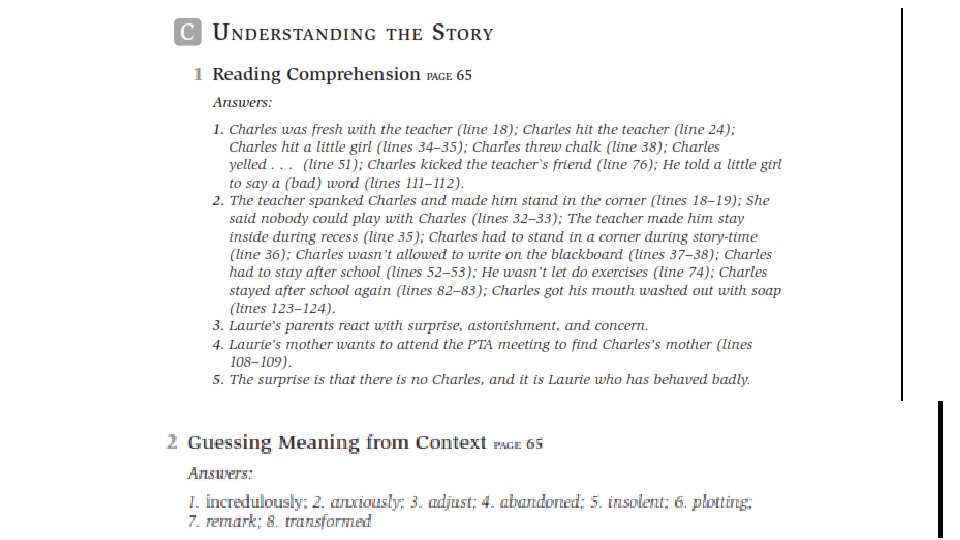
Reading comprehension questions 1) How does Laurie’s mother express to the reader that Laurie was growing up? 2) How do you think Laurie’s mom felt about Laurie growing up (making inferences)? 3) Provide 3 examples of Laurie’s bad behavior at home: 4) List 5 examples of Charles’s bad behavior at school: 5) Provide 3 ways Charles’s teacher punishes him: 6) How does the kindergarten teacher reward Charles for his good behavior? 7) Why does Laurie’s mother miss the first PTA meeting?
Further comprehension questions Q 1. Who is narrating the short story Charles? Q 2. According to the narrator, how did Laurie change when he started kindergarten? Q 3. When was Charles first mentioned in Laurie's home? Explain what he had done? Q 4. Explain how Charles became a household joke at Laurie's home. Q 5. Why were Laurie's parents looking forward to meeting his kindergarten teacher? Q 6. Why did Laurie's parents take so long to find out the truth about Charles? Q 7. Why did Laurie create the imaginary boy Charles? Q 8. As the story comes to an end, most of us are very surprised to learn the identity of Charles. If you go back and read the story again you may notice that the author plants clues along the way to prepare you. What clue to the identity of Charles can you find in the opening paragraph of the story?
Understanding Literary Elements 1. Describe the setting of the story: 2. How does the use of two different places as the setting impact the story? 3. How does the story being told from Laurie’s mother’s point of view impact the story? 4. What is the conflict a character must overcome? 5. How does Laurie’s mother describe Laurie at the beginning of the story? (What do you think about Laurie after reading the first paragraph? ) 6. How does this impact the reader’s view of Laurie? 7. What is theme (or moral) of the story?
Making inferences—When we make inferences, we are making educated guesses. The guesses are not right or wrong as long as you have evidence from the text to support your guess. 1. As the reader, what can we infer about Laurie’s mother’s expectations of Laurie? Why? 2. Do you think Laurie’s mother would have missed the first PTA meeting if she knew her son was the one behaving poorly? Why or why not? 3. How does Laurie respond when his dad asks, “What are they going to do about Charles, do you suppose? ” 4. Based on this answer do you think Laurie is concerned with the consequences? Why or why not? 5. How do we know Laurie’s father is not as concerned about Charles as Laurie’s mother? 6. At the end of the story, Shirley Jackson provides a surprise ending. However, if we look at the beginning, we see there are hints and clues to the fact that Laurie could be Charles. What is this type of literary element called?
Using Context Clues Use the surrounding text to help provide a definition for the underlined words 1. During the third and fourth weeks it looked like a reformation in Charles; Laurie reported grimly at lunch on Thursday of the third week, “Charles was so good today the teacher gave him an apple. ” Reformation? 2. Based on the previous sentence, how does Laurie feel about Charles behaving better? (Hint: Think about the adverb used to describe the way Laurie reported the news) 3. “With the third week of kindergarten Charles was an institution in our family [. ]” Institution? 4. “You know what Charles did today? ” Laurie demanded at the lunch table, in a voice slightly awed. “He told a little girl to say a word and she said it and the teacher washed her mouth out with soap and Charles laughed. ” Awed?

Additional Vocabulary
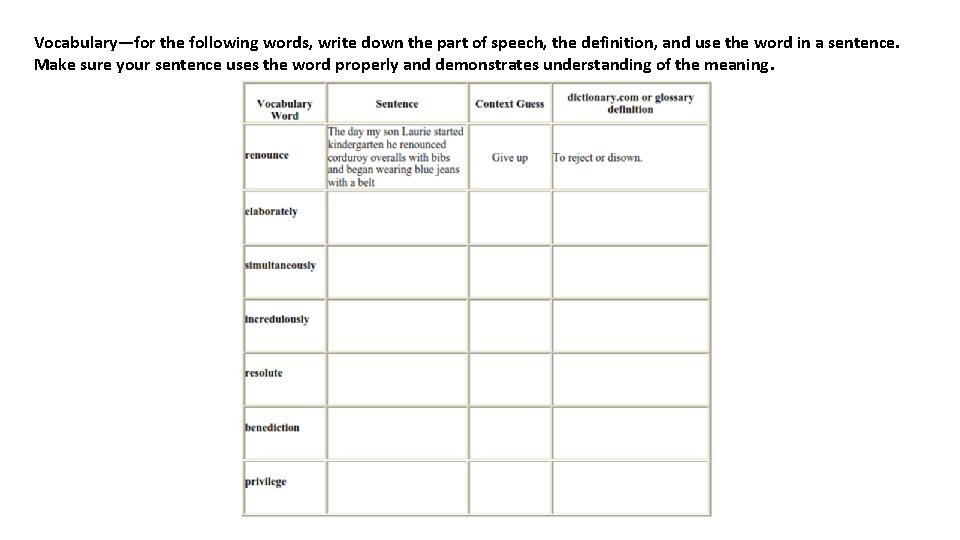
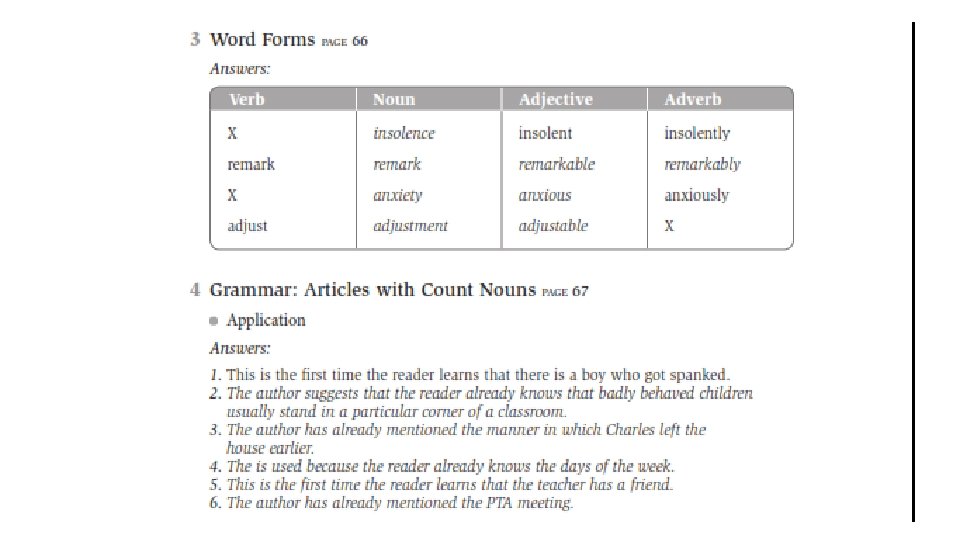
Vocabulary—for the following words, write down the part of speech, the definition, and use the word in a sentence. Make sure your sentence uses the word properly and demonstrates understanding of the meaning.
- Slides: 37