
Charles Darwin When he was born and we
Charles Darwin
When he was born and we did he die • Charles Darwin was born at Charles Robert Darwin 12 February 1809 • He died on 19 April 1882 at a place called Westminster Abbey

Early life and education Charles Robert Darwin was born in Shrewsbury, Shropshire, on 12 February 1809, at his family's home, The Mount. He was the fifth of six children of wealthy society doctor and financier Robert Darwin and Susannah Darwin (née Wedgwood). His grandfathers Erasmus Darwin and Josiah Wedgwood were both prominent abolitionists. Erasmus Darwin had promoted theories of evolution and common descent in his Zoonomia (1794), anticipating his grandson's work. Both families were largely Unitarian, though the Wedgwood were adopting Anglicanism. Robert Darwin, himself quietly a freethinker, had baby Charles baptised in November 1809 in the Anglican St Chad's Church, Shrewsbury, but Charles and his siblings attended the Unitarian chapel with their mother. The eight-year-old Charles already had a taste for natural history and collecting when he joined the day school run by its preacher in 1817. That July, his mother died. From September 1818, he joined his older brother Erasmus attending the nearby Anglican Shrewsbury School as a boarder • Painting of the seven-year-old Charles Darwin in 1816, by Ellen Sharples
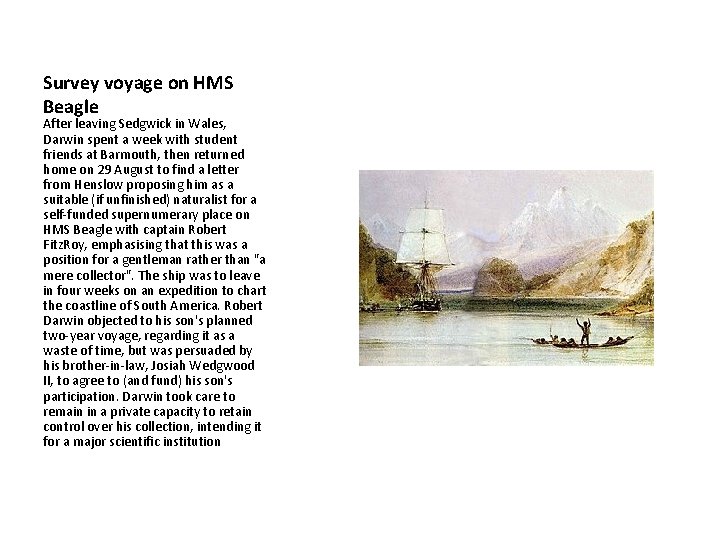
Survey voyage on HMS Beagle After leaving Sedgwick in Wales, Darwin spent a week with student friends at Barmouth, then returned home on 29 August to find a letter from Henslow proposing him as a suitable (if unfinished) naturalist for a self-funded supernumerary place on HMS Beagle with captain Robert Fitz. Roy, emphasising that this was a position for a gentleman rather than "a mere collector". The ship was to leave in four weeks on an expedition to chart the coastline of South America. Robert Darwin objected to his son's planned two-year voyage, regarding it as a waste of time, but was persuaded by his brother-in-law, Josiah Wedgwood II, to agree to (and fund) his son's participation. Darwin took care to remain in a private capacity to retain control over his collection, intending it for a major scientific institution
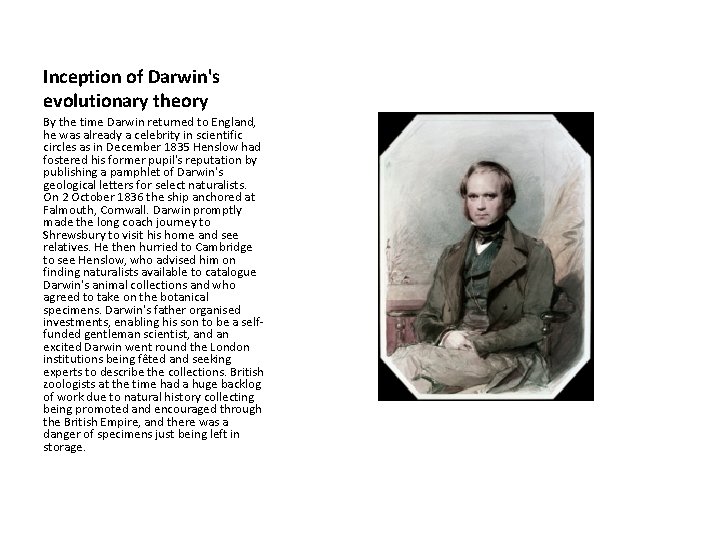
Inception of Darwin's evolutionary theory By the time Darwin returned to England, he was already a celebrity in scientific circles as in December 1835 Henslow had fostered his former pupil's reputation by publishing a pamphlet of Darwin's geological letters for select naturalists. On 2 October 1836 the ship anchored at Falmouth, Cornwall. Darwin promptly made the long coach journey to Shrewsbury to visit his home and see relatives. He then hurried to Cambridge to see Henslow, who advised him on finding naturalists available to catalogue Darwin's animal collections and who agreed to take on the botanical specimens. Darwin's father organised investments, enabling his son to be a selffunded gentleman scientist, and an excited Darwin went round the London institutions being fêted and seeking experts to describe the collections. British zoologists at the time had a huge backlog of work due to natural history collecting being promoted and encouraged through the British Empire, and there was a danger of specimens just being left in storage.
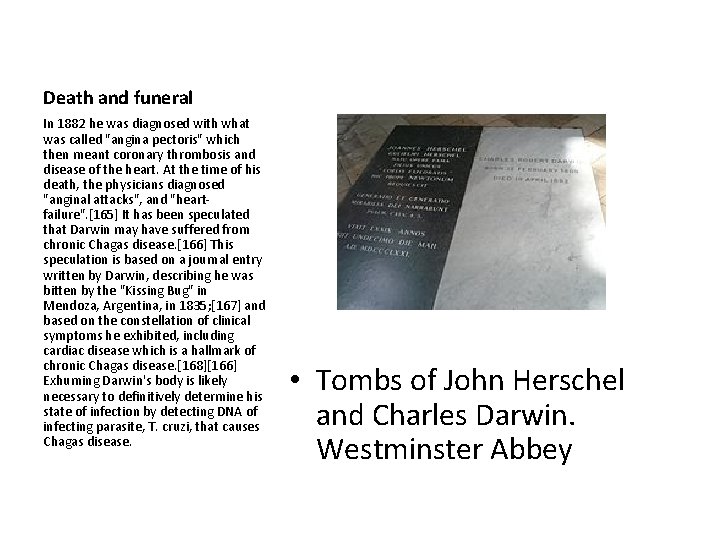
Death and funeral In 1882 he was diagnosed with what was called "angina pectoris" which then meant coronary thrombosis and disease of the heart. At the time of his death, the physicians diagnosed "anginal attacks", and "heartfailure". [165] It has been speculated that Darwin may have suffered from chronic Chagas disease. [166] This speculation is based on a journal entry written by Darwin, describing he was bitten by the "Kissing Bug" in Mendoza, Argentina, in 1835; [167] and based on the constellation of clinical symptoms he exhibited, including cardiac disease which is a hallmark of chronic Chagas disease. [168][166] Exhuming Darwin's body is likely necessary to definitively determine his state of infection by detecting DNA of infecting parasite, T. cruzi, that causes Chagas disease. • Tombs of John Herschel and Charles Darwin. Westminster Abbey
- Slides: 6