
Charles Darwin Natural Selection Charles Darwin English naturalist
- Slides: 14
Charles Darwin & Natural Selection
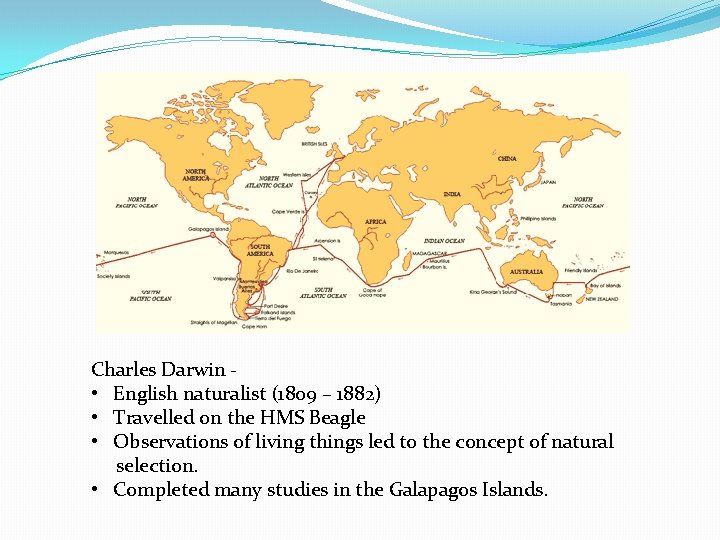
Charles Darwin • English naturalist (1809 – 1882) • Travelled on the HMS Beagle • Observations of living things led to the concept of natural selection. • Completed many studies in the Galapagos Islands.
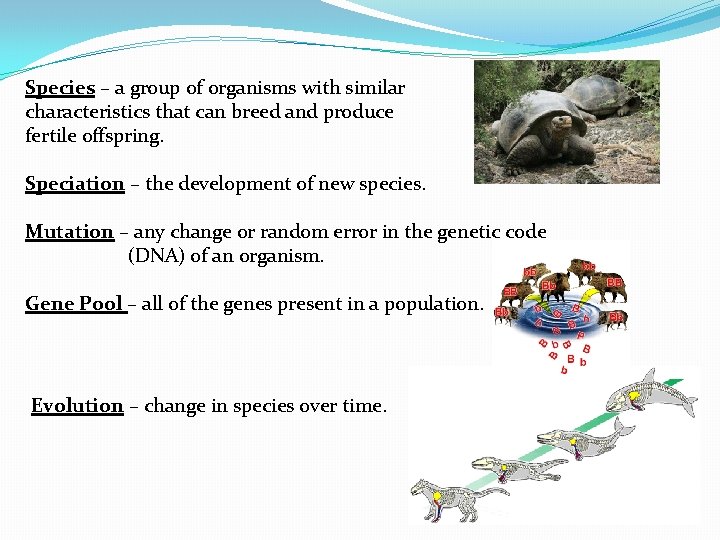
Species – a group of organisms with similar characteristics that can breed and produce fertile offspring. Speciation – the development of new species. Mutation – any change or random error in the genetic code (DNA) of an organism. Gene Pool – all of the genes present in a population. Evolution – change in species over time.
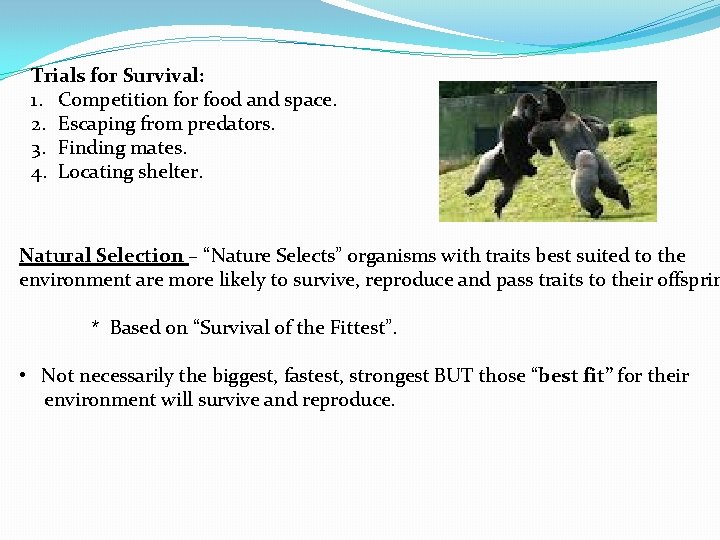
Trials for Survival: 1. Competition for food and space. 2. Escaping from predators. 3. Finding mates. 4. Locating shelter. Natural Selection – “Nature Selects” organisms with traits best suited to the environment are more likely to survive, reproduce and pass traits to their offsprin * Based on “Survival of the Fittest”. • Not necessarily the biggest, fastest, strongest BUT those “best fit” for their environment will survive and reproduce.
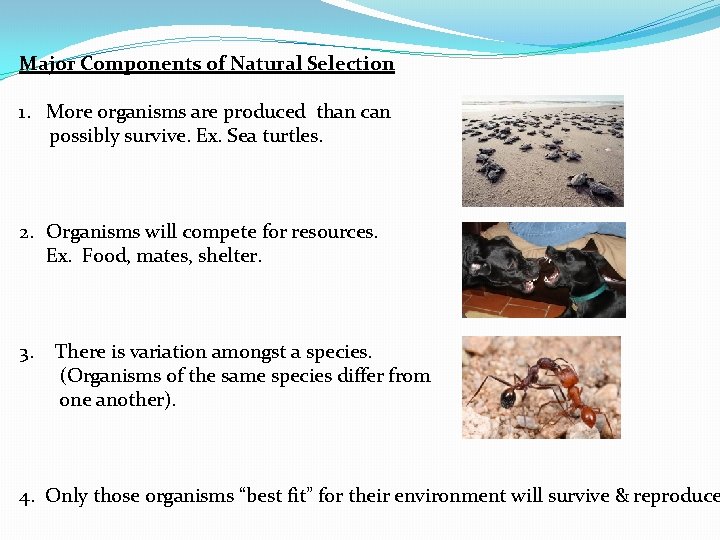
Major Components of Natural Selection 1. More organisms are produced than can possibly survive. Ex. Sea turtles. 2. Organisms will compete for resources. Ex. Food, mates, shelter. 3. There is variation amongst a species. (Organisms of the same species differ from one another). 4. Only those organisms “best fit” for their environment will survive & reproduce
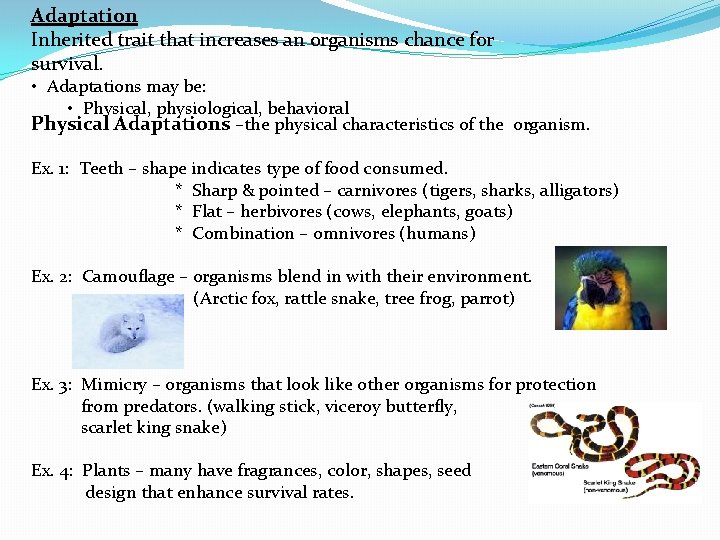
Adaptation Inherited trait that increases an organisms chance for survival. • Adaptations may be: • Physical, physiological, behavioral Physical Adaptations –the physical characteristics of the organism. Ex. 1: Teeth – shape indicates type of food consumed. * Sharp & pointed – carnivores (tigers, sharks, alligators) * Flat – herbivores (cows, elephants, goats) * Combination – omnivores (humans) Ex. 2: Camouflage – organisms blend in with their environment. (Arctic fox, rattle snake, tree frog, parrot) Ex. 3: Mimicry – organisms that look like other organisms for protection from predators. (walking stick, viceroy butterfly, scarlet king snake) Ex. 4: Plants – many have fragrances, color, shapes, seed design that enhance survival rates.
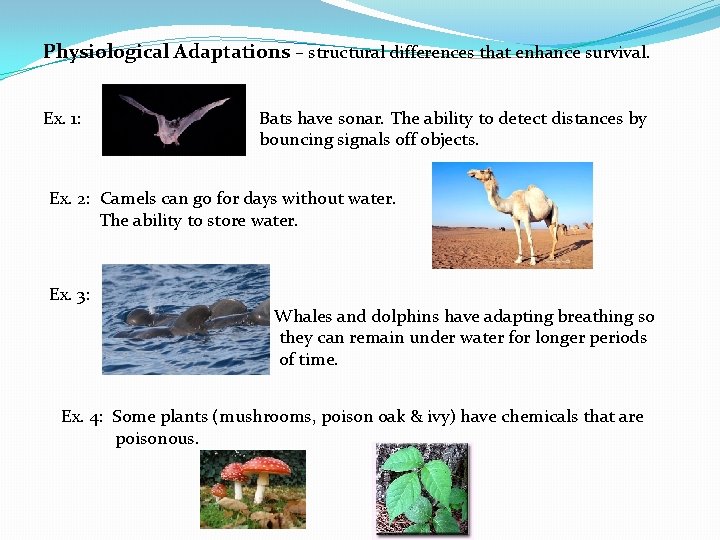
Physiological Adaptations – structural differences that enhance survival. Ex. 1: Bats have sonar. The ability to detect distances by bouncing signals off objects. Ex. 2: Camels can go for days without water. The ability to store water. Ex. 3: Whales and dolphins have adapting breathing so they can remain under water for longer periods of time. Ex. 4: Some plants (mushrooms, poison oak & ivy) have chemicals that are poisonous.
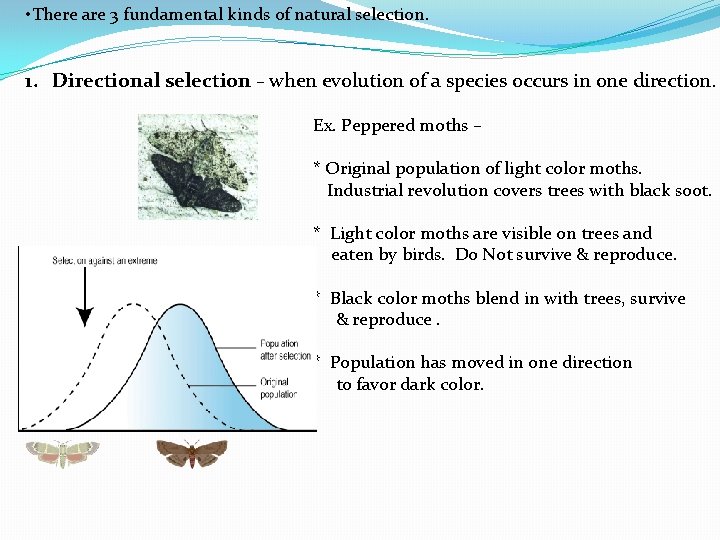
• There are 3 fundamental kinds of natural selection. 1. Directional selection – when evolution of a species occurs in one direction. Ex. Peppered moths – * Original population of light color moths. Industrial revolution covers trees with black soot. * Light color moths are visible on trees and eaten by birds. Do Not survive & reproduce. * Black color moths blend in with trees, survive & reproduce. * Population has moved in one direction to favor dark color.
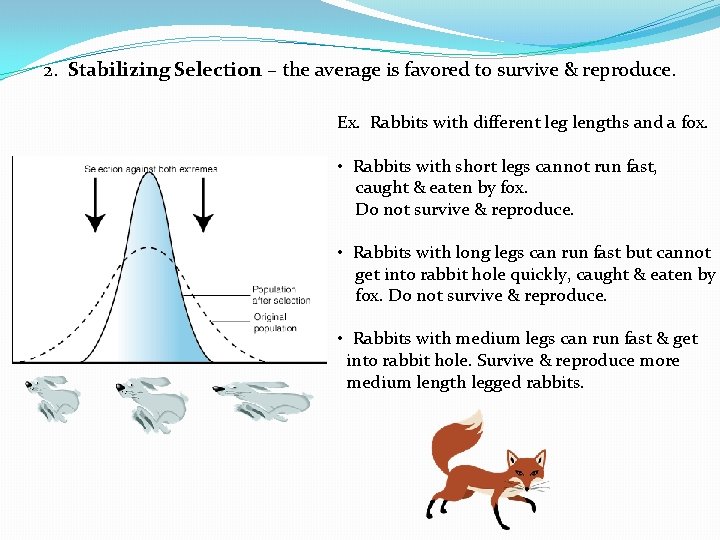
2. Stabilizing Selection – the average is favored to survive & reproduce. Ex. Rabbits with different leg lengths and a fox. • Rabbits with short legs cannot run fast, caught & eaten by fox. Do not survive & reproduce. • Rabbits with long legs can run fast but cannot get into rabbit hole quickly, caught & eaten by fox. Do not survive & reproduce. • Rabbits with medium legs can run fast & get into rabbit hole. Survive & reproduce more medium length legged rabbits.
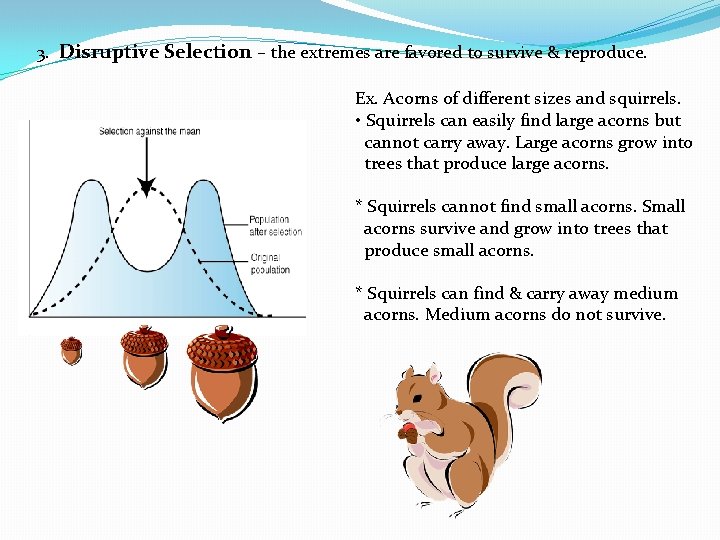
3. Disruptive Selection – the extremes are favored to survive & reproduce. Ex. Acorns of different sizes and squirrels. • Squirrels can easily find large acorns but cannot carry away. Large acorns grow into trees that produce large acorns. * Squirrels cannot find small acorns. Small acorns survive and grow into trees that produce small acorns. * Squirrels can find & carry away medium acorns. Medium acorns do not survive.
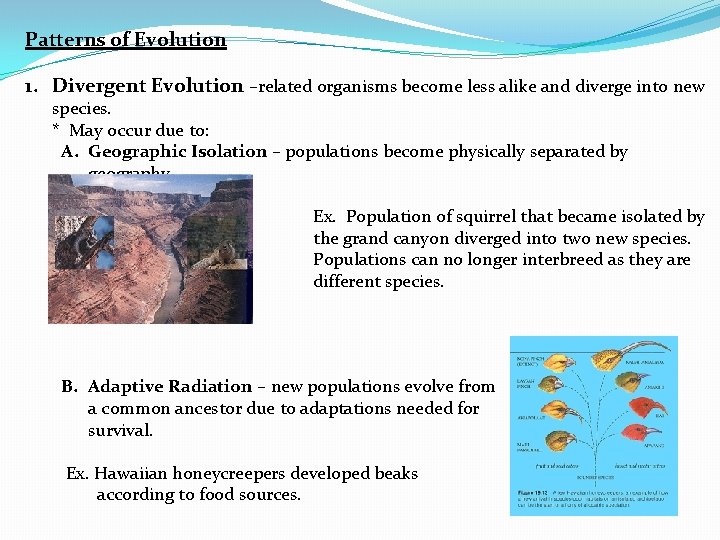
Patterns of Evolution 1. Divergent Evolution –related organisms become less alike and diverge into new species. * May occur due to: A. Geographic Isolation – populations become physically separated by geography. Ex. Population of squirrel that became isolated by the grand canyon diverged into two new species. Populations can no longer interbreed as they are different species. B. Adaptive Radiation – new populations evolve from a common ancestor due to adaptations needed for survival. Ex. Hawaiian honeycreepers developed beaks according to food sources.
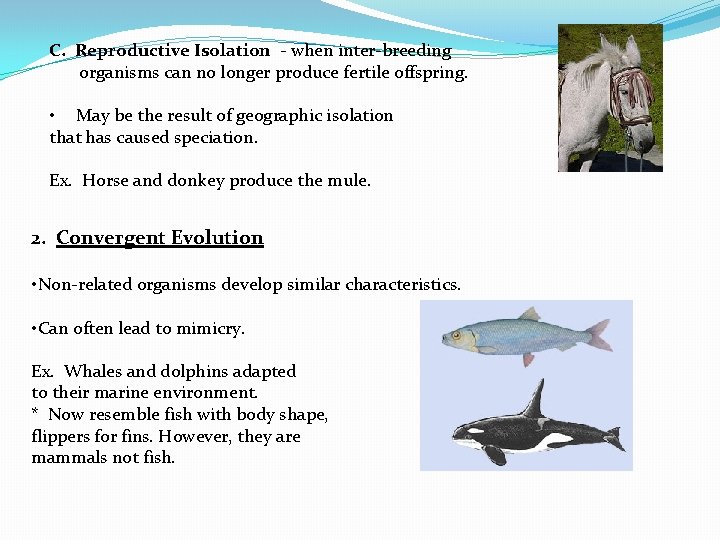
C. Reproductive Isolation - when inter-breeding organisms can no longer produce fertile offspring. • May be the result of geographic isolation that has caused speciation. Ex. Horse and donkey produce the mule. 2. Convergent Evolution • Non-related organisms develop similar characteristics. • Can often lead to mimicry. Ex. Whales and dolphins adapted to their marine environment. * Now resemble fish with body shape, flippers for fins. However, they are mammals not fish.
Genetic Equilibrium – the genetic make-up of a population will remain the same unless some external factor causes it to change. • A population in genetic equilibrium does not evolve. • Genetic equilibrium may be upset by: • • • Natural selection Migration Genetic drift Isolation Mutation Any change will result in evolution.
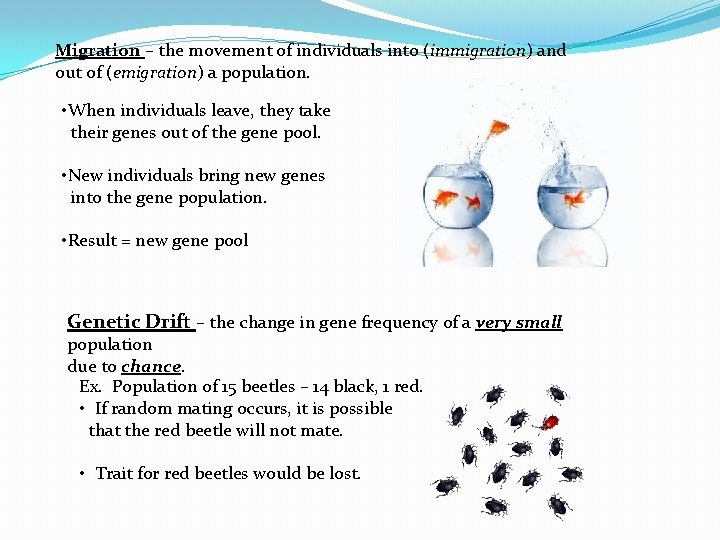
Migration – the movement of individuals into (immigration) and out of (emigration) a population. • When individuals leave, they take their genes out of the gene pool. • New individuals bring new genes into the gene population. • Result = new gene pool Genetic Drift – the change in gene frequency of a very small population due to chance. Ex. Population of 15 beetles – 14 black, 1 red. • If random mating occurs, it is possible that the red beetle will not mate. • Trait for red beetles would be lost.