
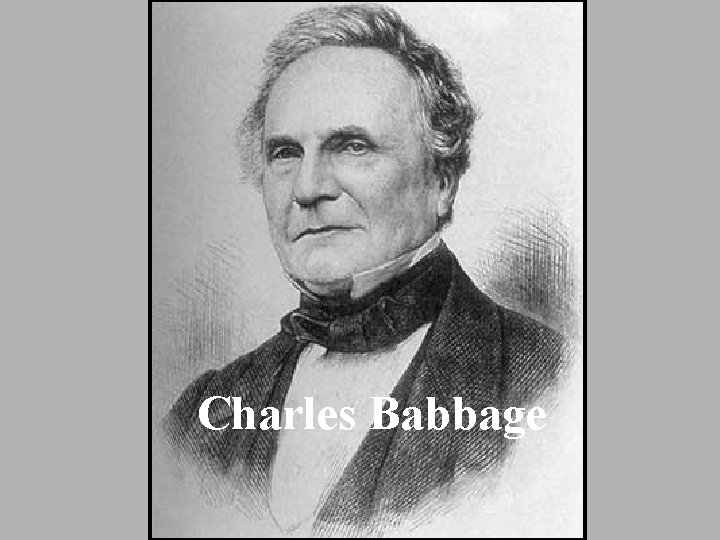
Charles Babbage First GeneralPurpose Automated Digital Computer Charles
Charles Babbage
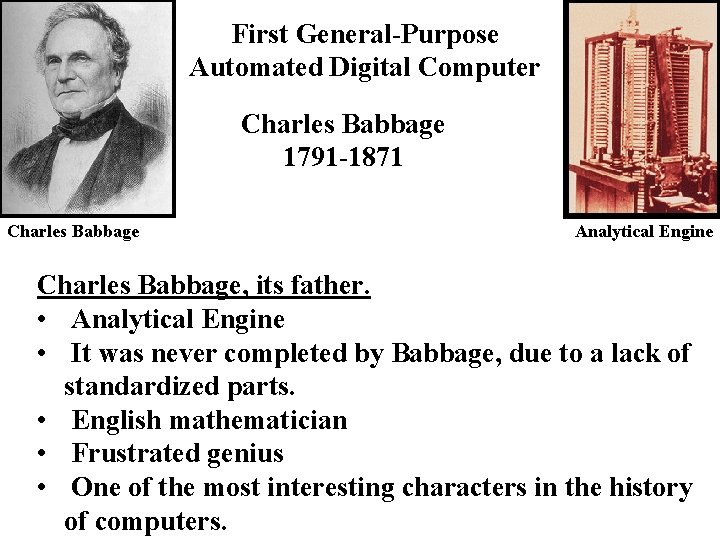
First General-Purpose Automated Digital Computer Charles Babbage 1791 -1871 Charles Babbage Analytical Engine Charles Babbage, its father. • Analytical Engine • It was never completed by Babbage, due to a lack of standardized parts. • English mathematician • Frustrated genius • One of the most interesting characters in the history of computers.
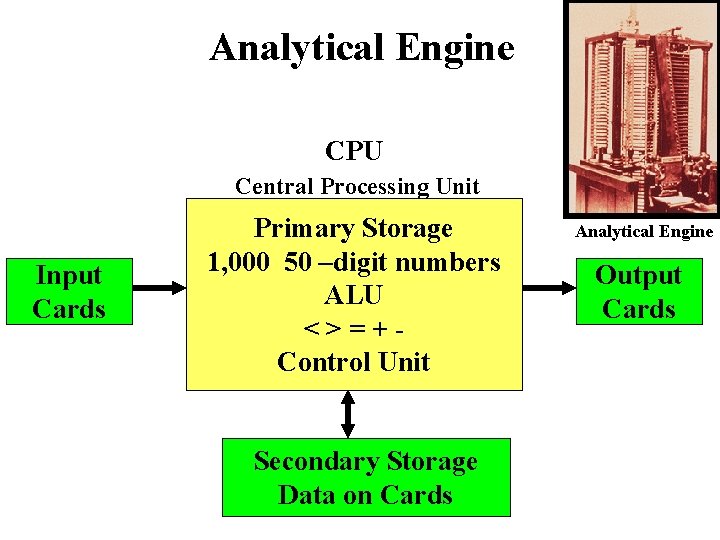
Analytical Engine CPU Central Processing Unit Input Cards Primary Storage 1, 000 50 –digit numbers ALU <>=+Control Unit Secondary Storage Data on Cards Analytical Engine Output Cards
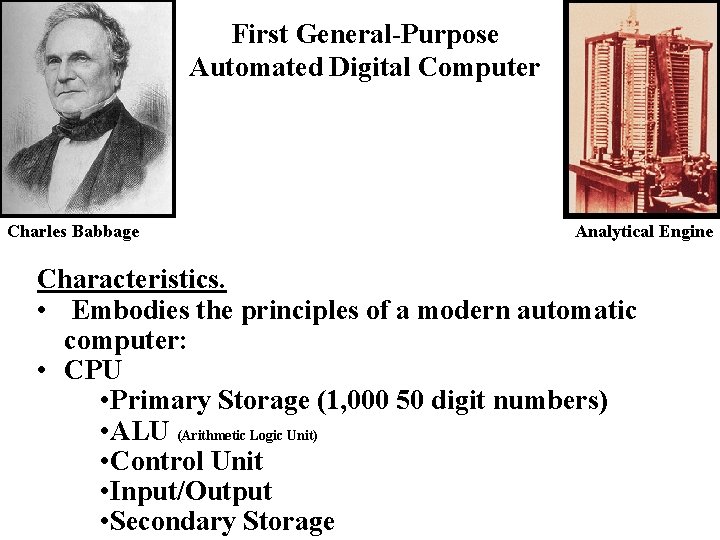
First General-Purpose Automated Digital Computer Charles Babbage Analytical Engine Characteristics. • Embodies the principles of a modern automatic computer: • CPU • Primary Storage (1, 000 50 digit numbers) • ALU (Arithmetic Logic Unit) • Control Unit • Input/Output • Secondary Storage
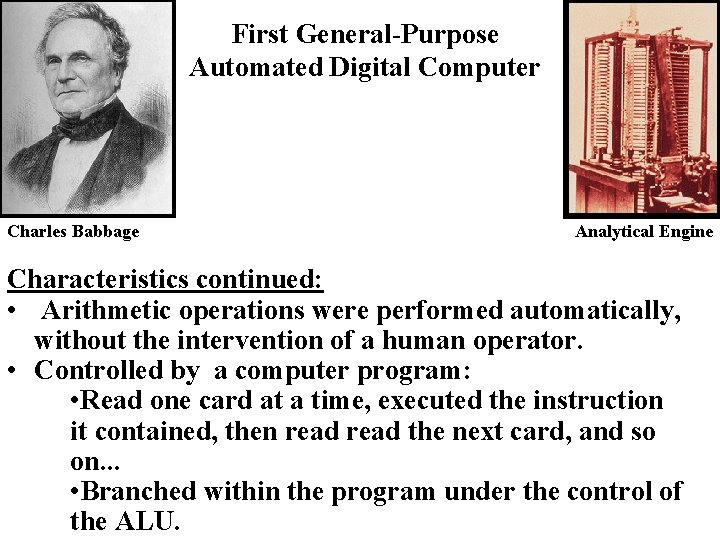
First General-Purpose Automated Digital Computer Charles Babbage Analytical Engine Characteristics continued: • Arithmetic operations were performed automatically, without the intervention of a human operator. • Controlled by a computer program: • Read one card at a time, executed the instruction it contained, then read the next card, and so on. . . • Branched within the program under the control of the ALU.
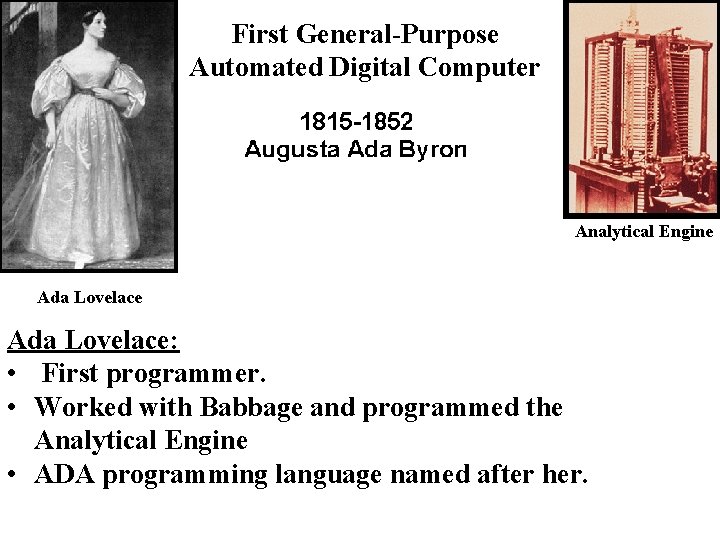
First General-Purpose Automated Digital Computer Analytical Engine Ada Lovelace: • First programmer. • Worked with Babbage and programmed the Analytical Engine • ADA programming language named after her.
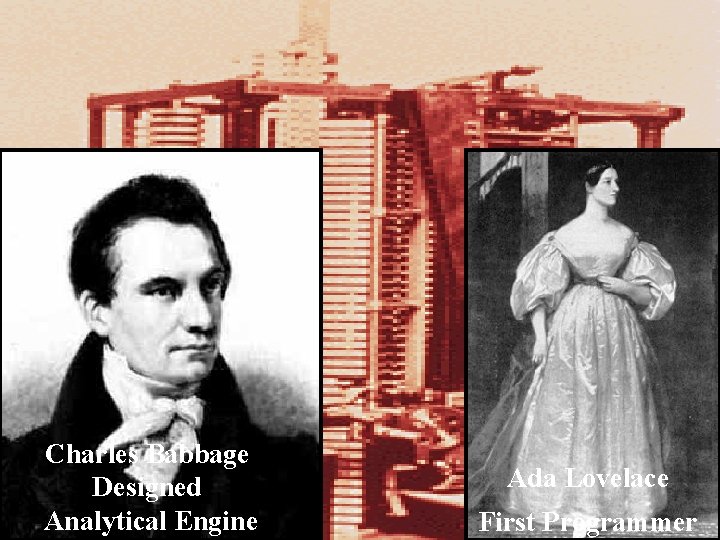
Charles Babbage Designed Analytical Engine Ada Lovelace First Programmer
VIDEO -- BAGGAGE Charles Babbage Analytical Engine (2 min)

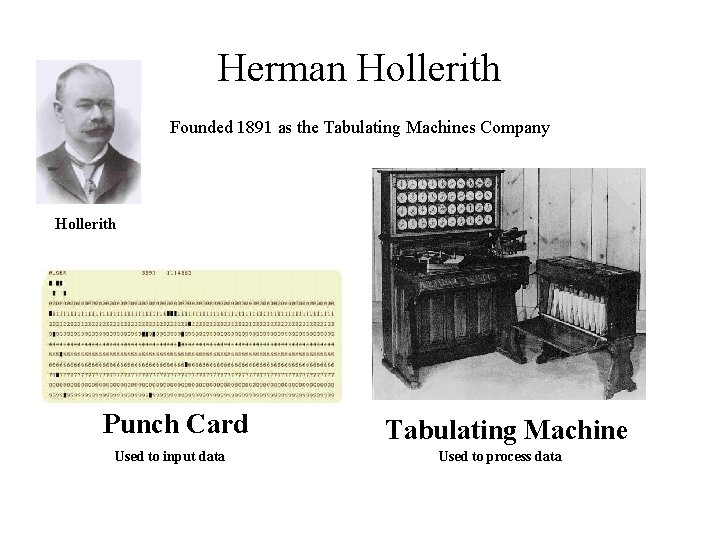
Herman Hollerith Founded 1891 as the Tabulating Machines Company Hollerith Punch Card Used to input data Tabulating Machine Used to process data
Herman Hollerith • Hollerith's Punched Cards The first practical use of punched cards for data processing is credited to the American inventor Herman Hollerith, who decided to use Jacquard's punched cards to represent the data gathered for the American census of 1890, and to read and collate this data using an automatic machine. Many references state that Hollerith originally made his punched cards the same size as the dollar bills of that era, because he realized that it would be convenient and economical to buy existing office furniture, such as desks and cabinets, that already contained receptacles to accommodate stacks of bills. Other sources consider this to be a popular fiction. Whatever the case, we do know that these cards were eventually standardized at 7 and 3/8 inches by 3 and 1/4 inches, and Hollerith's many patents permitted his company (which became International Business Machines (IBM) in 1924) to hold an effective monopoly on punched cards for many years. Herman Hollerith Copyright (c) 1997. Maxfield & Montrose Interactive • Hollerith Video (9 min)
Punch Card Systems Information systems can and are used for both good and evil.
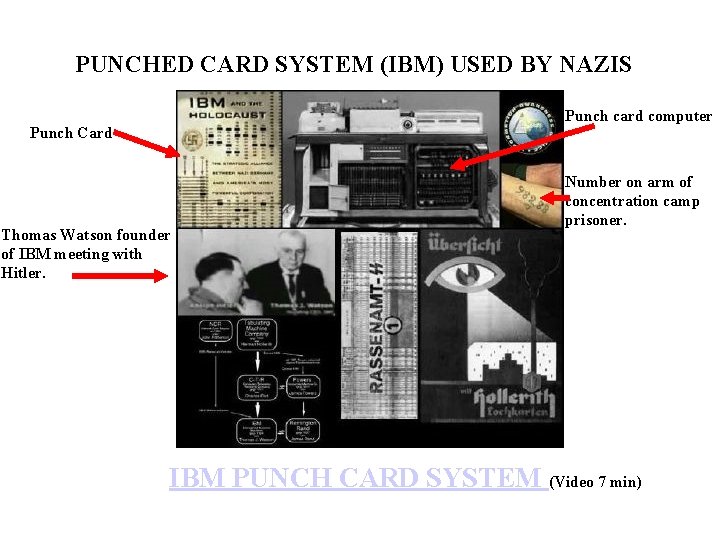
PUNCHED CARD SYSTEM (IBM) USED BY NAZIS Punch card computer Punch Card Thomas Watson founder of IBM meeting with Hitler. Number on arm of concentration camp prisoner. IBM PUNCH CARD SYSTEM (Video 7 min)

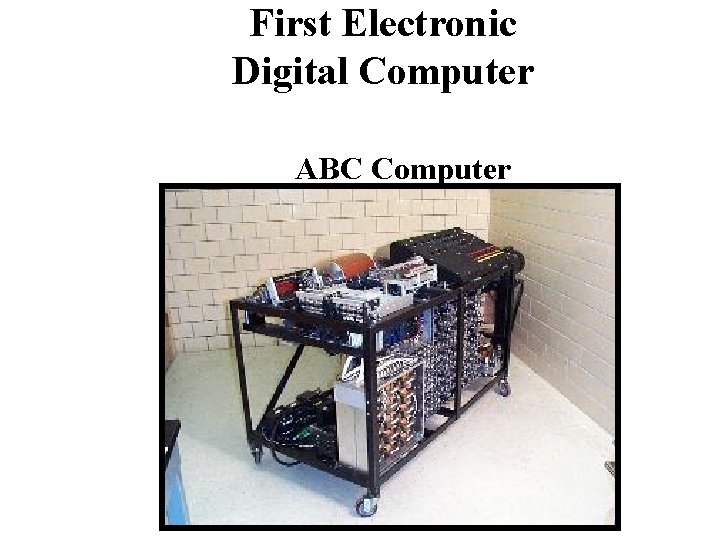
First Electronic Digital Computer ABC Computer

ABC Computer John Atanasoff Clifford Berry John Atanasoff • Father of the first ELECTRONIC digital computer. • Clifford Berry, a graduate assistant, aided Atanasoff. • ABC computer: • A = Atanasoff; B= Berry; C= Computer
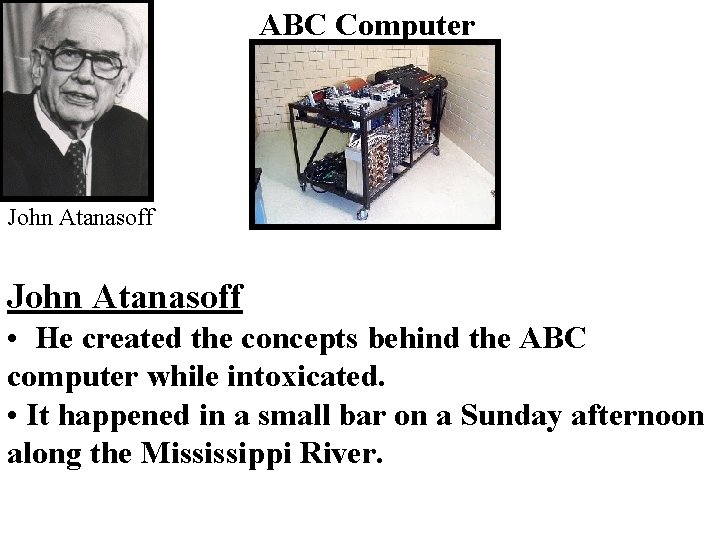
ABC Computer John Atanasoff • He created the concepts behind the ABC computer while intoxicated. • It happened in a small bar on a Sunday afternoon along the Mississippi River.
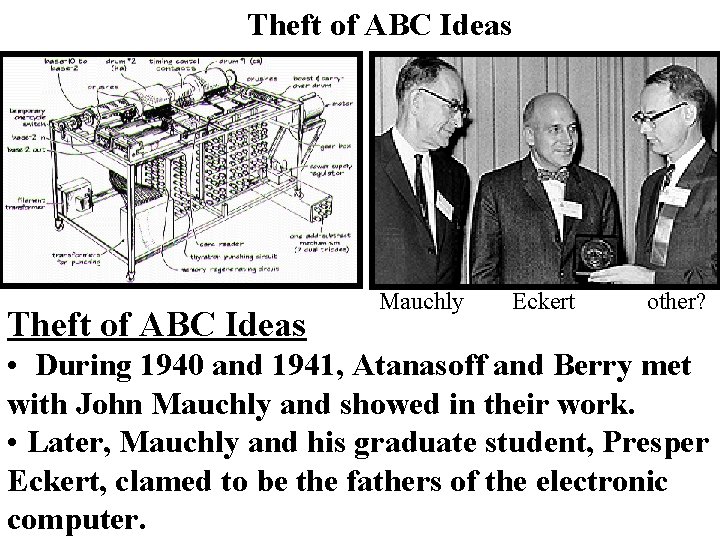
Theft of ABC Ideas Mauchly Eckert other? • During 1940 and 1941, Atanasoff and Berry met with John Mauchly and showed in their work. • Later, Mauchly and his graduate student, Presper Eckert, clamed to be the fathers of the electronic computer.
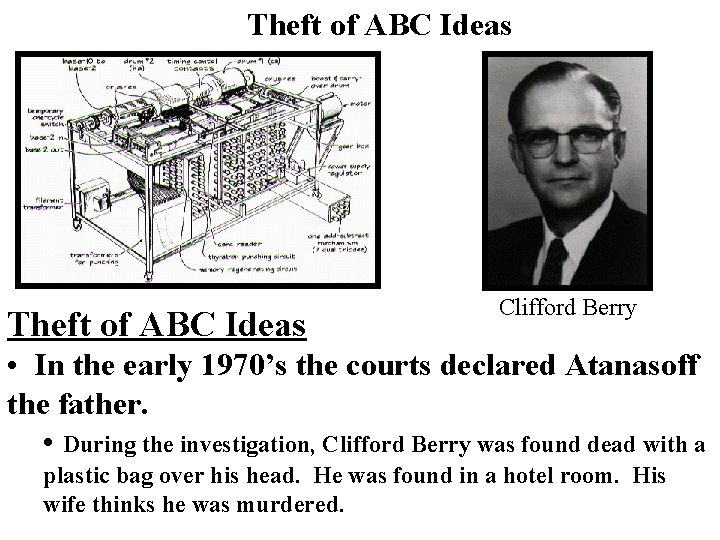
Theft of ABC Ideas Clifford Berry • In the early 1970’s the courts declared Atanasoff the father. • During the investigation, Clifford Berry was found dead with a plastic bag over his head. He was found in a hotel room. His wife thinks he was murdered.
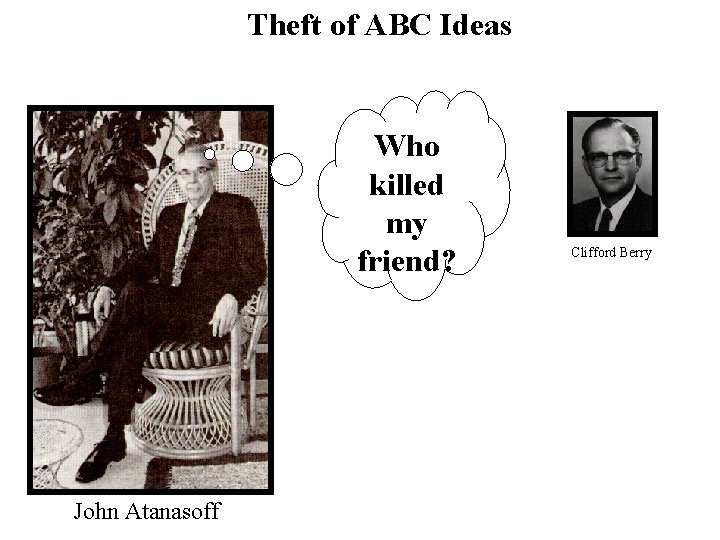
Theft of ABC Ideas Who killed my friend? John Atanasoff Clifford Berry
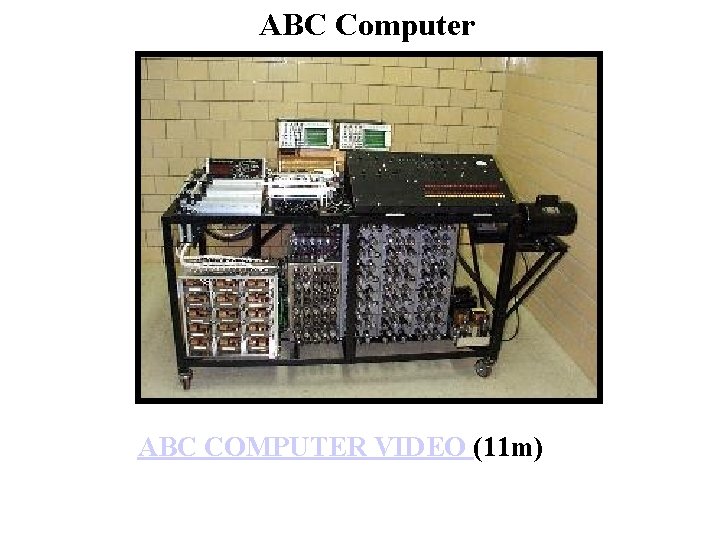
ABC Computer ABC COMPUTER VIDEO (11 m)
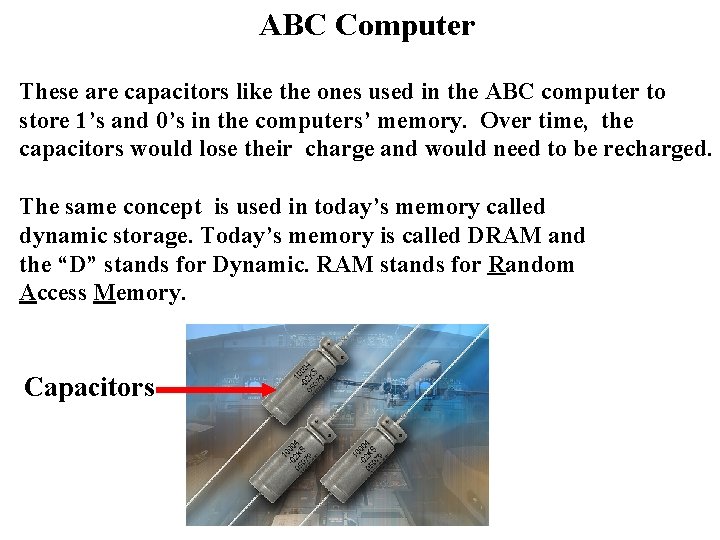
ABC Computer These are capacitors like the ones used in the ABC computer to store 1’s and 0’s in the computers’ memory. Over time, the capacitors would lose their charge and would need to be recharged. The same concept is used in today’s memory called dynamic storage. Today’s memory is called DRAM and the “D” stands for Dynamic. RAM stands for Random Access Memory. Capacitors

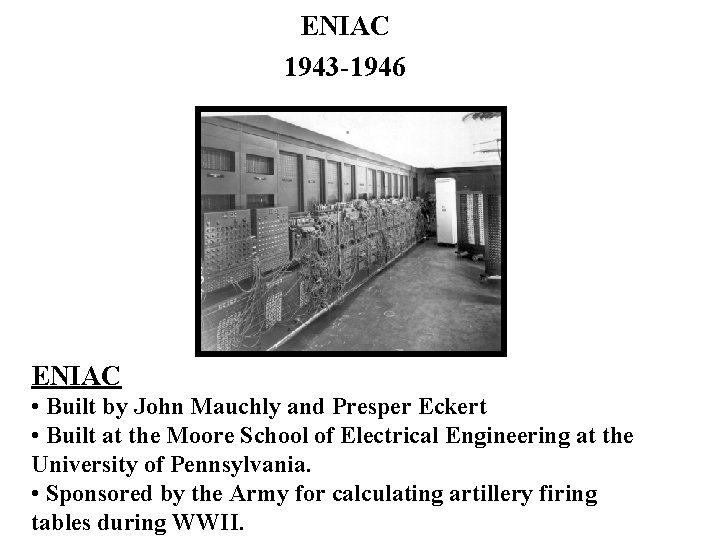
ENIAC 1943 -1946 ENIAC • Built by John Mauchly and Presper Eckert • Built at the Moore School of Electrical Engineering at the University of Pennsylvania. • Sponsored by the Army for calculating artillery firing tables during WWII.
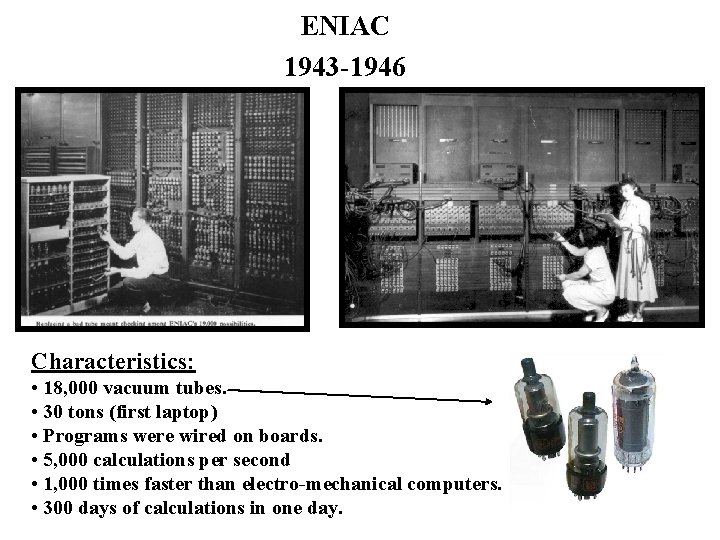
ENIAC 1943 -1946 Characteristics: • 18, 000 vacuum tubes. • 30 tons (first laptop) • Programs were wired on boards. • 5, 000 calculations per second • 1, 000 times faster than electro-mechanical computers. • 300 days of calculations in one day.
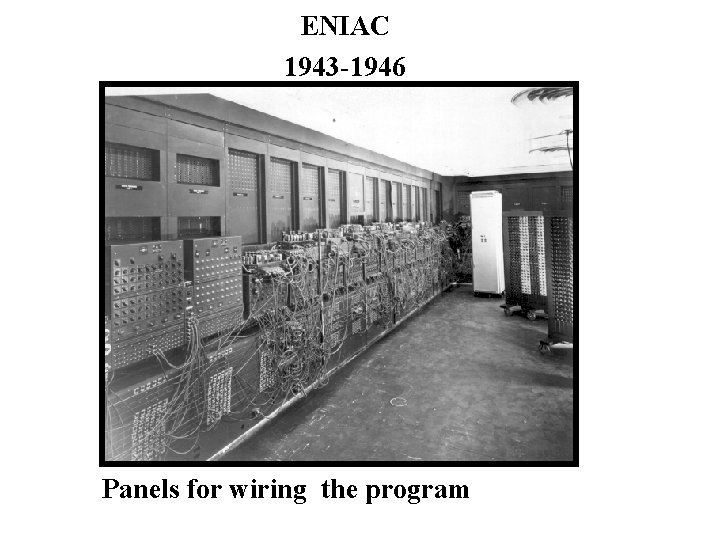
ENIAC 1943 -1946 Panels for wiring the program
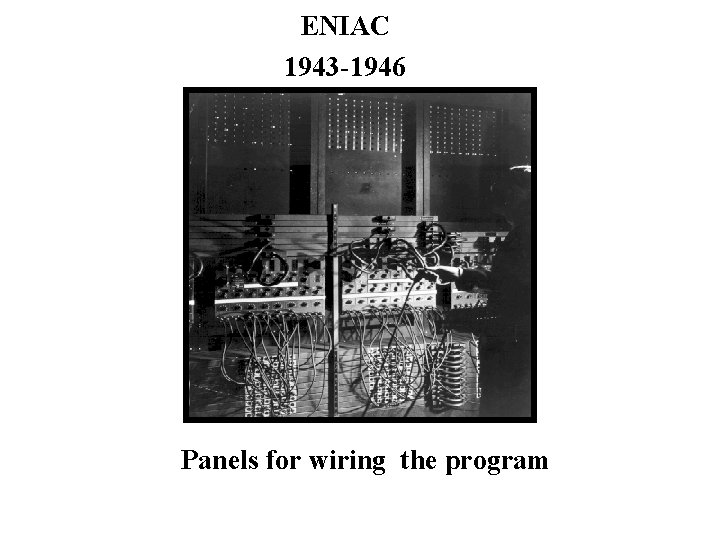
ENIAC 1943 -1946 Panels for wiring the program
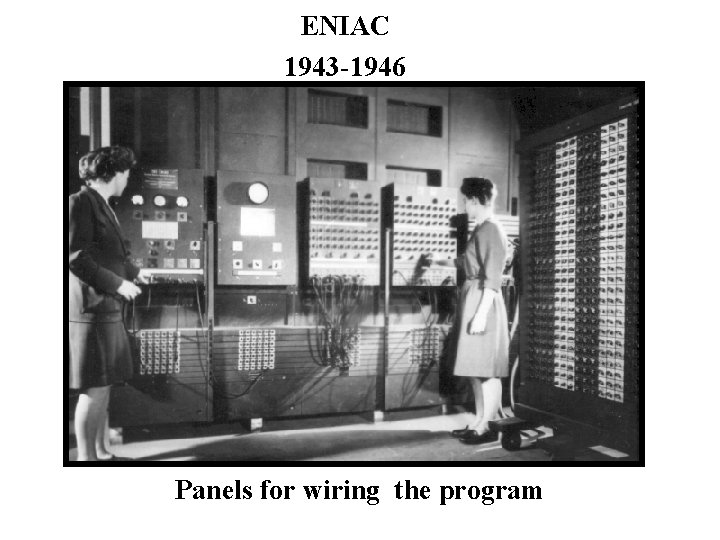
ENIAC 1943 -1946 Panels for wiring the program
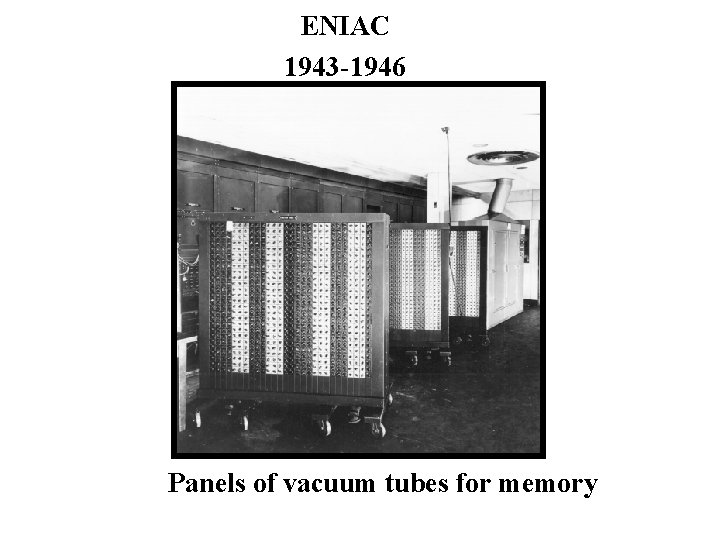
ENIAC 1943 -1946 Panels of vacuum tubes for memory
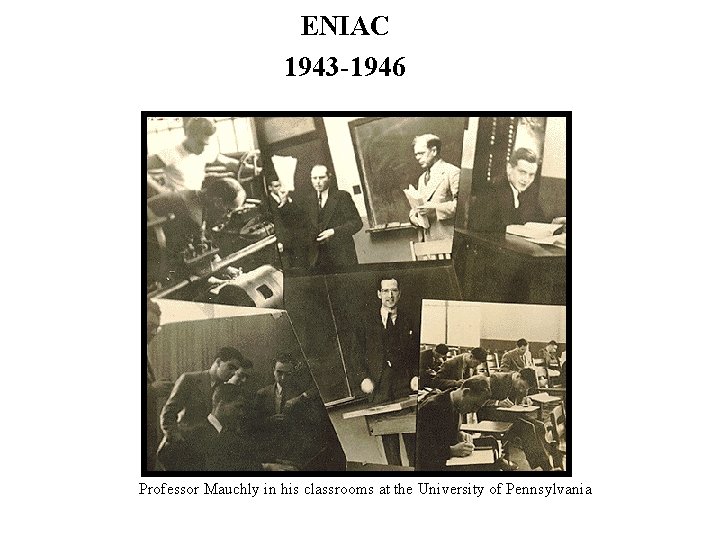
ENIAC 1943 -1946 Professor Mauchly in his classrooms at the University of Pennsylvania
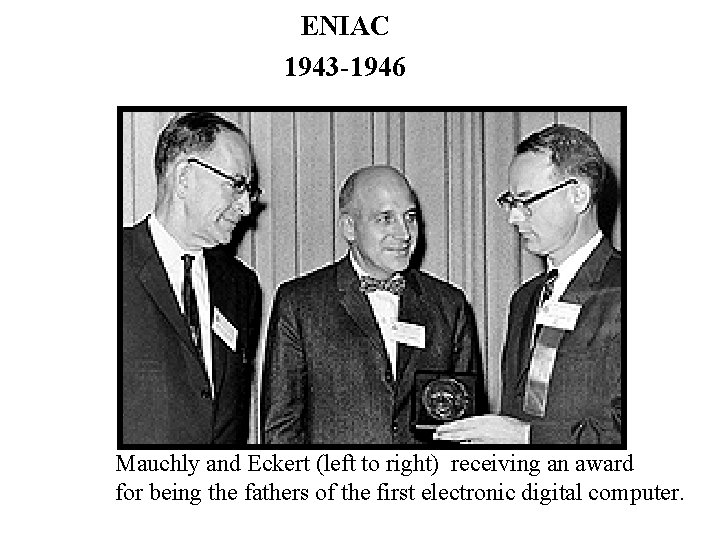
ENIAC 1943 -1946 Mauchly and Eckert (left to right) receiving an award for being the fathers of the first electronic digital computer.
ENIAC HISTORY VIDEOS Women programming the ENIAC (8 min) --Programmed it by plugging wires into sockets. Distortion of the truth (Only play the first 2 minutes. Note that no credit is given to Atanasoff by the CEO of Google. )

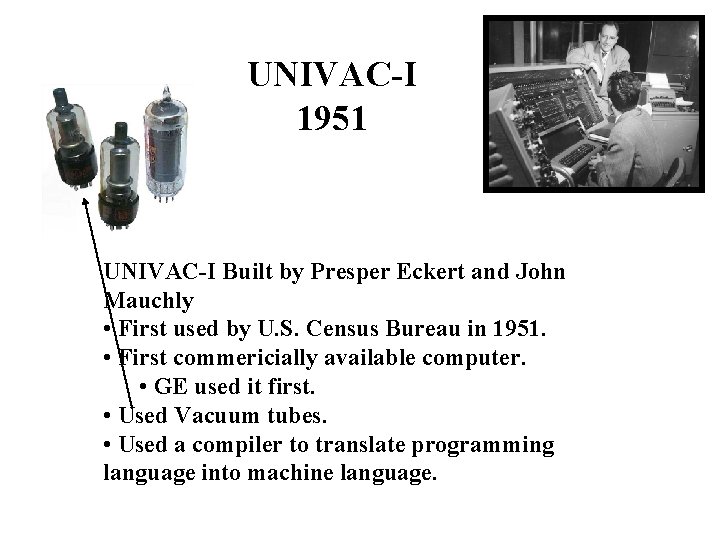
UNIVAC-I 1951 UNIVAC-I Built by Presper Eckert and John Mauchly • First used by U. S. Census Bureau in 1951. • First commericially available computer. • GE used it first. • Used Vacuum tubes. • Used a compiler to translate programming language into machine language.
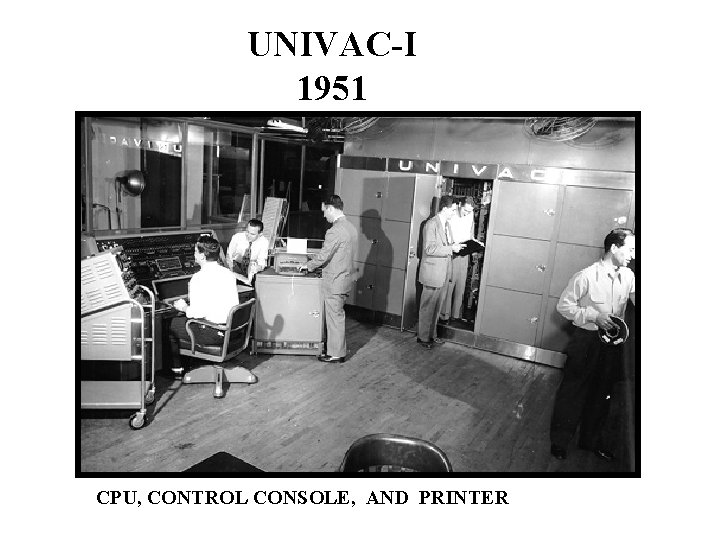
UNIVAC-I 1951 CPU, CONTROL CONSOLE, AND PRINTER
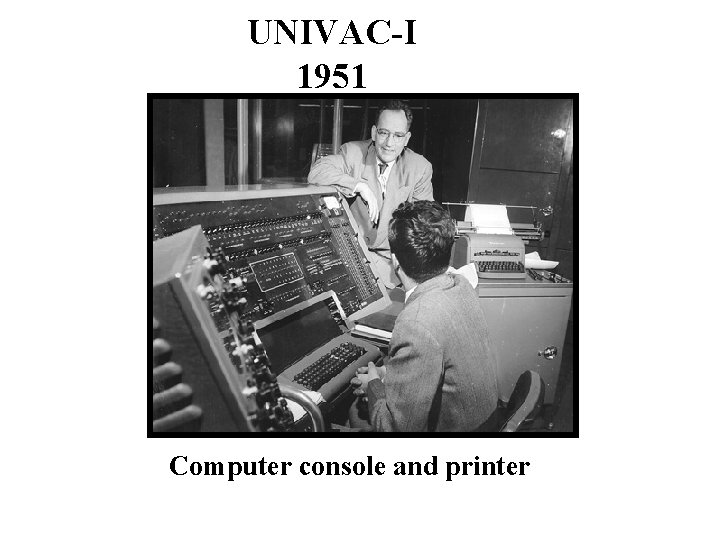
UNIVAC-I 1951 Computer console and printer
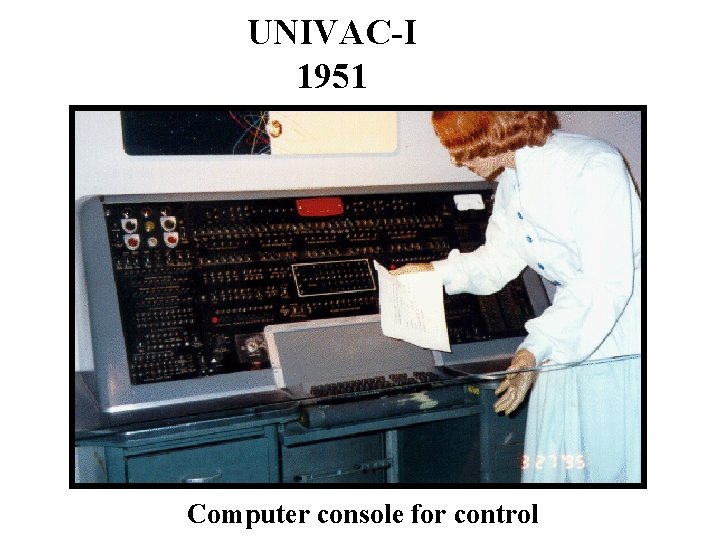
UNIVAC-I 1951 Computer console for control
UNIVAC-I 1951 BLUE BELL, Pennsylvania (CNN) -- Fifty years ago -- on June 14, 1951 -- the U. S. Census Bureau officially put into service what it calls the world's first commercial computer, known as UNIVAC I. UNIVAC stands for Universal Automatic Computer. The first model was built by the Eckert-Mauchly Computer Corp. , which was purchased by Remington Rand shortly before the UNIVAC went on sale. Perhaps the most famous computer of the era was the ENIAC, a computer developed for the U. S. military during World War II. Other computers developed in the 1940 s were mostly used by academia. But the UNIVAC I was the first computer to be widely used for commercial purposes -- 46 machines were built, for about $1 million each. Compared to other computers of the era, the UNIVAC I machines were small -- about the size of a onecar garage. Each contained about 5, 000 vacuum tubes, all of which had to be easily accessible for replacement because they burned out frequently. Keeping all those vacuum tubes cool was also a major design challenge. The machines were riddled with pipes that circulated cold water to keep the temperature down. Each unit was so bulky and needed so much maintenance that some of the companies that bought them never moved them to their own facility, instead leaving them on-site at Remington Rand.

John Blankenbaker Kenbak-I The ads in these 50 publications turned up Mr. Blankenbaker, now 68 years old.
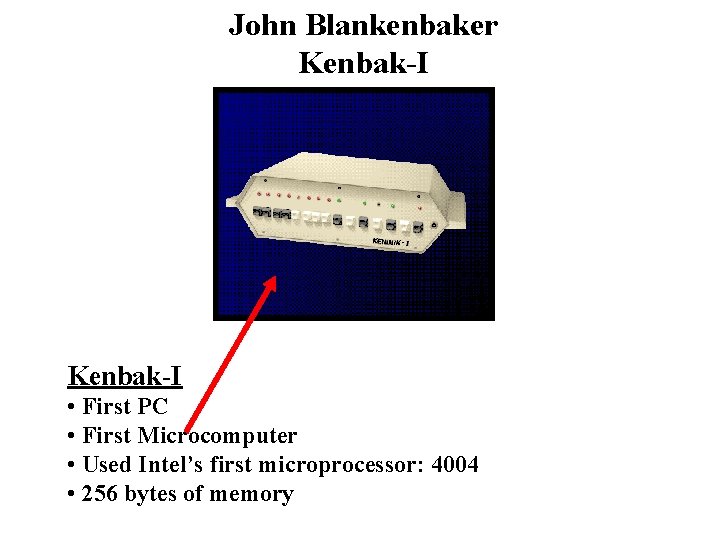
John Blankenbaker Kenbak-I • First PC • First Microcomputer • Used Intel’s first microprocessor: 4004 • 256 bytes of memory

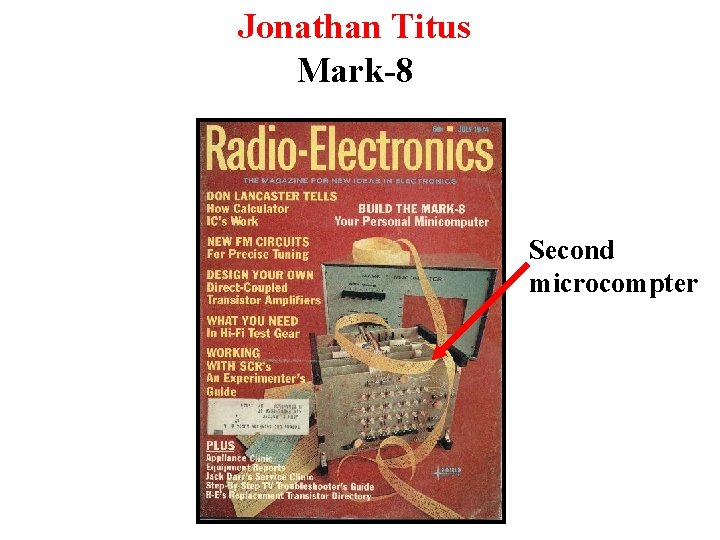
Jonathan Titus Mark-8 Second microcompter
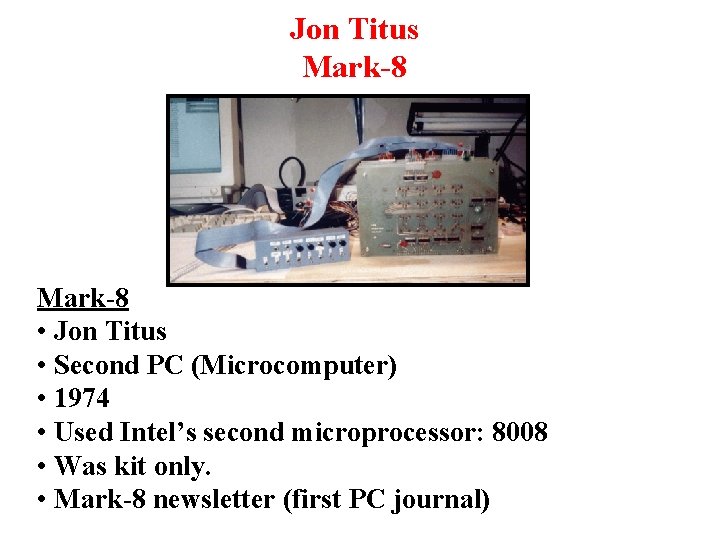
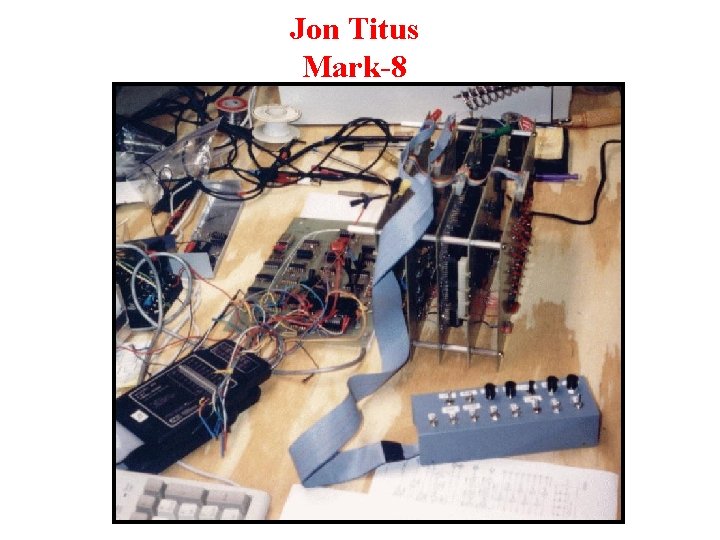
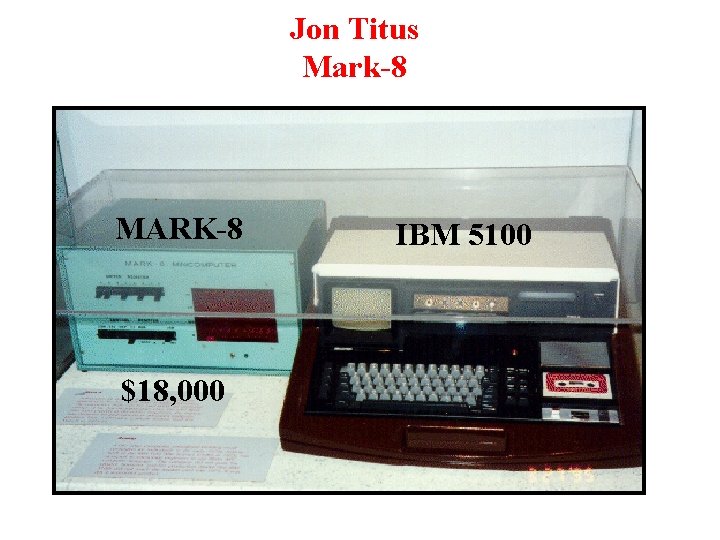
Jon Titus Mark-8 • Jon Titus • Second PC (Microcomputer) • 1974 • Used Intel’s second microprocessor: 8008 • Was kit only. • Mark-8 newsletter (first PC journal)
Jon Titus Mark-8
Jon Titus Mark-8 MARK-8 $18, 000 IBM 5100

SAMPLE TEST QUESTIONS (Charles Babbage) 1. Who is the father of the first general-purpose automated digital computer? a. Ada Lovelace b. Charles Babbage c. John Atanasoff d. Clifford Berry e. John Mauchly
SAMPLE TEST QUESTIONS (Charles Babbage) 2. Who was our first programmer? a. Ada Lovelace b. James Java c. Mary Pascal d. Clifford Berry e. John Mauchly
SAMPLE TEST QUESTIONS (Charles Babbage) 3. A programming language was named after this person. Who was he/she? a. Ada Lovelace b. James Java c. Mary Pascal d. Clifford Berry e. John Mauchly
SAMPLE TEST QUESTIONS (Charles Babbage) 4. This computer has most of the characteristics of a modern-day computer and was designed by Charles Babbage? a. ENIAC b. Tabulating Machine c. Mark II d. Analytical Engine e. ABC computer
SAMPLE TEST QUESTIONS (Charles Babbage) 5. What did the Analytical Engine use for Input, Output, and Secondary Storage? a. Flash memory b. Hard drive c. Punched cards d. Magnetic tape e. Ink plotter
SAMPLE TEST QUESTIONS (Charles Babbage) 6. How many 50 -digit numbers could the Analytical Engine store in its memory? a. 50 b. 100 c. 200 d. 300 e. 1, 000
SAMPLE TEST QUESTIONS (Charles Babbage) 7. Could the Analytical Engine branch from one part of the program to another part, such as to a part of the program to process overtime if hours exceed 40? a. Yes b. No
SAMPLE TEST QUESTIONS (Herman Hollerith) 8. For what was Herman Hollerith mainly credited? a. The invention of the Tabulating Machine b. The invention of the first electronic computer c. The invention of the punched card d. Developing a machine for the 1890 census. e. a and d
SAMPLE TEST QUESTIONS (Herman Hollerith) 9. Hollerith’s company in 1924 became what company? a. Apple b. IMSAI c. General Electric d. IBM e. HP
SAMPLE TEST QUESTIONS (Herman Hollerith) 10. The Nazi’s used a punched card computer for processing information for concentration camp victims. What company supplied the computer? a. Apple b. IMSAI c. General Electric d. IBM e. HP
SAMPLE TEST QUESTIONS (John Atanasoff) 11. John Atanasoff is legally the father of what computer technology? a. The first electronic digital computer. b. The first electo-mechanical computer c. The first tabulating computer d. The first microcomputer e. The first abacus
SAMPLE TEST QUESTIONS (John Atanasoff) 12. The ABC computer is named after? a. Clifford Berry b. Aldous Huxley c. John Atanasoff d. a and c e. a, b, and c
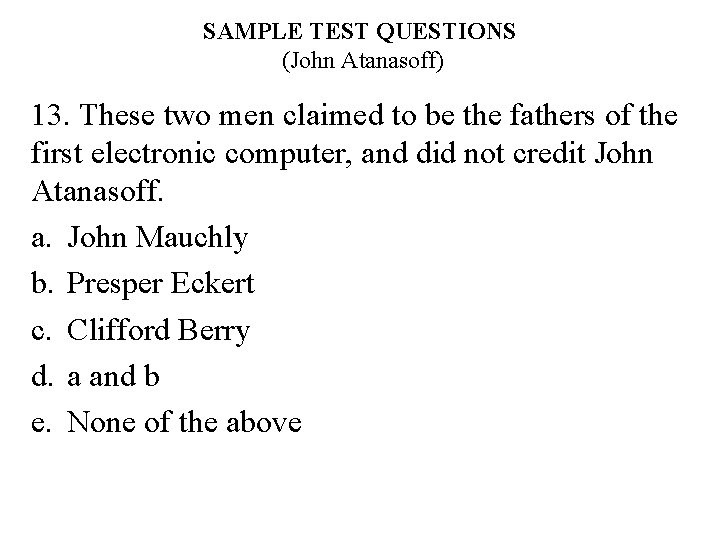
SAMPLE TEST QUESTIONS (John Atanasoff) 13. These two men claimed to be the fathers of the first electronic computer, and did not credit John Atanasoff. a. John Mauchly b. Presper Eckert c. Clifford Berry d. a and b e. None of the above
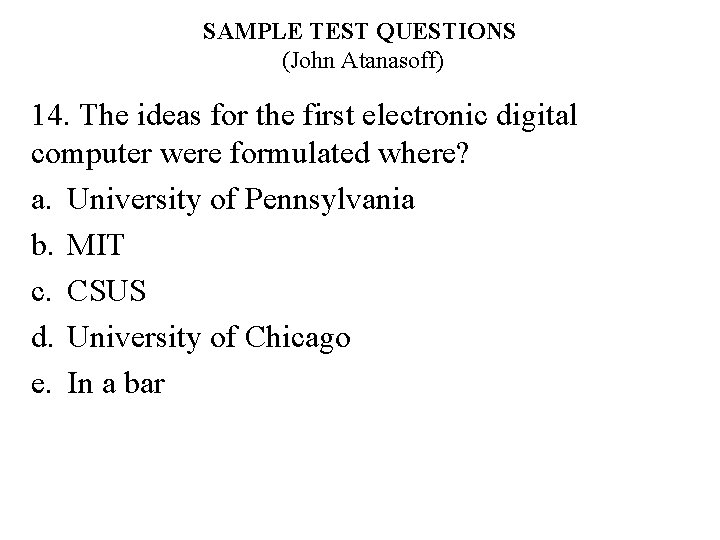
SAMPLE TEST QUESTIONS (John Atanasoff) 14. The ideas for the first electronic digital computer were formulated where? a. University of Pennsylvania b. MIT c. CSUS d. University of Chicago e. In a bar
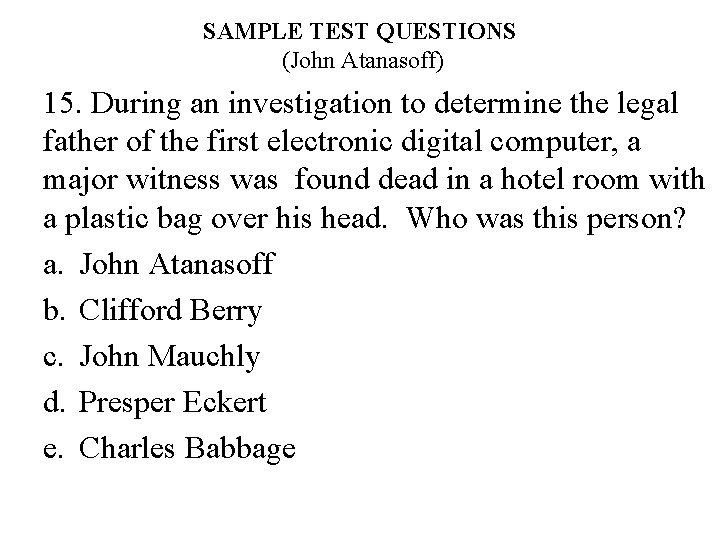
SAMPLE TEST QUESTIONS (John Atanasoff) 15. During an investigation to determine the legal father of the first electronic digital computer, a major witness was found dead in a hotel room with a plastic bag over his head. Who was this person? a. John Atanasoff b. Clifford Berry c. John Mauchly d. Presper Eckert e. Charles Babbage
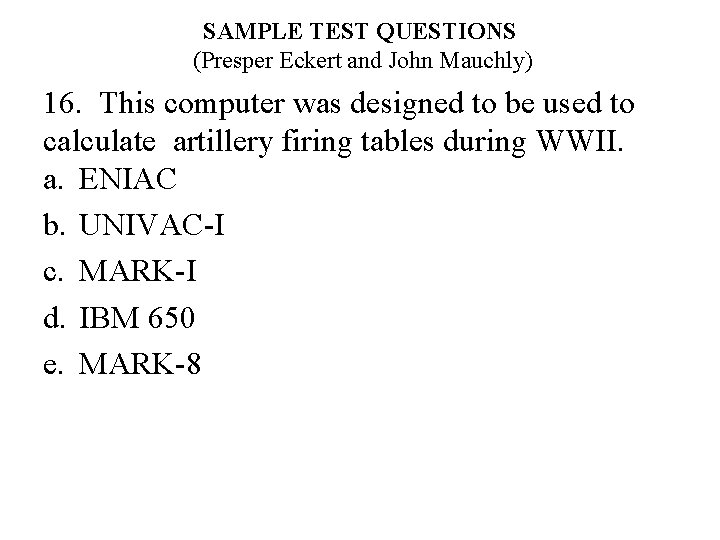
SAMPLE TEST QUESTIONS (Presper Eckert and John Mauchly) 16. This computer was designed to be used to calculate artillery firing tables during WWII. a. ENIAC b. UNIVAC-I c. MARK-I d. IBM 650 e. MARK-8
SAMPLE TEST QUESTIONS (Presper Eckert and John Mauchly) 17. This computer had 18, 000 vacuum tubes, weighed 30 tons, could do 5, 000 calculations per second, and was programmed by connecting wires onto a panel. a. ENIAC b. UNIVAC-I c. MARK-I d. Kenbak-I e. IBM 650
SAMPLE TEST QUESTIONS (Presper Eckert and John Mauchly) 18. This computer was first used by the U. S. Census Bureau in 1951? a. ENIAC b. UNIVAC-I c. MARK-I d. Kenbak-I e. IBM 650
SAMPLE TEST QUESTIONS (Presper Eckert and John Mauchly) 19. This computer used a compiler to translate an English-like program into machine language. No wiring on a panel was necessary. a. ENIAC b. UNIVAC-I c. MARK-I d. MARK-II
SAMPLE TEST QUESTIONS (Presper Eckert and John Mauchly) 20. This computer was the first commercially available computer. There were 46 of these built at a cost of about $1, 000. a. ENIAC b. UNIVAC-I c. MARK-I d. MARK-II
SAMPLE TEST QUESTIONS (John Blankenbaker) 21. This person built the first microcomputer PC and it used Intel’s first microprocessor (4004). It was called the Kenbak-I. a. John Mauchly b. Presper Eckert c. Clifford Berry d. John Blanenbaker e. Steve Jobs
SAMPLE TEST QUESTIONS (Jonathan Titus) 22. This person built the second microcomputer PC and it used Intel’s second microprocessor (8008). It was called the MARK-8. a. John Mauchly b. Presper Eckert c. Jonathan Titus d. John Blanenbaker e. Steve Jobs
- Slides: 70