
Charities and Social Enterprises A day for practitioners

- Slides: 17
Charities and Social Enterprises: A day for practitioners and researchers to discuss current challenges and escalating change Early Experiences Applying the Fair. Shares Model to Social Enterprise Development Rory Ridley-Duff (and Mike Bull) Aston Business School, 24 th April 2018
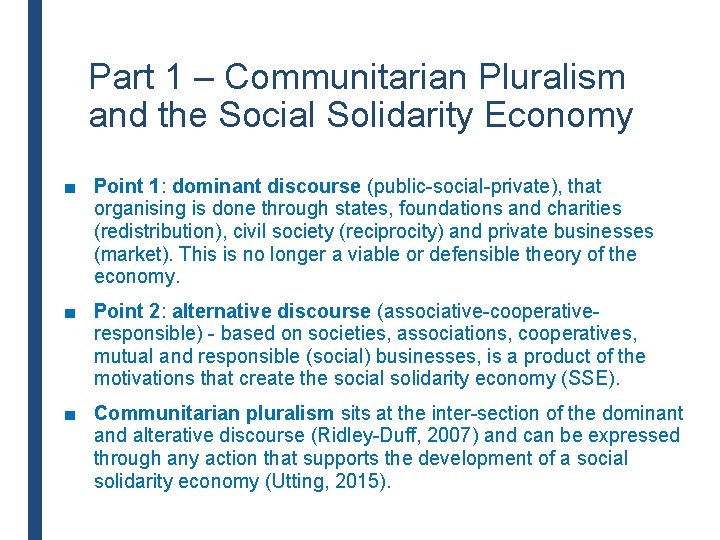
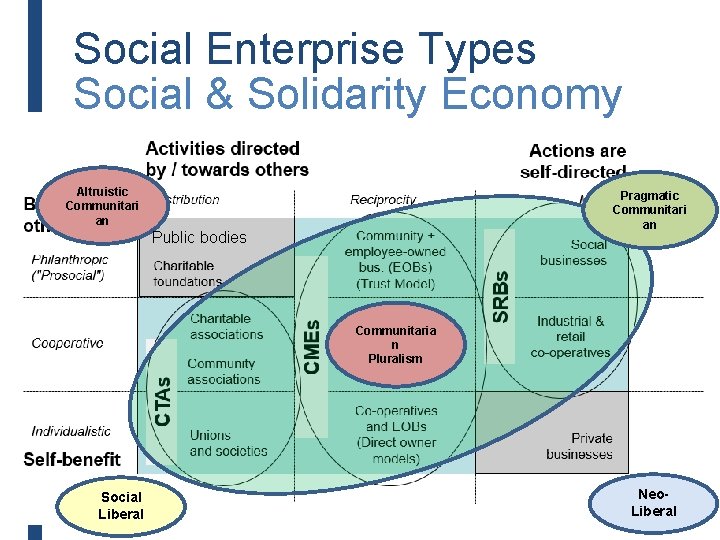
Part 1 – Communitarian Pluralism and the Social Solidarity Economy ■ Point 1: dominant discourse (public-social-private), that organising is done through states, foundations and charities (redistribution), civil society (reciprocity) and private businesses (market). This is no longer a viable or defensible theory of the economy. ■ Point 2: alternative discourse (associative-cooperativeresponsible) - based on societies, associations, cooperatives, mutual and responsible (social) businesses, is a product of the motivations that create the social solidarity economy (SSE). ■ Communitarian pluralism sits at the inter-section of the dominant and alterative discourse (Ridley-Duff, 2007) and can be expressed through any action that supports the development of a social solidarity economy (Utting, 2015).
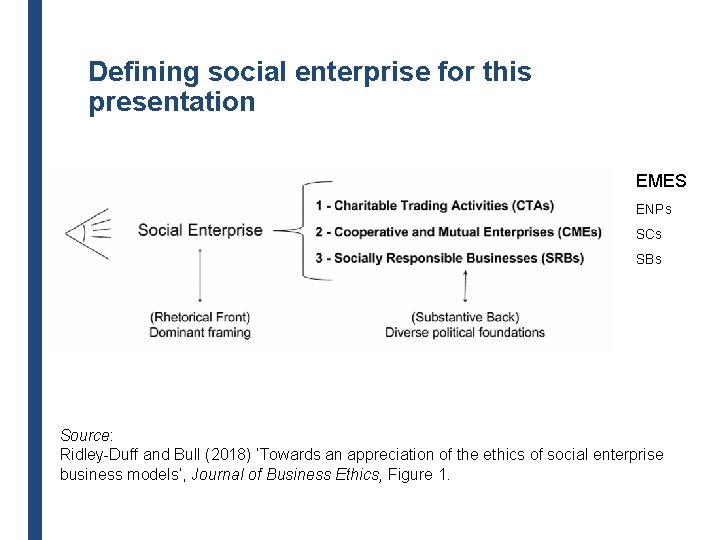
Defining social enterprise for this presentation EMES ENPs SCs SBs Source: Ridley-Duff and Bull (2018) ‘Towards an appreciation of the ethics of social enterprise business models’, Journal of Business Ethics, Figure 1.
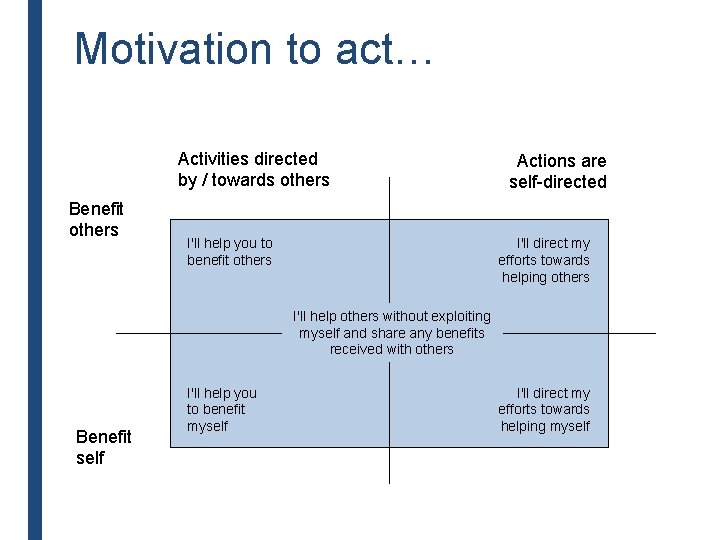
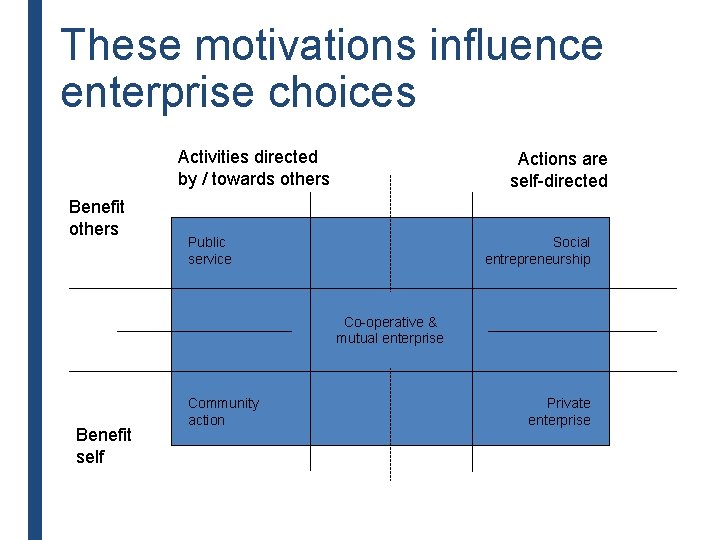
Motivation to act… Activities directed by / towards others Benefit others I'll help you to benefit others Actions are self-directed I'll direct my efforts towards helping others I'll help others without exploiting myself and share any benefits received with others Benefit self I'll help you to benefit myself I'll direct my efforts towards helping myself
These motivations influence enterprise choices Activities directed by / towards others Benefit others Actions are self-directed Public service Social entrepreneurship Co-operative & mutual enterprise Benefit self Community action Private enterprise
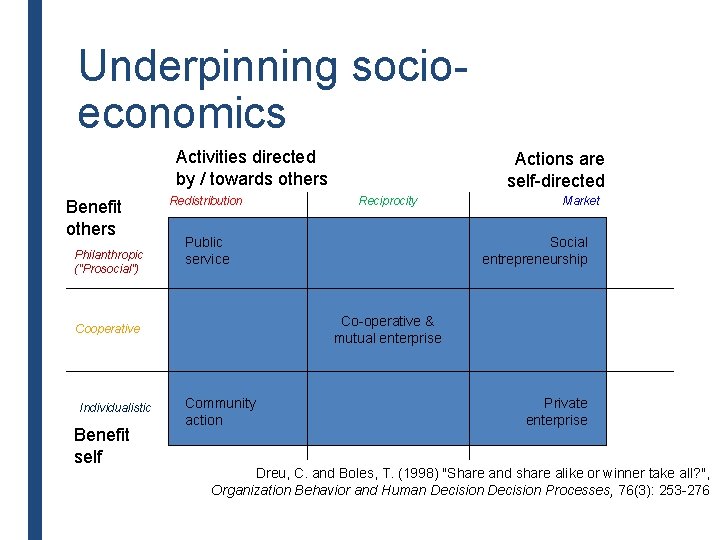
Underpinning socioeconomics Activities directed by / towards others Benefit others Philanthropic ("Prosocial") Redistribution Benefit self Reciprocity Public service Market Social entrepreneurship Co-operative & mutual enterprise Cooperative Individualistic Actions are self-directed Community action Private enterprise Dreu, C. and Boles, T. (1998) "Share and share alike or winner take all? ", Polanyi, K. Behavior (2001, [1944]) The Great Transformation, Boston: Beacon Press Organization and Human Decision Processes, 76(3): 253 -276
Social Enterprise Types Social & Solidarity Economy Activities directed by / towards others Altruistic Communitari Redistribution Benefit an others Philanthropic ("Prosocial") Actions are self-directed Reciprocity Publicbodies Market Pragmatic Communitari an Social entrepreneurship service Co-operative & Communitaria mutual enterprise n Cooperative Pluralism Individualistic Benefit self Social Liberal Community action Private enterprise Neo. Liberal
The SSE – the issue of definition ■ The social solidarity economy (SSE) is a term developed to embrace all the organisation types in the ‘alternative axis’ “The umbrella term is increasingly used to refer to forms of economic activity that prioritise social and often environment objectives, and involves producers, workers, consumers and citizens acting collectively and in solidarity” - Utting (2015), Social and Solidarity Economy: Beyond the Fringe, loc. ■ …cooperatives, mutual associations, grant-dependent and service-delivery NGOs, community volunteering, self-help groups, fair trade networks, solidarity purchasing, solidarity finance (complementary currencies/crowd finance), the sharing and collaborative economies. ■ Increasing focus on multi-stakeholder orientation and organisation, particularly through web-platforms (expression of communitarian pluralism).
The SSE – the issue of scale ■ Global employment in co-op economy (estimated) has risen from 100 m (2011) to 279 m (2017) (Coops UK, 2011; Eum, 2017). ■ European employment in the co-op economy estimated at 4. 6 m in 2004 (Avila and Campos, 2006) now 15. 4 m (Eum, 2017) ■ Fair trade: the proportion of small producer organisations (SPOs) (producer associations) has risen 73% to 80% between 2013 and 2017 (Fairtrade International, 2018), turnover now € 7. 88 bn ■ Creative Commons: There an estimated 1. 2 billion works licenced with CC (growing at a rate of 761, 000 a day). ■ Knowledge (outputs): 3 m academic articles from 11, 146 journals are now available through IS 40 A CIC. Research shifting to open access. ■ Knowledge (access): Wikipedia editors create 5 million new articles a year; 15 billion accesses a month (two for every person on the planet). (Wikimedia Foundation, 2017) ■ Mutual finance: 955 m people have financial products from cooperatives and mutuals (ICMIF, 2016 a; 2016 b) ■ Summary claim: ICA estimates 3 bn people ‘secured their livelihood’ through the co-operative economy (EURICSE/ICA, 2018).
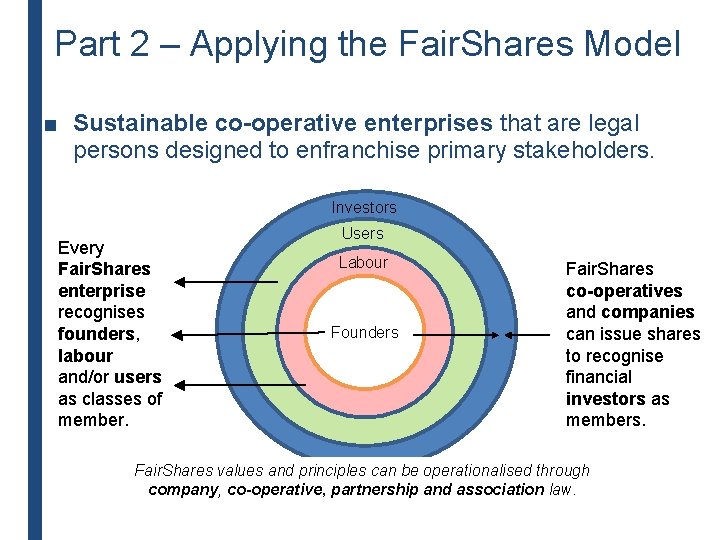
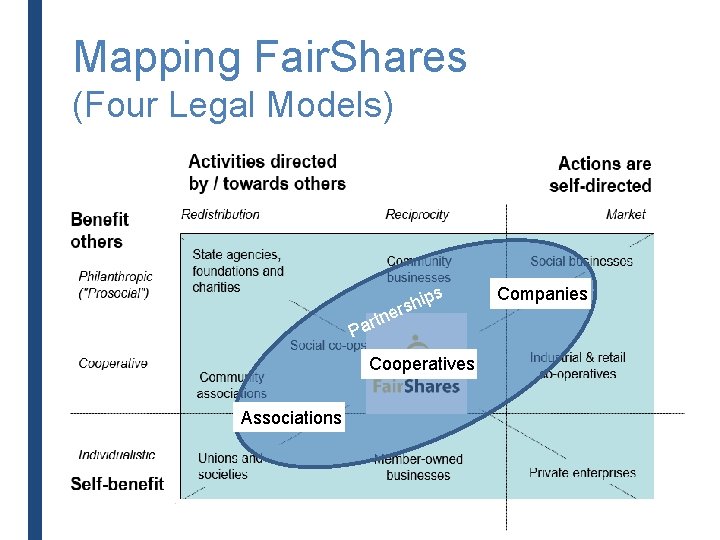
Part 2 – Applying the Fair. Shares Model ■ Sustainable co-operative enterprises that are legal persons designed to enfranchise primary stakeholders. Investors Every Fair. Shares enterprise recognises founders, labour and/or users as classes of member. Users Labour Founders Fair. Shares co-operatives and companies can issue shares to recognise financial investors as members. Fair. Shares values and principles can be operationalised through company, co-operative, partnership and association law.
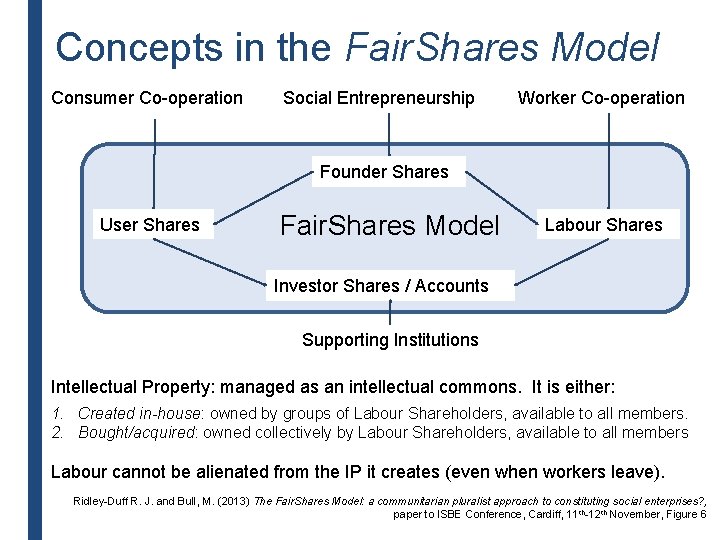
Concepts in the Fair. Shares Model Consumer Co-operation Social Entrepreneurship Worker Co-operation Founder Shares User Shares Fair. Shares Model Labour Shares Investor Shares / Accounts Supporting Institutions Intellectual Property: managed as an intellectual commons. It is either: 1. Created in-house: owned by groups of Labour Shareholders, available to all members. 2. Bought/acquired: owned collectively by Labour Shareholders, available to all members Labour cannot be alienated from the IP it creates (even when workers leave). Ridley-Duff R. J. and Bull, M. (2013) The Fair. Shares Model: a communitarian pluralist approach to constituting social enterprises? , paper to ISBE Conference, Cardiff, 11 th-12 th November, Figure 6
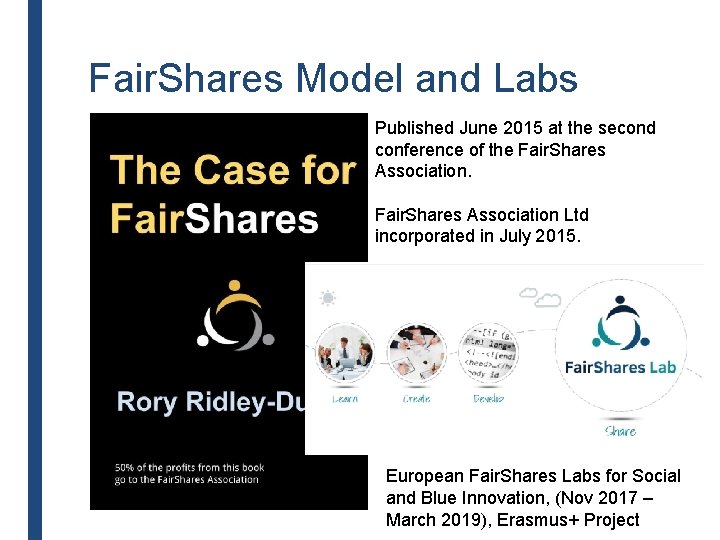
Fair. Shares Model and Labs Published June 2015 at the second conference of the Fair. Shares Association Ltd incorporated in July 2015. European Fair. Shares Labs for Social and Blue Innovation, (Nov 2017 – March 2019), Erasmus+ Project
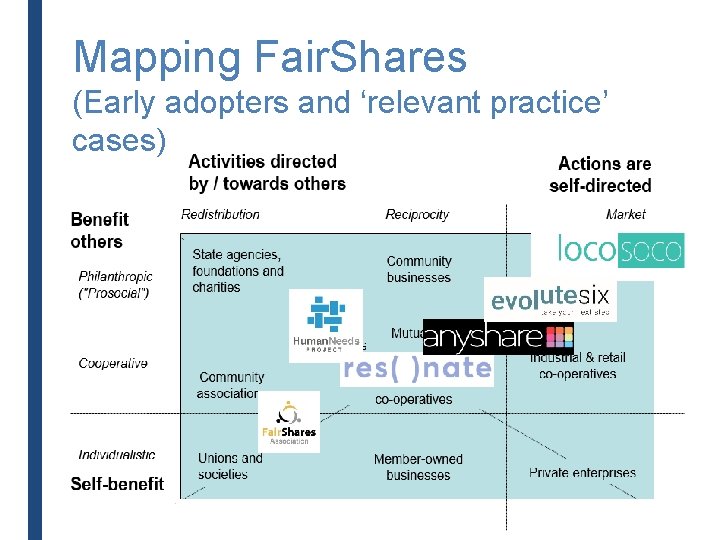
Mapping Fair. Shares (Early adopters and ‘relevant practice’ cases)
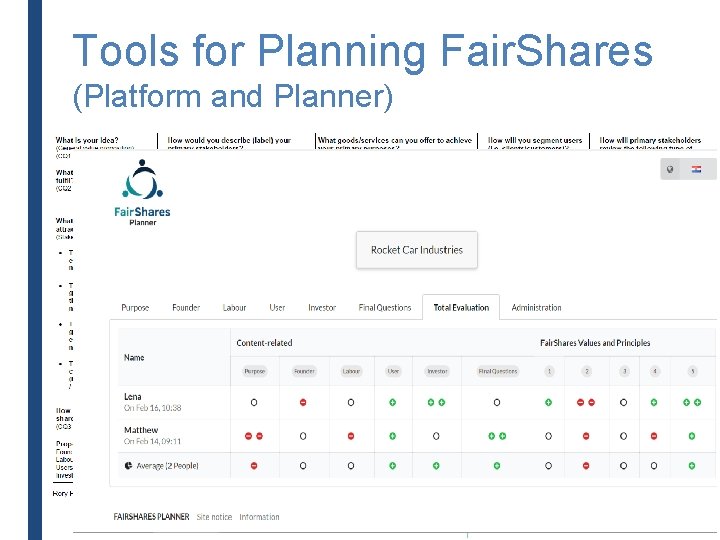
Tools for Planning Fair. Shares (Platform and Planner)
Mapping Fair. Shares (Four Legal Models) e rtn Pa ip rsh s Cooperatives Associations Companies
Conclusion Early findings from the Fair. Shares Labs project indicate: ■ New approaches to redistribution, reciprocity and markets through platforms for ‘associative’, ‘cooperative’ and ‘responsible’ social enterprise design. ■ Realisation of communitarian pluralism through enterprise education materials, platform support of multi-stakeholding, multistakeholder design tools and multi-stakeholder collaboration. ■ Legal expression of communitarian pluralism using existing bodies of law that prevent single-stakeholder hegemony (potentially compromised in practice). Six Fair. Shares Labs pilot projects take place in 2018 and a final project report will be published in 2019.
Thank you! Rory Ridley-Duff r. ridley-duff@shu. ac. uk