
Charitable Remainder Trust CRT A Split Interest Gift

Charitable Remainder Trust (CRT) A Split Interest Gift Plan Introduction to CRTs

Donor Challenge • Bought Growth Property or Stock • Property Has Increased in Value • Property Generates Low Income • Need Increased Income • Doesn’t Want to Pay ¼ in Taxes
Solutions to Donor Challenge Charitable Remainder Trusts • Bypass capital gain on transfer • Increase income • Provide Charitable deduction
Overview Charitable Remainder Trusts The Charitable Remainder Trust allows donors to convert appreciated low-income assets into income-producing assets…. at low tax cost.

Trust Basics: Parts of a Trust • Trustor: • One who trusts / creates the trust / donor / grantor • Trustee: • One who is trusted / manages the trust / fiduciary / holds title • Trust Document: • Terms / powers of trustee / legal entity

Trust Basics: Parts of a Trust • Assets: • What is held in trust (the property) • Beneficiary: • Income Beneficiary (Current Income Interest) • Remainder Beneficiary (Future Interest)

Charitable Remainder Trustor Donates Assets Trustee Holds Assets In Trust Remainder To Charity Life or Lives or Years Present Beneficiary Term of

Two Basic Types Charitable Remainder Trusts • Charitable Remainder Annuity Trust (“CRAT”) • Charitable Reminder Unitrust (“CRUT”)

Similar Characteristics Charitable Remainder Trusts • Irrevocable • Tax exempt trust • Split-Interest Trust
Similar Characteristics (cont’d) Charitable Remainder Trusts • Trust term • Life or lifetimes • Term of years not to exceed 20 years • If principal is exhausted, trust terminates. • Subject to certain private foundation rules
Similar Characteristics (cont’d) Charitable Remainder Trusts • Minimum 5% payout • Maximum 50% payout • Must yield a minimum of 10% to charity
Two Basic Types Charitable Remainder Trusts • Annuity Trust (“CRAT”) • Annuity trust amount determined by fixed percentage of initial FMV • Unitrust (“CRUT”) • Unitrust amount determined by fixed percentage of FMV valued annually

A Few Differences Charitable Remainder Trusts • Payout amounts • Annual asset valuations • Future asset additions • Probability of exhaustion • Payout options

1. Payout Amount Annuity Trust Unitrust Never Changes Varies

2. Annual Asset Evaluations Annuity Trust No. Value only at beginning of trust. Unitrust Yes. Value annually for life of trust.

3. Future Asset Additions Annuity Trust Unitrust No Yes
4. Probability of Exhaustion Annuity Trust Unitrust • Yes • No • Principal can decline • Probability of exhaustion negligible • No 5% test • Must pass 5% test

5. Payout Options Annuity Trust Unitrust • Only one • 4 options • Standard Unitrust • Net Income with Makeup Unitrust • FLIP Unitrust
5. Payout Options (cont’d) • Stan. CRUT (Type I) • Fixed % of variable trust value • Ni. CRUT (Type II) • Lesser of Net income or fixed % • Nim. CRUT (Type III) • Lesser of Net income or fixed % with makeup • FLIP • Starts as Ni. CRUT / Nim. Crut, then flips to Stan. CRUT
Annuity Trust Payout Example – 7% Year Earnings Rate Trust Value Annuity Amount 1 8% $1, 000 $ 70, 000 2 6% $1, 010, 000 $ 70, 000 3 10% $1, 000, 600 $ 70, 000 4 8% $1, 030, 660 $ 70, 000 5 4% $1, 043, 113 $ 70, 000 6 12% $1, 014, 837 $ 70, 000 7 6% $1, 066, 618 $ 70, 000 8 7% $1, 060, 615 $ 70, 000 9 3% $1, 064, 858 $ 70, 000 $1, 026, 804 $ 70, 000 10
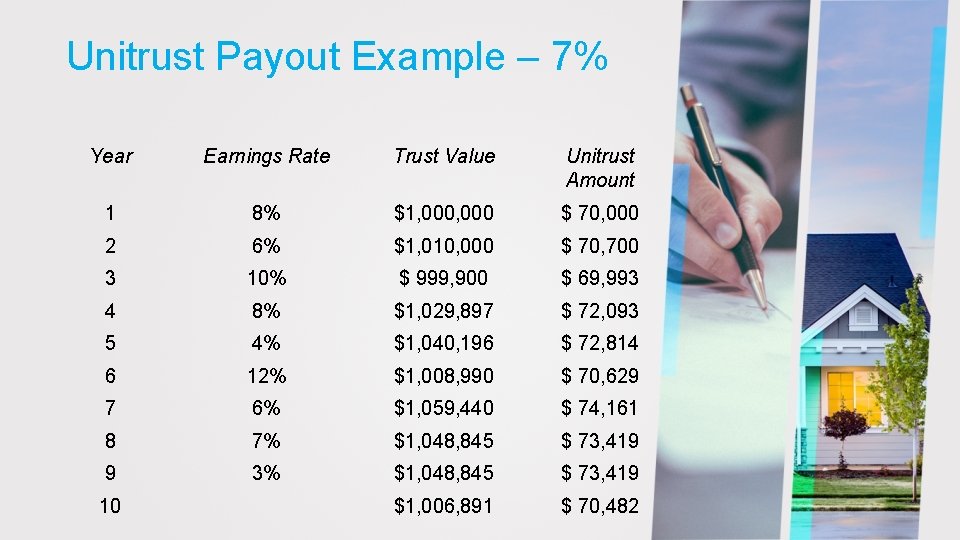
Unitrust Payout Example – 7% Year Earnings Rate Trust Value Unitrust Amount 1 8% $1, 000 $ 70, 000 2 6% $1, 010, 000 $ 70, 700 3 10% $ 999, 900 $ 69, 993 4 8% $1, 029, 897 $ 72, 093 5 4% $1, 040, 196 $ 72, 814 6 12% $1, 008, 990 $ 70, 629 7 6% $1, 059, 440 $ 74, 161 8 7% $1, 048, 845 $ 73, 419 9 3% $1, 048, 845 $ 73, 419 $1, 006, 891 $ 70, 482 10
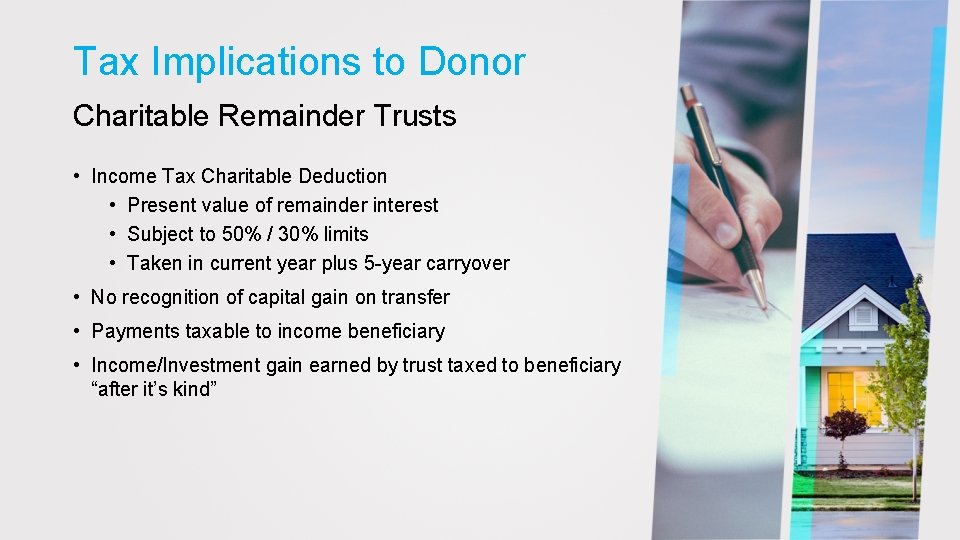
Tax Implications to Donor Charitable Remainder Trusts • Income Tax Charitable Deduction • Present value of remainder interest • Subject to 50% / 30% limits • Taken in current year plus 5 -year carryover • No recognition of capital gain on transfer • Payments taxable to income beneficiary • Income/Investment gain earned by trust taxed to beneficiary “after it’s kind”
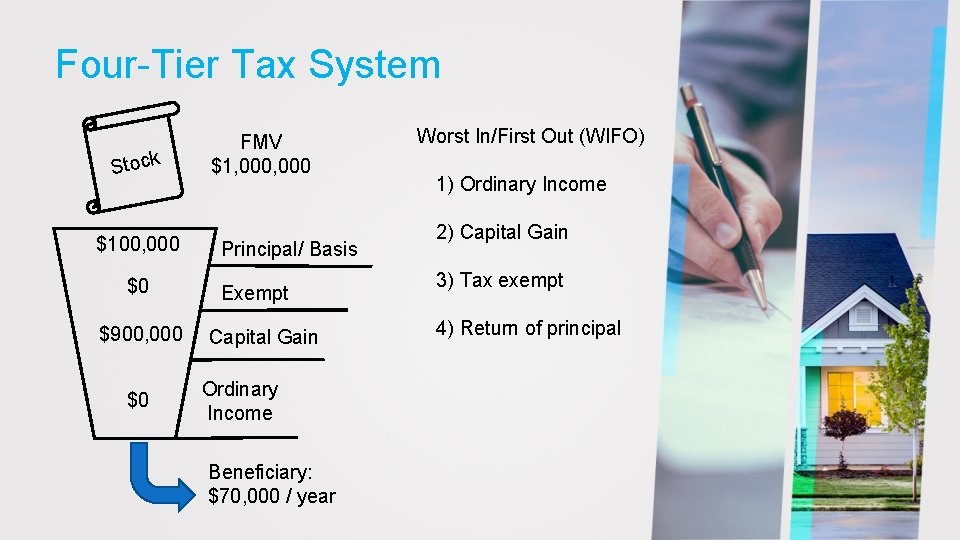
Four-Tier Tax System Stock $100, 000 $0 $900, 000 $0 FMV $1, 000 Principal/ Basis Exempt Capital Gain Ordinary Income Beneficiary: $70, 000 / year Worst In/First Out (WIFO) 1) Ordinary Income 2) Capital Gain 3) Tax exempt 4) Return of principal
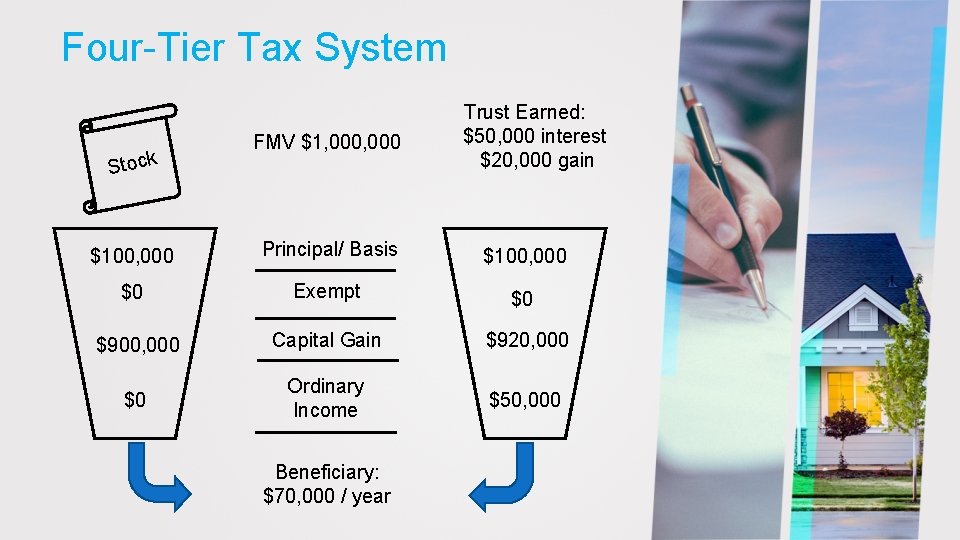
Four-Tier Tax System Stock FMV $1, 000 Trust Earned: $50, 000 interest $20, 000 gain $100, 000 Principal/ Basis $100, 000 $0 Exempt $0 $900, 000 Capital Gain $920, 000 $0 Ordinary Income $50, 000 Beneficiary: $70, 000 / year
Suitable Assets to Fund a CRT Charitable Remainder Trusts • Cash • Publicly traded stock • Closely-held stock • Certain real property • Tangible personal property • Certain intangible property
Potential Problem Assets Charitable Remainder Trusts • Debt-encumbered assets • Sole proprietorships • Partnership interests • Professional corporations • Certain real property • Unrelated Business Income assets (UBI) • S Corporation stock

Gift Substantiation Charitable Remainder Trusts • Exempt from written receipt requirement • Donor attaches to 1040 • Schedule A • Copy of deduction calculation • Form 8283 if required (appraisal summary) • Copy of Trust
First Information Return Charitable Remainder Trusts IRS Form 5227 (and K-1 s) must be filed each year for charitable remainder annuity trusts and unitrusts. The first return should also include the following: • A copy of the trust instrument • A written declaration under penalties of perjury that it is a true and complete copy. • Employer Identification Number Obtained
Early Termination Charitable Remainder Trusts • CRT is an irrevocable trust • May be terminated before the end of the measuring term • Income beneficiary surrenders or disclaims rights to future payouts. (Gets charitable tax deduction of present value of future payouts. ) • Charity terminates trust and distributes remainder to remainderman.
Summary of Benefits Charitable Remainder Trusts • Convert appreciated low income assets into income producing assets at low cost • Bypass capital gain on transfer • Increase income • Charitable deduction • Avoids probate
Question #1 • What is one Donor challenge a CRT might help solve?

Question #2 • What are the two types of Charitable Remainder Trusts?

Questions #3 • Name two characteristics that both Charitable Remainder Trusts have in common.

Question #4 • What is the longest term a Charitable Remainder Trust can be set up for?

Question #5 • What’s the largest payout rate a Charitable Remainder Trust can pay?

Question #6 • A Charitable Remainder Trust should be designed so that at least what percentage minimum should come to the charity?

Question #7 The payout of a Charitable Remainder Unitrust never changes. A) True B) False

Question #8 A Charitable Remainder Trust must be revalued every 5 years. A) True B) False
Question #9 • Which Charitable Remainder Trust type can a Donor make additions to?

Question #10 It is impossible for a Charitable Remainder Annuity Trust to run out of assets. A) True B) False

Question #11 • Which Charitable Remainder Trust type has four payout options?

Question #12 Principal is never paid out in a Type I, Standard Charitable Remainder Unitrust. A) True B) False

Question #13 • In a Type III, Net Income with Makeup Unitrust, does “makeup” happen every year?
Question #14 • A FLIP Unitrust means that, given the appropriate circumstances, a trust can flip from a Charitable Remainder Unitrust (CRUT) to a Charitable Remainder Annuity Trust (CRAT). A) True B) False

Question #15 • What are some events that might cause a FLIP Unitrust to flip?
Question #16 A Charitable Remainder Trust pays tax on the income it earns. A) True B) False

Question #17 • Can real property be used to fund a Charitable Remainder Trust?

Question #18 • Should a sole proprietorship be used to fund a Charitable Remainder Trust?

Question #19 • What is IRS Form 5227, who is responsible for filing it and when?

Question #20 • Is any tax sent along with the 5227?
Question #21 • A Charitable Remainder Unitrust (CRUT) pays a variable payment to the income beneficiary. • A) True • B) False
Question #22 • A Charitable Remainder Trust can be revoked by the Donor. • A) True • B) False
Question #23 • The Four-Tier System relates to • A) The four types of Charitable Remainder Unitrust (CRUT) payout options • B) The character and order of priority of the Charitable Remainder Unitrust (CRUT) payouts

Question #24 • What does WIFO stand for?

Question #25 • What is the taxable order of priority of payout categories in a Charitable Remainder Trust?

The End Charitable Remainder Trusts • Take a 15 minute break!
- Slides: 56