
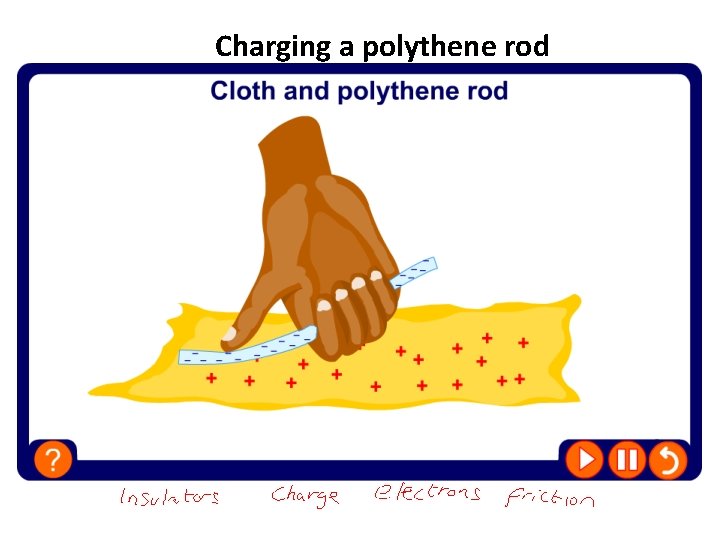
Charging a polythene rod The friction causes a
- Slides: 35
Charging a polythene rod
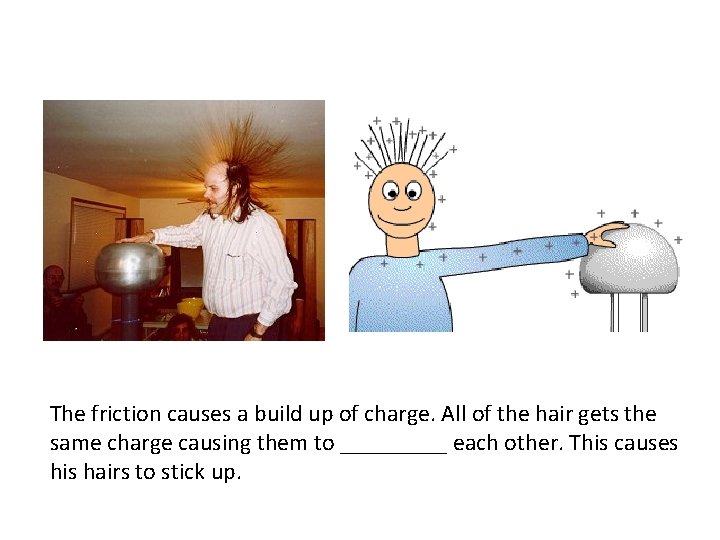
The friction causes a build up of charge. All of the hair gets the same charge causing them to _____ each other. This causes his hairs to stick up.
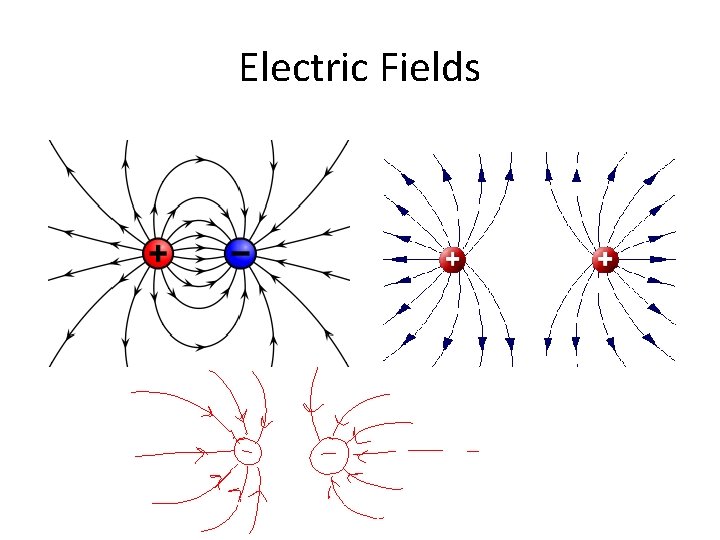
Electric Fields
How static charges can be a nuisance or dangerous Static charges can be a nuisance. For example: 1: Attracting Dust 2: Clothing clings 3: Shocks from door handles
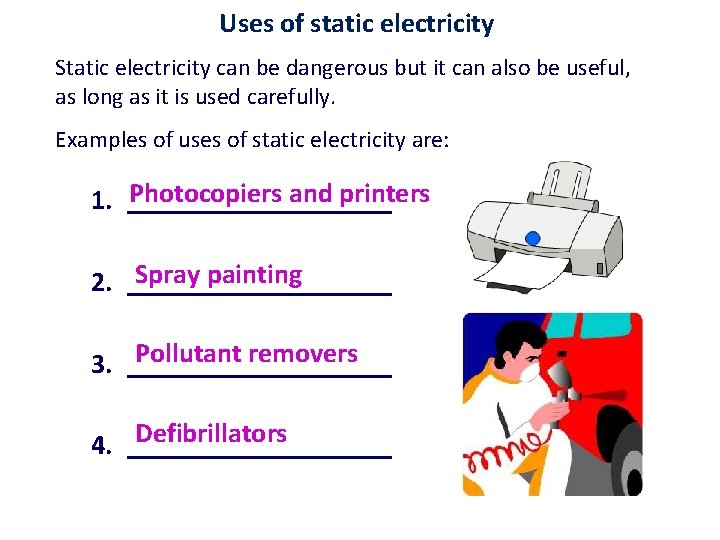
Uses of static electricity Static electricity can be dangerous but it can also be useful, as long as it is used carefully. Examples of uses of static electricity are: Photocopiers and printers 1. __________ Spray painting 2. __________ Pollutant removers 3. __________ Defibrillators 4. __________
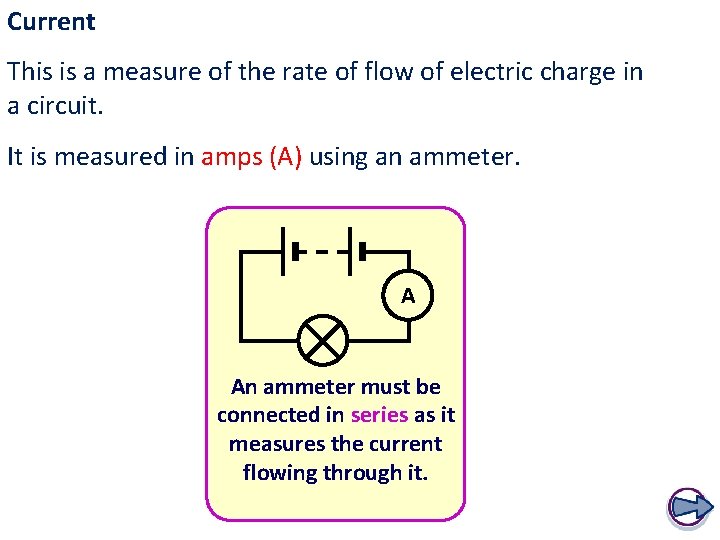
Current This is a measure of the rate of flow of electric charge in a circuit. It is measured in amps (A) using an ammeter. A An ammeter must be connected in series as it measures the current flowing through it.
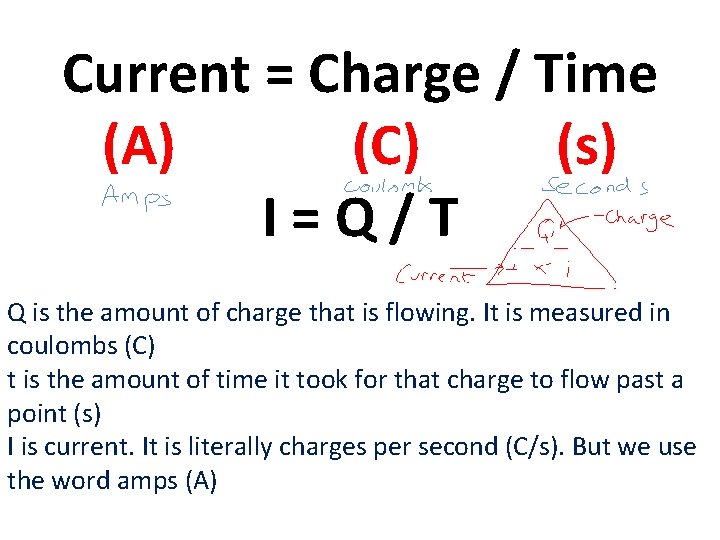
Current = Charge / Time (A) (C) (s) I=Q/T Q is the amount of charge that is flowing. It is measured in coulombs (C) t is the amount of time it took for that charge to flow past a point (s) I is current. It is literally charges per second (C/s). But we use the word amps (A)
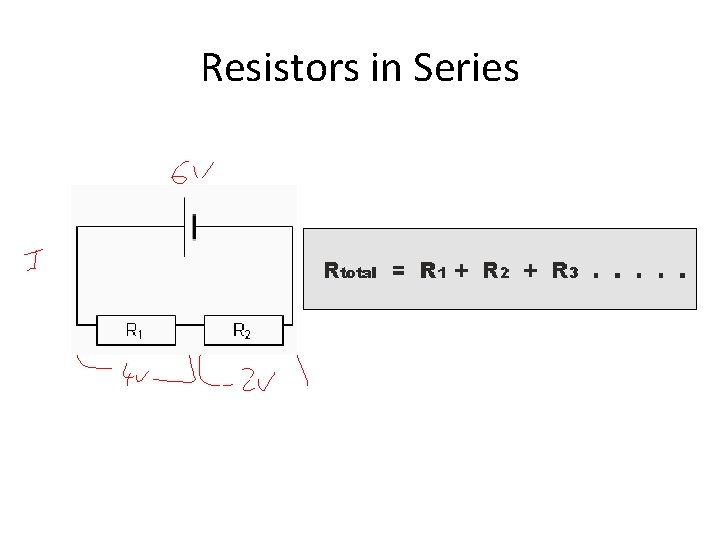
Resistors in Series
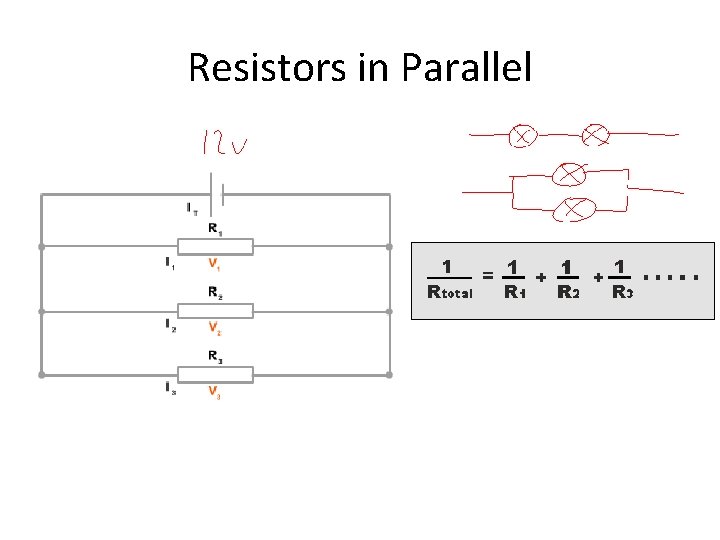
Resistors in Parallel
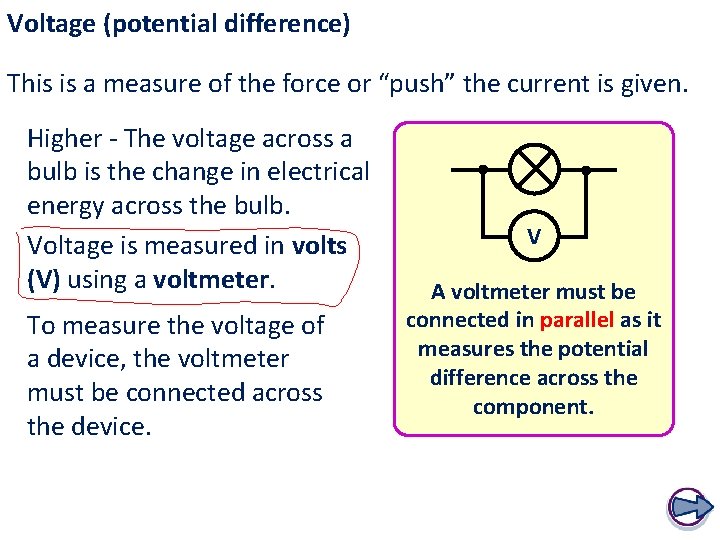
Voltage (potential difference) This is a measure of the force or “push” the current is given. Higher - The voltage across a bulb is the change in electrical energy across the bulb. Voltage is measured in volts (V) using a voltmeter. To measure the voltage of a device, the voltmeter must be connected across the device. V A voltmeter must be connected in parallel as it measures the potential difference across the component.
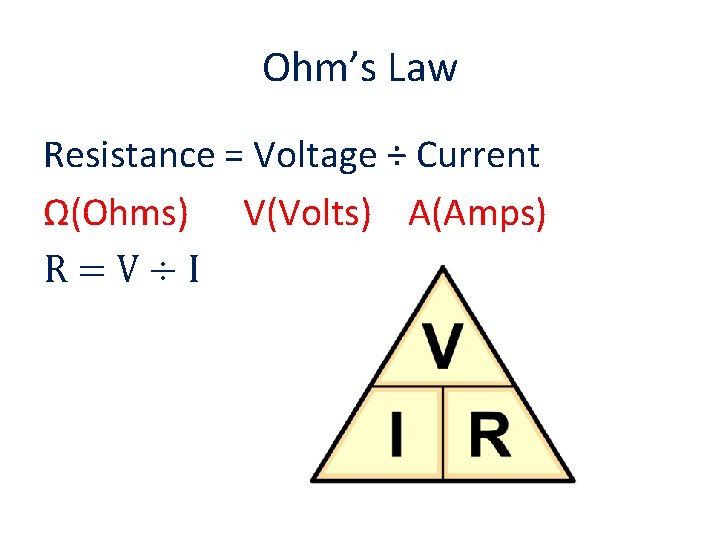
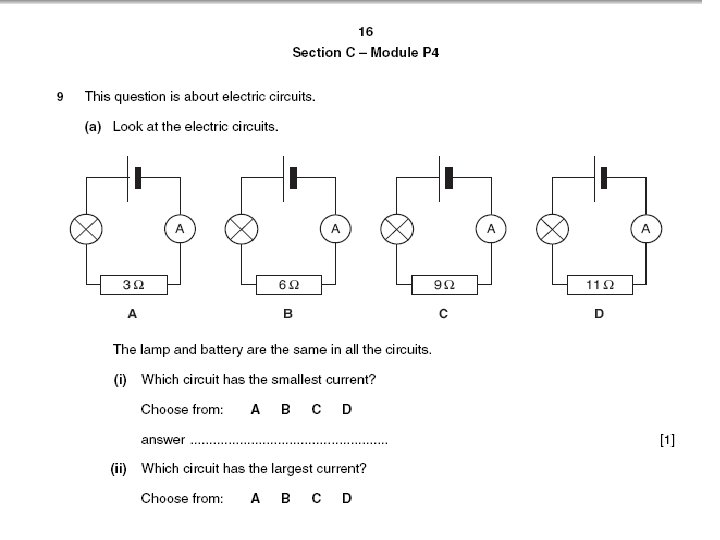
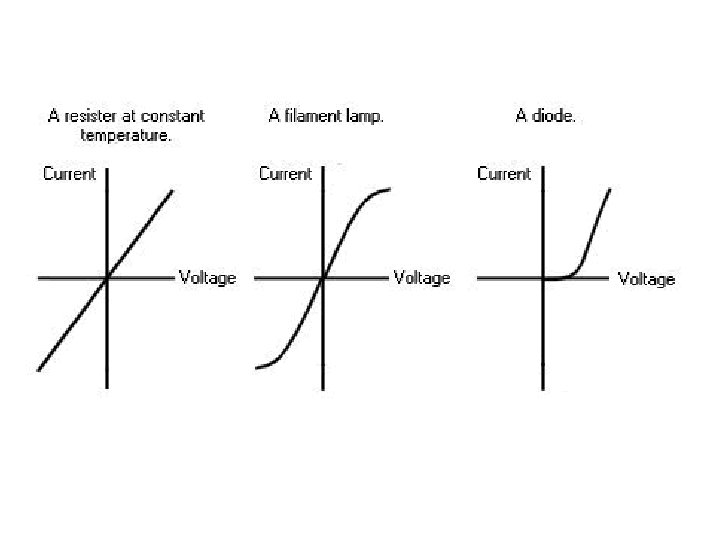
Ohm’s Law Resistance = Voltage ÷ Current Ω(Ohms) V(Volts) A(Amps) R=V÷I
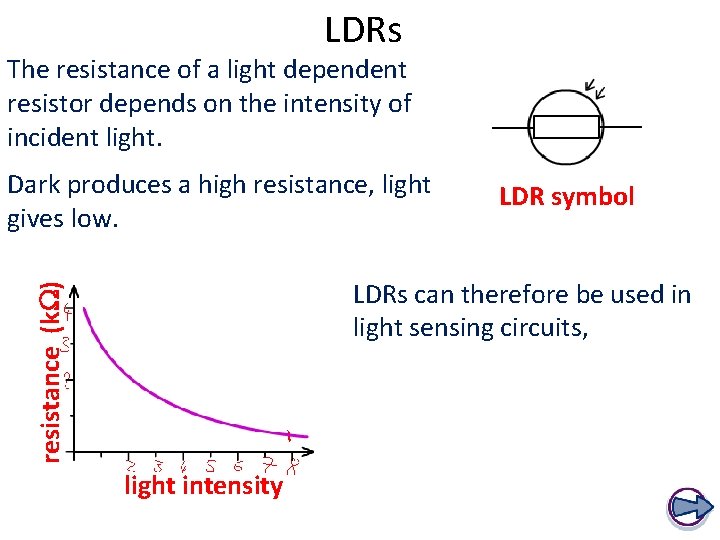
LDRs The resistance of a light dependent resistor depends on the intensity of incident light. Dark produces a high resistance, light gives low. LDR symbol resistance (k ) LDRs can therefore be used in light sensing circuits, light intensity
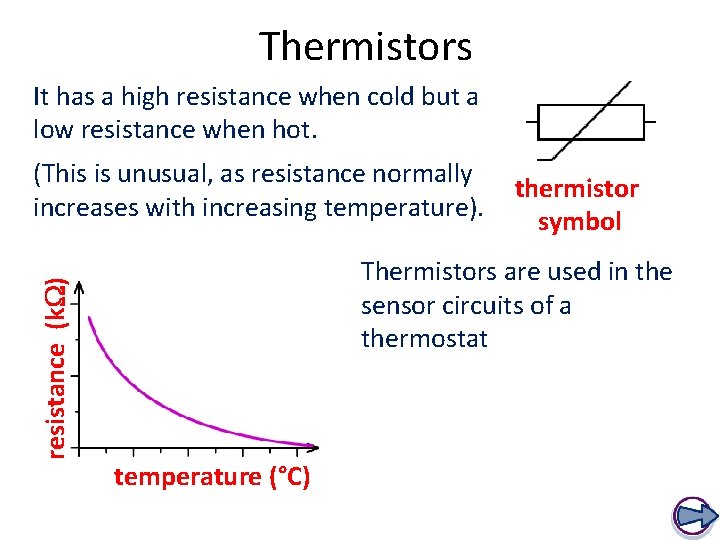
Thermistors It has a high resistance when cold but a low resistance when hot. resistance (k ) (This is unusual, as resistance normally increases with increasing temperature). thermistor symbol Thermistors are used in the sensor circuits of a thermostat temperature (°C)
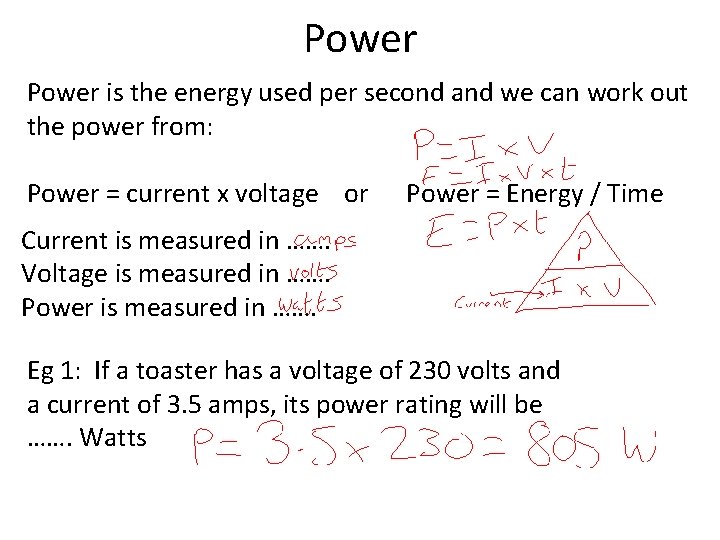
Power is the energy used per second and we can work out the power from: Power = current x voltage or Power = Energy / Time Current is measured in ……. Voltage is measured in ……. Power is measured in ……. Eg 1: If a toaster has a voltage of 230 volts and a current of 3. 5 amps, its power rating will be ……. Watts
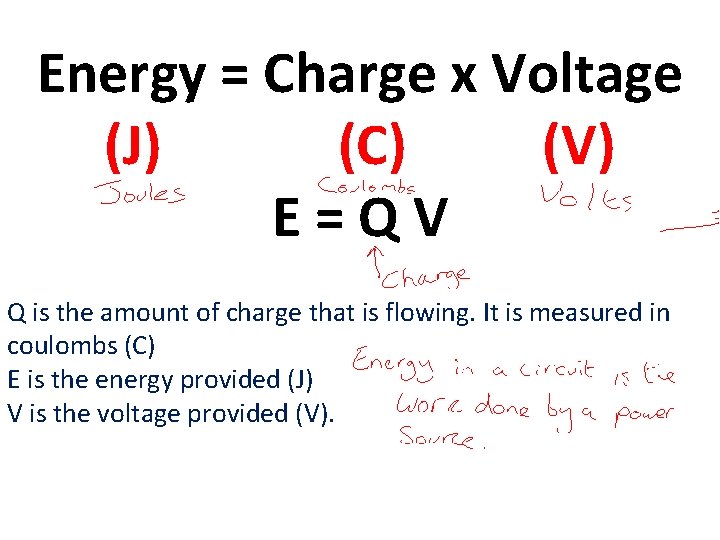
Energy = Charge x Voltage (J) (C) (V) E=QV Q is the amount of charge that is flowing. It is measured in coulombs (C) E is the energy provided (J) V is the voltage provided (V).
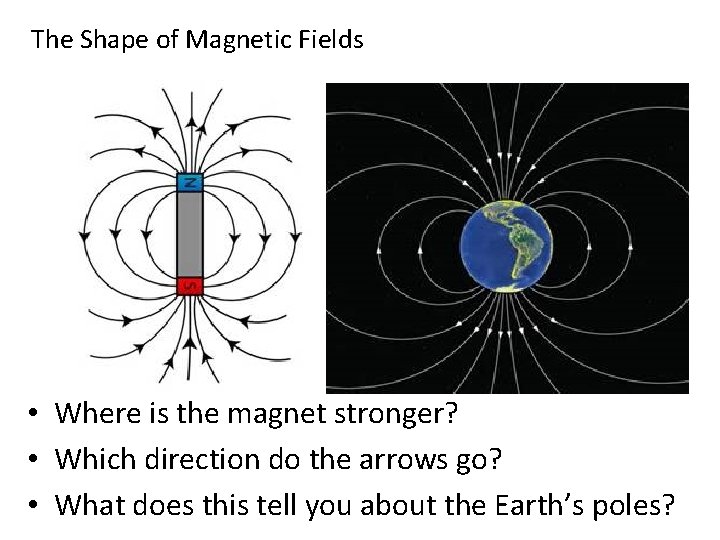
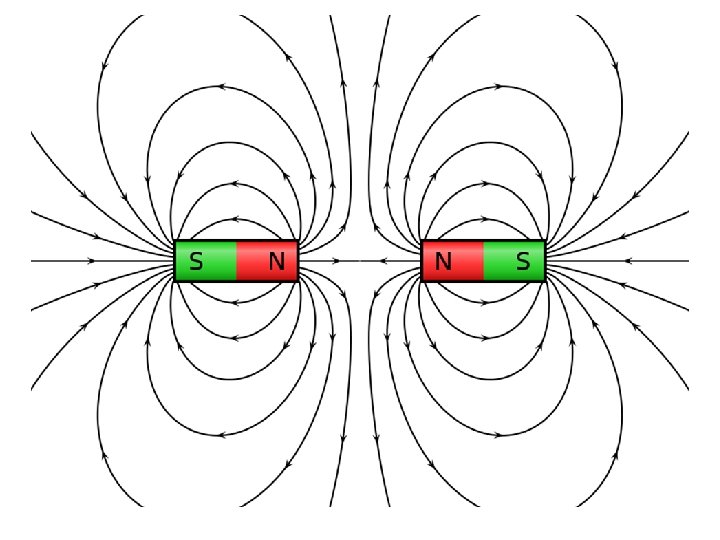
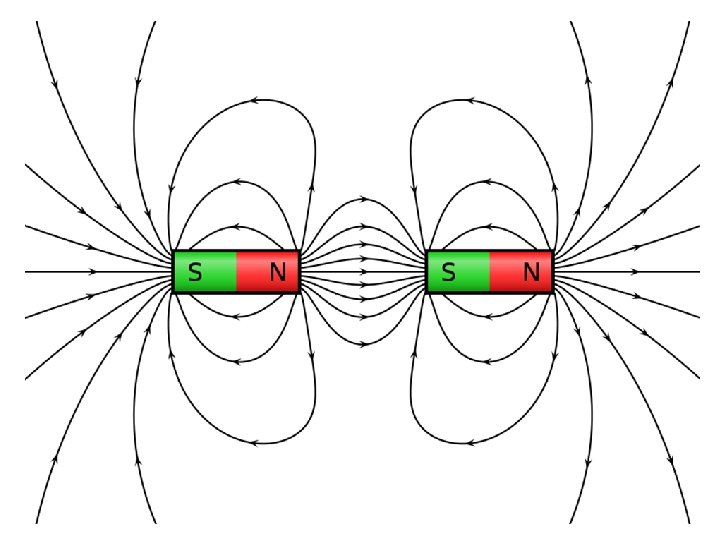
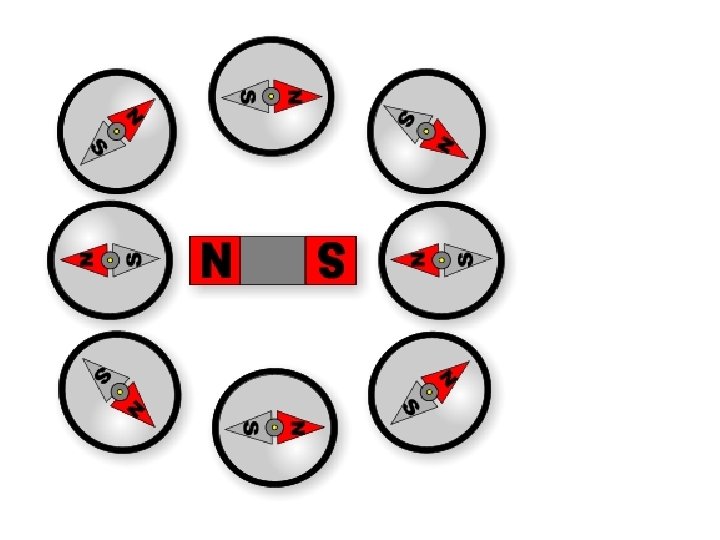
The Shape of Magnetic Fields • Where is the magnet stronger? • Which direction do the arrows go? • What does this tell you about the Earth’s poles?
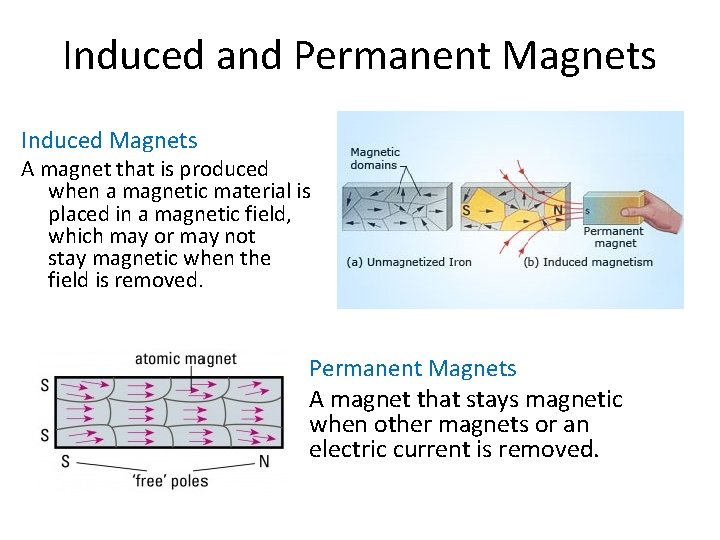
Induced and Permanent Magnets Induced Magnets A magnet that is produced when a magnetic material is placed in a magnetic field, which may or may not stay magnetic when the field is removed. when a Permanent Magnets A magnet that stays magnetic when other magnets or an electric current is removed.
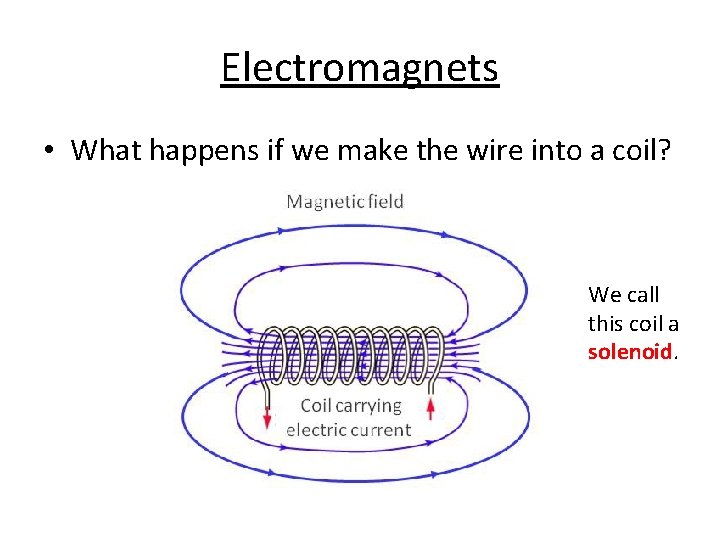
Electromagnets • What happens if we make the wire into a coil? We call this coil a solenoid.
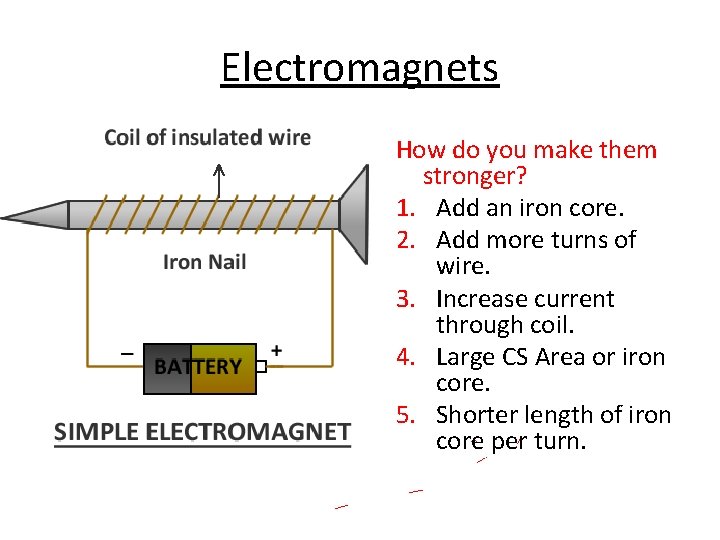
Electromagnets How do you make them stronger? 1. Add an iron core. 2. Add more turns of wire. 3. Increase current through coil. 4. Large CS Area or iron core. 5. Shorter length of iron core per turn.
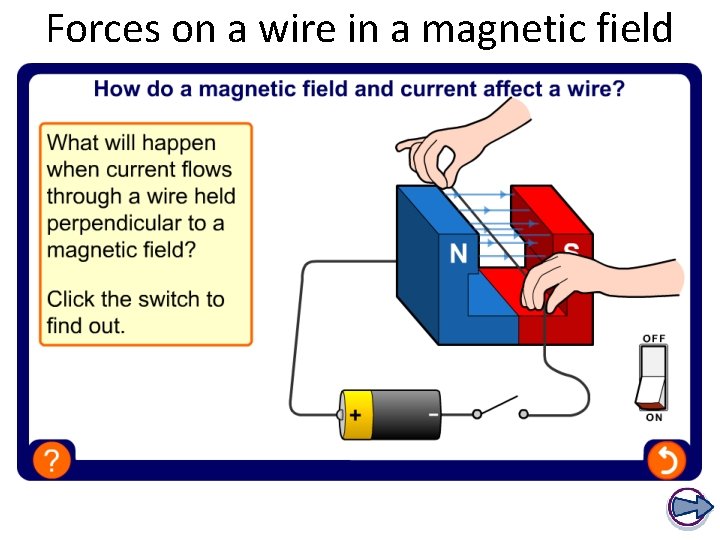
Forces on a wire in a magnetic field
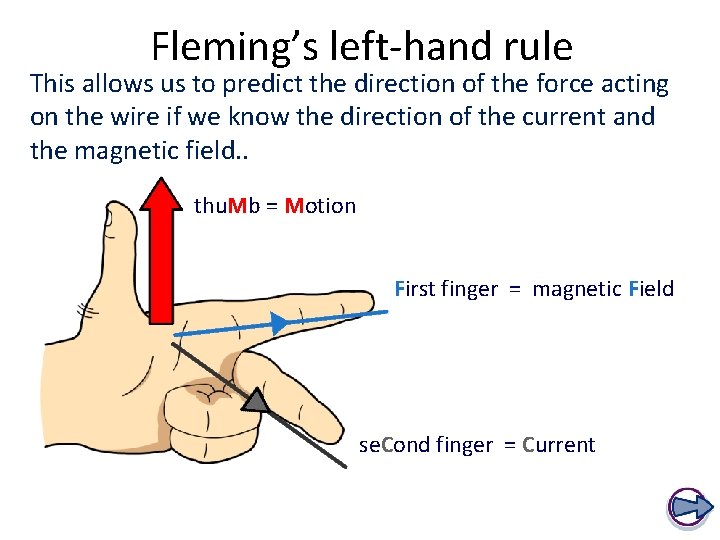
Fleming’s left-hand rule This allows us to predict the direction of the force acting on the wire if we know the direction of the current and the magnetic field. . thu. Mb = Motion First finger = magnetic Field se. Cond finger = Current
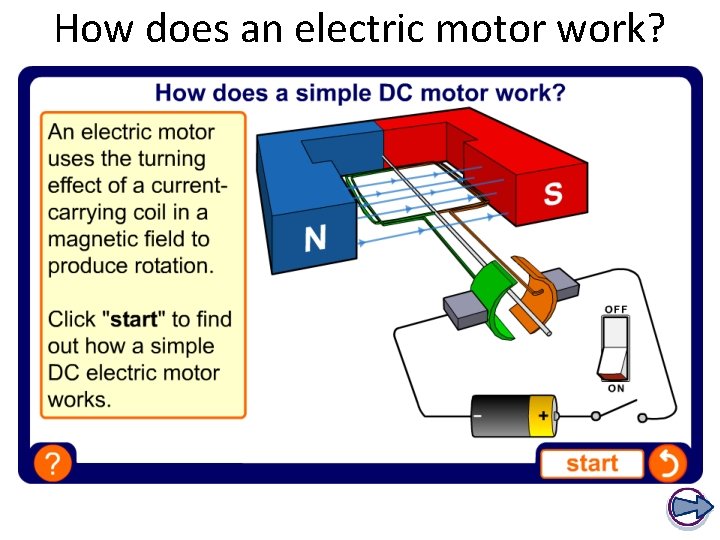
How does an electric motor work?
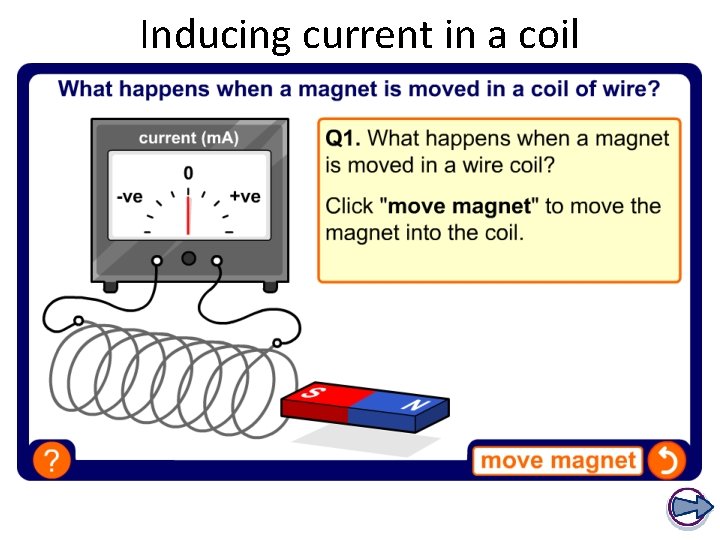
Inducing current in a coil
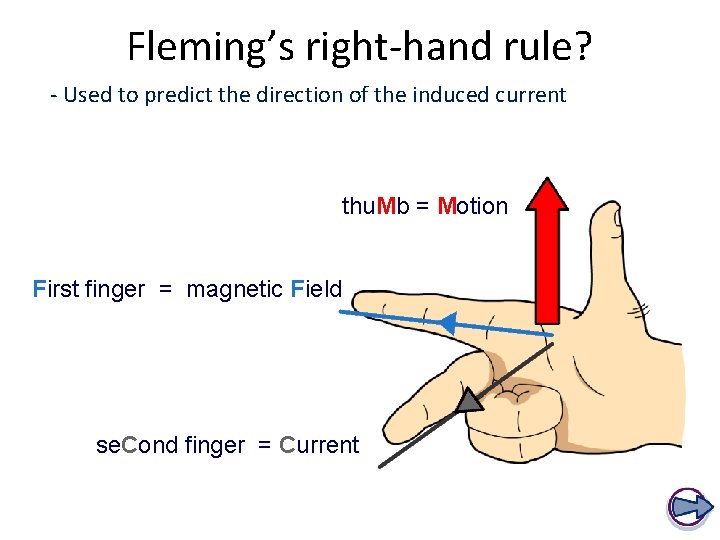
Fleming’s right-hand rule? - Used to predict the direction of the induced current thu. Mb = Motion First finger = magnetic Field se. Cond finger = Current
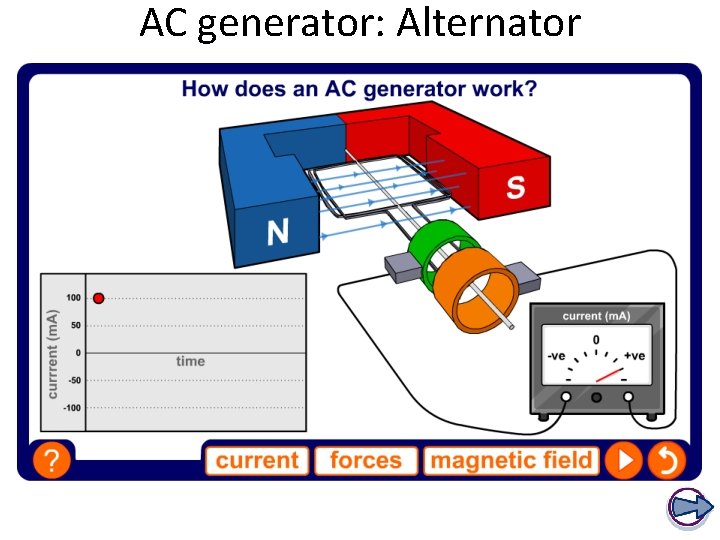
AC generator: Alternator
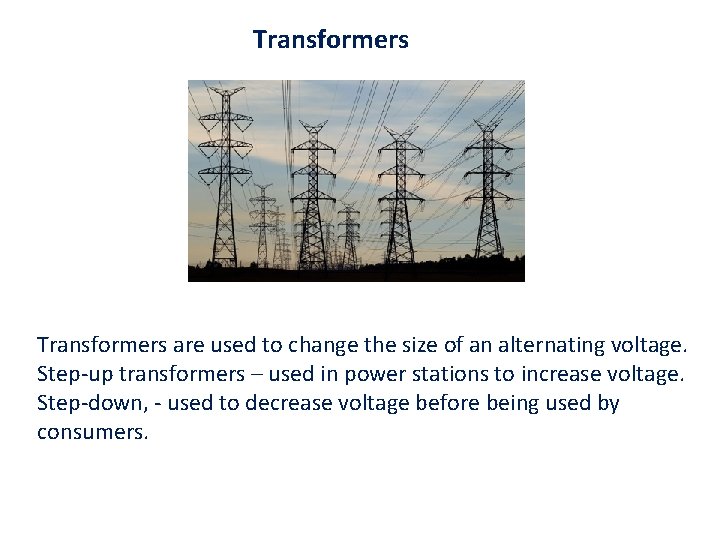
Transformers are used to change the size of an alternating voltage. Step-up transformers – used in power stations to increase voltage. Step-down, - used to decrease voltage before being used by consumers.
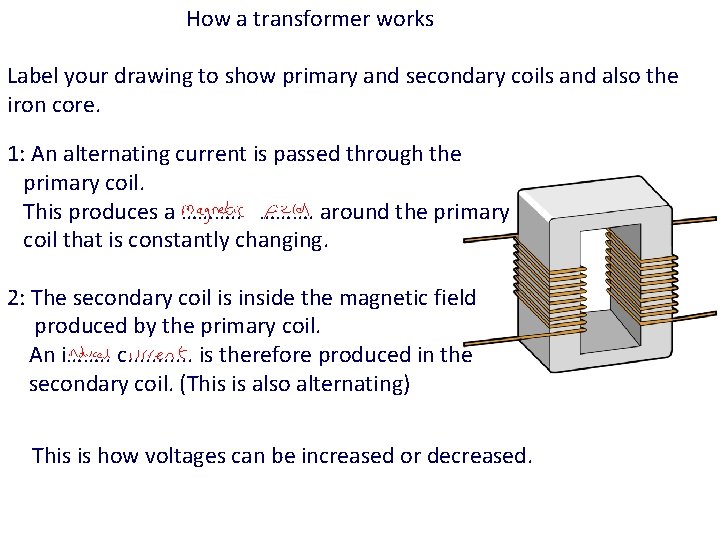
How a transformer works Label your drawing to show primary and secondary coils and also the iron core. 1: An alternating current is passed through the primary coil. This produces a ………. around the primary coil that is constantly changing. 2: The secondary coil is inside the magnetic field produced by the primary coil. An i……. . c. . . is therefore produced in the secondary coil. (This is also alternating) This is how voltages can be increased or decreased.
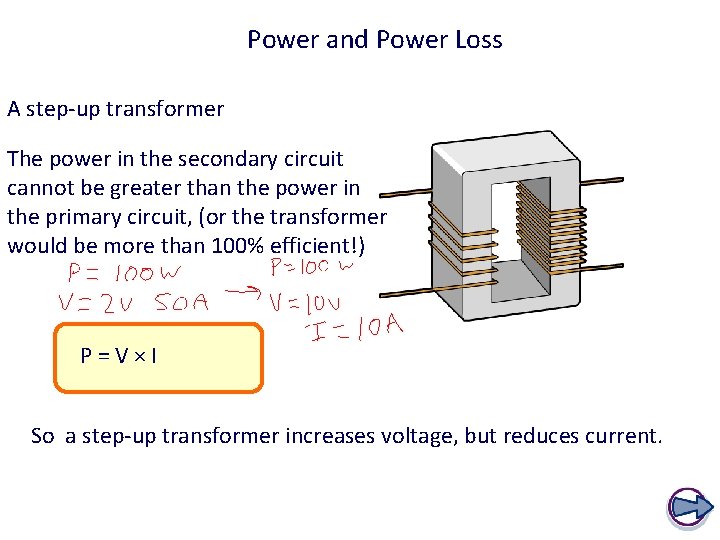
Power and Power Loss A step-up transformer The power in the secondary circuit cannot be greater than the power in the primary circuit, (or the transformer would be more than 100% efficient!) P=V×I So a step-up transformer increases voltage, but reduces current.
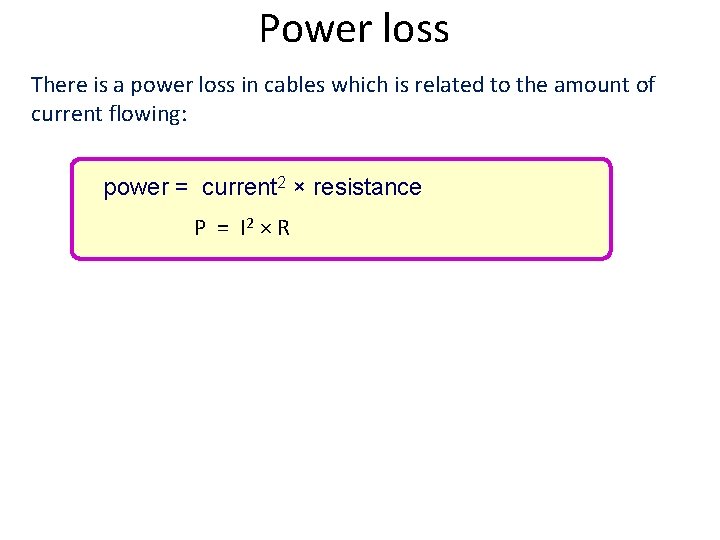
Power loss There is a power loss in cables which is related to the amount of current flowing: power = current 2 × resistance P = I 2 × R