
Charge spreading Shivam Joshi and Paul Colas Using

- Slides: 7
Charge spreading Shivam Joshi and Paul Colas Using Werner Riegler’s calculations
• Very preliminary study, needs interaction with Werner Riegler • 2 striking points in Werner’s formulae : - Looks to depend on the full size of the pad plane, rather than the pad scale - RC (resistivity per square times the capacitance per unit surface) does not appear as such in the formulae. • We try to study this with a LC-TPC based model : 1 padrow of elongated pads (3 x 7 mm²), R=2. 5 Mohm/sq, d_1=120 µm
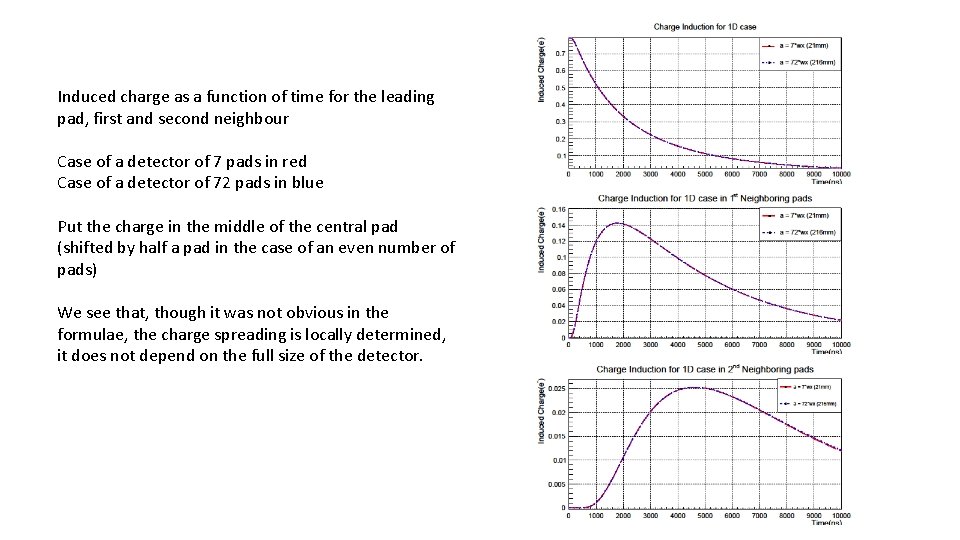
Induced charge as a function of time for the leading pad, first and second neighbour Case of a detector of 7 pads in red Case of a detector of 72 pads in blue Put the charge in the middle of the central pad (shifted by half a pad in the case of an even number of pads) We see that, though it was not obvious in the formulae, the charge spreading is locally determined, it does not depend on the full size of the detector.
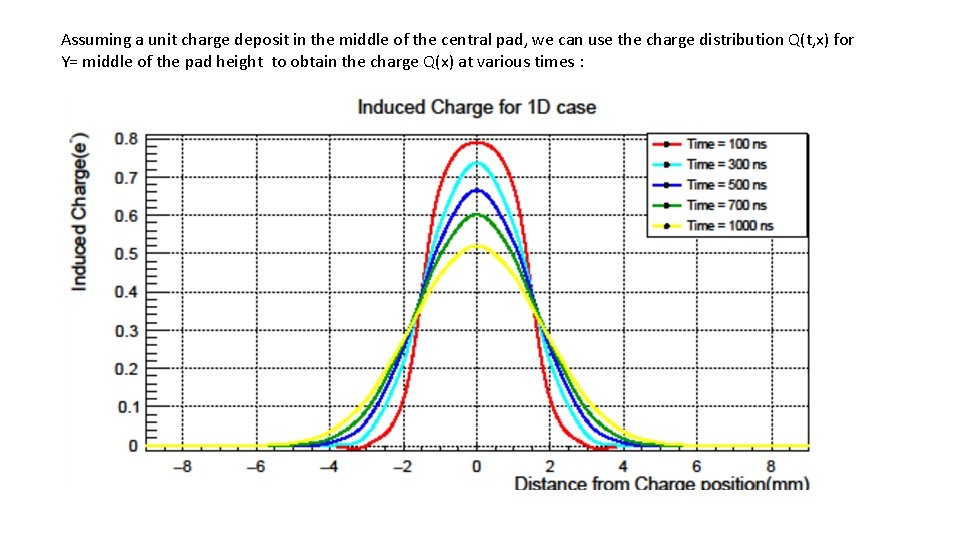
Assuming a unit charge deposit in the middle of the central pad, we can use the charge distribution Q(t, x) for Y= middle of the pad height to obtain the charge Q(x) at various times :
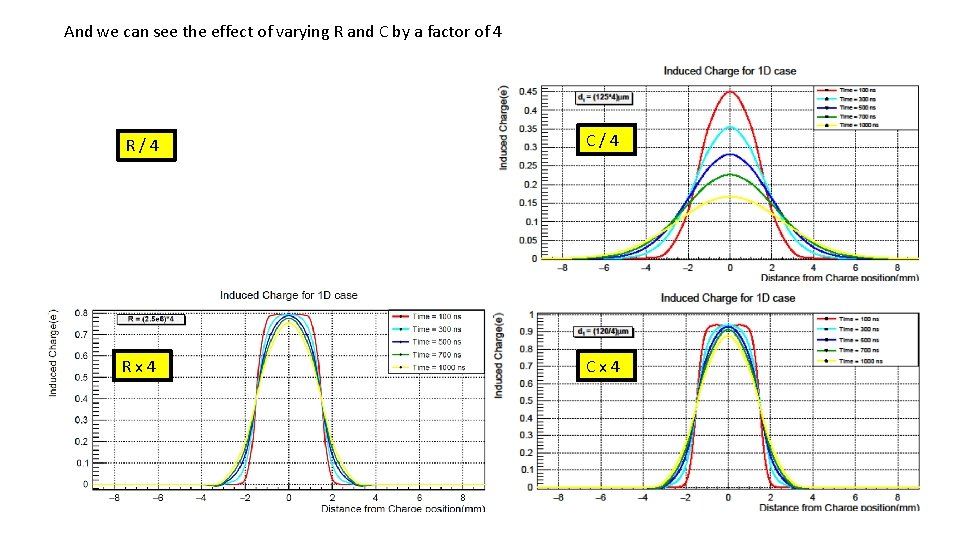
And we can see the effect of varying R and C by a factor of 4 R/4 C/4 Rx 4 Cx 4
Conclusion • We checked that the solution of the weighting field equation is local, i. e. the induced charge waveform does not depend on the full size of the detector. • We also checked that changing R or changing C by the same factor gives the same charge distribution shape (though increasing C increases the signal intensity)