
Charge order in organic conductors NMR Ferenc Zamborszky
Charge order in organic conductors NMR Ferenc Zamborszky Weiqiang Yu David Chow Pawel Wzietek Sylvie Lefebvre Molecules and crystals: Craig Merlic Andreas Baur Dean Tantillo Barakat Alavi Compounds are M 2+X- 1. Case ¼-filled: CO may be important for the g. s of the insulators: ET, TMTTF 2. What about the conductors (and superconductors)?
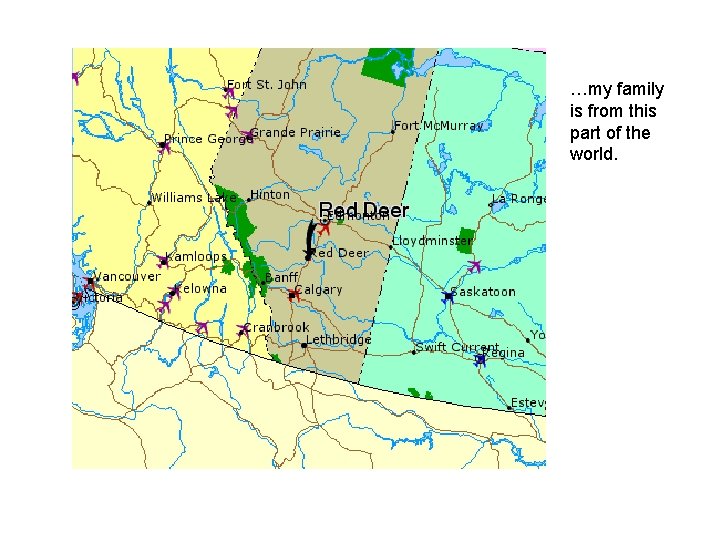
…my family is from this part of the world.
![“kappa” phase kappa-(ET)2 X, X=Cu(NCS)2 Distinction of highest Tc’s: Cu(NCS)2 10 K Cu[N(CN)2]Br 11](http://slidetodoc.com/presentation_image_h2/42a89e9dd67ed9cf43011cb077e9d402/image-3.jpg "“kappa” phase kappa-(ET)2 X, X=Cu(NCS)2 Distinction of highest Tc’s: Cu(NCS)2 10 K Cu[N(CN)2]Br 11")
“kappa” phase kappa-(ET)2 X, X=Cu(NCS)2 Distinction of highest Tc’s: Cu(NCS)2 10 K Cu[N(CN)2]Br 11 K Cu[N(CN)2]Cl 13 K (w/ pressure)
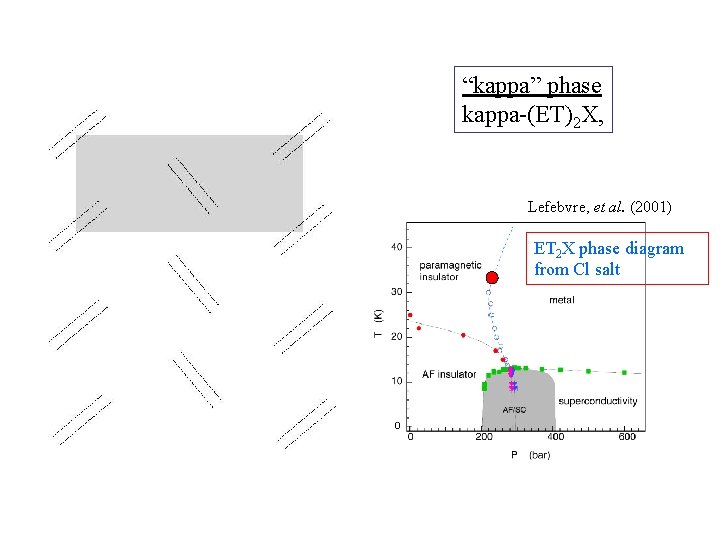
“kappa” phase kappa-(ET)2 X, Lefebvre, et al. (2001) ET 2 X phase diagram from Cl salt
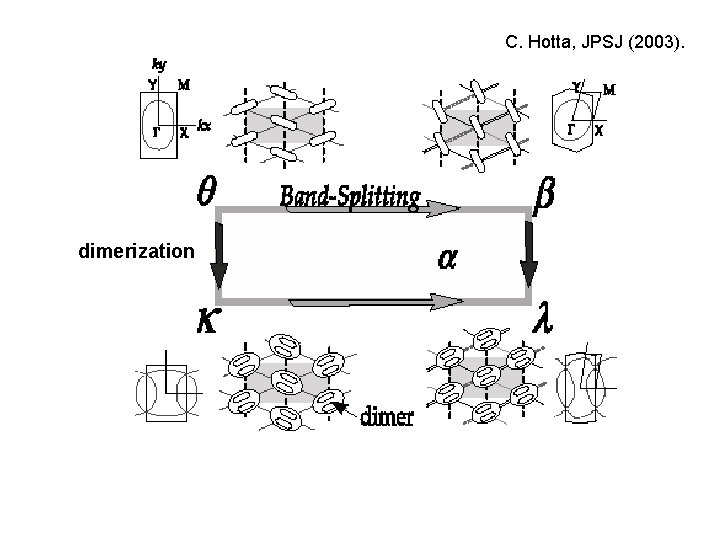
C. Hotta, JPSJ (2003). dimerization

Simplified model: Extended Hubbard on anisotropic triangular lattice horizontal and vertical t, V C. Hotta JPSJ (2003)
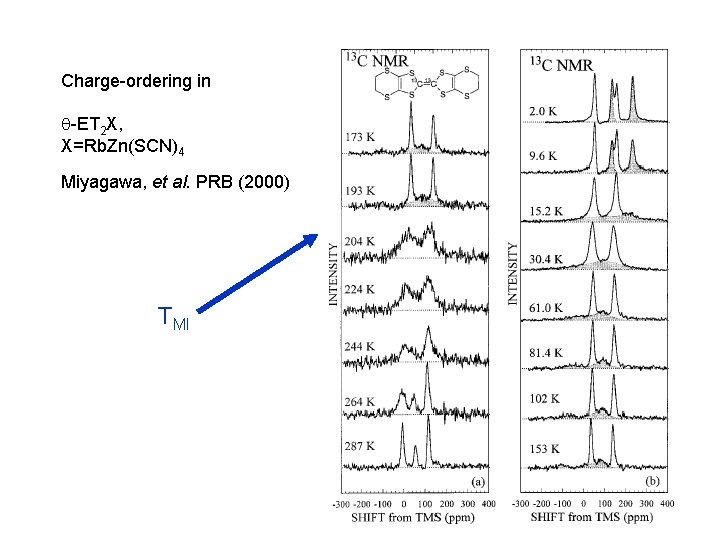
Charge-ordering in q-ET 2 X, X=Rb. Zn(SCN)4 Miyagawa, et al. PRB (2000) TMI
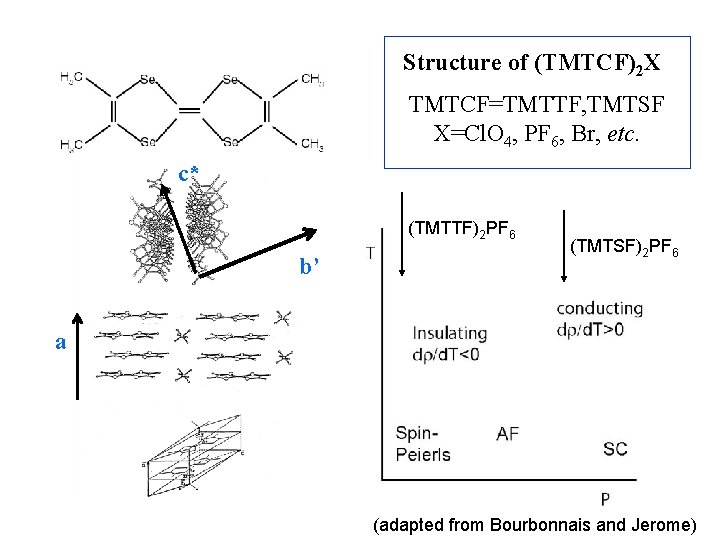
Structure of (TMTCF)2 X TMTCF=TMTTF, TMTSF X=Cl. O 4, PF 6, Br, etc. c* (TMTTF)2 PF 6 b’ (TMTSF)2 PF 6 a (adapted from Bourbonnais and Jerome)
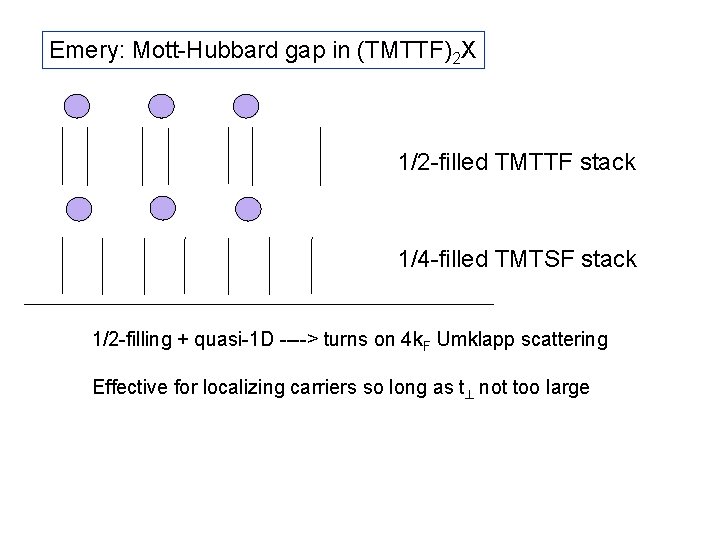
Emery: Mott-Hubbard gap in (TMTTF)2 X 1/2 -filled TMTTF stack 1/4 -filled TMTSF stack 1/2 -filling + quasi-1 D ----> turns on 4 k. F Umklapp scattering Effective for localizing carriers so long as t not too large
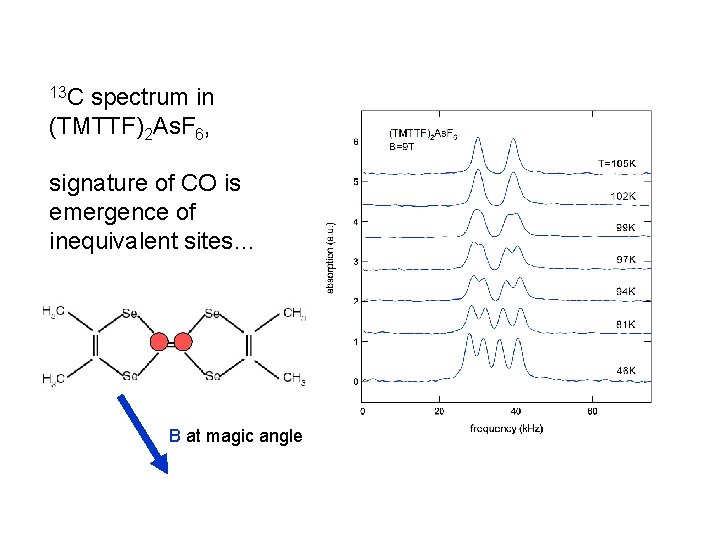
13 C spectrum in (TMTTF)2 As. F 6, signature of CO is emergence of inequivalent sites… B at magic angle
Some questions to ask (is the phase diagram, as drawn, telling the story? ): 1. What is nature of MI transition? 2. What is impact of CO on ground state? SP vs. AF commensurate magnetism LOOK AT As. F 6 (ground state SP), Sb. F 6 (ground state comm. AF) 3. What is nature of conducting phases of ET, TMTSF salts?
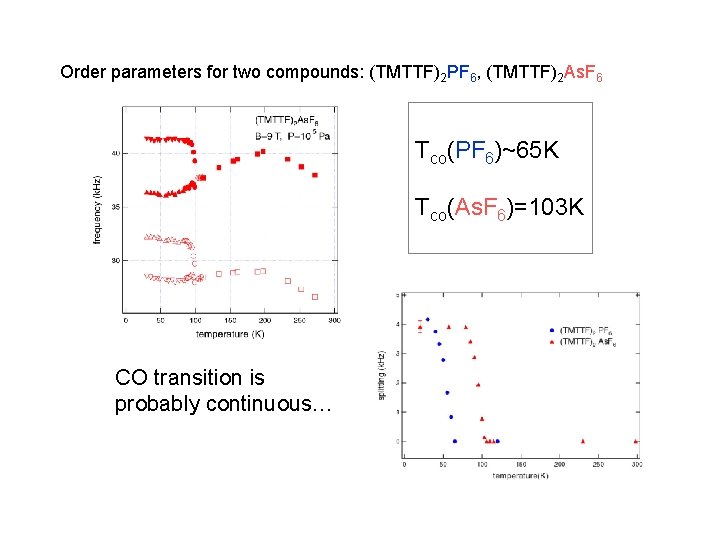
Order parameters for two compounds: (TMTTF)2 PF 6, (TMTTF)2 As. F 6 Tco(PF 6)~65 K Tco(As. F 6)=103 K CO transition is probably continuous…
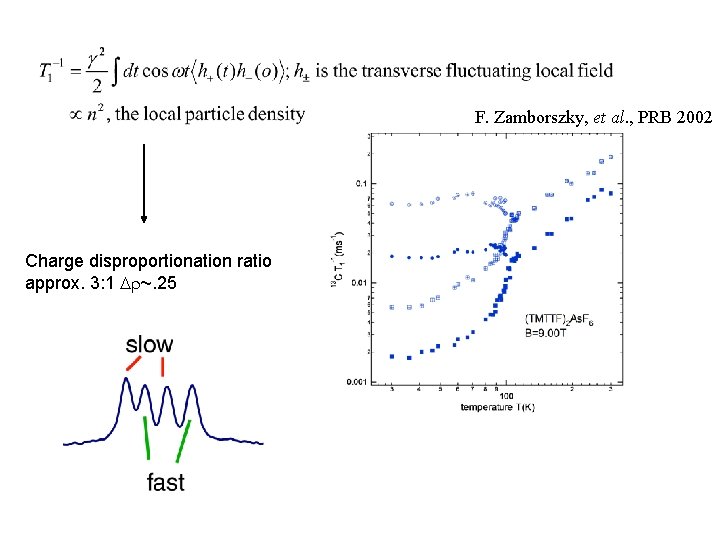
F. Zamborszky, et al. , PRB 2002 Charge disproportionation ratio approx. 3: 1 ~. 25
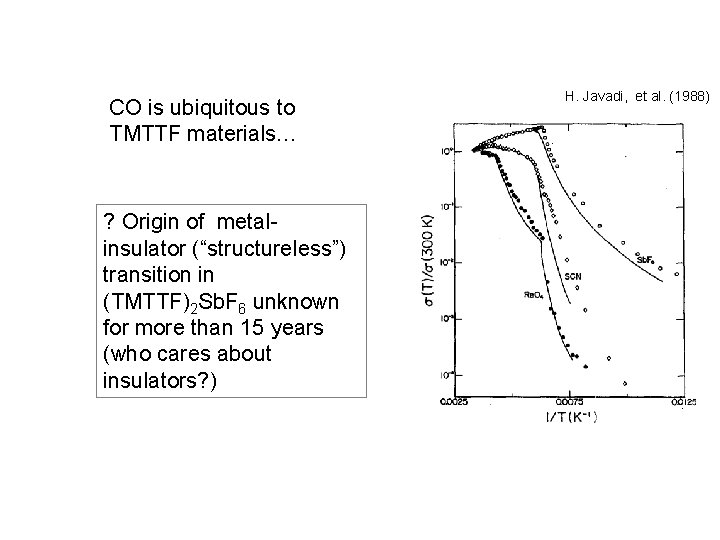
CO is ubiquitous to TMTTF materials… ? Origin of metalinsulator (“structureless”) transition in (TMTTF)2 Sb. F 6 unknown for more than 15 years (who cares about insulators? ) H. Javadi, et al. (1988)
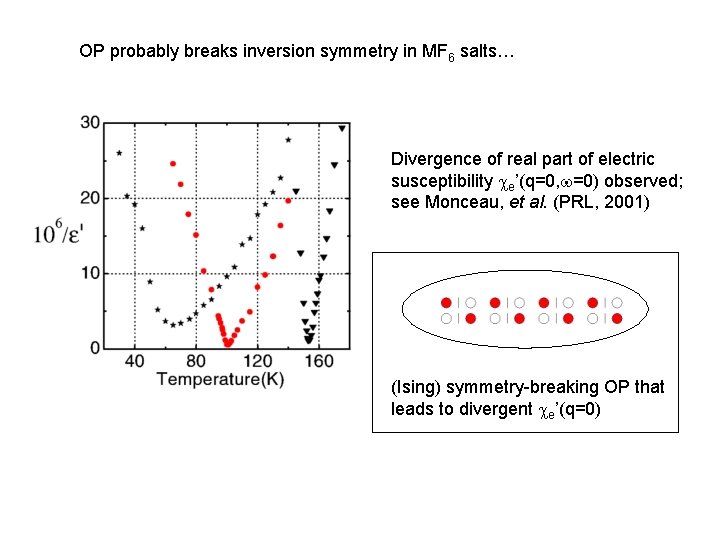
OP probably breaks inversion symmetry in MF 6 salts… Divergence of real part of electric susceptibility ce’(q=0, =0) observed; see Monceau, et al. (PRL, 2001) (Ising) symmetry-breaking OP that leads to divergent ce’(q=0)
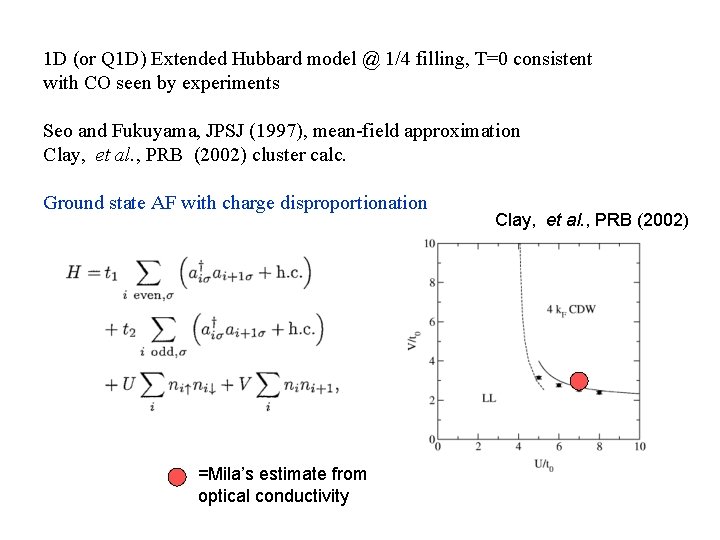
1 D (or Q 1 D) Extended Hubbard model @ 1/4 filling, T=0 consistent with CO seen by experiments Seo and Fukuyama, JPSJ (1997), mean-field approximation Clay, et al. , PRB (2002) cluster calc. Ground state AF with charge disproportionation =Mila’s estimate from optical conductivity Clay, et al. , PRB (2002)
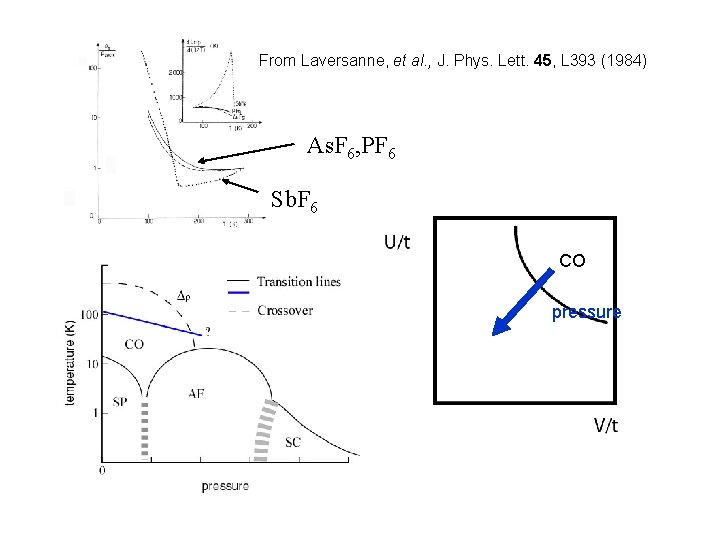
From Laversanne, et al. , J. Phys. Lett. 45, L 393 (1984) As. F 6, PF 6 Sb. F 6 CO pressure
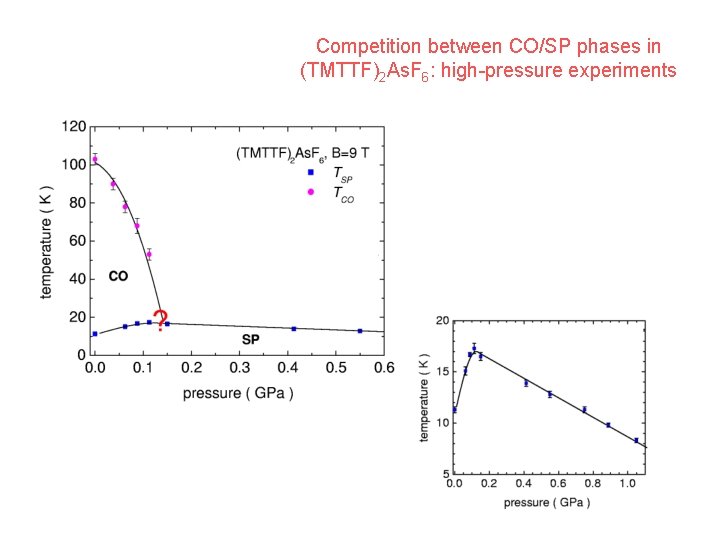
Competition between CO/SP phases in (TMTTF)2 As. F 6: high-pressure experiments
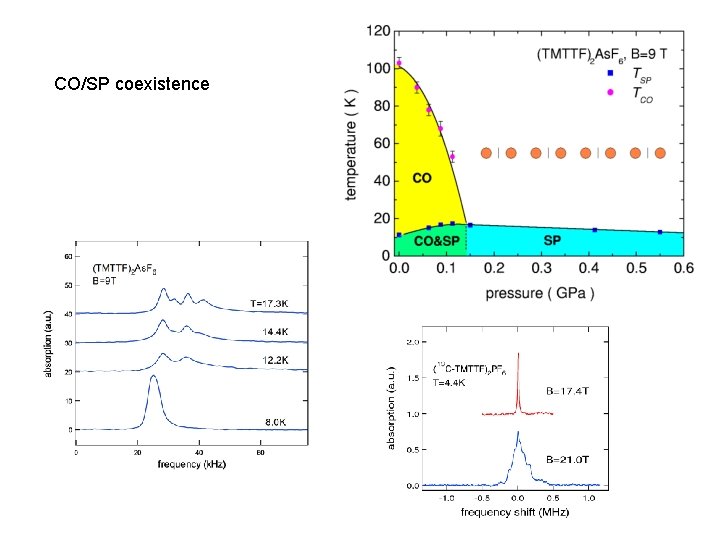
CO/SP coexistence
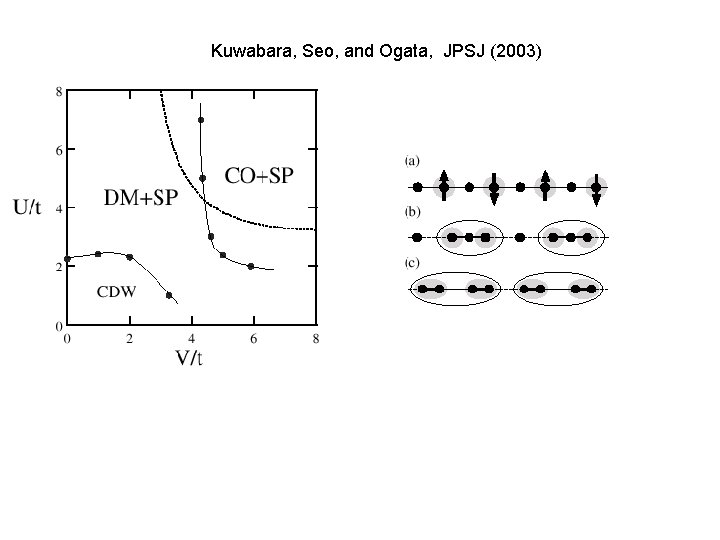
Kuwabara, Seo, and Ogata, JPSJ (2003)
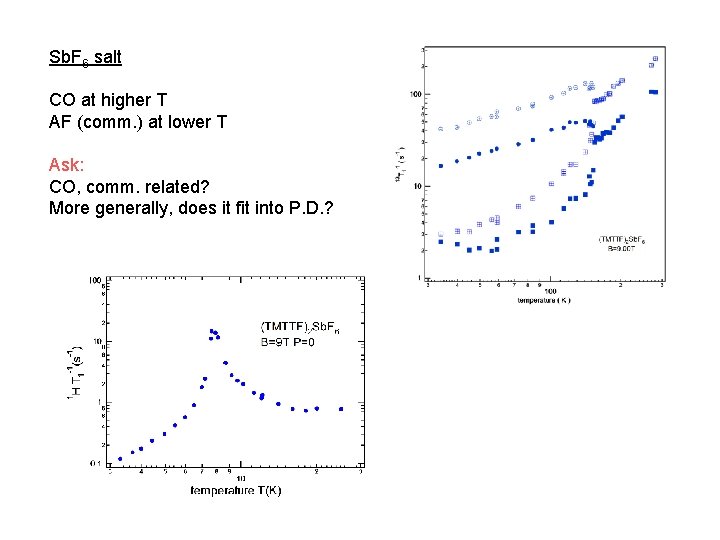
Sb. F 6 salt CO at higher T AF (comm. ) at lower T Ask: CO, comm. related? More generally, does it fit into P. D. ?

/2 t 1/2 preparation Here: echo ampl. ~cos( ct 1/2) 2 D technique used to eliminate internuclear dipolar field t 1/2 t 2 detect T=200 K, P=1 bar
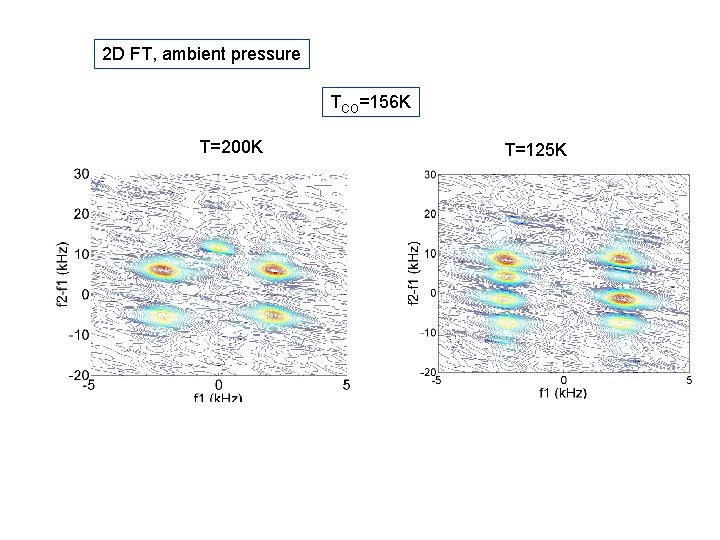
2 D FT, ambient pressure TCO=156 K T=200 K T=125 K
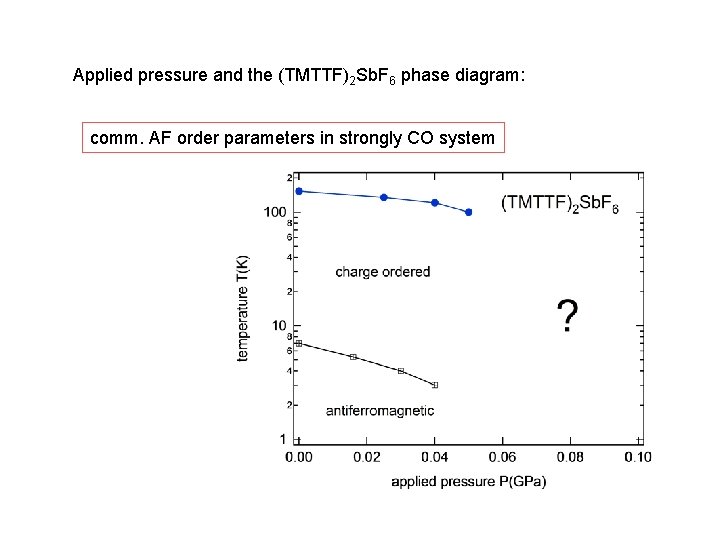
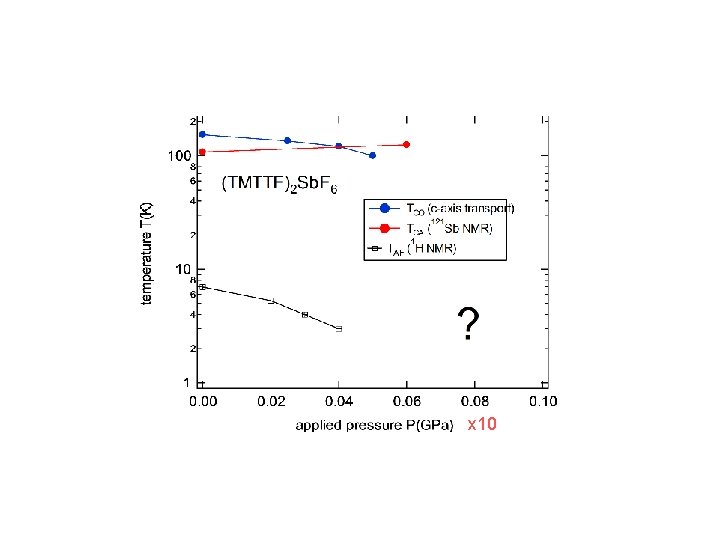
Applied pressure and the (TMTTF)2 Sb. F 6 phase diagram: comm. AF order parameters in strongly CO system
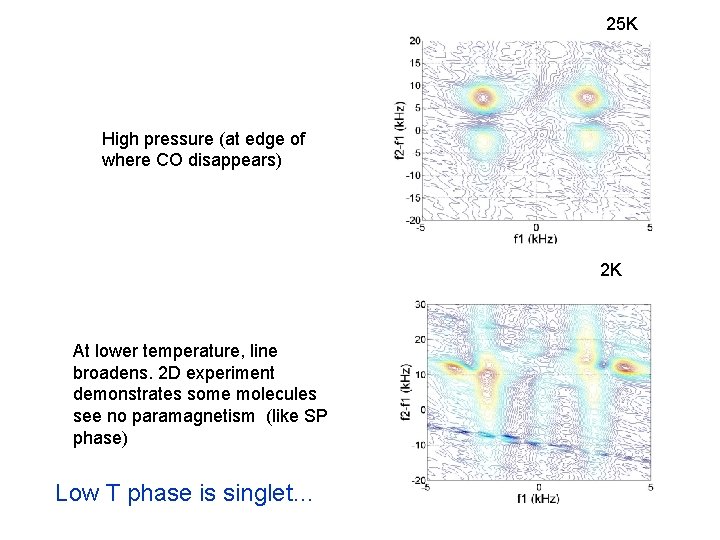
25 K High pressure (at edge of where CO disappears) 2 K At lower temperature, line broadens. 2 D experiment demonstrates some molecules see no paramagnetism (like SP phase) Low T phase is singlet…
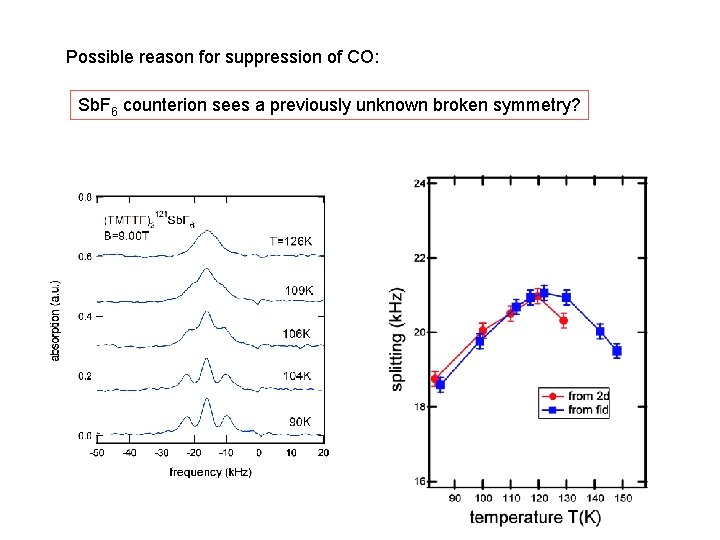
Possible reason for suppression of CO: Sb. F 6 counterion sees a previously unknown broken symmetry?
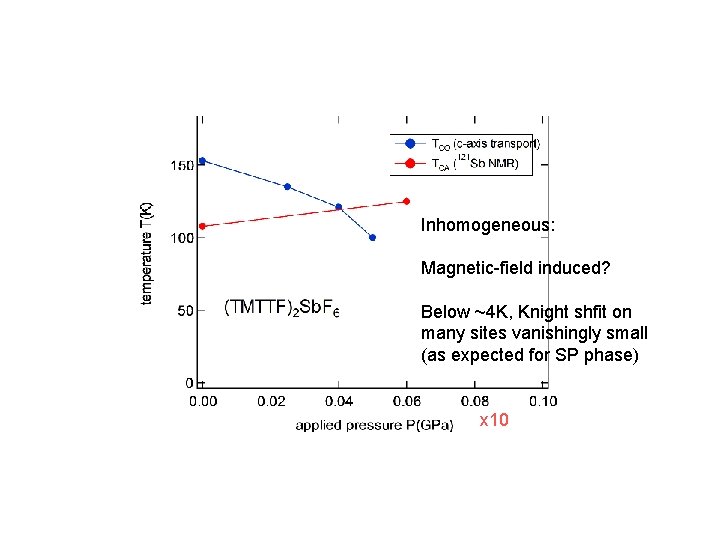
Inhomogeneous: Magnetic-field induced? Below ~4 K, Knight shfit on many sites vanishingly small (as expected for SP phase) x 10
x 10
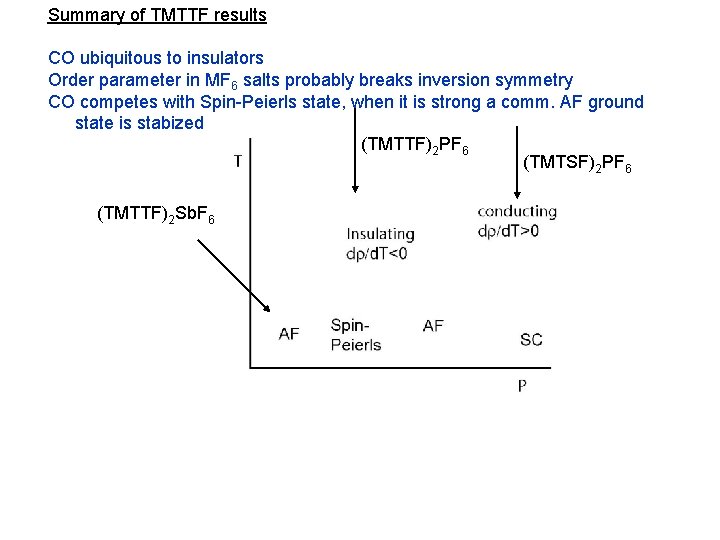
Summary of TMTTF results CO ubiquitous to insulators Order parameter in MF 6 salts probably breaks inversion symmetry CO competes with Spin-Peierls state, when it is strong a comm. AF ground state is stabized (TMTTF)2 PF 6 (TMTSF)2 PF 6 (TMTTF)2 Sb. F 6
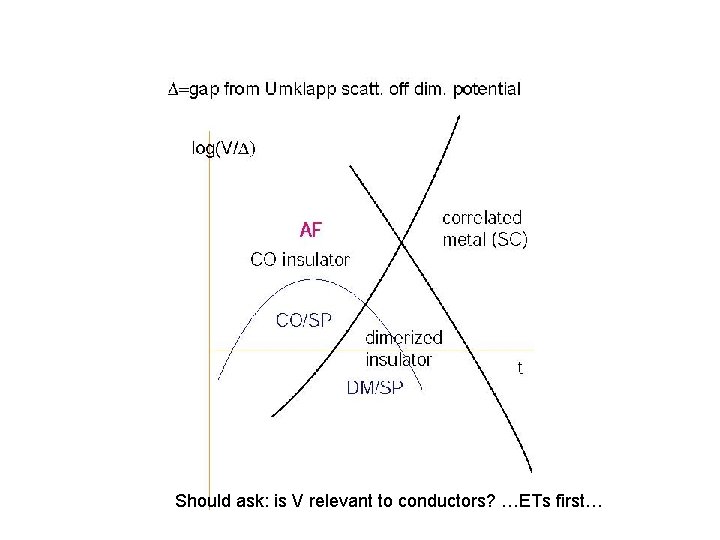
Should ask: is V relevant to conductors? …ETs first…
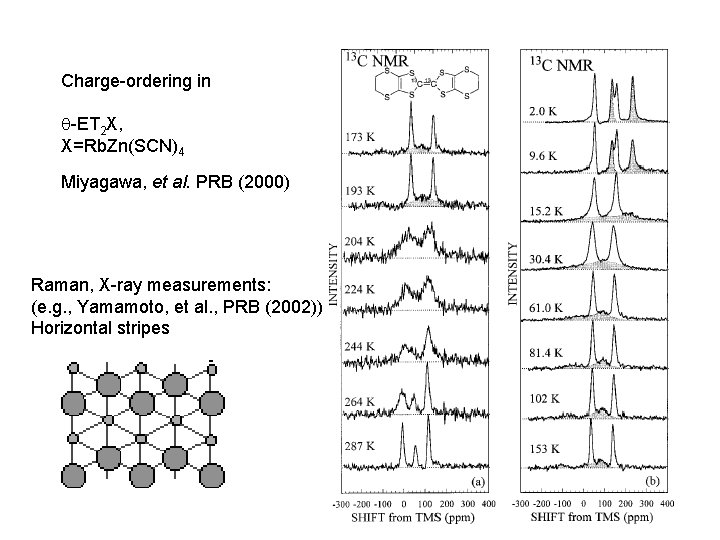
Charge-ordering in q-ET 2 X, X=Rb. Zn(SCN)4 Miyagawa, et al. PRB (2000) Raman, X-ray measurements: (e. g. , Yamamoto, et al. , PRB (2002)) Horizontal stripes
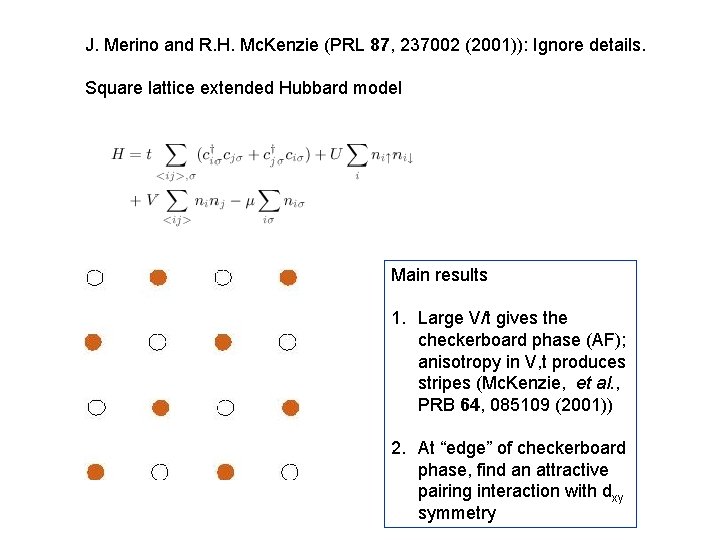
J. Merino and R. H. Mc. Kenzie (PRL 87, 237002 (2001)): Ignore details. Square lattice extended Hubbard model Main results 1. Large V/t gives the checkerboard phase (AF); anisotropy in V, t produces stripes (Mc. Kenzie, et al. , PRB 64, 085109 (2001)) 2. At “edge” of checkerboard phase, find an attractive pairing interaction with dxy symmetry
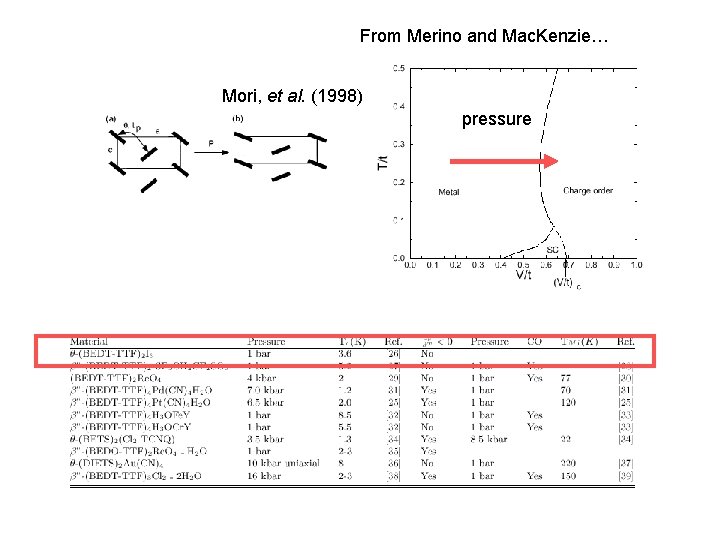
From Merino and Mac. Kenzie… Mori, et al. (1998) pressure
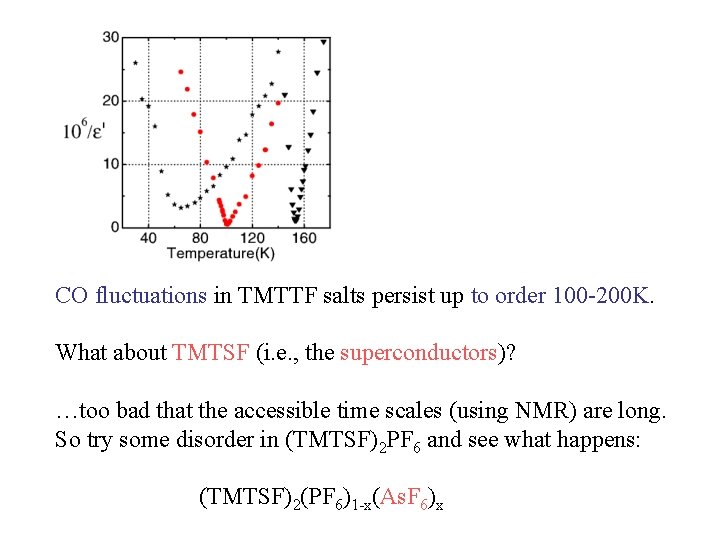
CO fluctuations in TMTTF salts persist up to order 100 -200 K. What about TMTSF (i. e. , the superconductors)? …too bad that the accessible time scales (using NMR) are long. So try some disorder in (TMTSF)2 PF 6 and see what happens: (TMTSF)2(PF 6)1 -x(As. F 6)x
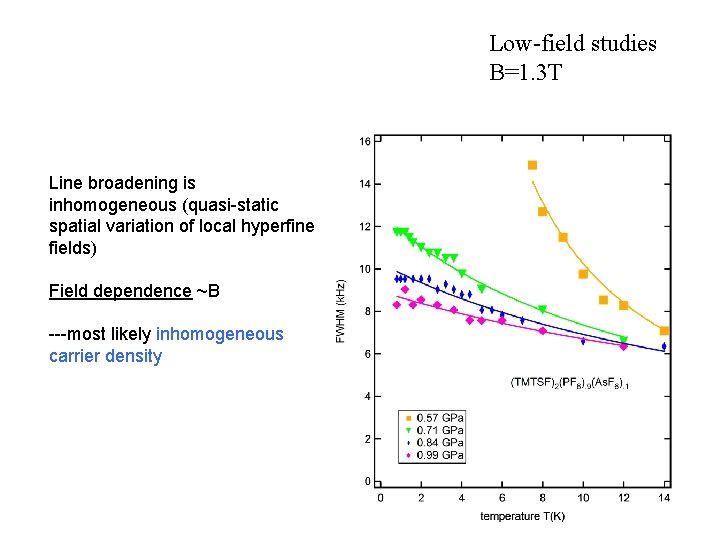
Low-field studies B=1. 3 T Line broadening is inhomogeneous (quasi-static spatial variation of local hyperfine fields) Field dependence ~B ---most likely inhomogeneous carrier density
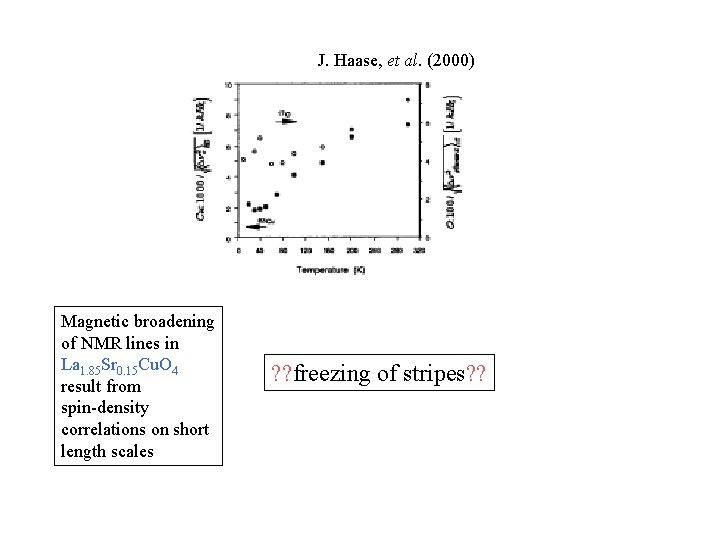
J. Haase, et al. (2000) Magnetic broadening of NMR lines in La 1. 85 Sr 0. 15 Cu. O 4 result from spin-density correlations on short length scales ? ? freezing of stripes? ?
Summary ¼-filled (or nearly so) M 2 X susceptible to CO Interactions relevant to CO have important role in ground state of insulators in TMTTF, ET families Presumably, could stabilize different CO phases in ET with uniaxial stress along different directions. What intermediate, ground state properties emerge? If spin and/or charge fluctuations important to SC, then in general, V should be important in that physics, too.
- Slides: 37