
Charge Instabilities At The Metamagnetic Transition Carsten Honerkamp
Charge Instabilities At The Metamagnetic Transition Carsten Honerkamp Max Planck Institute for Solid State Research Stuttgart 1 Layered Sr-Ruthenates 2 Stoner and Pomeranchuk scenarios for the metamagnetic transition 3 2 D Hubbard model perspective: mechanisms? 4 Micro phase separation? cond-mat/0502370
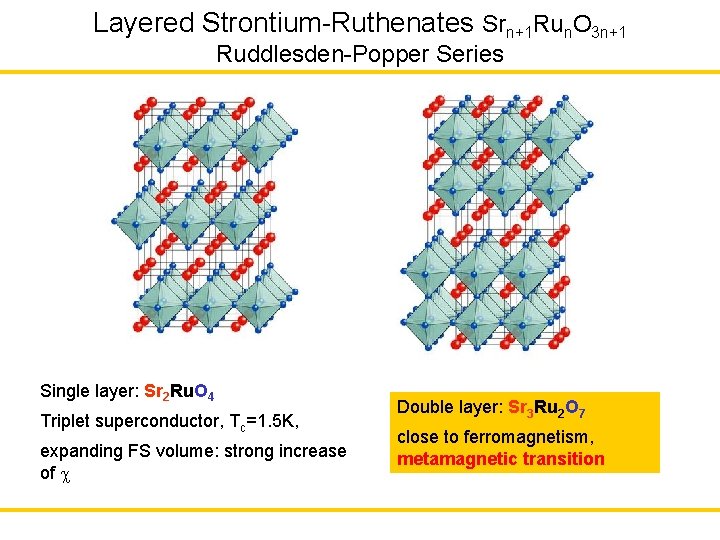
Layered Strontium-Ruthenates Srn+1 Run. O 3 n+1 Ruddlesden-Popper Series Single layer: Sr 2 Ru. O 4 Triplet superconductor, Tc=1. 5 K, expanding FS volume: strong increase of c Double layer: Sr 3 Ru 2 O 7 close to ferromagnetism, metamagnetic transition
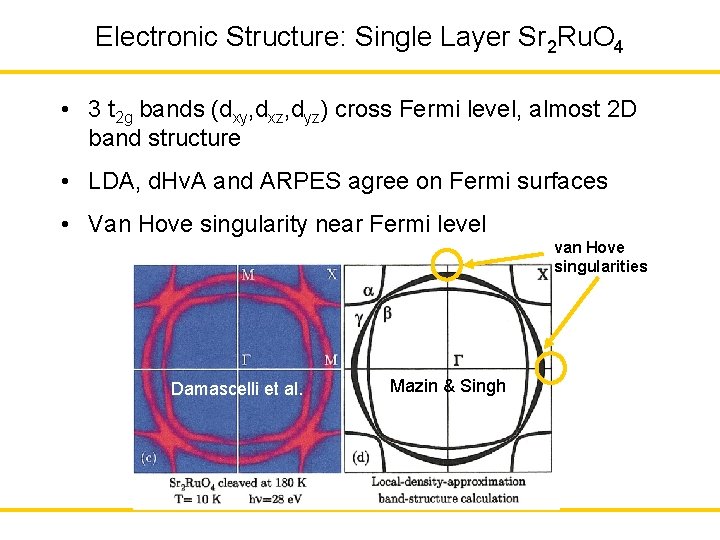
Electronic Structure: Single Layer Sr 2 Ru. O 4 • 3 t 2 g bands (dxy, dxz, dyz) cross Fermi level, almost 2 D band structure • LDA, d. Hv. A and ARPES agree on Fermi surfaces • Van Hove singularity near Fermi level van Hove singularities Damascelli et al. Mazin & Singh
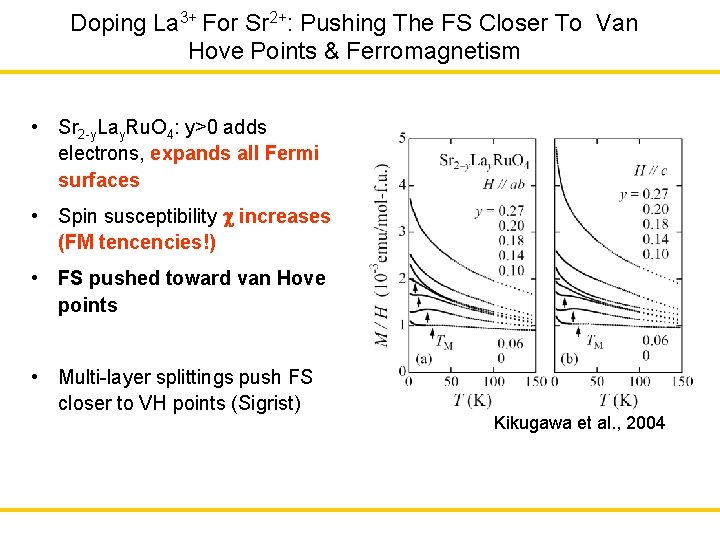
Doping La 3+ For Sr 2+: Pushing The FS Closer To Van Hove Points & Ferromagnetism • Sr 2 -y. Lay. Ru. O 4: y>0 adds electrons, expands all Fermi surfaces • Spin susceptibility c increases (FM tencencies!) • FS pushed toward van Hove points • Multi-layer splittings push FS closer to VH points (Sigrist) Kikugawa et al. , 2004
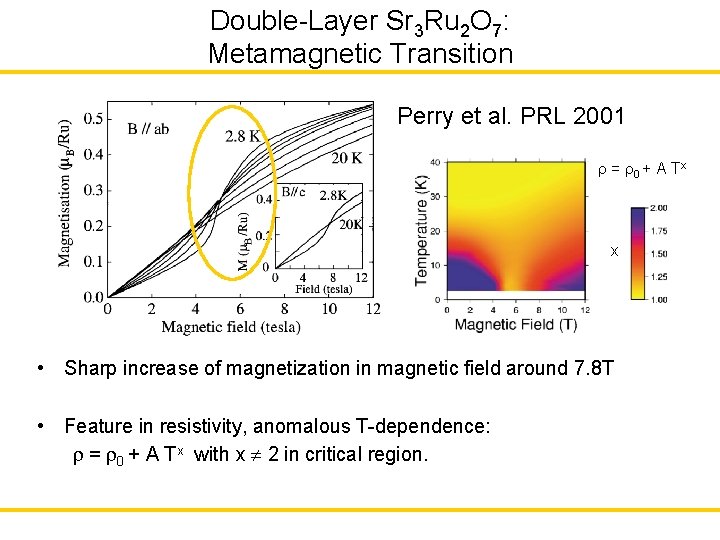
Double-Layer Sr 3 Ru 2 O 7: Metamagnetic Transition Perry et al. PRL 2001 r = r 0 + A T x x • Sharp increase of magnetization in magnetic field around 7. 8 T • Feature in resistivity, anomalous T-dependence: r = r 0 + A Tx with x 2 in critical region.

Stoner Picture • Mean field theory for local repulsion U: metamagnetic transition near van Hove filling VH Do. S h<hc Minimize g(T, h, n)= f. HF – hm m m Do. S m Binz & Sigrist 2003: x=distance to VH filling magnetization h>hc m hc magnetic field h
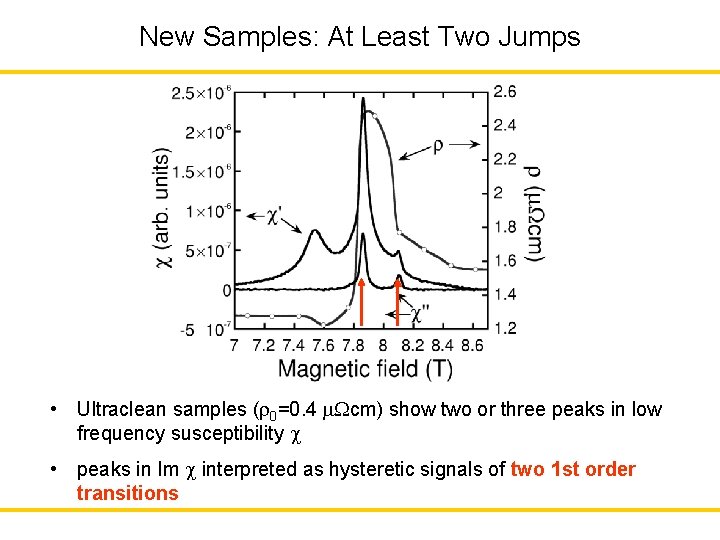
New Samples: At Least Two Jumps • Ultraclean samples (r 0=0. 4 m cm) show two or three peaks in low frequency susceptibility c • peaks in Im c interpreted as hysteretic signals of two 1 st order transitions
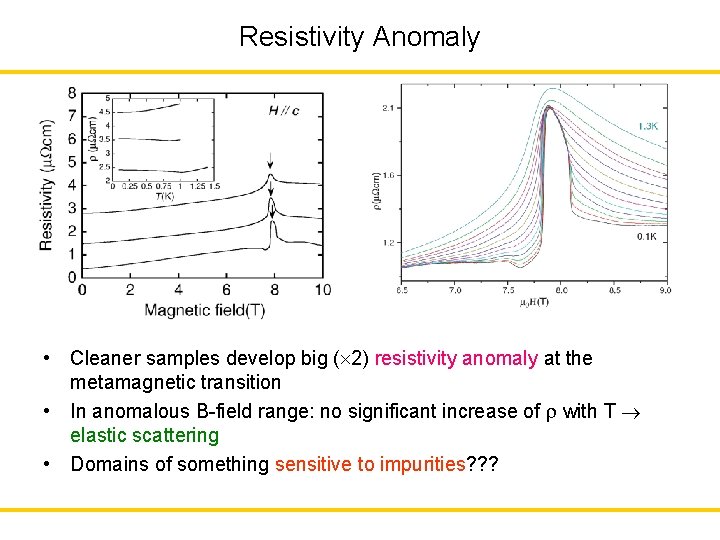
Resistivity Anomaly • Cleaner samples develop big ( 2) resistivity anomaly at the metamagnetic transition • In anomalous B-field range: no significant increase of r with T elastic scattering • Domains of something sensitive to impurities? ? ?
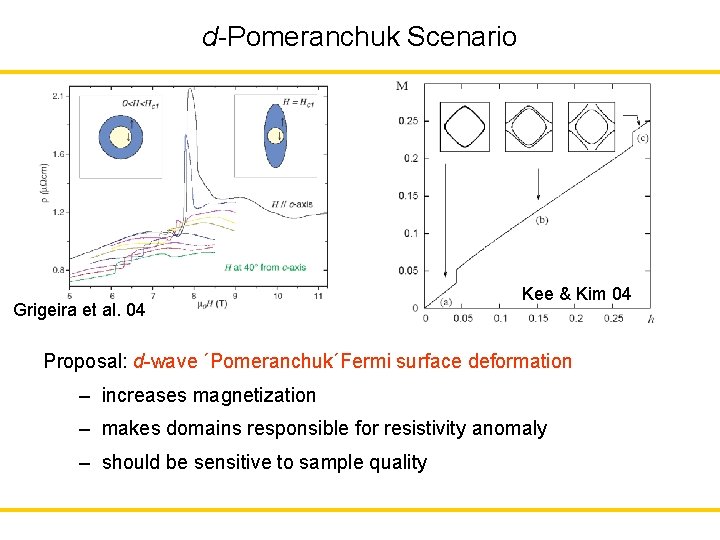
d-Pomeranchuk Scenario Grigeira et al. 04 Kee & Kim 04 Proposal: d-wave ´Pomeranchuk´Fermi surface deformation – increases magnetization – makes domains responsible for resistivity anomaly – should be sensitive to sample quality
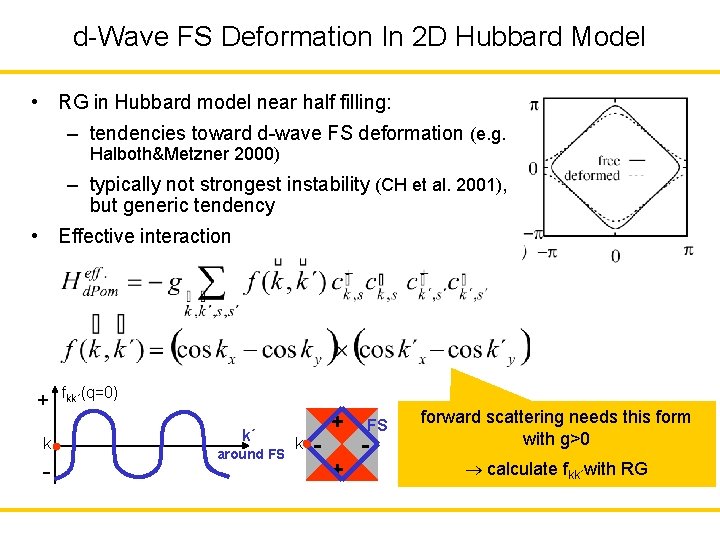
d-Wave FS Deformation In 2 D Hubbard Model • RG in Hubbard model near half filling: – tendencies toward d-wave FS deformation (e. g. Halboth&Metzner 2000) – typically not strongest instability (CH et al. 2001), but generic tendency • Effective interaction + k - fkk´(q=0) k´ around FS k - + + FS - forward scattering needs this form with g>0 calculate fkk´with RG
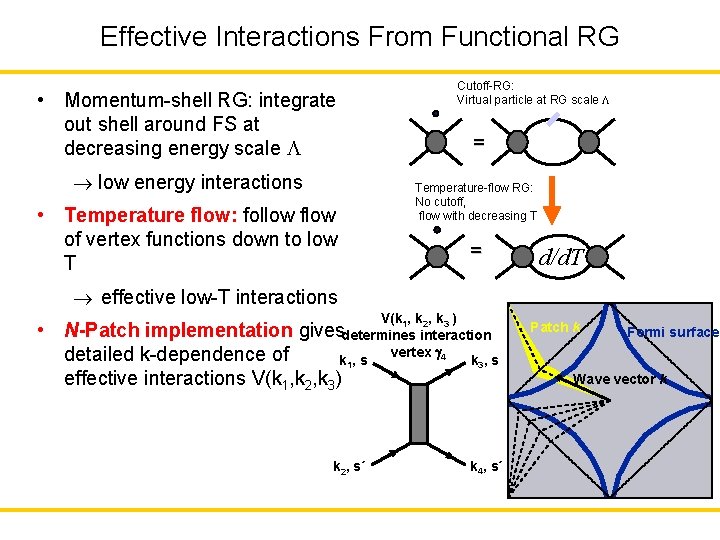
Effective Interactions From Functional RG • Momentum-shell RG: integrate out shell around FS at decreasing energy scale L low energy interactions • Temperature flow: follow flow of vertex functions down to low T Cutoff-RG: Virtual particle at RG scale L = Temperature-flow RG: No cutoff, flow with decreasing T = d/d. T effective low-T interactions V(k 1, k 2, k 3 ) givesdetermines interaction vertex g 4 k 1, s k 3, s • N-Patch implementation detailed k-dependence of effective interactions V(k 1, k 2, k 3) k 2, s´ Patch k Fermi surface Wave vector k k 4, s´
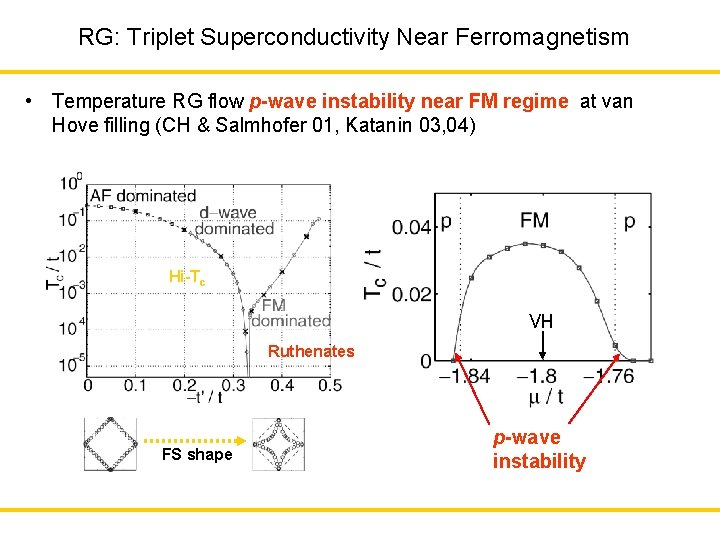
RG: Triplet Superconductivity Near Ferromagnetism • Temperature RG flow p-wave instability near FM regime at van Hove filling (CH & Salmhofer 01, Katanin 03, 04) Hi-Tc VH Ruthenates FS shape p-wave instability
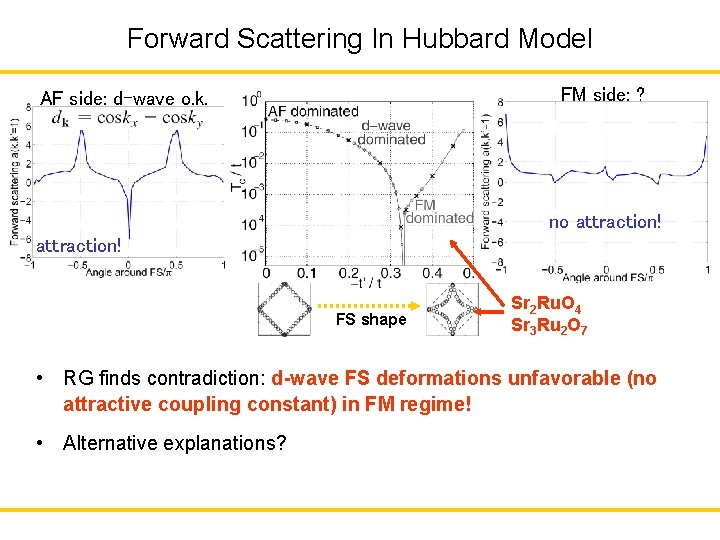
Forward Scattering In Hubbard Model FM side: ? AF side: d-wave o. k. no attraction! FS shape Sr 2 Ru. O 4 Sr 3 Ru 2 O 7 • RG finds contradiction: d-wave FS deformations unfavorable (no attractive coupling constant) in FM regime! • Alternative explanations?
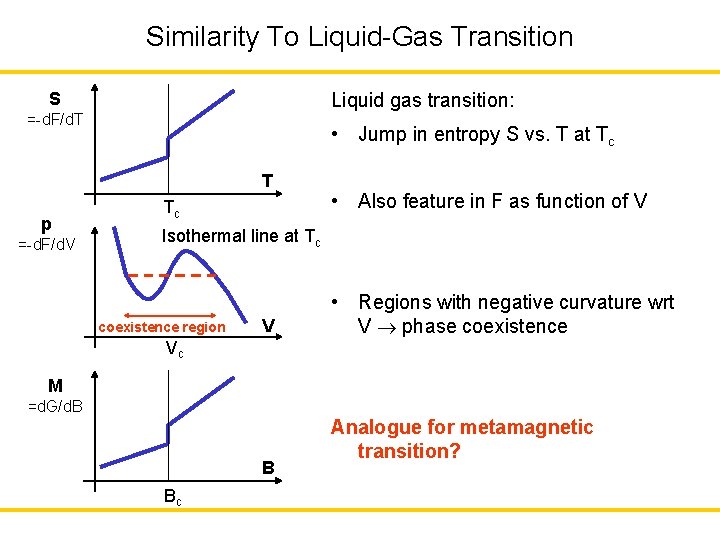
Similarity To Liquid-Gas Transition S Liquid gas transition: =-d. F/d. T • Jump in entropy S vs. T at Tc T p =-d. F/d. V Tc • Also feature in F as function of V Isothermal line at Tc coexistence region V Vc • Regions with negative curvature wrt V phase coexistence M =d. G/d. B B Bc Analogue for metamagnetic transition?

Unstable Density Regions Near MM Transition coexistence region Gibbs potential G(h, n, T) h fixed (unstable region easily removed b disorder) n n<(h) n>(h) • Gibbs potential G(T, h, n) in Binz-Sigrist mean-field model has negative curvature wrt density n Coulomb-frustrated phase separation? m(x) magnetization n(x) density nav n> p 1 -p l n< x p 1 -p l x

Maxwell Destruction Of Magnetization Jump? n> M =d. G/d. B n< B increase h • Mixing parameter p from Maxwell construction: Density: ntot= (1 -p) n<(h) + p n>(h) (p varies continuously from 0 to 1 through transition) Magnetization: mtot= (1 -p) m<(h)+ p m>(h) • Does phase separation wipe out magnetization-step? Bc
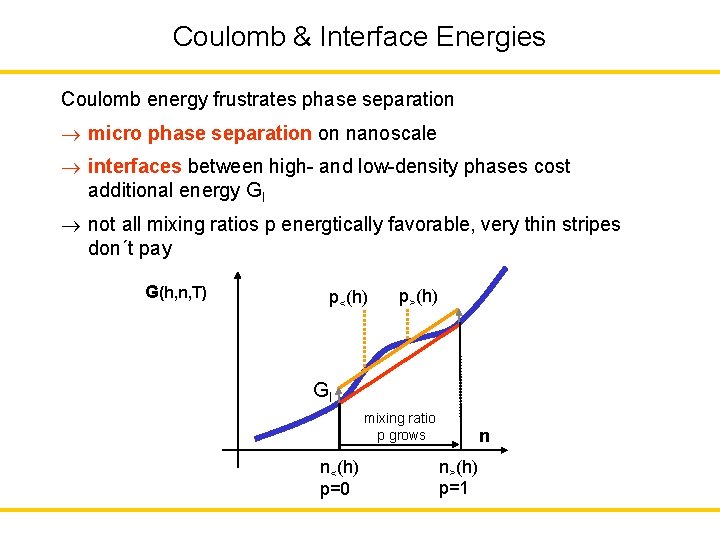
Coulomb & Interface Energies Coulomb energy frustrates phase separation micro phase separation on nanoscale interfaces between high- and low-density phases cost additional energy GI not all mixing ratios p energtically favorable, very thin stripes don´t pay G(h, n, T) p<(h) p>(h) GI mixing ratio p grows n<(h) p=0 n n>(h) p=1
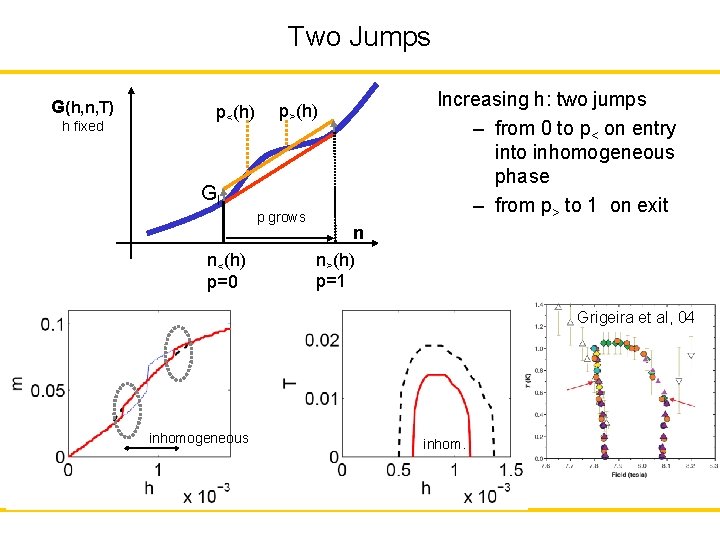
Two Jumps G(h, n, T) h fixed p<(h) Increasing h: two jumps – from 0 to p< on entry into inhomogeneous phase – from p> to 1 on exit p>(h) GI p grows n<(h) p=0 n n>(h) p=1 Grigeira et al, 04 inhomogeneous inhom.
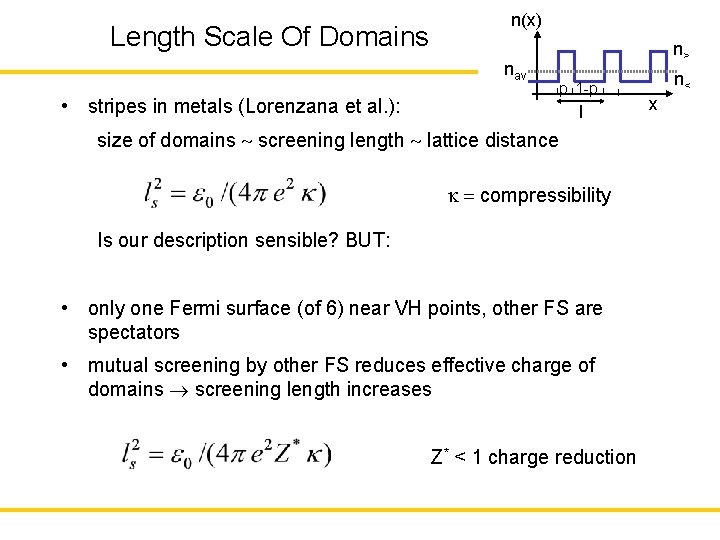
Length Scale Of Domains n(x) nav • stripes in metals (Lorenzana et al. ): n> p 1 -p l size of domains screening length lattice distance k = compressibility Is our description sensible? BUT: • only one Fermi surface (of 6) near VH points, other FS are spectators • mutual screening by other FS reduces effective charge of domains screening length increases Z* < 1 charge reduction n< x
Conclusions • Strontium-Ruthenates are good test case for understanding of correlation effects • Scenarios for resistivity anomaly at metamagnetic transition – Pomeranchuk FS deformation hard to reconcile with FM tendencies and Hubbrd-type models – MM transition invites micro phase separation, Coulomb+interface energies might create two magnetization jumps – Alternative: uncharged Condon domains due to demagnetization (Binz, Sigrist et al. ) Possible experimental test: STM (Cornell group)
- Slides: 20