
Charge calculations in pyrometallurgical processes Charge calculations are
- Slides: 27
Charge calculations in pyrometallurgical processes
Charge calculations are carried out prior to operating a metallurgical process to determine the quantity of each type of raw material fed to the furnace in order to obtain the desired quantity of products It is similar to stoichiometric problems but the engineer has to have a detailed knowledge on the internal working of the process in order to write the relevant reactions Material balance by careful and detailed tracking of all elements in the input and output is the prerequisite of heat balance and complete definition of the system Multiple reactions in metallurgical process makes it hard to keep track of all the chemical species in the reactants and products Complex charge calculation problems can be solved easily by simplifying assumptions e. g. It is safe to assume in iron blast furnace that all Ca. O, Mg. O and Al 2 O 3 of the charge end up in the slag Also molten pig iron can be considered to contain all Fe coming from the ore All CO 2 in the flue gases can be thought to originate from the reactions and air is simply O 2 and N 2
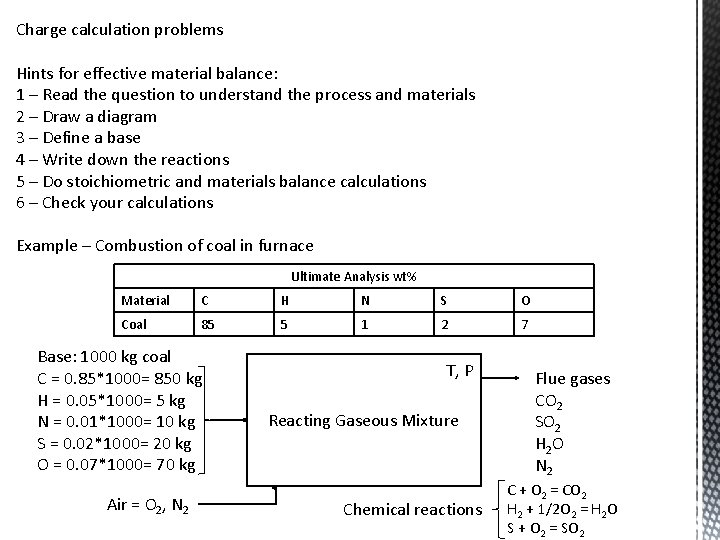
Charge calculation problems Hints for effective material balance: 1 – Read the question to understand the process and materials 2 – Draw a diagram 3 – Define a base 4 – Write down the reactions 5 – Do stoichiometric and materials balance calculations 6 – Check your calculations Example – Combustion of coal in furnace Ultimate Analysis wt% Material C H N S O Coal 85 5 1 2 7 Base: 1000 kg coal C = 0. 85*1000= 850 kg H = 0. 05*1000= 5 kg N = 0. 01*1000= 10 kg S = 0. 02*1000= 20 kg O = 0. 07*1000= 70 kg Air = O 2, N 2 T, P Reacting Gaseous Mixture Chemical reactions Flue gases CO 2 SO 2 H 2 O N 2 C + O 2 = CO 2 H 2 + 1/2 O 2 = H 2 O S + O 2 = SO 2
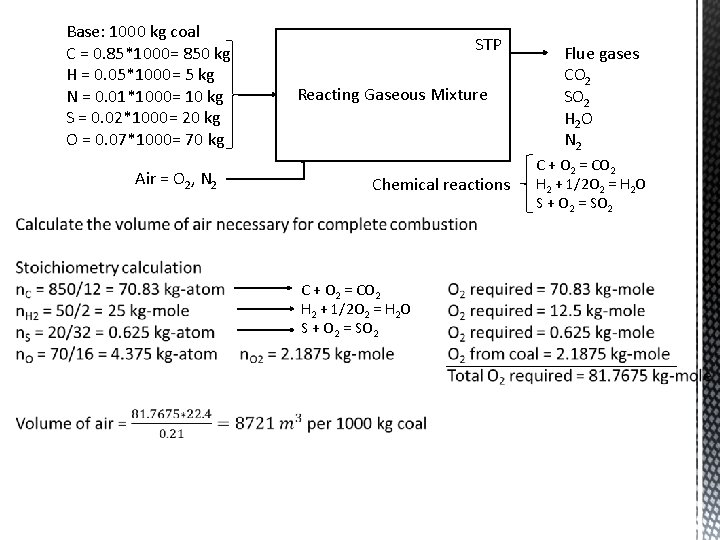
Base: 1000 kg coal C = 0. 85*1000= 850 kg H = 0. 05*1000= 5 kg N = 0. 01*1000= 10 kg S = 0. 02*1000= 20 kg O = 0. 07*1000= 70 kg Air = O 2, N 2 STP Reacting Gaseous Mixture Chemical reactions C + O 2 = CO 2 H 2 + 1/2 O 2 = H 2 O S + O 2 = SO 2 Flue gases CO 2 SO 2 H 2 O N 2 C + O 2 = CO 2 H 2 + 1/2 O 2 = H 2 O S + O 2 = SO 2
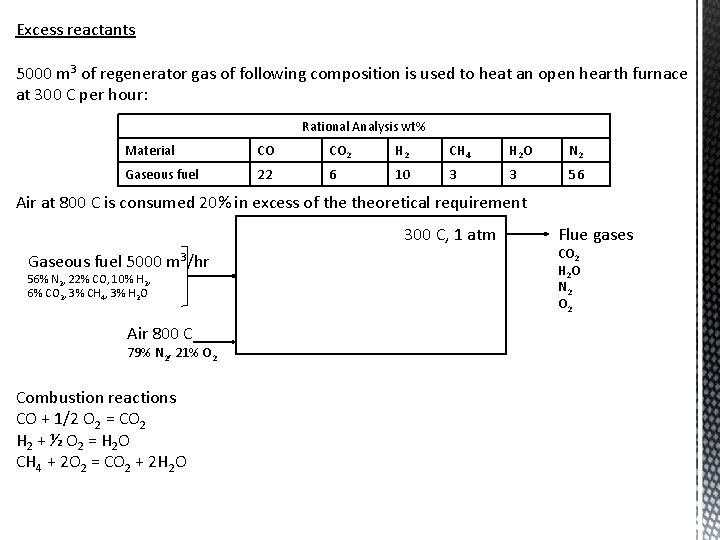
Excess reactants 5000 m 3 of regenerator gas of following composition is used to heat an open hearth furnace at 300 C per hour: Rational Analysis wt% Material CO CO 2 H 2 CH 4 H 2 O N 2 Gaseous fuel 22 6 10 3 3 56 Air at 800 C is consumed 20% in excess of theoretical requirement 300 C, 1 atm Gaseous fuel 5000 m 3/hr 56% N 2, 22% CO, 10% H 2, 6% CO 2, 3% CH 4, 3% H 2 O Air 800 C 79% N 2, 21% O 2 Combustion reactions CO + 1/2 O 2 = CO 2 H 2 + ½ O 2 = H 2 O CH 4 + 2 O 2 = CO 2 + 2 H 2 O Flue gases CO 2 H 2 O N 2 O 2
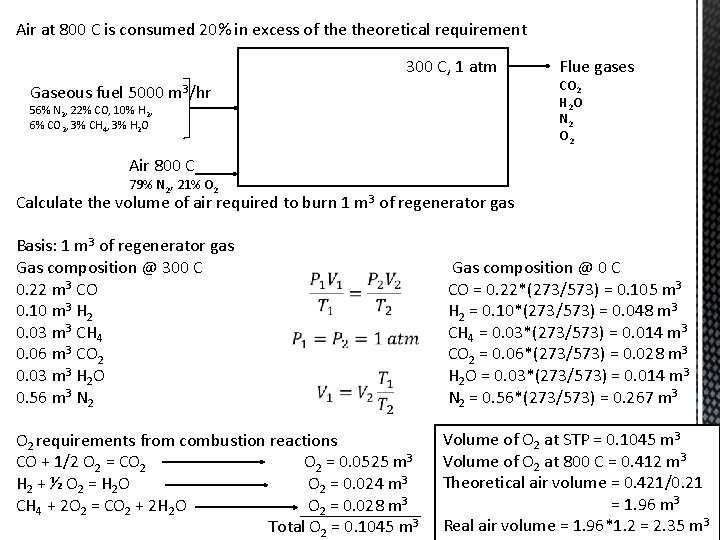
Air at 800 C is consumed 20% in excess of theoretical requirement 300 C, 1 atm Gaseous fuel 5000 m 3/hr 56% N 2, 22% CO, 10% H 2, 6% CO 2, 3% CH 4, 3% H 2 O Flue gases CO 2 H 2 O N 2 O 2 Air 800 C 79% N 2, 21% O 2 Calculate the volume of air required to burn 1 m 3 of regenerator gas Basis: 1 m 3 of regenerator gas Gas composition @ 300 C 0. 22 m 3 CO 0. 10 m 3 H 2 0. 03 m 3 CH 4 0. 06 m 3 CO 2 0. 03 m 3 H 2 O 0. 56 m 3 N 2 O 2 requirements from combustion reactions CO + 1/2 O 2 = CO 2 = 0. 0525 m 3 H 2 + ½ O 2 = H 2 O O 2 = 0. 024 m 3 CH 4 + 2 O 2 = CO 2 + 2 H 2 O O 2 = 0. 028 m 3 Total O 2 = 0. 1045 m 3 Gas composition @ 0 C CO = 0. 22*(273/573) = 0. 105 m 3 H 2 = 0. 10*(273/573) = 0. 048 m 3 CH 4 = 0. 03*(273/573) = 0. 014 m 3 CO 2 = 0. 06*(273/573) = 0. 028 m 3 H 2 O = 0. 03*(273/573) = 0. 014 m 3 N 2 = 0. 56*(273/573) = 0. 267 m 3 Volume of O 2 at STP = 0. 1045 m 3 Volume of O 2 at 800 C = 0. 412 m 3 Theoretical air volume = 0. 421/0. 21 = 1. 96 m 3 Real air volume = 1. 96*1. 2 = 2. 35 m 3
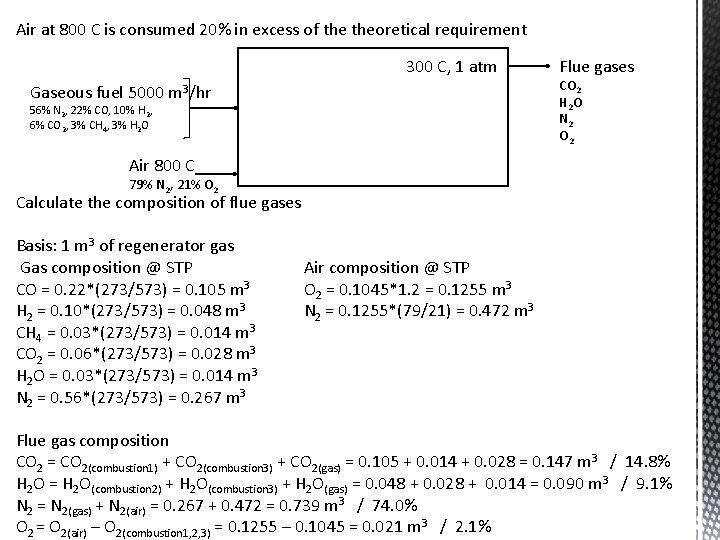
Air at 800 C is consumed 20% in excess of theoretical requirement 300 C, 1 atm Gaseous fuel 5000 m 3/hr 56% N 2, 22% CO, 10% H 2, 6% CO 2, 3% CH 4, 3% H 2 O Flue gases CO 2 H 2 O N 2 O 2 Air 800 C 79% N 2, 21% O 2 Calculate the composition of flue gases Basis: 1 m 3 of regenerator gas Gas composition @ STP CO = 0. 22*(273/573) = 0. 105 m 3 H 2 = 0. 10*(273/573) = 0. 048 m 3 CH 4 = 0. 03*(273/573) = 0. 014 m 3 CO 2 = 0. 06*(273/573) = 0. 028 m 3 H 2 O = 0. 03*(273/573) = 0. 014 m 3 N 2 = 0. 56*(273/573) = 0. 267 m 3 Air composition @ STP O 2 = 0. 1045*1. 2 = 0. 1255 m 3 N 2 = 0. 1255*(79/21) = 0. 472 m 3 Flue gas composition CO 2 = CO 2(combustion 1) + CO 2(combustion 3) + CO 2(gas) = 0. 105 + 0. 014 + 0. 028 = 0. 147 m 3 / 14. 8% H 2 O = H 2 O(combustion 2) + H 2 O(combustion 3) + H 2 O(gas) = 0. 048 + 0. 028 + 0. 014 = 0. 090 m 3 / 9. 1% N 2 = N 2(gas) + N 2(air) = 0. 267 + 0. 472 = 0. 739 m 3 / 74. 0% O 2 = O 2(air) – O 2(combustion 1, 2, 3) = 0. 1255 – 0. 1045 = 0. 021 m 3 / 2. 1%
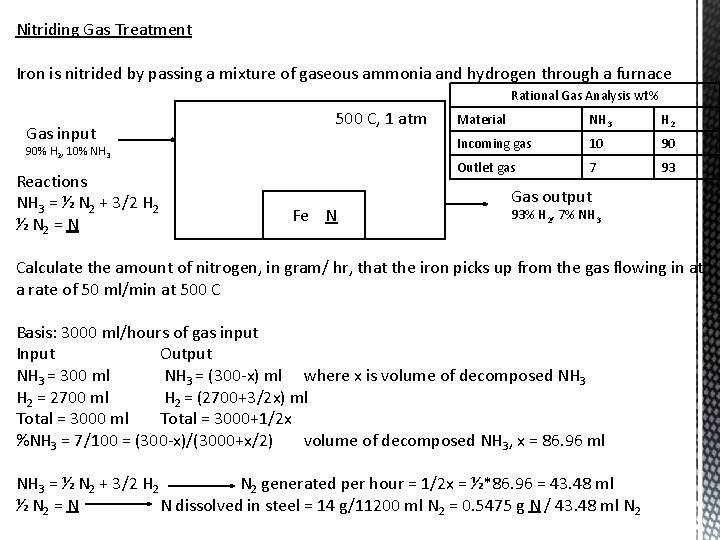
Nitriding Gas Treatment Iron is nitrided by passing a mixture of gaseous ammonia and hydrogen through a furnace Rational Gas Analysis wt% Gas input 500 C, 1 atm 90% H 2, 10% NH 3 Reactions NH 3 = ½ N 2 + 3/2 H 2 ½ N 2 = N Fe N Material NH 3 H 2 Incoming gas 10 90 Outlet gas 7 93 Gas output 93% H 2, 7% NH 3 Calculate the amount of nitrogen, in gram/ hr, that the iron picks up from the gas flowing in at a rate of 50 ml/min at 500 C Basis: 3000 ml/hours of gas input Input Output NH 3 = 300 ml NH 3 = (300 -x) ml where x is volume of decomposed NH 3 H 2 = 2700 ml H 2 = (2700+3/2 x) ml Total = 3000+1/2 x %NH 3 = 7/100 = (300 -x)/(3000+x/2) volume of decomposed NH 3, x = 86. 96 ml NH 3 = ½ N 2 + 3/2 H 2 N 2 generated per hour = 1/2 x = ½*86. 96 = 43. 48 ml ½ N 2 = N N dissolved in steel = 14 g/11200 ml N 2 = 0. 5475 g N / 43. 48 ml N 2
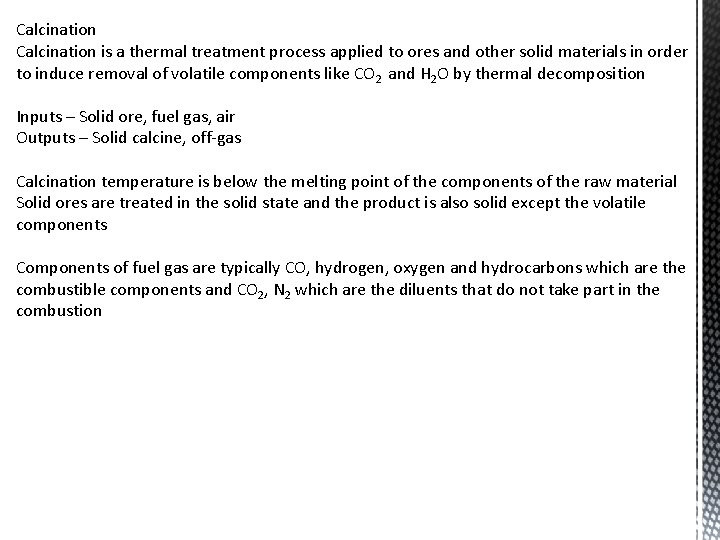
Calcination is a thermal treatment process applied to ores and other solid materials in order to induce removal of volatile components like CO 2 and H 2 O by thermal decomposition Inputs – Solid ore, fuel gas, air Outputs – Solid calcine, off-gas Calcination temperature is below the melting point of the components of the raw material Solid ores are treated in the solid state and the product is also solid except the volatile components Components of fuel gas are typically CO, hydrogen, oxygen and hydrocarbons which are the combustible components and CO 2, N 2 which are the diluents that do not take part in the combustion
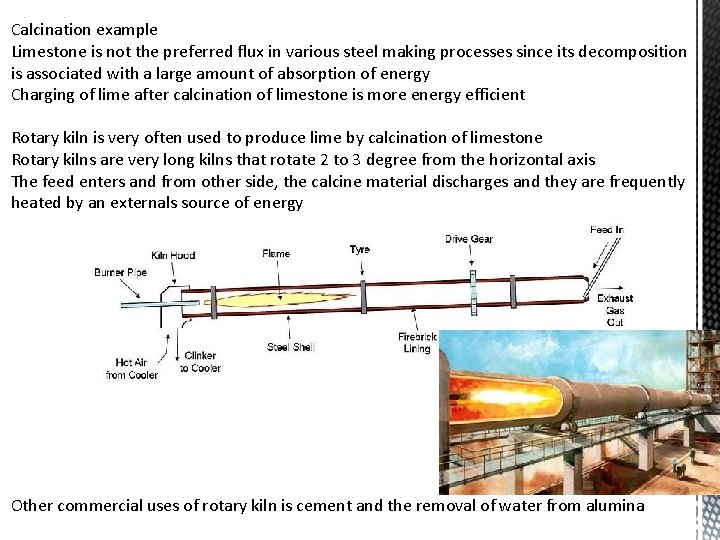
Calcination example Limestone is not the preferred flux in various steel making processes since its decomposition is associated with a large amount of absorption of energy Charging of lime after calcination of limestone is more energy efficient Rotary kiln is very often used to produce lime by calcination of limestone Rotary kilns are very long kilns that rotate 2 to 3 degree from the horizontal axis The feed enters and from other side, the calcine material discharges and they are frequently heated by an externals source of energy Other commercial uses of rotary kiln is cement and the removal of water from alumina
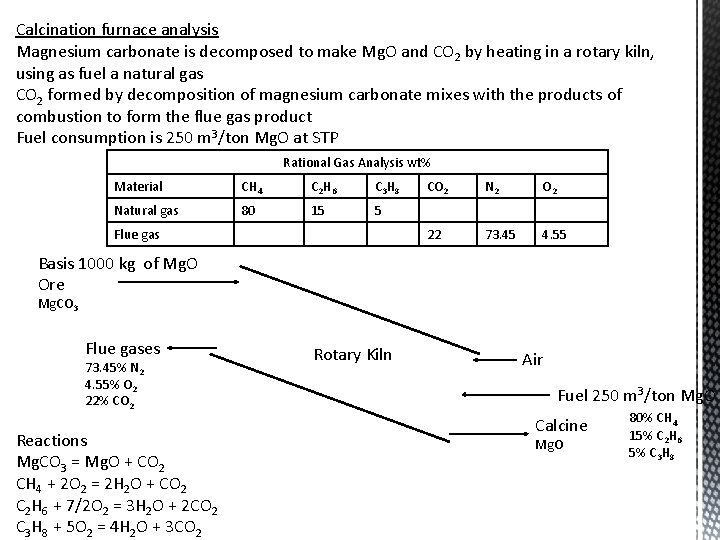
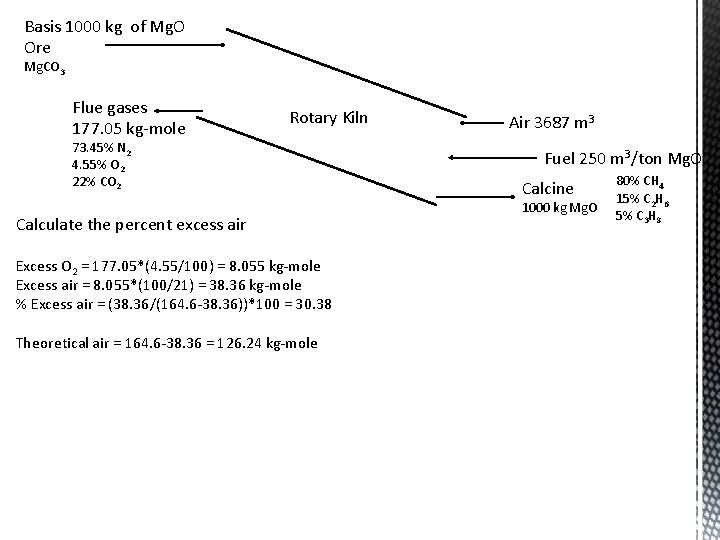
Calcination furnace analysis Magnesium carbonate is decomposed to make Mg. O and CO 2 by heating in a rotary kiln, using as fuel a natural gas CO 2 formed by decomposition of magnesium carbonate mixes with the products of combustion to form the flue gas product Fuel consumption is 250 m 3/ton Mg. O at STP Rational Gas Analysis wt% Material CH 4 C 2 H 6 C 3 H 8 Natural gas 80 15 5 Flue gas CO 2 N 2 O 2 22 73. 45 4. 55 Basis 1000 kg of Mg. O Ore Mg. CO 3 Flue gases 73. 45% N 2 4. 55% O 2 22% CO 2 Reactions Mg. CO 3 = Mg. O + CO 2 CH 4 + 2 O 2 = 2 H 2 O + CO 2 C 2 H 6 + 7/2 O 2 = 3 H 2 O + 2 CO 2 C 3 H 8 + 5 O 2 = 4 H 2 O + 3 CO 2 Rotary Kiln Air Fuel 250 m 3/ton Mg. O Calcine Mg. O 80% CH 4 15% C 2 H 6 5% C 3 H 8
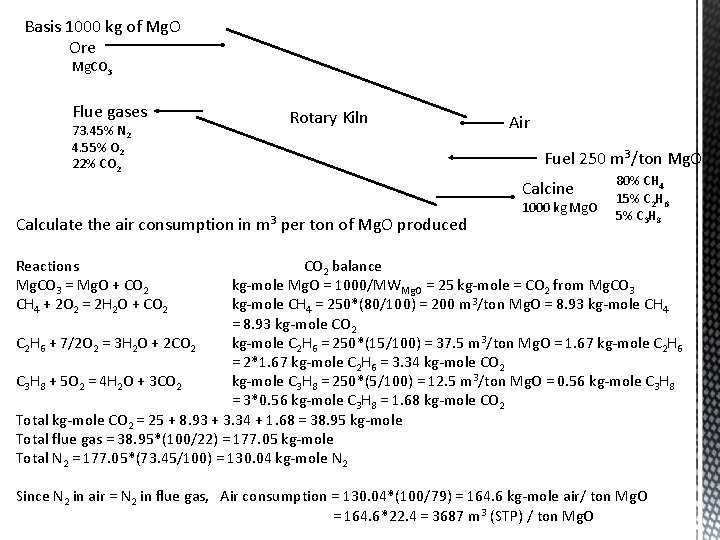
Basis 1000 kg of Mg. O Ore Mg. CO 3 Flue gases 73. 45% N 2 4. 55% O 2 22% CO 2 Rotary Kiln Air Fuel 250 m 3/ton Mg. O Calcine Calculate the air consumption in m 3 per ton of Mg. O produced 1000 kg Mg. O 80% CH 4 15% C 2 H 6 5% C 3 H 8 Reactions Mg. CO 3 = Mg. O + CO 2 CH 4 + 2 O 2 = 2 H 2 O + CO 2 balance kg-mole Mg. O = 1000/MWMg. O = 25 kg-mole = CO 2 from Mg. CO 3 kg-mole CH 4 = 250*(80/100) = 200 m 3/ton Mg. O = 8. 93 kg-mole CH 4 = 8. 93 kg-mole CO 2 C 2 H 6 + 7/2 O 2 = 3 H 2 O + 2 CO 2 kg-mole C 2 H 6 = 250*(15/100) = 37. 5 m 3/ton Mg. O = 1. 67 kg-mole C 2 H 6 = 2*1. 67 kg-mole C 2 H 6 = 3. 34 kg-mole CO 2 C 3 H 8 + 5 O 2 = 4 H 2 O + 3 CO 2 kg-mole C 3 H 8 = 250*(5/100) = 12. 5 m 3/ton Mg. O = 0. 56 kg-mole C 3 H 8 = 3*0. 56 kg-mole C 3 H 8 = 1. 68 kg-mole CO 2 Total kg-mole CO 2 = 25 + 8. 93 + 3. 34 + 1. 68 = 38. 95 kg-mole Total flue gas = 38. 95*(100/22) = 177. 05 kg-mole Total N 2 = 177. 05*(73. 45/100) = 130. 04 kg-mole N 2 Since N 2 in air = N 2 in flue gas, Air consumption = 130. 04*(100/79) = 164. 6 kg-mole air/ ton Mg. O = 164. 6*22. 4 = 3687 m 3 (STP) / ton Mg. O
Basis 1000 kg of Mg. O Ore Mg. CO 3 Flue gases 177. 05 kg-mole Rotary Kiln 73. 45% N 2 4. 55% O 2 22% CO 2 Calculate the percent excess air Excess O 2 = 177. 05*(4. 55/100) = 8. 055 kg-mole Excess air = 8. 055*(100/21) = 38. 36 kg-mole % Excess air = (38. 36/(164. 6 -38. 36))*100 = 30. 38 Theoretical air = 164. 6 -38. 36 = 126. 24 kg-mole Air 3687 m 3 Fuel 250 m 3/ton Mg. O Calcine 1000 kg Mg. O 80% CH 4 15% C 2 H 6 5% C 3 H 8
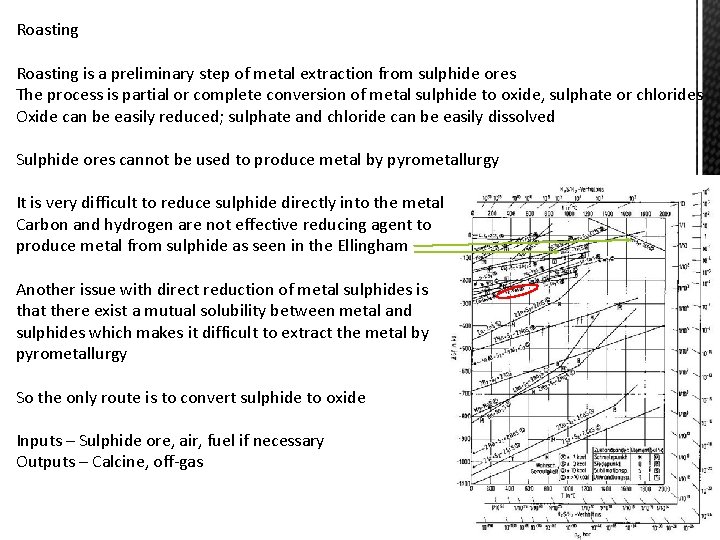
Roasting is a preliminary step of metal extraction from sulphide ores The process is partial or complete conversion of metal sulphide to oxide, sulphate or chlorides Oxide can be easily reduced; sulphate and chloride can be easily dissolved Sulphide ores cannot be used to produce metal by pyrometallurgy It is very difficult to reduce sulphide directly into the metal Carbon and hydrogen are not effective reducing agent to produce metal from sulphide as seen in the Ellingham Another issue with direct reduction of metal sulphides is that there exist a mutual solubility between metal and sulphides which makes it difficult to extract the metal by pyrometallurgy So the only route is to convert sulphide to oxide Inputs – Sulphide ore, air, fuel if necessary Outputs – Calcine, off-gas
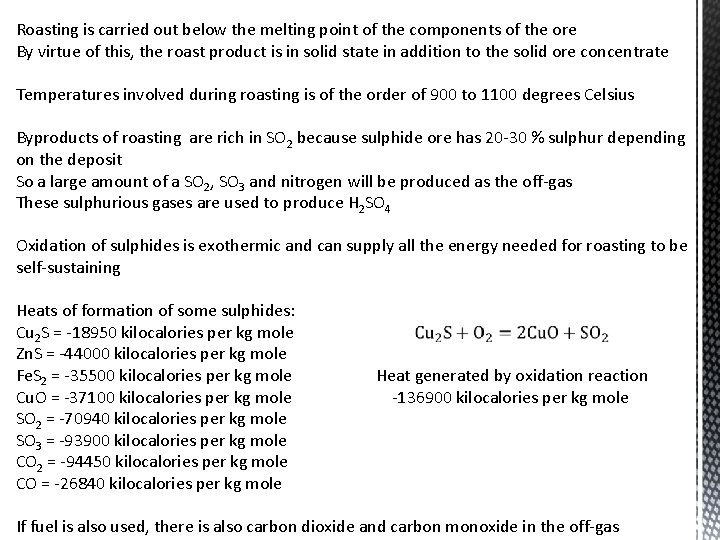
Roasting is carried out below the melting point of the components of the ore By virtue of this, the roast product is in solid state in addition to the solid ore concentrate Temperatures involved during roasting is of the order of 900 to 1100 degrees Celsius Byproducts of roasting are rich in SO 2 because sulphide ore has 20 -30 % sulphur depending on the deposit So a large amount of a SO 2, SO 3 and nitrogen will be produced as the off-gas These sulphurious gases are used to produce H 2 SO 4 Oxidation of sulphides is exothermic and can supply all the energy needed for roasting to be self-sustaining Heats of formation of some sulphides: Cu 2 S = -18950 kilocalories per kg mole Zn. S = -44000 kilocalories per kg mole Fe. S 2 = -35500 kilocalories per kg mole Cu. O = -37100 kilocalories per kg mole SO 2 = -70940 kilocalories per kg mole SO 3 = -93900 kilocalories per kg mole CO 2 = -94450 kilocalories per kg mole CO = -26840 kilocalories per kg mole Heat generated by oxidation reaction -136900 kilocalories per kg mole If fuel is also used, there is also carbon dioxide and carbon monoxide in the off-gas
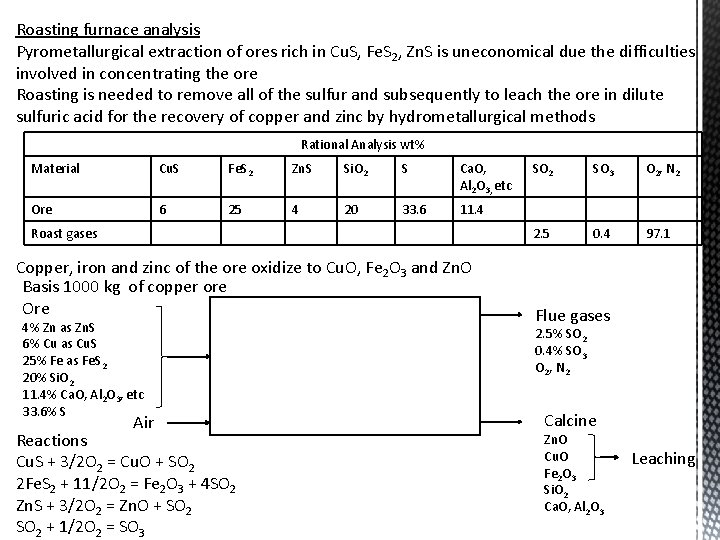
Roasting furnace analysis Pyrometallurgical extraction of ores rich in Cu. S, Fe. S 2, Zn. S is uneconomical due the difficulties involved in concentrating the ore Roasting is needed to remove all of the sulfur and subsequently to leach the ore in dilute sulfuric acid for the recovery of copper and zinc by hydrometallurgical methods Rational Analysis wt% Material Cu. S Fe. S 2 Zn. S Si. O 2 S Ca. O, Al 2 O 3, etc Ore 6 25 4 20 33. 6 11. 4 Roast gases Copper, iron and zinc of the ore oxidize to Cu. O, Fe 2 O 3 and Zn. O Basis 1000 kg of copper ore Ore 4% Zn as Zn. S 6% Cu as Cu. S 25% Fe as Fe. S 2 20% Si. O 2 11. 4% Ca. O, Al 2 O 3, etc 33. 6% S Air Reactions Cu. S + 3/2 O 2 = Cu. O + SO 2 2 Fe. S 2 + 11/2 O 2 = Fe 2 O 3 + 4 SO 2 Zn. S + 3/2 O 2 = Zn. O + SO 2 + 1/2 O 2 = SO 3 SO 2 SO 3 O 2, N 2 2. 5 0. 4 97. 1 Flue gases 2. 5% SO 2 0. 4% SO 3 O 2, N 2 Calcine Zn. O Cu. O Fe 2 O 3 Si. O 2 Ca. O, Al 2 O 3 Leaching
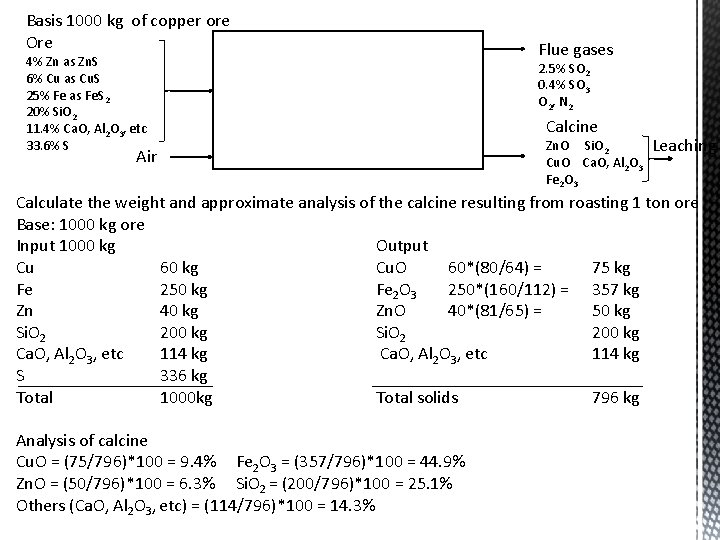
Basis 1000 kg of copper ore Ore 4% Zn as Zn. S 6% Cu as Cu. S 25% Fe as Fe. S 2 20% Si. O 2 11. 4% Ca. O, Al 2 O 3, etc 33. 6% S Air Flue gases 2. 5% SO 2 0. 4% SO 3 O 2, N 2 Calcine Zn. O Si. O 2 Cu. O Ca. O, Al 2 O 3 Fe 2 O 3 Leaching Calculate the weight and approximate analysis of the calcine resulting from roasting 1 ton ore Base: 1000 kg ore Input 1000 kg Output Cu 60 kg Cu. O 60*(80/64) = 75 kg Fe 250 kg Fe 2 O 3 250*(160/112) = 357 kg Zn 40 kg Zn. O 40*(81/65) = 50 kg Si. O 2 200 kg Ca. O, Al 2 O 3, etc 114 kg S 336 kg Total 1000 kg Total solids 796 kg Analysis of calcine Cu. O = (75/796)*100 = 9. 4% Fe 2 O 3 = (357/796)*100 = 44. 9% Zn. O = (50/796)*100 = 6. 3% Si. O 2 = (200/796)*100 = 25. 1% Others (Ca. O, Al 2 O 3, etc) = (114/796)*100 = 14. 3%
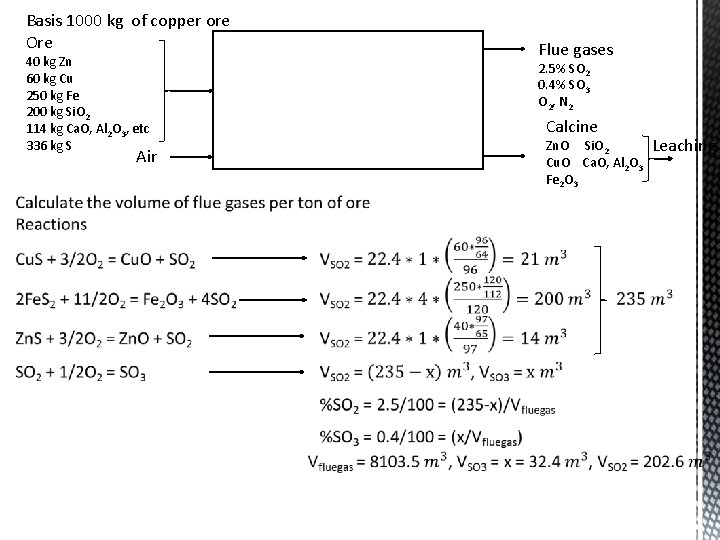
Basis 1000 kg of copper ore Ore 40 kg Zn 60 kg Cu 250 kg Fe 200 kg Si. O 2 114 kg Ca. O, Al 2 O 3, etc 336 kg S Air Flue gases 2. 5% SO 2 0. 4% SO 3 O 2, N 2 Calcine Zn. O Si. O 2 Cu. O Ca. O, Al 2 O 3 Fe 2 O 3 Leaching
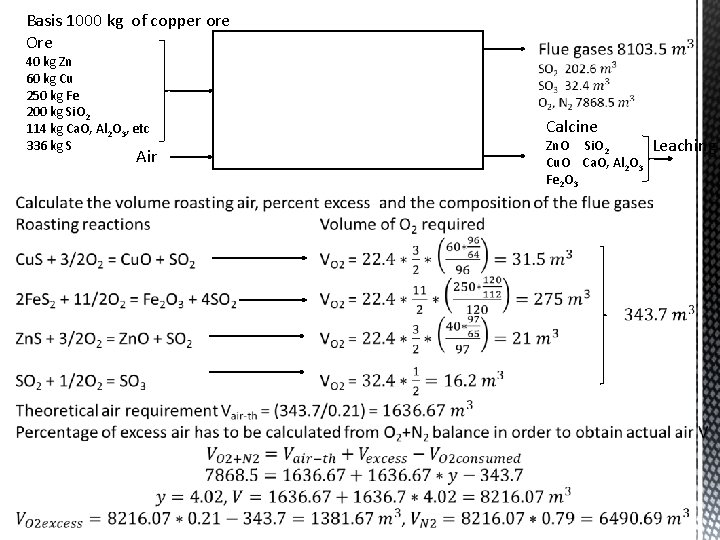
Basis 1000 kg of copper ore Ore 40 kg Zn 60 kg Cu 250 kg Fe 200 kg Si. O 2 114 kg Ca. O, Al 2 O 3, etc 336 kg S Air Calcine Zn. O Si. O 2 Cu. O Ca. O, Al 2 O 3 Fe 2 O 3 Leaching
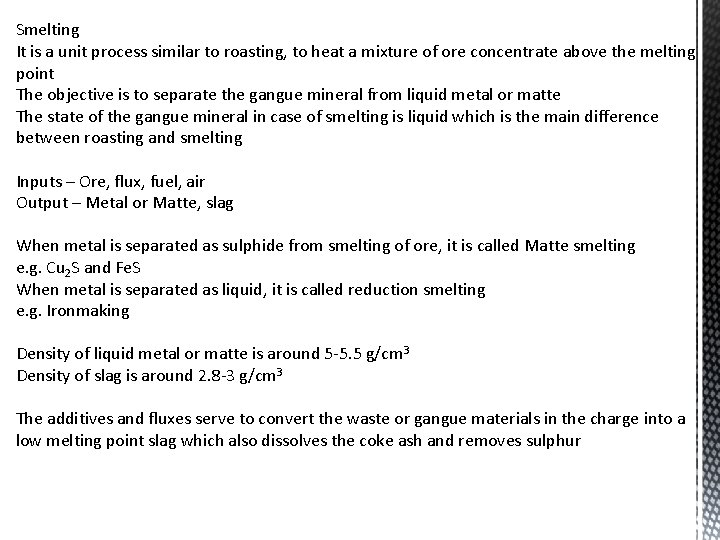
Smelting It is a unit process similar to roasting, to heat a mixture of ore concentrate above the melting point The objective is to separate the gangue mineral from liquid metal or matte The state of the gangue mineral in case of smelting is liquid which is the main difference between roasting and smelting Inputs – Ore, flux, fuel, air Output – Metal or Matte, slag When metal is separated as sulphide from smelting of ore, it is called Matte smelting e. g. Cu 2 S and Fe. S When metal is separated as liquid, it is called reduction smelting e. g. Ironmaking Density of liquid metal or matte is around 5 -5. 5 g/cm 3 Density of slag is around 2. 8 -3 g/cm 3 The additives and fluxes serve to convert the waste or gangue materials in the charge into a low melting point slag which also dissolves the coke ash and removes sulphur
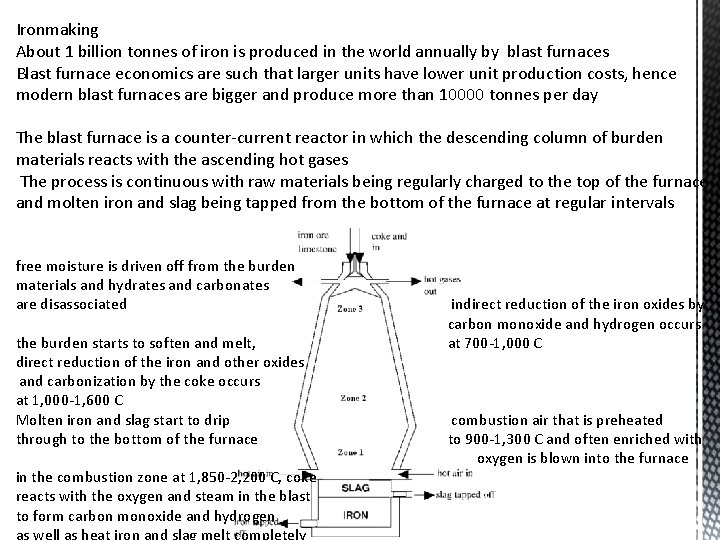
Ironmaking About 1 billion tonnes of iron is produced in the world annually by blast furnaces Blast furnace economics are such that larger units have lower unit production costs, hence modern blast furnaces are bigger and produce more than 10000 tonnes per day The blast furnace is a counter-current reactor in which the descending column of burden materials reacts with the ascending hot gases The process is continuous with raw materials being regularly charged to the top of the furnace and molten iron and slag being tapped from the bottom of the furnace at regular intervals free moisture is driven off from the burden materials and hydrates and carbonates are disassociated the burden starts to soften and melt, direct reduction of the iron and other oxides and carbonization by the coke occurs at 1, 000 -1, 600 C Molten iron and slag start to drip through to the bottom of the furnace in the combustion zone at 1, 850 -2, 200 C, coke reacts with the oxygen and steam in the blast to form carbon monoxide and hydrogen as well as heat iron and slag melt completely indirect reduction of the iron oxides by carbon monoxide and hydrogen occurs at 700 -1, 000 C combustion air that is preheated to 900 -1, 300 C and often enriched with oxygen is blown into the furnace
The blast furnace itself is a steel shaft lined with fire resistant, refractory materials The hottest part of furnace - where the walls reach a temperature >300 °C - are water cooled Coke is a principle source of thermal energy and as well as chemical energy in ironmaking Carbon of the coke reduces iron oxide to iron The combustion of carbon of coke also provides a thermal energy Hot blast air is introduced through the tuyere so a counter current against the descending burden is created by the gases travelling upward In any counter current heat and mass exchange reactor, which consists of gas and solid, the permeability of the bed and the distribution of the burden are very important issues For the smooth operation of the blast furnace, the upward rising gases should travel unhindered They should also transfer their heat and mass to the descending burden The burden distribution should be homogeneous so that it constitutes a uniform distribution of iron and facilitate smooth movement of burden gases
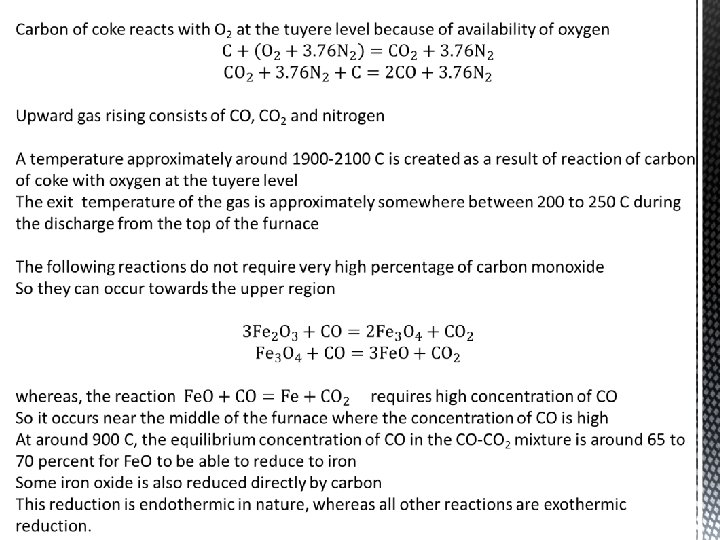
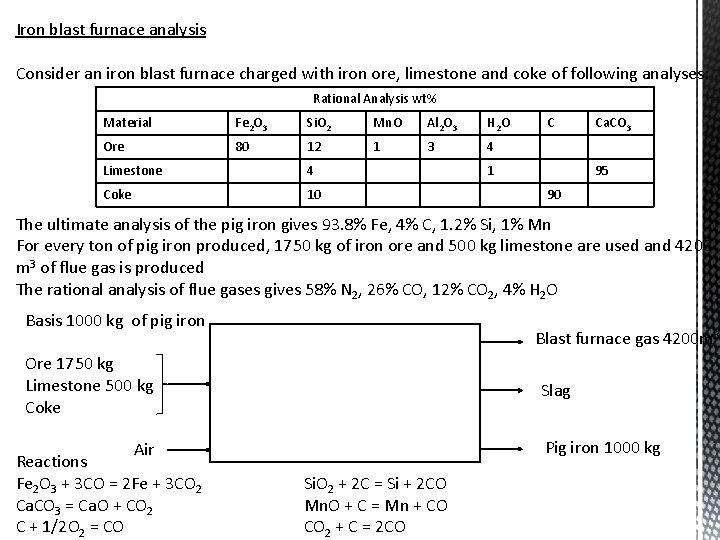
Iron blast furnace analysis Consider an iron blast furnace charged with iron ore, limestone and coke of following analyses: Rational Analysis wt% Material Fe 2 O 3 Si. O 2 Mn. O Al 2 O 3 H 2 O Ore 80 12 1 3 4 Limestone 4 Coke 10 C 1 Ca. CO 3 95 90 The ultimate analysis of the pig iron gives 93. 8% Fe, 4% C, 1. 2% Si, 1% Mn For every ton of pig iron produced, 1750 kg of iron ore and 500 kg limestone are used and 4200 m 3 of flue gas is produced The rational analysis of flue gases gives 58% N 2, 26% CO, 12% CO 2, 4% H 2 O Basis 1000 kg of pig iron Blast furnace gas 4200 m 3 Ore 1750 kg Limestone 500 kg Coke Air Reactions Fe 2 O 3 + 3 CO = 2 Fe + 3 CO 2 Ca. CO 3 = Ca. O + CO 2 C + 1/2 O 2 = CO Slag Pig iron 1000 kg Si. O 2 + 2 C = Si + 2 CO Mn. O + C = Mn + CO CO 2 + C = 2 CO
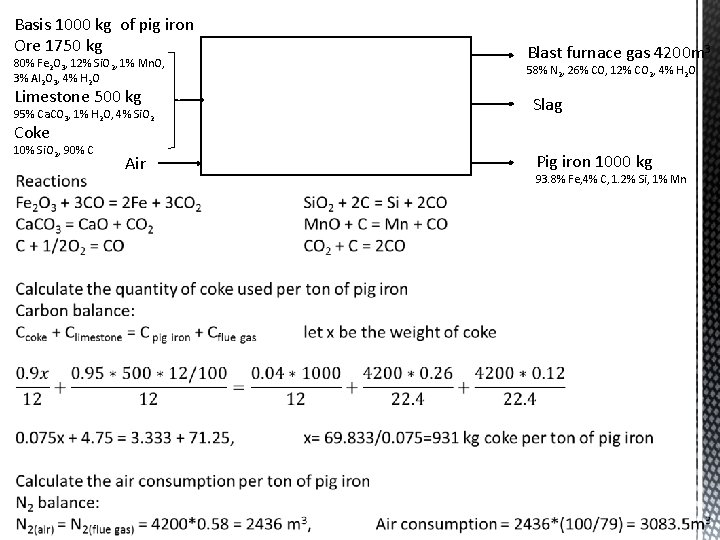
Basis 1000 kg of pig iron Ore 1750 kg 80% Fe 2 O 3, 12% Si. O 2, 1% Mn. O, 3% Al 2 O 3, 4% H 2 O Limestone 500 kg 95% Ca. CO 3, 1% H 2 O, 4% Si. O 2 Blast furnace gas 4200 m 3 58% N 2, 26% CO, 12% CO 2, 4% H 2 O Slag Coke 10% Si. O 2, 90% C Air Pig iron 1000 kg 93. 8% Fe, 4% C, 1. 2% Si, 1% Mn
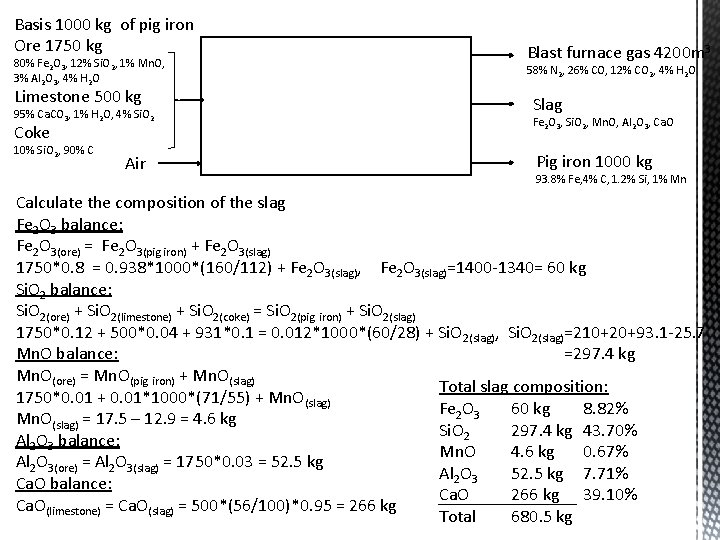
Basis 1000 kg of pig iron Ore 1750 kg 80% Fe 2 O 3, 12% Si. O 2, 1% Mn. O, 3% Al 2 O 3, 4% H 2 O Limestone 500 kg 95% Ca. CO 3, 1% H 2 O, 4% Si. O 2 Coke 10% Si. O 2, 90% C Air Blast furnace gas 4200 m 3 58% N 2, 26% CO, 12% CO 2, 4% H 2 O Slag Fe 2 O 3, Si. O 2, Mn. O, Al 2 O 3, Ca. O Pig iron 1000 kg 93. 8% Fe, 4% C, 1. 2% Si, 1% Mn Calculate the composition of the slag Fe 2 O 3 balance: Fe 2 O 3(ore) = Fe 2 O 3(pig iron) + Fe 2 O 3(slag) 1750*0. 8 = 0. 938*1000*(160/112) + Fe 2 O 3(slag), Fe 2 O 3(slag)=1400 -1340= 60 kg Si. O 2 balance: Si. O 2(ore) + Si. O 2(limestone) + Si. O 2(coke) = Si. O 2(pig iron) + Si. O 2(slag) 1750*0. 12 + 500*0. 04 + 931*0. 1 = 0. 012*1000*(60/28) + Si. O 2(slag), Si. O 2(slag)=210+20+93. 1 -25. 7 Mn. O balance: =297. 4 kg Mn. O(ore) = Mn. O(pig iron) + Mn. O(slag) Total slag composition: 1750*0. 01 + 0. 01*1000*(71/55) + Mn. O(slag) Fe 2 O 3 60 kg 8. 82% Mn. O(slag) = 17. 5 – 12. 9 = 4. 6 kg Si. O 2 297. 4 kg 43. 70% Al 2 O 3 balance: Mn. O 4. 6 kg 0. 67% Al 2 O 3(ore) = Al 2 O 3(slag) = 1750*0. 03 = 52. 5 kg Al 2 O 3 52. 5 kg 7. 71% Ca. O balance: Ca. O 266 kg 39. 10% Ca. O(limestone) = Ca. O(slag) = 500*(56/100)*0. 95 = 266 kg Total 680. 5 kg