
Charge and spin states of Fe in binary
Charge and spin states of Fe in binary compounds Proposal to the ISOLDE and Neutron Time-of-Flight Committee H. P. Gunnlaugsson & L. Hemmingsen et al. ,
Outline • Why: – Fe important (magnetic/spin) dopant in many materials – Can (with e. MS) be used to probe intrinsic defects • Isomer-shift and charge state at nucleus • Current state of knowledge and new approach • How & expected outcome ATH. í skjalinu er laus „toppur“ ofan á grunninum, svo hægt sé að láta ljósmynd ná undir toppinn. Eftir að ljósmynd hefur verið sett inn í skjalið, notið þá „Arrange“ -> „Bring to front“ til að lyfta toppinum yfir ljósmyndina. Ef ekki er þörf á að myndefni nái undir toppinn er honum einfaldlega eytt af síðunni.
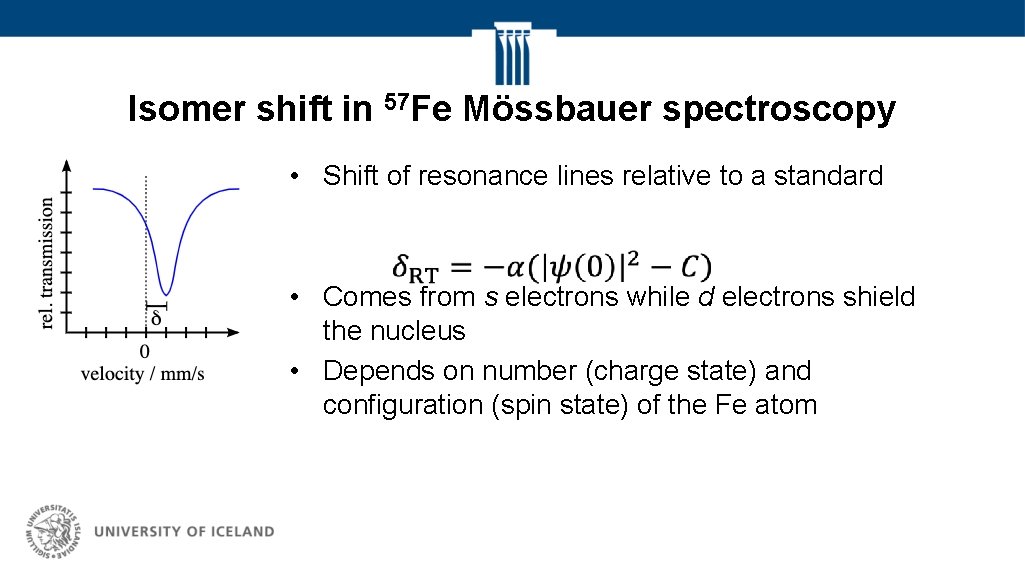
Isomer shift in 57 Fe Mössbauer spectroscopy • Shift of resonance lines relative to a standard • Comes from s electrons while d electrons shield the nucleus • Depends on number (charge state) and configuration (spin state) of the Fe atom
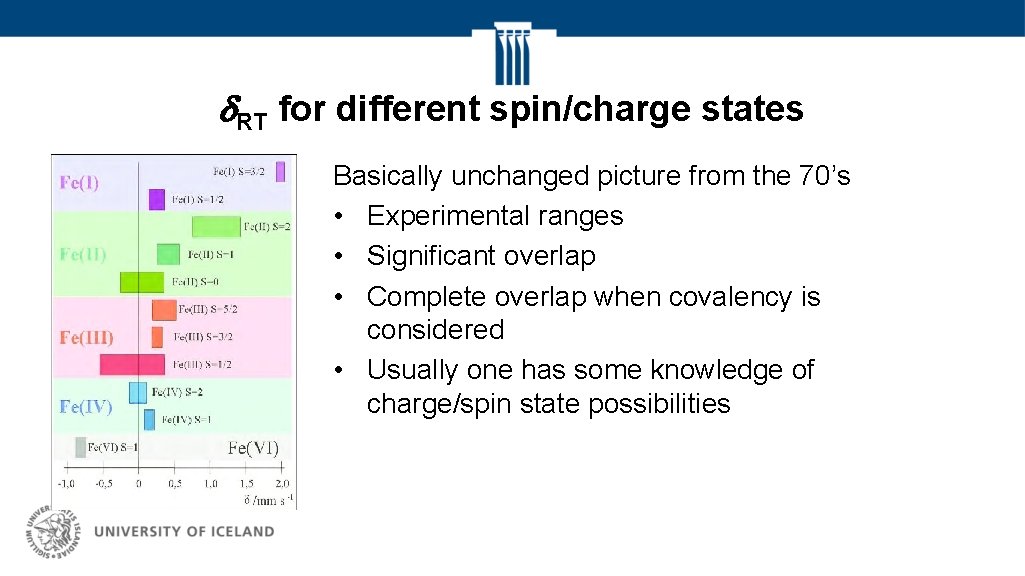
d. RT for different spin/charge states Basically unchanged picture from the 70’s • Experimental ranges • Significant overlap • Complete overlap when covalency is considered • Usually one has some knowledge of charge/spin state possibilities
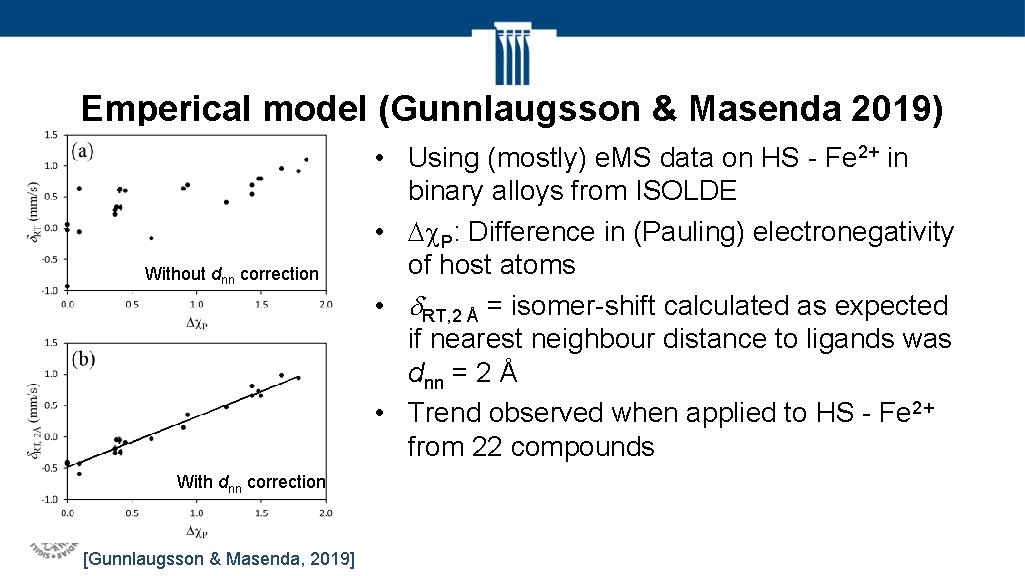
Emperical model (Gunnlaugsson & Masenda 2019) Without dnn correction With dnn correction [Gunnlaugsson & Masenda, 2019] • Using (mostly) e. MS data on HS - Fe 2+ in binary alloys from ISOLDE • Dc. P: Difference in (Pauling) electronegativity of host atoms • d. RT, 2 Å = isomer-shift calculated as expected if nearest neighbour distance to ligands was dnn = 2 Å • Trend observed when applied to HS - Fe 2+ from 22 compounds
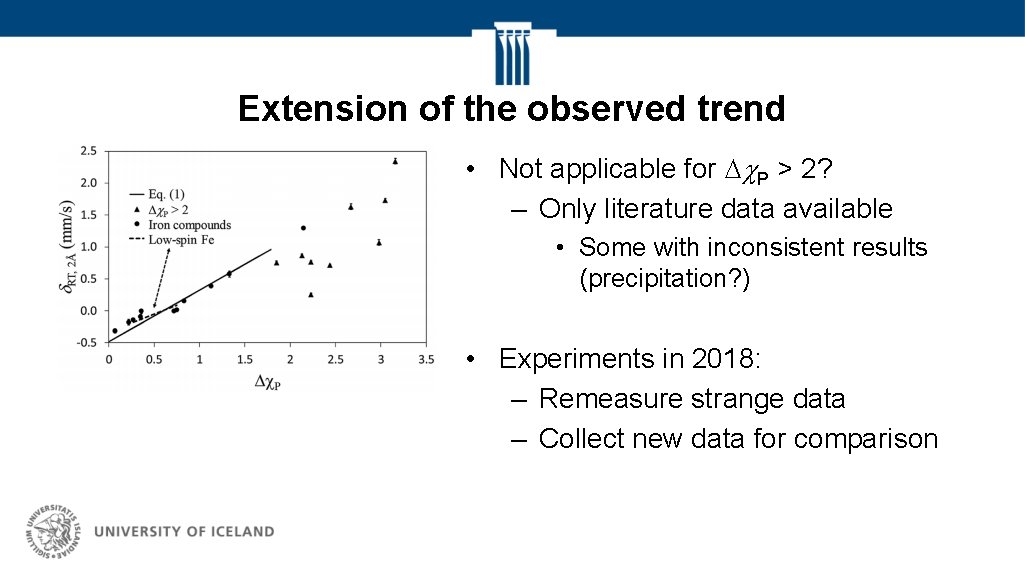
Extension of the observed trend • Not applicable for Dc. P > 2? – Only literature data available • Some with inconsistent results (precipitation? ) • Experiments in 2018: – Remeasure strange data – Collect new data for comparison
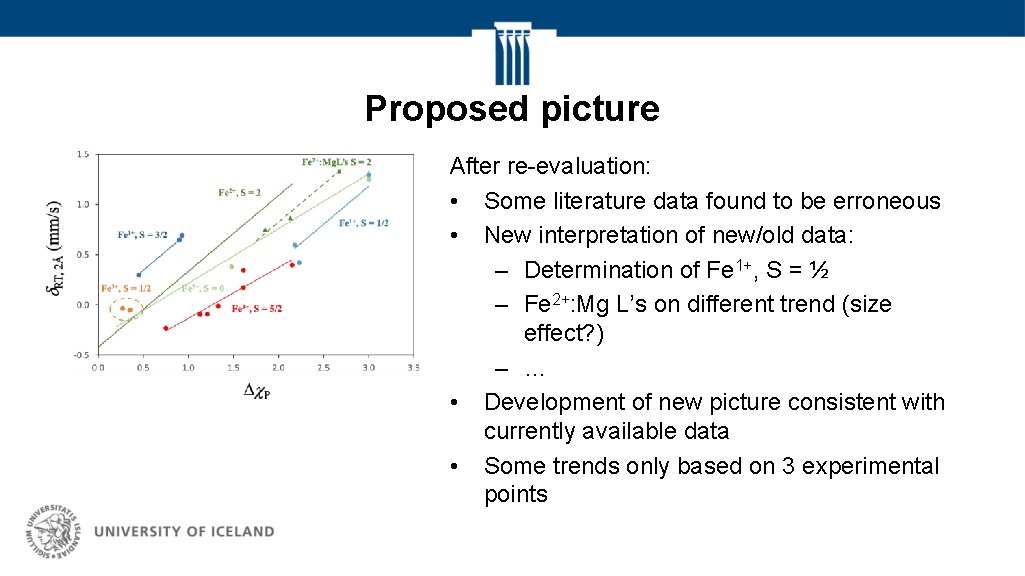
Proposed picture After re-evaluation: • Some literature data found to be erroneous • New interpretation of new/old data: – Determination of Fe 1+, S = ½ – Fe 2+: Mg L’s on different trend (size effect? ) – … • Development of new picture consistent with currently available data • Some trends only based on 3 experimental points
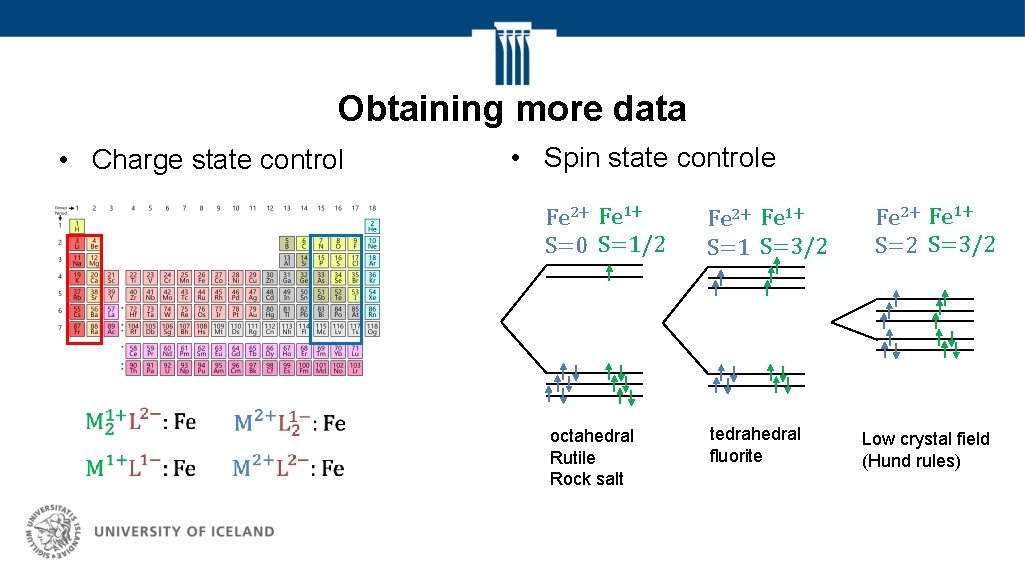
Obtaining more data • Charge state control • Spin state controle Fe 2+ Fe 1+ S=0 S=1/2 Fe 2+ Fe 1+ S=1 S=3/2 octahedral Rutile Rock salt tedrahedral fluorite Fe 2+ Fe 1+ S=2 S=3/2 Low crystal field (Hund rules)
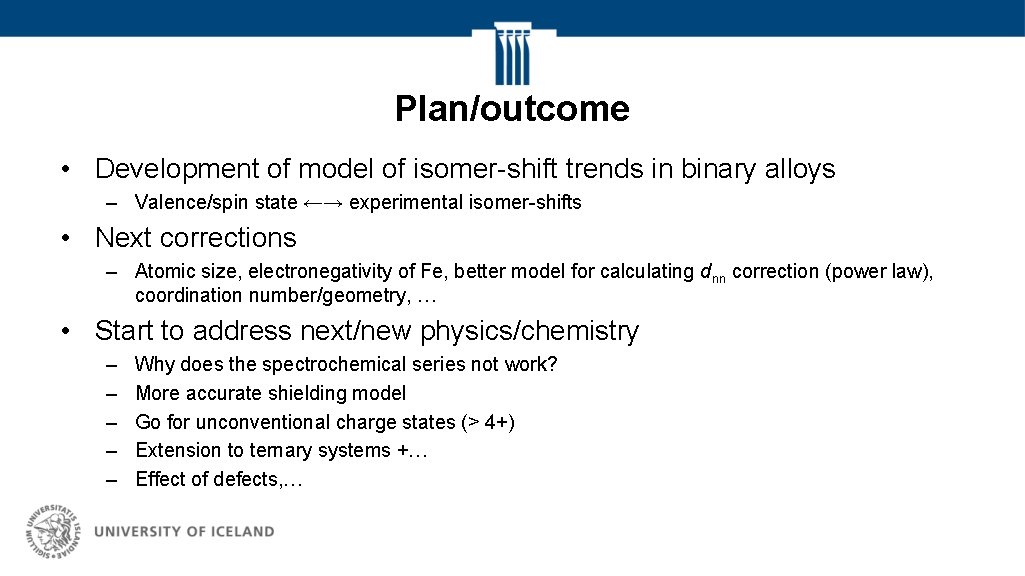
Plan/outcome • Development of model of isomer-shift trends in binary alloys – Valence/spin state ←→ experimental isomer-shifts • Next corrections – Atomic size, electronegativity of Fe, better model for calculating dnn correction (power law), coordination number/geometry, … • Start to address next/new physics/chemistry – – – Why does the spectrochemical series not work? More accurate shielding model Go for unconventional charge states (> 4+) Extension to ternary systems +… Effect of defects, …
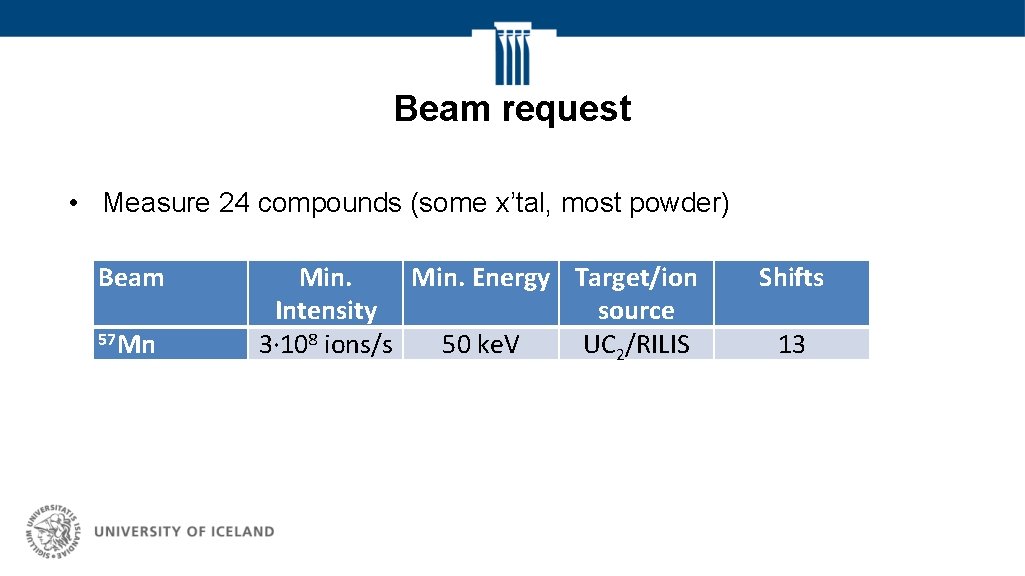
Beam request • Measure 24 compounds (some x’tal, most powder) Beam 57 Mn Min. Energy Target/ion Intensity source 3∙ 108 ions/s 50 ke. V UC 2/RILIS Shifts 13
- Slides: 10