
Characterizing RNA dynamics using structure based models Rhiannon
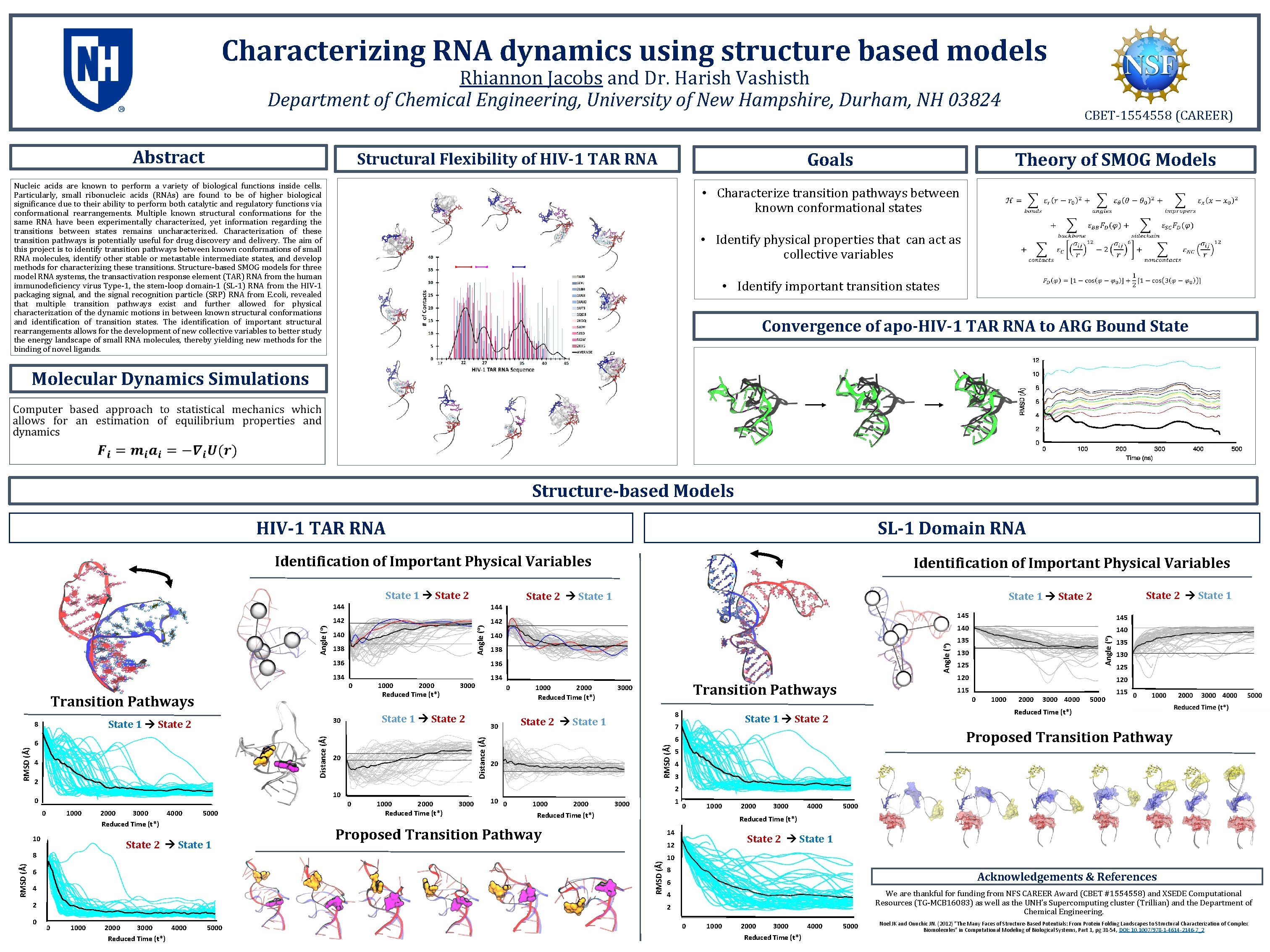
Characterizing RNA dynamics using structure based models Rhiannon Jacobs and Dr. Harish Vashisth Department of Chemical Engineering, University of New Hampshire, Durham, NH 03824 Abstract Theory of SMOG Models Goals Structural Flexibility of HIV-1 TAR RNA Nucleic acids are known to perform a variety of biological functions inside cells. Particularly, small ribonucleic acids (RNAs) are found to be of higher biological significance due to their ability to perform both catalytic and regulatory functions via conformational rearrangements. Multiple known structural conformations for the same RNA have been experimentally characterized, yet information regarding the transitions between states remains uncharacterized. Characterization of these transition pathways is potentially useful for drug discovery and delivery. The aim of this project is to identify transition pathways between known conformations of small RNA molecules, identify other stable or metastable intermediate states, and develop methods for characterizing these transitions. Structure-based SMOG models for three model RNA systems, the transactivation response element (TAR) RNA from the human immunodeficiency virus Type-1, the stem-loop domain-1 (SL-1) RNA from the HIV-1 packaging signal, and the signal recognition particle (SRP) RNA from E. coli, revealed that multiple transition pathways exist and further allowed for physical characterization of the dynamic motions in between known structural conformations and identification of transition states. The identification of important structural rearrangements allows for the development of new collective variables to better study the energy landscape of small RNA molecules, thereby yielding new methods for the binding of novel ligands. CBET-1554558 (CAREER) • Characterize transition pathways between known conformational states • Identify physical properties that can act as collective variables • Identify important transition states Convergence of apo-HIV-1 TAR RNA to ARG Bound State Molecular Dynamics Simulations Structure-based Models HIV-1 TAR RNA SL-1 Domain RNA Identification of Important Physical Variables 144 142 136 134 4 2 0 1000 10 4000 5000 0 30 1000 2000 Reduced Time (t*) Transition Pathways 3000 8 State 2 State 1 6 4 2 1000 2000 3000 4000 Reduced Time (t*) 5000 140 135 130 125 120 115 1000 2000 3000 4000 5000 Proposed Transition Pathway 5 4 3 2 0 1000 2000 Reduced Time (t*) 3000 1000 2000 Reduced Time (t*) 1 3000 0 1000 2000 3000 4000 5000 Reduced Time (t*) Proposed Transition Pathway 14 State 2 State 1 12 10 8 Acknowledgements & References 6 We are thankful for funding from NFS CAREER Award (CBET #1554558) and XSEDE Computational Resources (TG-MCB 16083) as well as the UNH’s Supercomputing cluster (Trillian) and the Department of Chemical Engineering. 4 2 0 145 Reduced Time (t*) 6 20 145 0 State 1 State 2 7 RMSD (Å) 2000 3000 Reduced Time (t*) State 2 State 1 8 0 20 10 0 3000 Distance (Å) RMSD (Å) 6 1000 2000 Reduced Time (t*) State 1 State 2 30 State 1 State 2 138 136 0 Angle (º) 138 140 RMSD (Å) 140 State 2 State 1 State 2 Angle (º) 144 Transition Pathways 8 State 2 State 1 Angle (º) State 1 State 2 Identification of Important Physical Variables 0 1000 2000 3000 4000 Reduced Time (t*) 5000 Noel JK and Onuchic JN. (2012) "The Many Faces of Structure-Based Potentials: From Protein Folding Landscapes to Structural Characterization of Complex Biomolecules" in Computational Modeling of Biological Systems, Part 1, pg 31 -54, DOI: 10. 1007/978 -1 -4614 -2146 -7_2
- Slides: 1