
Characterizing Performance of Consistency Algorithms by Algorithm Configuration
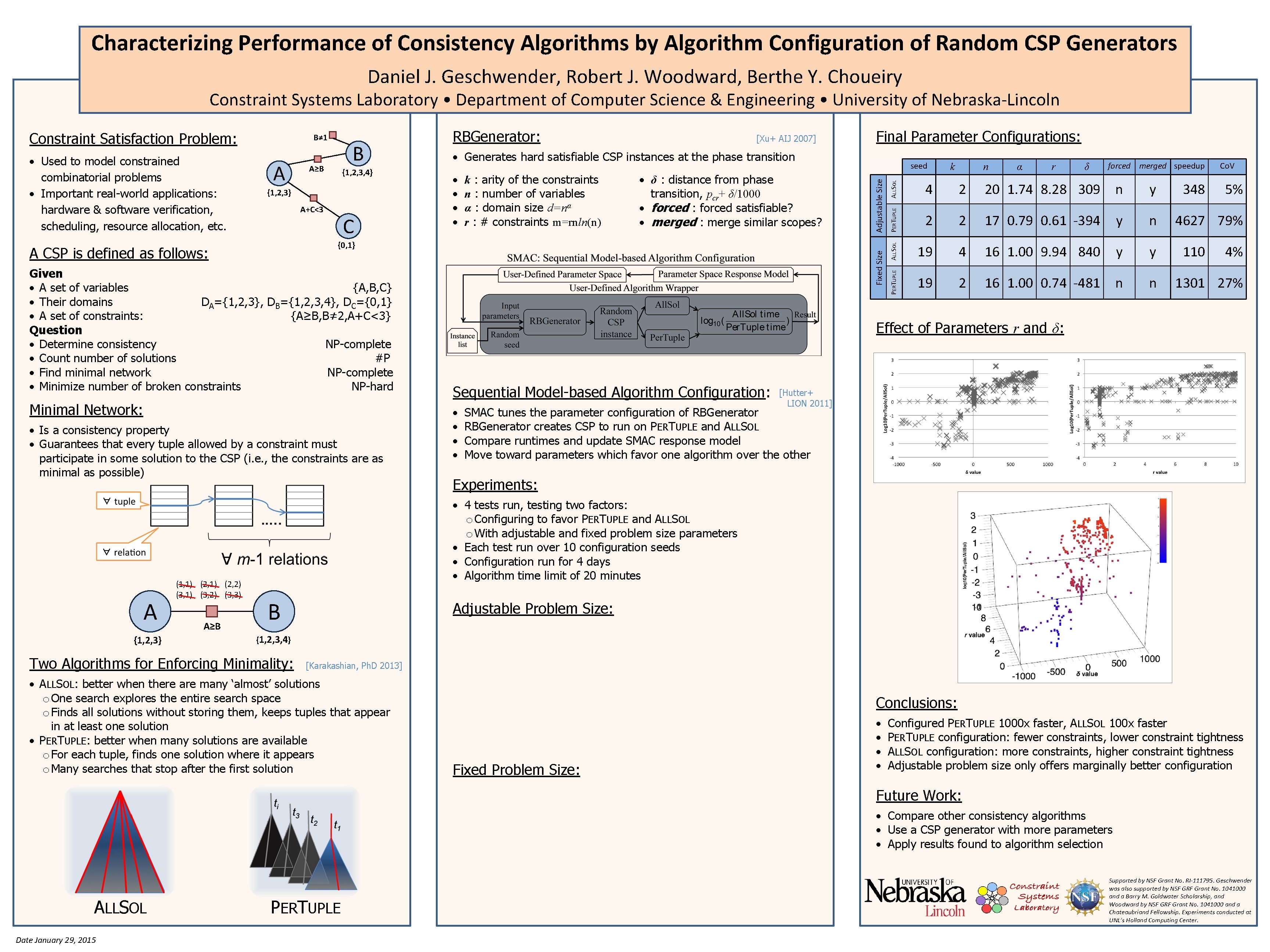
Characterizing Performance of Consistency Algorithms by Algorithm Configuration of Random CSP Generators Daniel J. Geschwender, Robert J. Woodward, Berthe Y. Choueiry Constraint Systems Laboratory • Department of Computer Science & Engineering • University of Nebraska-Lincoln A+C<3 C Given A set of variables {A, B, C} Their domains DA={1, 2, 3}, DB={1, 2, 3, 4}, DC={0, 1} A set of constraints: {A≥B, B≠ 2, A+C<3} Question Determine consistency NP-complete Count number of solutions #P Find minimal network NP-complete Minimize number of broken constraints NP-hard Minimal Network: Is a consistency property Guarantees that every tuple allowed by a constraint must participate in some solution to the CSP (i. e. , the constraints are as minimal as possible) A {1, 2, 3} A≥B k : arity of the constraints n : number of variables α : domain size d=nα r : # constraints m=rnln(n) δ : distance from phase transition, pcr+ δ/1000 forced : forced satisfiable? merged : merge similar scopes? {0, 1} A CSP is defined as follows: (1, 1) (2, 2) (3, 1) (3, 2) (3, 3) seed k n α r δ forced merged speedup ALLSOL {1, 2, 3} Generates hard satisfiable CSP instances at the phase transition 4 2 20 1. 74 8. 28 309 n y PERTUPLE {1, 2, 3, 4} Final Parameter Configurations: 2 2 17 0. 79 0. 61 -394 y n ALLSOL A≥B [Xu+ AIJ 2007] 19 4 16 1. 00 9. 94 840 y y PERTUPLE A B RBGenerator: Fixed Size Used to model constrained combinatorial problems Important real-world applications: hardware & software verification, scheduling, resource allocation, etc. B≠ 1 Adjustable Size Constraint Satisfaction Problem: 19 2 16 1. 00 0. 74 -481 n n 348 Co. V 5% 4627 79% 110 4% 1301 27% Effect of Parameters r and δ: Sequential Model-based Algorithm Configuration: [Hutter+ LION 2011] SMAC tunes the parameter configuration of RBGenerator creates CSP to run on PERTUPLE and ALLSOL Compare runtimes and update SMAC response model Move toward parameters which favor one algorithm over the other Experiments: 4 tests run, testing two factors: o Configuring to favor PERTUPLE and ALLSOL o With adjustable and fixed problem size parameters Each test run over 10 configuration seeds Configuration run for 4 days Algorithm time limit of 20 minutes B Adjustable Problem Size: {1, 2, 3, 4} Two Algorithms for Enforcing Minimality: [Karakashian, Ph. D 2013] ALLSOL: better when there are many ‘almost’ solutions o One search explores the entire search space o Finds all solutions without storing them, keeps tuples that appear in at least one solution PERTUPLE: better when many solutions are available o For each tuple, finds one solution where it appears o Many searches that stop after the first solution Conclusions: Fixed Problem Size: Configured PERTUPLE 1000 x faster, ALLSOL 100 x faster PERTUPLE configuration: fewer constraints, lower constraint tightness ALLSOL configuration: more constraints, higher constraint tightness Adjustable problem size only offers marginally better configuration Future Work: Compare other consistency algorithms Use a CSP generator with more parameters Apply results found to algorithm selection ALLSOL Date January 29, 2015 PERTUPLE Supported by NSF Grant No. RI-111795. Geschwender was also supported by NSF GRF Grant No. 1041000 and a Barry M. Goldwater Scholarship, and Woodward by NSF GRF Grant No. 1041000 and a Chateaubriand Fellowship. Experiments conducted at UNL’s Holland Computing Center.
- Slides: 1