
Characterizing Functional Health Status of Surgical Patients in



- Slides: 25
Characterizing Functional Health Status of Surgical Patients in Clinical Notes Skube SJ, Lindemann EA, Arsoniadis EG, Akre M, Wick EC, Melton GB
Background • Functional health status is an individual’s ability to perform daily activities required to meet basic needs, fulfill usual roles, and maintain their health and well-being Wilson IB, Cleary PD. Linking clinical variables with health-related quality of life. A conceptual model of patient outcomes. JAMA. 1995; 273(1): 59 -65.
Background • Functional status is important in: – Determination of overall general health – Assists in estimating perioperative risk – Factors in occurrence of adverse events • More broadly, functional status can be correlated with one’s overall health and quality of life Huysmans HA, van Ark E. Predictors of perioperative mortality, morbidity and late quality of life in coronary bypass surgery. Eur Heart J. 1989; 10 Suppl H: 10 -2. Carmon E, Keidar A, Ravid A, Goldman G, Rabau M. The correlation between quality of life and functional outcome in ulcerative colitis patients after proctocolectomy ileal pouch anal anastomosis. Colorectal Dis. 2003; 5(3): 228 -32. Crawford RS, Cambria RP, Abularrage CJ, Conrad MF, Lancaster RT, Watkins MT, et al. Preoperative functional status predicts perioperative outcomes after infrainguinal bypass surgery. J Vasc Surg. 2010; 51(2): 351 -8; discussion 8 -9. Albright EL, Davenport DL, Roth JS. Preoperative functional health status impacts outcomes after ventral hernia repair. Am Surg. 2012; 78(2): 230 -4.
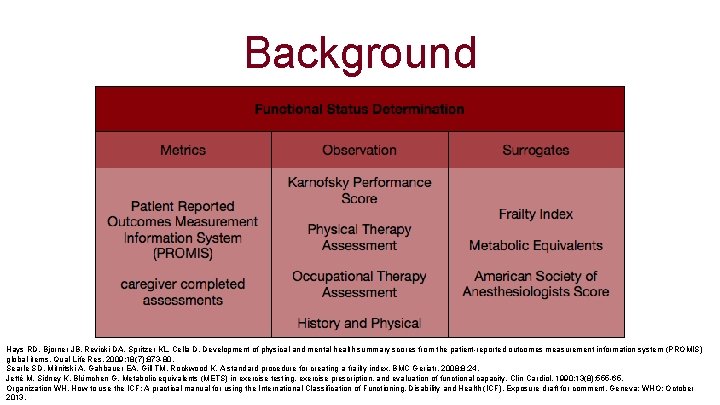
Background Hays RD, Bjorner JB, Revicki DA, Spritzer KL, Cella D. Development of physical and mental health summary scores from the patient-reported outcomes measurement information system (PROMIS) global items. Qual Life Res. 2009; 18(7): 873 -80. Searle SD, Mitnitski A, Gahbauer EA, Gill TM, Rockwood K. A standard procedure for creating a frailty index. BMC Geriatr. 2008; 8: 24. Jetté M, Sidney K, Blümchen G. Metabolic equivalents (METS) in exercise testing, exercise prescription, and evaluation of functional capacity. Clin Cardiol. 1990; 13(8): 555 -65. Organization WH. How to use the ICF: A practical manual for using the International Classification of Functioning, Disability and Health (ICF). Exposure draft for comment. Geneva: WHO; October 2013.
Use Case • Outcomes databases such as the American College of Surgeons National Surgical Quality Improvement Program (ACS-NSQIP) offer high quality data for quality improvement and research efforts • Complex data is currently collected manually by trained surgical clinical reviewers • Assess functional status in the use case of the NSQIP database Ingraham AM, Richards KE, Hall BL, Ko CY. Quality improvement in surgery: the American College of Surgeons National Surgical Quality Improvement Program approach. Adv Surg. 2010; 44: 251. Hollenbeak CS, Boltz MM, Wang L, Schubart J, Ortenzi G, Zhu J, et al. Cost-effectiveness of the National Surgical Quality Improvement Program. Ann Surg. 2011; 254(4): 619 -24. Dimick JB, Chen SL, Taheri PA, Henderson WG, Khuri SF, Campbell DA. Hospital costs associated with surgical complications: a report from the private-sector National Surgical Quality Improvement Program. J Am Coll Surg. 2004; 199(4): 531 -7.
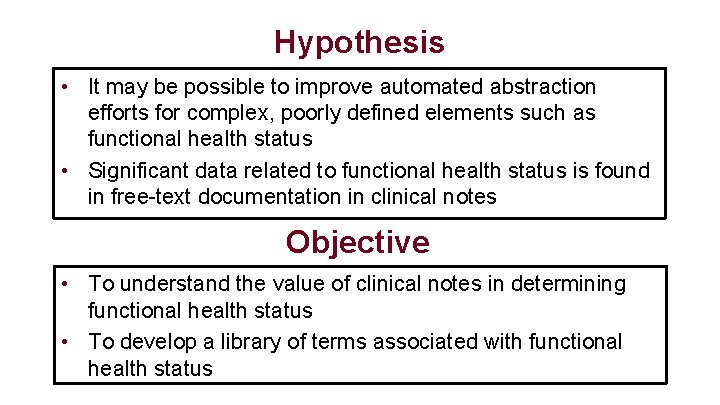
Hypothesis • It may be possible to improve automated abstraction efforts for complex, poorly defined elements such as functional health status • Significant data related to functional health status is found in free-text documentation in clinical notes Objective • To understand the value of clinical notes in determining functional health status • To develop a library of terms associated with functional health status
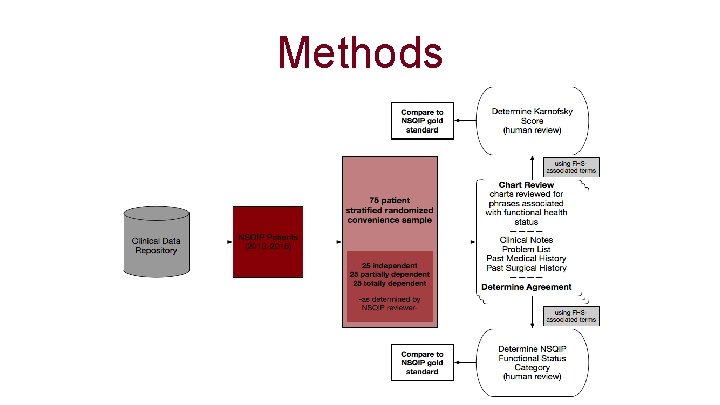
Methods
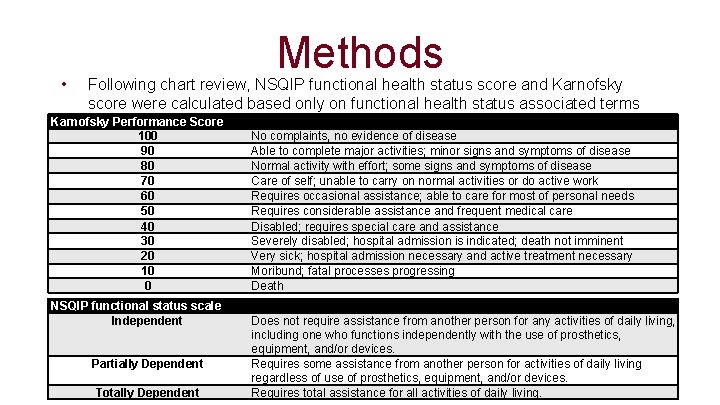
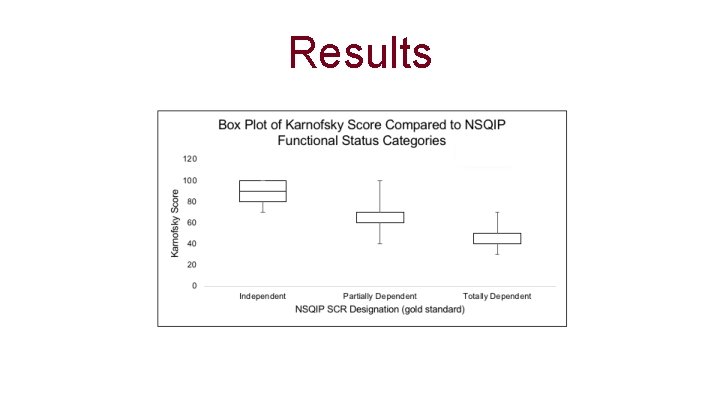
• Methods Following chart review, NSQIP functional health status score and Karnofsky score were calculated based only on functional health status associated terms Karnofsky Performance Score 100 90 80 70 60 50 40 30 20 10 0 NSQIP functional status scale Independent Partially Dependent Totally Dependent No complaints, no evidence of disease Able to complete major activities; minor signs and symptoms of disease Normal activity with effort; some signs and symptoms of disease Care of self; unable to carry on normal activities or do active work Requires occasional assistance; able to care for most of personal needs Requires considerable assistance and frequent medical care Disabled; requires special care and assistance Severely disabled; hospital admission is indicated; death not imminent Very sick; hospital admission necessary and active treatment necessary Moribund; fatal processes progressing Death Does not require assistance from another person for any activities of daily living, including one who functions independently with the use of prosthetics, equipment, and/or devices. Requires some assistance from another person for activities of daily living regardless of use of prosthetics, equipment, and/or devices. Requires total assistance for all activities of daily living.
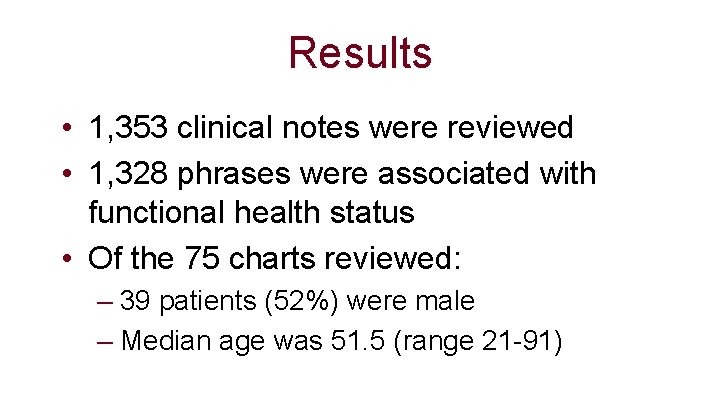
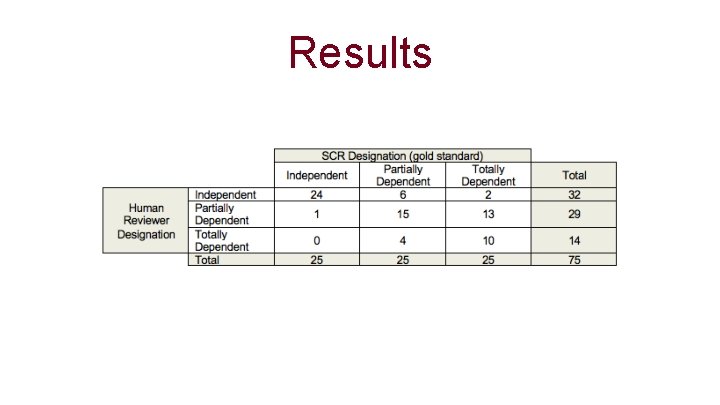
Results • 1, 353 clinical notes were reviewed • 1, 328 phrases were associated with functional health status • Of the 75 charts reviewed: – 39 patients (52%) were male – Median age was 51. 5 (range 21 -91)
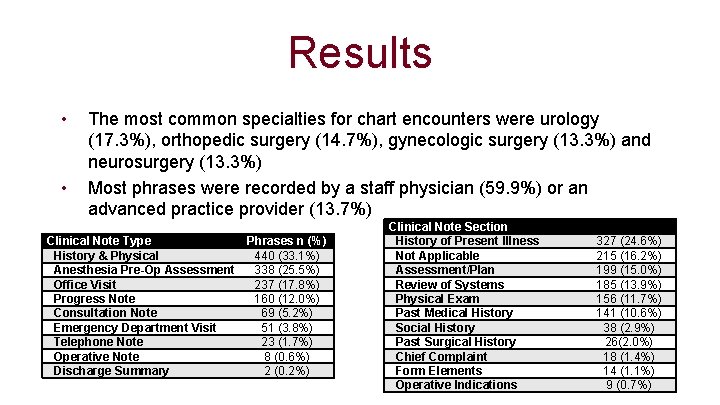
Results • • The most common specialties for chart encounters were urology (17. 3%), orthopedic surgery (14. 7%), gynecologic surgery (13. 3%) and neurosurgery (13. 3%) Most phrases were recorded by a staff physician (59. 9%) or an advanced practice provider (13. 7%) Clinical Note Type History & Physical Anesthesia Pre-Op Assessment Office Visit Progress Note Consultation Note Emergency Department Visit Telephone Note Operative Note Discharge Summary Phrases n (%) 440 (33. 1%) 338 (25. 5%) 237 (17. 8%) 160 (12. 0%) 69 (5. 2%) 51 (3. 8%) 23 (1. 7%) 8 (0. 6%) 2 (0. 2%) Clinical Note Section History of Present Illness Not Applicable Assessment/Plan Review of Systems Physical Exam Past Medical History Social History Past Surgical History Chief Complaint Form Elements Operative Indications 327 (24. 6%) 215 (16. 2%) 199 (15. 0%) 185 (13. 9%) 156 (11. 7%) 141 (10. 6%) 38 (2. 9%) 26(2. 0%) 18 (1. 4%) 14 (1. 1%) 9 (0. 7%)
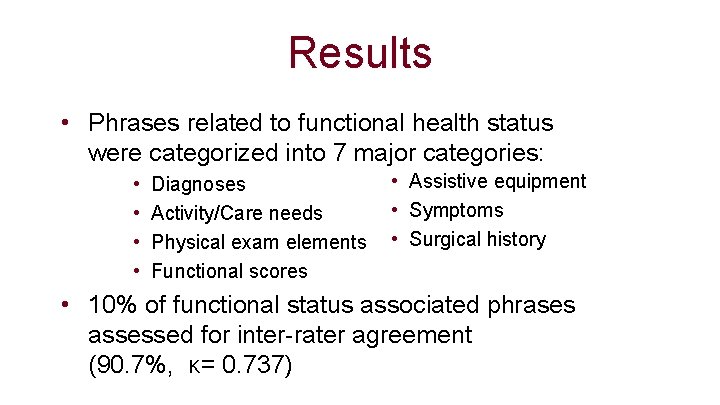
Results • Phrases related to functional health status were categorized into 7 major categories: • • Diagnoses Activity/Care needs Physical exam elements Functional scores • Assistive equipment • Symptoms • Surgical history • 10% of functional status associated phrases assessed for inter-rater agreement (90. 7%, κ= 0. 737)
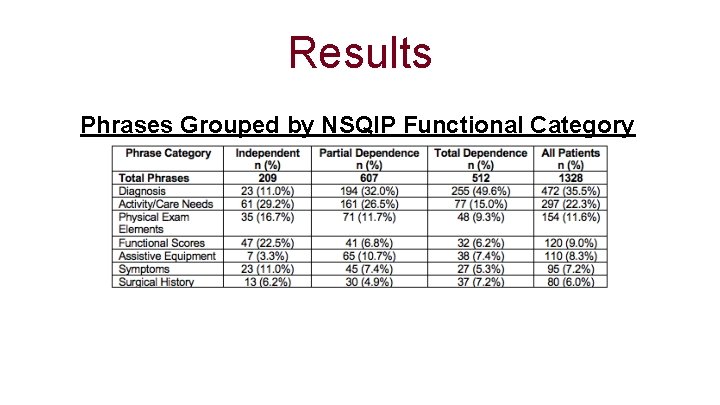
Results Phrases Grouped by NSQIP Functional Category
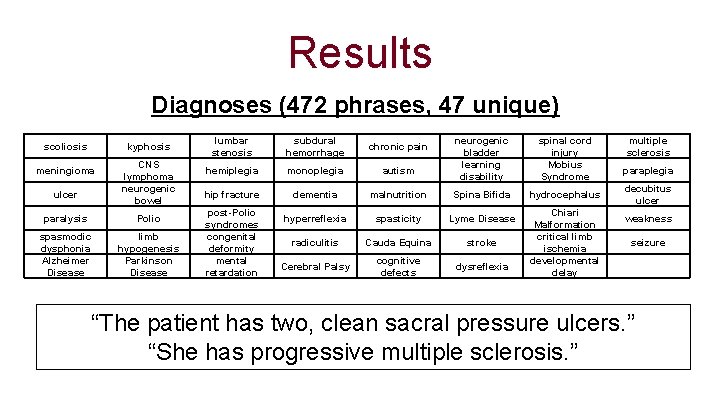
Results Diagnoses (472 phrases, 47 unique) scoliosis kyphosis meningioma ulcer CNS lymphoma neurogenic bowel paralysis Polio spasmodic dysphonia Alzheimer Disease limb hypogenesis Parkinson Disease lumbar stenosis subdural hemorrhage chronic pain hemiplegia monoplegia autism hip fracture dementia post-Polio syndromes congenital deformity mental retardation neurogenic bladder learning disability spinal cord injury Mobius Syndrome malnutrition Spina Bifida hydrocephalus hyperreflexia spasticity Lyme Disease radiculitis Cauda Equina stroke Cerebral Palsy cognitive defects dysreflexia Chiari Malformation critical limb ischemia developmental delay multiple sclerosis paraplegia decubitus ulcer weakness seizure “The patient has two, clean sacral pressure ulcers. ” “She has progressive multiple sclerosis. ”
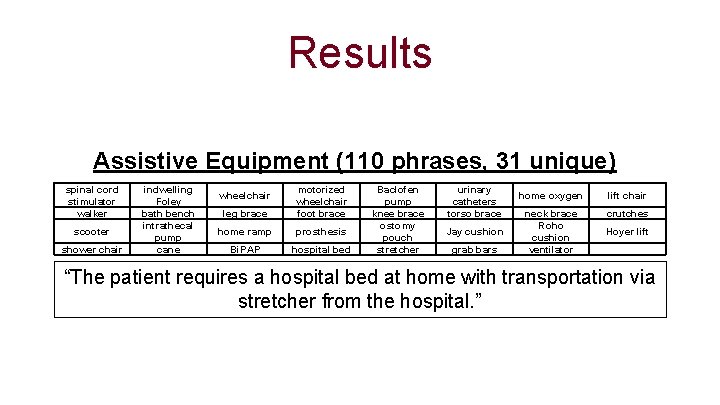
Results Assistive Equipment (110 phrases, 31 unique) spinal cord stimulator walker scooter shower chair indwelling Foley bath bench intrathecal pump cane leg brace motorized wheelchair foot brace home ramp prosthesis Bi. PAP hospital bed wheelchair Baclofen pump knee brace ostomy pouch stretcher urinary catheters torso brace Jay cushion grab bars home oxygen lift chair neck brace Roho cushion ventilator crutches Hoyer lift “The patient requires a hospital bed at home with transportation via stretcher from the hospital. ”
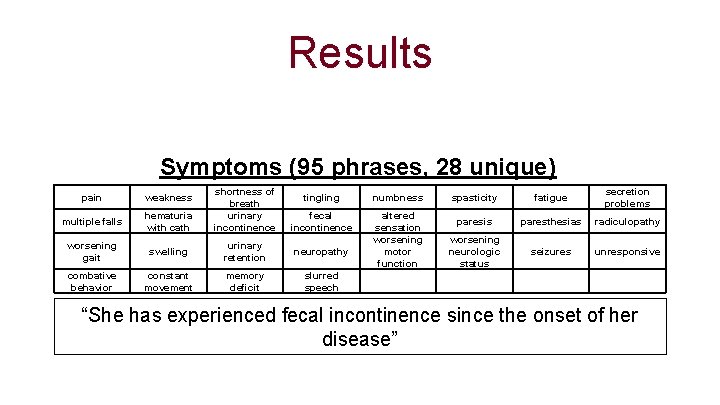
Results Symptoms (95 phrases, 28 unique) shortness of breath urinary incontinence pain weakness tingling numbness multiple falls hematuria with cath fecal incontinence altered sensation worsening motor function worsening gait swelling urinary retention neuropathy combative behavior constant movement memory deficit slurred speech spasticity fatigue secretion problems paresis paresthesias radiculopathy worsening neurologic status seizures unresponsive “She has experienced fecal incontinence since the onset of her disease”
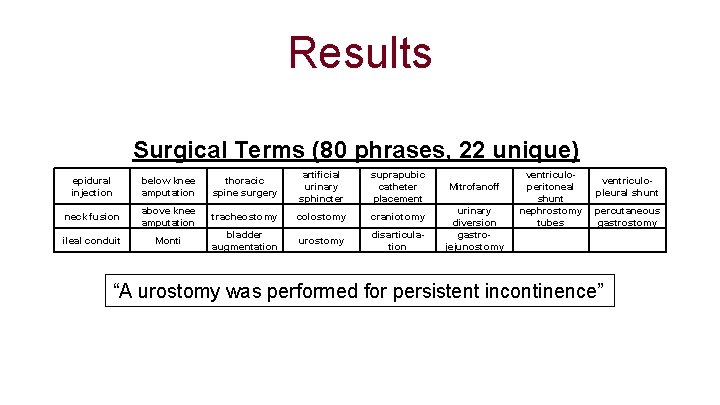
Results Surgical Terms (80 phrases, 22 unique) epidural injection below knee amputation thoracic spine surgery artificial urinary sphincter suprapubic catheter placement neck fusion above knee amputation tracheostomy colostomy craniotomy ileal conduit Monti bladder augmentation urostomy disarticulation Mitrofanoff urinary diversion gastrojejunostomy ventriculoperitoneal pleural shunt nephrostomy percutaneous tubes gastrostomy “A urostomy was performed for persistent incontinence”
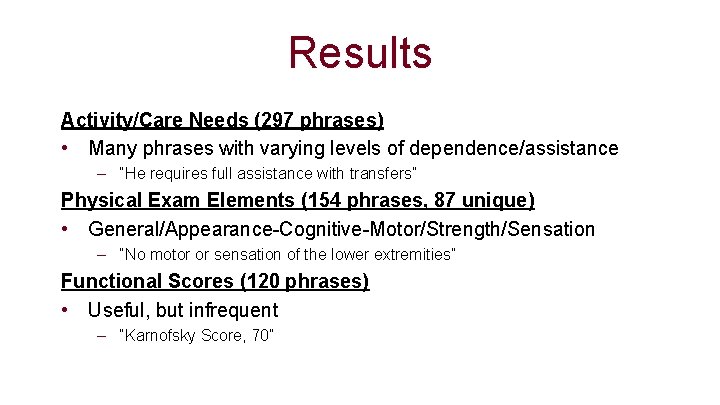
Results Activity/Care Needs (297 phrases) • Many phrases with varying levels of dependence/assistance – “He requires full assistance with transfers” Physical Exam Elements (154 phrases, 87 unique) • General/Appearance-Cognitive-Motor/Strength/Sensation – “No motor or sensation of the lower extremities” Functional Scores (120 phrases) • Useful, but infrequent – “Karnofsky Score, 70”
Results
Results
Discussion • Functional status is a complex topic that can vary by provider and has not been well integrated into electronic medical records and clinical workflows • As functional status complexity increases, there was wider variability in categorical designation (NSQIP and Karnofsky Score)
Limitations • • Retrospective review Undocumented factors Single institution Underrepresentation of physical and occupational therapists
Future Plans • Publish a database of functional status terms • Improve automated detection techniques for functional health status determinations
Conclusion • Functional status can be found in clinical notes through diagnoses, activity and home care descriptions, physical exam elements, functional scores, assistive equipment, symptoms, and surgical procedures • There is a lack of standardized functional health status documentation • Phrases found in this study could be used to assist in the automation of detection of functional health status
Acknowledgements Project Mentor: Genevieve Melton-Meaux, MD, Ph. D This research was supported by the University of Minnesota Academic Health Center Faculty Development Award, Agency for Healthcare Research and Quality (R 01 HS 24532), National Institutes of Health (NIH) Clinical and Translational Science Award (CTSA) program (UL 1 TR 000114), NIH/National Institute of General Medical Sciences (NIGMS) (R 01 GM 120079), Fairview Health Services, and University of Minnesota Physicians.
Thank You