
Characterizations and Modeling of the Wireless Channel Lecture

- Slides: 19
Characterizations and Modeling of the Wireless Channel Lecture Note 3
Wireless channel disturbances Ø Additive noise, like thermal background noise Ø Multiplicative noise Ø Distortion due to time dispersion Ø Corruptive elements are in the forms of: Ø Multipath delay spread Ø Doppler spread due to motion Ø Signal fading of frequency-selective and nonfrequency-selective variety
Multipath propagation environment Ø Wireless propagation channel contains objects (particles) randomly scattering the energy of transmitted signals Ø Scattered signals arrive at receiver out of step Ø These objects (particles) are called scatterers Ø Scatterers introduce: Ø Fading Ø Multipath delay spread Ø Doppler spread Ø Attenuation
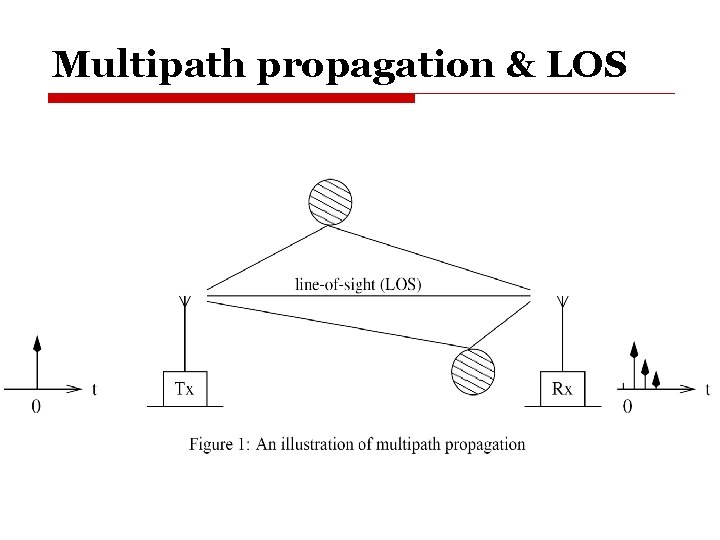
Multipath delay spread Ø Scattering by randomly located scatterers gives rise to different paths with different path-lengths/propagation-delays, resulting in multipath delay spread Ø If the propagation channel doesn’t exhibit multipath delay spread, a point source (a single tone sinusoid) appears at front end of receiver as another point source Ø A multipath situation arises when a transmitted point source is received as multipoint source, with each of individually received points experiencing a different transmission delay Ø The effect of multipath propagation on digital transmission can be characterized by time dispersion and fading
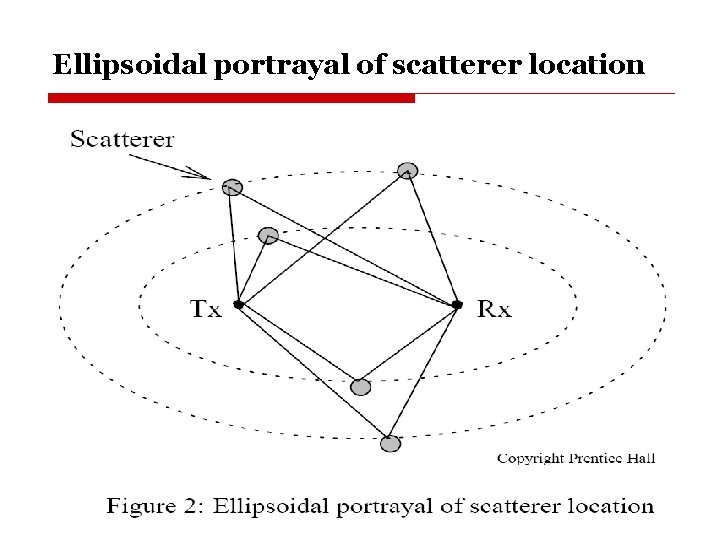
Wireless channel time dispersion Ø The transmitted point source will be received as a smeared wave due to multipath delay spread Ø Non-overlapping scatterers give rise to distinct multi paths – characterized by their locations in scattering medium. Ø All scatterers are located on ellipses with transmitter (Tx) and receiver (Rx) as the foci. One ellipse is associated with one path length/delay Ø Signals reflected by scatterers located on the same ellipse experience the same propagation delay and thus signal components from these multi-paths are indistinguishable at the receiver Ø Signals that are reflected by scatterers located on different ellipses arrive a the receiver with different delays
Ellipsoidal portrayal of scatterer location
Flat fading vs. frequency-selective fading and ISI Ø If max difference in delay spread is small compared with symbol duration of transmitted signal, channel is said to exhibit flat fading Ø If difference in delay spread is large compared with the symbol duration of transmitted signal, the channel exhibits frequency-selective fading Ø In time domain, received signals corresponding to successive transmitted symbols through frequency-selective fading channel will overlap, giving rise to a phenomenon called inter-symbol interference (ISI) Ø ISI is a signal-dependent distortion Ø The severity of ISI increase with the width of delay spread. Ø ISI distortion in time domain can also be examined in frequency domain Ø ISI degrades transmission performance, which can be overcome by the channel equalization techniques
Background noise and AWGN Ø Inherent background noise can be approximated as thermal noise and treated as Additive White Gaussian (AWGN) Ø Digital transmission over practical wireless channels is mainly limited by interference or distortion other than AWGN
Wireless channel fading Ø The multipath components can affect the received signal strength constructively or destructively, depending on carrier frequency and delay differences among the multi paths Ø As a mobile station moves, the position of each scatterer w. r. t. transmitter and receiver may change Ø The overall effect caused by multipath delay spread, Doppler spread, attenuation, thermal noise, etc. is that the received signal level fluctuates with time, which is the phenomenon called fading
Line-of-Sight (LOS) vs. non-line-of-sight (NLOS) Ø The delay of Line-of-Sight (LOS) or direct path is the shortest path among the multi paths, having smallest propagation delay (often assumed to be zero); the delay of non-line-of-sight (NLOS) or reflected path has longer propagation delay
Multipath propagation & LOS
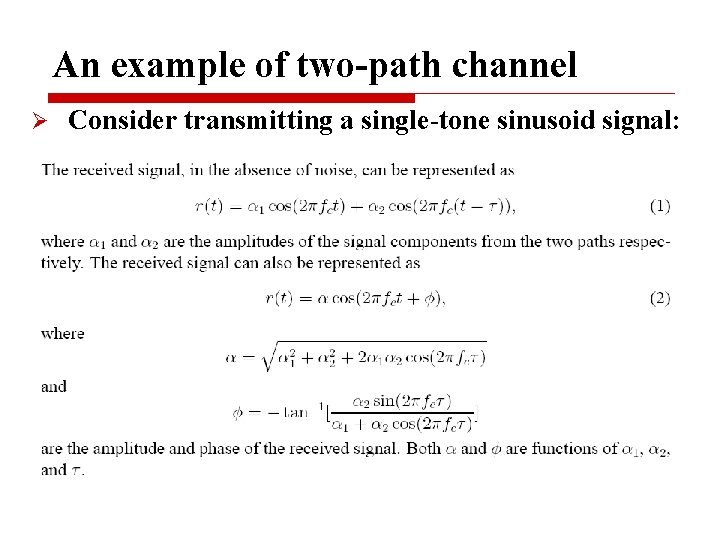
An example of two-path channel Ø Consider transmitting a single-tone sinusoid signal:
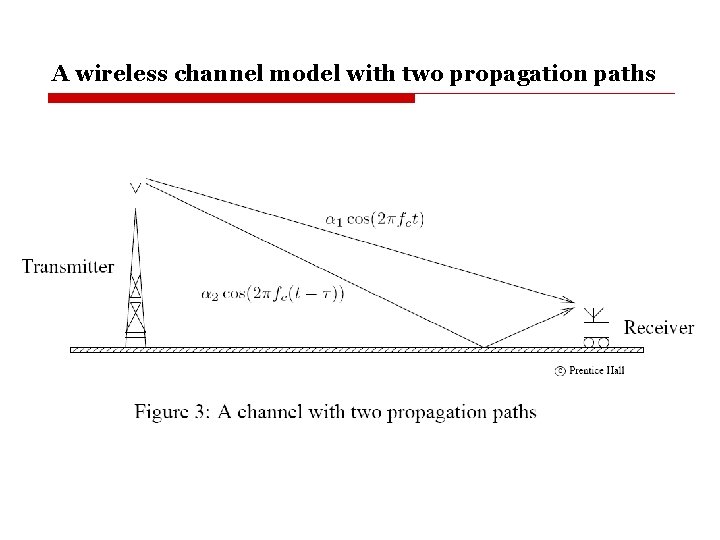
A wireless channel model with two propagation paths
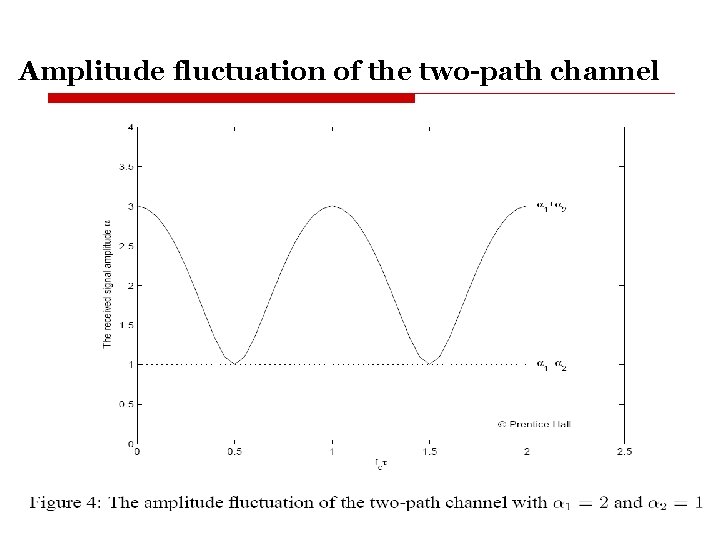
Amplitude fluctuation of the two-path channel
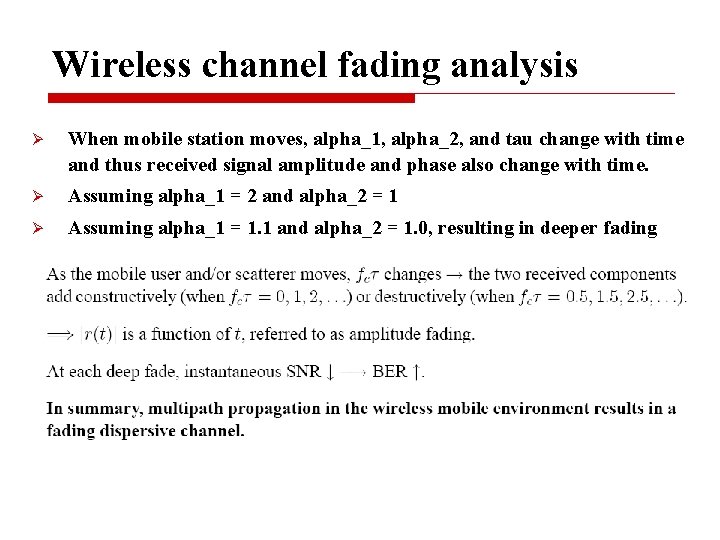
Wireless channel fading analysis Ø When mobile station moves, alpha_1, alpha_2, and tau change with time and thus received signal amplitude and phase also change with time. Ø Assuming alpha_1 = 2 and alpha_2 = 1 Ø Assuming alpha_1 = 1. 1 and alpha_2 = 1. 0, resulting in deeper fading
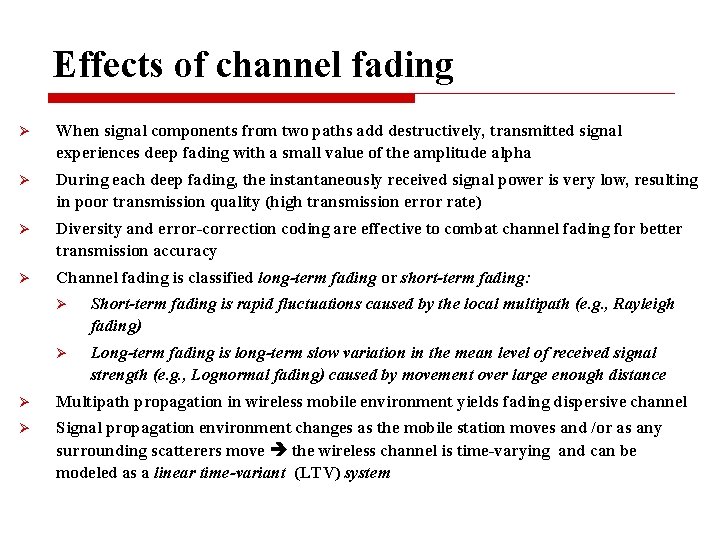
Effects of channel fading Ø When signal components from two paths add destructively, transmitted signal experiences deep fading with a small value of the amplitude alpha Ø During each deep fading, the instantaneously received signal power is very low, resulting in poor transmission quality (high transmission error rate) Ø Diversity and error-correction coding are effective to combat channel fading for better transmission accuracy Ø Channel fading is classified long-term fading or short-term fading: Ø Short-term fading is rapid fluctuations caused by the local multipath (e. g. , Rayleigh fading) Ø Long-term fading is long-term slow variation in the mean level of received signal strength (e. g. , Lognormal fading) caused by movement over large enough distance Ø Multipath propagation in wireless mobile environment yields fading dispersive channel Ø Signal propagation environment changes as the mobile station moves and /or as any surrounding scatterers move the wireless channel is time-varying and can be modeled as a linear time-variant (LTV) system
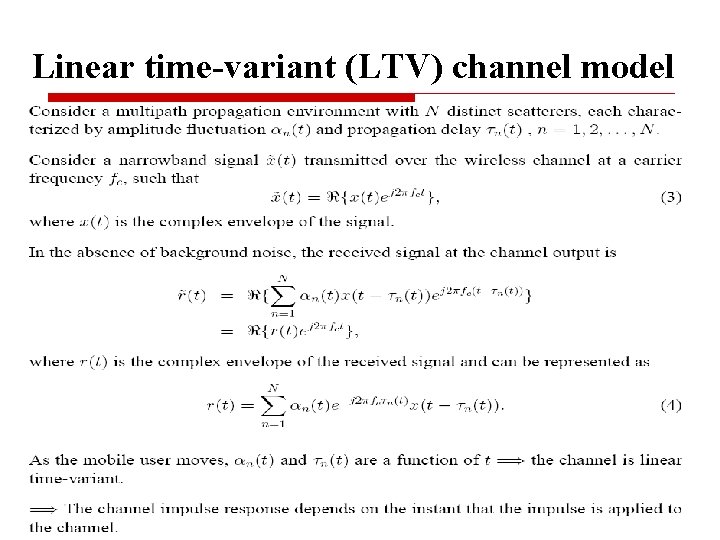
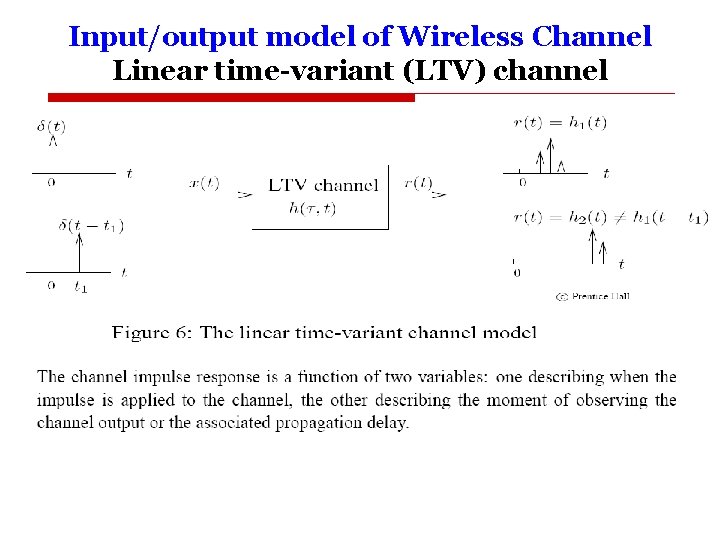
Linear time-variant (LTV) channel model
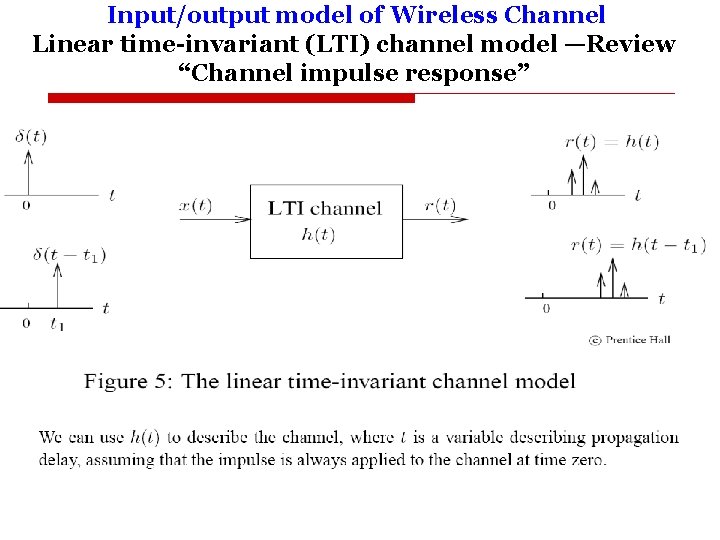
Input/output model of Wireless Channel Linear time-invariant (LTI) channel model —Review “Channel impulse response”
Input/output model of Wireless Channel Linear time-variant (LTV) channel