
Characterization Techniques Tutorial Tutorial 2 By ASSIS TA
Characterization Techniques “Tutorial” Tutorial 2 By ASSIS TA N T PROC ESSO R ASSIST ANT PR OCESSOR DR. RRAOU AOUFF M AHMOOD MAHMO OD
Characterization techniques a) Chemical characterization: 1. Optical Spectroscopy 2. Electron Spectroscopy 3. Ionic Spectrometry 4. Rutherford Backscattering Spectrometry (RBS) 5. Secondary Ion Mass Spectrometry (SIMS)
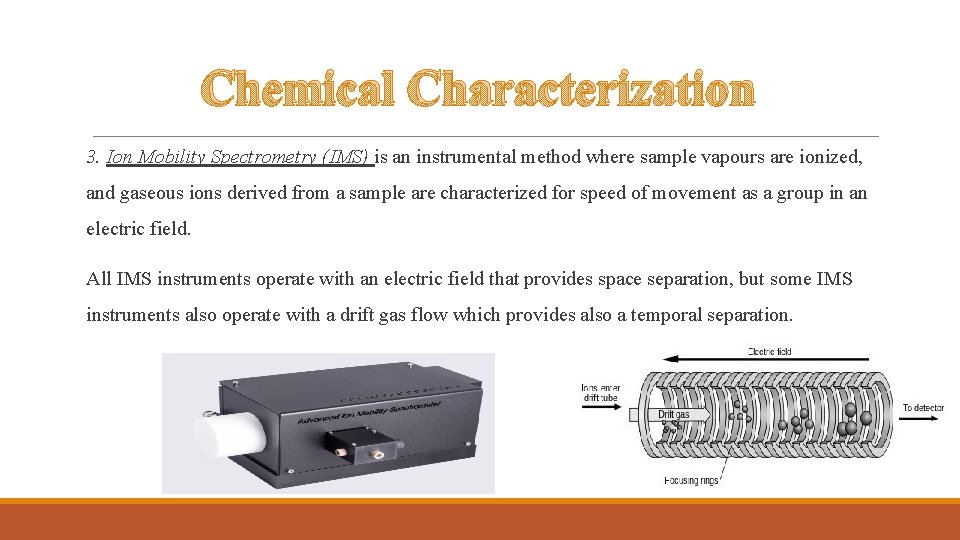
Chemical Characterization 3. Ion Mobility Spectrometry (IMS) is an instrumental method where sample vapours are ionized, and gaseous ions derived from a sample are characterized for speed of movement as a group in an electric field. All IMS instruments operate with an electric field that provides space separation, but some IMS instruments also operate with a drift gas flow which provides also a temporal separation.
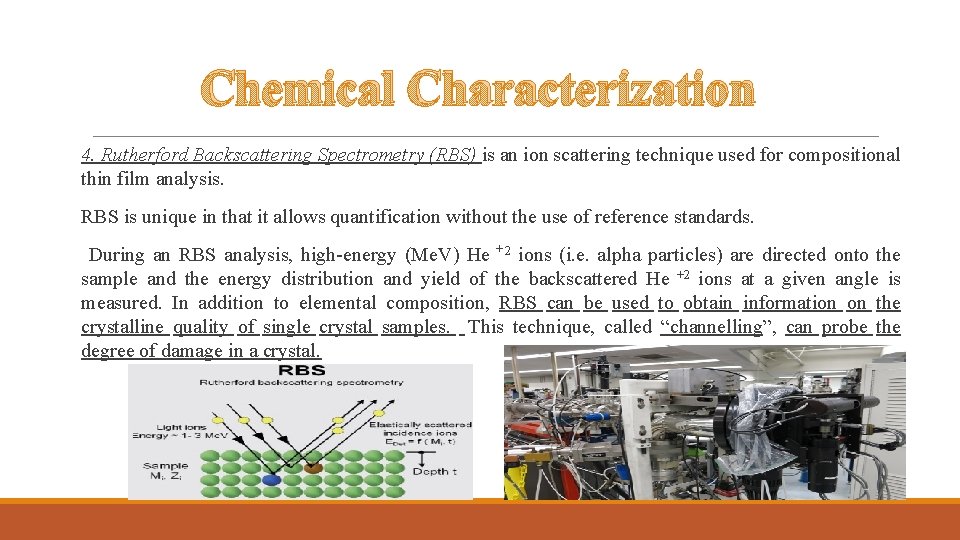
Chemical Characterization 4. Rutherford Backscattering Spectrometry (RBS) is an ion scattering technique used for compositional thin film analysis. RBS is unique in that it allows quantification without the use of reference standards. During an RBS analysis, high-energy (Me. V) He +2 ions (i. e. alpha particles) are directed onto the sample and the energy distribution and yield of the backscattered He +2 ions at a given angle is measured. In addition to elemental composition, RBS can be used to obtain information on the crystalline quality of single crystal samples. This technique, called “channelling”, can probe the degree of damage in a crystal.
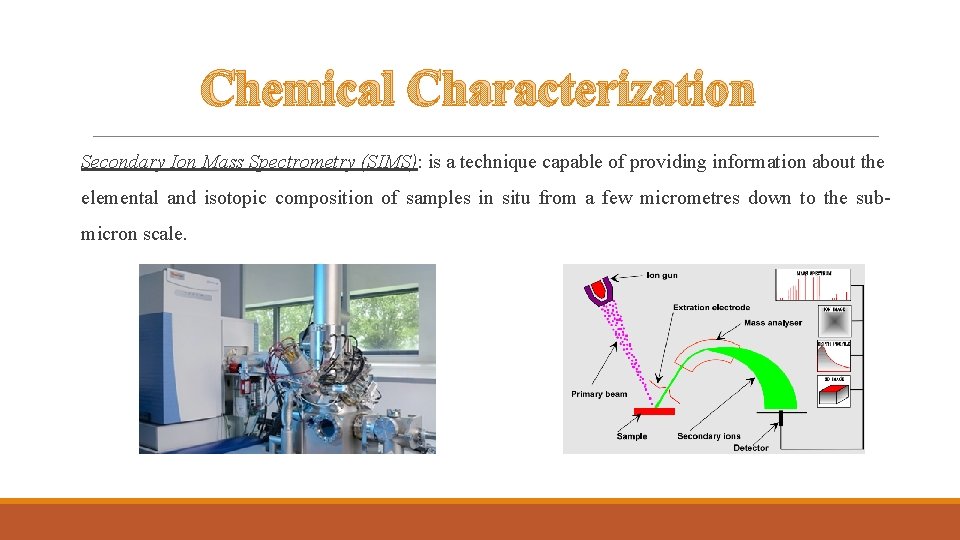
Chemical Characterization Secondary Ion Mass Spectrometry (SIMS): is a technique capable of providing information about the elemental and isotopic composition of samples in situ from a few micrometres down to the submicron scale.
Characterization techniques b) Structural characterization: 1. X-Ray diffraction technique 2. Electron microscopy 3. Dynamic light Scattering
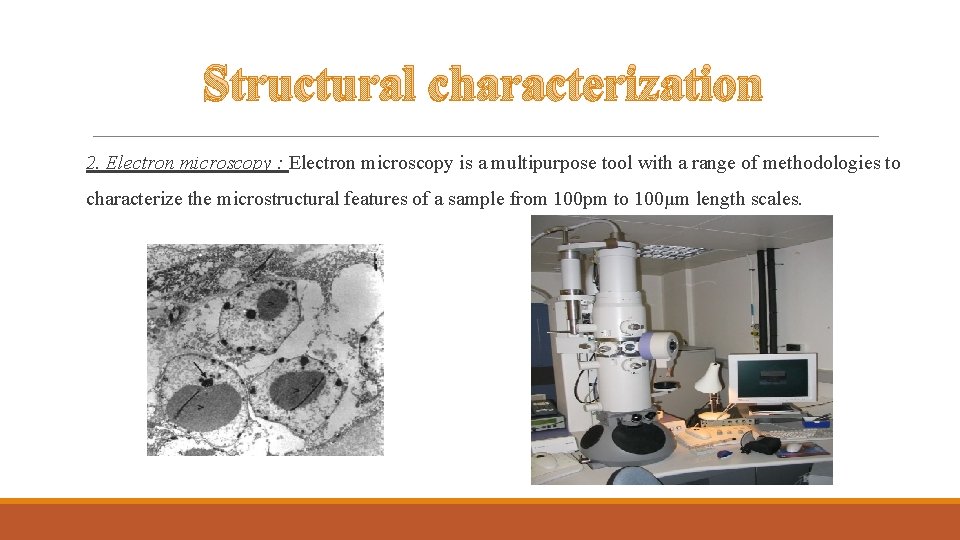
Structural characterization 2. Electron microscopy : Electron microscopy is a multipurpose tool with a range of methodologies to characterize the microstructural features of a sample from 100 pm to 100μm length scales.
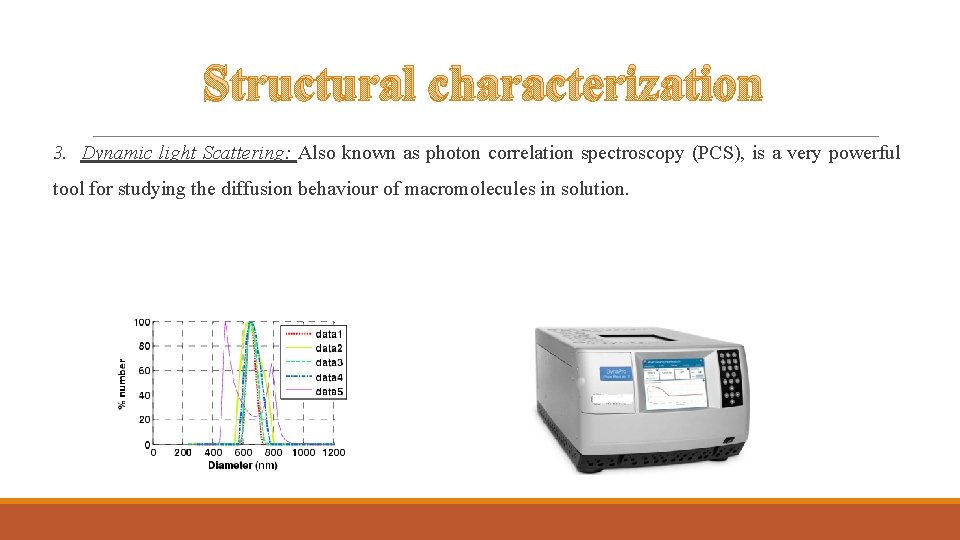
Structural characterization 3. Dynamic light Scattering: Also known as photon correlation spectroscopy (PCS), is a very powerful tool for studying the diffusion behaviour of macromolecules in solution.
- Slides: 8