
Characterization System for Radiation Pattern and Sensitivity Estimation


- Slides: 30
Characterization System for Radiation Pattern and Sensitivity Estimation of UHF RFID Tags Riccardo Colella, Luca Catarinucci, Paolo Coppola, Luciano Tarricone Innovation Engineering Department University of Salento - Lecce - Italy
Outline Ø Rationale and goals Ø Significant metrics for passive UHF RFID tags Ø Proposed cost-effective tag testing platform Ø Validation and Measurement results Ø Concluding remarks 2015 IEEE AP-S/USNC-URSI, Vancouver, July 19 -24, 2015 2
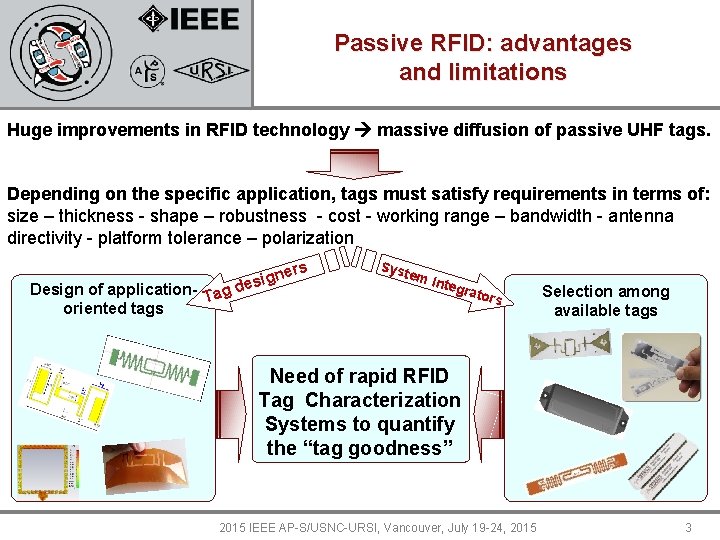
Passive RFID: advantages and limitations Huge improvements in RFID technology massive diffusion of passive UHF tags. Depending on the specific application, tags must satisfy requirements in terms of: size – thickness - shape – robustness - cost - working range – bandwidth - antenna directivity - platform tolerance – polarization rs ne esig Design of application- Tag d oriented tags Syst em I nteg rato rs Selection among available tags Need of rapid RFID Tag Characterization Systems to quantify the “tag goodness” 2015 IEEE AP-S/USNC-URSI, Vancouver, July 19 -24, 2015 3
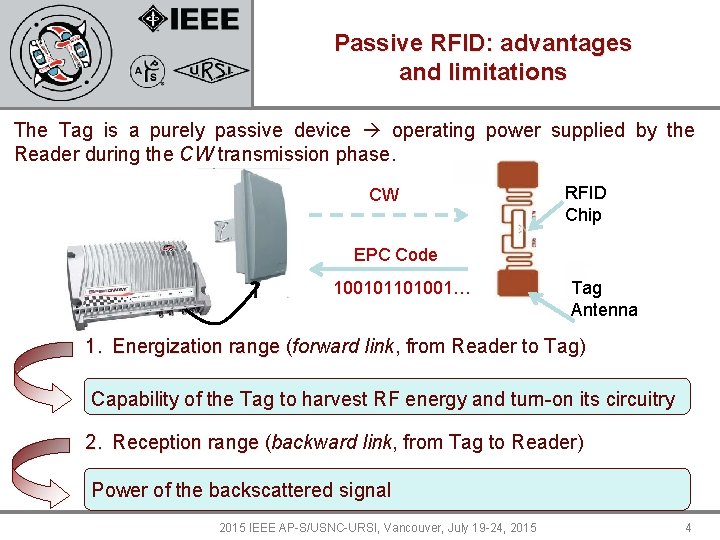
Passive RFID: advantages and limitations The Tag is a purely passive device operating power supplied by the Reader during the CW transmission phase. CW RFID Chip EPC Code 100101101001… Tag Antenna 1. Energization range (forward link, from Reader to Tag) Capability of the Tag to harvest RF energy and turn-on its circuitry 2. Reception range (backward link, from Tag to Reader) Power of the backscattered signal 2015 IEEE AP-S/USNC-URSI, Vancouver, July 19 -24, 2015 4
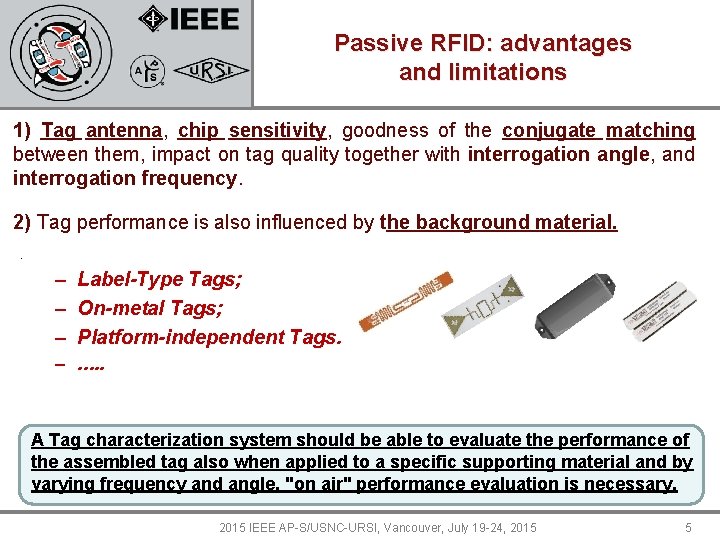
Passive RFID: advantages and limitations 1) Tag antenna, chip sensitivity, goodness of the conjugate matching between them, impact on tag quality together with interrogation angle, and interrogation frequency. 2) Tag performance is also influenced by the background material. . – Label-Type Tags; – On-metal Tags; – Platform-independent Tags. – …. . A Tag characterization system should be able to evaluate the performance of the assembled tag also when applied to a specific supporting material and by varying frequency and angle. ʺon airʺ performance evaluation is necessary. 2015 IEEE AP-S/USNC-URSI, Vancouver, July 19 -24, 2015 5
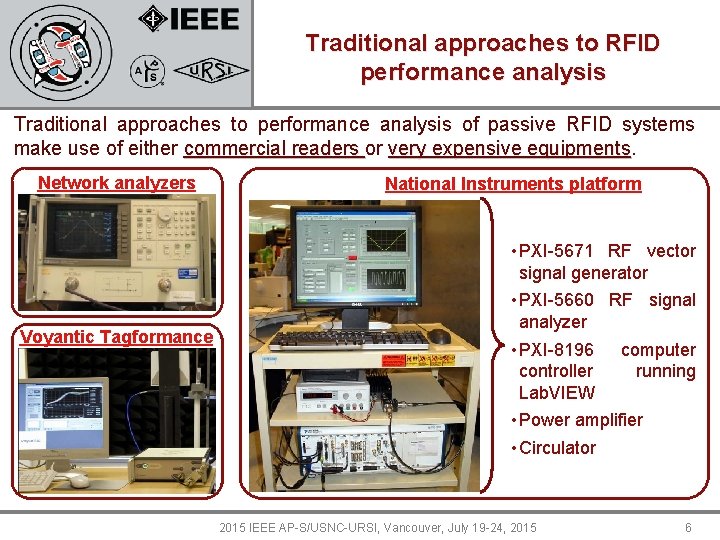
Traditional approaches to RFID performance analysis Traditional approaches to performance analysis of passive RFID systems make use of either commercial readers or very expensive equipments Network analyzers Voyantic Tagformance National Instruments platform • PXI-5671 RF vector signal generator • PXI-5660 RF signal analyzer • PXI-8196 computer controller running Lab. VIEW • Power amplifier • Circulator 2015 IEEE AP-S/USNC-URSI, Vancouver, July 19 -24, 2015 6
Goals Ø To develop a cost-effective experimental set-up suitable for the complete “on-air” performance analysis of passive RFID tags in the UHF band. Ø To implement low-level metrics significant in terms of tag quality, such as “Tag Sensitivity” and estimated working distance by varying frequency and/or interrogation angle, but also tag antenna radiation pattern. Ø To verify the appropriateness of the proposed approach for RFID devices testing 2015 IEEE AP-S/USNC-URSI, Vancouver, July 19 -24, 2015 7
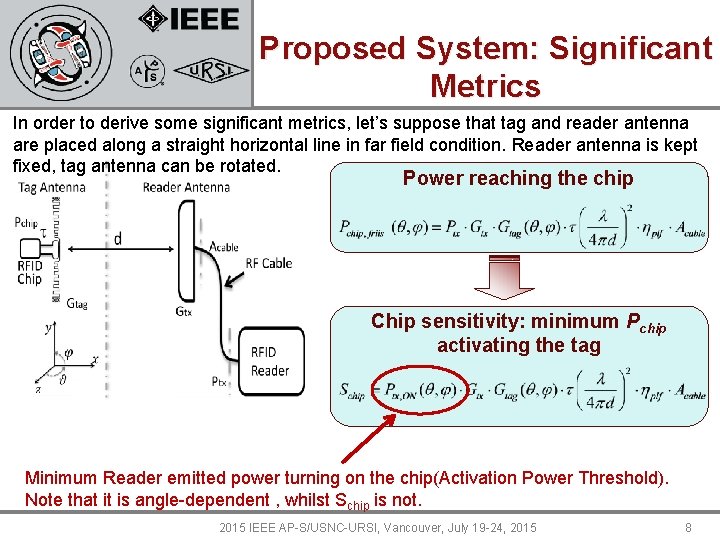
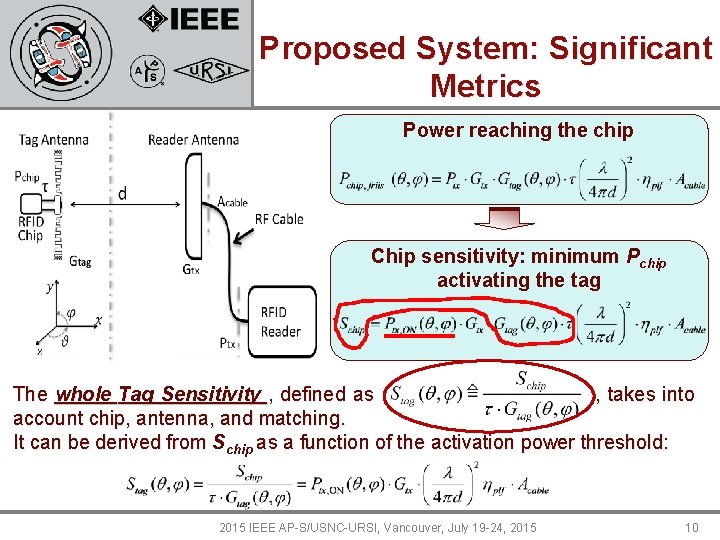
Proposed System: Significant Metrics In order to derive some significant metrics, let’s suppose that tag and reader antenna are placed along a straight horizontal line in far field condition. Reader antenna is kept fixed, tag antenna can be rotated. Power reaching the chip Chip sensitivity: minimum Pchip activating the tag Minimum Reader emitted power turning on the chip(Activation Power Threshold). Note that it is angle-dependent , whilst Schip is not. 2015 IEEE AP-S/USNC-URSI, Vancouver, July 19 -24, 2015 8
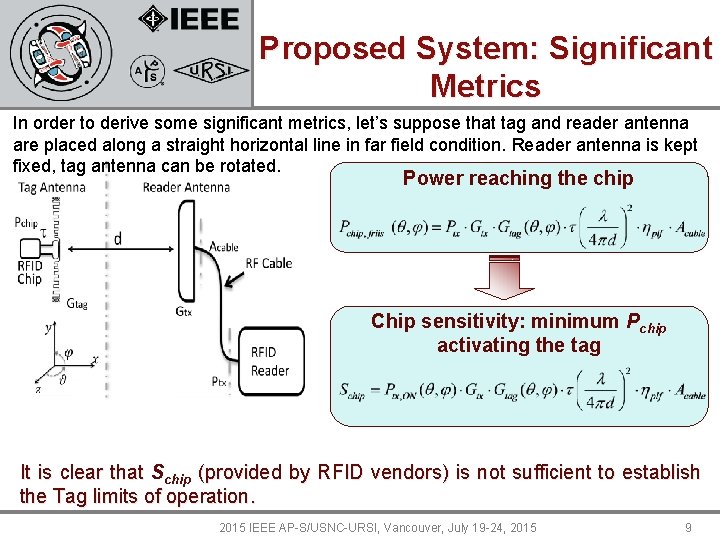
Proposed System: Significant Metrics In order to derive some significant metrics, let’s suppose that tag and reader antenna are placed along a straight horizontal line in far field condition. Reader antenna is kept fixed, tag antenna can be rotated. Power reaching the chip Chip sensitivity: minimum Pchip activating the tag It is clear that Schip (provided by RFID vendors) is not sufficient to establish the Tag limits of operation. 2015 IEEE AP-S/USNC-URSI, Vancouver, July 19 -24, 2015 9
Proposed System: Significant Metrics Power reaching the chip Chip sensitivity: minimum Pchip activating the tag The whole Tag Sensitivity , defined as , takes into account chip, antenna, and matching. It can be derived from Schip as a function of the activation power threshold: 2015 IEEE AP-S/USNC-URSI, Vancouver, July 19 -24, 2015 10
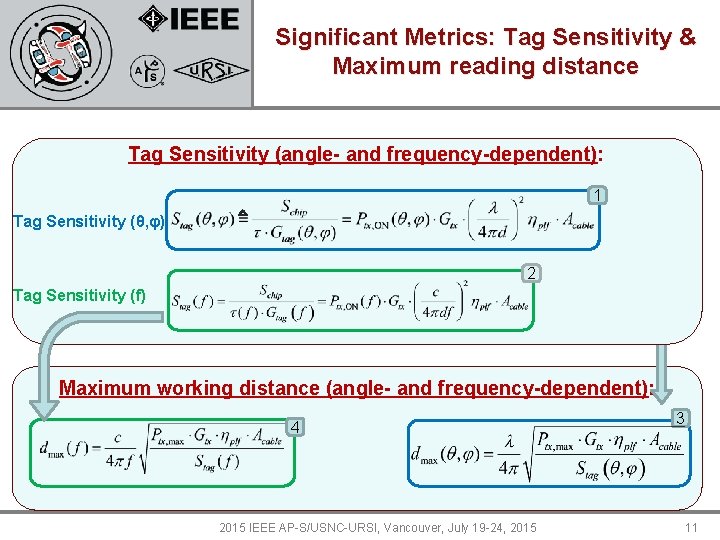
Significant Metrics: Tag Sensitivity & Maximum reading distance Tag Sensitivity (angle- and frequency-dependent): 1 Tag Sensitivity (θ, φ) 2 Tag Sensitivity (f) Maximum working distance (angle- and frequency-dependent): 4 2015 IEEE AP-S/USNC-URSI, Vancouver, July 19 -24, 2015 3 11
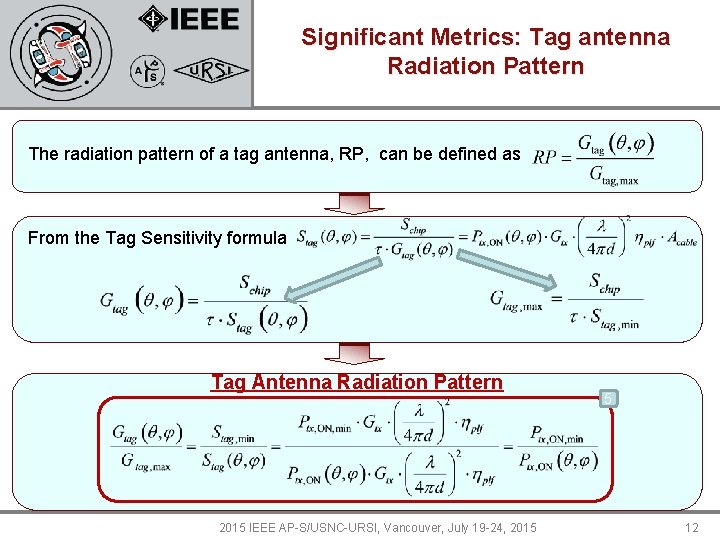
Significant Metrics: Tag antenna Radiation Pattern The radiation pattern of a tag antenna, RP, can be defined as From the Tag Sensitivity formula Tag Antenna Radiation Pattern 2015 IEEE AP-S/USNC-URSI, Vancouver, July 19 -24, 2015 5 12
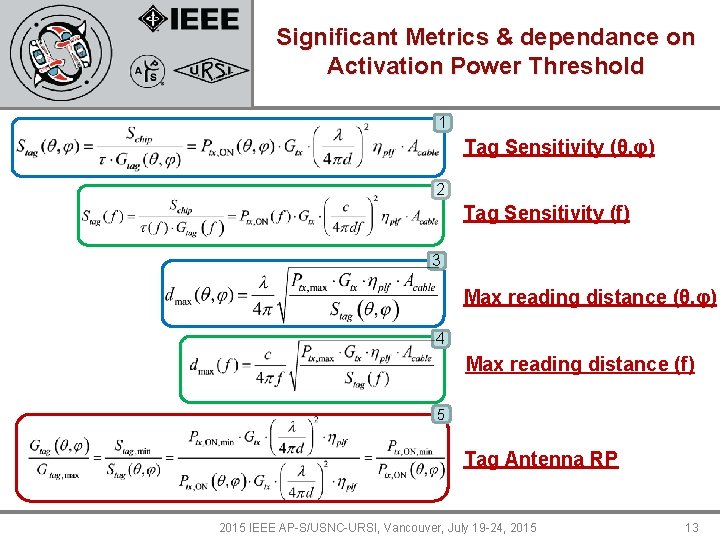
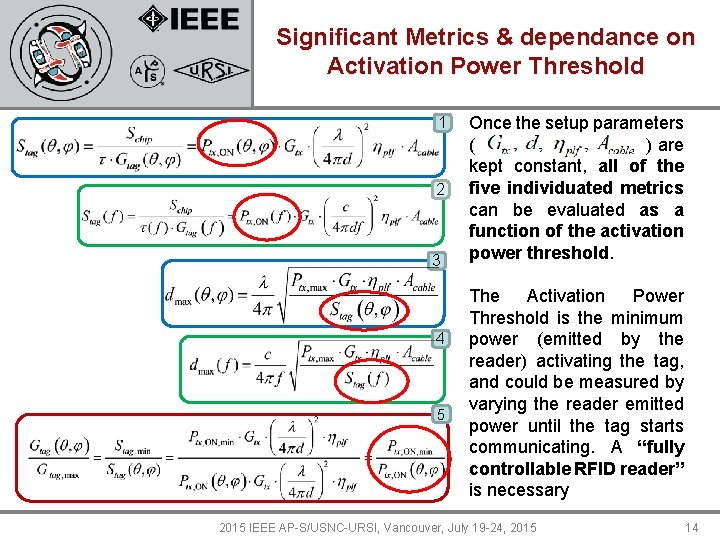
Significant Metrics & dependance on Activation Power Threshold 1 Tag Sensitivity (θ, φ) 2 Tag Sensitivity (f) 3 Max reading distance (θ, φ) 4 Max reading distance (f) 5 Tag Antenna RP 2015 IEEE AP-S/USNC-URSI, Vancouver, July 19 -24, 2015 13
Significant Metrics & dependance on Activation Power Threshold 1 2 3 4 5 Once the setup parameters ( ) are kept constant, all of the five individuated metrics can be evaluated as a function of the activation power threshold. The Activation Power Threshold is the minimum power (emitted by the reader) activating the tag, and could be measured by varying the reader emitted power until the tag starts communicating. A “fully controllable RFID reader” is necessary 2015 IEEE AP-S/USNC-URSI, Vancouver, July 19 -24, 2015 14
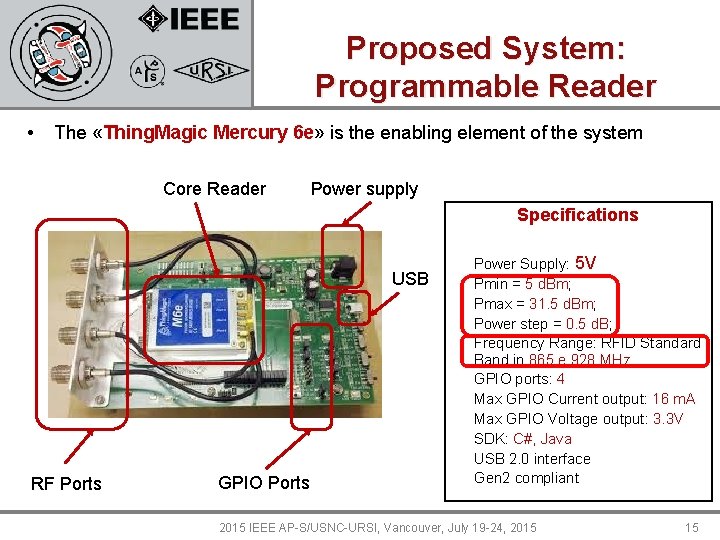
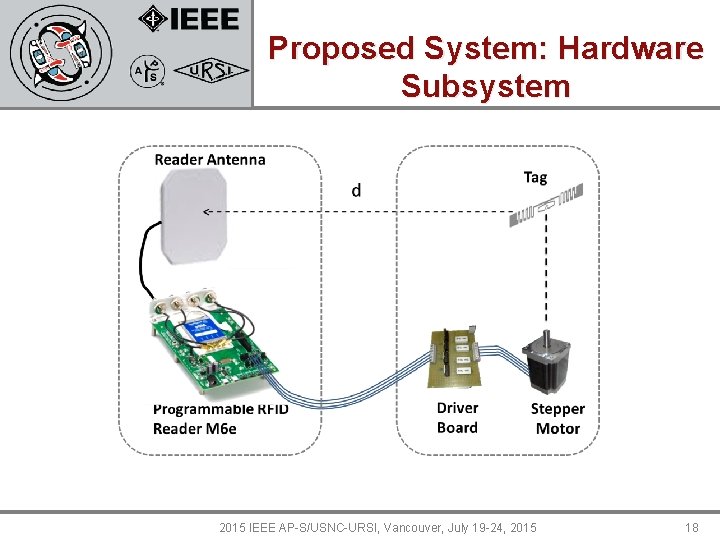
Proposed System: Programmable Reader • The «Thing. Magic Mercury 6 e» is the enabling element of the system Core Reader Power supply Specifications USB RF Ports GPIO Ports � � � Power Supply: 5 V Pmin = 5 d. Bm; Pmax = 31. 5 d. Bm; Power step = 0. 5 d. B; Frequency Range: RFID Standard Band in 865 e 928 MHz. GPIO ports: 4 Max GPIO Current output: 16 m. A Max GPIO Voltage output: 3. 3 V SDK: C#, Java USB 2. 0 interface Gen 2 compliant 2015 IEEE AP-S/USNC-URSI, Vancouver, July 19 -24, 2015 15
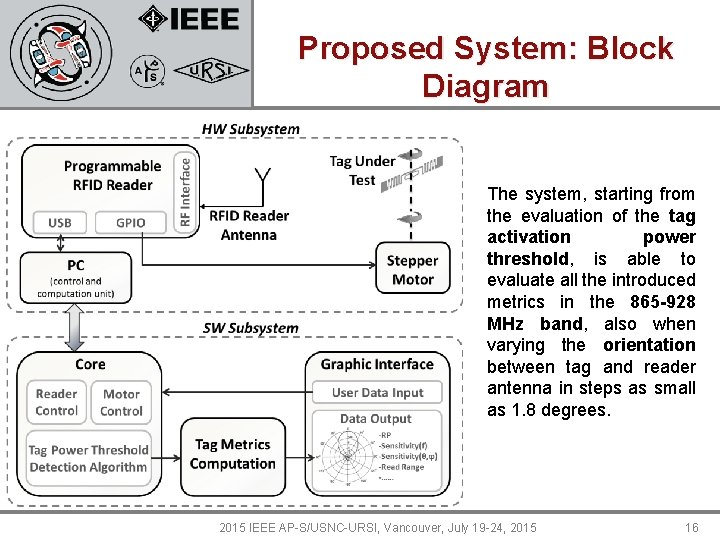
Proposed System: Block Diagram The system, starting from the evaluation of the tag activation power threshold, is able to evaluate all the introduced metrics in the 865 -928 MHz band, also when varying the orientation between tag and reader antenna in steps as small as 1. 8 degrees. 2015 IEEE AP-S/USNC-URSI, Vancouver, July 19 -24, 2015 16
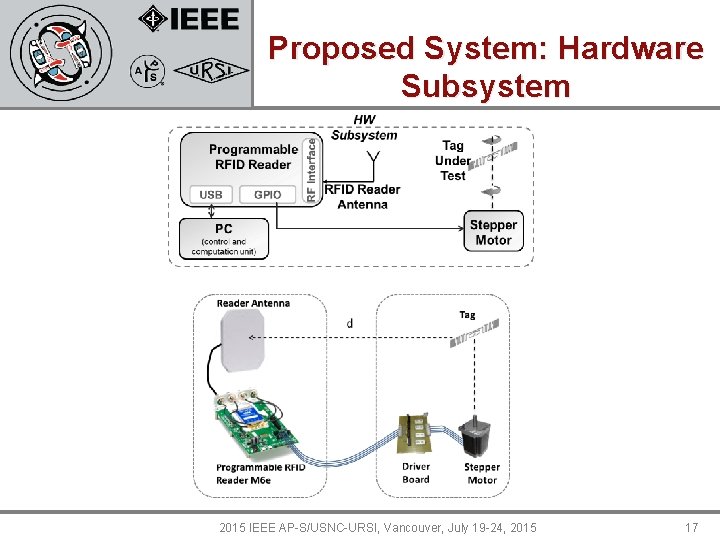
Proposed System: Hardware Subsystem 2015 IEEE AP-S/USNC-URSI, Vancouver, July 19 -24, 2015 17
Proposed System: Hardware Subsystem 2015 IEEE AP-S/USNC-URSI, Vancouver, July 19 -24, 2015 18
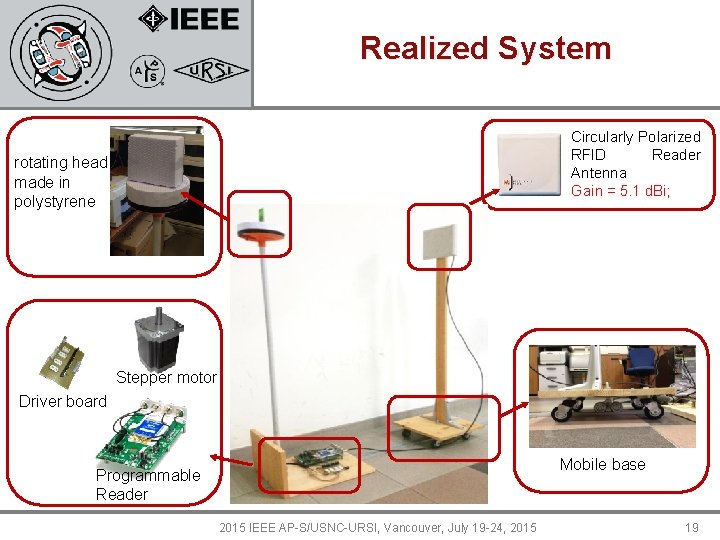
Realized System Circularly Polarized RFID Reader Antenna Gain = 5. 1 d. Bi; rotating head made in polystyrene Stepper motor Driver board Mobile base Programmable Reader 2015 IEEE AP-S/USNC-URSI, Vancouver, July 19 -24, 2015 19
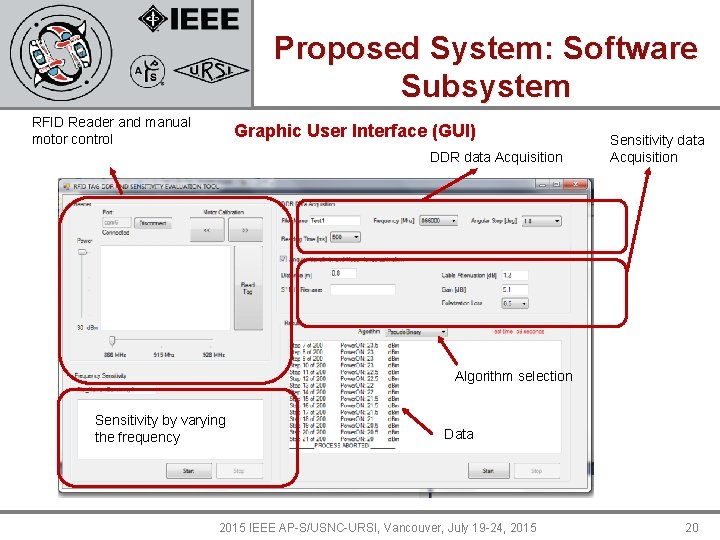
Proposed System: Software Subsystem RFID Reader and manual motor control Graphic User Interface (GUI) DDR data Acquisition Sensitivity data Acquisition Algorithm selection Sensitivity by varying the frequency Data 2015 IEEE AP-S/USNC-URSI, Vancouver, July 19 -24, 2015 20
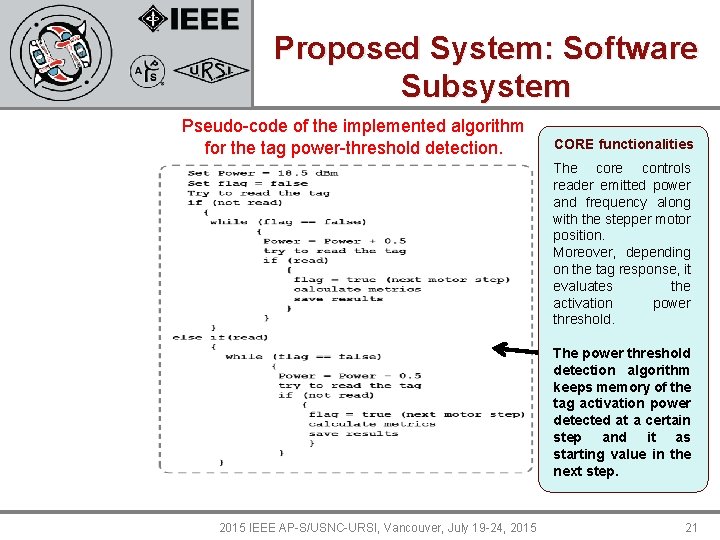
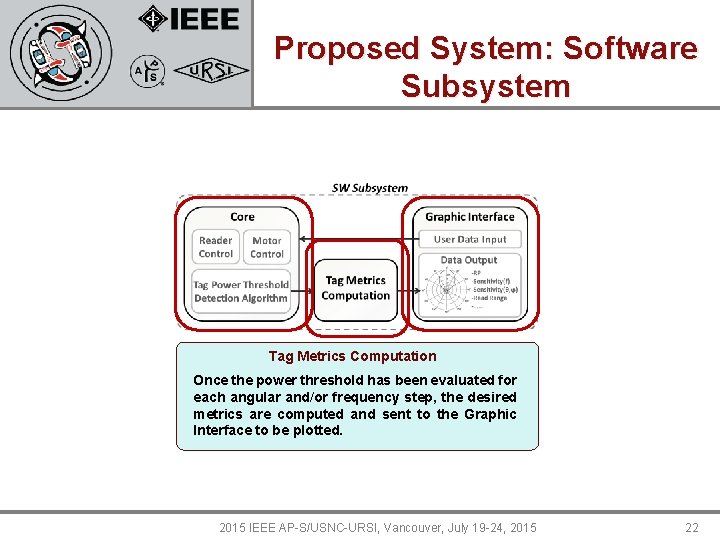
Proposed System: Software Subsystem Pseudo-code of the implemented algorithm for the tag power-threshold detection. CORE functionalities The core controls reader emitted power and frequency along with the stepper motor position. Moreover, depending on the tag response, it evaluates the activation power threshold. The power threshold detection algorithm keeps memory of the tag activation power detected at a certain step and it as starting value in the next step. 2015 IEEE AP-S/USNC-URSI, Vancouver, July 19 -24, 2015 21
Proposed System: Software Subsystem Tag Metrics Computation Once the power threshold has been evaluated for each angular and/or frequency step, the desired metrics are computed and sent to the Graphic Interface to be plotted. 2015 IEEE AP-S/USNC-URSI, Vancouver, July 19 -24, 2015 22
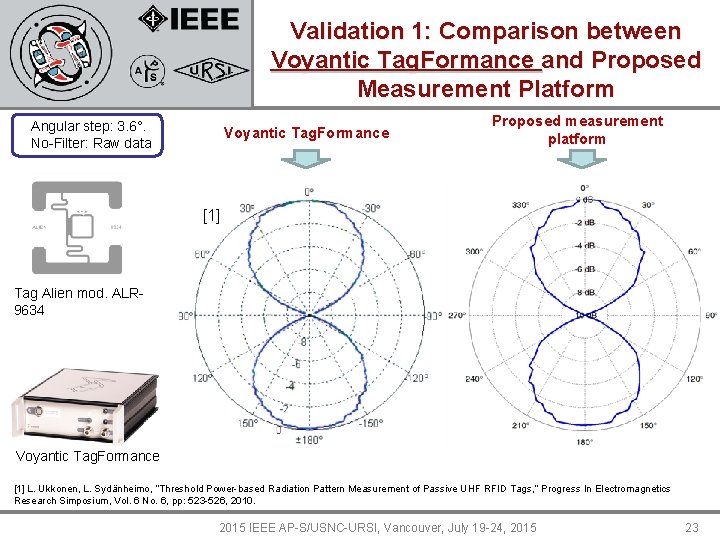
Validation 1: Comparison between Voyantic Tag. Formance and Proposed Measurement Platform Angular step: 3. 6°. No-Filter: Raw data Voyantic Tag. Formance Proposed measurement platform [1] Tag Alien mod. ALR 9634 Voyantic Tag. Formance [1] L. Ukkonen, L. Sydänheimo, “Threshold Power-based Radiation Pattern Measurement of Passive UHF RFID Tags, ” Progress In Electromagnetics Research Simposium, Vol. 6 No. 6, pp: 523 -526, 2010. 2015 IEEE AP-S/USNC-URSI, Vancouver, July 19 -24, 2015 23
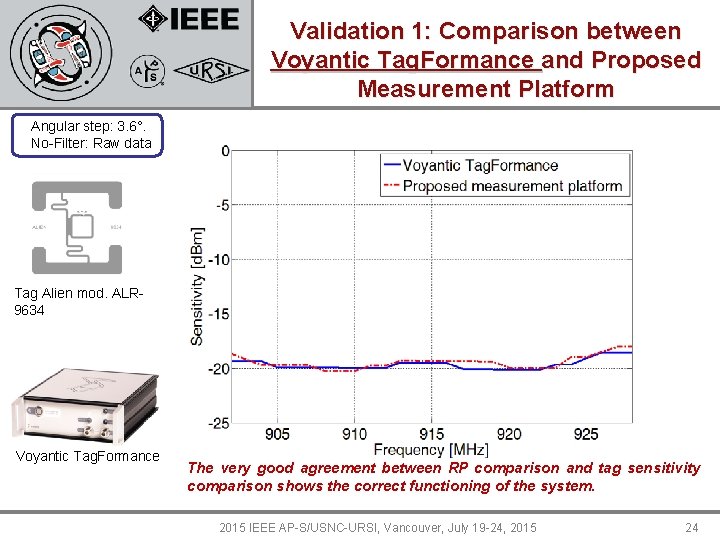
Validation 1: Comparison between Voyantic Tag. Formance and Proposed Measurement Platform Angular step: 3. 6°. No-Filter: Raw data Tag Alien mod. ALR 9634 Voyantic Tag. Formance The very good agreement between RP comparison and tag sensitivity comparison shows the correct functioning of the system. 2015 IEEE AP-S/USNC-URSI, Vancouver, July 19 -24, 2015 24
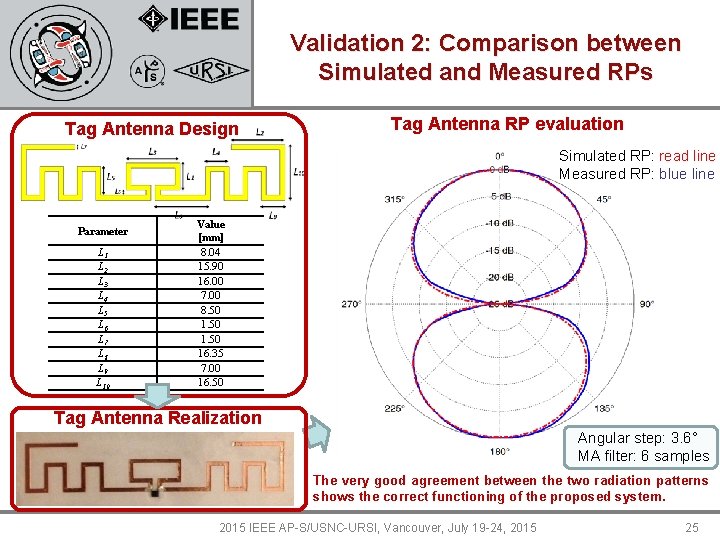
Validation 2: Comparison between Simulated and Measured RPs Tag Antenna Design Tag Antenna RP evaluation Simulated RP: read line Measured RP: blue line Parameter L 1 L 2 L 3 L 4 L 5 L 6 L 7 L 8 L 9 L 10 Value [mm] 8. 04 15. 90 16. 00 7. 00 8. 50 16. 35 7. 00 16. 50 Tag Antenna Realization Angular step: 3. 6° MA filter: 6 samples The very good agreement between the two radiation patterns shows the correct functioning of the proposed system. 2015 IEEE AP-S/USNC-URSI, Vancouver, July 19 -24, 2015 25
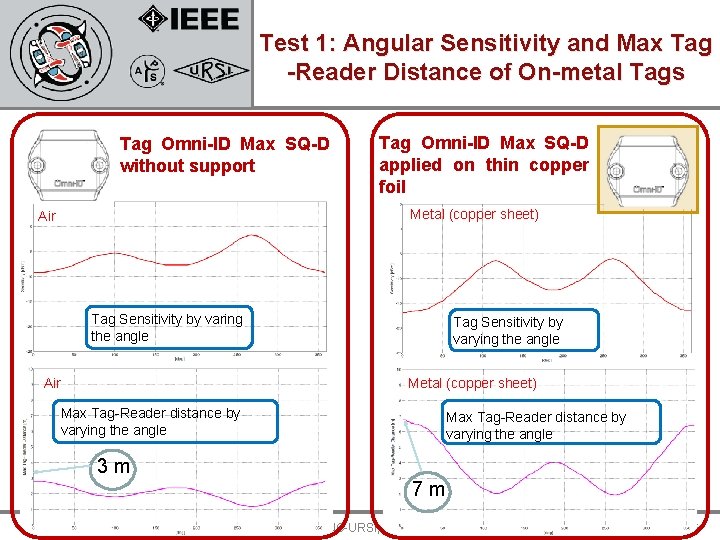
Test 1: Angular Sensitivity and Max Tag -Reader Distance of On-metal Tags Tag Omni-ID Max SQ-D without support Tag Omni-ID Max SQ-D applied on thin copper foil Metal (copper sheet) Air Tag Sensitivity by varing the angle Tag Sensitivity by varying the angle Metal (copper sheet) Air Max Tag-Reader distance by varying the angle 3 m 7 m 2015 IEEE AP-S/USNC-URSI, Vancouver, July 19 -24, 2015 26
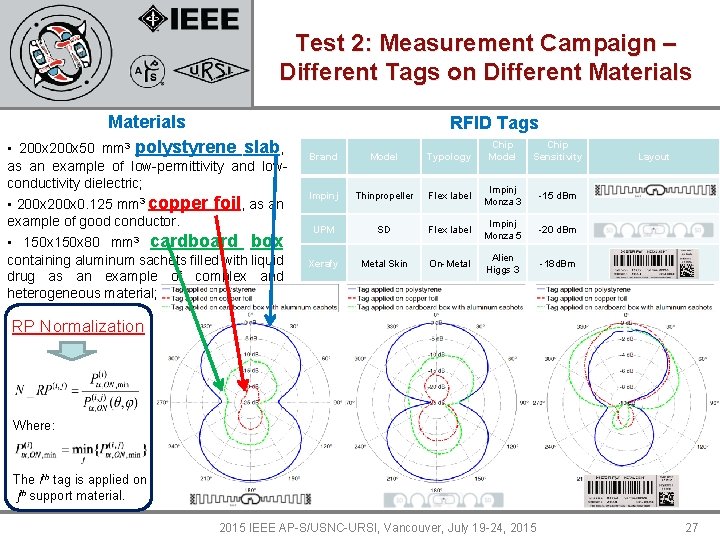
Test 2: Measurement Campaign – Different Tags on Different Materials mm 3 polystyrene slab, • 200 x 50 as an example of low-permittivity and lowconductivity dielectric; • 200 x 0. 125 mm 3 copper foil, as an example of good conductor. • 150 x 80 mm 3 cardboard box containing aluminum sachets filled with liquid drug as an example of complex and heterogeneous material; RFID Tags Chip Model Chip Sensitivity Flex label Impinj Monza 3 -15 d. Bm SD Flex label Impinj Monza 5 -20 d. Bm Metal Skin On-Metal Alien Higgs 3 -18 d. Bm Brand Model Typology Impinj Thinpropeller UPM Xerafy Layout RP Normalization Where: The ith tag is applied on jth support material. 2015 IEEE AP-S/USNC-URSI, Vancouver, July 19 -24, 2015 27
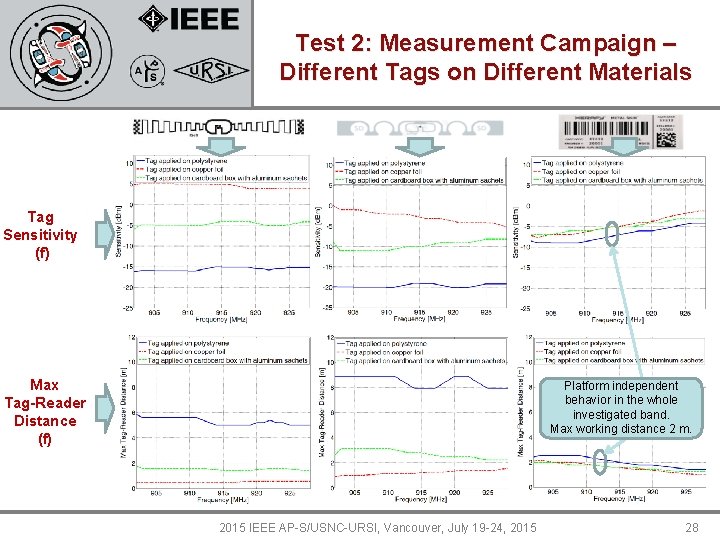
Test 2: Measurement Campaign – Different Tags on Different Materials Tag Sensitivity (f) Max Tag-Reader Distance (f) Platform independent behavior in the whole investigated band. Max working distance 2 m. 2015 IEEE AP-S/USNC-URSI, Vancouver, July 19 -24, 2015 28
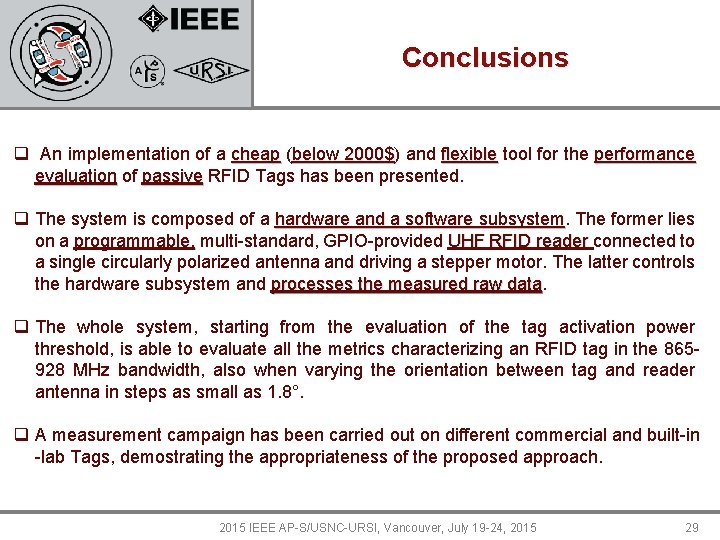
Conclusions q An implementation of a cheap (below 2000$) 2000$ and flexible tool for the performance evaluation of passive RFID Tags has been presented. q The system is composed of a hardware and a software subsystem The former lies on a programmable, multi-standard, GPIO-provided UHF RFID reader connected to a single circularly polarized antenna and driving a stepper motor. The latter controls the hardware subsystem and processes the measured raw data q The whole system, starting from the evaluation of the tag activation power threshold, is able to evaluate all the metrics characterizing an RFID tag in the 865928 MHz bandwidth, also when varying the orientation between tag and reader antenna in steps as small as 1. 8°. q A measurement campaign has been carried out on different commercial and built-in -lab Tags, demostrating the appropriateness of the proposed approach. 2015 IEEE AP-S/USNC-URSI, Vancouver, July 19 -24, 2015 29
Characterization System for Radiation Pattern and Sensitivity Estimation of UHF RFID Tags Riccardo Colella, Luca Catarinucci, Paolo Coppola, Luciano Tarricone luca. catarinucci@unisalento. it Thank you Innovation Engineering Department University of Salento - Lecce - Italy 30