
Characterization of the EarthMoonMars Radiation Environment during the
- Slides: 1
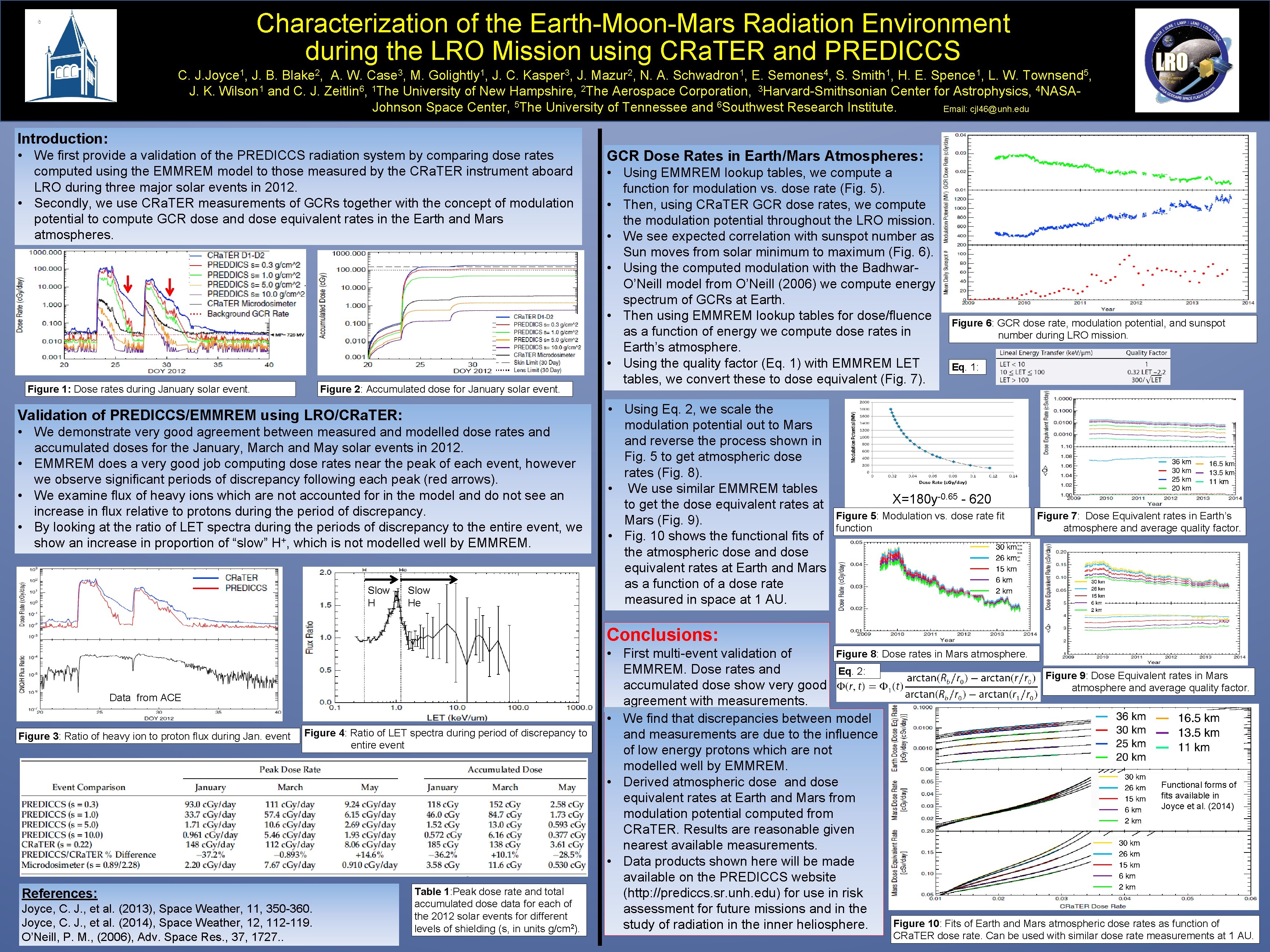
Characterization of the Earth-Moon-Mars Radiation Environment during the LRO Mission using CRa. TER and PREDICCS C. J. Joyce 1, J. B. Blake 2, A. W. Case 3, M. Golightly 1, J. C. Kasper 3, J. Mazur 2, N. A. Schwadron 1, E. Semones 4, S. Smith 1, H. E. Spence 1, L. W. Townsend 5, J. K. Wilson 1 and C. J. Zeitlin 6, 1 The University of New Hampshire, 2 The Aerospace Corporation, 3 Harvard-Smithsonian Center for Astrophysics, 4 NASAJohnson Space Center, 5 The University of Tennessee and 6 Southwest Research Institute. Email: cjl 46@unh. edu Introduction: • We first provide a validation of the PREDICCS radiation system by comparing dose rates computed using the EMMREM model to those measured by the CRa. TER instrument aboard LRO during three major solar events in 2012. • Secondly, we use CRa. TER measurements of GCRs together with the concept of modulation potential to compute GCR dose and dose equivalent rates in the Earth and Mars atmospheres. Figure 1: Dose rates during January solar event. Figure 2: Accumulated dose for January solar event. Validation of PREDICCS/EMMREM using LRO/CRa. TER: • We demonstrate very good agreement between measured and modelled dose rates and accumulated doses for the January, March and May solar events in 2012. • EMMREM does a very good job computing dose rates near the peak of each event, however we observe significant periods of discrepancy following each peak (red arrows). • We examine flux of heavy ions which are not accounted for in the model and do not see an increase in flux relative to protons during the period of discrepancy. • By looking at the ratio of LET spectra during the periods of discrepancy to the entire event, we show an increase in proportion of “slow” H+, which is not modelled well by EMMREM. Slow He GCR Dose Rates in Earth/Mars Atmospheres: • Using EMMREM lookup tables, we compute a function for modulation vs. dose rate (Fig. 5). • Then, using CRa. TER GCR dose rates, we compute the modulation potential throughout the LRO mission. • We see expected correlation with sunspot number as Sun moves from solar minimum to maximum (Fig. 6). • Using the computed modulation with the Badhwar. O’Neill model from O’Neill (2006) we compute energy spectrum of GCRs at Earth. • Then using EMMREM lookup tables for dose/fluence as a function of energy we compute dose rates in Earth’s atmosphere. • Using the quality factor (Eq. 1) with EMMREM LET tables, we convert these to dose equivalent (Fig. 7). • Using Eq. 2, we scale the modulation potential out to Mars and reverse the process shown in Fig. 5 to get atmospheric dose rates (Fig. 8). • We use similar EMMREM tables to get the dose equivalent rates at Mars (Fig. 9). • Fig. 10 shows the functional fits of the atmospheric dose and dose equivalent rates at Earth and Mars as a function of a dose rate measured in space at 1 AU. Figure 6: GCR dose rate, modulation potential, and sunspot number during LRO mission. Eq. 1: X=180 y-0. 65 - 620 Figure 5: Modulation vs. dose rate fit function Figure 7: Dose Equivalent rates in Earth’s atmosphere and average quality factor. Conclusions: Data from ACE Figure 3: Ratio of heavy ion to proton flux during Jan. event Figure 4: Ratio of LET spectra during period of discrepancy to entire event References: Joyce, C. J. , et al. (2013), Space Weather, 11, 350 -360. Joyce, C. J. , et al. (2014), Space Weather, 12, 112 -119. O’Neill, P. M. , (2006), Adv. Space Res. , 37, 1727. . Table 1: Peak dose rate and total accumulated dose data for each of the 2012 solar events for different levels of shielding (s, in units g/cm 2). Figure 8: Dose rates in Mars atmosphere. • First multi-event validation of EMMREM. Dose rates and Eq. 2: Figure 9: Dose Equivalent rates in Mars accumulated dose show very good atmosphere and average quality factor. agreement with measurements. • We find that discrepancies between model and measurements are due to the influence of low energy protons which are not modelled well by EMMREM. • Derived atmospheric dose and dose Functional forms of fits available in equivalent rates at Earth and Mars from Joyce et al. (2014) modulation potential computed from CRa. TER. Results are reasonable given nearest available measurements. • Data products shown here will be made available on the PREDICCS website (http: //prediccs. sr. unh. edu) for use in risk assessment for future missions and in the Figure 10: Fits of Earth and Mars atmospheric dose rates as function of study of radiation in the inner heliosphere. CRa. TER dose rate. Can be used with similar dose rate measurements at 1 AU.