
Characterization of 3 G ControlPlane Signaling Overhead from
- Slides: 22
Characterization of 3 G Control-Plane Signaling Overhead from a Data-Plane Perspective Li Qian 1, Edmond W. W. Chan 1, Patrick P. C. Lee 2 and Cheng He 1 1 Noah’s Ark Lab, Huawei Research, China 2 The Chinese University of Hong Kong, Hong Kong 1
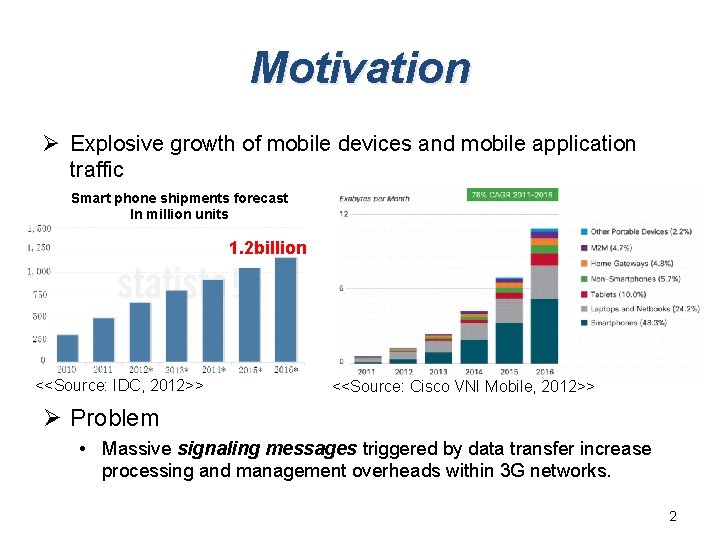
Motivation Ø Explosive growth of mobile devices and mobile application traffic Smart phone shipments forecast In million units 1. 2 billion <<Source: IDC, 2012>> <<Source: Cisco VNI Mobile, 2012>> Ø Problem • Massive signaling messages triggered by data transfer increase processing and management overheads within 3 G networks. 2
Our Work Goal: To characterize 3 G control-plane signaling overhead due to initiation/release of radio resources with only raw IP data packets Ø Contributions: • Using national 3 G network traces/logs to validate a data-plane approach for control-plane signaling overhead inference • First extensive measurement study of signaling loads induced by different transport protocols and network applications 3
Related Work Ø Measurement studies of 3 G network • Round-trip times of TCP flow data (GPRS/UMTS network) [Kilpi_Networking 2006] • Compare similarity and difference with wireline data traffic (CDMA 2000) [Ridoux_INFOCOMM 2006] • TCP performance and traffic anomalies (GPRS/UMTS network) [Ricciato_Co. Next 2005] [Alconze_Globecom 2009] Ø Control-plane performance of 3 G network • Signaling overhead from security perspective [Lee_computer networks 2009] • Infer RRC state transition from data-plane TCP traffic to quantify energy consumption [Qian_IMC 2010] [Qian_ICNP 2010] and application resource usage [Qian_Mobysis 2011] 4
Related Work Ø Data traffic behavior of different types of devices • Compare handheld and non-handheld devices in campus Wi. Fi network [Gember_PAM 2011] • Study smart phone traffic and differences of user behaviors based traces of individual devices [Falaki_IMC 2010] • 3 GTest, a tool generate probe traffic to measure the 3 G network performance [Huang_Mobi. Sys 2011] • Study of data/control-plane performance of different mobile terminals [He_Networking 2012] 5
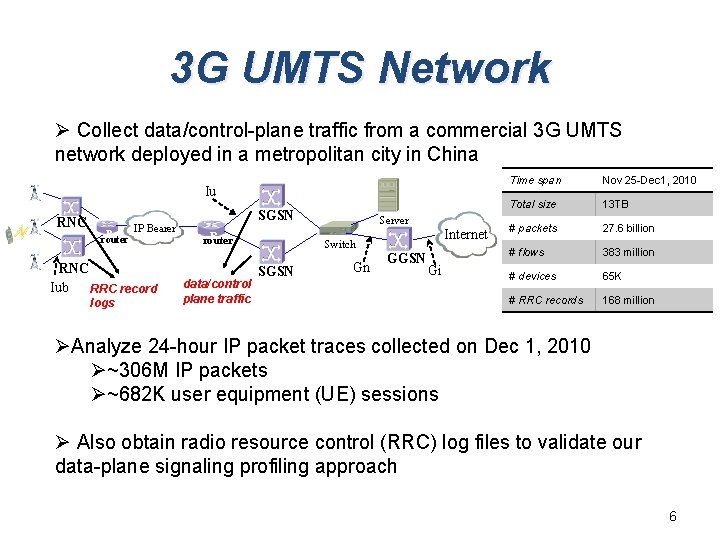
3 G UMTS Network Ø Collect data/control-plane traffic from a commercial 3 G UMTS network deployed in a metropolitan city in China Iu RNC IP Bearer R router RNC Iub RRC record logs SGSN R router data/control plane traffic Server Switch SGSN Gn Internet GGSN Gi Time span Nov 25 -Dec 1, 2010 Total size 13 TB # packets 27. 6 billion # flows 383 million # devices 65 K # RRC records 168 million ØAnalyze 24 -hour IP packet traces collected on Dec 1, 2010 Ø~306 M IP packets Ø~682 K user equipment (UE) sessions Ø Also obtain radio resource control (RRC) log files to validate our data-plane signaling profiling approach 6
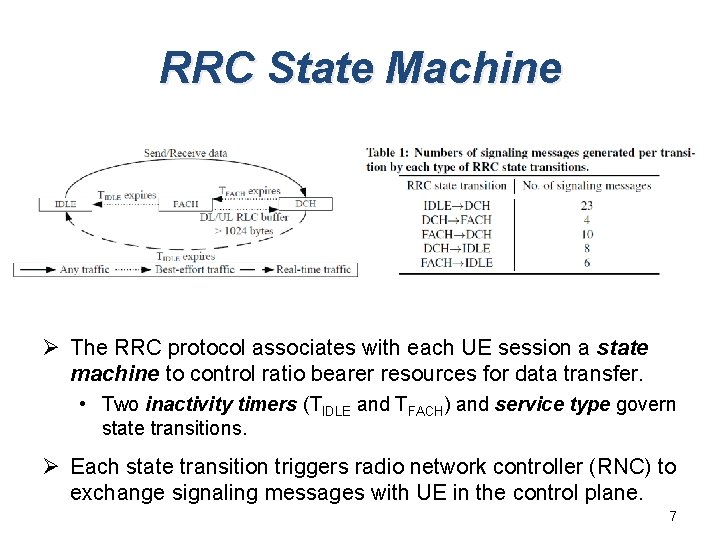
RRC State Machine Ø The RRC protocol associates with each UE session a state machine to control ratio bearer resources for data transfer. • Two inactivity timers (TIDLE and TFACH) and service type govern state transitions. Ø Each state transition triggers radio network controller (RNC) to exchange signaling messages with UE in the control plane. 7
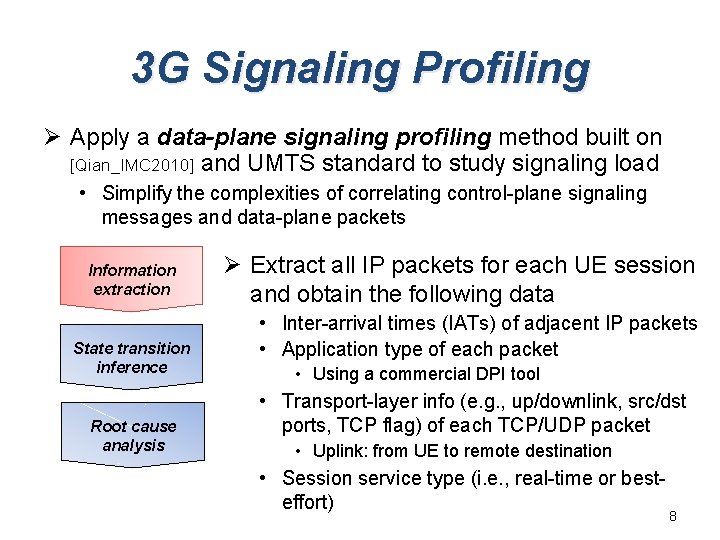
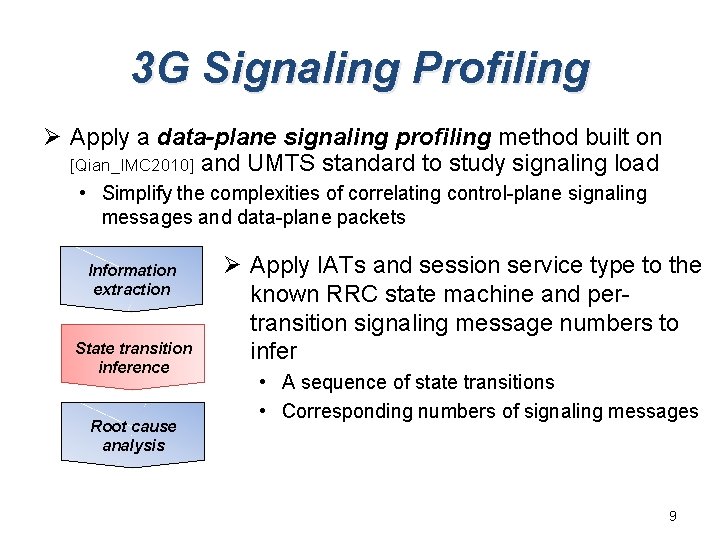
3 G Signaling Profiling Ø Apply a data-plane signaling profiling method built on [Qian_IMC 2010] and UMTS standard to study signaling load • Simplify the complexities of correlating control-plane signaling messages and data-plane packets … Information extraction … State transition inference … Root cause analysis Ø Extract all IP packets for each UE session and obtain the following data • Inter-arrival times (IATs) of adjacent IP packets • Application type of each packet • Using a commercial DPI tool • Transport-layer info (e. g. , up/downlink, src/dst ports, TCP flag) of each TCP/UDP packet • Uplink: from UE to remote destination • Session service type (i. e. , real-time or besteffort) 8
3 G Signaling Profiling Ø Apply a data-plane signaling profiling method built on [Qian_IMC 2010] and UMTS standard to study signaling load • Simplify the complexities of correlating control-plane signaling messages and data-plane packets … Information extraction … State transition inference • A sequence of state transitions • Corresponding numbers of signaling messages … Root cause analysis Ø Apply IATs and session service type to the known RRC state machine and pertransition signaling message numbers to infer 9
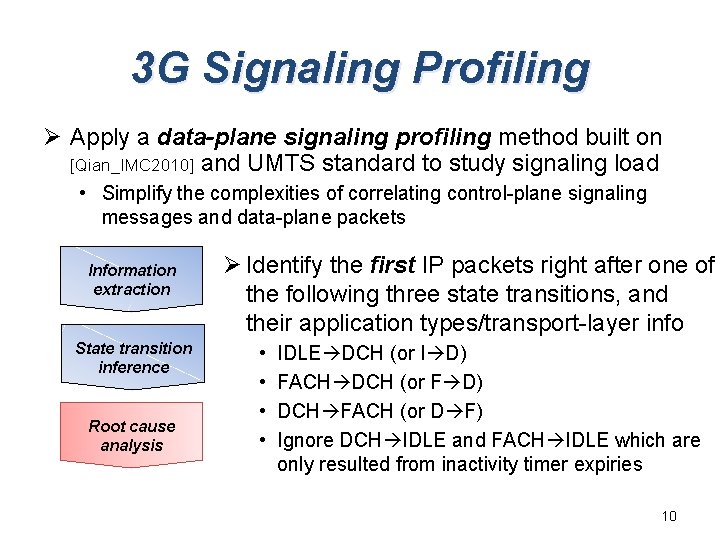
3 G Signaling Profiling Ø Apply a data-plane signaling profiling method built on [Qian_IMC 2010] and UMTS standard to study signaling load • Simplify the complexities of correlating control-plane signaling messages and data-plane packets … Information extraction … State transition inference … Root cause analysis Ø Identify the first IP packets right after one of the following three state transitions, and their application types/transport-layer info • • IDLE DCH (or I D) FACH DCH (or F D) DCH FACH (or D F) Ignore DCH IDLE and FACH IDLE which are only resulted from inactivity timer expiries 10
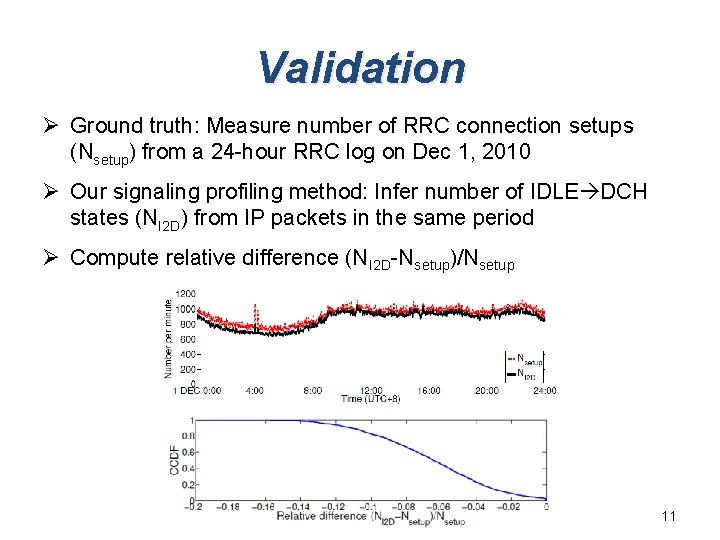
Validation Ø Ground truth: Measure number of RRC connection setups (Nsetup) from a 24 -hour RRC log on Dec 1, 2010 Ø Our signaling profiling method: Infer number of IDLE DCH states (NI 2 D) from IP packets in the same period Ø Compute relative difference (NI 2 D-Nsetup)/Nsetup 11
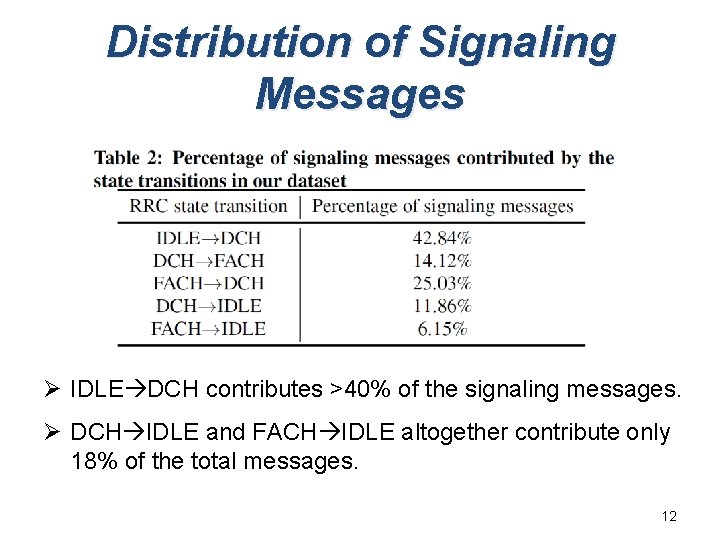
Distribution of Signaling Messages Ø IDLE DCH contributes >40% of the signaling messages. Ø DCH IDLE and FACH IDLE altogether contribute only 18% of the total messages. 12
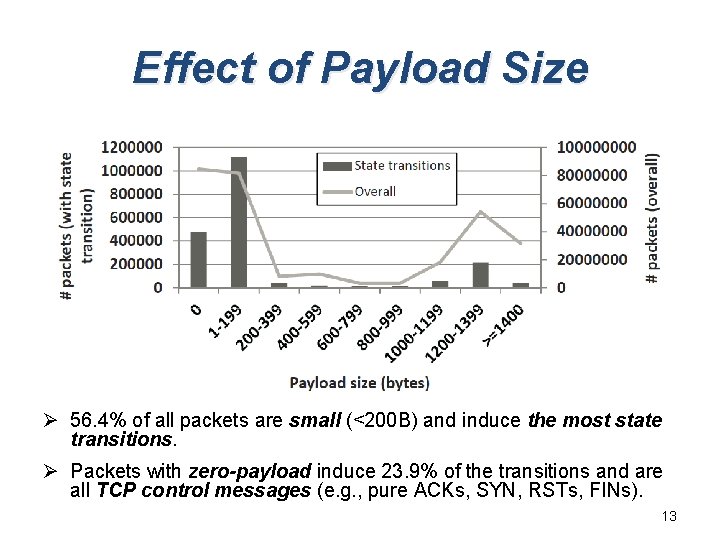
Effect of Payload Size Ø 56. 4% of all packets are small (<200 B) and induce the most state transitions. Ø Packets with zero-payload induce 23. 9% of the transitions and are all TCP control messages (e. g. , pure ACKs, SYN, RSTs, FINs). 13
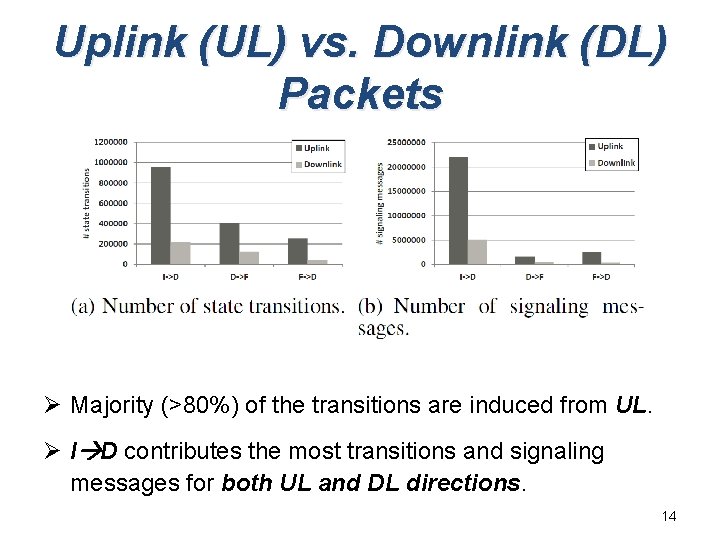
Uplink (UL) vs. Downlink (DL) Packets Ø Majority (>80%) of the transitions are induced from UL. Ø I D contributes the most transitions and signaling messages for both UL and DL directions. 14
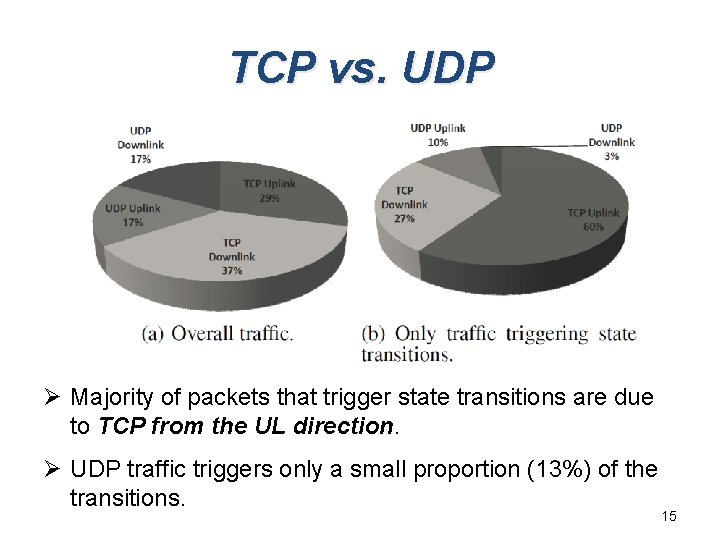
TCP vs. UDP Ø Majority of packets that trigger state transitions are due to TCP from the UL direction. Ø UDP traffic triggers only a small proportion (13%) of the transitions. 15
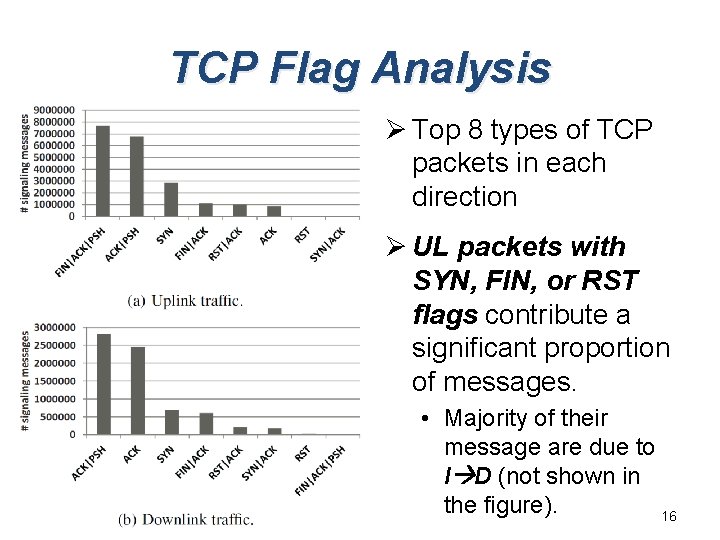
TCP Flag Analysis Ø Top 8 types of TCP packets in each direction Ø UL packets with SYN, FIN, or RST flags contribute a significant proportion of messages. • Majority of their message are due to I D (not shown in the figure). 16
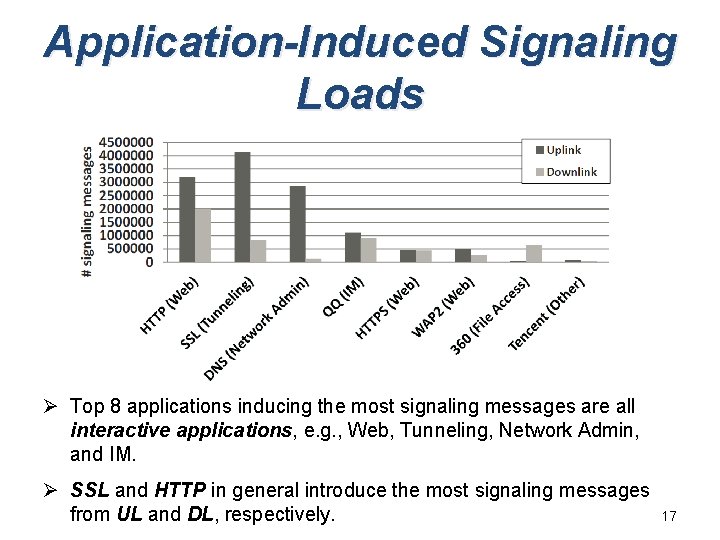
Application-Induced Signaling Loads Ø Top 8 applications inducing the most signaling messages are all interactive applications, e. g. , Web, Tunneling, Network Admin, and IM. Ø SSL and HTTP in general introduce the most signaling messages from UL and DL, respectively. 17
Signaling-prone vs. Signalingaverse Applications Ø Define signaling density Φ=Ntrans/Npackets of each application • Ntrans: Total # of induced transitions • Npackets: Total # of packets Ø Signaling-prone applications: large Φ Ø Signaling-averse applications: small Φ 18
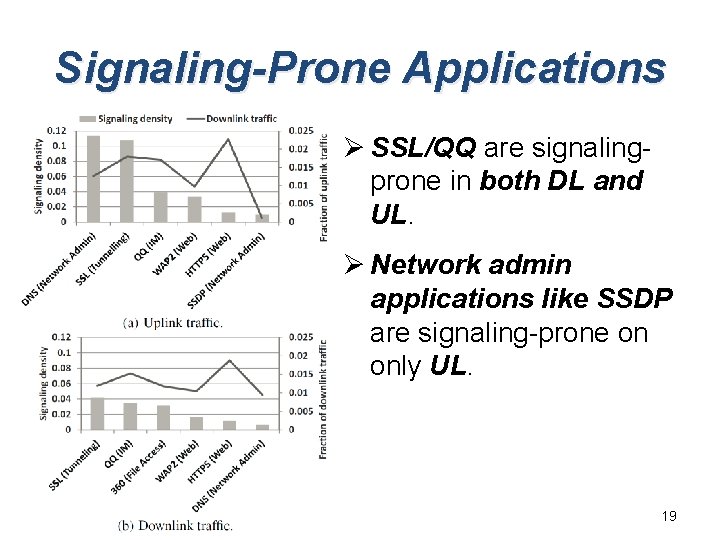
Signaling-Prone Applications Ø SSL/QQ are signalingprone in both DL and UL. Ø Network admin applications like SSDP are signaling-prone on only UL. 19
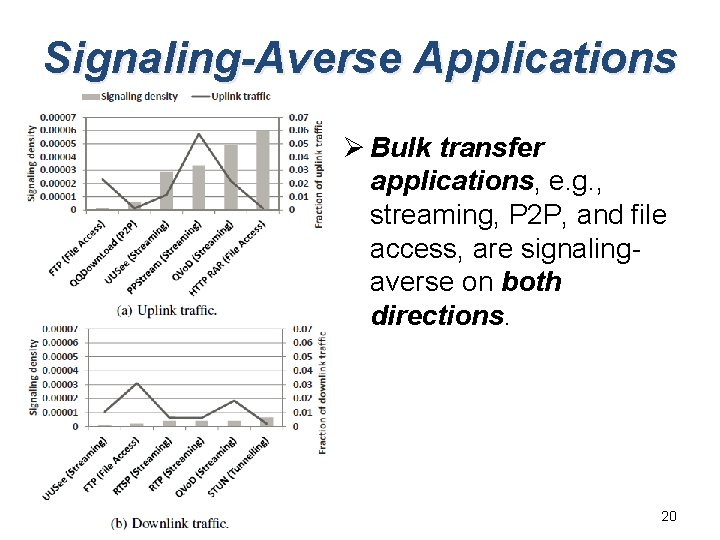
Signaling-Averse Applications Ø Bulk transfer applications, e. g. , streaming, P 2 P, and file access, are signalingaverse on both directions. 20
Conclusions Ø Show that the pure data-plane signaling profiling approach can accurately infer state transitions due to RRC connection setups Ø Conduct the first comprehensive measurement in a citywide 3 G network to study the impact of raw data packets, transport protocols, and network applications on signaling loads Ø Observe that most signaling messages are attributed to I D • Possible solution: apply protocol/application-specific inactivity timers to avoid spurious RRC connection re-establishments 21
Q&A Ø Thanks for your time 22