
Characteristics People with Tourettes make involuntary movements or

- Slides: 20
Characteristics �People with Tourette’s make involuntary movements or noises. These are called tics. �Simple Tics: sudden, brief, repetitive movements that involve a limited number of muscle groups �Complex Tics: distinct, coordinated patterns of movements involving several muscle groups �Vocal Tics: noises that a person makes with their voice �Motor Tics: tics involving movement of the body
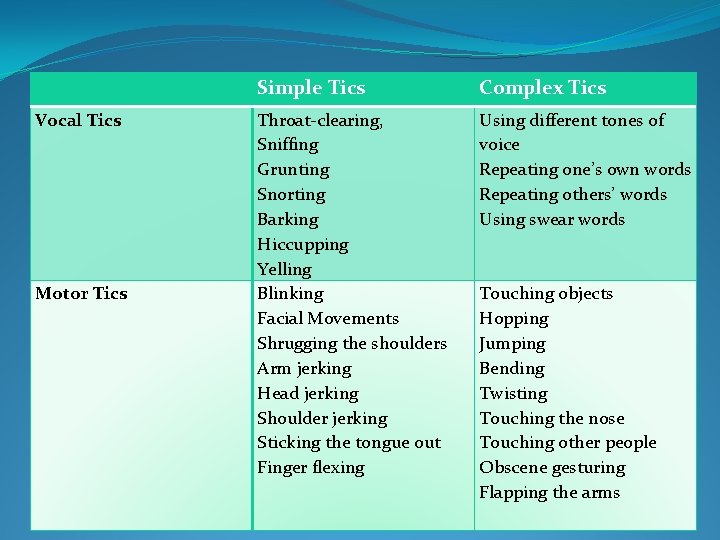
Simple Tics Complex Tics Vocal Tics Throat-clearing, Sniffing Grunting Snorting Barking Hiccupping Yelling Blinking Facial Movements Shrugging the shoulders Arm jerking Head jerking Shoulder jerking Sticking the tongue out Finger flexing Using different tones of voice Repeating one’s own words Repeating others’ words Using swear words Motor Tics Touching objects Hopping Jumping Bending Twisting Touching the nose Touching other people Obscene gesturing Flapping the arms
Serious Tics: �Coprolalia: uttering socially inappropriate words such as swearing �Echolalia: repeating the words or phrases of others �Self-harming tics: scratching oneself, punching oneself, hitting one’s head on hard objects.
Things to keep in mind �No case is typical. �Tics can change over time. �Tics can worsen and get better over time. �Often worst during adolescence. �Certain things can worsen tics. �Stress, anxiety, excitement, shirts with tight collars, hearing someone else cough or clear their throat.
Holding in Tics �Tics are often preceded by a premonitory urge. �Trying not to tic: �Can feel like holding your breath �Trying not to hiccup �Trying not to blink
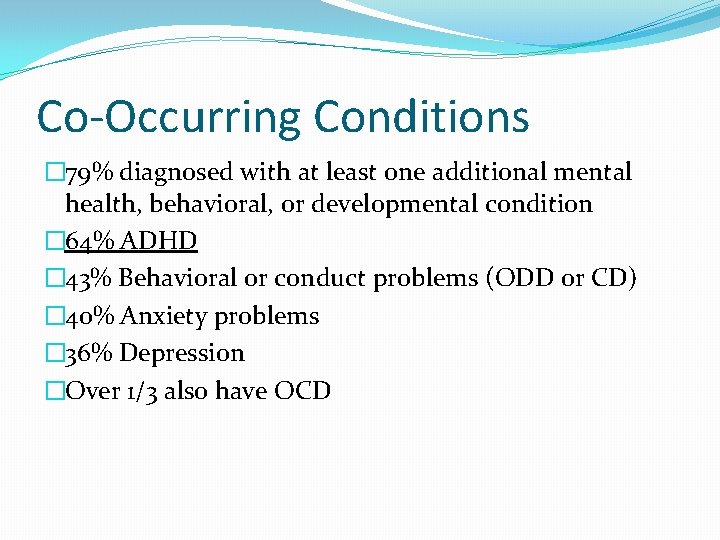
Co-Occurring Conditions � 79% diagnosed with at least one additional mental health, behavioral, or developmental condition � 64% ADHD � 43% Behavioral or conduct problems (ODD or CD) � 40% Anxiety problems � 36% Depression �Over 1/3 also have OCD
Causes �No one knows. �It is thought to be genetic. �Genes may just increase susceptibility for the disorder. �Monozygotic twins show a 50 -70% concordance. �Dizygotic twins show a 9% concordance. �Some studied noted abnormal frontal lobe discharges.
Prevalence �Tourette’s affects all racial and ethnic groups. �Males are affected 3 times more than females. �More common in children. �Tourette’s often decreases or goes away with age.
How is Tourette’s Diagnosed �Diagnosis is fairly subjective. �Patients must have a case history of at least 1 year. �Facial tics are usually the first ones displayed. �Patients explain and show doctors their tics, and the doctor diagnoses them with Tourette’s.
1825 – First Recorded Case Jean – Marc Gaspard Itard (1774 – 1838), perhaps most remembered for his work with the ‘Wild Child of Aveyron’, noted the characteristics of Marquise de Dampierre.
Marquise de Dampierre � 26 years of age �Noble, intelligent young lady �“In the midst of a conversation that interests her extremely, all of a sudden, without being able to prevent it, she interrupts what she is saying or what she is listening to with bizarre shouts and with words that are even more extraordinary and which make a deplorable contrast with her intellect and distinguished manner. ”
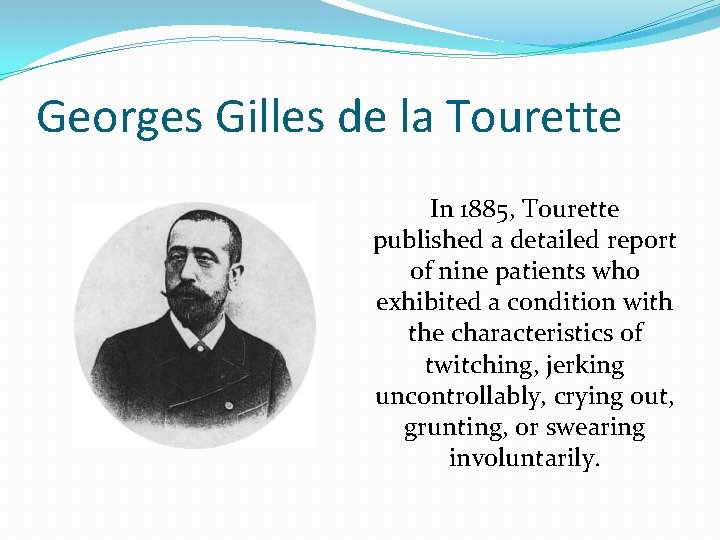
Georges Gilles de la Tourette In 1885, Tourette published a detailed report of nine patients who exhibited a condition with the characteristics of twitching, jerking uncontrollably, crying out, grunting, or swearing involuntarily.
�Tourette argued in his report that it was distinct from other known diseases and disorders of the time. �Cited first example as Marquise de Dampierre. �Because a set of signs and symptoms, a course of illness, and a predisposing cause had been identified, Tourette argued that a disease had been described. �This was challenged by Parisian colleagues.
Early th 20 Century �The psychoanalytic influence on Tourette’s was that it was a psychiatric problem. �Patients and families were often told that their own psychological maladjustments were to blame for their treatments. �Tics were attributed to sexual impulses and/or conflict between parent and child, resulting in deficits of will and character.
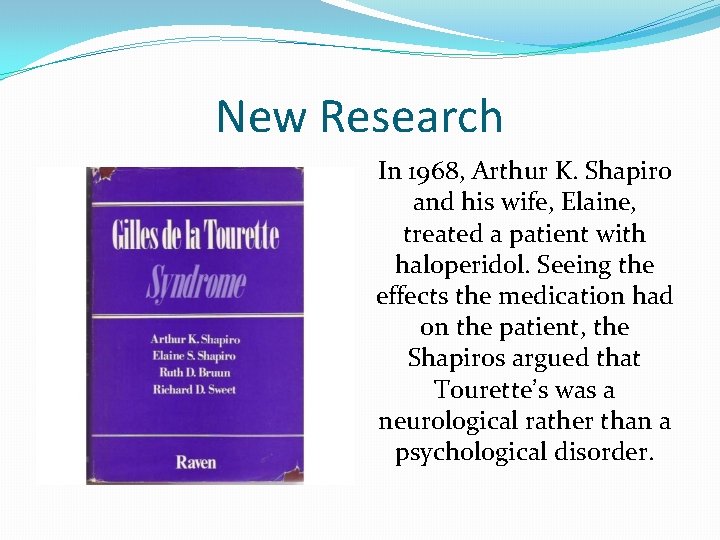
New Research In 1968, Arthur K. Shapiro and his wife, Elaine, treated a patient with haloperidol. Seeing the effects the medication had on the patient, the Shapiros argued that Tourette’s was a neurological rather than a psychological disorder.
Today �Tic disorders are considered to be an inherited neuropsychiatric disorder. �There are many places in which individuals with Tourette’s can receive treatment and support.
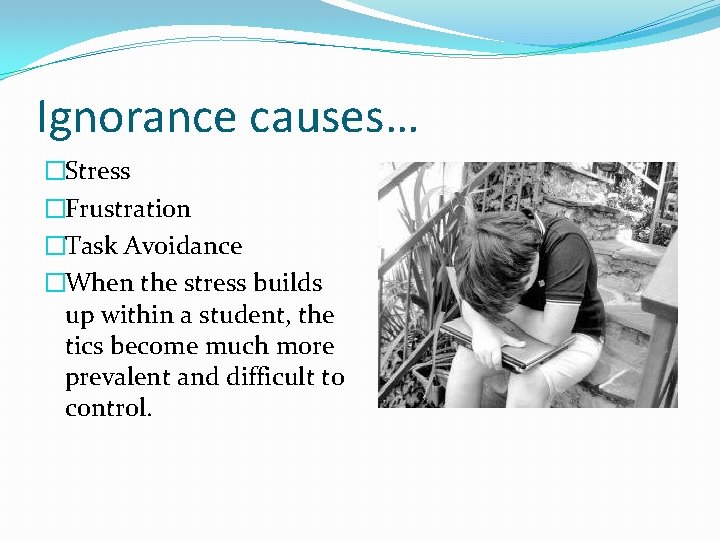
Ignorance causes… �Stress �Frustration �Task Avoidance �When the stress builds up within a student, the tics become much more prevalent and difficult to control.
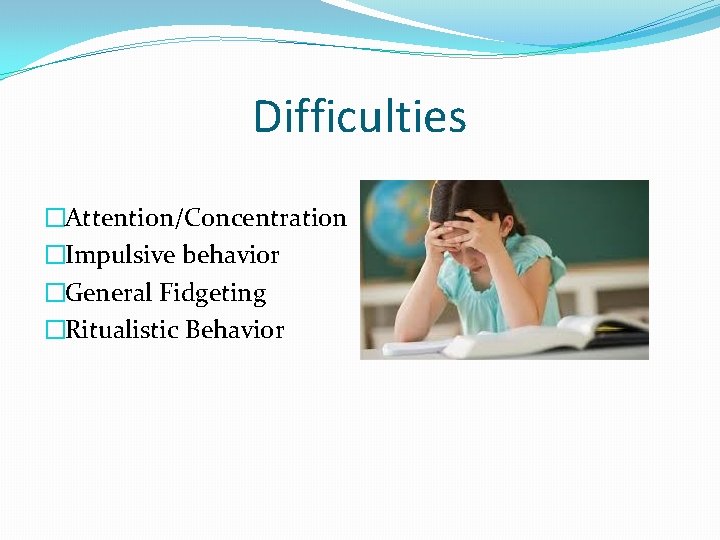
Difficulties �Attention/Concentration �Impulsive behavior �General Fidgeting �Ritualistic Behavior
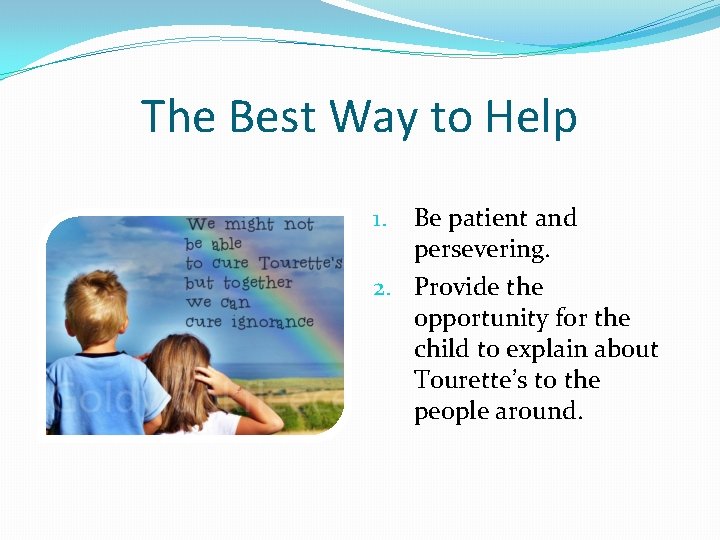
The Best Way to Help Be patient and persevering. 2. Provide the opportunity for the child to explain about Tourette’s to the people around. 1.