
CHARACTERISTICS OF THE WIRELESS CHANNEL CHARACTERISTICS PATH LOSS
- Slides: 9
CHARACTERISTICS OF THE WIRELESS CHANNEL CHARACTERISTICS Ø PATH LOSS Ø FADING Ø INTERFERENCE Ø DOPPLER SHIFT TWO KEY CONSTRAINTS Ø NYQUIST'S THEOREMS Ø SHANNON'S THEOREMS
Path loss � Ratio of the power of the transmitted signal to the power of the same signal received by the receiver � Estimation of path loss is very important � Path loss is dependent on a number of factors radio frequency used nature of the terrain � several models are required to describe the variety of transmission environments
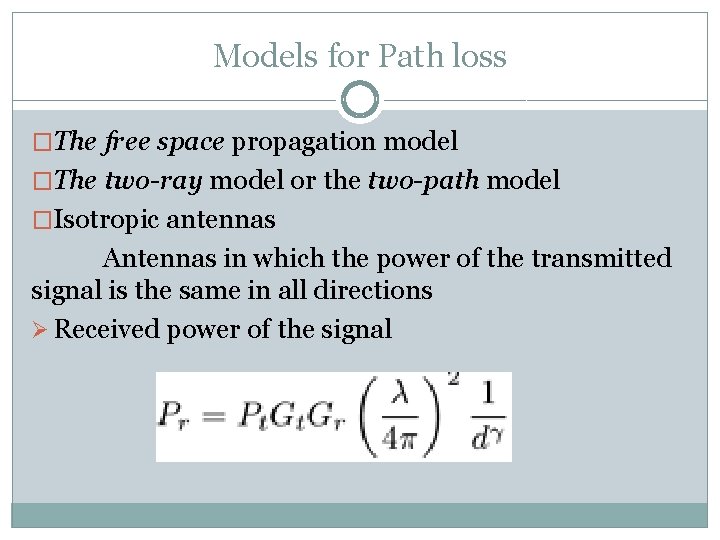
Models for Path loss �The free space propagation model �The two-ray model or the two-path model �Isotropic antennas Antennas in which the power of the transmitted signal is the same in all directions Ø Received power of the signal
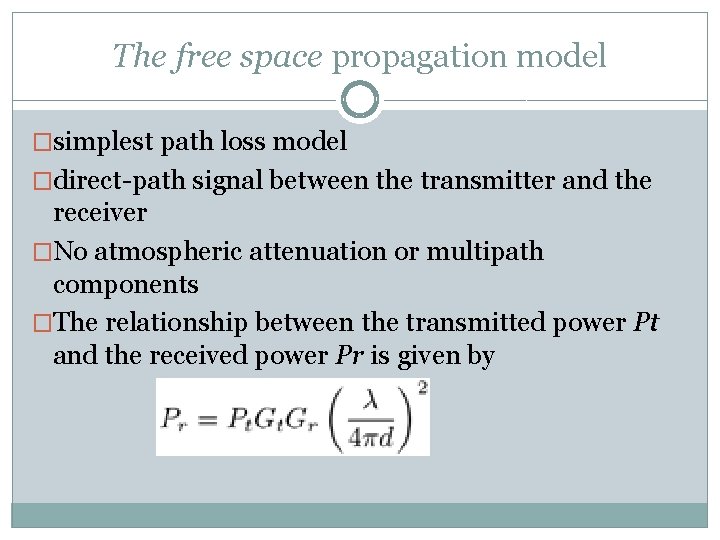
The free space propagation model �simplest path loss model �direct-path signal between the transmitter and the receiver �No atmospheric attenuation or multipath components �The relationship between the transmitted power Pt and the received power Pr is given by
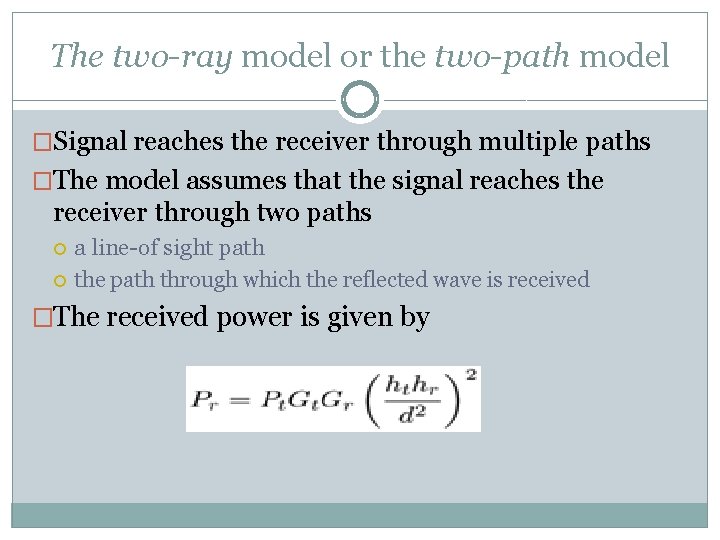
The two-ray model or the two-path model �Signal reaches the receiver through multiple paths �The model assumes that the signal reaches the receiver through two paths a line-of sight path the path through which the reflected wave is received �The received power is given by
Fading �The fluctuations in signal strength when received at the receiver �Two Types fast fading/small-scale fading � The rapid fluctuations in the amplitude, phase, or multipath delays of the received signal Slow fading/large-scale fading � occurs when objects that partially absorb the transmissions lie between the transmitter and receiver
Interference �adjacent channel interference �co-channel interference �Inter-symbol interference
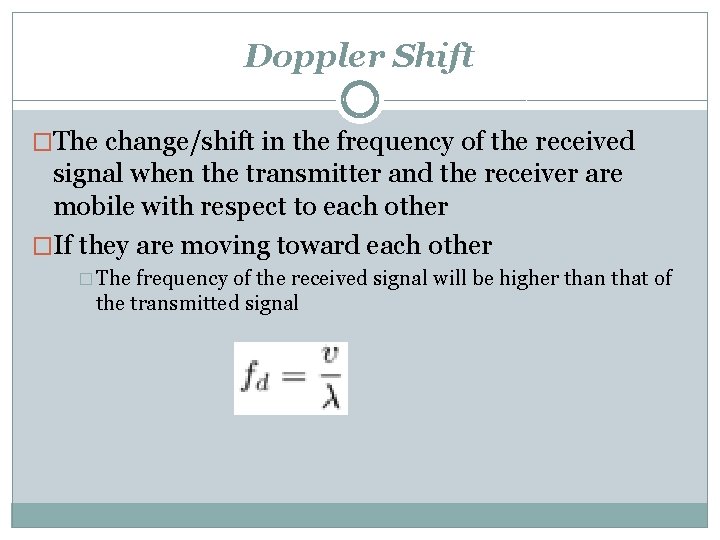
Doppler Shift �The change/shift in the frequency of the received signal when the transmitter and the receiver are mobile with respect to each other �If they are moving toward each other � The frequency of the received signal will be higher than that of the transmitted signal
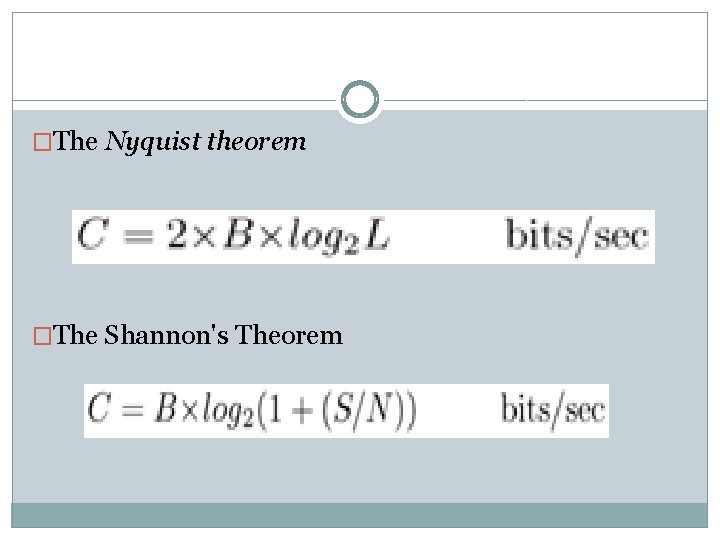
�The Nyquist theorem �The Shannon's Theorem