
Characteristics of Organisational Structure By Laura Mackay Tall
Characteristics of Organisational Structure By Laura Mackay

Tall A tall organisational structure consists of many levels of management and teams. There is a very long chain of command, normally not exceeding 8 levels. This goes from the top of the organisation with the Chief Executive all the way down to the bottom of the organisation with the Shop Workers. Advantages of a tall structure is that there is a clear management structure and the function at each level has clear responsibility and control. There is a clear progression ladder. Disadvantages of a tall structure is that because there is so many levels, it may be hard and take its time for decisions to be made. Good communication may suffer as there are many levels of management to keep going through.
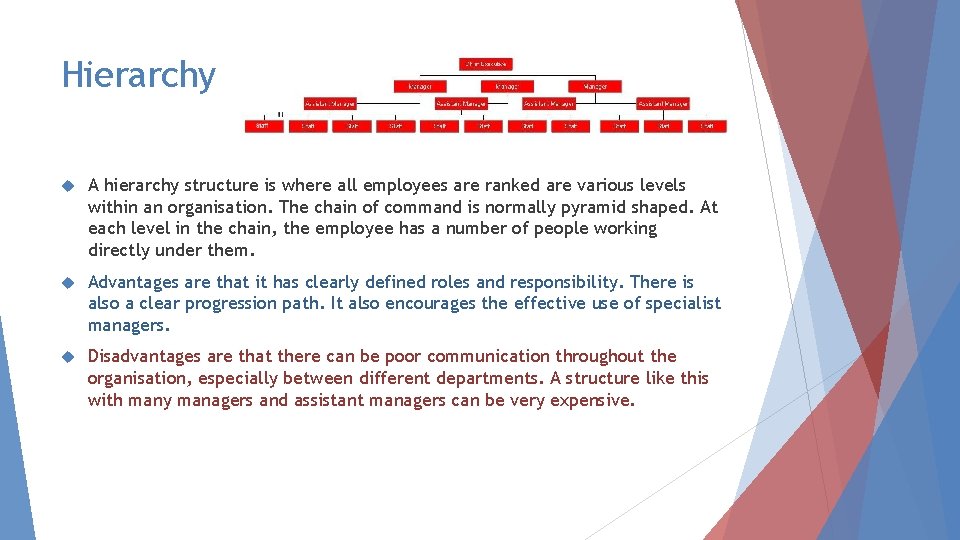
Hierarchy A hierarchy structure is where all employees are ranked are various levels within an organisation. The chain of command is normally pyramid shaped. At each level in the chain, the employee has a number of people working directly under them. Advantages are that it has clearly defined roles and responsibility. There is also a clear progression path. It also encourages the effective use of specialist managers. Disadvantages are that there can be poor communication throughout the organisation, especially between different departments. A structure like this with many managers and assistant managers can be very expensive.
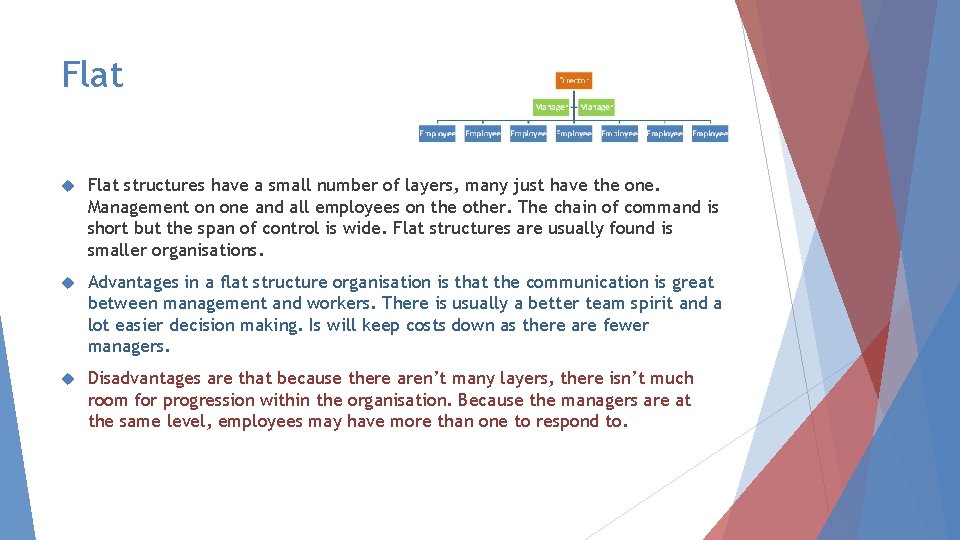
Flat structures have a small number of layers, many just have the one. Management on one and all employees on the other. The chain of command is short but the span of control is wide. Flat structures are usually found is smaller organisations. Advantages in a flat structure organisation is that the communication is great between management and workers. There is usually a better team spirit and a lot easier decision making. Is will keep costs down as there are fewer managers. Disadvantages are that because there aren’t many layers, there isn’t much room for progression within the organisation. Because the managers are at the same level, employees may have more than one to respond to.

Centralised In a centralised structure, head office will usually retain majority of the power and responsibility. It keeps all the decision making firmly at the top. Advantages are that decisions made will benefit the company as a whole and they will be made by experienced management. Having a strong leadership is often best implemented within a centralised organisation. It can be easier to control and co-ordinate from the centre. Disadvantages is that because of reduced manager authority, it can reduce motivation levels.
Decentralised structure will spread their responsibility and power amongst various outlets – lower level managers, including branches or units not within head office. Advantages to a decentralised structure is that senior managers can concentrate on more important decisions whilst delegating less important decisions to people down the organisational structure. Lower level managers may be empowered and this will increase motivation within the workplace. Disadvantages is that it will not be as consistent as different branches may follow different practices and policies. It is also harder to achieve a tighter financial control and risk of going over budget.
Entrepreneurial Structure An entrepreneurial structure would be most commonly found in sole traders that have just a few employees. Workers have little to no say in the decisionmaking process. An advantage of entrepreneurial structure is how quickly the decision-making process is. It is also one of the least expensive structures because it does not have any middle layers of management. Disadvantages are that if the business grows bigger, there may be too many decisions for one person to make. They may not also know much about the problem as they think they do, someone else with more experience would be suited.
- Slides: 7