
Characteristics of Muscles Muscle cells are elongated muscle
- Slides: 52
Characteristics of Muscles • Muscle cells are elongated (muscle cell = muscle fiber) • Contraction of muscles is due to the movement of microfilaments • All muscles share some terminology – Prefix myo refers to muscle (myocardial) – Prefix mys refers to muscle (myastenia gravis) – Prefix sarco refers to flesh (sarcolema)
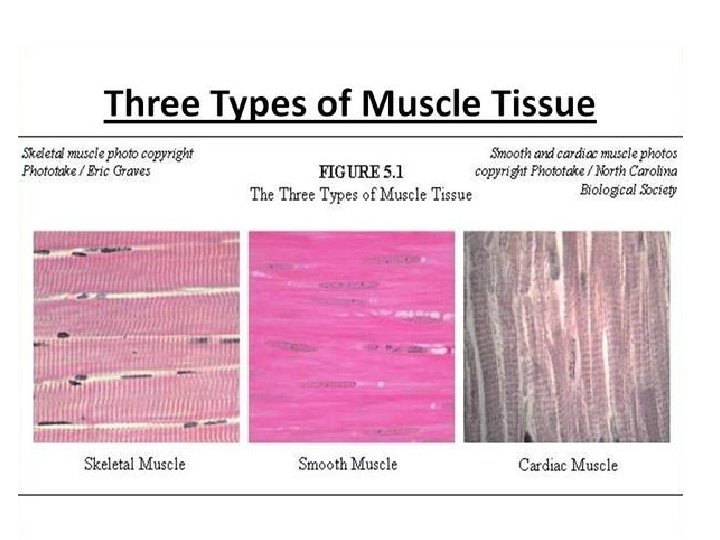
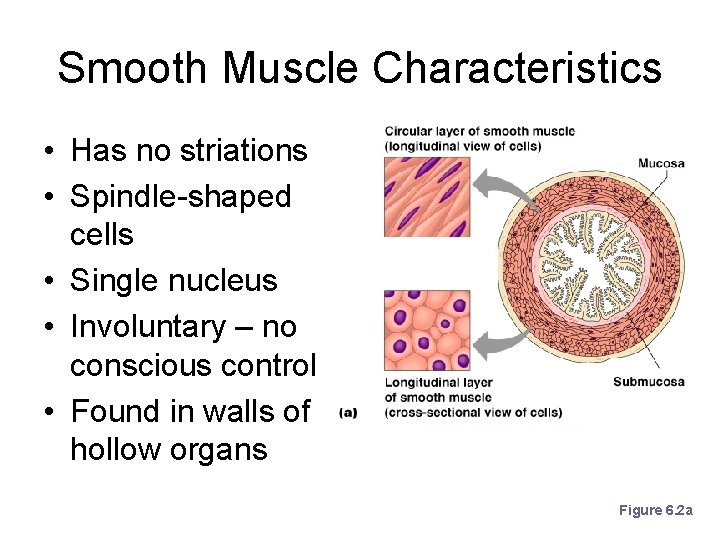
Smooth Muscle Characteristics • Has no striations • Spindle-shaped cells • Single nucleus • Involuntary – no conscious control • Found in walls of hollow organs Figure 6. 2 a
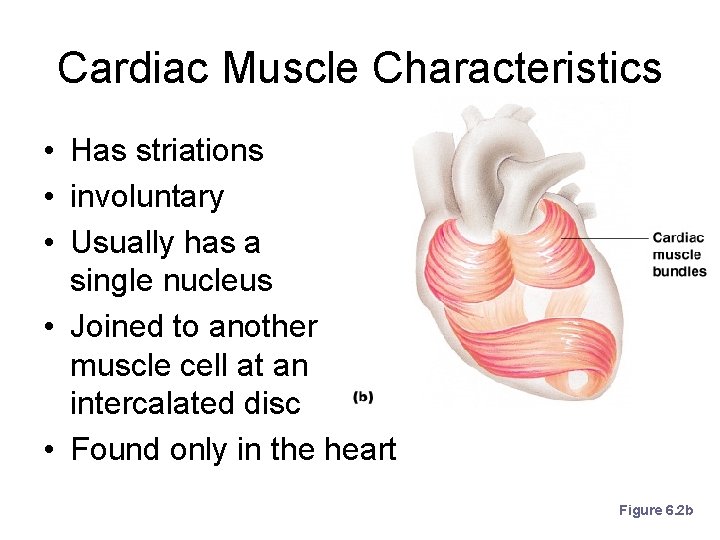
Cardiac Muscle Characteristics • Has striations • involuntary • Usually has a single nucleus • Joined to another muscle cell at an intercalated disc • Found only in the heart Figure 6. 2 b
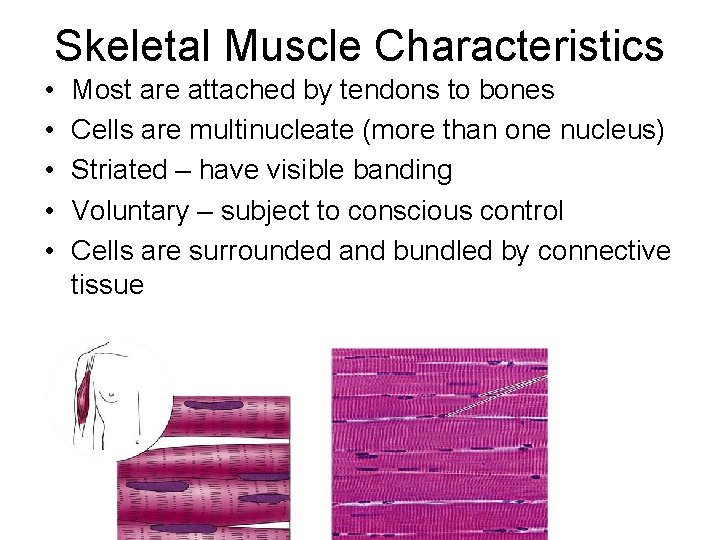
Skeletal Muscle Characteristics • • • Most are attached by tendons to bones Cells are multinucleate (more than one nucleus) Striated – have visible banding Voluntary – subject to conscious control Cells are surrounded and bundled by connective tissue
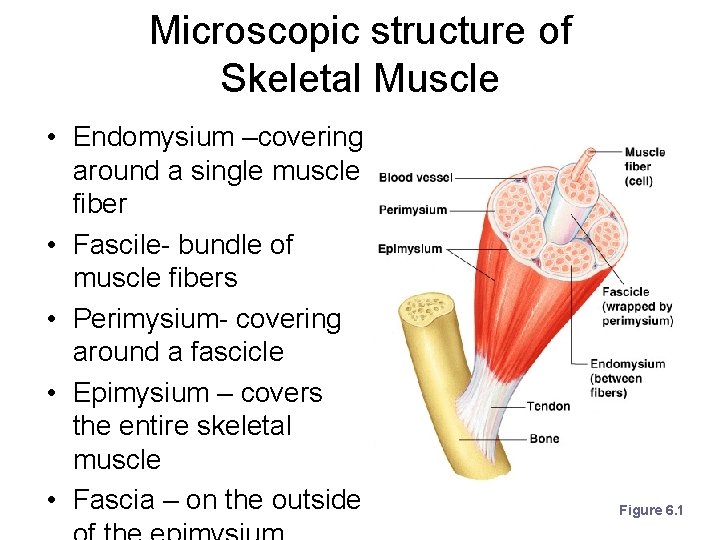
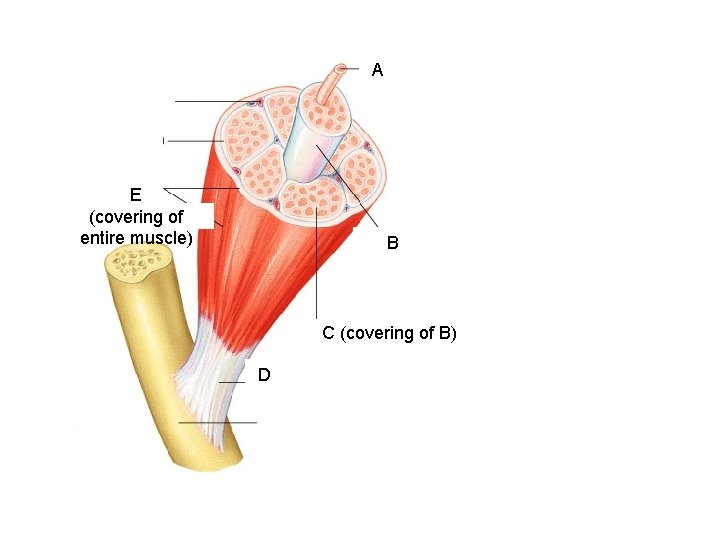
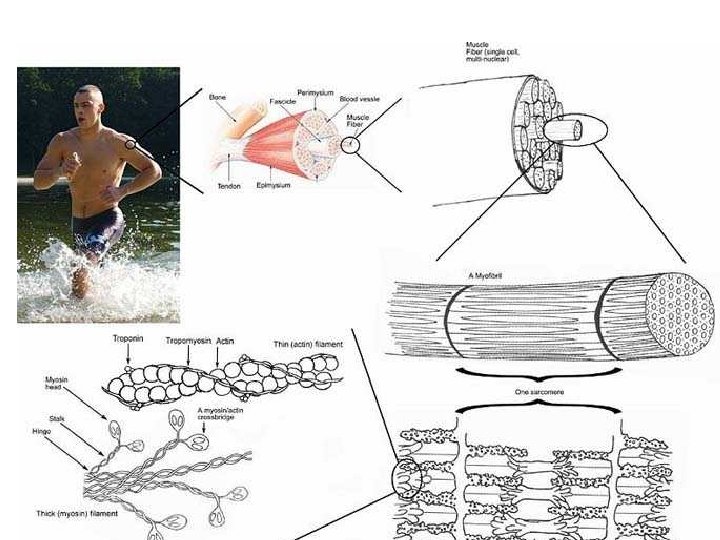
Microscopic structure of Skeletal Muscle • Endomysium –covering around a single muscle fiber • Fascile- bundle of muscle fibers • Perimysium- covering around a fascicle • Epimysium – covers the entire skeletal muscle • Fascia – on the outside Figure 6. 1
A E (covering of entire muscle) B C (covering of B) D
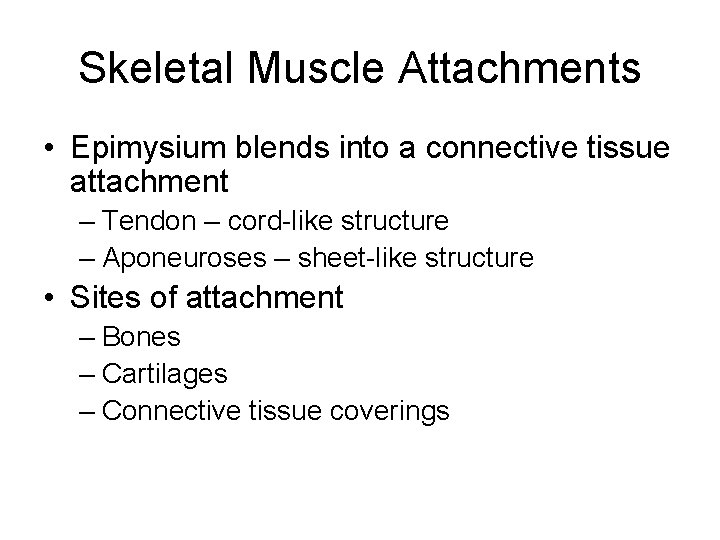
Skeletal Muscle Attachments • Epimysium blends into a connective tissue attachment – Tendon – cord-like structure – Aponeuroses – sheet-like structure • Sites of attachment – Bones – Cartilages – Connective tissue coverings
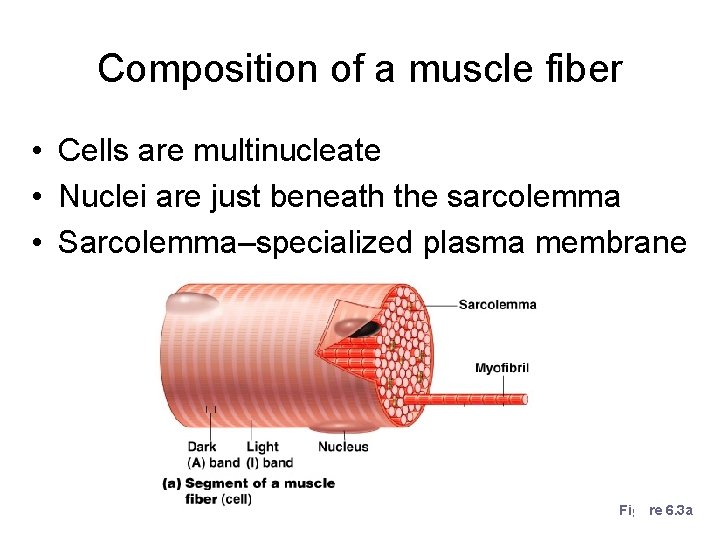
Composition of a muscle fiber • Cells are multinucleate • Nuclei are just beneath the sarcolemma • Sarcolemma–specialized plasma membrane Figure 6. 3 a
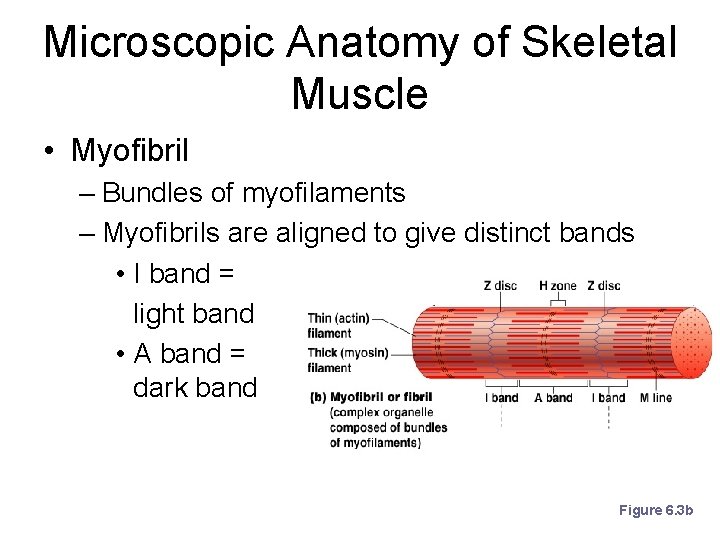
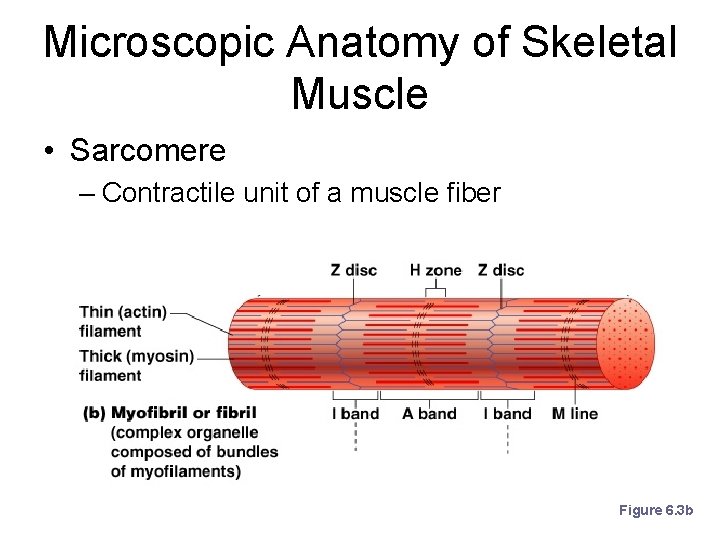
Microscopic Anatomy of Skeletal Muscle • Myofibril – Bundles of myofilaments – Myofibrils are aligned to give distinct bands • I band = light band • A band = dark band Figure 6. 3 b
Microscopic Anatomy of Skeletal Muscle • Sarcomere – Contractile unit of a muscle fiber Figure 6. 3 b
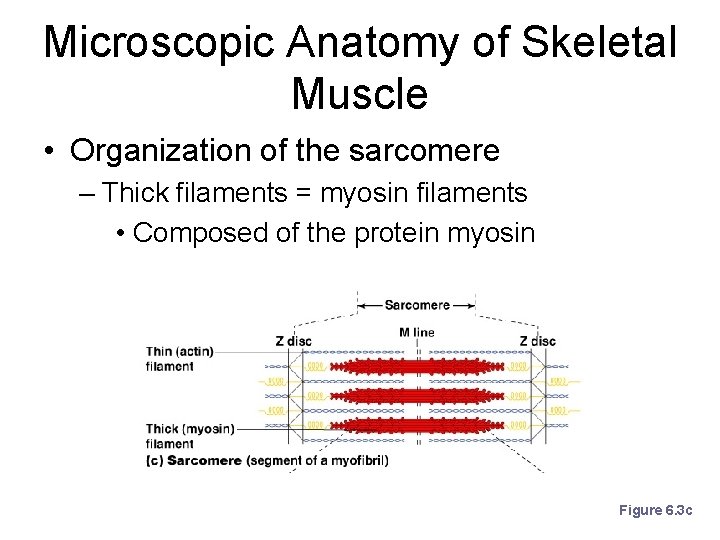
Microscopic Anatomy of Skeletal Muscle • Organization of the sarcomere – Thick filaments = myosin filaments • Composed of the protein myosin Figure 6. 3 c
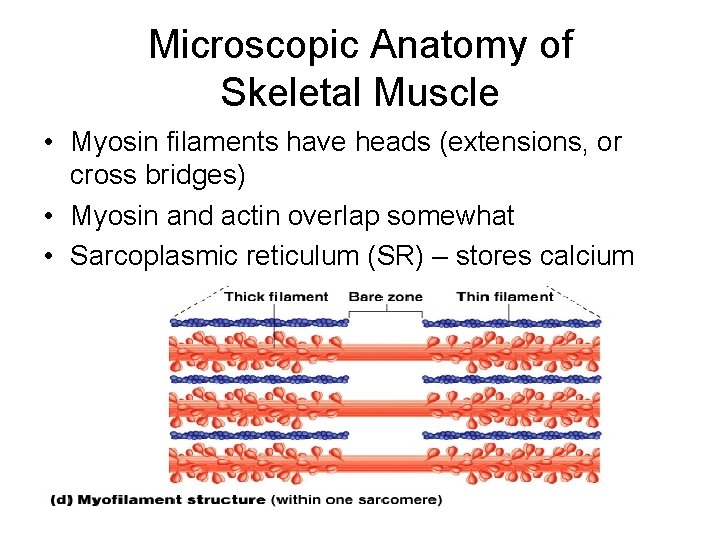
Microscopic Anatomy of Skeletal Muscle • Myosin filaments have heads (extensions, or cross bridges) • Myosin and actin overlap somewhat • Sarcoplasmic reticulum (SR) – stores calcium
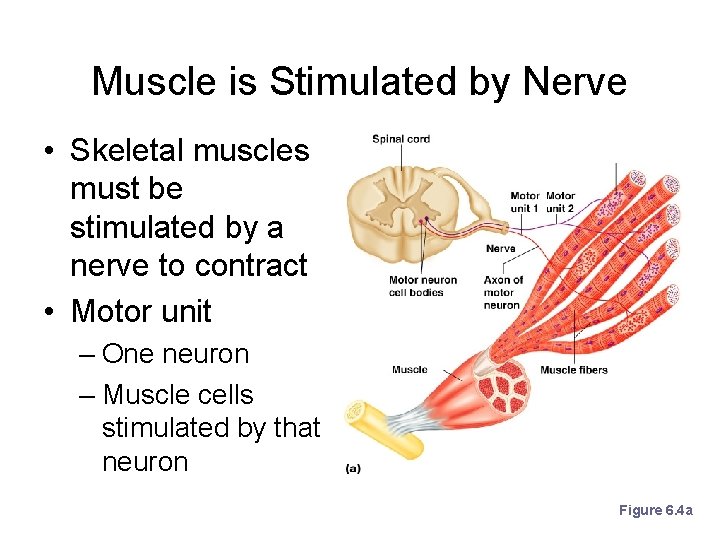
Muscle is Stimulated by Nerve • Skeletal muscles must be stimulated by a nerve to contract • Motor unit – One neuron – Muscle cells stimulated by that neuron Figure 6. 4 a
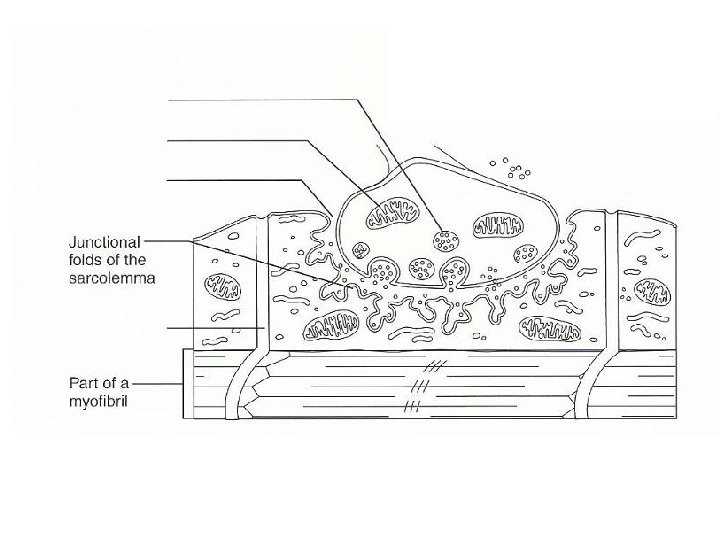
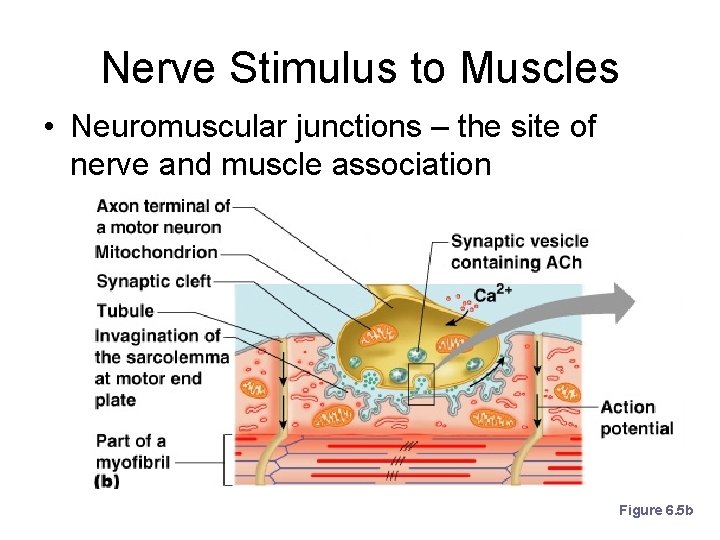
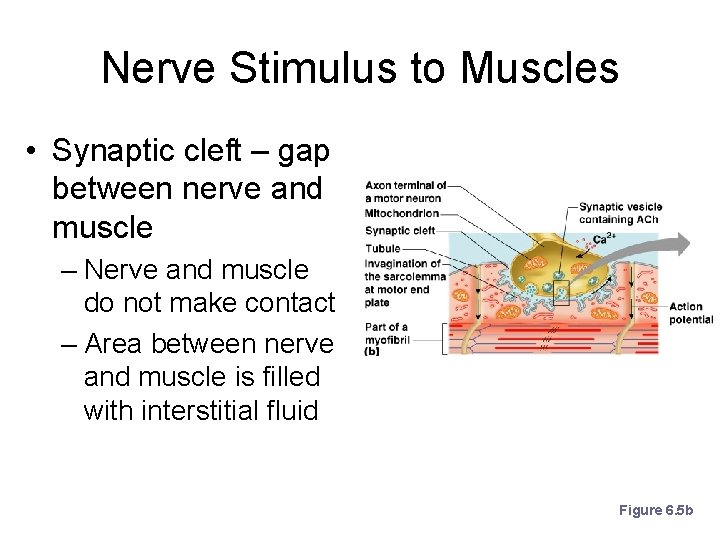
Nerve Stimulus to Muscles • Neuromuscular junctions – the site of nerve and muscle association Figure 6. 5 b
Nerve Stimulus to Muscles • Synaptic cleft – gap between nerve and muscle – Nerve and muscle do not make contact – Area between nerve and muscle is filled with interstitial fluid Figure 6. 5 b
Transmission of Nerve Impulse • Neurotransmitter – a chemical released by the nerve upon arrival of nerve impulse – The neurotransmitter - acetylcholine • Neurotransmitter attaches to receptors on the sarcolemma • Sarcolemma becomes permeable to sodium (Na+) • Sodium enters the cell and generates an action potential • Once started, muscle contraction cannot be stopped
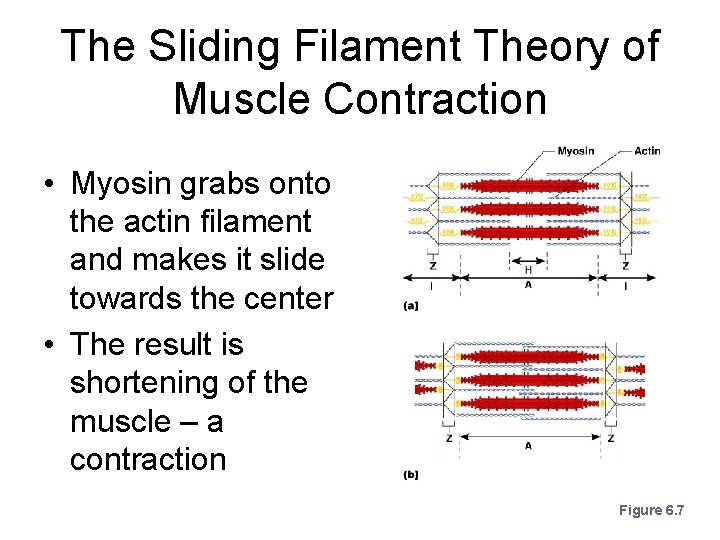
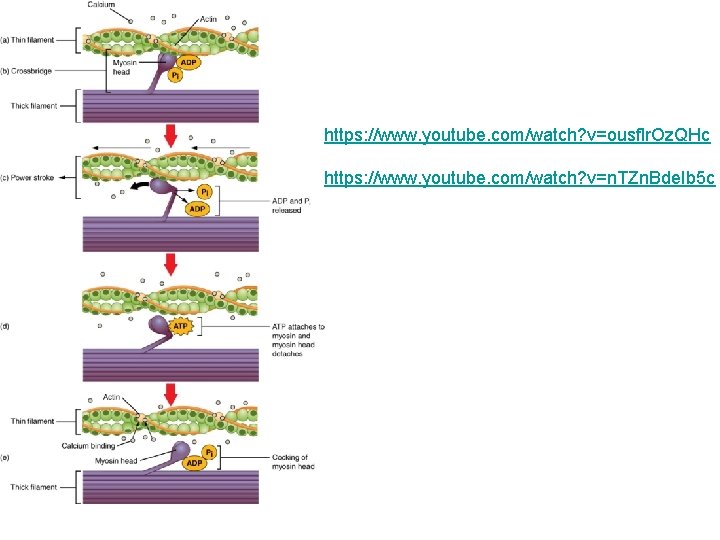
The Sliding Filament Theory of Muscle Contraction • Myosin grabs onto the actin filament and makes it slide towards the center • The result is shortening of the muscle – a contraction Figure 6. 7
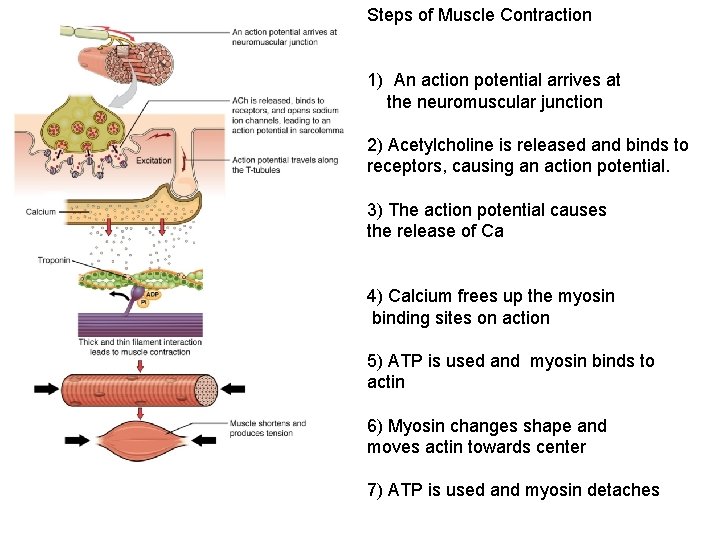
Steps of Muscle Contraction 1) An action potential arrives at the neuromuscular junction 2) Acetylcholine is released and binds to receptors, causing an action potential. 3) The action potential causes the release of Ca 4) Calcium frees up the myosin binding sites on action 5) ATP is used and myosin binds to actin 6) Myosin changes shape and moves actin towards center 7) ATP is used and myosin detaches
https: //www. youtube. com/watch? v=ousflr. Oz. QHc https: //www. youtube. com/watch? v=n. TZn. Bde. Ib 5 c
Properties of Skeletal Muscle Activity • Irritability – ability to receive and respond to a stimulus • Contractility – ability to shorten when an adequate stimulus is received
Contraction of a Skeletal Muscle • Muscle fiber contraction is “all or none” • Within a skeletal muscle, not all fibers may be stimulated during the same interval • Different combinations of muscle fiber contractions may give differing responses • Graded responses – different degrees of skeletal muscle shortening
Types of Graded Responses • Twitch – Single, brief contraction – Not a normal muscle function • Tetanus (summing of contractions) – One contraction is immediately followed by another – The muscle does not completely return to a resting state – The effects are added Figure 6. 9 a–b
Types of Graded Responses • Unfused (incomplete) tetanus – Some relaxation occurs between contractions – The results are summed • Fused – No evidence of relaxation before the following contractions – The result is a sustained muscle contraction Figure 6. 9 c–d
Muscle Response to Strong Stimuli • Muscle force depends upon the number of fibers that are stimulated • More fibers contracting results in greater muscle tension • Muscles can continue to contract unless they run out of energy
Energy for Muscle Contraction • Muscles use stored ATP for energy – Bonds of ATP are broken to release energy • After this initial use, other pathways must be utilized to produce ATP • Direct phosphorylation – Muscle cells contain creatine phosphate – After ATP is depleted, ADP is left – CP transfers energy to ADP, to regenerate ATP
Energy for Muscle Contraction • Aerobic Respiration (Cellular respiration) – Series of metabolic pathways that occur in the mitochondria – Glucose is broken down to carbon dioxide and water, releasing energy – This is a slower reaction that requires continuous oxygen Figure 6. 10 b
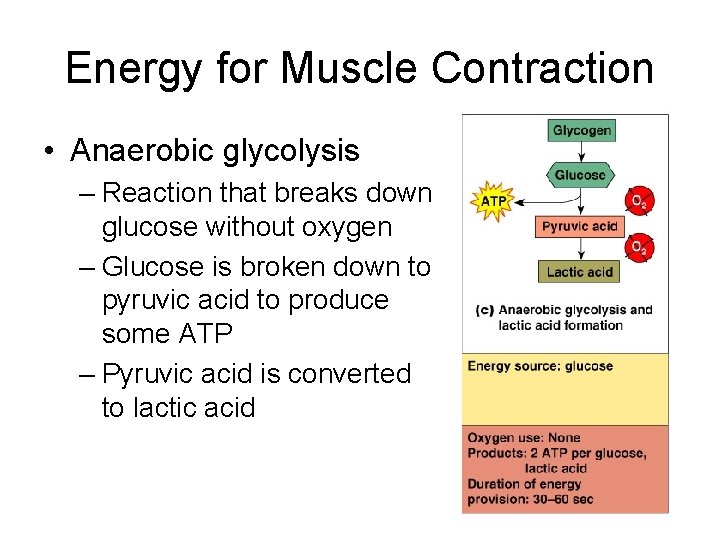
Energy for Muscle Contraction • Anaerobic glycolysis – Reaction that breaks down glucose without oxygen – Glucose is broken down to pyruvic acid to produce some ATP – Pyruvic acid is converted to lactic acid
Muscle Fatigue and Oxygen Debt • When a muscle is fatigued, it is unable to contract • The common reason for muscle fatigue is oxygen debt – Oxygen must be placed – Oxygen is required to rid of accumulated lactic acid • Increase acidity (from lactic acid) and lack of ATP causes the muscle to contract less
2 Types of Muscle Contractions • Isotonic contractions – Myofilaments are able to slide past each other during contractions – Tension in the muscles increases – The muscle shortens • Isometric contractions – Tension in the muscles increases – The muscle is unable to shorten
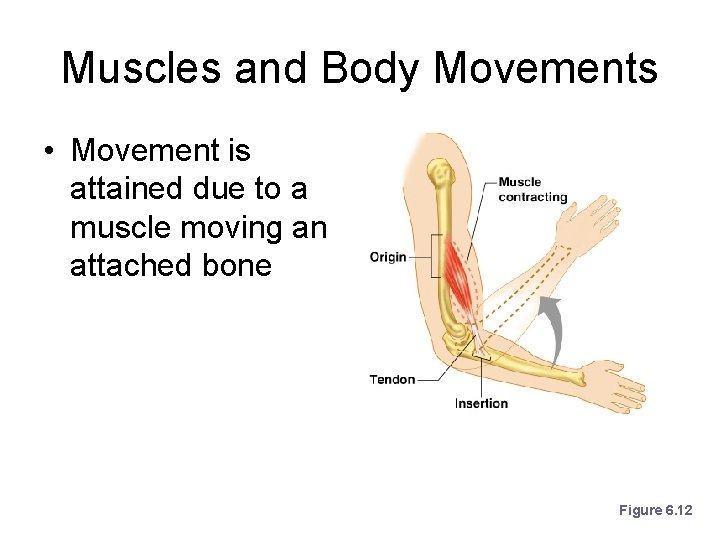
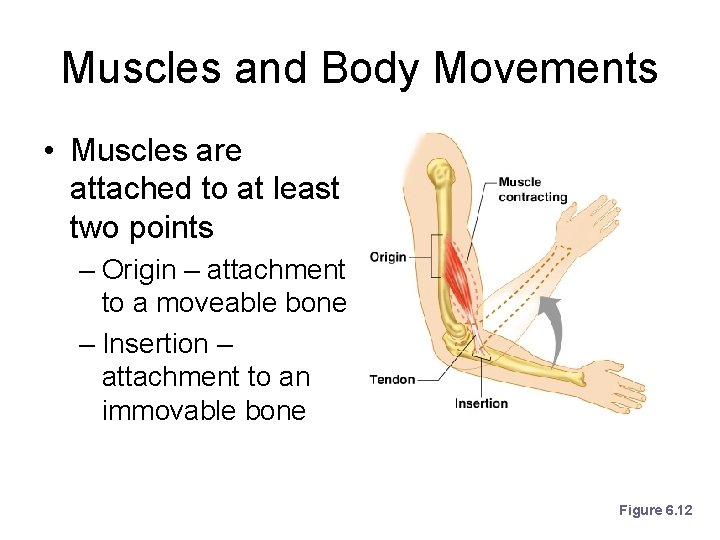
Muscles and Body Movements • Movement is attained due to a muscle moving an attached bone Figure 6. 12
Muscles and Body Movements • Muscles are attached to at least two points – Origin – attachment to a moveable bone – Insertion – attachment to an immovable bone Figure 6. 12
Effects of Exercise on Muscle • Results of increased muscle use – Increase in muscle size – Increase in muscle strength – Increase in muscle efficiency – Muscle becomes more fatigue resistant
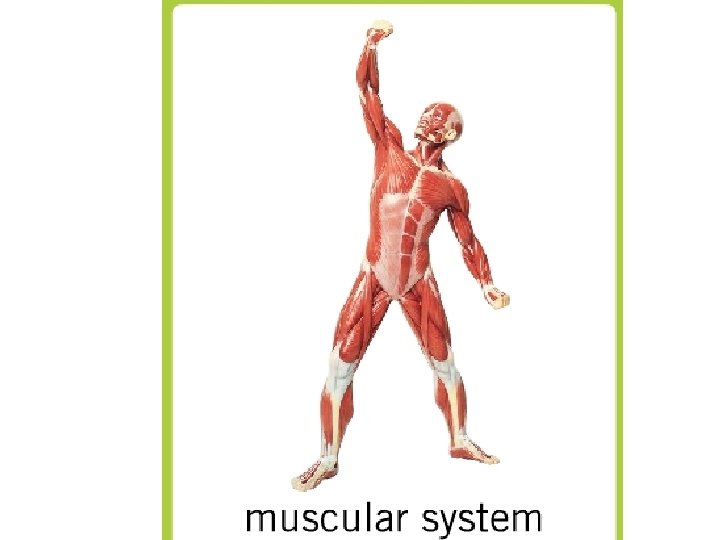
The Muscular System (c)
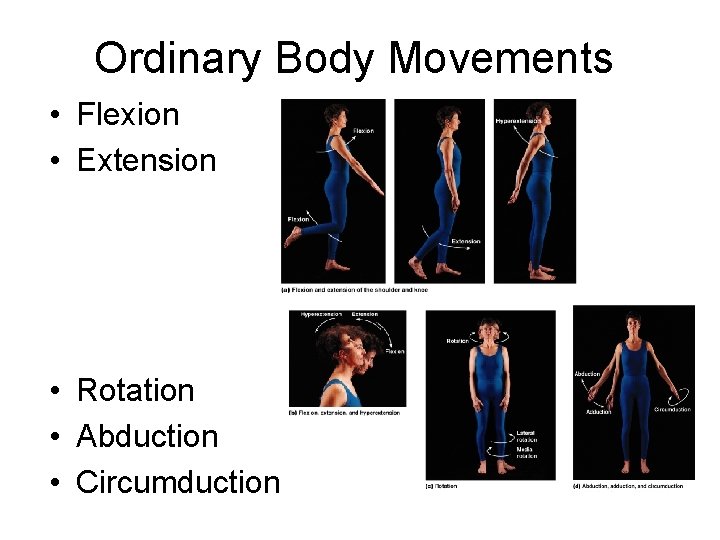
Ordinary Body Movements • Flexion • Extension • Rotation • Abduction • Circumduction
Special Movements • • Dorsifelxion Plantar flexion Inversion Eversion Supination Pronation Opposition
Types of Muscles • Prime mover – muscle with the major responsibility for a certain movement • Antagonist – muscle that opposes or reverses a prime mover • Synergist – muscle that aids a prime mover in a movement and helps prevent rotation • Fixator – stabilizes the origin of a prime mover
Naming of Skeletal Muscles • Direction of muscle fibers – Example: rectus (straight) • Relative size of the muscle – Example: maximus (largest)
Naming of Skeletal Muscles • Location of the muscle – Example: many muscles are named for bones (e. g. , temporalis) • Number of origins – Example: triceps (three heads)
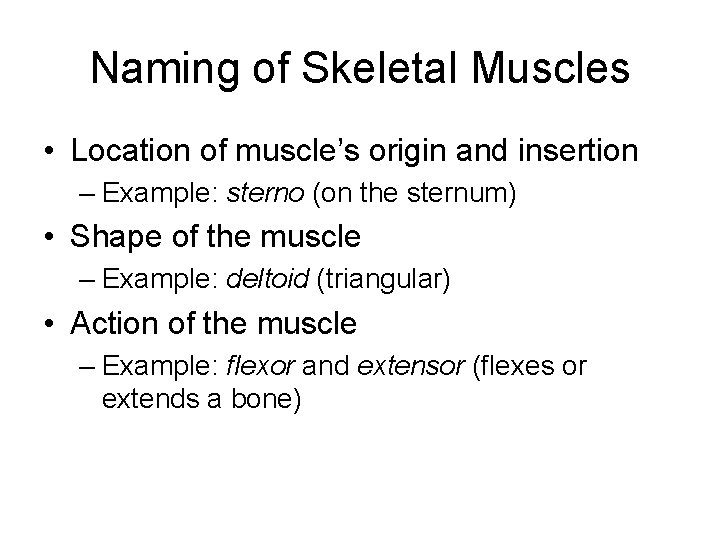
Naming of Skeletal Muscles • Location of muscle’s origin and insertion – Example: sterno (on the sternum) • Shape of the muscle – Example: deltoid (triangular) • Action of the muscle – Example: flexor and extensor (flexes or extends a bone)
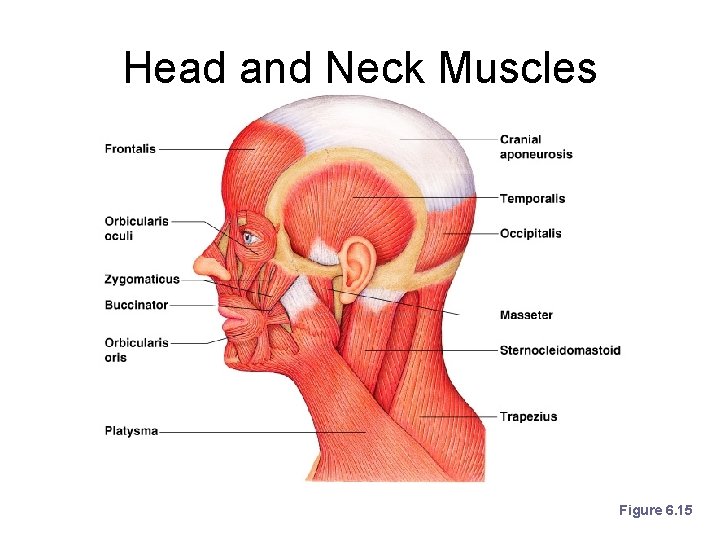
Head and Neck Muscles Figure 6. 15
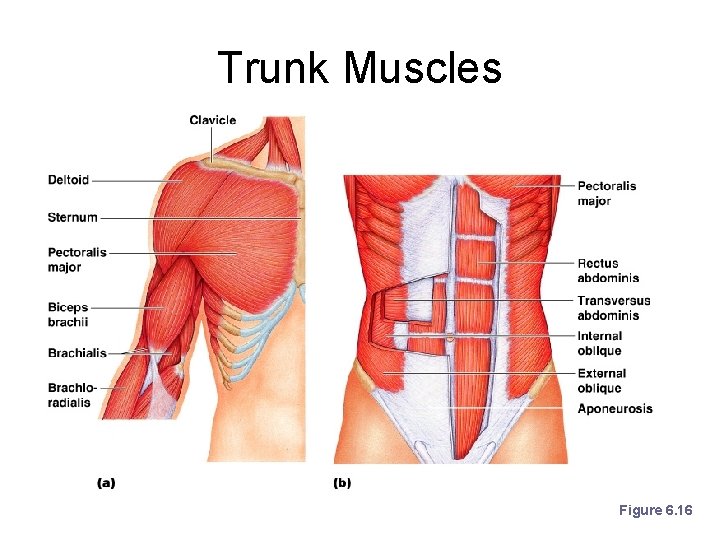
Trunk Muscles Figure 6. 16
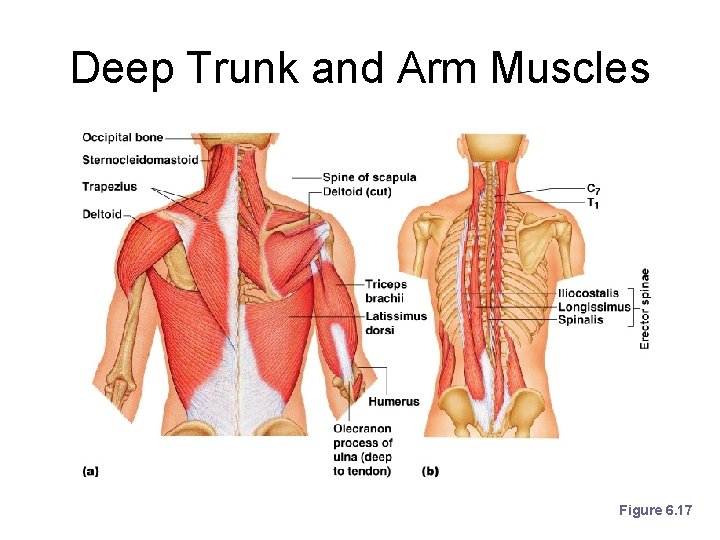
Deep Trunk and Arm Muscles Figure 6. 17
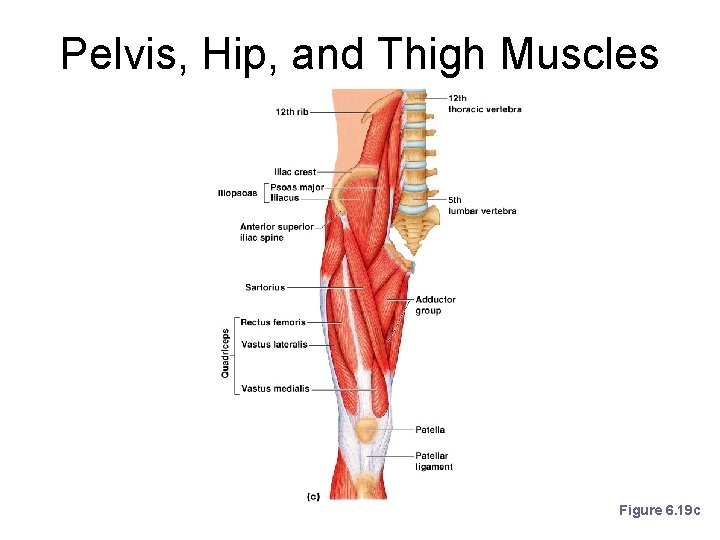
Pelvis, Hip, and Thigh Muscles Figure 6. 19 c
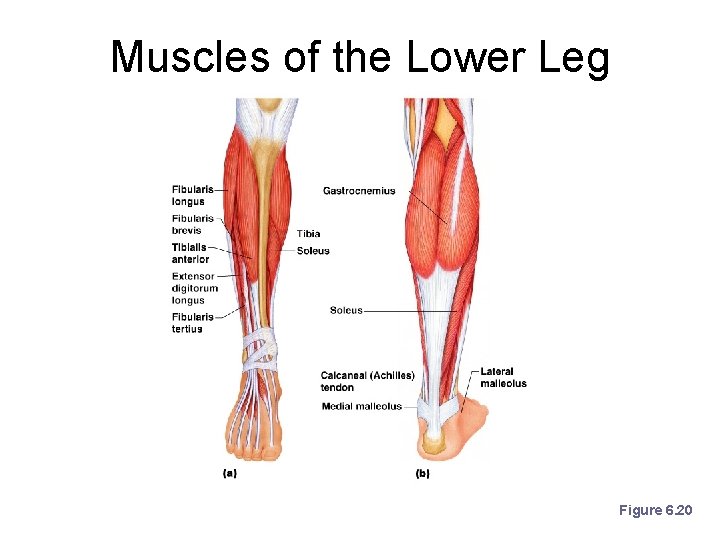
Muscles of the Lower Leg Figure 6. 20
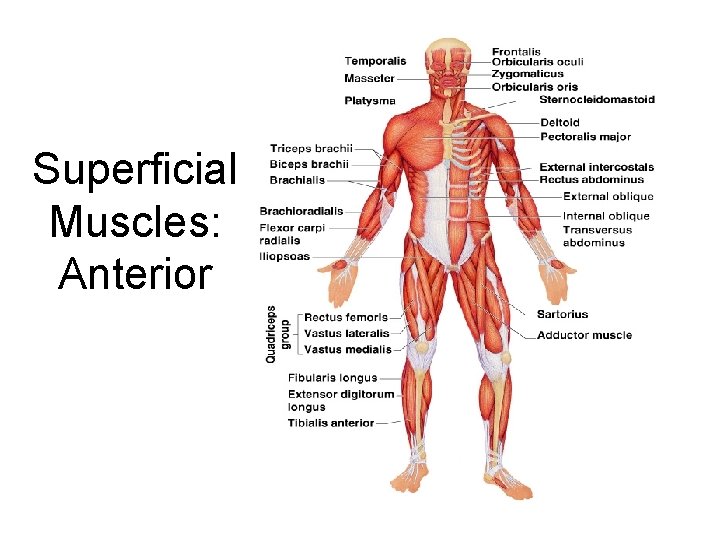
Superficial Muscles: Anterior
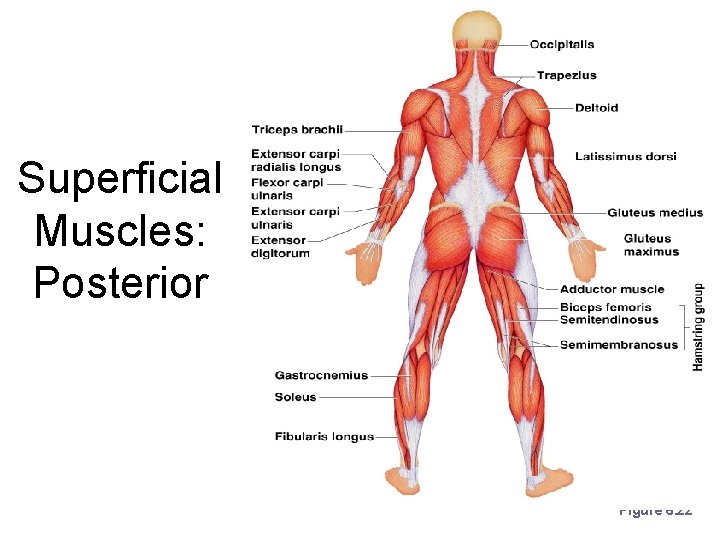
Superficial Muscles: Posterior Figure 6. 22