
Characteristics of Microbursts Microburst Location Microburst Size Utilizing
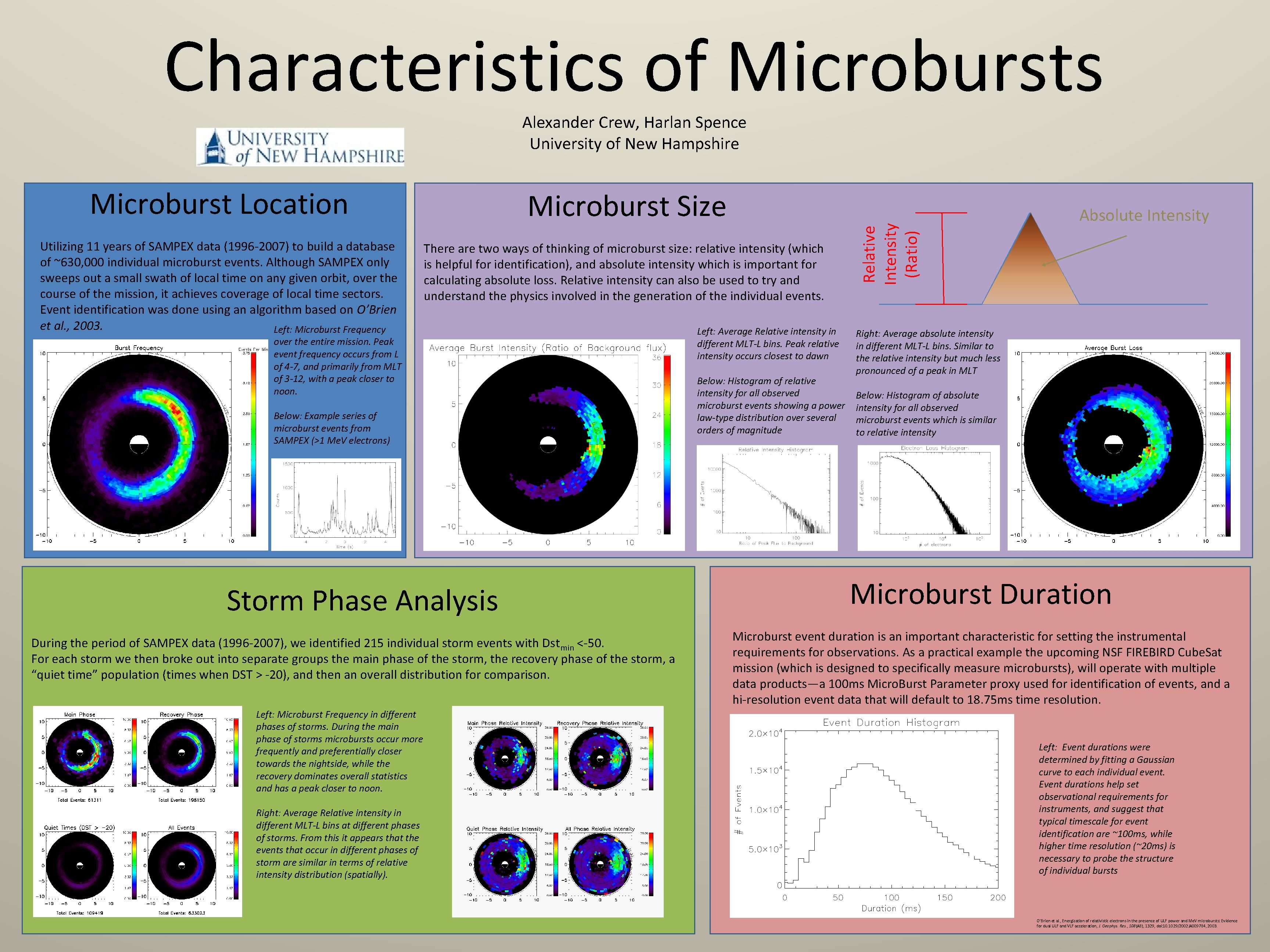
Characteristics of Microbursts Microburst Location Microburst Size Utilizing 11 years of SAMPEX data (1996 -2007) to build a database of ~630, 000 individual microburst events. Although SAMPEX only sweeps out a small swath of local time on any given orbit, over the course of the mission, it achieves coverage of local time sectors. Event identification was done using an algorithm based on O’Brien et al. , 2003. Left: Microburst Frequency There are two ways of thinking of microburst size: relative intensity (which is helpful for identification), and absolute intensity which is important for calculating absolute loss. Relative intensity can also be used to try and understand the physics involved in the generation of the individual events. over the entire mission. Peak event frequency occurs from L of 4 -7, and primarily from MLT of 3 -12, with a peak closer to noon. Below: Example series of microburst events from SAMPEX (>1 Me. V electrons) Storm Phase Analysis During the period of SAMPEX data (1996 -2007), we identified 215 individual storm events with Dst min <-50. For each storm we then broke out into separate groups the main phase of the storm, the recovery phase of the storm, a “quiet time” population (times when DST > -20), and then an overall distribution for comparison. Left: Microburst Frequency in different phases of storms. During the main phase of storms microbursts occur more frequently and preferentially closer towards the nightside, while the recovery dominates overall statistics and has a peak closer to noon. Right: Average Relative intensity in different MLT-L bins at different phases of storms. From this it appears that the events that occur in different phases of storm are similar in terms of relative intensity distribution (spatially). Left: Average Relative intensity in different MLT-L bins. Peak relative intensity occurs closest to dawn Below: Histogram of relative intensity for all observed microburst events showing a power law-type distribution over several orders of magnitude Relative Intensity (Ratio) Alexander Crew, Harlan Spence University of New Hampshire Absolute Intensity Right: Average absolute intensity in different MLT-L bins. Similar to the relative intensity but much less pronounced of a peak in MLT Below: Histogram of absolute intensity for all observed microburst events which is similar to relative intensity Microburst Duration Microburst event duration is an important characteristic for setting the instrumental requirements for observations. As a practical example the upcoming NSF FIREBIRD Cube. Sat mission (which is designed to specifically measure microbursts), will operate with multiple data products—a 100 ms Micro. Burst Parameter proxy used for identification of events, and a hi-resolution event data that will default to 18. 75 ms time resolution. Left: Event durations were determined by fitting a Gaussian curve to each individual event. Event durations help set observational requirements for instruments, and suggest that typical timescale for event identification are ~100 ms, while higher time resolution (~20 ms) is necessary to probe the structure of individual bursts O’Brien et al. , Energization of relativistic electrons in the presence of ULF power and Me. V microbursts: Evidence for dual ULF and VLF acceleration, J. Geophys. Res. , 108(A 8), 1329, doi: 10. 1029/2002 JA 009784, 2003.
- Slides: 1