
Characteristics of Life LO Describe the structure of
Characteristics of Life
LO: Describe the structure of viruses SLE: Think critically and solve problems Viral Disease Informational slide: Make a slide that shares information about a viral disease. It should include: 1. The name of the disease 2. The name of the virus (if it’s different from the disease it causes) 3. Symptoms of the disease 4. A picture of the virus 5. How it spreads 2 points. Due Friday, November 15.
Things you must have or do to be alive: 1. Have cells: all living things are composed of one or more cells. A cell is a membrane-covered structure that contains the chemicals and “organs” needed to live. The membrane protects the inside of the cell from the immediate environment. • Single-celled organisms have only one cell • Multi-celled organisms have more than one cell. You are a multi-celled organism with trillions of cells.
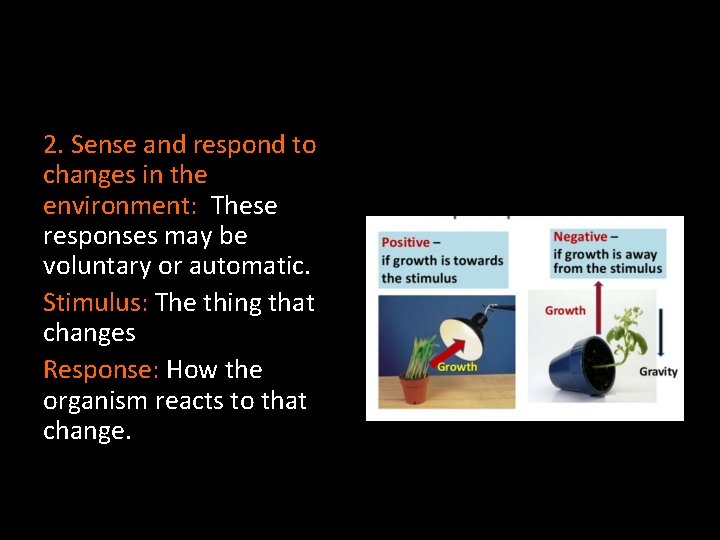
2. Sense and respond to changes in the environment: These responses may be voluntary or automatic. Stimulus: The thing that changes Response: How the organism reacts to that change.
3. Reproduce: All living things can make more of themselves. Asexual reproduction: A single parent produces offspring that are genetically identical to the parent. Sexual reproduction: Two parents create offspring that have half the DNA of each parent.
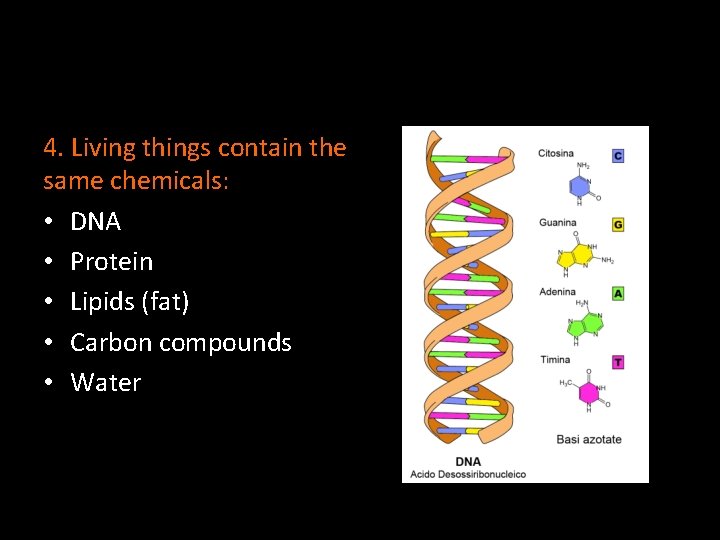
4. Living things contain the same chemicals: • DNA • Protein • Lipids (fat) • Carbon compounds • Water
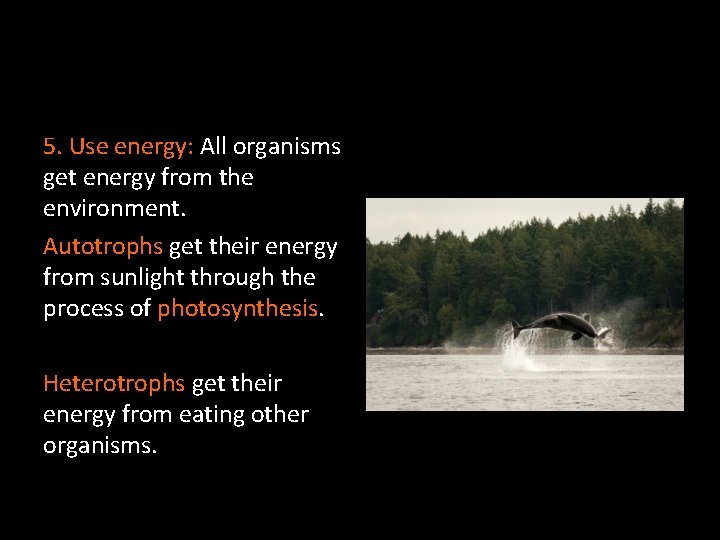
5. Use energy: All organisms get energy from the environment. Autotrophs get their energy from sunlight through the process of photosynthesis. Heterotrophs get their energy from eating other organisms.
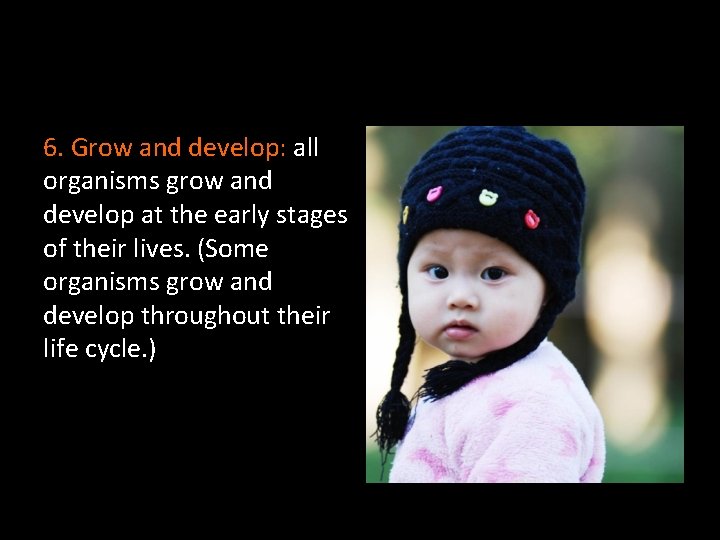
6. Grow and develop: all organisms grow and develop at the early stages of their lives. (Some organisms grow and develop throughout their life cycle. )
LO: Describe the characteristics that all living things share. SLE: Meet or exceed NGSS. Create a song or rap that describes six characteristics of life.
Characteristics of Life Posters: Create an illustrated poster that describes characteristics of life. For each characteristic, include: 1. A description of that characteristic 2. A picture (show good judgment here) 3. An example of that characteristic in a specific organism. (Ex: how do humans grow and develop? )
What does being alive mean? Alive: The object is carrying out life processes (using energy, growing and developing, responding to the environment, etc. ) Dead: The object was once alive, but no longer is. Nonliving: The object was never alive.
The Needs of Living things: 1. Air (either oxygen or carbon dioxide, depending on what kind of organism it is. ) 2. Water: Most of the chemical reactions within and outside of cells require water. 3. Living Space: All organisms need a space that contains the resources that they need. 4. Energy 5. Chemicals of life: DNA, lipids, carbon compounds, protein, water
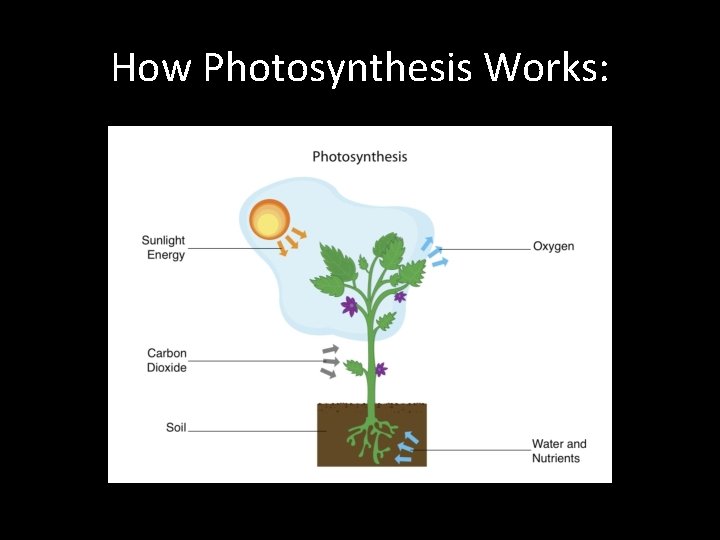
How Photosynthesis Works:
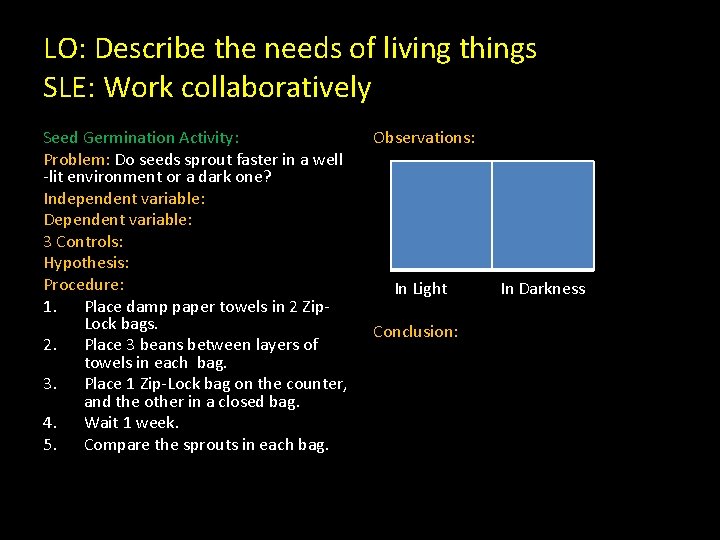
LO: Describe the needs of living things SLE: Work collaboratively Seed Germination Activity: Problem: Do seeds sprout faster in a well -lit environment or a dark one? Independent variable: Dependent variable: 3 Controls: Hypothesis: Procedure: 1. Place damp paper towels in 2 Zip. Lock bags. 2. Place 3 beans between layers of towels in each bag. 3. Place 1 Zip-Lock bag on the counter, and the other in a closed bag. 4. Wait 1 week. 5. Compare the sprouts in each bag. Observations: In Light Conclusion: In Darkness
LO: Describe the characteristics of living things. SLE: Meet or exceed NGSS Checkpoint Quiz on the Characteristics of Organisms: 1. ) What is a cell? 2. ) Describe the difference between sexual and asexual reproduction. 3. ) How do plants get energy? 4. ) List four chemicals that all living things have. 5. ) What types of organisms have cells?
How Organisms are Classified: What scientists observe when classifying organisms: • Cell structure • How it gets energy • Body structure • How it reproduces • How it evolved

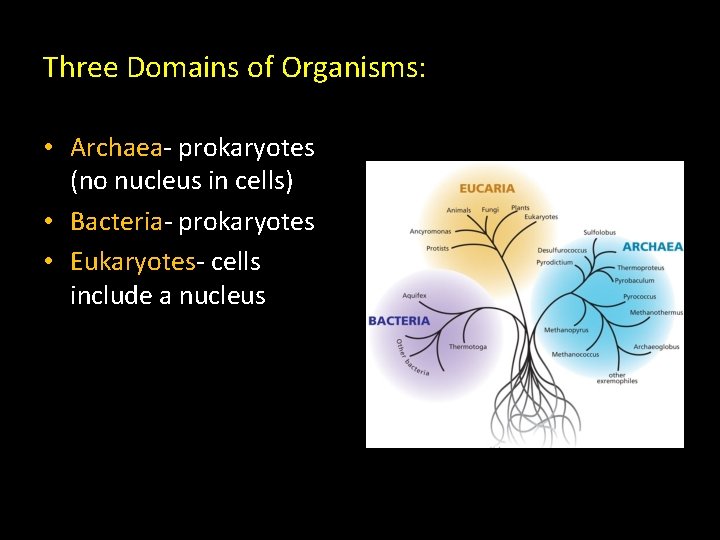
Three Domains of Organisms: • Archaea- prokaryotes (no nucleus in cells) • Bacteria- prokaryotes • Eukaryotes- cells include a nucleus
Kingdoms of Organisms: 1. 2. 3. 4. Plants Animals Fungi: molds, yeasts and mushrooms Protists: Mostly single-celled organisms with a cell nucleus 5. Bacteria 6. Archaea: Like bacteria, only more primitive (they evolved first)
Groups within kingdoms: From Large group to smaller group: • Kingdom • Phylum • Class • Order • Family • Genus • Species Humans are classified like this: Kingdom: Animal Phylum: Vertebrate Class: Mammal Order: Primate Family: Apes Genus: Homo (hominids) Species: Sapiens (human) Latin species name: Homo Sapiens
Classification Project: LO: Describe how organisms are classified SLE: Articulate ideas clearly and effectively 1. Choose an animal or plant, and find out how it’s classified. Then make a Power Point about that organism. 2. Include: a. Classification groups (Domain, kingdom, phylum, class, etc. ) b. Information about cell structure, body plan, reproduction, energy needs, and evolution (one statement/sentence about each) c. At least one photo of that organism Your project is due on Thursday, October 31.
LO: Describe characteristics of kingdoms of organisms SLE: Apply mindful habits for success Kingdoms of Organisms Booklets: Make a book that describes the main features of each of the six kingdoms of organisms: 1. Each kingdom should be its own page. (Take two pieces of drawing paper and fold them in half. 2. Your book should include a title page and a full heading 3. Each page should include: a. ) The name of the kingdom b. ) The types of cells (Prokaryotes or eukaryotes) c. ) Single-celled or multi-celled d. ) Reproduction (sexual or asexual) e. ) 2 examples of specific species of members of that kingdom: include the name and a drawing of each species (two drawings per page).
LO: Describe characteristics of living things SLE: Meet or exceed NGSS Checkpoint Quiz on Characteristics of Organisms List and describe six characteristics that all living things have in common: 1. 2. 3. 4. 5. 6.
LO: Describe how organisms are classified SLE: Meet or exceed NGSS Checkpoint Quiz on Classification: 1. ) List six kingdoms of organisms. 2. ) Of the three main domains of organisms, which domain contains organisms that have a nucleus in their cells? 3. ) What’s the difference between an autotroph and a heterotroph? 4. ) Which kingdom of organisms contains only living things that get their energy from the sun? 5. ) List three things that a scientist would look at before classifying a newly discovered organism.
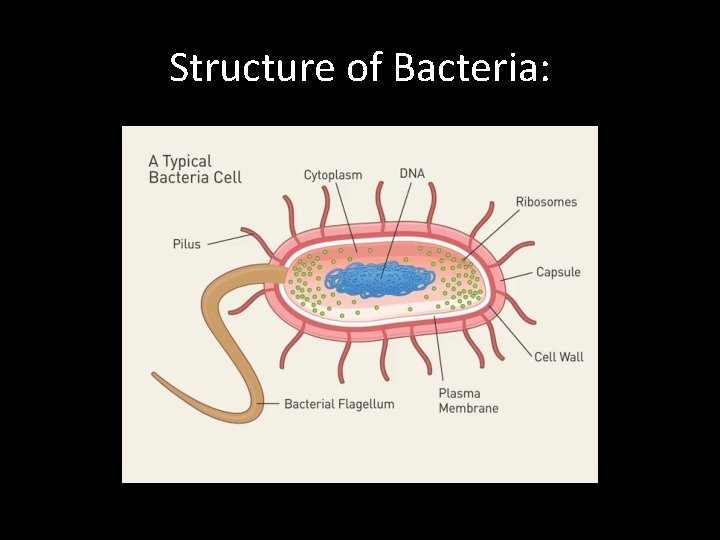
Structure of Bacteria:
LO: Describe how organisms respond to stimuli SLE: Work collaboratively Problem: Which stimulus do meal worms respond to the most- sound, light, or touch? Hypothesis: Independent variable: Dependent variable: 3 controls: Procedure (show me before you begin): Data: (This will probably be qualitative) Conclusion:
Bacteria are Prokaryotes: Prokaryotes are organisms without a nucleus in their cells; the DNA floats around freely in the cytoplasm of the cell. Eukaryotes do have a cell nucleus. All organisms except for bacteria and archaea are eukaryotes.
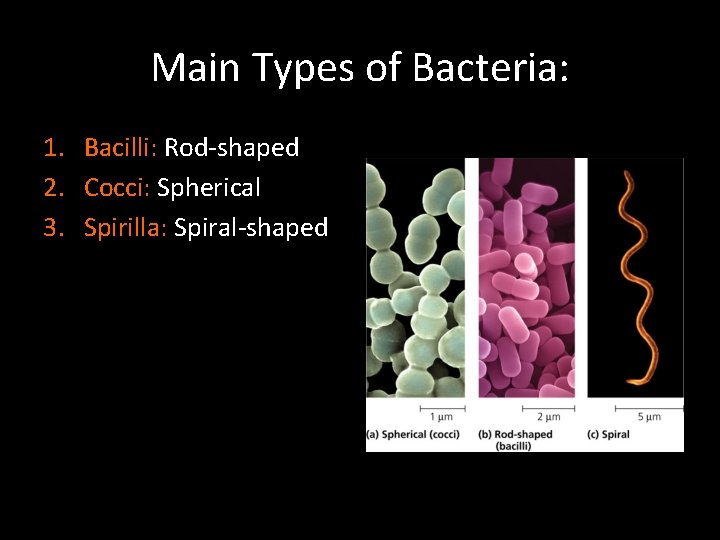
Main Types of Bacteria: 1. Bacilli: Rod-shaped 2. Cocci: Spherical 3. Spirilla: Spiral-shaped
How Bacteria Reproduce: Conditions Favorable to Bacteria: • Bacteria reproduce through binary fission: The cells produce extra DNA, then the cell splits in two. The new cell is genetically the same as the old cell. Bacteria like conditions that are: • Warm (10 -50 C) • Wet or moist • Rich in nutrients Some bacteria are producers; others are consumers.
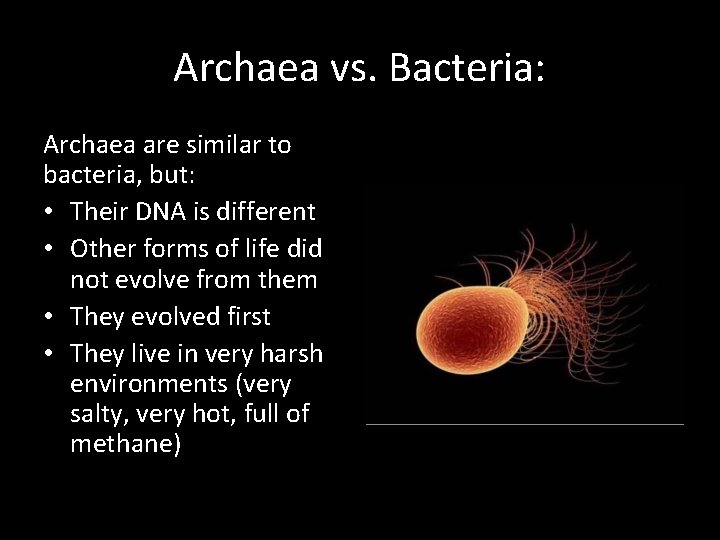
Archaea vs. Bacteria: Archaea are similar to bacteria, but: • Their DNA is different • Other forms of life did not evolve from them • They evolved first • They live in very harsh environments (very salty, very hot, full of methane)
Homework: LO: Describe the structure and behavior of bacteria SLE: Articulate ideas cleary and effectively 1. Read p. 24 -29 2. Review questions on p. 29
LO: Describe the structure of bacteria SLE: Work independently Make an informational poster about the structure of bacteria: 1. 2. 3. 4. Draw a color diagram of a bacterial cell; Label the parts of the cell Describe the function of each part Include a title; write a full heading on the back.
LO: Describe how organisms are classified. SLE: Meet or exceed NGSS Checkpoint Quiz on Classification: 1. ) List 6 kingdoms of organisms. 2. ) Which kingdoms of organisms consist entirely of prokaryotes? 3. ) Which kingdoms of organisms consist only of organisms that reproduce sexually? 4. ) List three domains of organisms. 5. ) Which kingdom consists only of producers?
LO: Describe the role of bacteria in the environment. SLE: Articulate ideas clearly, creatively, and effectively. Bacteria Essay Assignment: Think about the films you just saw, and read the article on bacteria provided by Mr. Tice. Then write a 5 -10 sentence paragraph on bacteria that communicates the following ideas: 1. Where do bacteria live? 2. How are bacteria beneficial for humans? 3. How can bacteria be dangerous to humans? You will have today in class to work on this assignment. It’s due on Wednesday, but feel free to give it to me as soon as you’ve completed it.
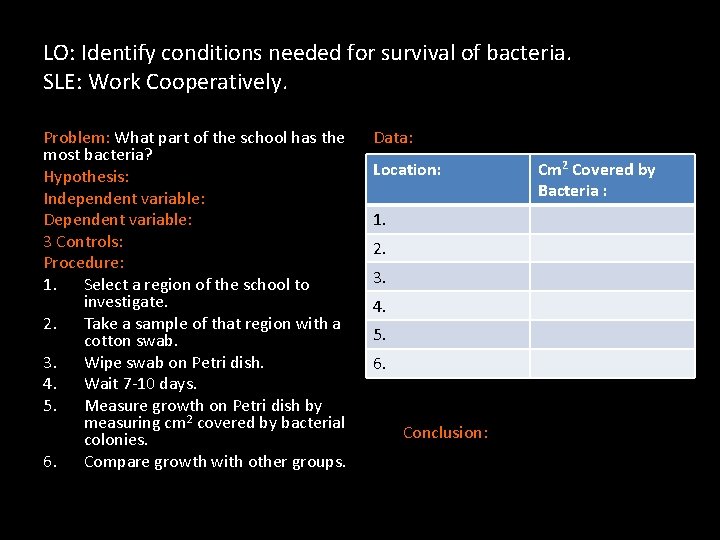
LO: Identify conditions needed for survival of bacteria. SLE: Work Cooperatively. Problem: What part of the school has the most bacteria? Hypothesis: Independent variable: Dependent variable: 3 Controls: Procedure: 1. Select a region of the school to investigate. 2. Take a sample of that region with a cotton swab. 3. Wipe swab on Petri dish. 4. Wait 7 -10 days. 5. Measure growth on Petri dish by measuring cm 2 covered by bacterial colonies. 6. Compare growth with other groups. Data: Location: 1. 2. 3. 4. 5. 6. Conclusion: Cm 2 Covered by Bacteria :
LO: describe the structure and behavior of bacteria SLE: meet or exceed NGSS Checkpoint Quiz on Bacteria: 1. What characteristic of bacteria and archaea make them very different from plants, animals, fungi, and protists? 2. What part of a bacterium produces protein? 3. How do bacteria reproduce? 4. List two ways bacteria are helpful to humans. 5. List one way bacteria can be harmful to humans.
How Organisms Are Classified: To classify means to place into groups based on characteristics that seem important. What scientists look for when they classify organisms: 1. Cell structure 2. Body structure 3. How they reproduce 4. How they get energy 5. How they respond to their environment 6. How they evolved
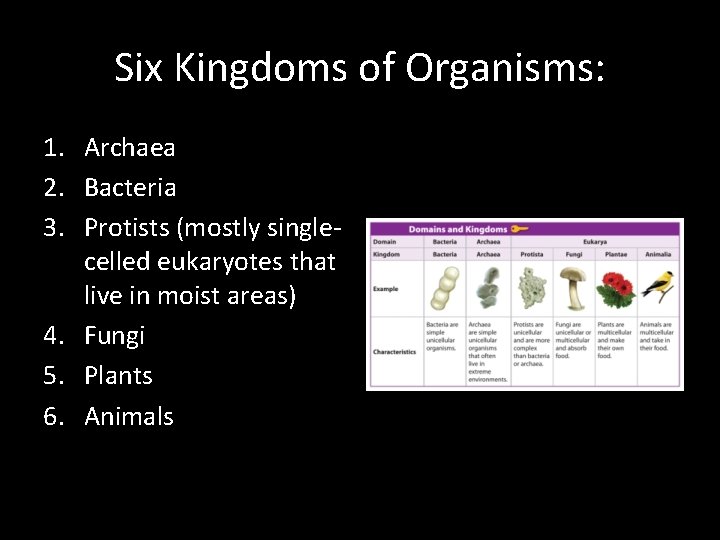
Six Kingdoms of Organisms: 1. Archaea 2. Bacteria 3. Protists (mostly singlecelled eukaryotes that live in moist areas) 4. Fungi 5. Plants 6. Animals
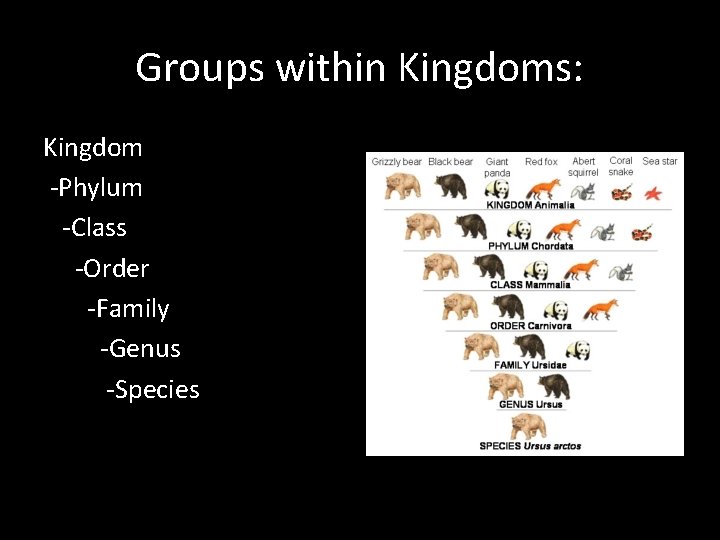
Groups within Kingdoms: Kingdom -Phylum -Class -Order -Family -Genus -Species
Classification Presentation LO: Describe how organisms are classified SLE: Apply organization and study skills Make a 1 -3 slide PPT that describes how an organism is classified. Include information about: 1. Its classification( kingdom, phylum, class, etc. ) 2. Why it was classified the way it was: Its cell structure, body structure, reproductive strategy, energy needs, how it moves, and what it evolved from 3. At least one picture The presentation is due on Thursday, Nov. 5, and is worth 5 points!
LO: Describe how organisms are classified. SLE: Apply academic habits for success. Checkpoint quiz on classification: 1. List six kingdoms of organisms. (2 pts) 2. List the smaller groups within kingdoms of organisms, starting with the largest group down to the smallest. (2 pts) 3. Describe the difference between a eukaryote and a prokaryote. (1 pt)
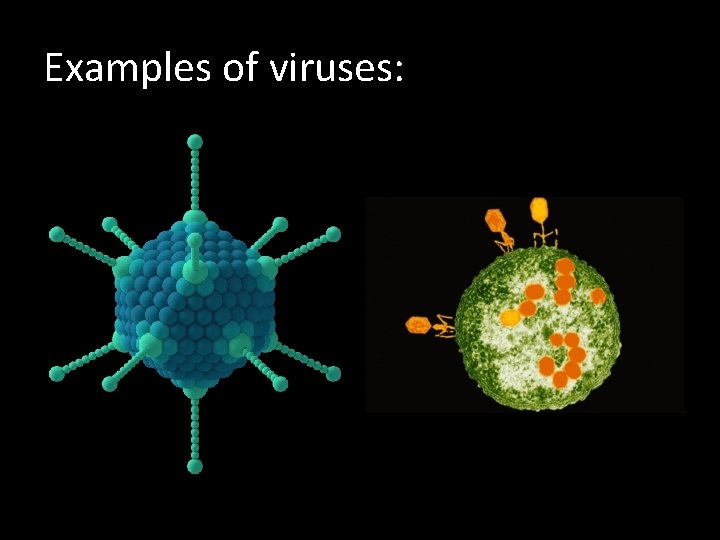
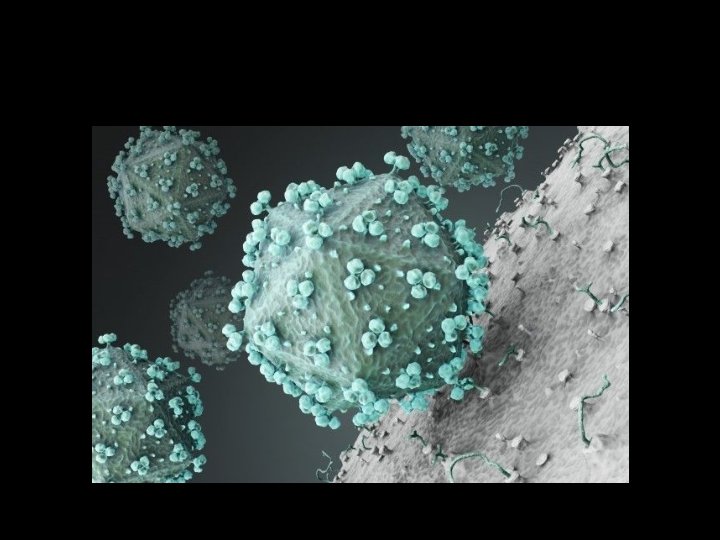
Viruses: Very Small and Very Annoying (OK, deadly) A virus is a self-replicating microscopic particle that invades cells and re-programs the DNA in the cell to make more viruses. (This often kills the cell. )
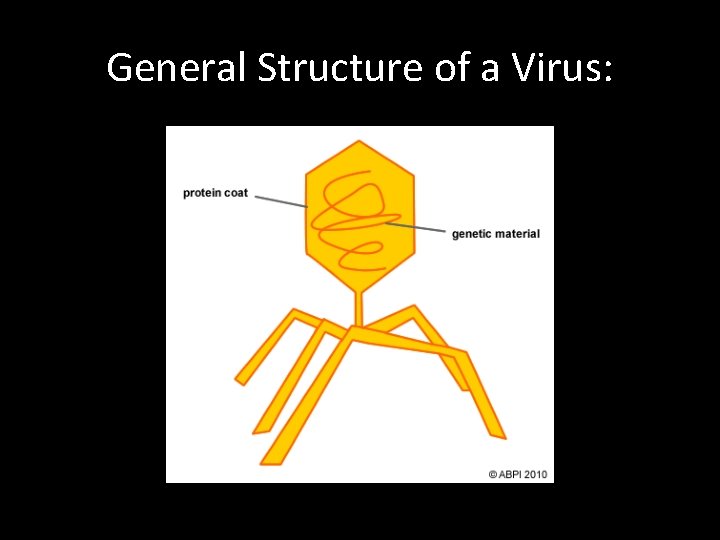
General Structure of a Virus:
Question: Are viruses living things? Answer: Not really. • Although viruses contain DNA and can reproduce more of themselves, they are not considered living things because: • They’re not made of cells • They don’t use energy • They don’t grow and develop • They don’t really respond to the environment • They can’t reproduce without cells
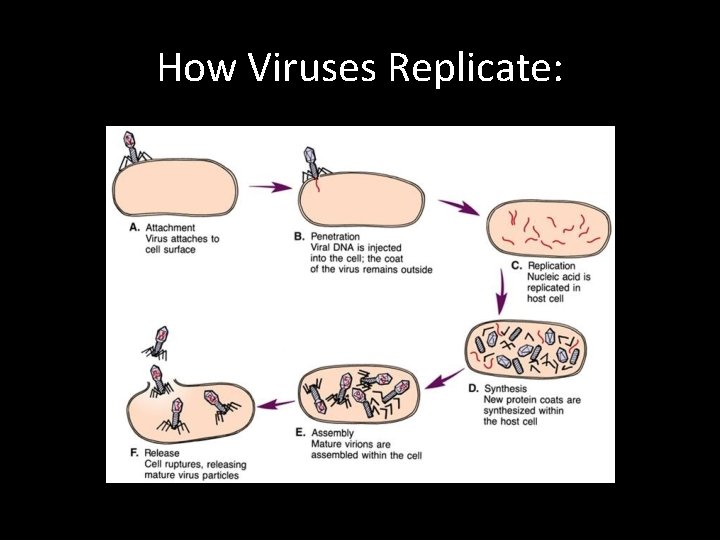
How Viruses Replicate:
Are Viruses Bad for You? Yes.
Examples of viruses:
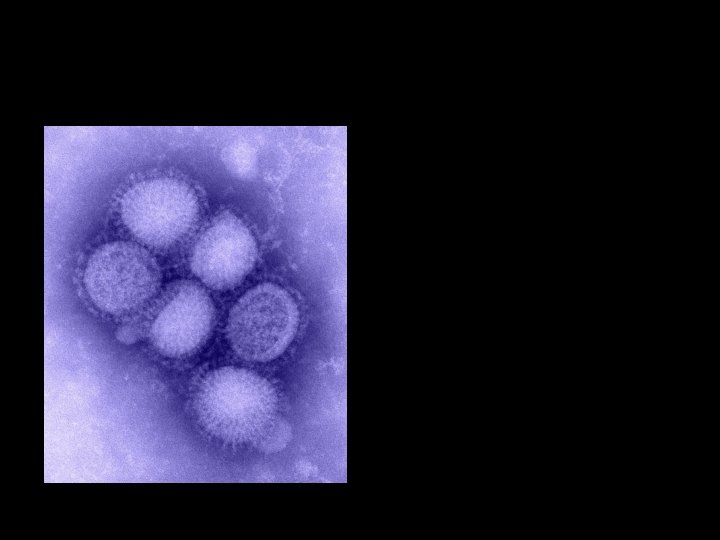
Your Body’s Defenses Against Disease. Causing Microbes: Seven lines of Defense: 1. Skin/mucus: Skin acts as a barrier; mucus traps incoming microbes so you can cough/sneeze/spit them out, or swallow them. 2. Inflammatory response: Specialized cells recognize particles that don’t belong in your body, and send chemical signals to white blood cells. These cells cause inflammation (swelling, redness, fever, etc. ) They can also cause allergies, if they start attacking things that are actually harmless. 3. White blood cells: These very large cells travel throughout the body and devour invading particles. 4. Antibodies: Cells that identify specific invaders and attach themselves to it, allowing white blood cells to identify them. 5. Lymphocytes: white blood cells that go after specific invaders (tailor-made to destroy a specific virus) 6. T cells: direct other cells of the immune system to fight a specific invader 7. Cell suicide: Cells that are infected send out a chemical signal to white blood cells that they should be destroyed before they burst open.
LO: Describe the structure and function of viruses SLE: Meet or exceed NGSS Checkpoint Quiz on Viruses: 1. Draw a diagram of a virus and label the parts. 2. Describe how viruses make more of themselves. (2 points) 3. Give two reasons that viruses are considered to be nonliving. 4. How can you prevent yourself from being infected with a viral disease?
How to stop the spread of infectious disease: 1. 2. 3. 4. 5. 6. 7. 8. Wash hands frequently Avoid contact with others when you are ill Get a lot of sleep (at least 8 hours) Eat a balanced, healthy diet (especially fruit and veggies!) Avoid drugs and alcohol Avoid dirty/polluted water Drink a lot of water Get vaccinated
LO: Describe the body’s defenses against infectious disease SLE: Articulate ideas clearly and effectively Create a comic strip/storyboard that describes the body’s defense against infectious diseases: • Use one panel for each type of defense. • In the large part of the panel, include a diagram in color. • In the small panel, write a caption that describes how that type of defense works. • The title should be at the top, the heading on the back • The completed story board is due on Monday.
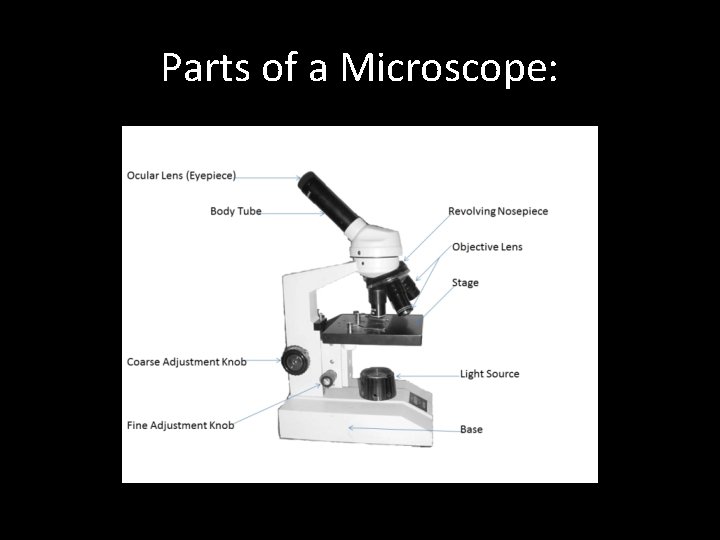
Parts of a Microscope:
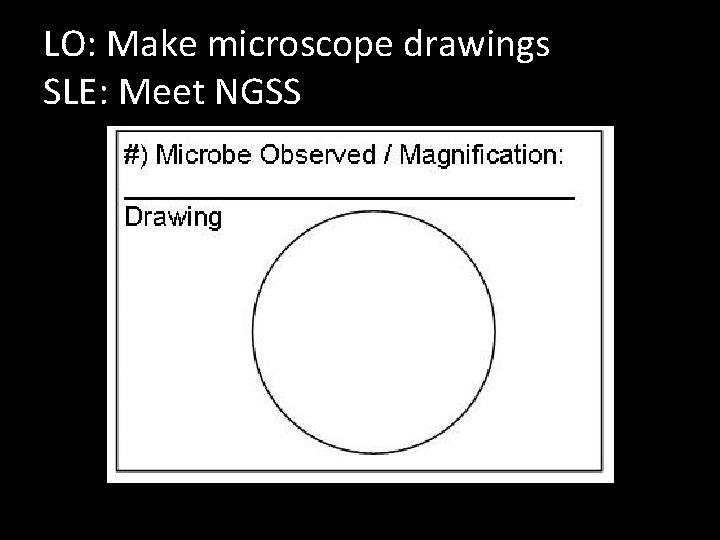
LO: Make microscope drawings SLE: Meet NGSS
Homework: LO: Describe viruses and bacteria SLE: Work independently p. 42 -43
LO: Describe role of microorganisms in infectious disease SLE: Meet NGSS Checkpoint Quiz: Infectious Disease 1. ) Will antibiotics cure patients who have a viral disease? Why or why not? 2. ) Why do some scientists believe that the Black Death was caused by an Ebola-like virus instead of the plague bacterium? 3. ) What is the best way for individuals to prevent the spread of infectious disease? 4. ) On which part of a microscope do you put the slide? 5. )List three symptoms of Ebola.
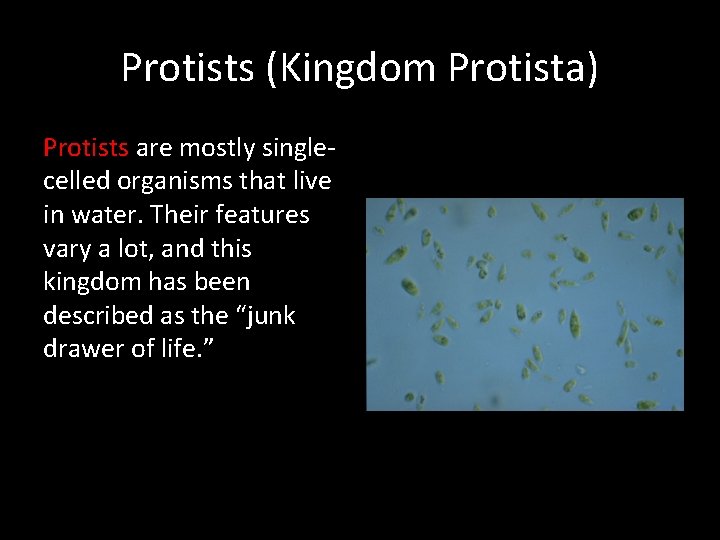
Protists (Kingdom Protista) Protists are mostly singlecelled organisms that live in water. Their features vary a lot, and this kingdom has been described as the “junk drawer of life. ”
Features common to all protists: • Are eukaryotes • Less complex than other eukaryotes (do not have specialized tissues) • Most are single-celled • Can be either autotrophic (producers) or heterotrophic (consumers) • Live mostly in water • Most reproduce asexually, though many reproduce sexually. Some species reproduce both ways.
Main Types of Protists: Algae: Protists that are producers (get energy from photosynthesis). Algae are classified according to color: • Red algae: Most are tropical species of seaweed • Green Algae: Are the most common type, and include phytoplankton, which produce most of Earth’s oxygen. • Brown algae: Most are seaweed/kelp species that live in cooler waters (like Puget Sound).
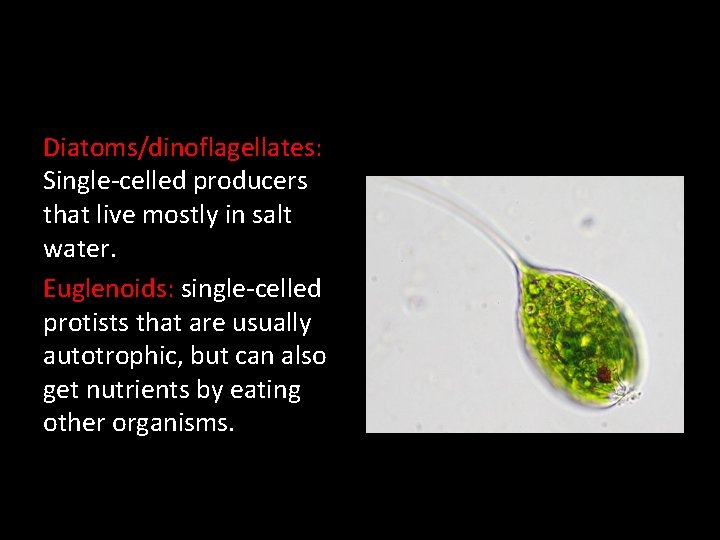
Diatoms/dinoflagellates: Single-celled producers that live mostly in salt water. Euglenoids: single-celled protists that are usually autotrophic, but can also get nutrients by eating other organisms.
Protozoans: Heterotrophic protists. Amoeba: Single-celled consumer protists that eat their prey by surrounding it with parts of its cell membrane. Ciliates: Consumer protists that move with the help of hair-like cells called cilia.
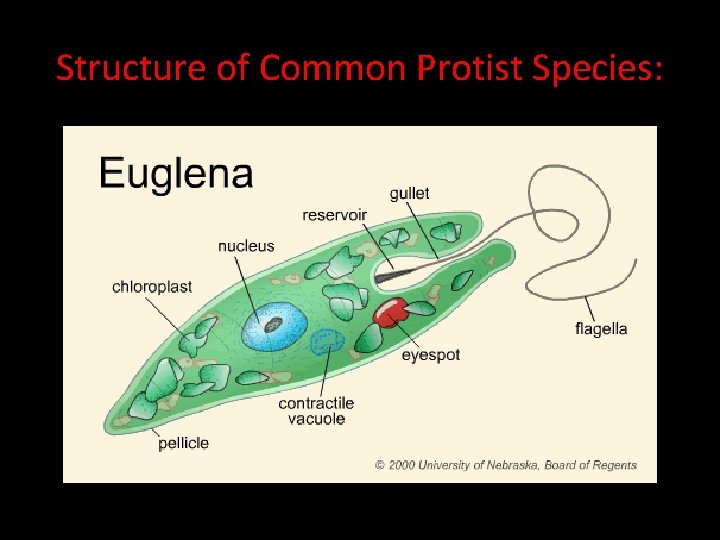
Structure of Common Protist Species:
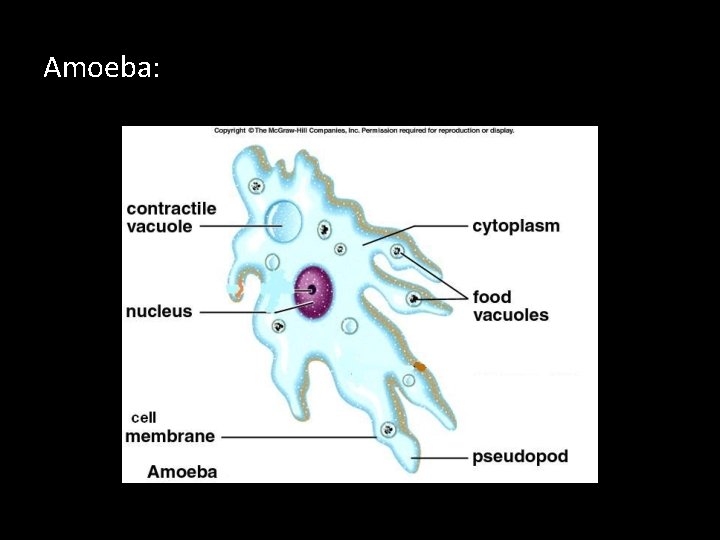
Amoeba:
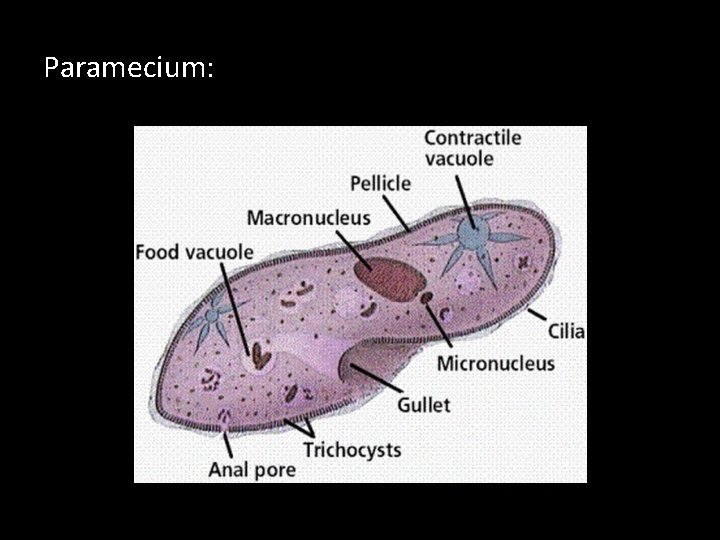
Paramecium:
LO: Describe features of protists SLE: Work Collaboratively Make Microscope drawings of five of the following organisms: (On loose leaf, color OK but not required. ) 1. Euglena 2. Paramecium 3. Mixed plankton (protozoans & algae) 4. Bacteria (not a protist, but still interesting) 5. Diatoms 6. Desmids (a type of algae) 7. Chlorella (algae) 8. Diatoms 9. Plankton 10. Volvox 11. Spirogyra 12. Amoeba For each organism, draw it, title it, and say what objective lens you used. When you finish with a slide, pass it on to others.
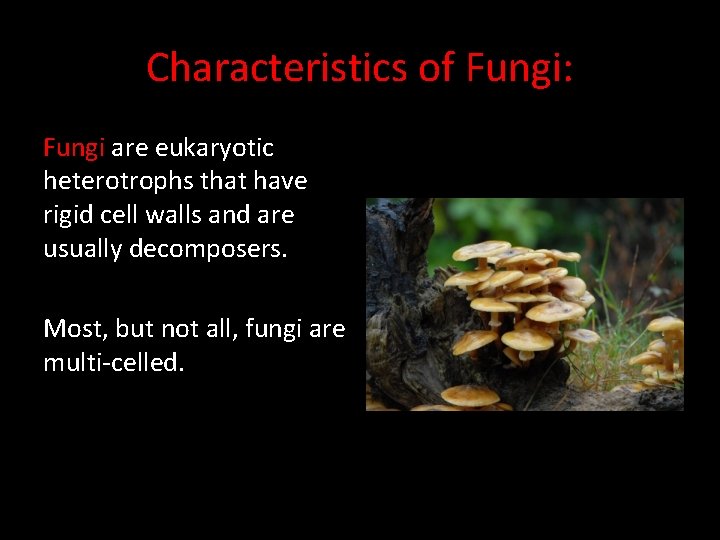
Characteristics of Fungi: Fungi are eukaryotic heterotrophs that have rigid cell walls and are usually decomposers. Most, but not all, fungi are multi-celled.
How fungi get energy: Fungi are heterotrophs, but they cannot move fast or catch their food. Instead, they live on their food by secreting digestive juices onto their food and then absorbing the dissolved nutrients. • Some fungi are decomposers; • Others are parasites: They harm the living organisms that they feed upon. https: //www. youtube. com/watch? v=Xu. Kj. BIBBAL 8
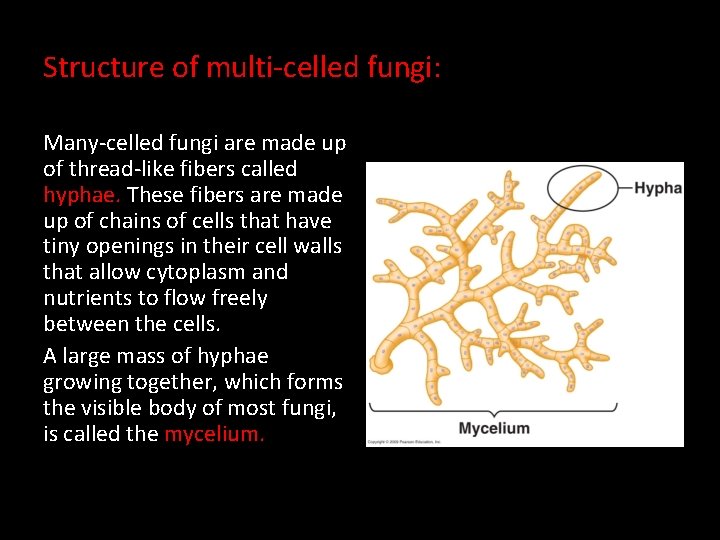
Structure of multi-celled fungi: Many-celled fungi are made up of thread-like fibers called hyphae. These fibers are made up of chains of cells that have tiny openings in their cell walls that allow cytoplasm and nutrients to flow freely between the cells. A large mass of hyphae growing together, which forms the visible body of most fungi, is called the mycelium.
How fungi reproduce: • Fungi usually reproduce asexually using spores or when some hyphae break off and grow into a new individual. • Sometimes fungi reproduce by growing specialized structures that release sexual spores into the environment.
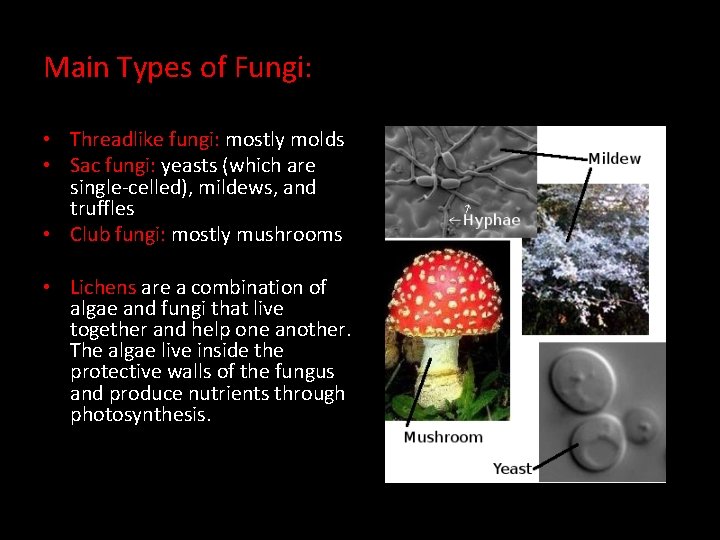
Main Types of Fungi: • Threadlike fungi: mostly molds • Sac fungi: yeasts (which are single-celled), mildews, and truffles • Club fungi: mostly mushrooms • Lichens are a combination of algae and fungi that live together and help one another. The algae live inside the protective walls of the fungus and produce nutrients through photosynthesis.
Homework: LO: Describe characteristics of fungi SLE: Work independently 1. Read p. 60 -66 2. Complete review questions on p. 67 (loose leaf; include full heading)
LO: Describe the environmental needs of fungi SLE: Work collaboratively Problem: Do bread molds prefer living in lighted or dark environments? Hypothesis: Independent variable: Dependent variable: 3 controls: Procedure: 1. Dampen two pieces of bread 2. Place each piece in a separate Ziplock bag 3. Place one bag in the light, and one in a sealed box 4. Wait one week 5. Compare mold growth Data: (will be qualitative) Conclusion:
LO: Describe characteristics of protists and fungi SLE: Meet or exceed NGSS Checkpoint quiz on protists and fungi: 1. What’s a protist? 2. How are the cells of protists different from bacterial cells? 3. What are plant-like, producer protists called? 4. How are fungi important to the overall environment? 5. Name three main groups of fungi.
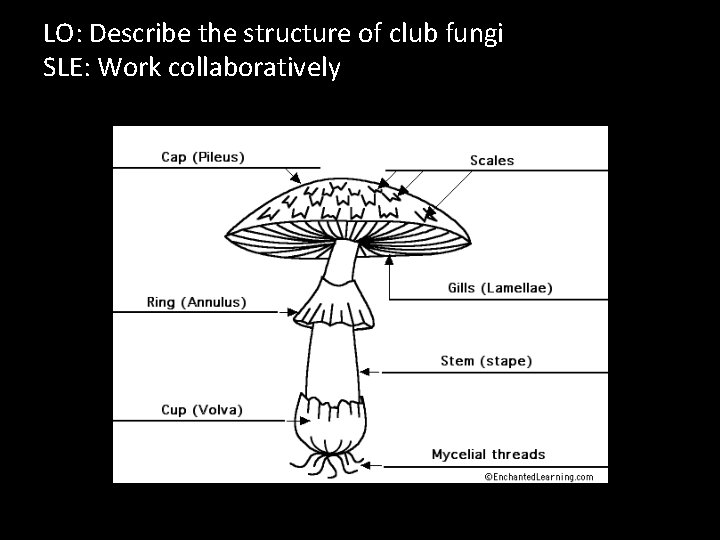
LO: Describe the structure of club fungi SLE: Work collaboratively
LO: Describe the structure of fungi SLE: Meet or exceed NGSS Checkpoint Quiz on Fungi: 1. List three major groups of fungi. 2. What are hyphae? What do they look like? 3. How do mushrooms reproduce? 4. Describe one way that fungi are helpful to other organisms (including humans). 5. Are fungi autotrophic? Explain how you know.
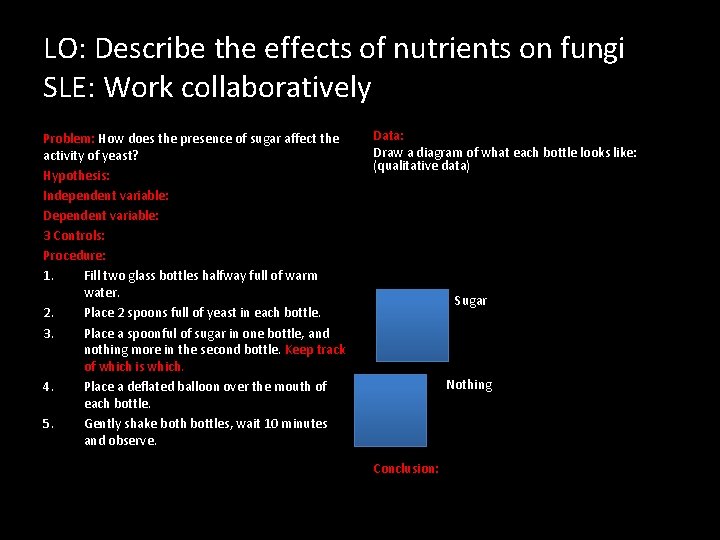
LO: Describe the effects of nutrients on fungi SLE: Work collaboratively Problem: How does the presence of sugar affect the activity of yeast? Hypothesis: Independent variable: Dependent variable: 3 Controls: Procedure: 1. Fill two glass bottles halfway full of warm water. 2. Place 2 spoons full of yeast in each bottle. 3. Place a spoonful of sugar in one bottle, and nothing more in the second bottle. Keep track of which is which. 4. Place a deflated balloon over the mouth of each bottle. 5. Gently shake both bottles, wait 10 minutes and observe. Data: Draw a diagram of what each bottle looks like: (qualitative data) Sugar Nothing Conclusion:
- Slides: 77