
Characteristics of Life https www ck 12 orgbiologycharacteristicsoflifelessonCharacteristicsofLife
Characteristics of Life https: //www. ck 12. org/biology/characteristics-of-life/lesson/Characteristics-of-Life. Advanced-BIO-ADV/? referrer=concept_details
Learning Objectives Identify the seven characteristics of living things. Define cell Describe an adaptation Explain a complex chemistry Describe the importance of homeostasis
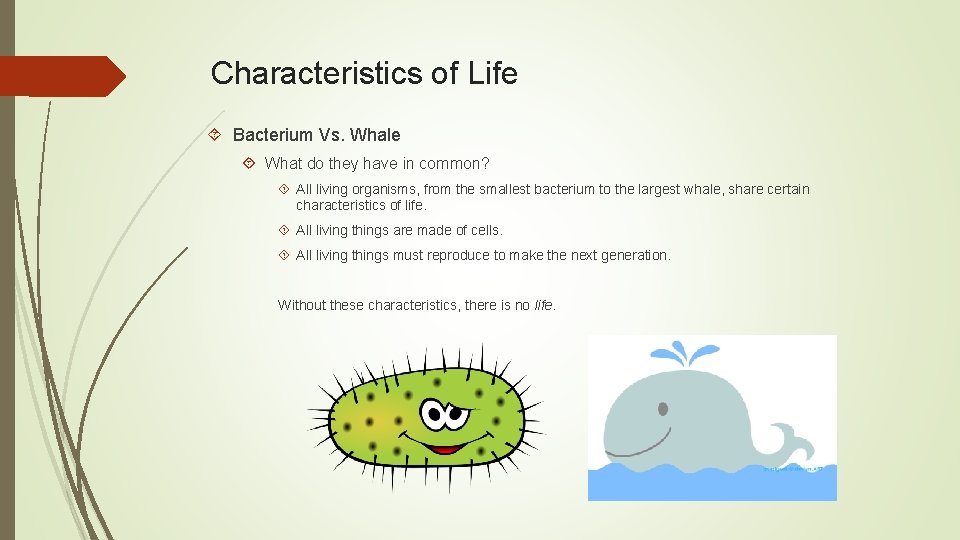
Characteristics of Life Bacterium Vs. Whale What do they have in common? All living organisms, from the smallest bacterium to the largest whale, share certain characteristics of life. All living things are made of cells. All living things must reproduce to make the next generation. Without these characteristics, there is no life.
Biology examines the structure, function, growth, origin, evolution, and distribution of living things. Biology classifies and describes organisms, their functions, how species come into existence, and the interactions they have with each other and with the natural environment. Four unifying principles form the foundation of modern biology Cell theory Evolution Genetics Homeostasis
What is life? Biologists define life by listing characteristics that living things share. Something that has ALL of the characteristics of life is considered to be alive. An individual living creature is called an organism. There are many characteristics that living organisms share. All living organisms: Respond to their environment Grow and change Have complex chemistry Maintain homeostasis Are built of structures called cells Pass their traits onto their offspring
#1 Responding to the Environment All living organisms respond to their environment. Living things know what is going on around them, and respond to changes in the environment. An adaptation refers to the process of becoming adjusted to an environment. Adaptation may include Structural Physiological Behavioral traits that improve an organism’s likelihood of survival, and thus, reproduction.
#2 Growth and Change All living organisms have the ability to grow and change. A seed may look like a pebble, but under the right conditions it will sprout and form a seedling that will grow into a larger plant. Even the smallest bacteria must grow (This bacteria will reproduce by dividing into two separate bacterium.
#3 Reproduction All living organisms must have the ability to reproduce. Living things make more organisms like themselves. If a species cannot create the next generation, the species will go extinct. Reproduction is the process of making the next generation and bay be a sexual or an asexual process. Sexual reproduction: involves two parents and the fusion of gametes, haploid sex cells from each parent (produces offspring that are genetically unique and increases genetic variation within a species). Asexual reproduction: involves only one parent. It occurs without a fusion of gametes (produces offspring that are all genetically identical to the parent).
#4 Have Complex Chemistry All living organisms have a complex chemistry. A flower has a complicated and beautiful structure. Transports water through its petals Produces pigment molecules Breaks down sugar for energy Undergoes a large number of other biochemical reactions that are needed for living organisms to stay alive. The sum of all the chemical reactions in a cell is metabolism.
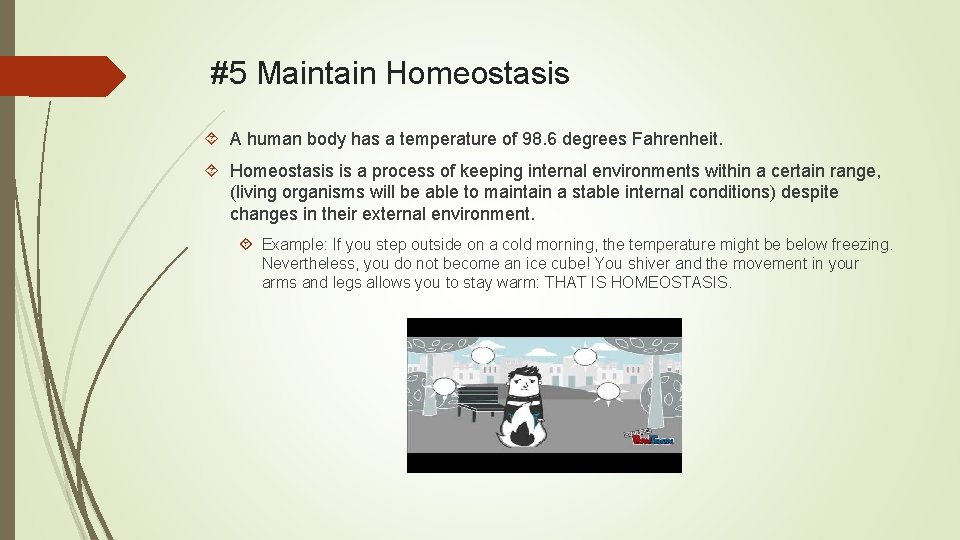
#5 Maintain Homeostasis A human body has a temperature of 98. 6 degrees Fahrenheit. Homeostasis is a process of keeping internal environments within a certain range, (living organisms will be able to maintain a stable internal conditions) despite changes in their external environment. Example: If you step outside on a cold morning, the temperature might be below freezing. Nevertheless, you do not become an ice cube! You shiver and the movement in your arms and legs allows you to stay warm: THAT IS HOMEOSTASIS.
#6 Built of Cells All living organisms are made of structures called cells. Organisms that are very different such as ferns, fish, and elephants all look similar at the cellular level. A cell is the basic unit of structure and function of all living organisms. All living organisms are made of one or more cells: a simple bacterium will consist of just one cell, whereas you are made of trillions of cells! Atoms -> molecules -> macromolecules -> organelles -> cells. Cells -> tissue -> organs -> organ systems -> entire organism.
Video to Watch
Your assignment Answer the 5 questions below on a separate sheet of paper, take a picture of it and upload to the assignment folder under “Characteristics of Life”. 1. What are the four unifying principles that form the foundation of modern biology? 2. Identify three of the seven characteristics of living things. 3. What is adaptiation? 4. Distinguish between metabolism and homeostasis. 5. What is a cell?
- Slides: 13