
Characteristics of Kinesthetic Learners Tune Paruparong Bukid Kinesthetic
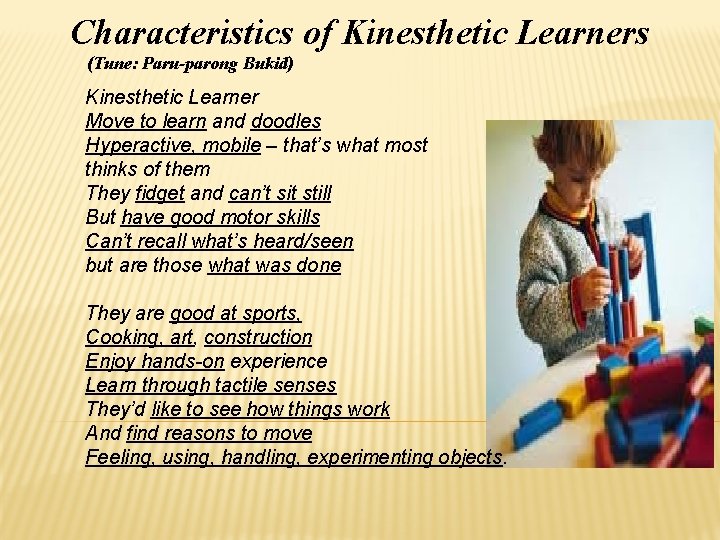
Characteristics of Kinesthetic Learners (Tune: Paru-parong Bukid) Kinesthetic Learner Move to learn and doodles Hyperactive, mobile – that’s what most thinks of them They fidget and can’t sit still But have good motor skills Can’t recall what’s heard/seen but are those what was done They are good at sports, Cooking, art, construction Enjoy hands-on experience Learn through tactile senses They’d like to see how things work And find reasons to move Feeling, using, handling, experimenting objects.
Characteristics of Kinesthetic Learners • Want to feel, smell, and taste everything. • Good at drawing designs, art, cooking, construction, engineering, sports, mechanics, and using appliances and tools • Need opportunities to be mobile; Sits near the door or someplace else and take frequent breaks where they can easily get up and move around.
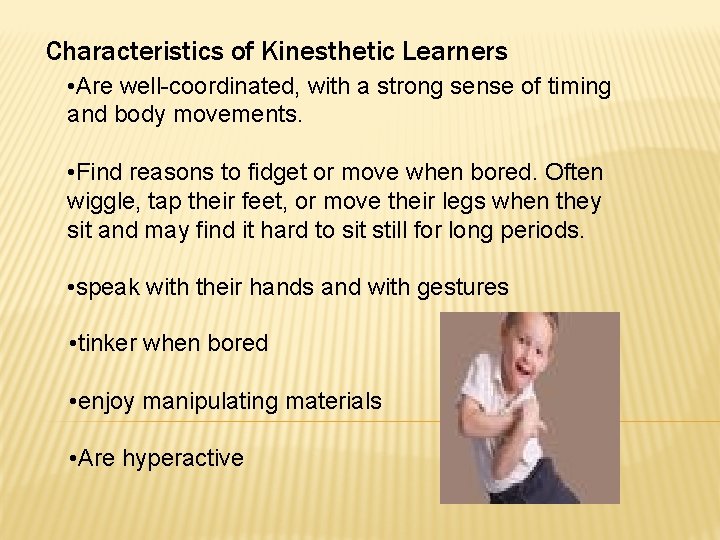
Characteristics of Kinesthetic Learners • Are well-coordinated, with a strong sense of timing and body movements. • Find reasons to fidget or move when bored. Often wiggle, tap their feet, or move their legs when they sit and may find it hard to sit still for long periods. • speak with their hands and with gestures • tinker when bored • enjoy manipulating materials • Are hyperactive
K i n e s t h e t I c Learners Involves feeling, handling, using, manipulating, sorting, assembling or experimenting with concrete objects or by using full body movement. Large and small muscles hold memory so involving movement in the learning process creates muscle memory.
HOW DO KINESTHETIC LEARNERS LEARN
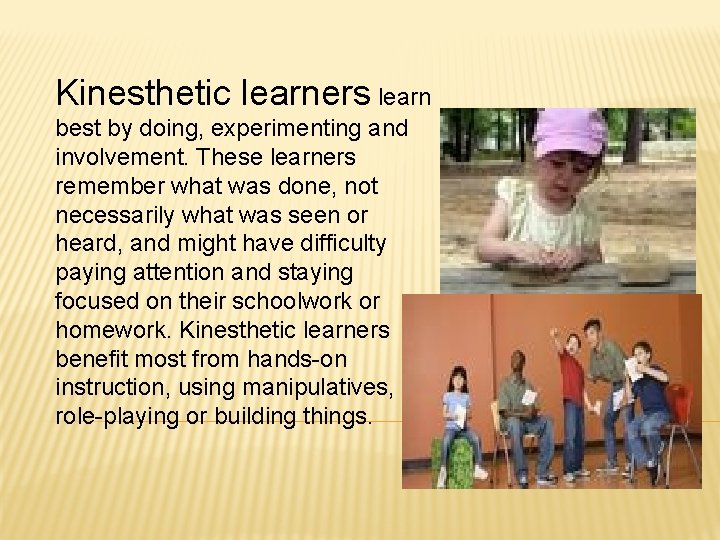
Kinesthetic learners learn best by doing, experimenting and involvement. These learners remember what was done, not necessarily what was seen or heard, and might have difficulty paying attention and staying focused on their schoolwork or homework. Kinesthetic learners benefit most from hands-on instruction, using manipulatives, role-playing or building things.
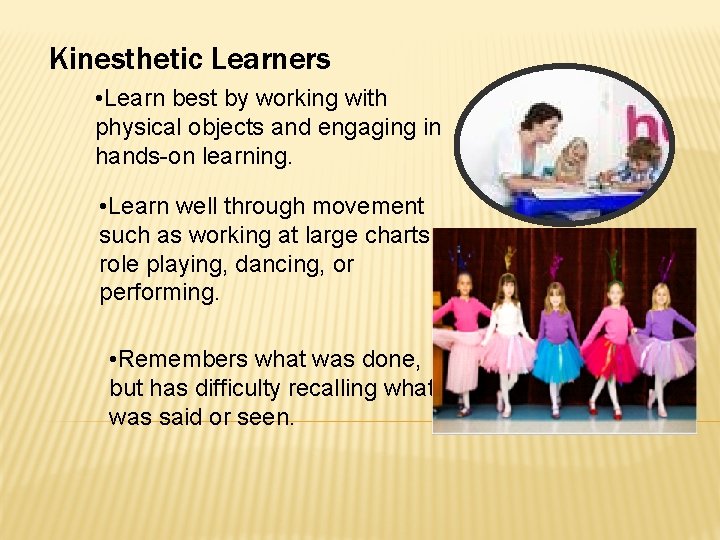
Kinesthetic Learners • Learn best by working with physical objects and engaging in hands-on learning. • Learn well through movement such as working at large charts, role playing, dancing, or performing. • Remembers what was done, but has difficulty recalling what was said or seen.
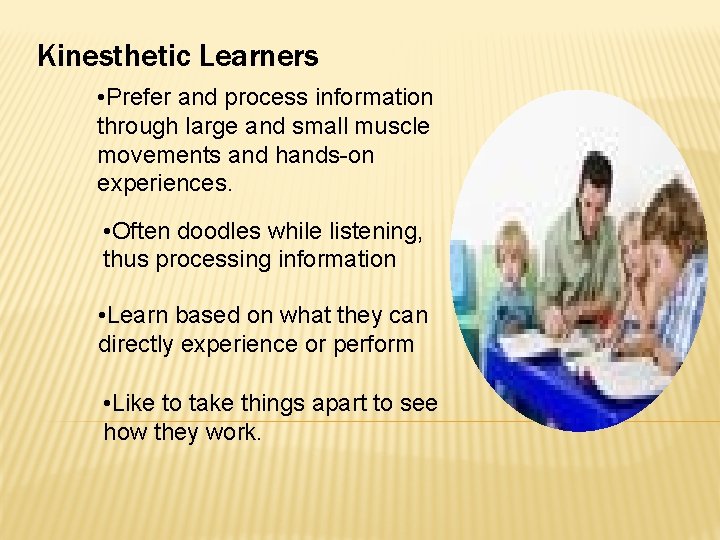
Kinesthetic Learners • Prefer and process information through large and small muscle movements and hands-on experiences. • Often doodles while listening, thus processing information • Learn based on what they can directly experience or perform • Like to take things apart to see how they work.
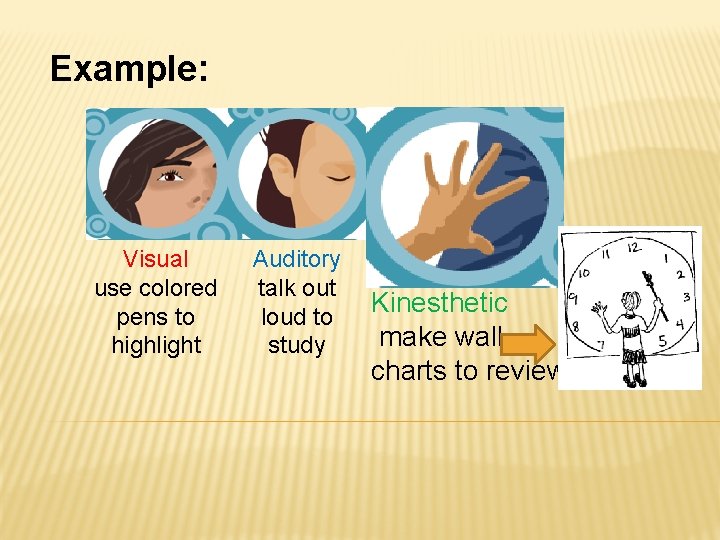
Example: Visual use colored pens to highlight Auditory talk out loud to study Kinesthetic make wall charts to review
Kinesthetic learners do things differently but that doesn’t mean they do them worse. Teach concepts with concrete examples rather than just numbers on a chalkboard. . Let them study in several short blocks of time, instead of one extended time period.
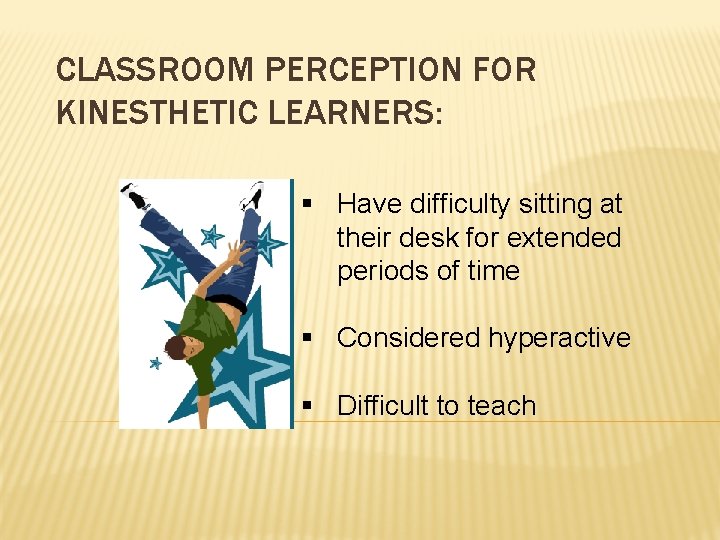
CLASSROOM PERCEPTION FOR KINESTHETIC LEARNERS: § Have difficulty sitting at their desk for extended periods of time § Considered hyperactive § Difficult to teach
NOW WE KNOW BETTER… … …that these students aren’t being difficult …that they are kinesthetic learners they just learn differently and learn best when they can move around and engage their small and large muscles groups.
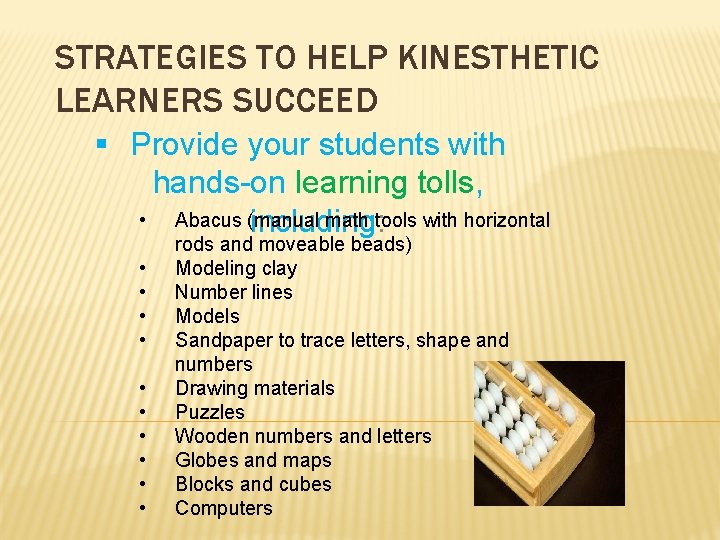
STRATEGIES TO HELP KINESTHETIC LEARNERS SUCCEED § Provide your students with hands-on learning tolls, • Abacus (manual math tools with horizontal including: • • • rods and moveable beads) Modeling clay Number lines Models Sandpaper to trace letters, shape and numbers Drawing materials Puzzles Wooden numbers and letters Globes and maps Blocks and cubes Computers
STRATEGIES TO HELP KINESTHETIC LEARNERS SUCCEED § Provide your students with hands-on learning opportunities, including: • • • Experiments Fieldtrips Role playing Projects Games
TEACHERS CAN HELP KINESTHETIC LEARNERS IN THE CLASSROOM BY: § Providing a varied menu of learning activities. • • Showing them how to do things. Use letter tiles and magnetic letters to teach spelling. Keep lessons short and offers breaks in between each part. Play games, spelling games, board games, flashcards. Used alphabet tiles to build words and word tiles to build sentences. Make flashcards with kinesthetic learners. Teach math by finding things to count (pennies,
TEACHERS CAN HELP KINESTHETIC LEARNERS IN THE CLASSROOM BY: § § § § Doing activities that require the learners to move around. (information trail or treasure hunt) Providing learning aids that students can handle. (object selection) Giving lots of opportunities for writing. Encourage to role play the learning. Making appropriate use of technology. (computers, video, DVD) Keeping it real. ( wrapping – up abstract concepts in real tasks) Keeping it “really real”. (museum visit, field trips) Using games for “serious fun”.
KINESTHETIC LEARNERS LEARNING OUTPUT MUST BE SUCCESSFUL BY ALLOWING THEM TO: § § § Rework any notes they have made (with examples) Associate specific examples with abstract concepts Include pictorial cues in the notes Encourage the students to carry kinesthetic activity at home Practice writing the kinds of answers they will face in the examination Talk over their learning with other students who learn in the same way.
Kinesthetic learning is a modality that seems to be the most fixed. Kinesthetic learners find it harder to break out of this learning style and adopt to other learning styles. In an average school class, one third (1/3) of students may be kinesthetic learners. This group often misunderstood and labelled as “underachieving”. While this may sometimes accurate, it’s also true that many of them did not fulfill their potentials because their learning tools and opportunities does not fully meet their needs to succeed.
As TEACHERS , we should be open to the possibility that kinesthetic learning may alleviate some real difficulties that some students encounter in our school systems.
We need to help students maximise their learning potential so they can take their place in the adult world, where it is more and more important to become skilled in diverse ways, so helping all students not just kinesthetic learners, to use effectively a kinesthetic learning style when it is
REFERENCES: Wong, Linda. Essential Study Skills, 7 th ed. Massachusetts: Wadsworth, Cengage Learning. 2012. Print. Web search by Google: Learning Styles and Differences, Education. com Gloria Moskowitz-Sweet, Licensed Clinical Social Worker of Parents Place Express: How to Teach Kinesthetic Learners, e. How. com April 2012

THANK YOU!
- Slides: 23