
CHARACTERISTICS OF GROUNDWATER IN LOKOJA NIGERIA BY SEAN
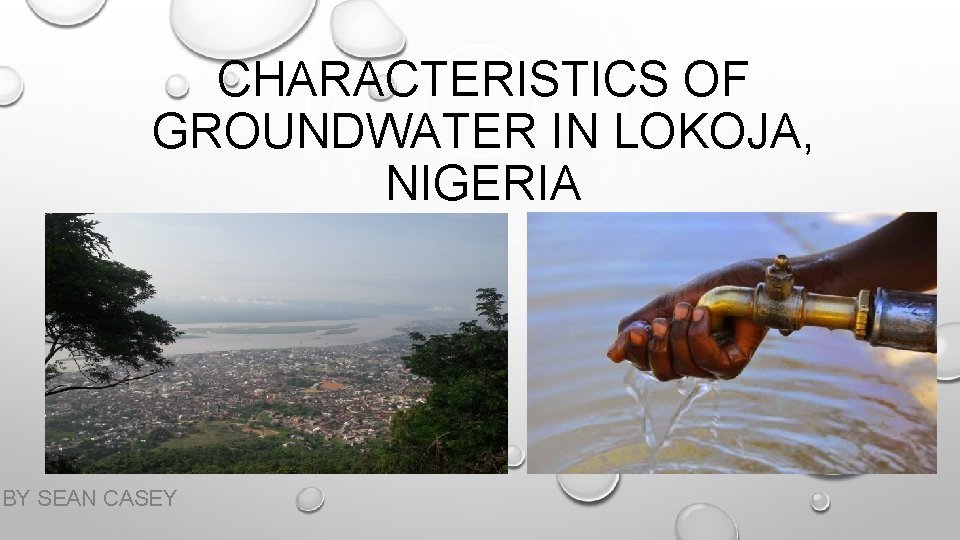
CHARACTERISTICS OF GROUNDWATER IN LOKOJA, NIGERIA BY SEAN CASEY
Overview • Full Article Title: Hydrochemistry and stable Isotopes (18 O and 2 H) characteristics of groundwater in Lokoja and its environs, Central Nigeria • Authors: Rufai Ayuba, Moshood N. Tijani, Daniel Snow • Published: September 28, 2019 • Published for: Springer Nature, a global academic publishing company
Introduction • Purpose: To determine hydrochemical and stable isotope characteristics of groundwater in Lokoja • Groundwater is the focus of this study because: • Surface waters in the area are contaminated from anthropogenic activity, and the cost of treatment to make it potable is high • Groundwater is the most common source for drinking water in Lokoja, because government pipe-provided water is unreliable and does not reach all communities in the area • The Lokoja area receives adequate rainfall and recharge to resupply the groundwater aquifers, making it a practical drinking water supply. In addition to precipitation, these aquifers are supplied from the River Niger, River Benue, and River Mimi, made possible by permeations from underground fracturing, jointing, and shearing.
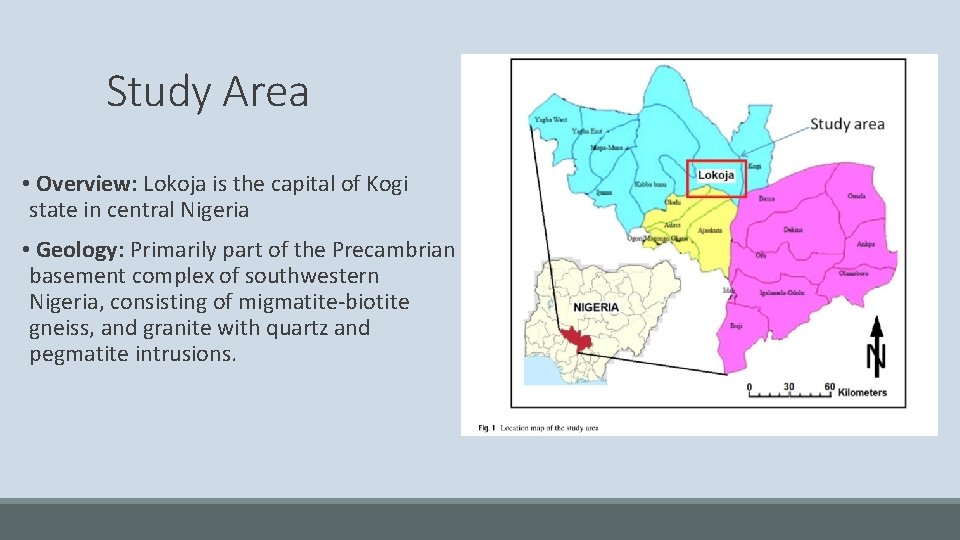
Study Area • Overview: Lokoja is the capital of Kogi state in central Nigeria • Geology: Primarily part of the Precambrian basement complex of southwestern Nigeria, consisting of migmatite-biotite gneiss, and granite with quartz and pegmatite intrusions.
Methods • Sampling: 39 sites were sampled, two samples were collected at each site • Samples were collected in cleaned 120 m. L plastic bottles • One sample was collected for cation analysis, the other for anion analysis • Cation samples were acidified to less than 2 p. H to prevent precipitation of ions • Analysis: Multiple testing methods were used to determine p. H, TDS, and ion concentrations of the collected samples • Hanna pen used for p. H, TDS, and electrical conductivity (EC) • Atomic absorption spectrophotometry (AAS) used for Ca 2+, Mg 2+ , Na+ and K+ (major cation) concentrations • Ion chromatography (IC) used for NO 3 - , SO 42 - , and Cl- (major anion) concentrations • Mass Spectrometry used for determining 18 O and 2 H (stable isotope) concentrations • Titration used for alkalinity (HCO 3 - )
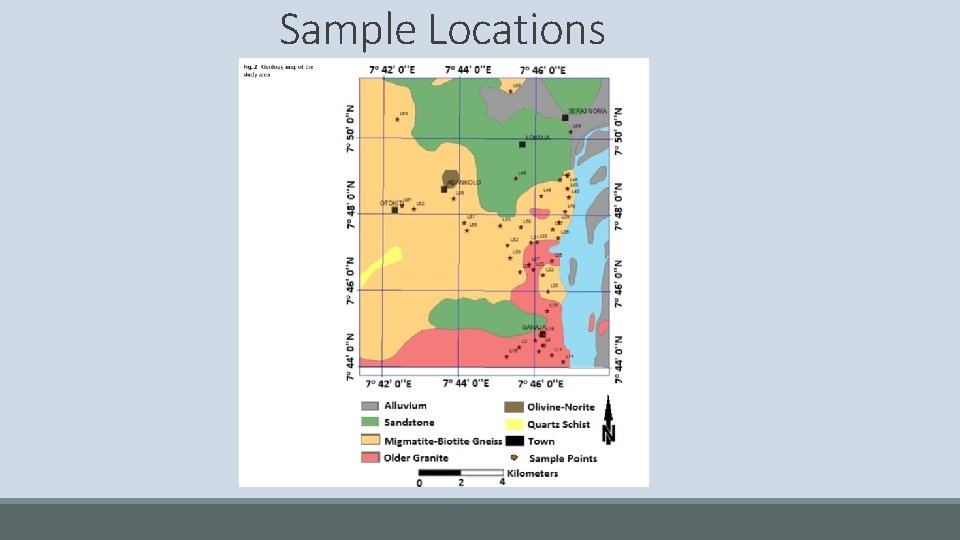
Sample Locations
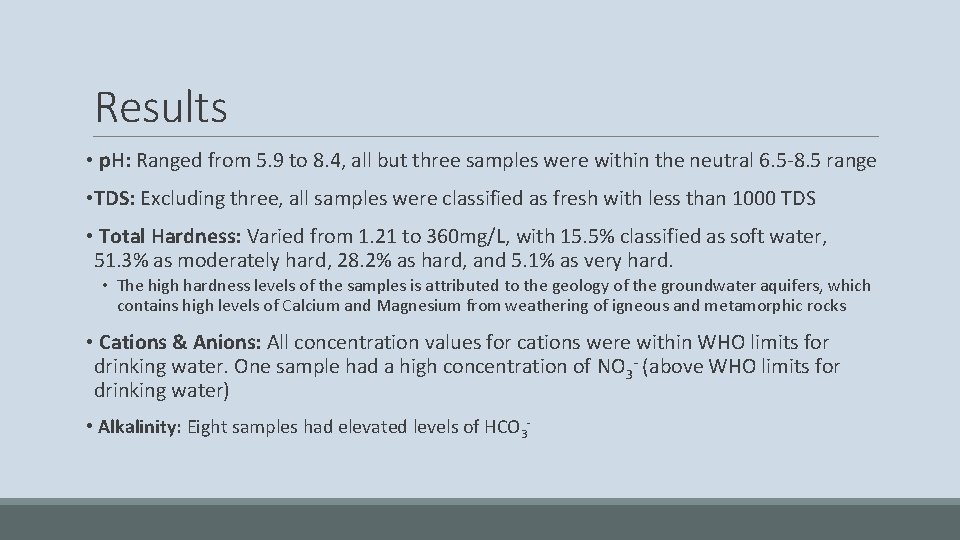
Results • p. H: Ranged from 5. 9 to 8. 4, all but three samples were within the neutral 6. 5 -8. 5 range • TDS: Excluding three, all samples were classified as fresh with less than 1000 TDS • Total Hardness: Varied from 1. 21 to 360 mg/L, with 15. 5% classified as soft water, 51. 3% as moderately hard, 28. 2% as hard, and 5. 1% as very hard. • The high hardness levels of the samples is attributed to the geology of the groundwater aquifers, which contains high levels of Calcium and Magnesium from weathering of igneous and metamorphic rocks • Cations & Anions: All concentration values for cations were within WHO limits for drinking water. One sample had a high concentration of NO 3 - (above WHO limits for drinking water) • Alkalinity: Eight samples had elevated levels of HCO 3 -
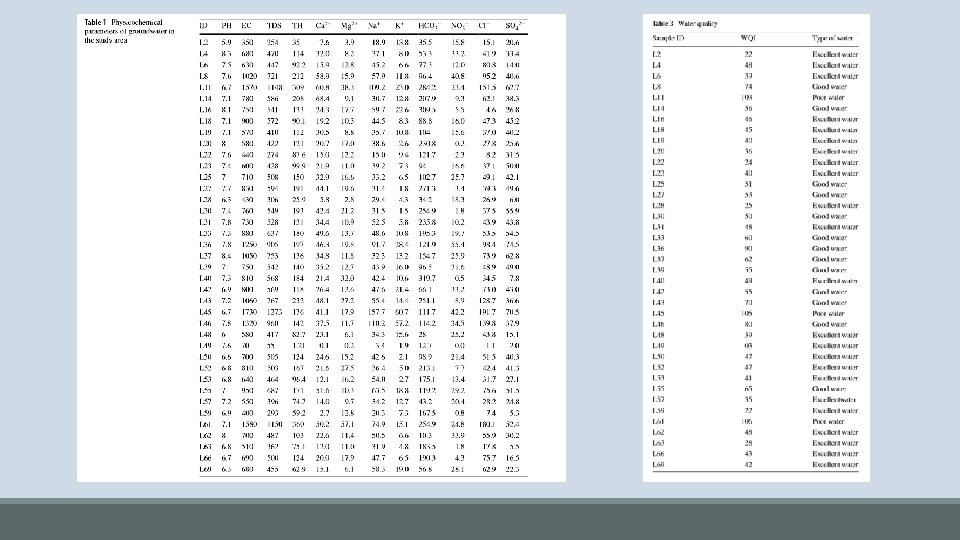
Conclusions • For Drinking: 59% of samples represent excellent water, 33. 3% represent good water, and 7. 7% represent poor water • Suitability is determined using the WQI (water quality index) technique • WQI is calculated by weighting certain variables based on their importance to drinking water and producing a rating that considers the influences on water quality in the area • For Irrigation: 69. 2% suitable, 20. 8% unsuitable • Suitability is determined using sodium adsorption ratio (SAR) and sodium percentage • High SAR and Na% can increase compaction and decrease porosity in soils, undesirable for irrigation
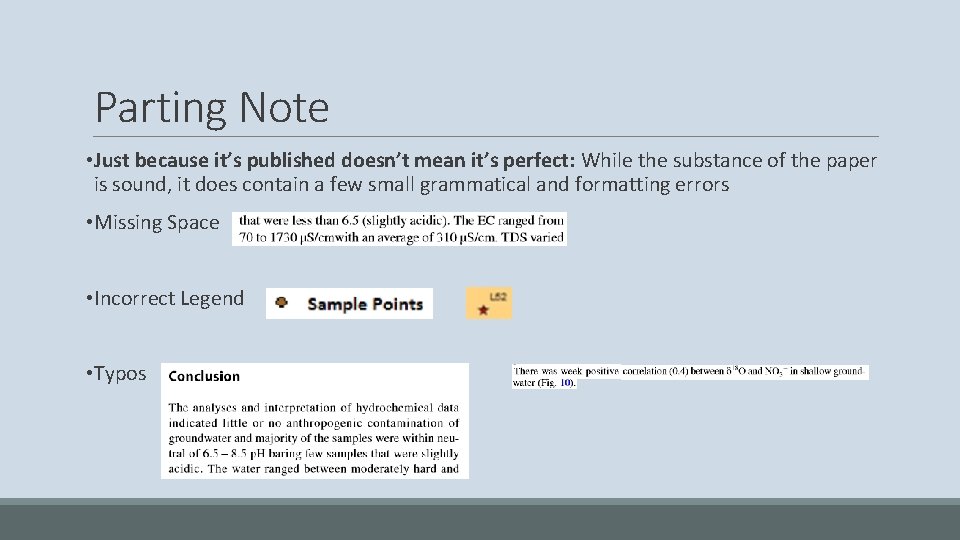
Parting Note • Just because it’s published doesn’t mean it’s perfect: While the substance of the paper is sound, it does contain a few small grammatical and formatting errors • Missing Space • Incorrect Legend • Typos

Questions?
- Slides: 11