
Characteristics of Fluids How do fluids move Review
- Slides: 13
Characteristics of Fluids How do fluids move?
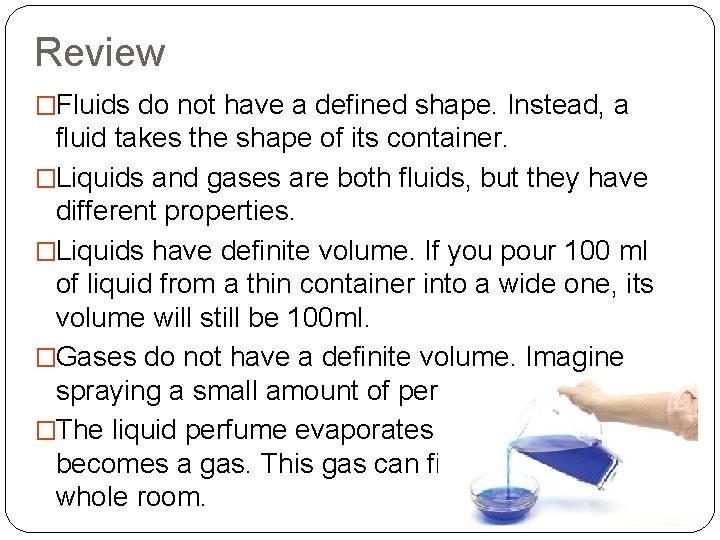
Review �Fluids do not have a defined shape. Instead, a fluid takes the shape of its container. �Liquids and gases are both fluids, but they have different properties. �Liquids have definite volume. If you pour 100 ml of liquid from a thin container into a wide one, its volume will still be 100 ml. �Gases do not have a definite volume. Imagine spraying a small amount of perfume into the air. �The liquid perfume evaporates and becomes a gas. This gas can fill a whole room.
Particle Theory �The particle theory of matter helps explain why fluids behave the way they do. �The main points of the particle theory are: �All matter is made up of tiny particles �Particles have spaces between them �Particles are moving all of the time �Particles move faster when they are heated
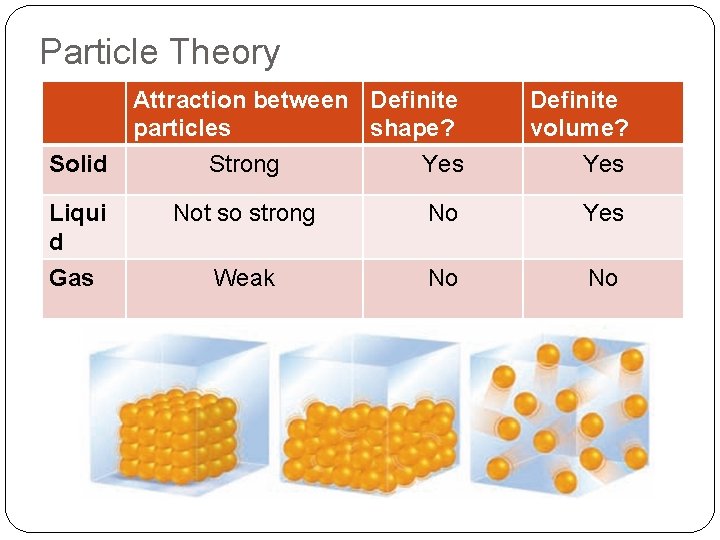
Particle Theory �Solid: �The particles of a solid only vibrate. �They do not move very far because the force of attraction between them is so strong. �They are stuck together so tightly that they cannot move past one another. �This strong attraction between particles gives solids their definite shape and volume.
Particle Theory �Liquid: �The particles of liquids are farther apart than particles of solids. �The force of attraction is strong enough to hold the liquid together. That is why liquids have a definite volume. �The force is weak enough that the particles can move past one another. That is why liquids do not have a definite shape.
Particle Theory �Gas: �The particles of a gas are much farther apart, and their force of attraction is weak. �That is why gas particles do not have a definite shape or volume.
Particle Theory Solid Attraction between Definite particles shape? Strong Yes Definite volume? Yes Liqui d Not so strong No Yes Gas Weak No No
Ability To Flow �Particles of liquids and gases are free to move about. That is why fluids are able to flow. �Their ability to flow is a key characteristic of fluids. �Here are some examples of how fluids flow: �Oil can flow through pipes �Air can flow around the wings of a plane. �Water can flow over rocks in a river.
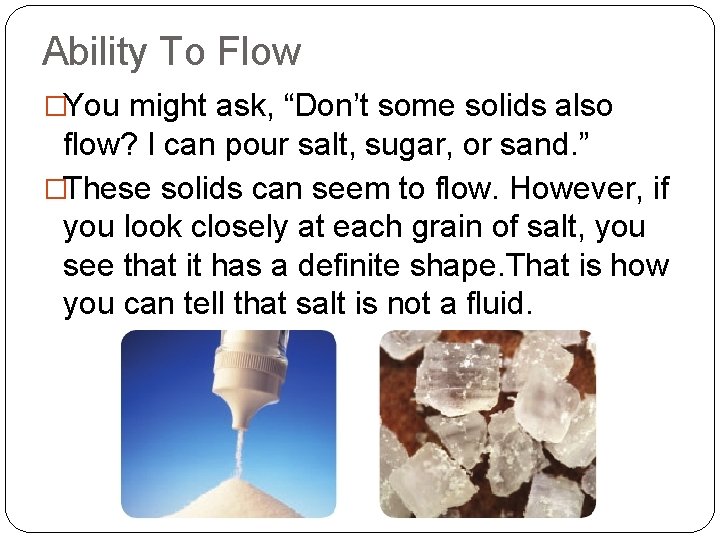
Ability To Flow �You might ask, “Don’t some solids also flow? I can pour salt, sugar, or sand. ” �These solids can seem to flow. However, if you look closely at each grain of salt, you see that it has a definite shape. That is how you can tell that salt is not a fluid.
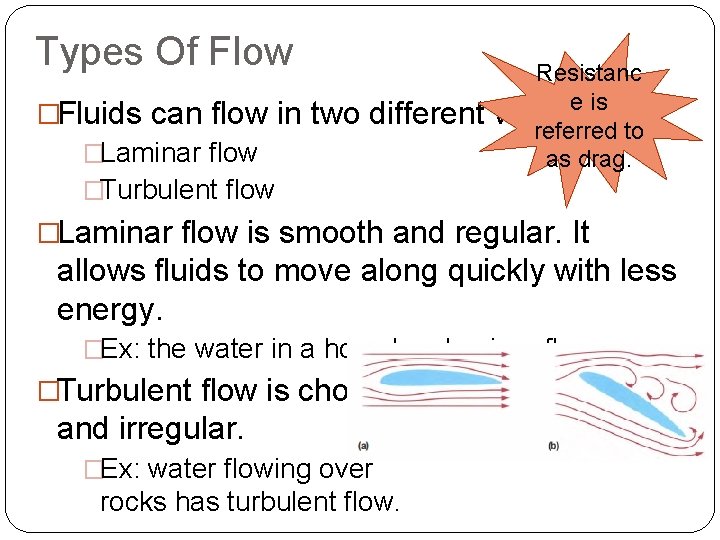
Types Of Flow �Fluids can flow in two different �Laminar flow �Turbulent flow Resistanc e is ways: referred to as drag. �Laminar flow is smooth and regular. It allows fluids to move along quickly with less energy. �Ex: the water in a hose has laminar flow �Turbulent flow is choppy and irregular. �Ex: water flowing over rocks has turbulent flow.
Types Of Flow �Imagine a river flowing down a hill. The white foam that splashes up shows that the water has turbulent flow. �Turbulence can also be found in the human body. In a healthy body, blood flows smoothly through arteries. �Over time, material called plaque can build up in arteries. Plaque build-up creates turbulence in the blood flow. �Turbulent blood flow can cause blood clots which can block arteries and cause heart attacks or strokes.
Taming Turbulence �Objects such as cars, boats, and planes move through fluids. �Laminar flow around these objects lets them move more easily through the fluid. �Laminar flow makes the object more efficient because less energy is needed to push the object through the fluid. �Scientists and engineers study laminar and turbulent flow so that they can make fluids flow more smoothly. �They may also design objects that are streamlined.
Check Your Thinking 1. What are some examples of turbulent flow and laminar flow in our lives? 2. Why might a car manufacturer change the shape of side mirrors on a particular model? 3. Would you prefer turbulent flow or laminar flow around a racing bicycle? Which would you like for white water rafting?