
Characteristics of Effective Classroom Rules A Review of
- Slides: 18
Characteristics of Effective Classroom Rules: A Review of the Literature Peter Alter, Ph. D. Saint Mary’s College of California Todd Haydon, Ph. D. University of Cincinnati Terry Scott, Ph. D. University of Louisville
Statement of the Problem Assistance with classroom management is the most frequent request made by teachers. Ineffective classroom management impacts teachers and student in negative ways. Student discipline problems were the second most frequently cited reason (after salary) for teacher dissatisfaction. Teacher education programs provide inadequate preparation in classroom management.
Classroom Rules Classroom rules are commonly identified as an integral part of an effective classroom management system. They are very easily implemented and focus on the prevention of challenging behaviors before they occur. In a commissioned report, Greenberg and colleagues (2014) describe classroom rules as one of the ‘Big Five’ strategies in a list that also included (1) routines, (2) praise, (3) consequences for misbehavior, and (4) engagement.
Characteristics of Classroom Rules Secondary sources (classroom management textbooks, practitioner-based articles, etc…) devote considerable effort to describe characteristics of effective classroom rules. Unfortunately, this array of secondary sources has not been uniform in their recommendations.
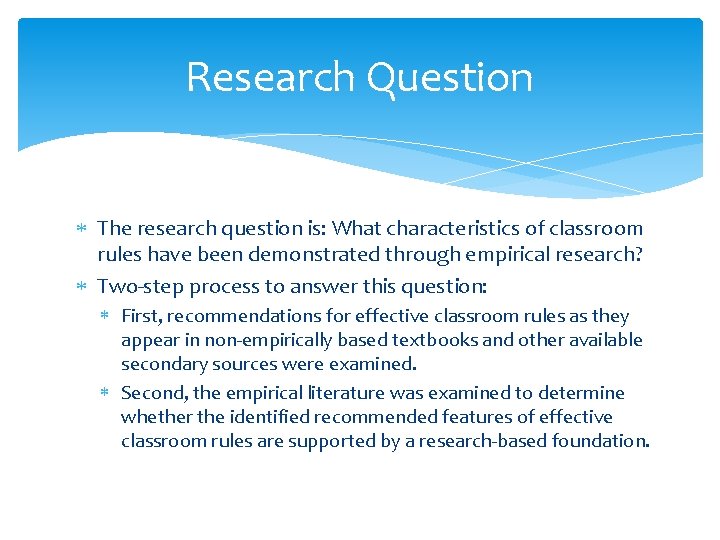
Research Question The research question is: What characteristics of classroom rules have been demonstrated through empirical research? Two-step process to answer this question: First, recommendations for effective classroom rules as they appear in non-empirically based textbooks and other available secondary sources were examined. Second, the empirical literature was examined to determine whether the identified recommended features of effective classroom rules are supported by a research-based foundation.
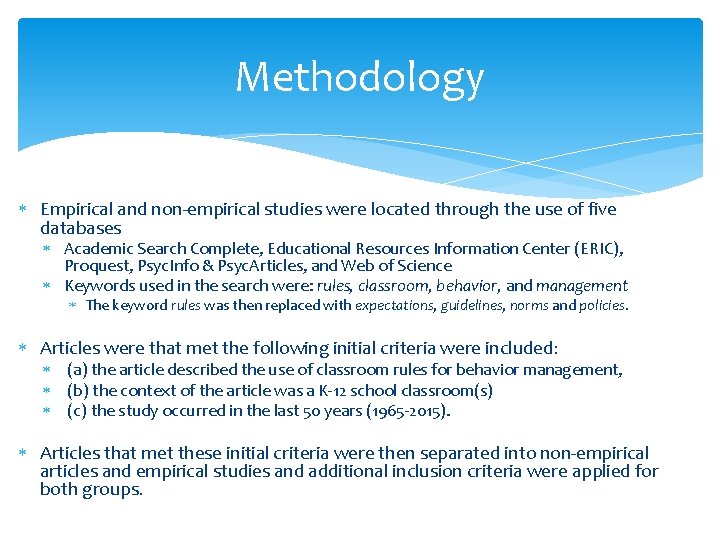
Methodology Empirical and non-empirical studies were located through the use of five databases Academic Search Complete, Educational Resources Information Center (ERIC), Proquest, Psyc. Info & Psyc. Articles, and Web of Science Keywords used in the search were: rules, classroom, behavior, and management The keyword rules was then replaced with expectations, guidelines, norms and policies. Articles were that met the following initial criteria were included: (a) the article described the use of classroom rules for behavior management, (b) the context of the article was a K-12 school classroom(s) (c) the study occurred in the last 50 years (1965 -2015). Articles that met these initial criteria were then separated into non-empirical articles and empirical studies and additional inclusion criteria were applied for both groups.
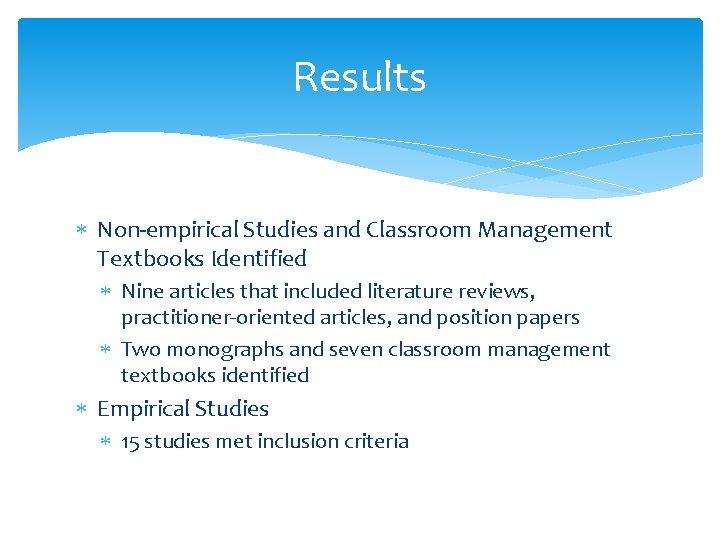
Results Non-empirical Studies and Classroom Management Textbooks Identified Nine articles that included literature reviews, practitioner-oriented articles, and position papers Two monographs and seven classroom management textbooks identified Empirical Studies 15 studies met inclusion criteria
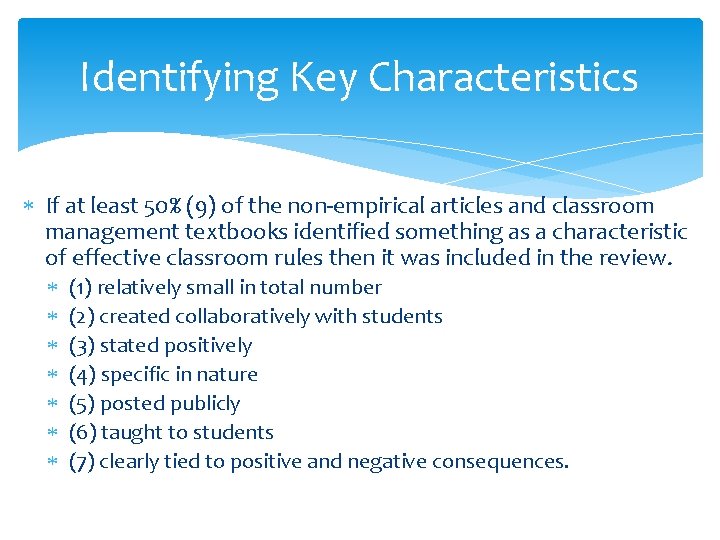
Identifying Key Characteristics If at least 50% (9) of the non-empirical articles and classroom management textbooks identified something as a characteristic of effective classroom rules then it was included in the review. (1) relatively small in total number (2) created collaboratively with students (3) stated positively (4) specific in nature (5) posted publicly (6) taught to students (7) clearly tied to positive and negative consequences.
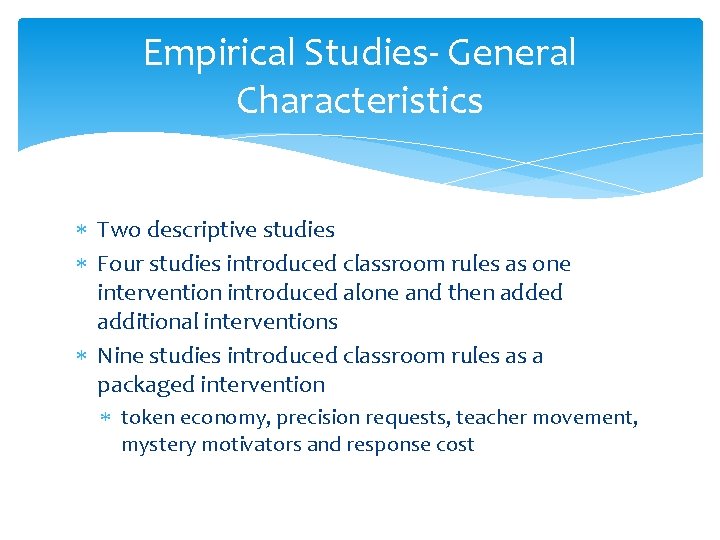
Empirical Studies- General Characteristics Two descriptive studies Four studies introduced classroom rules as one intervention introduced alone and then added additional interventions Nine studies introduced classroom rules as a packaged intervention token economy, precision requests, teacher movement, mystery motivators and response cost
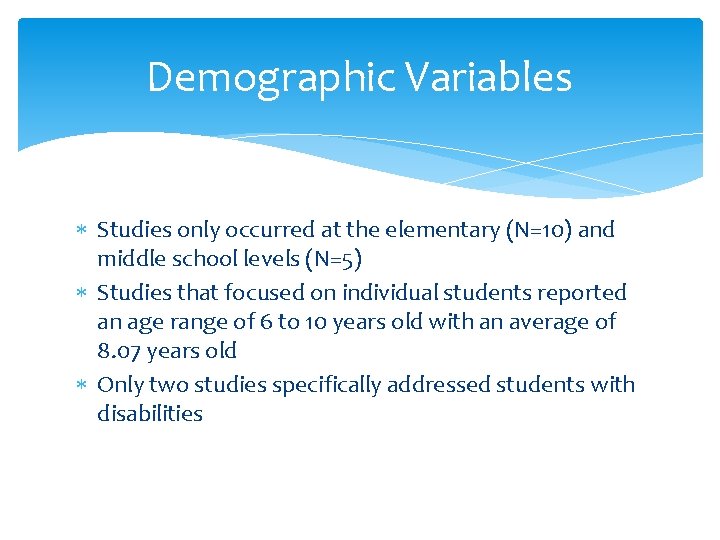
Demographic Variables Studies only occurred at the elementary (N=10) and middle school levels (N=5) Studies that focused on individual students reported an age range of 6 to 10 years old with an average of 8. 07 years old Only two studies specifically addressed students with disabilities
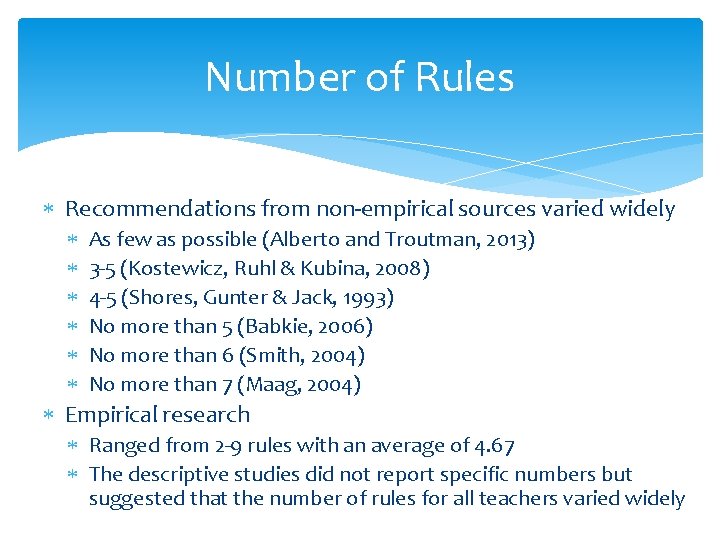
Number of Rules Recommendations from non-empirical sources varied widely As few as possible (Alberto and Troutman, 2013) 3 -5 (Kostewicz, Ruhl & Kubina, 2008) 4 -5 (Shores, Gunter & Jack, 1993) No more than 5 (Babkie, 2006) No more than 6 (Smith, 2004) No more than 7 (Maag, 2004) Empirical research Ranged from 2 -9 rules with an average of 4. 67 The descriptive studies did not report specific numbers but suggested that the number of rules for all teachers varied widely
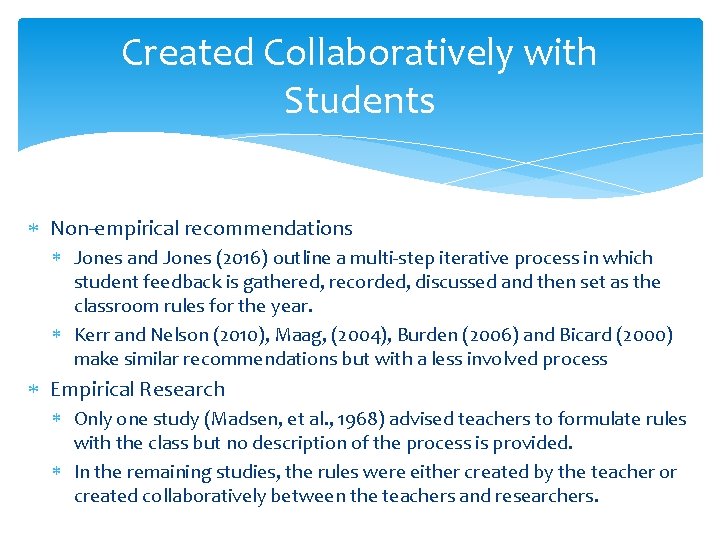
Created Collaboratively with Students Non-empirical recommendations Jones and Jones (2016) outline a multi-step iterative process in which student feedback is gathered, recorded, discussed and then set as the classroom rules for the year. Kerr and Nelson (2010), Maag, (2004), Burden (2006) and Bicard (2000) make similar recommendations but with a less involved process Empirical Research Only one study (Madsen, et al. , 1968) advised teachers to formulate rules with the class but no description of the process is provided. In the remaining studies, the rules were either created by the teacher or created collaboratively between the teachers and researchers.
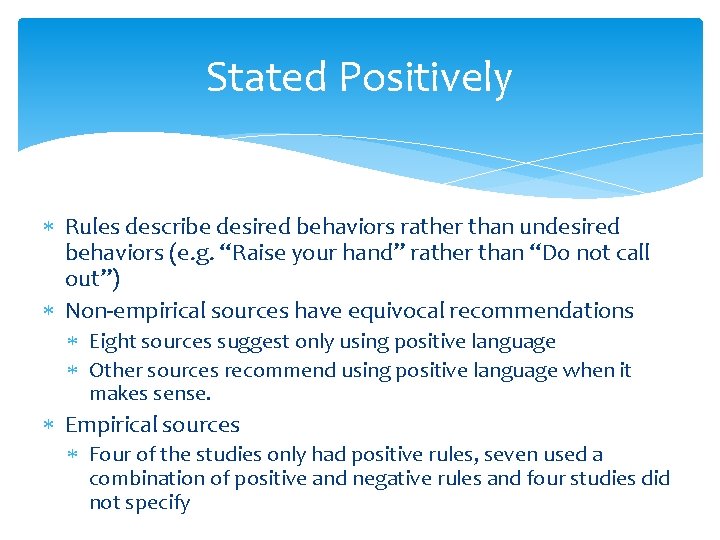
Stated Positively Rules describe desired behaviors rather than undesired behaviors (e. g. “Raise your hand” rather than “Do not call out”) Non-empirical sources have equivocal recommendations Eight sources suggest only using positive language Other sources recommend using positive language when it makes sense. Empirical sources Four of the studies only had positive rules, seven used a combination of positive and negative rules and four studies did not specify
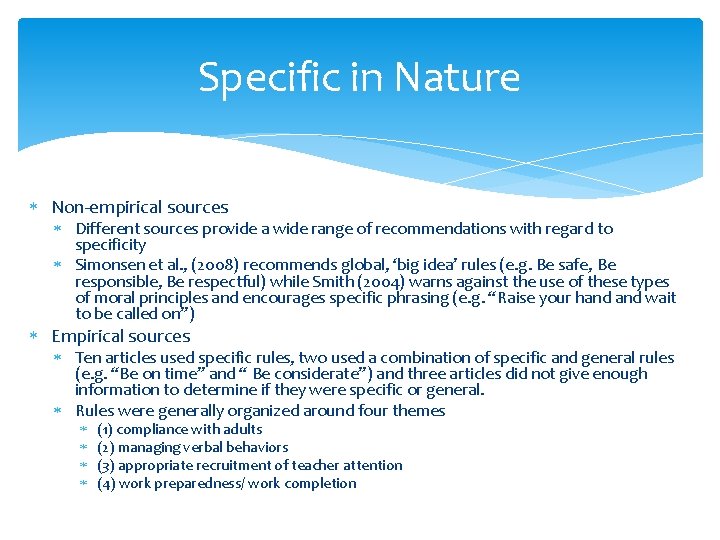
Specific in Nature Non-empirical sources Different sources provide a wide range of recommendations with regard to specificity Simonsen et al. , (2008) recommends global, ‘big idea’ rules (e. g. Be safe, Be responsible, Be respectful) while Smith (2004) warns against the use of these types of moral principles and encourages specific phrasing (e. g. “Raise your hand wait to be called on”) Empirical sources Ten articles used specific rules, two used a combination of specific and general rules (e. g. “Be on time” and “ Be considerate”) and three articles did not give enough information to determine if they were specific or general. Rules were generally organized around four themes (1) compliance with adults (2) managing verbal behaviors (3) appropriate recruitment of teacher attention (4) work preparedness/ work completion
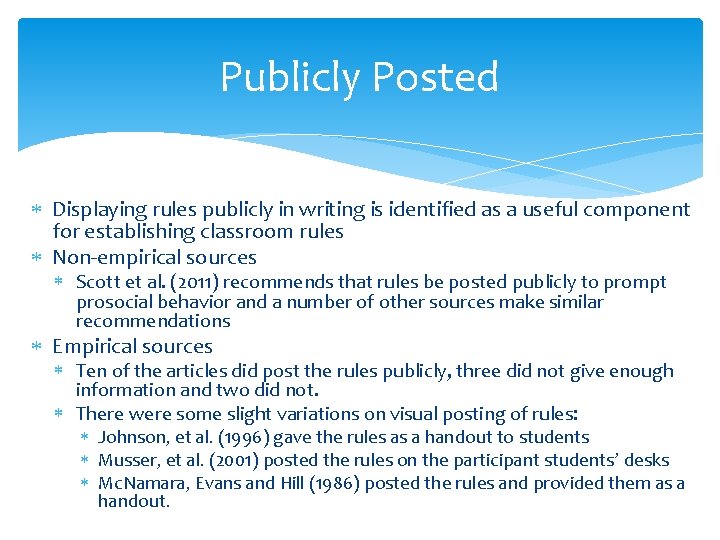
Publicly Posted Displaying rules publicly in writing is identified as a useful component for establishing classroom rules Non-empirical sources Scott et al. (2011) recommends that rules be posted publicly to prompt prosocial behavior and a number of other sources make similar recommendations Empirical sources Ten of the articles did post the rules publicly, three did not give enough information and two did not. There were some slight variations on visual posting of rules: Johnson, et al. (1996) gave the rules as a handout to students Musser, et al. (2001) posted the rules on the participant students’ desks Mc. Namara, Evans and Hill (1986) posted the rules and provided them as a handout.
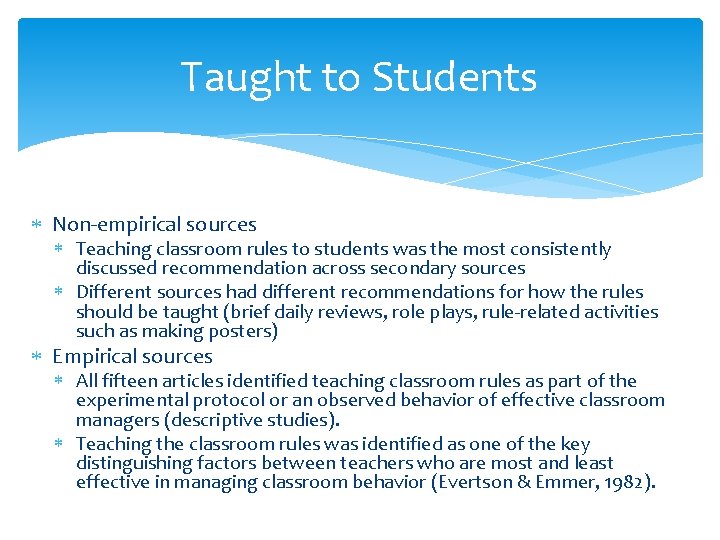
Taught to Students Non-empirical sources Teaching classroom rules to students was the most consistently discussed recommendation across secondary sources Different sources had different recommendations for how the rules should be taught (brief daily reviews, role plays, rule-related activities such as making posters) Empirical sources All fifteen articles identified teaching classroom rules as part of the experimental protocol or an observed behavior of effective classroom managers (descriptive studies). Teaching the classroom rules was identified as one of the key distinguishing factors between teachers who are most and least effective in managing classroom behavior (Evertson & Emmer, 1982).
Tied to Positive and Negative Consequences Non-empirical sources Kerr and Nelson (2010) specify that these consequences must go beyond threats or lectures and must have consistent follow-through. Bicard (2000) and Shores, Gunter and Jack (1993) make similar recommendations and also encourage that the rules and their consequences be reviewed together during teaching/ re-teaching moments. Empirical sources All thirteen of the experimental articles included in this review specified the use of consequences tied to the identified rules In the two descriptive studies, the role of consequences tied to rules was highlighted. Greenwood and colleagues (1974) also provided teacher training to increase teachers’ use of appropriate consequences and discourage inappropriate ones This included discouraging teachers from “all negative physical contact such as hitting, spanking or pulling” (p. 416).
Discussion An assumption of effectiveness Teaching the rules to students and tying rules to positive and/or negative consequences were the key characteristics. The importance of other class rule characteristics remains equivocal and should be presented in that way. It is impossible to overstate the importance of the personal characteristics of teachers who are firm, fair and consistent. A dearth of research regarding the value of classroom rules remains and more research at the secondary level is imperative.