
Characteristics of Canadas Forests Canadas Forests are both
Characteristics of Canada’s Forests
Canada’s Forests are both: Commercial Areas in Canada in which trees can be harvested for a profit - Warmer, wetter areas with longer growing seasons - British Columbia, Northern Alberta, Mid Manitoba, Southern Ontario and Quebec
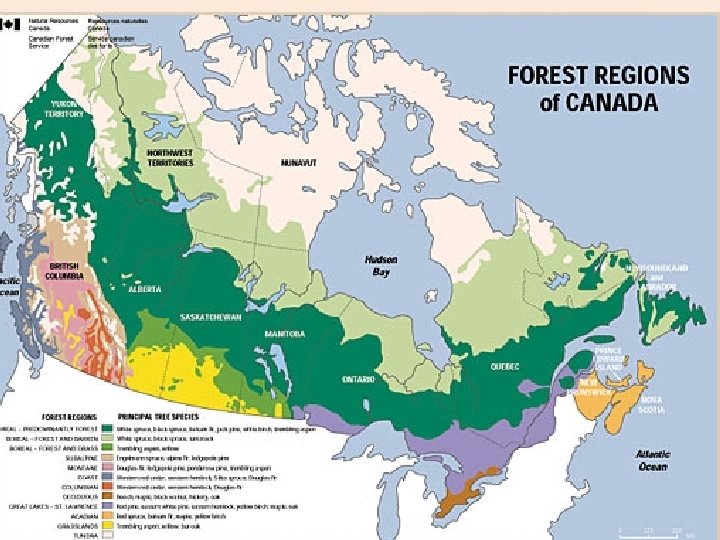
Non Commercial Areas in Canada which are not harvested for industrial use. -Low temperatures, Low levels of precipitation, Short growing season -Northern Manitoba, Northern Quebec
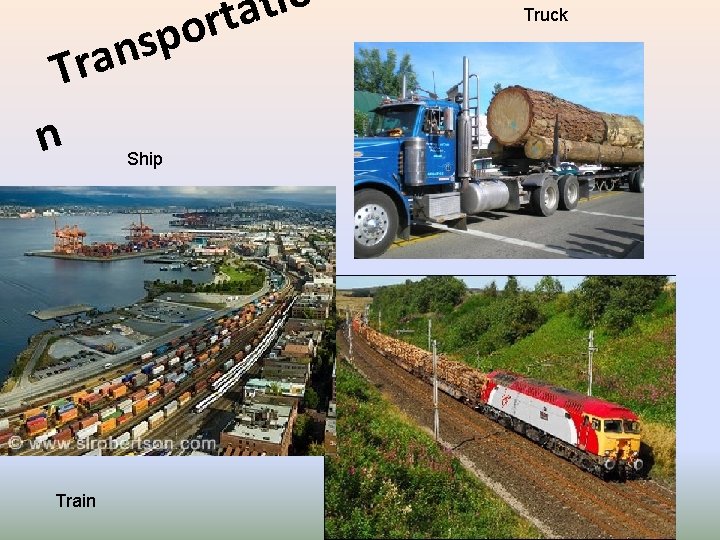
o i t rta o p s ran T n Train Ship Truck
Transportation • Three main transportation methods: – Train – Truck – Ship • Depending on where you are in Canada, the method of transportation will be different
Canada’s Forest Regions 1) Boreal Forest Region: - Across Manitoba, Southern Ontario and Quebec - Long Winters and Low Precipitation = slow tree growth - Coniferous (softwood) trees ex. Black Spruce, White Spruce
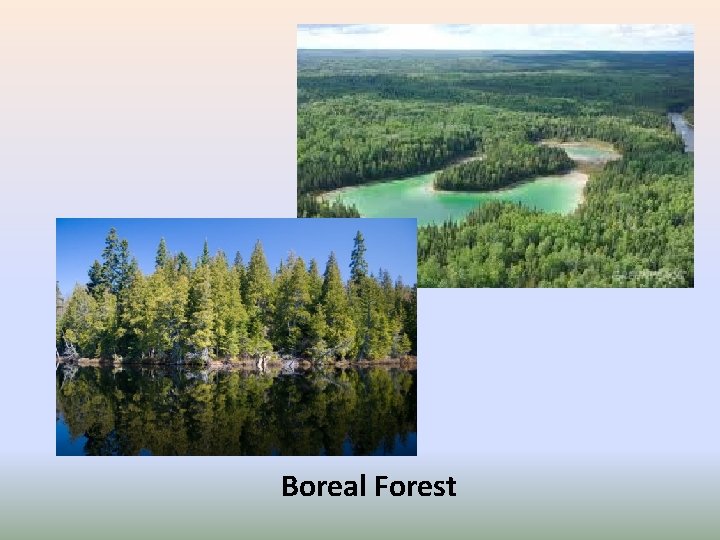
Boreal Forest
Canada’s Forest Regions 2) Taiga Forest Region - Prairie region of Canada, NWT - Thin soils, cool temperatures, short growing season, permafrost - Coniferous trees
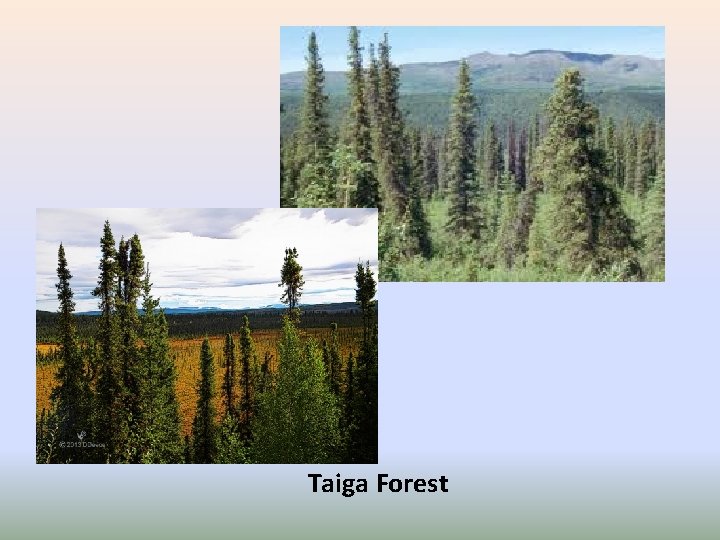
Taiga Forest
Canada’s Forest Regions 3) West Coast Forest Region - Western Coast of British Columbia, slopes of coastal mountains - Long growing season, high precipitation, moderate temperatures - Douglas fir, Spruce, Western Red Cedar - Highest volume of wood in Canada
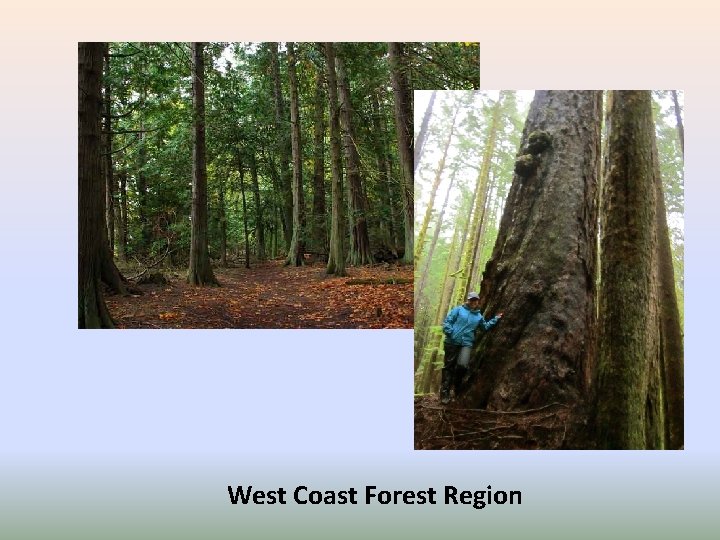
West Coast Forest Region
Canada’s Forest Regions 4) Montane Forest Region -Interior British Columbia, Western Alberta -Lower precipitation levels and shorter growing season than West Coast -Smaller coniferous trees such as Spruce -Second highest volume of wood in Canada
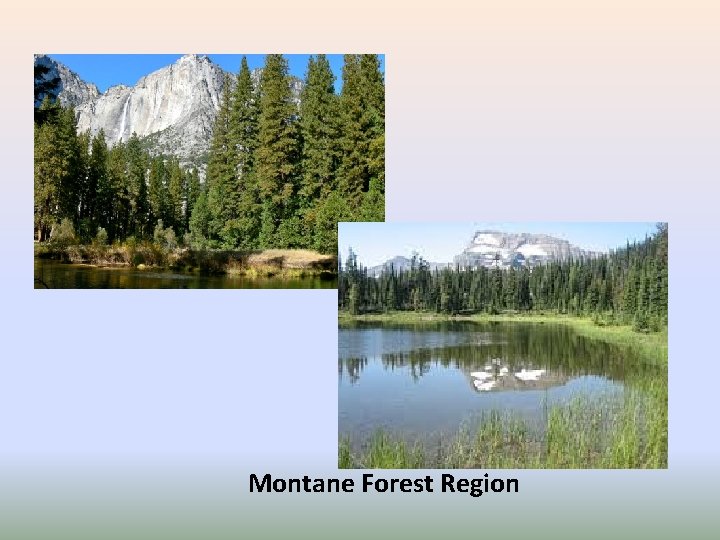
Montane Forest Region
Canada’s Forest Regions 5) Mixed Forest Region - New Brunswick, Halifax and Southern Quebec - Warmer temperatures, longer growing seasons and high precipitation - Fir and Spruce in the North, Coniferous trees and Deciduous trees in the South - Hardwood trees (maple, birch) valuable for furniture and flooring
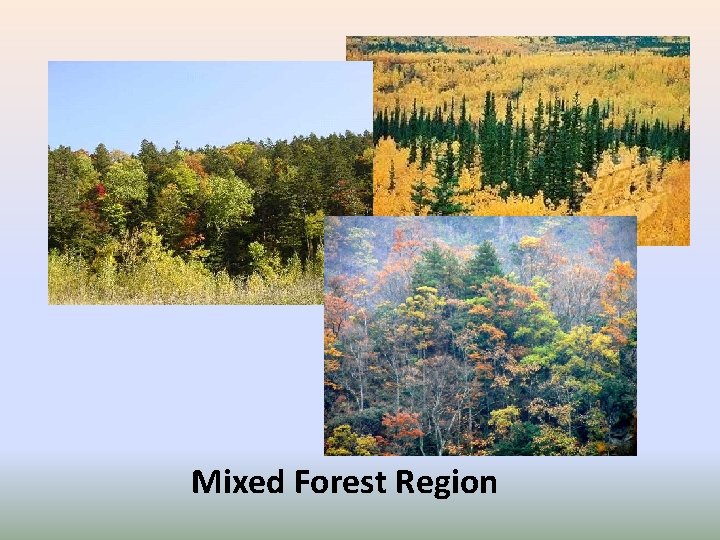
Mixed Forest Region
Economic Impact of Forests • 1 out of every 16 jobs in Canada depend on the forestry industry • The forest industry produces products that are worth $80 billion a year
Types of Logging Clear Cutting • Clear Cutting – Loggers remove all the trees – The area is replanted – The new forest grows up uniformly (same species, size and age of trees) – makes for easy logging next time – Vast majority of logging operations – Fastest and cheapest method
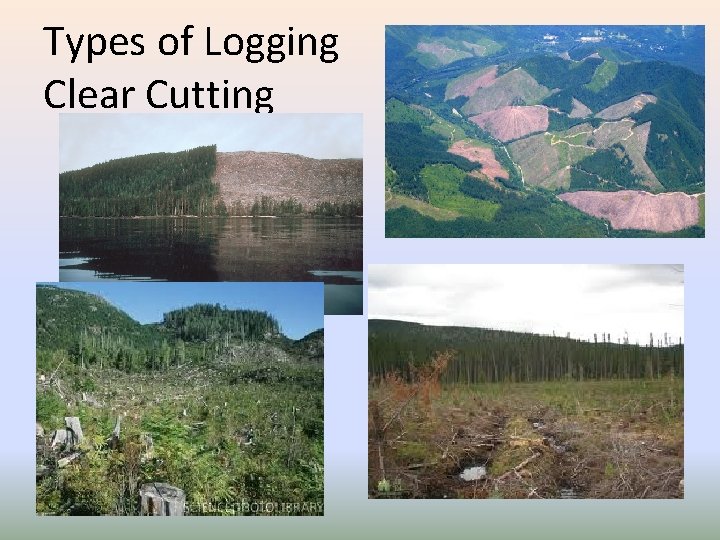
Types of Logging Clear Cutting
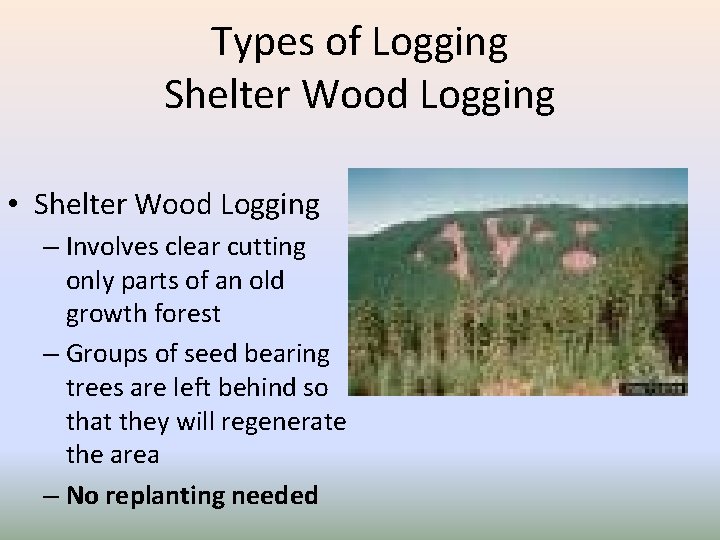
Types of Logging Shelter Wood Logging • Shelter Wood Logging – Involves clear cutting only parts of an old growth forest – Groups of seed bearing trees are left behind so that they will regenerate the area – No replanting needed
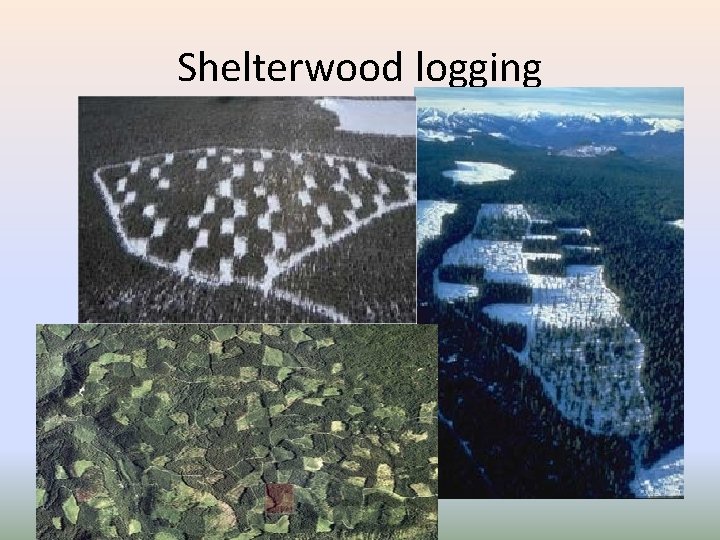
Shelterwood logging
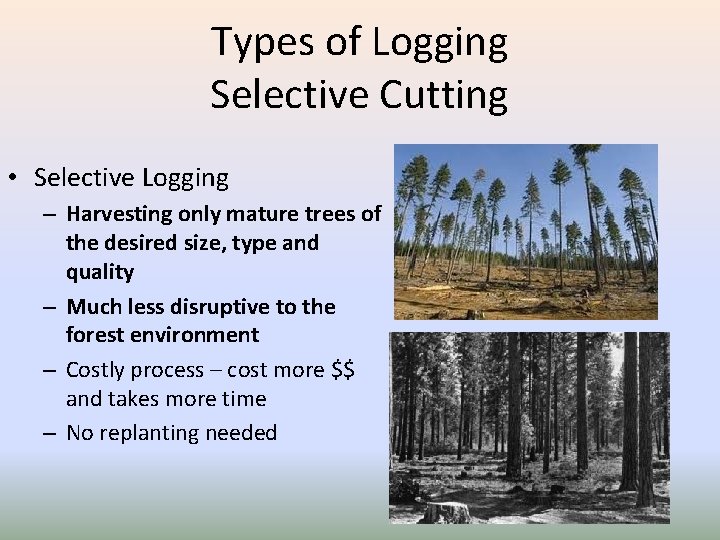
Types of Logging Selective Cutting • Selective Logging – Harvesting only mature trees of the desired size, type and quality – Much less disruptive to the forest environment – Costly process – cost more $$ and takes more time – No replanting needed
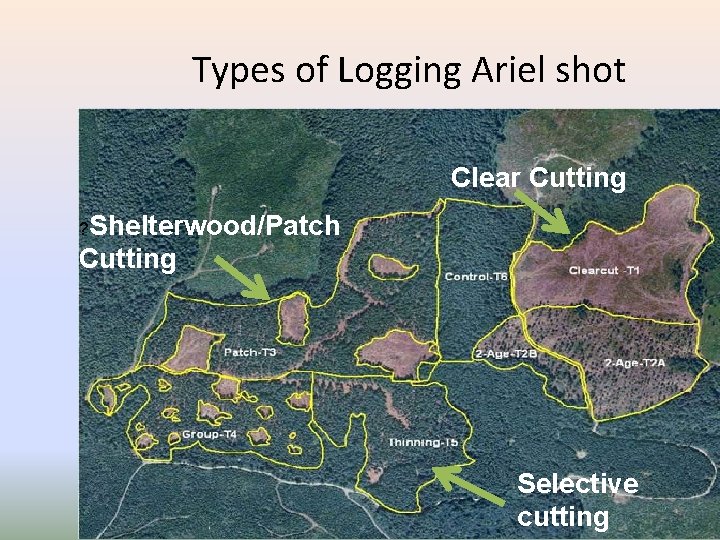
Types of Logging Ariel shot Clear Cutting ? Shelterwood/Patch Cutting Selective cutting
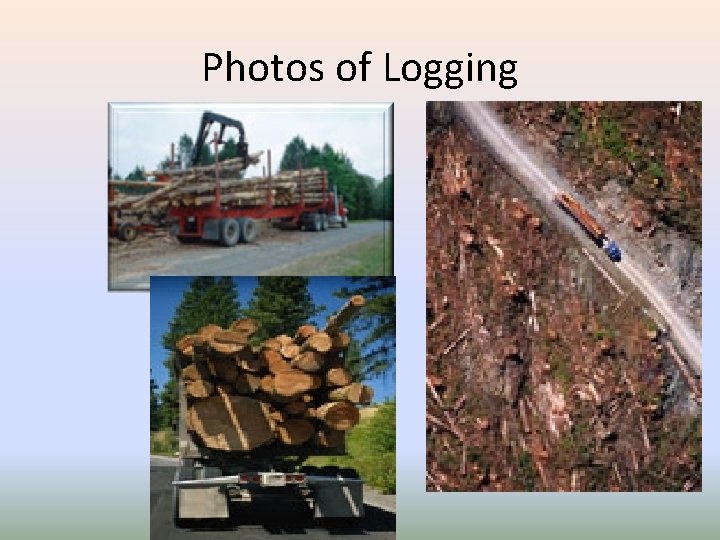
Photos of Logging
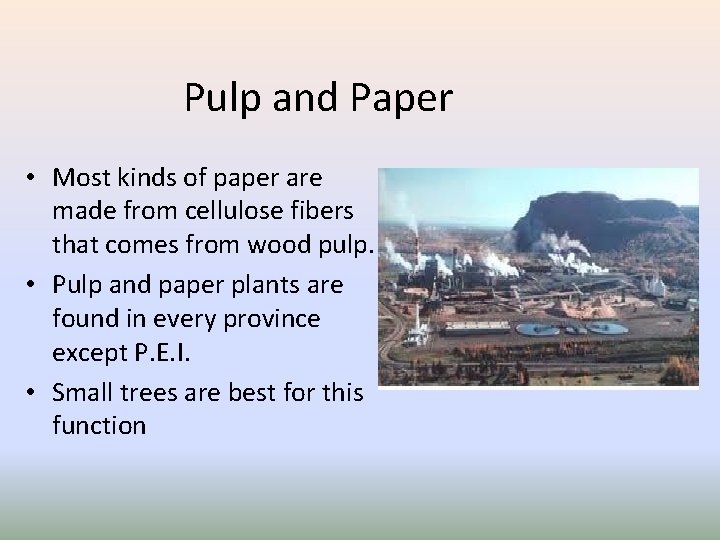
Pulp and Paper • Most kinds of paper are made from cellulose fibers that comes from wood pulp. • Pulp and paper plants are found in every province except P. E. I. • Small trees are best for this function
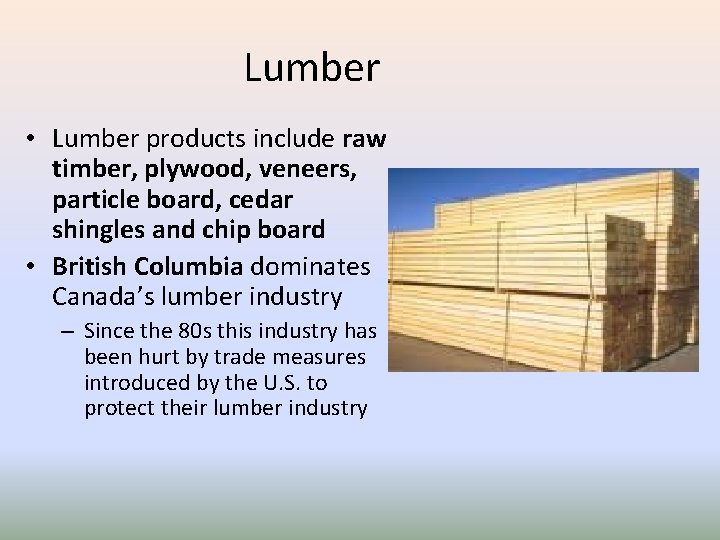
Lumber • Lumber products include raw timber, plywood, veneers, particle board, cedar shingles and chip board • British Columbia dominates Canada’s lumber industry – Since the 80 s this industry has been hurt by trade measures introduced by the U. S. to protect their lumber industry
Why should we protect our forests? • To sustain our timber supply - $$ for Canada’s economy • Helps to decrease the amount of flooding in areas – The trees hold the water in the soil • To protect habitats of various animal species
Environmental Hazards • Acid Precipitation – Produced by the emission from factories in industrial areas – Seriously damaged maple syrup producing forests – Some coniferous trees have also been damaged – their needles turn yellow and eventually the tree dies • Insects, Pests and Disease – Trees that die yearly from insects and disease are higher than the area harvested annually by forest companies

Now time for some video clips! Pay attention as they will help with your reflection Assessment on Diverse Perspectives!
• • Environmentalist Group Video FSC You are, we are the Forest Stewardship Council 2 mins https: //www. youtube. com/watch? v=h. WSvqx. Ra. NWE Published on Nov 27, 2014 Do you love forests? Do you want to live a sustainable life and help secure our planet’s future? Watch this short video and find out who we are, what we do, and why we do it. You are, we are, the Forest Stewardship Council.
• Forests 20 minutes from Ed Library 122997 L 0227 vsp • • • Summary: In this program, we explore the concept of sustainability in regards to Canada's forests which cover half of our landmass. We begin with a look at the history of deforestation practices and the impact this had on biodiversity and habitats. Traditional industrial forest practices have also had a detrimental impact on local and aboriginal communities. Various examples are provided from First Nation communities across the country. The program also highlights the newer approaches to forest management in Canada. Initiatives by government organizations, the Aboriginal Forestry Initiative, and various local groups now work at saving and sustainably managing our forests. Moving forward, we need to decide what role forests play in our economy, our biosphere and our culture. We need to find a solution that balances economic needs with environmental needs. This program provides an excellent introduction to the topics of sustainability, the critical role forests play in the carbon cycle and climate change, and the importance of forests in our cultural, spiritual and physical health. OPAC: 137393
• https: //www. youtube. com/watch? v=jx. HX 3_s 48 v 8 Canada's Sustainable Forests: topics including timber, biodiversity and the boreal forest (Newer/more current Industry view) • https: //www. youtube. com/watch? v=yhma. Eg. Bm. NXQ As Long as the Rivers Flow: The Story of the Grassy Narrows Blockade (Part 1) 10 mins (First Nations/Society View) • Clayoquot Sound: The sound and the fury 10 mins(doesn’t work) (Environmentalist and Industry views) • The Footprint of the Canadian Forest Industry (4 mins – good) • Tour Canada's Boreal Forest (3 mins)
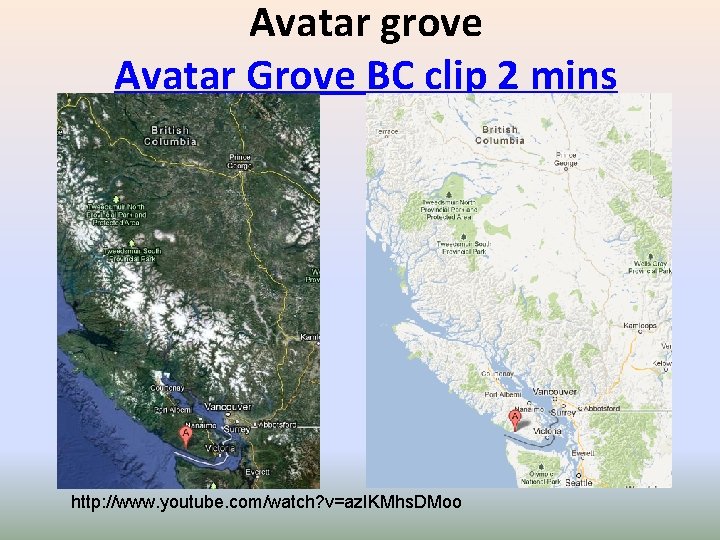
Avatar grove Avatar Grove BC clip 2 mins http: //www. youtube. com/watch? v=az. IKMhs. DMoo
• http: //www. youtube. com/watch? v=0 j. Z 4 XTrs b. KY – Tree Planting with a band member from Bare Naked Ladies (language content) • Tree Planting TED Talk 10 mins • Sustainable Forestry TED Talk • John Deere Treeplanting and harvesting machines 22 mins • Videos after this point do not work
• The replanting of a nation • http: //www. cbc. ca/archives/categories/economy-business/naturalresources/clearcutting-and-logging-the-war-of-the-woods-1/the-replanting-of-anation. html • For years, Canada has been logging more than it has been replanting by a threeto-one ratio. The backlog of barren land is rising at an alarming rate, and the need for reforestation is as great as ever. One man determined to plant as much as he can is Dirk Brinkman. In this CBC Television clip, The Journal sits down with Brinkman, operator of Canada's largest tree-planting company, to talk about the gargantuan task of planting trees in the tangled devastation left behind by clearcutting. 1987 • 15 mins • http: //www. cbc. ca/archives/categories/economy-business/naturalresources/clearcutting-and-logging-the-war-of-the-woods-1/you-do-not-treatmother-earth-this-way. html • Clearcutting in the forests of Meadow Lake, Sask. , has the native community divided. Native protestors say logging destroys hunting and trapping areas. Leaders of the nine bands argue that local people should control the logging operation, giving them the power to balance environmental and economic development. But environmentalist David Suzuki doesn't want to hear about it, joining protestors at a blockade outside the forest. "You do not treat Mother Earth this way, " shouts a defiant Suzuki in this CBC Television clip • 2 mins
• • • CBC Debate: Greenpeace vs. Macmillan Bloedel (13 mins 15 secs) http: //www. cbc. ca/archives/categories/economy-business/naturalresources/clearcutting-and-logging-the-war-of-the-woods-1/cbc-debategreenpeace-vs-macmillan-bloedel. html Battle over logging in B. C. The war in the Clayoquot woods is over (2 min 13 sec) http: //www. cbc. ca/archives/categories/economy-business/naturalresources/clearcutting-and-logging-the-war-of-the-woods-1/the-war-in-theclayoquot-woods-is-over. html Two years after the 'Summer of Protest, ' the B. C. government calls for the end of conventional clearcutting in Clayoquot Sound. Forestry Minister Andrew Petter tells reporters that the government accepts a scientific panel's report to end clearcutting in the ancient rainforest in its entirety. Greenpeace views it as a huge victory, but spokeswoman Karen Mahon argues that if the ban on clearcutting "applies to Clayoquot, it should apply to the whole coast of B. C. " Providing jobs versus proper forest management http: //www. cbc. ca/archives/categories/economy-business/naturalresources/clearcutting-and-logging-the-war-of-the-woods-1/providing-jobs-versusproper-forest-management. html Timber companies are a major player in Manitoba's economy. Hundreds of hectares of trees are clearcut in the province's Boreal forests every year. As the forest industry expands in Manitoba, environmentalists say the need for government to balance the economy with sound forest management has never been greater. The province wants to keep Manitobans working, and argues clearcutting helps regenerate the forest. In this CBC Television clip, 24 Hours looks at both sides of the issue. 10 mins
- Slides: 36