
Characteristics of a National Innovation System Presented to
- Slides: 23
Characteristics of a National Innovation System Presented to: AEA Research Technology and Development Technical Interest Group CES / AEA Evaluation Conference Presented by: George Teather October 28, 2005 www. pmn. net Tel: Fax: Email: (613) 824 -2423 (613) 824 -2583 gteather@sympatico. ca
Presentation Outline u Explore dimensions of the terms “Innovation”, “Innovation Process” and “National Innovation System” u Examine some specific models, their strengths and weaknesses and applicability u Describe the Canadian Innovation System G. Teather AEA 2004 2
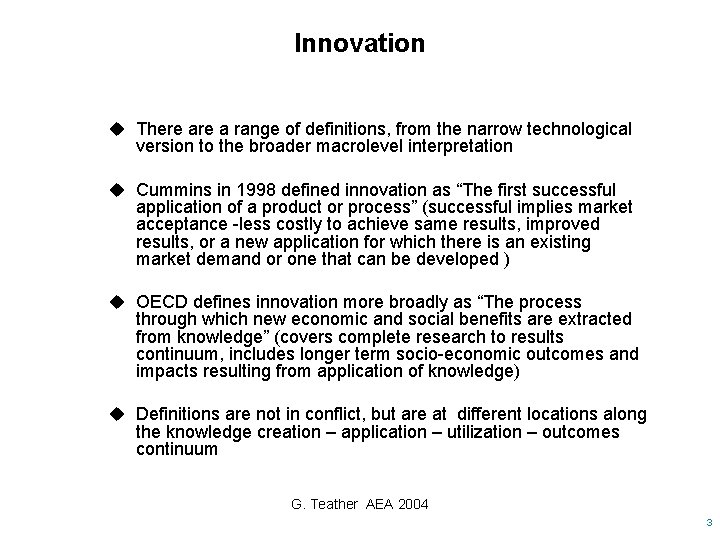
Innovation u There a range of definitions, from the narrow technological version to the broader macrolevel interpretation u Cummins in 1998 defined innovation as “The first successful application of a product or process” (successful implies market acceptance -less costly to achieve same results, improved results, or a new application for which there is an existing market demand or one that can be developed ) u OECD defines innovation more broadly as “The process through which new economic and social benefits are extracted from knowledge” (covers complete research to results continuum, includes longer term socio-economic outcomes and impacts resulting from application of knowledge) u Definitions are not in conflict, but are at different locations along the knowledge creation – application – utilization – outcomes continuum G. Teather AEA 2004 3
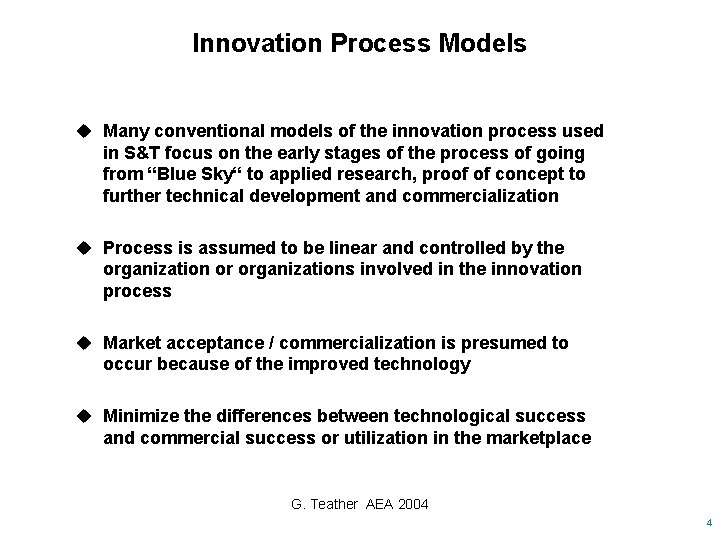
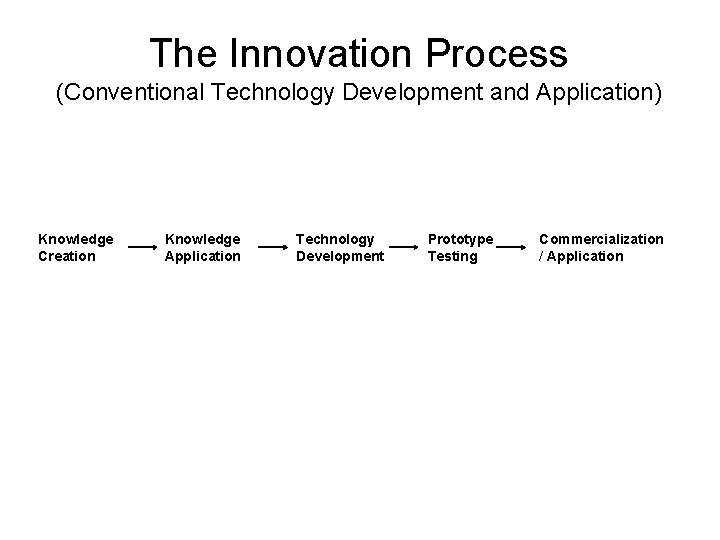
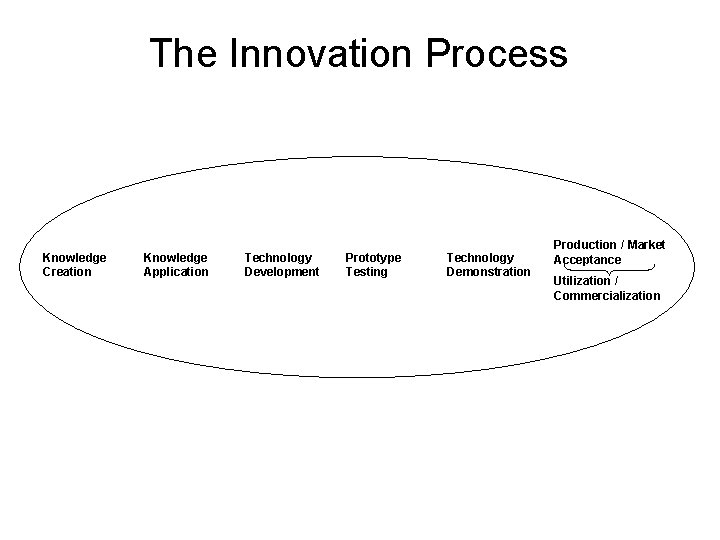
Innovation Process Models u Many conventional models of the innovation process used in S&T focus on the early stages of the process of going from “Blue Sky“ to applied research, proof of concept to further technical development and commercialization u Process is assumed to be linear and controlled by the organization or organizations involved in the innovation process u Market acceptance / commercialization is presumed to occur because of the improved technology u Minimize the differences between technological success and commercial success or utilization in the marketplace G. Teather AEA 2004 4
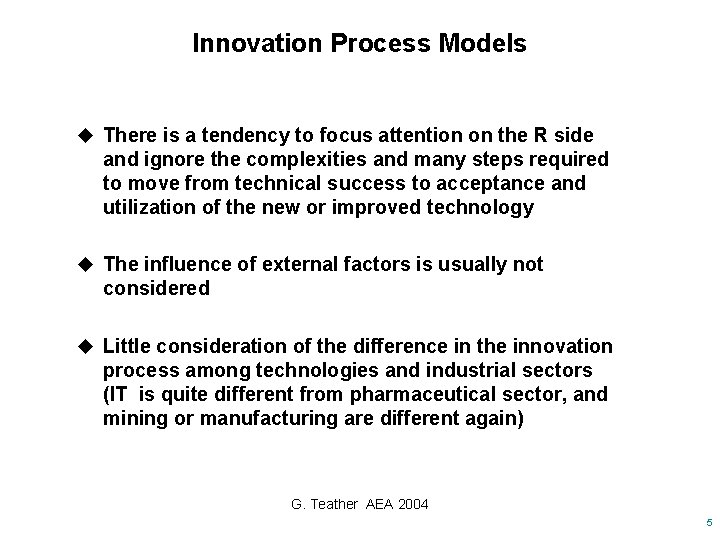
Innovation Process Models u There is a tendency to focus attention on the R side and ignore the complexities and many steps required to move from technical success to acceptance and utilization of the new or improved technology u The influence of external factors is usually not considered u Little consideration of the difference in the innovation process among technologies and industrial sectors (IT is quite different from pharmaceutical sector, and mining or manufacturing are different again) G. Teather AEA 2004 5
The Innovation Process (Conventional Technology Development and Application) Knowledge Creation Knowledge Application Technology Development Prototype Testing Commercialization / Application
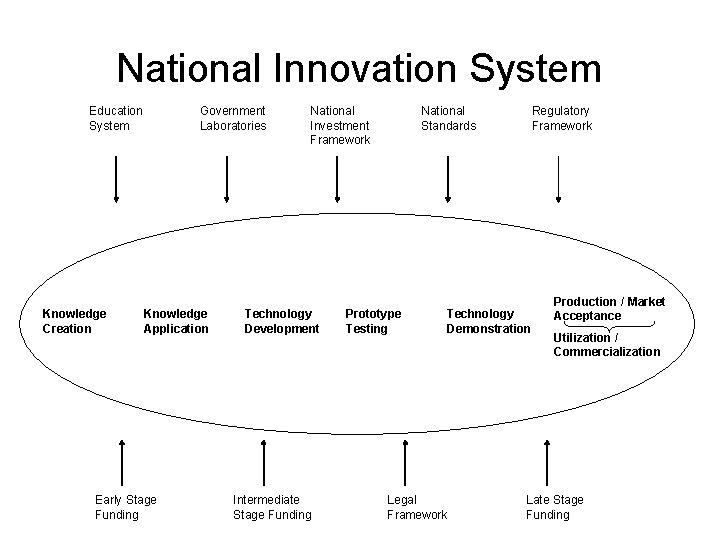
The Innovation Process Knowledge Creation Knowledge Application Technology Development Prototype Testing Technology Demonstration Production / Market Acceptance Utilization / Commercialization
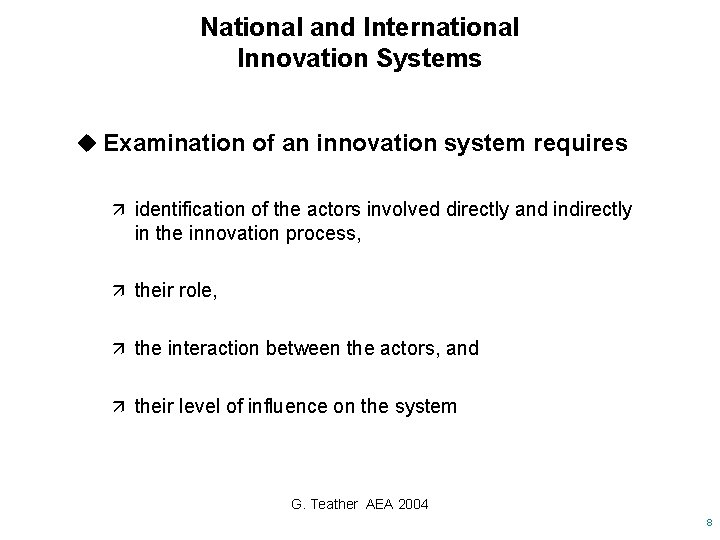
National and International Innovation Systems u Examination of an innovation system requires ä identification of the actors involved directly and indirectly in the innovation process, ä their role, ä the interaction between the actors, and ä their level of influence on the system G. Teather AEA 2004 8
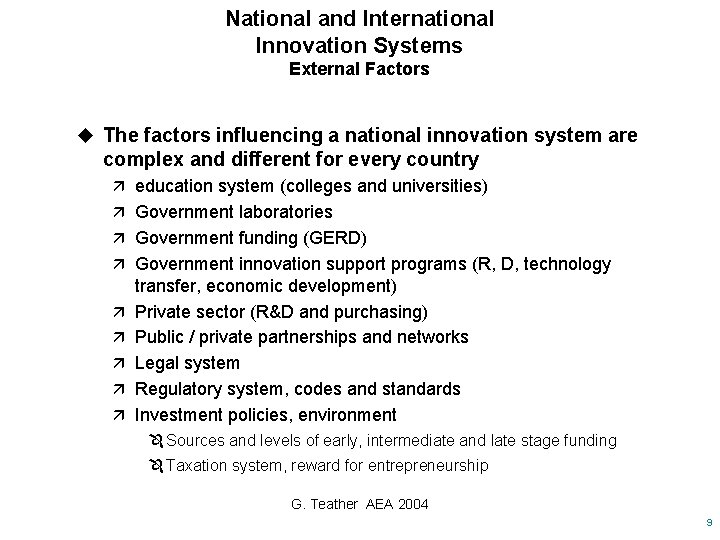
National and International Innovation Systems External Factors u The factors influencing a national innovation system are complex and different for every country ä education system (colleges and universities) ä Government laboratories ä Government funding (GERD) ä Government innovation support programs (R, D, technology ä ä ä transfer, economic development) Private sector (R&D and purchasing) Public / private partnerships and networks Legal system Regulatory system, codes and standards Investment policies, environment Ô Sources and levels of early, intermediate and late stage funding Ô Taxation system, reward for entrepreneurship G. Teather AEA 2004 9
National Innovation System Education System Knowledge Creation Government Laboratories Knowledge Application Early Stage Funding National Investment Framework Technology Development Intermediate Stage Funding National Standards Prototype Testing Regulatory Framework Technology Demonstration Legal Framework Production / Market Acceptance Utilization / Commercialization Late Stage Funding
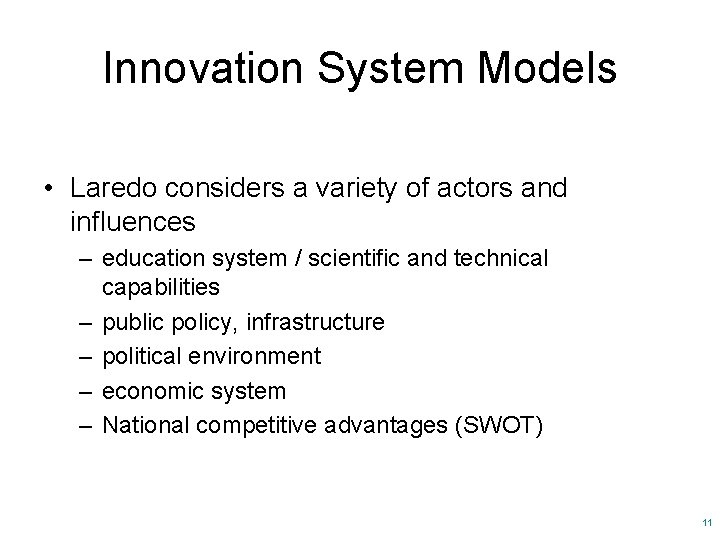
Innovation System Models • Laredo considers a variety of actors and influences – education system / scientific and technical capabilities – public policy, infrastructure – political environment – economic system – National competitive advantages (SWOT) 11
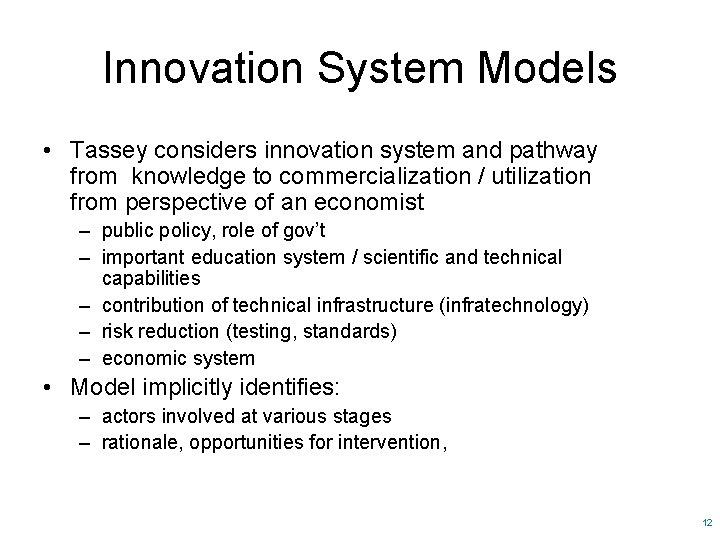
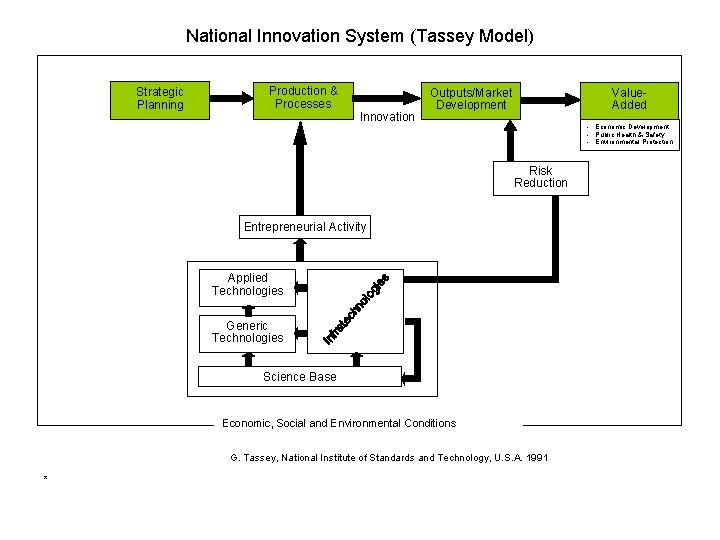
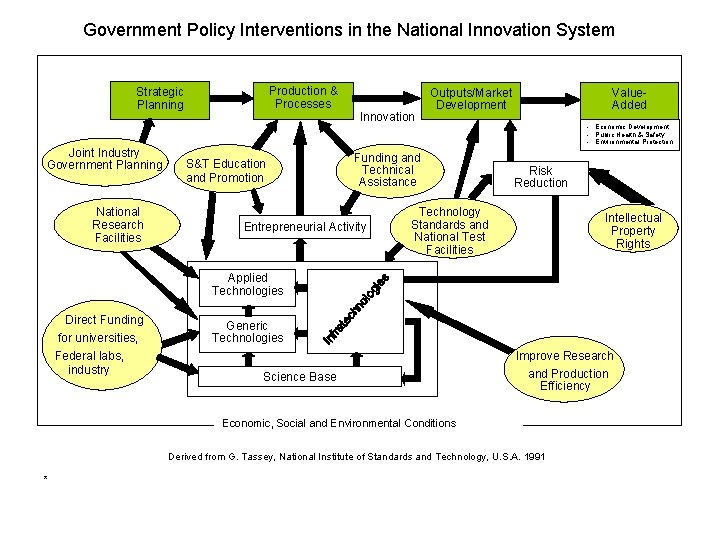
Innovation System Models • Tassey considers innovation system and pathway from knowledge to commercialization / utilization from perspective of an economist – public policy, role of gov’t – important education system / scientific and technical capabilities – contribution of technical infrastructure (infratechnology) – risk reduction (testing, standards) – economic system • Model implicitly identifies: – actors involved at various stages – rationale, opportunities for intervention, 12
National Innovation System (Tassey Model) Strategic Planning Production & Processes Innovation Outputs/Market Development Value. Added - Economic Development - Public Health & Safety - Environmental Protection Risk Reduction Entrepreneurial Activity Applied Technologies Generic Technologies Science Base Economic, Social and Environmental Conditions G. Tassey, National Institute of Standards and Technology, U. S. A. 1991 *
Government Policy Interventions in the National Innovation System Production & Processes Strategic Planning Joint Industry Government Planning National Research Facilities S&T Education and Promotion Innovation Outputs/Market Development Funding and Technical Assistance Entrepreneurial Activity Value. Added - Economic Development - Public Health & Safety - Environmental Protection Risk Reduction Technology Standards and National Test Facilities Intellectual Property Rights Applied Technologies Direct Funding for universities, Federal labs, industry Generic Technologies Science Base Improve Research and Production Efficiency Economic, Social and Environmental Conditions Derived from G. Tassey, National Institute of Standards and Technology, U. S. A. 1991 *
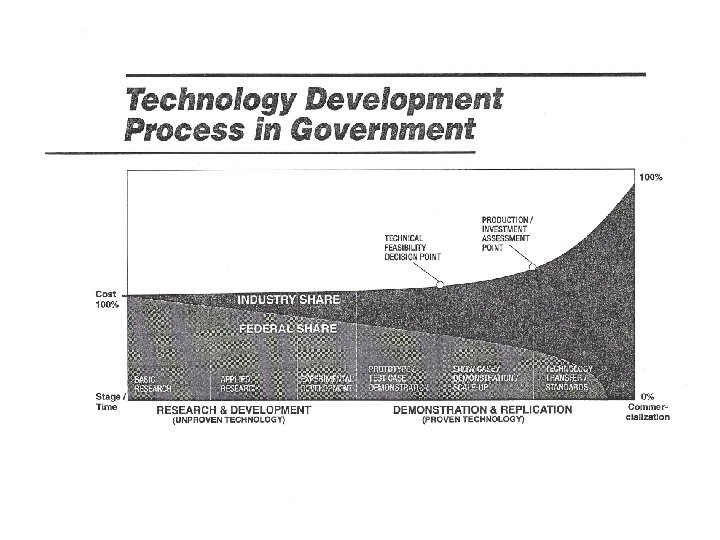
Innovation Environment in Canada u Federal investment in R&D is seventh out of eight G 8 countries (GERD = 1. 7%) u Innovation performance overall is low u Scientific Research Tax Deduction (SRED) to firms conducting R&D (Frascati definition) is very high u Data on firm expenditures across innovation spectrum u Graph of relative spending of government and industry across innovation spectrum G. Teather AEA 2004 15
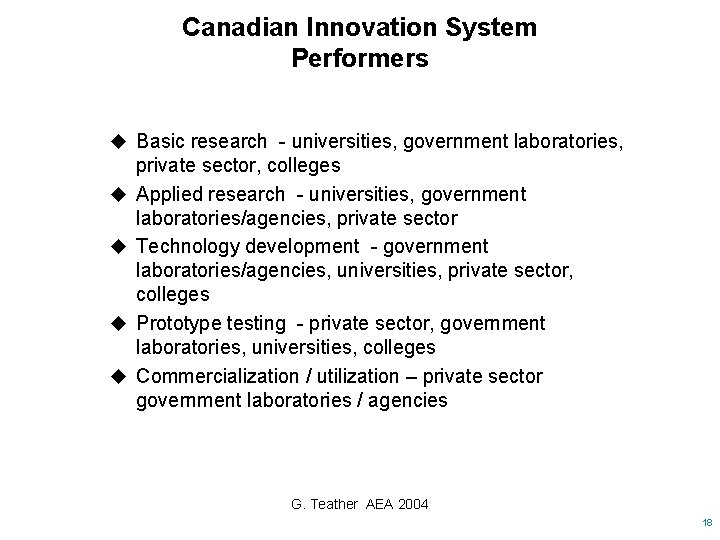
Canadian Innovation System Performers u Basic research - universities, government laboratories, u u private sector, colleges Applied research - universities, government laboratories/agencies, private sector Technology development - government laboratories/agencies, universities, private sector, colleges Prototype testing - private sector, government laboratories, universities, colleges Commercialization / utilization – private sector government laboratories / agencies G. Teather AEA 2004 18
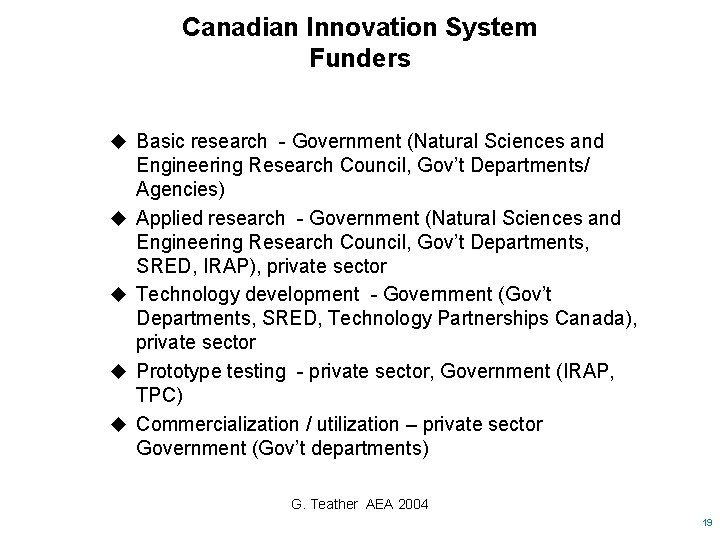
Canadian Innovation System Funders u Basic research - Government (Natural Sciences and u u Engineering Research Council, Gov’t Departments/ Agencies) Applied research - Government (Natural Sciences and Engineering Research Council, Gov’t Departments, SRED, IRAP), private sector Technology development - Government (Gov’t Departments, SRED, Technology Partnerships Canada), private sector Prototype testing - private sector, Government (IRAP, TPC) Commercialization / utilization – private sector Government (Gov’t departments) G. Teather AEA 2004 19
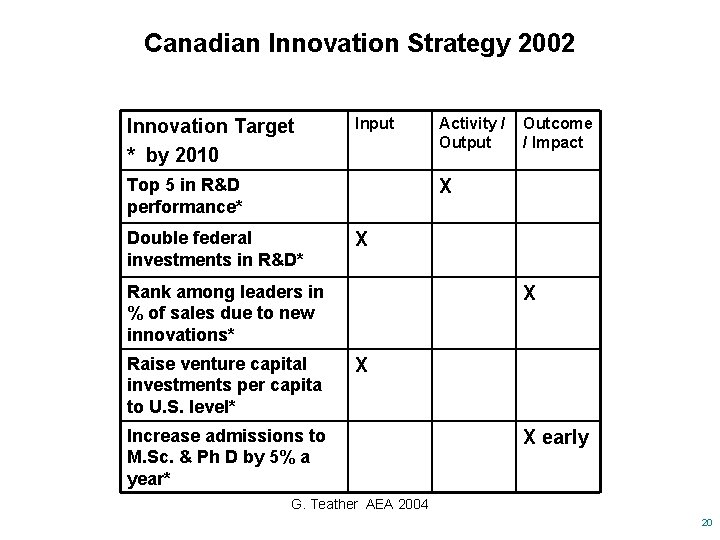
Canadian Innovation Strategy 2002 Innovation Target * by 2010 Input Top 5 in R&D performance* Activity / Output Outcome / Impact X Double federal investments in R&D* X Rank among leaders in % of sales due to new innovations* Raise venture capital investments per capita to U. S. level* X X Increase admissions to M. Sc. & Ph D by 5% a year* X early G. Teather AEA 2004 20
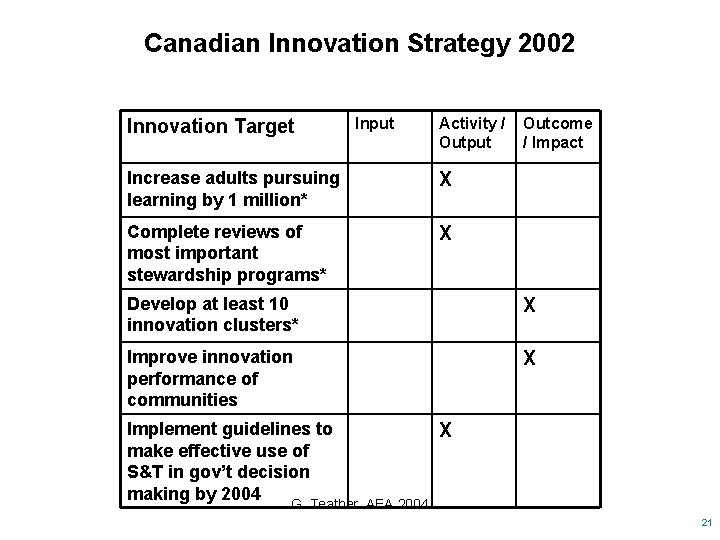
Canadian Innovation Strategy 2002 Innovation Target Input Activity / Output Increase adults pursuing learning by 1 million* X Complete reviews of most important stewardship programs* X Outcome / Impact Develop at least 10 innovation clusters* X Improve innovation performance of communities X Implement guidelines to make effective use of S&T in gov’t decision making by 2004 X G. Teather AEA 2004 21
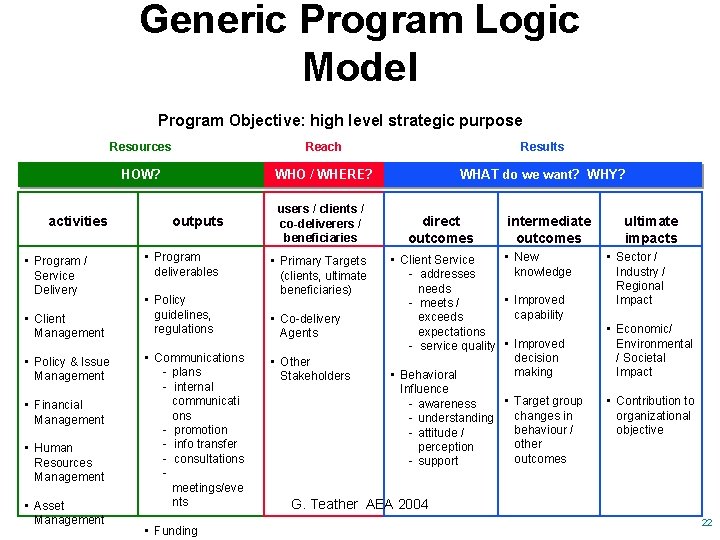
Generic Program Logic Model Program Objective: high level strategic purpose activities • Program / Service Delivery • Client Management • Policy & Issue Management • Financial Management • Human Resources Management • Asset Management Resources Reach Results HOW? WHO / WHERE? WHAT do we want? WHY? outputs • Program deliverables • Policy guidelines, regulations • Communications - plans - internal communicati ons - promotion - info transfer - consultations meetings/eve nts • Funding users / clients / co-deliverers / beneficiaries • Primary Targets (clients, ultimate beneficiaries) • Co-delivery Agents • Other Stakeholders direct outcomes intermediate outcomes • New • Client Service knowledge - addresses needs • Improved - meets / capability exceeds expectations - service quality • Improved decision making • Behavioral Influence • Target group - awareness changes in - understanding behaviour / - attitude / other perception outcomes - support ultimate impacts • Sector / Industry / Regional Impact • Economic/ Environmental / Societal Impact • Contribution to organizational objective G. Teather AEA 2004 22
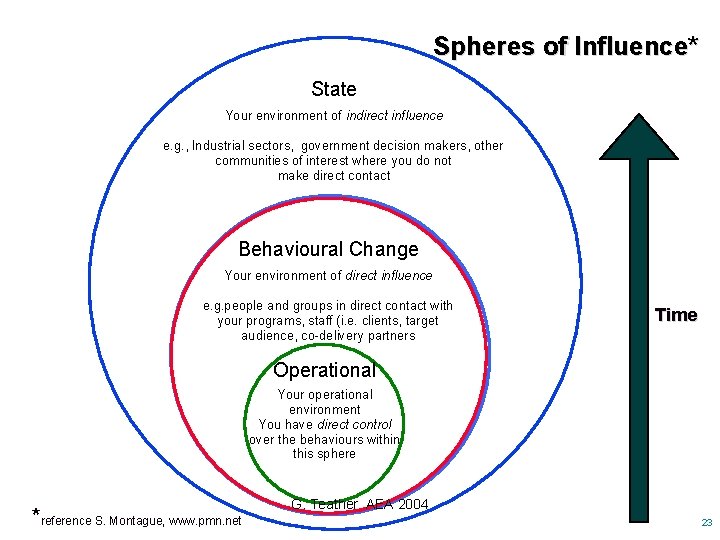
Spheres of Influence* State Your environment of indirect influence e. g. , Industrial sectors, government decision makers, other communities of interest where you do not make direct contact Behavioural Change Your environment of direct influence e. g. people and groups in direct contact with your programs, staff (i. e. clients, target audience, co-delivery partners Time Operational Your operational environment You have direct control over the behaviours within this sphere *reference S. Montague, www. pmn. net G. Teather AEA 2004 23