
Characteristics of a Good Interviewer Comfort with topicrecognize
- Slides: 21
Characteristics of a Good Interviewer • Comfort with topic—recognize biases, discomforts • Self Awareness (physical, emotional, cognitive, values) • Patience • Knowing the interview protocol • ACTIVE LISTENING
What NOT to Do in a Qualitative Interview • Don’t ask leading questions • Don’t interrupt • Tolerate (rather than disrupt) pauses • Avoid yes/no questions • Avoid putting words in her/his mouth or answering the question for her/him • Don’t “solve problems” during the interview • Don’t ask more than one question at a time • EXAMPLE: FROM BAD TO GOOD INTERVIEWING https: //www. youtube. com/watch? v=FGH 2 t. Yu. Xf 0 s
Strategies to Encourage • Neutral verbal expressions such as “uh huh, ”“interesting, ” and “tell me more” or “I see…” • Verbal expressions of empathy, such as, “I can see why you say that was difficult for you” • Ways to convey trustworthiness and interest • “These are probably not the kind of questions that adults usually ask you…but we are really trying to understand how young people’s lives change at this age…” • “You are the expert here. ” • Mirroring technique repeating what the participant said, such as, “So you said that you were. . . ” or “Useful? ” (if they said “useful”) • Culturally appropriate body language or gestures, such as nodding in acknowledgment or
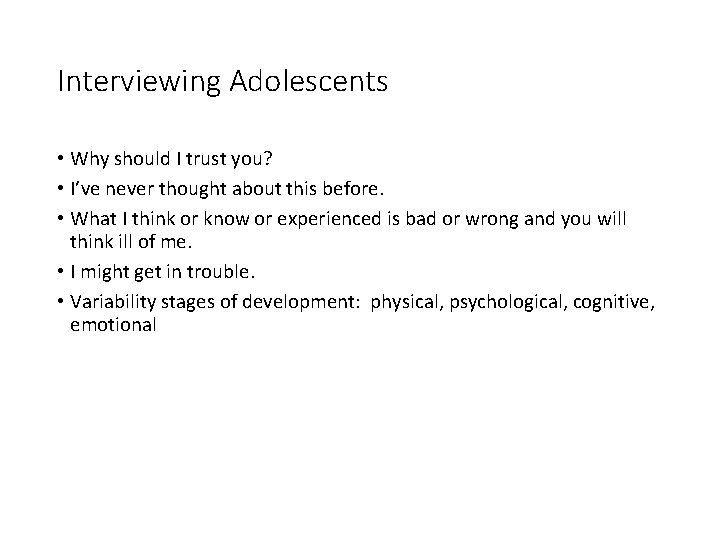
Interviewing Adolescents • Why should I trust you? • I’ve never thought about this before. • What I think or know or experienced is bad or wrong and you will think ill of me. • I might get in trouble. • Variability stages of development: physical, psychological, cognitive, emotional
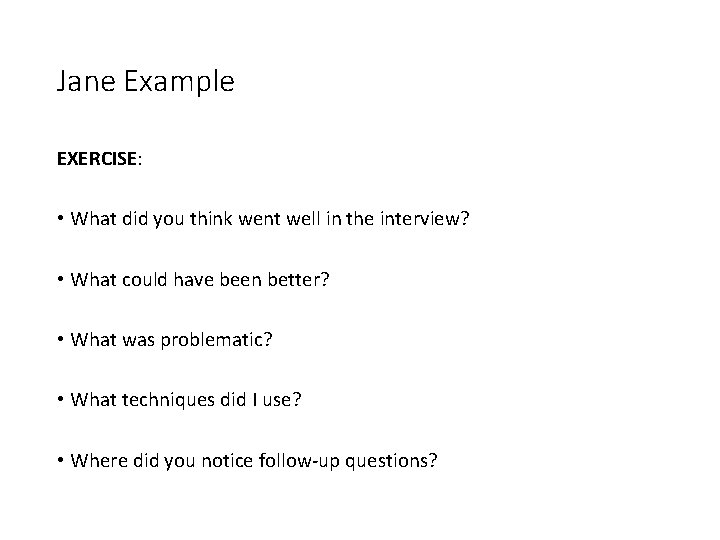
Jane Example EXERCISE: • What did you think went well in the interview? • What could have been better? • What was problematic? • What techniques did I use? • Where did you notice follow-up questions?
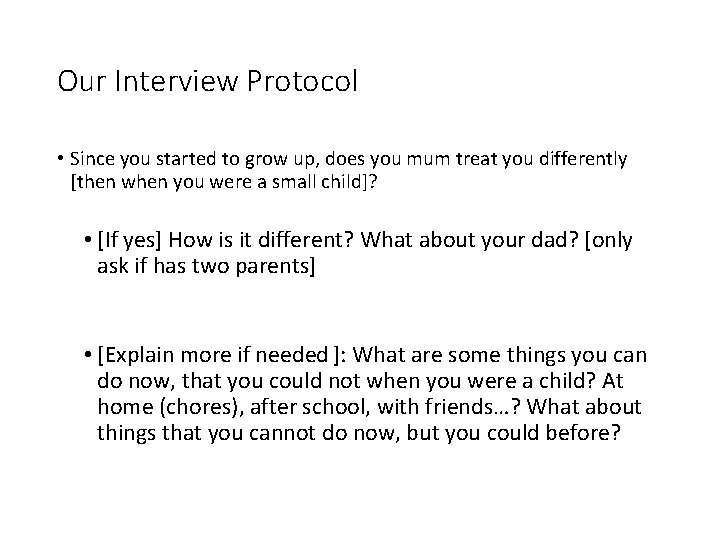
Our Interview Protocol • Since you started to grow up, does you mum treat you differently [then when you were a small child]? • [If yes] How is it different? What about your dad? [only ask if has two parents] • [Explain more if needed ]: What are some things you can do now, that you could not when you were a child? At home (chores), after school, with friends…? What about things that you cannot do now, but you could before?
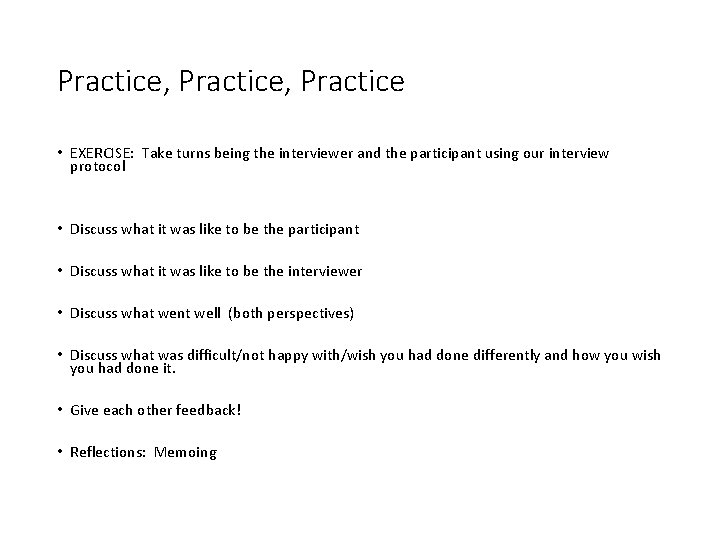
Practice, Practice • EXERCISE: Take turns being the interviewer and the participant using our interview protocol • Discuss what it was like to be the participant • Discuss what it was like to be the interviewer • Discuss what went well (both perspectives) • Discuss what was difficult/not happy with/wish you had done differently and how you wish you had done it. • Give each other feedback! • Reflections: Memoing
What to Do When… • They won’t answer • They give brief answers • They seem not to be comfortable • They are shy or upset • You are uncomfortable or worried • You lose track of your place or skip questions • If they go off “road” into other topics, to get overtalkers focused • Interruptions/others walk in room etc.
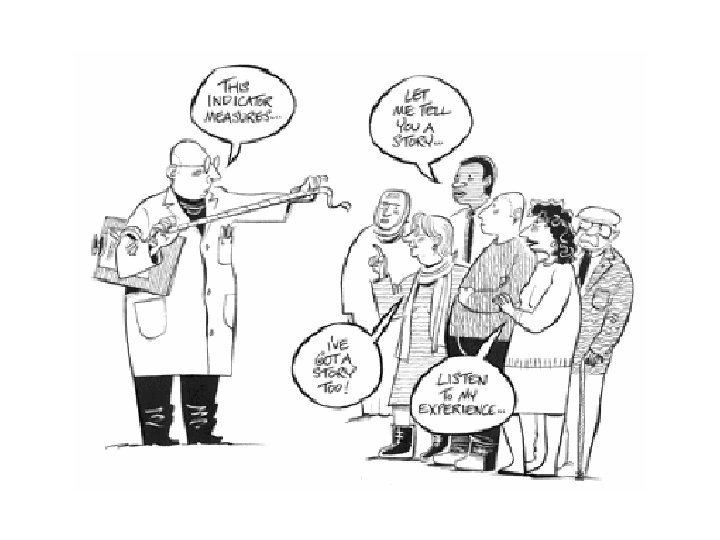
Narrative Interviewing: Stories • Storytelling is an essential characteristic of the human condition. • What is a narrative? • A story: beginning, middle and end • How we “live” our lives and make our experiences coherent (without realizing it) • Multiple stories about most experiences
Why Narrative Interviews? Storytelling is a means of transferring: • Meaning (IMPLICIT) • Tradition: (Explicit) • Morals: (Implicit/Explicit) • Culture: (Implicit)
Purposes of Narrative Interviews in the GEAS • experiential data from young boy and girl adolescents • Experiential data from parents • Generating ideas/items for new “bottom up” gender scales
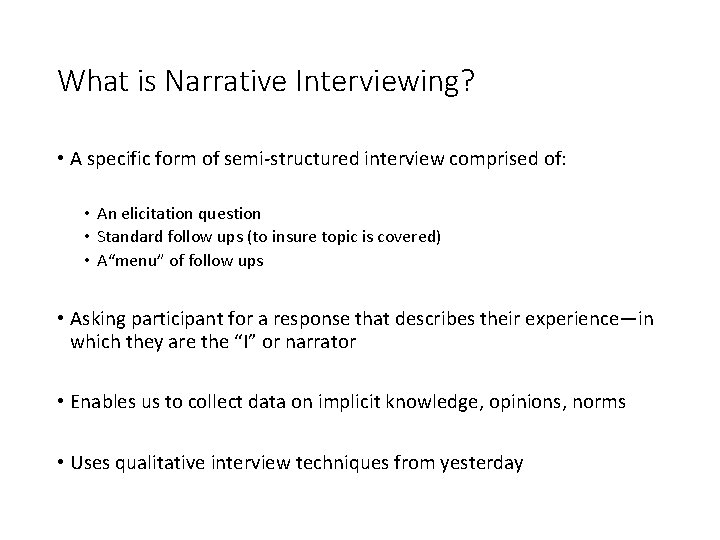
What is Narrative Interviewing? • A specific form of semi-structured interview comprised of: • An elicitation question • Standard follow ups (to insure topic is covered) • A“menu” of follow ups • Asking participant for a response that describes their experience—in which they are the “I” or narrator • Enables us to collect data on implicit knowledge, opinions, norms • Uses qualitative interview techniques from yesterday
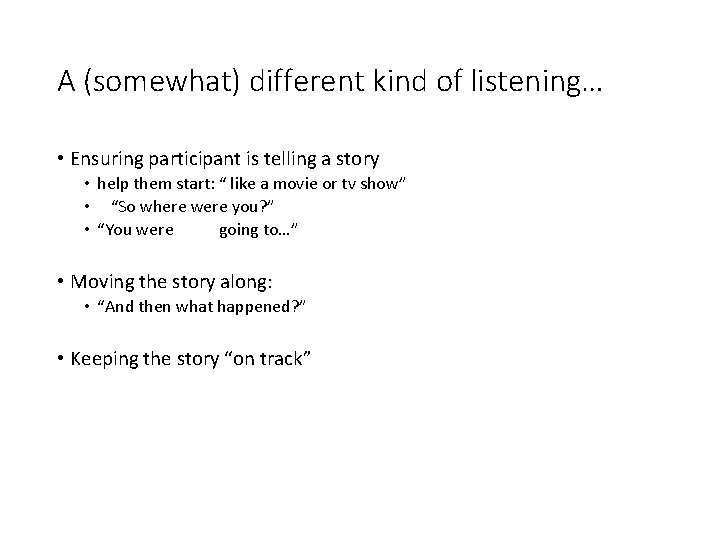
A (somewhat) different kind of listening… • Ensuring participant is telling a story • help them start: “ like a movie or tv show” • “So where were you? ” • “You were going to…” • Moving the story along: • “And then what happened? ” • Keeping the story “on track”
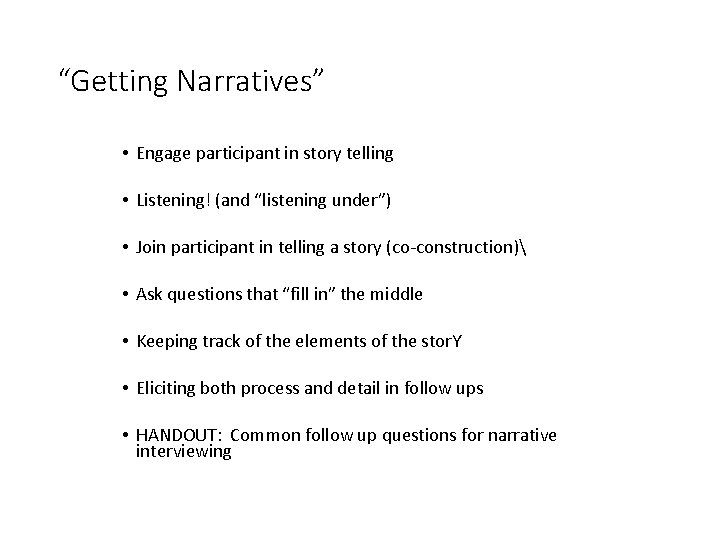
“Getting Narratives” • Engage participant in story telling • Listening! (and “listening under”) • Join participant in telling a story (co-construction) • Ask questions that “fill in” the middle • Keeping track of the elements of the stor. Y • Eliciting both process and detail in follow ups • HANDOUT: Common follow up questions for narrative interviewing
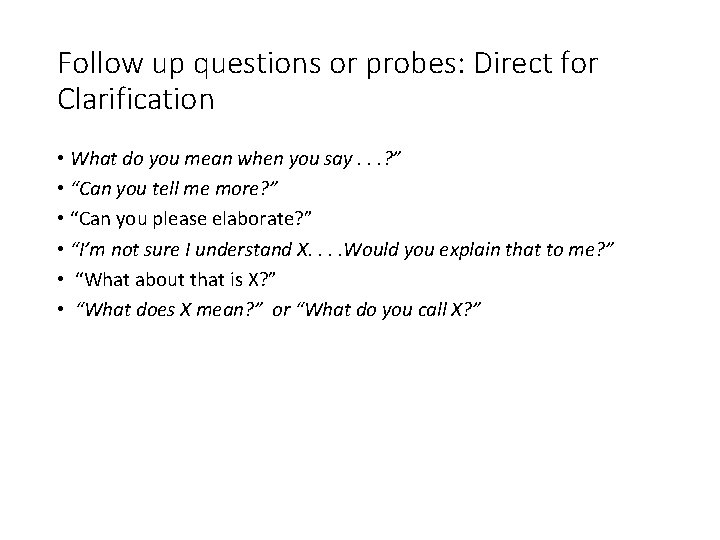
Follow up questions or probes: Direct for Clarification • What do you mean when you say. . . ? ” • “Can you tell me more? ” • “Can you please elaborate? ” • “I’m not sure I understand X. . Would you explain that to me? ” • “What about that is X? ” • “What does X mean? ” or “What do you call X? ”
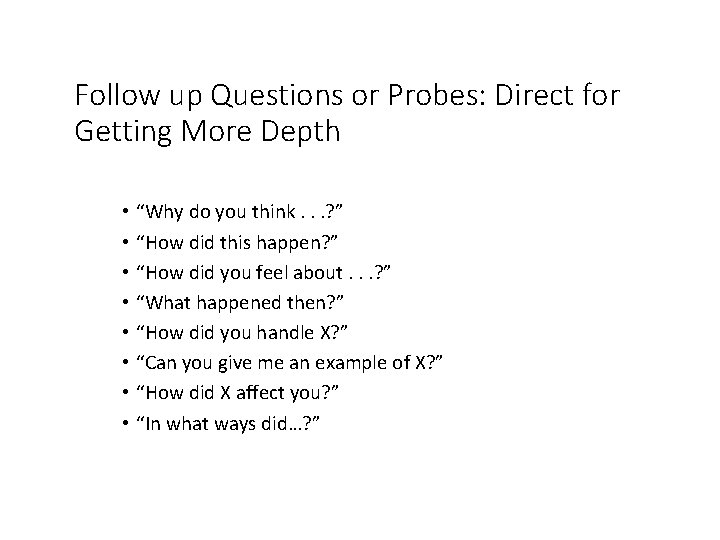
Follow up Questions or Probes: Direct for Getting More Depth • “Why do you think. . . ? ” • “How did this happen? ” • “How did you feel about. . . ? ” • “What happened then? ” • “How did you handle X? ” • “Can you give me an example of X? ” • “How did X affect you? ” • “In what ways did…? ”
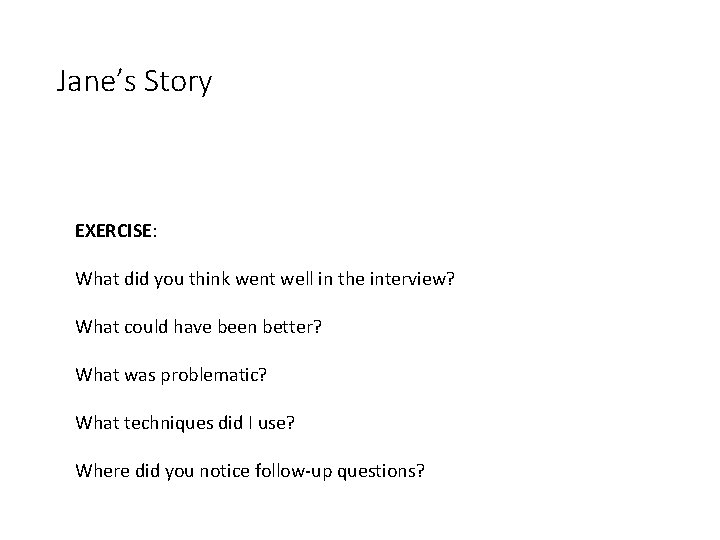
Jane’s Story EXERCISE: What did you think went well in the interview? What could have been better? What was problematic? What techniques did I use? Where did you notice follow-up questions?
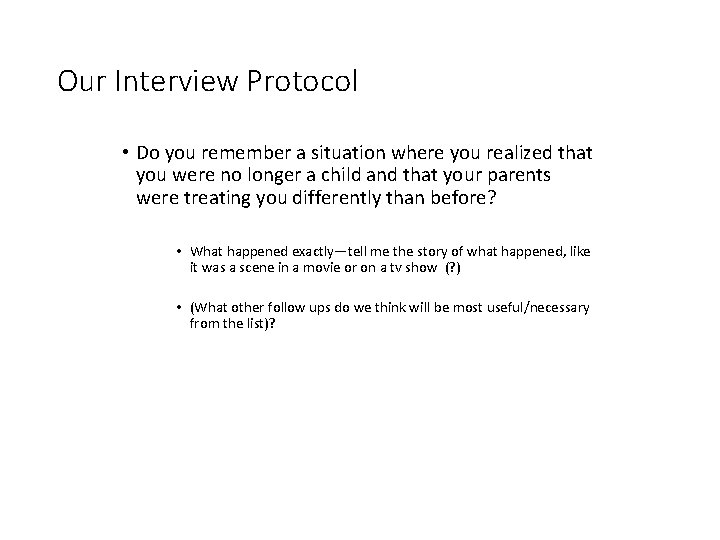
Our Interview Protocol • Do you remember a situation where you realized that you were no longer a child and that your parents were treating you differently than before? • What happened exactly—tell me the story of what happened, like it was a scene in a movie or on a tv show (? ) • (What other follow ups do we think will be most useful/necessary from the list)?
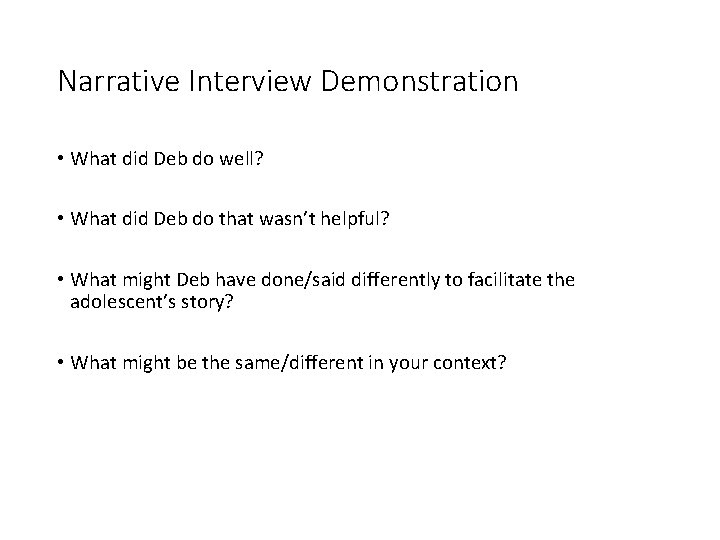
Narrative Interview Demonstration • What did Deb do well? • What did Deb do that wasn’t helpful? • What might Deb have done/said differently to facilitate the adolescent’s story? • What might be the same/different in your context?
Practice, Practice • EXERCISE: Take turns being the interviewer and the participant using our narrative interview protocol (observer/notetaker) • Discuss what it was like to be the participant • Discuss what it was like to be the interviewer • Discuss what went well (both perspectives) • Discuss what was difficult/not happy with/wish you had done differently and how you wish you had done it. • Give each other feedback! (Feedback to the group) • Reflections: Memoing