
CHARACTERISTICS ENROLLMENT PATTERNS GRADUATION RATES AND SERVICE USE



- Slides: 46
CHARACTERISTICS, ENROLLMENT PATTERNS, GRADUATION RATES AND SERVICE USE OF COLLEGE STUDENTS WITH ADHD/LD Theresa L. Maitland, Ph. D The Learning Center’s ADHD/LD Services UNC Chapel Hill IRB Approved Study #07 -1097 tmaitlan@email. unc. edu
BACKGROUND Brief history IRB reviewed study § § Did not constitute human subject research Master set of ADHD/LD students with disability data Obtained high school and UNC records from Office of Research Created de-identified data set Two private funds supported Erica Richman, Ph. D to serve as research coordinator Many thanks to our collaborators & contributors: § § § Research Coordinator: Erica Richman Ph. D. Database designer: Steve Robbillard Database consultants: Billie Shambley, Angela Coley and Geeta Menon Leon Hamlet, Registrar’s Office Dr. Lynn Williford, Assistant Provost; Weiguo Jiang, Data Analyst from the Office of Institutional Research: and Dr. Lawrence Rosenfeld from the IRB office were instrumental in the study’s completion.
VERY LITTLE IS KNOWN ABOUT THE COLLEGE EXPERIENCES OF STUDENTS WITH ADHD/LD LD/ADHD College Students May have increased rates of academic probation § (Heiligenstein et al. , 1999) May have lower GPAs-nearly 1. 0 lower § ( Blasé et al. , 2009; Frazier et al. , 2007) May have higher graduation rates (and persistence rates) § (Canto et al. , 2005; Huber, 2009; Vogel & Adelman 1992) May have lower overall retention & graduation rates: 11%-50% lower § Horn et al. , 1999; Greg, 2009; Greenbaum et al. , 1995; Lee et al. (2008); Murray et al. , 2000) May have the same graduation rates by may take longer to graduate § (Vogel & Adelman 1990, 1992; Jorgeson et al. , 2003, Wessel et al. , )
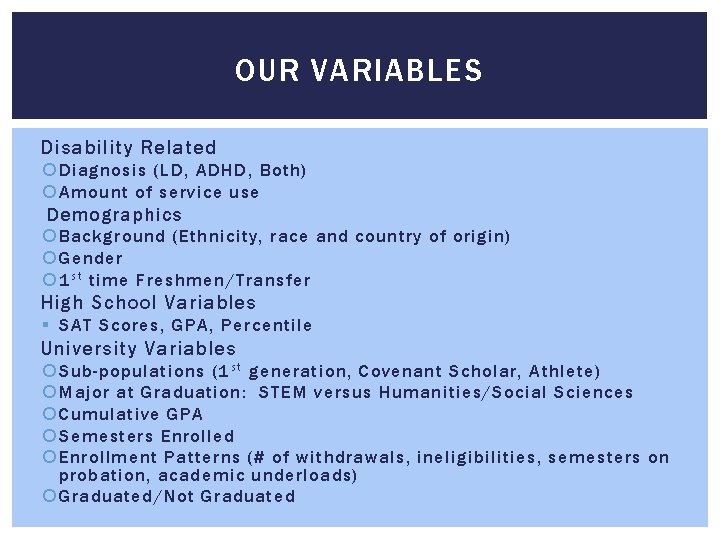
OUR VARIABLES Disability Related Diagnosis (LD, ADHD, Both) Amount of service use Demographics Background (Ethnicity, race and country of origin) Gender 1 s t time Freshmen/Transfer High School Variables § SAT Scores, GPA, Percentile University Variables Sub-populations (1 s t generation, Covenant Scholar, Athlete) Major at Graduation: STEM versus Humanities/Social Sciences Cumulative GPA Semesters Enrolled Enrollment Patterns (# of withdrawals, ineligibilities, semesters on probation, academic underloads) Graduated/Not Graduated
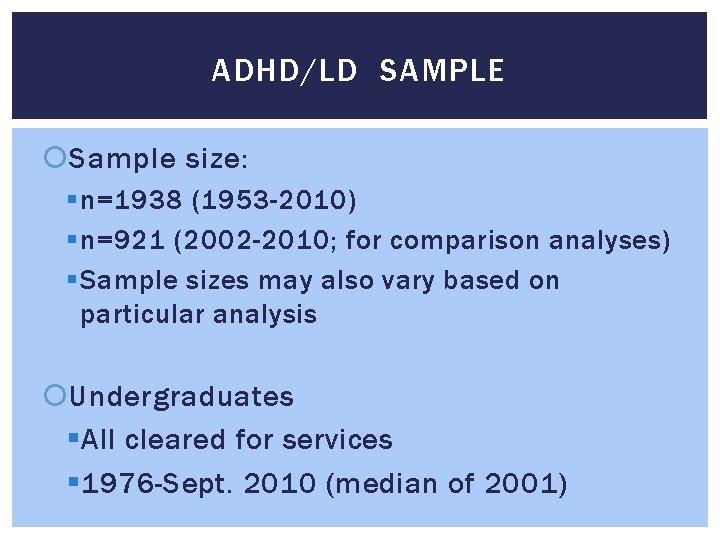
ADHD/LD SAMPLE Sample size: § n=1938 (1953 -2010) § n=921 (2002 -2010; for comparison analyses) § Sample sizes may also vary based on particular analysis Undergraduates § All cleared for services § 1976 -Sept. 2010 (median of 2001)
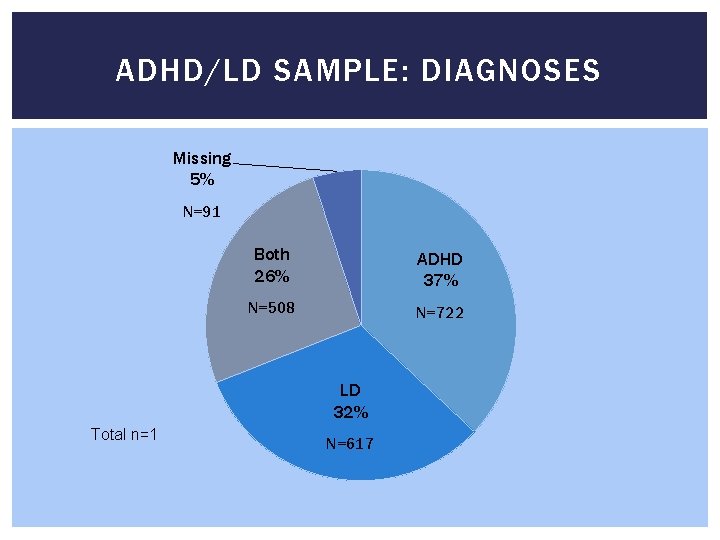
ADHD/LD SAMPLE: DIAGNOSES Missing 5% N=91 Both 26% ADHD 37% N=508 N=722 LD 32% Total n=1938 N=617
RANDOM SAMPLE N=8994 All Undergraduate Students § ADHD/LD removed § 2002 -2010 Cohorts
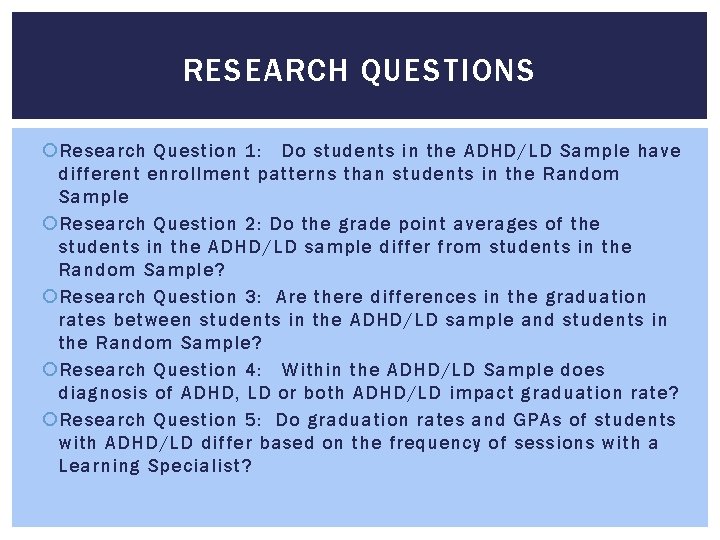
RESEARCH QUESTIONS Research Question 1: Do students in the ADHD/LD Sample have different enrollment patterns than students in the Random Sample Research Question 2: Do the grade point averages of the students in the ADHD/LD sample differ from students in the Random Sample? Research Question 3: Are there differences in the graduation rates between students in the ADHD/LD sample and students in the Random Sample? Research Question 4: Within the ADHD/LD Sample does diagnosis of ADHD, LD or both ADHD/LD impact graduation rate? Research Question 5: Do graduation rates and GPAs of students with ADHD/LD differ based on the frequency of sessions with a Learning Specialist?
STATISTICAL ANALYSES All descriptive and comparative analyses were performed using Stata. IC 12 (Stata. Corp, 2011). Descriptive statistics, including measures of central tendency, cross-tabulations, and chi-squares were used to compare means and characterize the sample with respect to student demographics, high school, and academic success variables. Linear regression, logistic regression, and multi-nomial logistic regression models were employed to examine the relationships among service use, student characteristics, diagnosis, and academic success
COMPARISONS: DEMOGRAPHICS & CHARACTERISTICS
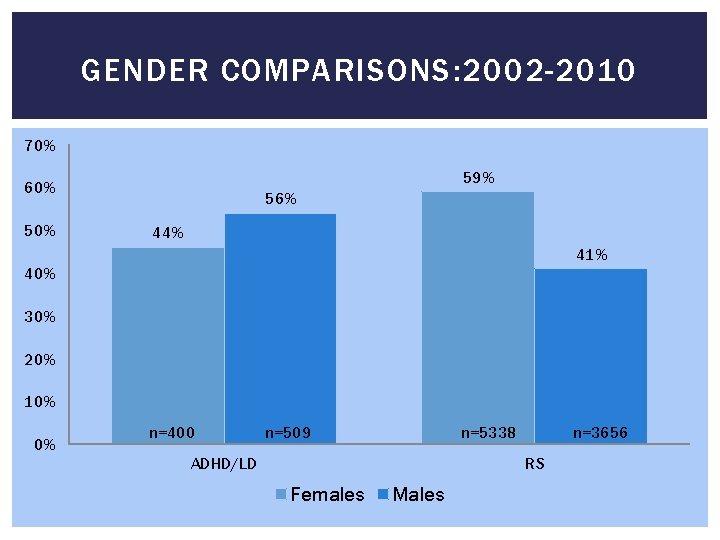
GENDER COMPARISONS: 2002 -2010 70% 59% 60% 56% 44% 41% 40% 30% 20% 10% 0% n=400 n=509 n=5338 ADHD/LD n=3656 RS Females Males
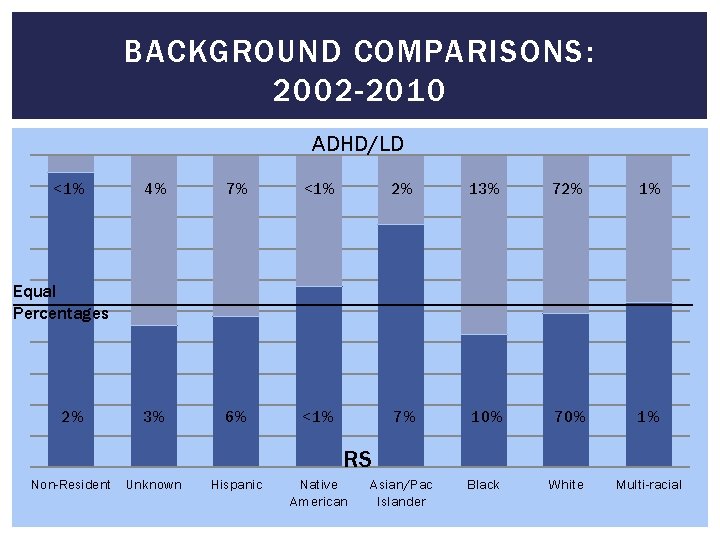
BACKGROUND COMPARISONS: 2002 -2010 ADHD/LD <1% 4% 7% <1% 2% 13% 72% 1% Equal __________________________________ Percentages 2% 3% 6% <1% 7% 10% 70% 1% Asian/Pac Islander Black White Multi-racial RS Non-Resident Unknown Hispanic Native American
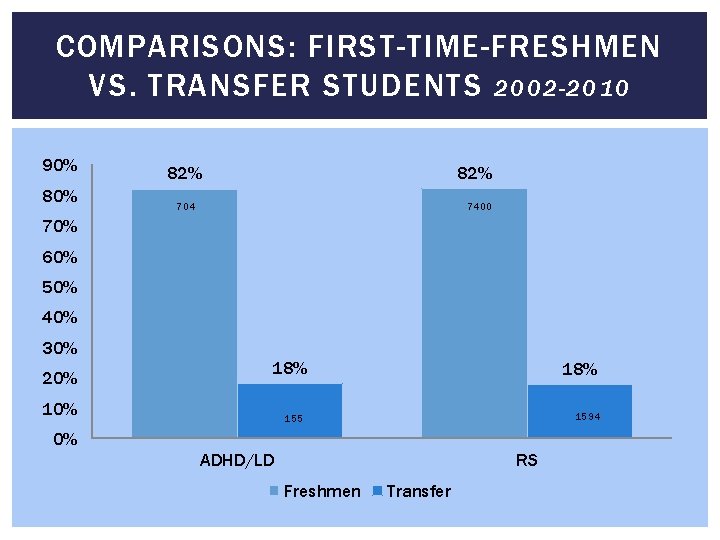
COMPARISONS: FIRST-TIME-FRESHMEN VS. TRANSFER STUDENTS 2002 -2010 90% 82% 82% 704 7400 70% 60% 50% 40% 30% 20% 18% 1594 155 0% ADHD/LD RS Freshmen Transfer
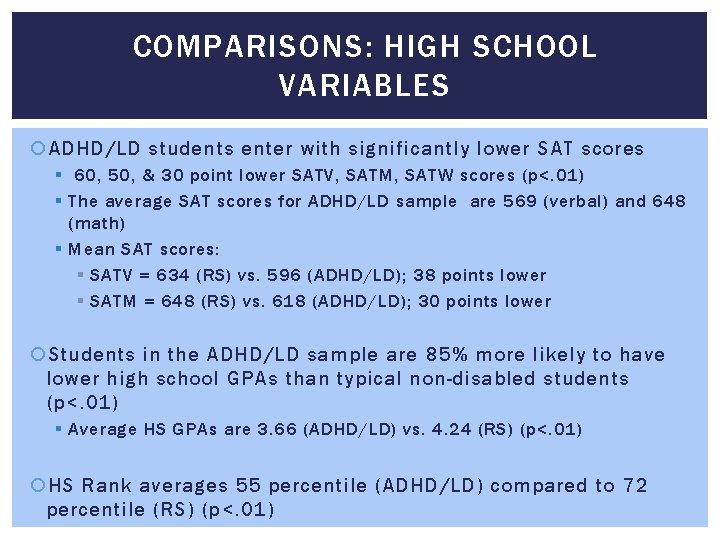
COMPARISONS: HIGH SCHOOL VARIABLES ADHD/LD students enter with significantly lower SAT scores § 60, 50, & 30 point lower SATV, SATM, SATW scores (p<. 01) § The average SAT scores for ADHD/LD sample are 569 (verbal) and 648 (math) § Mean SAT scores: § SATV = 634 (RS) vs. 596 (ADHD/LD); 38 points lower § SATM = 648 (RS) vs. 618 (ADHD/LD); 30 points lower Students in the ADHD/LD sample are 85% more likely to have lower high school GPAs than typical non-disabled students (p<. 01) § Average HS GPAs are 3. 66 (ADHD/LD) vs. 4. 24 (RS) (p<. 01) HS Rank averages 55 percentile (ADHD/LD) compared to 72 percentile (RS) (p<. 01)
ENROLLMENT PATTERNS 2002 -2010 ADHD/LD N=1193 RS N=8994 Sample Comparisons
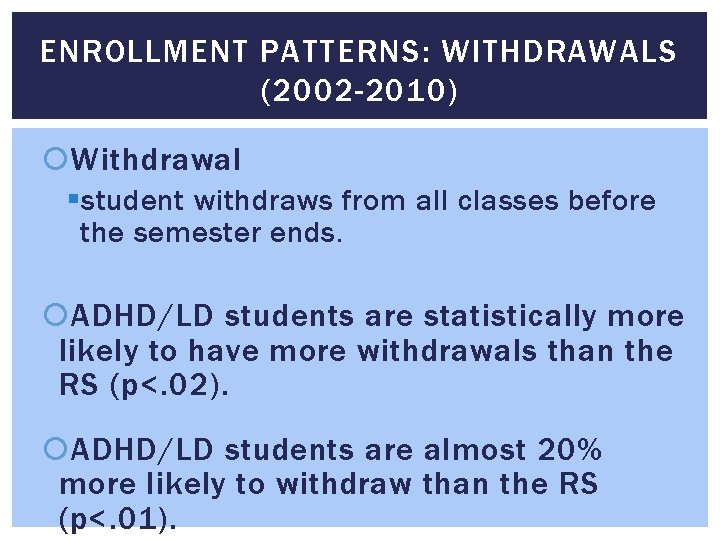
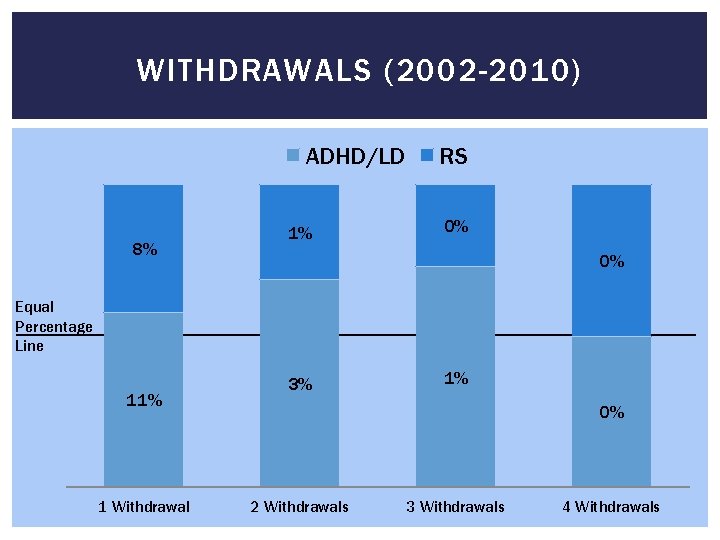
ENROLLMENT PATTERNS: WITHDRAWALS (2002 -2010) Withdrawal § student withdraws from all classes before the semester ends. ADHD/LD students are statistically more likely to have more withdrawals than the RS (p<. 02). ADHD/LD students are almost 20% more likely to withdraw than the RS (p<. 01).
WITHDRAWALS (2002 -2010) ADHD/LD 8% 1% RS 0% 0% Equal Percentage __________________________________ Line 11% 1 Withdrawal 3% 1% 0% 2 Withdrawals 3 Withdrawals 4 Withdrawals
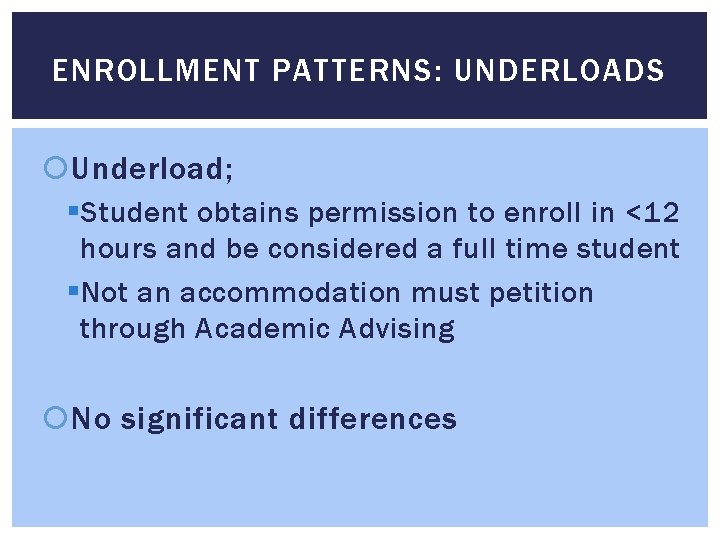
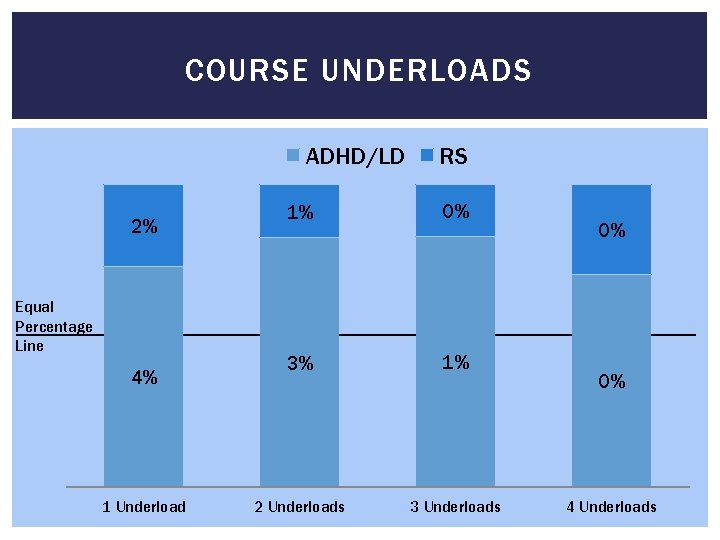
ENROLLMENT PATTERNS: UNDERLOADS Underload; § Student obtains permission to enroll in <12 hours and be considered a full time student § Not an accommodation must petition through Academic Advising No significant differences
COURSE UNDERLOADS ADHD/LD 2% 1% RS 0% 0% Equal Percentage __________________________________ Line 4% 1 Underload 3% 1% 2 Underloads 3 Underloads 0% 4 Underloads
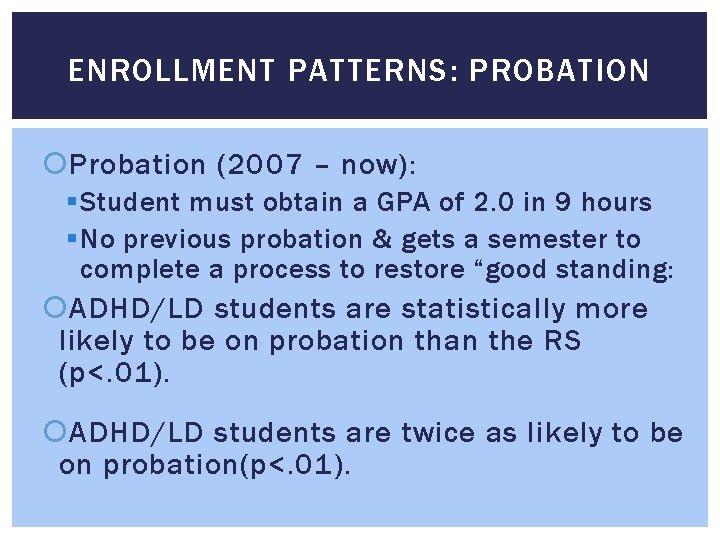
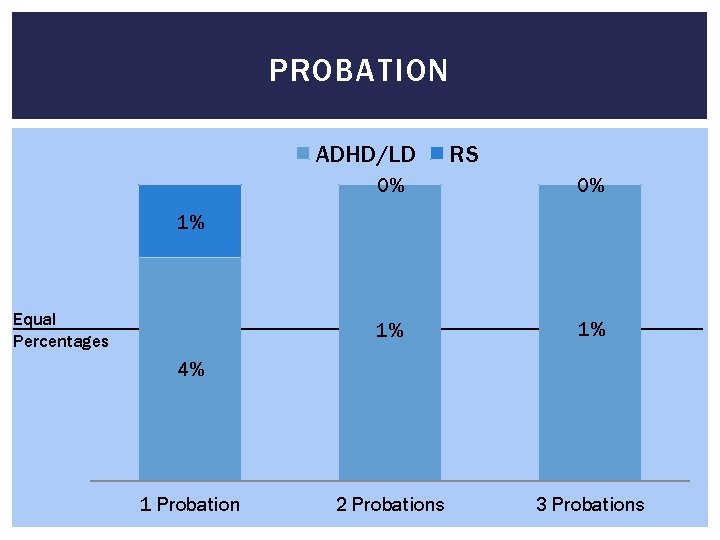
ENROLLMENT PATTERNS: PROBATION Probation (2007 – now): § Student must obtain a GPA of 2. 0 in 9 hours § No previous probation & gets a semester to complete a process to restore “good standing: ADHD/LD students are statistically more likely to be on probation than the RS (p<. 01). ADHD/LD students are twice as likely to be on probation(p<. 01).
PROBATION ADHD/LD 0% RS 0% 1% Equal ___________________________________ 1% 1% Percentages 4% 1 Probation 2 Probations 3 Probations
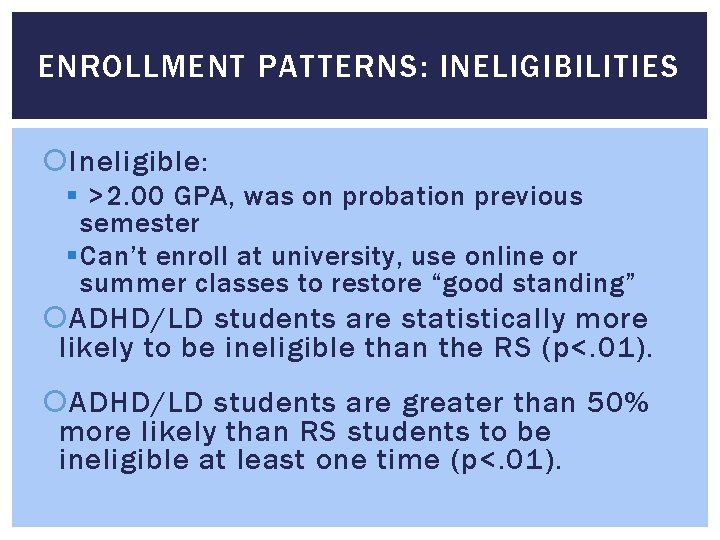
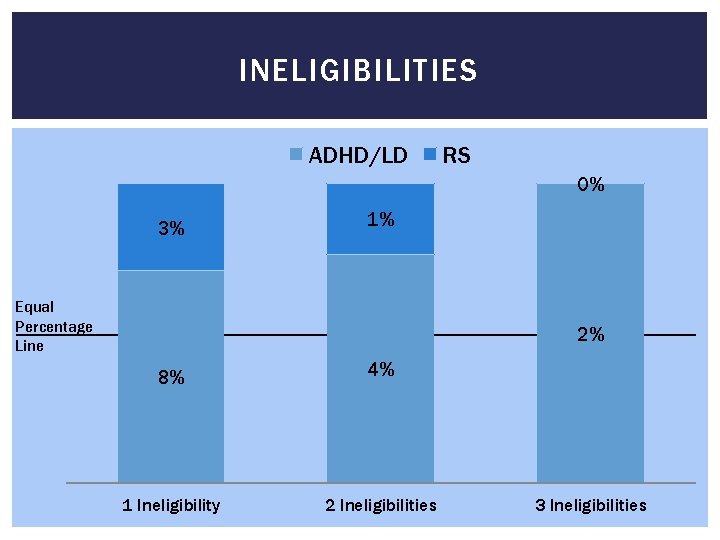
ENROLLMENT PATTERNS: INELIGIBILITIES Ineligible: § >2. 00 GPA, was on probation previous semester § Can’t enroll at university, use online or summer classes to restore “good standing” ADHD/LD students are statistically more likely to be ineligible than the RS (p<. 01). ADHD/LD students are greater than 50% more likely than RS students to be ineligible at least one time (p<. 01).
INELIGIBILITIES ADHD/LD RS 0% 3% 1% Equal Percentage __________________________________ 2% Line 8% 4% 1 Ineligibility 2 Ineligibilities 3 Ineligibilities
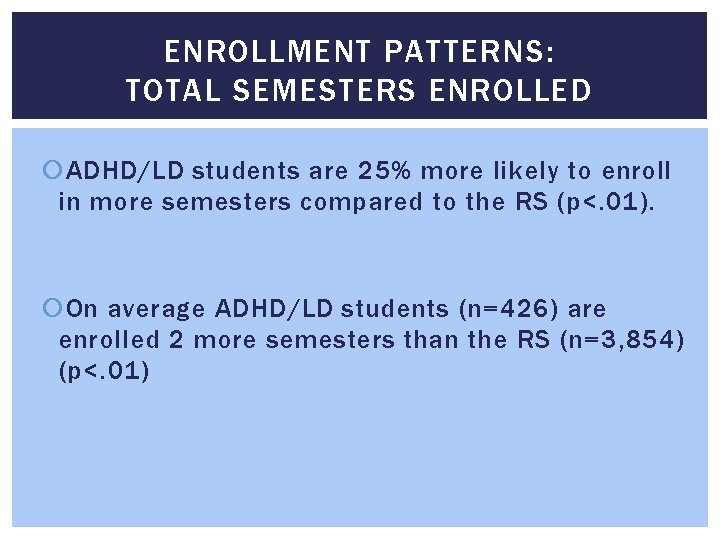
ENROLLMENT PATTERNS: TOTAL SEMESTERS ENROLLED ADHD/LD students are 25% more likely to enroll in more semesters compared to the RS (p<. 01). On average ADHD/LD students (n=426) are enrolled 2 more semesters than the RS (n=3, 854) (p<. 01)
COLLEGE ACADEMIC VARIABLES: GPA & GRADUATION RATES Sample Comparisons
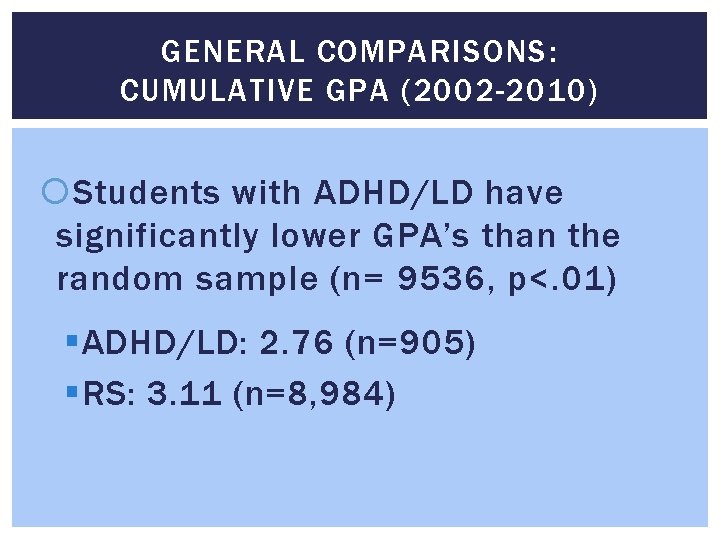
GENERAL COMPARISONS: CUMULATIVE GPA (2002 -2010) Students with ADHD/LD have significantly lower GPA’s than the random sample (n= 9536, p<. 01) §ADHD/LD: 2. 76 (n=905) §RS: 3. 11 (n=8, 984)
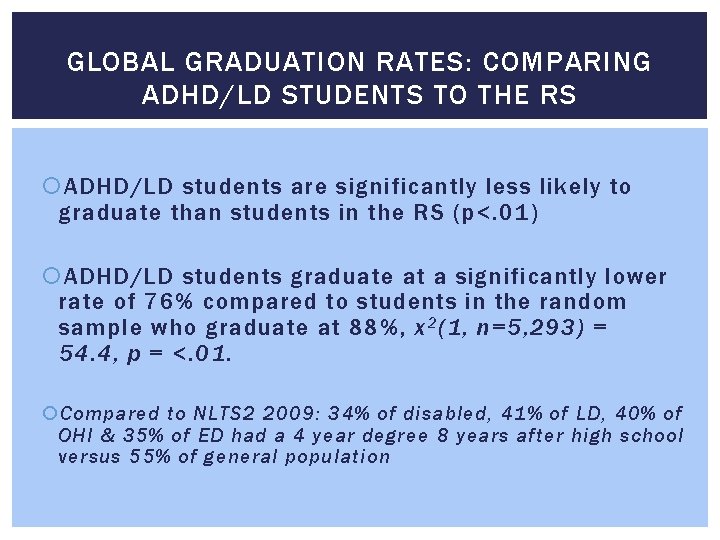
GLOBAL GRADUATION RATES: COMPARING ADHD/LD STUDENTS TO THE RS ADHD/LD students are significantly less likely to graduate than students in the RS (p<. 01) ADHD/LD students graduate at a significantly lower rate of 76% compared to students in the random sample who graduate at 88%, x 2 (1, n=5, 293) = 54. 4, p = <. 01. Compared to NLTS 2 2009: 34% of disabled, 41% of LD, 40% of OHI & 35% of ED had a 4 year degree 8 years after high school versus 55% of general population
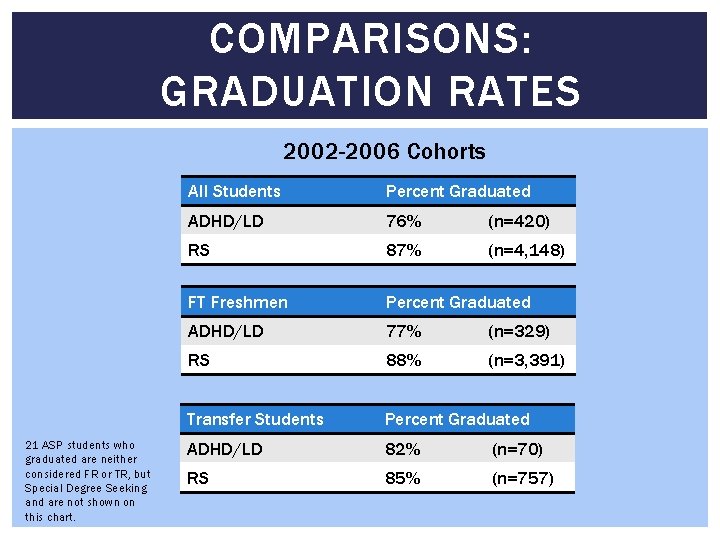
COMPARISONS: GRADUATION RATES 2002 -2006 Cohorts 21 ASP students who graduated are neither considered FR or TR, but Special Degree Seeking and are not shown on this chart. All Students Percent Graduated ADHD/LD 76% (n=420) RS 87% (n=4, 148) FT Freshmen Percent Graduated ADHD/LD 77% (n=329) RS 88% (n=3, 391) Transfer Students Percent Graduated ADHD/LD 82% (n=70) RS 85% (n=757)
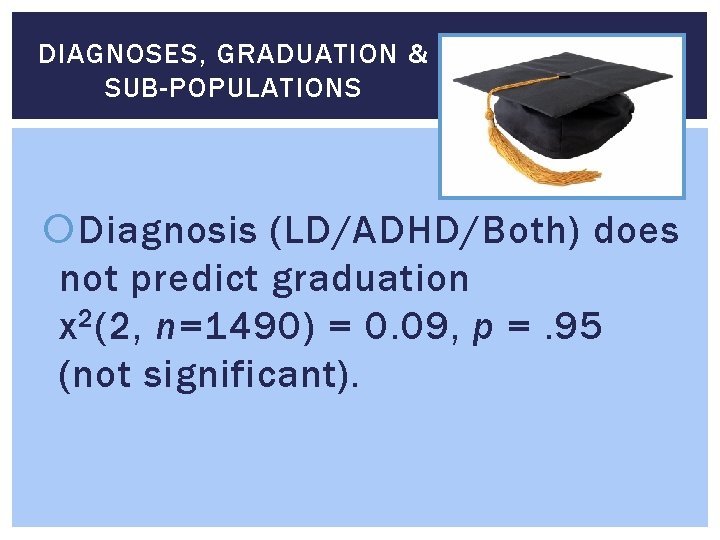
DIAGNOSES, GRADUATION & SUB-POPULATIONS Diagnosis (LD/ADHD/Both) does not predict graduation x 2 (2, n=1490) = 0. 09, p =. 95 (not significant).
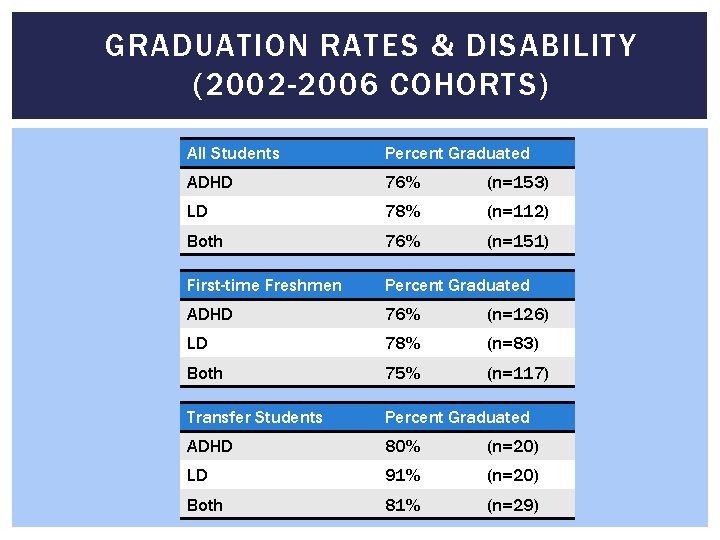
GRADUATION RATES & DISABILITY (2002 -2006 COHORTS) All Students Percent Graduated ADHD 76% (n=153) LD 78% (n=112) Both 76% (n=151) First-time Freshmen Percent Graduated ADHD 76% (n=126) LD 78% (n=83) Both 75% (n=117) Transfer Students Percent Graduated ADHD 80% (n=20) LD 91% (n=20) Both 81% (n=29)
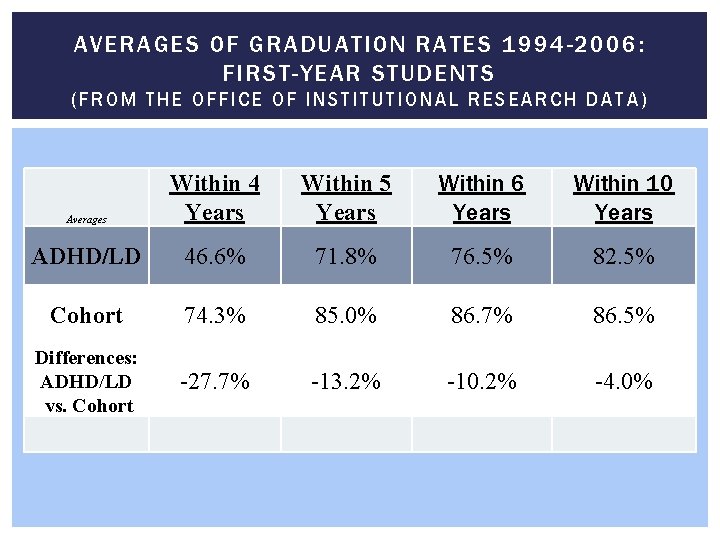
AVERAGES OF GRADUATION RATES 1994 -2006: FIRST-YEAR STUDENTS (F ROM THE OFFICE OF INSTITUTIONAL RESEA RC H D ATA) Averages Within 4 Years Within 5 Years Within 6 Years Within 10 Years ADHD/LD 46. 6% 71. 8% 76. 5% 82. 5% Cohort 74. 3% 85. 0% 86. 7% 86. 5% Differences: ADHD/LD vs. Cohort -27. 7% -13. 2% -10. 2% -4. 0%
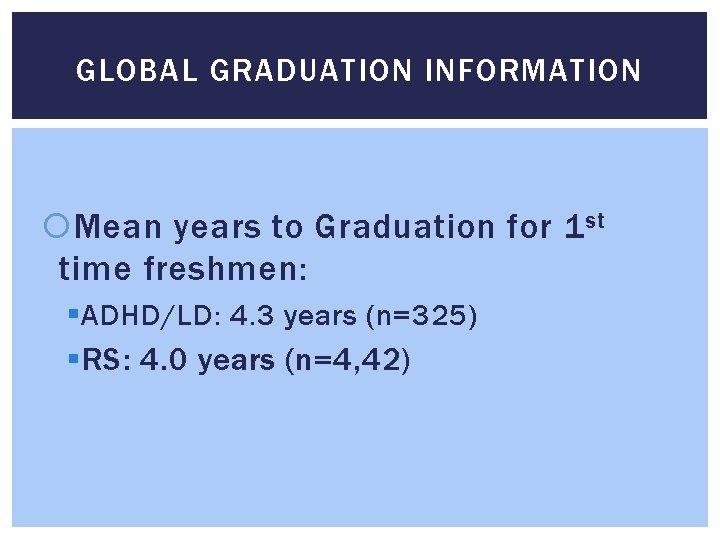
GLOBAL GRADUATION INFORMATION Mean years to Graduation for 1 st time freshmen: § ADHD/LD: 4. 3 years (n=325) § RS: 4. 0 years (n=4, 42)
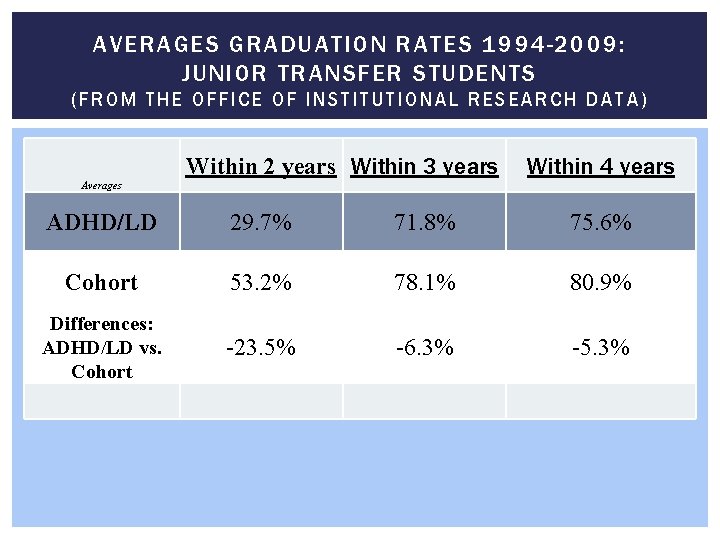
AVERAGES GRADUATION RATES 1994 -2009: JUNIOR TRANSFER STUDENTS (F ROM THE OFFICE OF INSTITUTIONAL RESEA RC H D ATA) Within 2 years Within 3 years Within 4 years Averages ADHD/LD 29. 7% 71. 8% 75. 6% Cohort 53. 2% 78. 1% 80. 9% Differences: ADHD/LD vs. Cohort -23. 5% -6. 3% -5. 3%
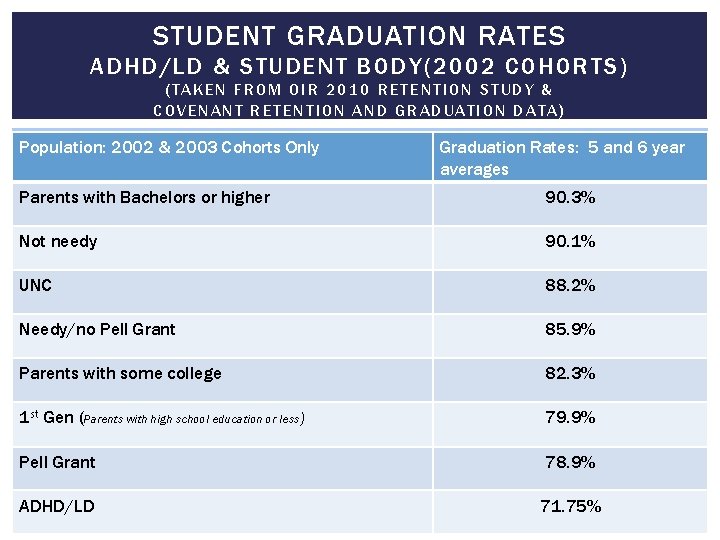
STUDENT GRADUATION RATES ADHD/LD & STUDENT BODY(2002 COHORTS) (TAKEN FROM OIR 2010 RETENTION STUDY & COVENANT RETENTION AND GRADUATION DATA) Population: 2002 & 2003 Cohorts Only Graduation Rates: 5 and 6 year averages Parents with Bachelors or higher 90. 3% Not needy 90. 1% UNC 88. 2% Needy/no Pell Grant 85. 9% Parents with some college 82. 3% 1 st Gen (Parents with high school education or less) 79. 9% Pell Grant 78. 9% ADHD/LD 71. 75%
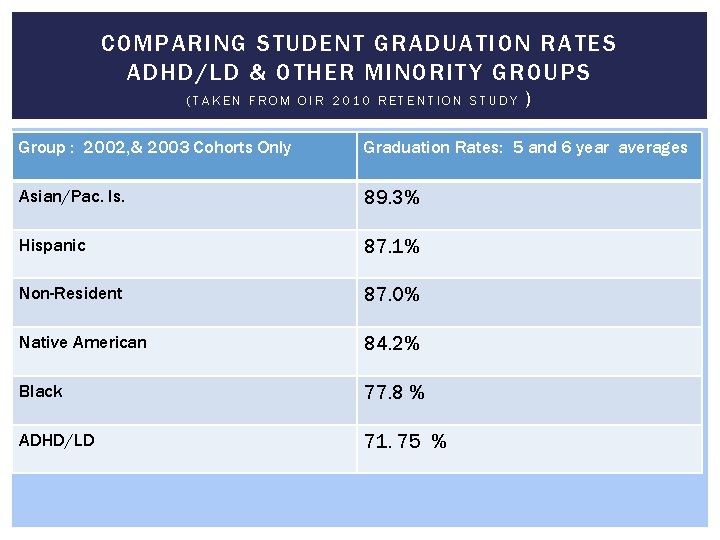
COMPARING STUDENT GRADUATION RATES ADHD/LD & OTHER MINORITY GROUPS (TAKEN FROM OIR 2010 RETENTION STUDY ) Group : 2002, & 2003 Cohorts Only Graduation Rates: 5 and 6 year averages Asian/Pac. Is. 89. 3% Hispanic 87. 1% Non-Resident 87. 0% Native American 84. 2% Black 77. 8 % ADHD/LD 71. 75 %
USE OF SERVICES ADHD/LD SAMPLE
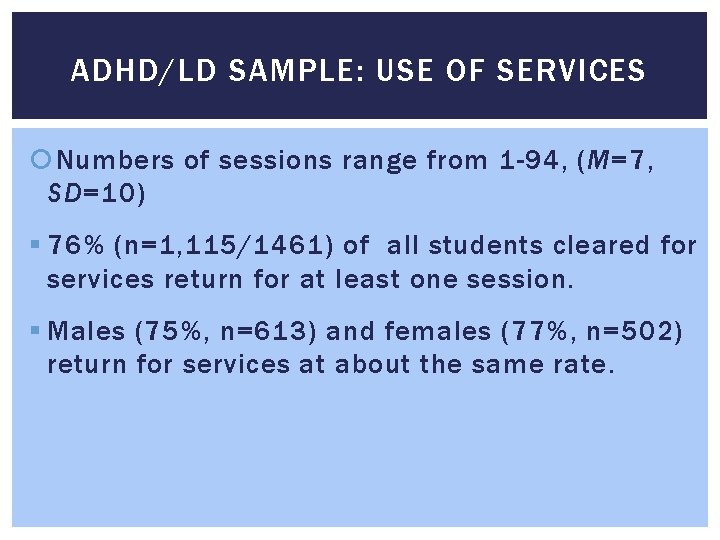
ADHD/LD SAMPLE: USE OF SERVICES Numbers of sessions range from 1 -94, (M=7, SD=10) § 76% (n=1, 115/1461) of all students cleared for services return for at least one session. § Males (75%, n=613) and females (77%, n=502) return for services at about the same rate.
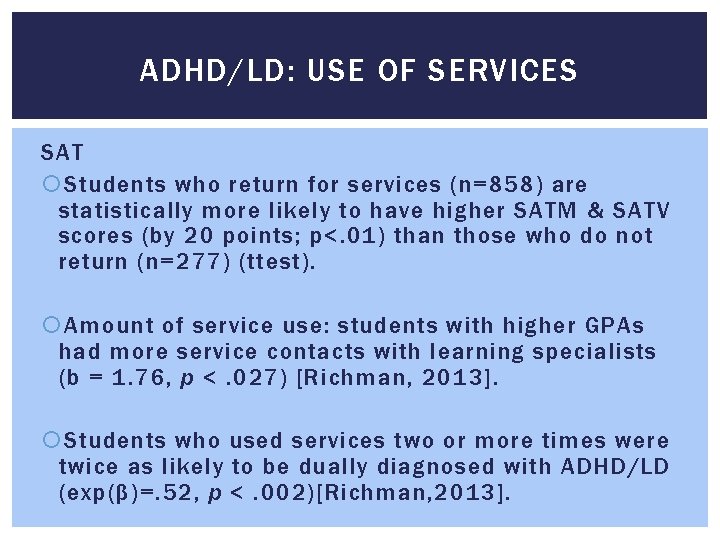
ADHD/LD: USE OF SERVICES SAT Students who return for services (n=858) are statistically more likely to have higher SATM & SATV scores (by 20 points; p<. 01) than those who do not return (n=277) (ttest). Amount of service use: students with higher GPAs had more service contacts with learning specialists (b = 1. 76, p <. 027) [Richman, 2013]. Students who used services two or more times were twice as likely to be dually diagnosed with ADHD/LD (exp(β)=. 52, p <. 002)[Richman, 2013].
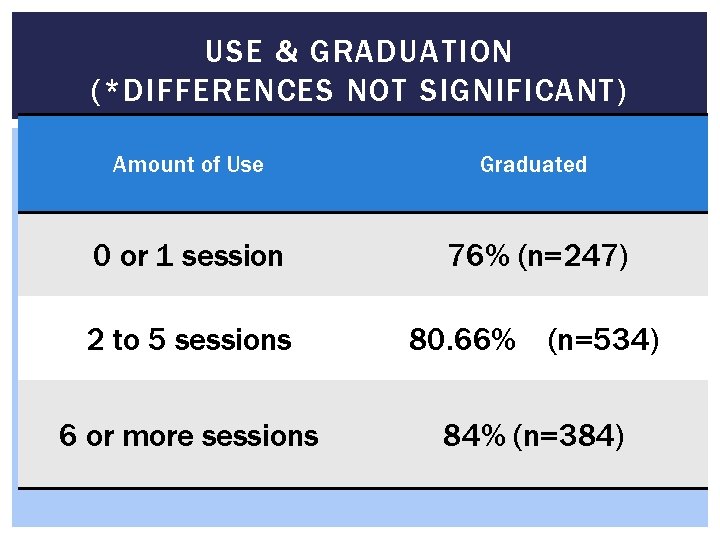
USE & GRADUATION (*DIFFERENCES NOT SIGNIFICANT) Amount of Use Graduated 0 or 1 session 76% (n=247) 2 to 5 sessions 6 or more sessions 80. 66% (n=534) 84% (n=384)
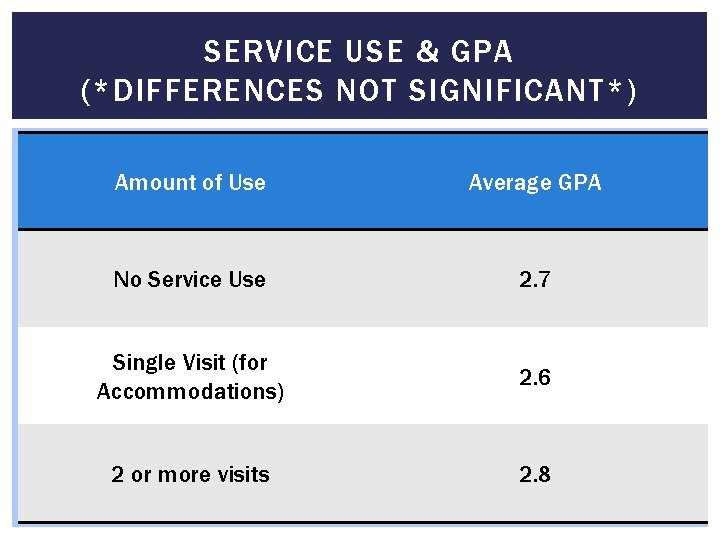
SERVICE USE & GPA (*DIFFERENCES NOT SIGNIFICANT*) Amount of Use Average GPA No Service Use 2. 7 Single Visit (for Accommodations) 2. 6 2 or more visits 2. 8
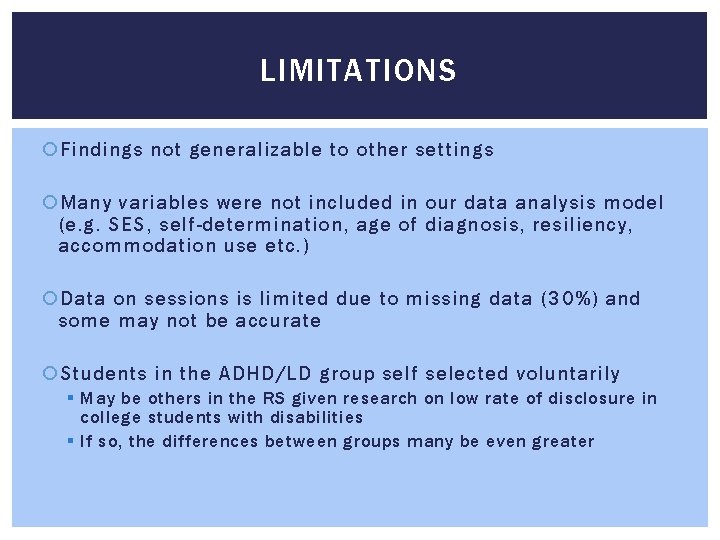
LIMITATIONS Findings not generalizable to other settings Many variables were not included in our data analysis model (e. g. SES, self-determination, age of diagnosis, resiliency, accommodation use etc. ) Data on sessions is limited due to missing data (30%) and some may not be accurate Students in the ADHD/LD group self selected voluntarily § May be others in the RS given research on low rate of disclosure in college students with disabilities § If so, the differences between groups many be even greater
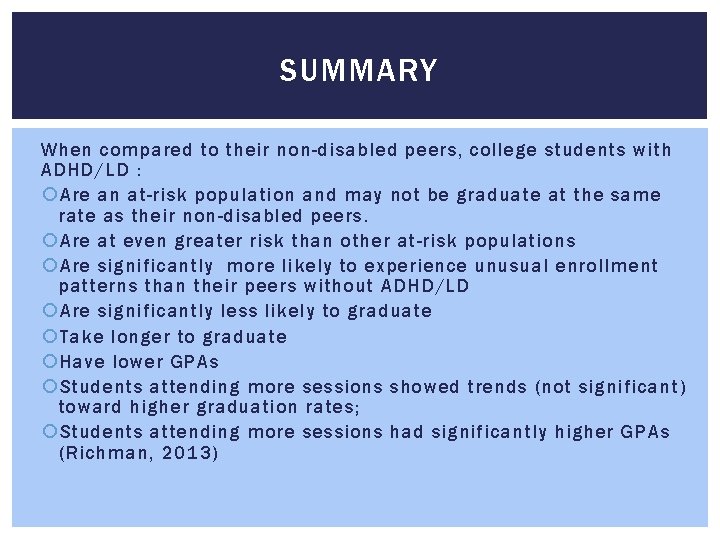
SUMMARY When compared to their non-disabled peers, college students with ADHD/LD : Are an at-risk population and may not be graduate at the same rate as their non-disabled peers. Are at even greater risk than other at-risk populations Are significantly more likely to experience unusual enrollment patterns than their peers without ADHD/LD Are significantly less likely to graduate Take longer to graduate Have lower GPAs Students attending more sessions showed trends (not significant) toward higher graduation rates; Students attending more sessions had significantly higher GPAs (Richman, 2013)
IMPLICATIONS Additional studies are needed in different settings to see if findings are consistent and to determine what factors influence student success Need to identify and implement evidenced based practices at the high school and college level Need to disseminate “at-risk” status for transitioning teens to: § Parents and teens § College administrators setting policy and developing programming for at-risk groups on campuses § Need creative programming strategies to attract teens reluctant to access services
Q &A Copy of edited slides: email tmaitlan@email. unc. edu Statistical/Methodological questions; § Email me and I will get them to our Research Assistant: Erica Richman
REFERENCES Blasé, S. L. , Gilbert, A. N. , Anastopoulos, A. D. , Costello, E. , Hoyle, R. H. , Swartzwelder, H. , & Rabiner, D. L. (2009). Self-Reported ADHD and adjustment in college: Cross-sectional and longitudinal findings. Journal of Attention Disorders, 13(3), 297 -309. doi: 10. 1177/1087054709334446 Canto, A. , I. , Proctor, B. E. , & Prevatt, F. (2005). Educational outcomes of students first diagnosed with learning disabilities in postsecondary school. Journal of College Admissions, 189. 8 -13 Frazier, T. W. , Youngstrom, E. A. , Glutting, J. J. , & Watkins, M. W. (2007). ADHD and achievement: Meta-analysis of the child, adolescent, and adult literatures and a concomitant study with college students. Journal of Learning Disabilities, 40, 49 -65. doi: 10. 1177/00222194070400010401 Greenbaum, B. , Graham, S. , & Scales, W. (1995). Adults with learning disabilities: Educational and social experiences during college. Exceptional Children, 61(5), 460 -471. Gregg, N. (2009). Adolescents and adults with learning disabilities and ADHD: Assessment and accommodation. New York, NY: Guilford Press. Heiligenstein, E. , Guenther, G. , Levy, A. , Savino, F. , & Fulwiler, J. (1999). Psychological and academic functioning in college students with attention deficit hyperactivity disorder. Journal of American College Health, 47(4), 181 -185. doi: 10. 1080/07448489909595644 Horn, L. , Berktold, J. , & Bobbitt, L. (1999). Students with disabilities in postsecondary education: a profile of preparation, participation and outcomes. Postsecondary Education Descriptive Analysis Reports. U. S. Department of Education: National Center for Education Statistics.
Huger, Marianne, (2009). The Retention of College Students with Learning Disabilities. A Dissertation Submitted to The Faculty of The Graduate School of Education and Human Development of The George Washington University in partial fulfillment of the requirements for the degree of Doctor of Education. Jorgensen, S. , Fichten, C. S. , Havel, A. , Lamb, D. , James, C. , & Barile, M. (2003). Students with and without disabilities at Dawson College graduate at the same rate. Journal for Vocational Special Needs Education, 25(2 -3), 44 -46. Murray, C. , Goldstein, D. E. , Nourse, S. , & Edgar, E. (2000). The postsecondary school attendance and completion rates of high school graduates with learning disabilities. Learning Disabilities Research & Practice, 15(3), 119 -127. Richman, E. (2013). The Academic Success of College Students with ADHD/LD. A Dissertation Submitted to the Faculty of The Graduate School of Social Work at UNC Chapel Hill in partial fulfillment of the requirements for the degree of a Doctor of Social Work. Vogel, S. , & Adelman, P. (1992). The success of college students with learning disabilities: Factors related to educational attainment. Journal of Learning Disabilities, 25, 430 -441 Wessel, R. , D. , Jones, J. A. , Markle, L. , Westfall, C. (2009). Retention and graduation of students with disabilities: Facilitating student success. Journal of Postsecondary Education and Disability, 21(3), 116 -124.