
Characteristics and Problems of the Gifted neural propagation
Characteristics and Problems of the Gifted: neural propagation depth and flow motivation as a model of intelligence and creativity Francis HEYLIGHEN
Who are the Gifted? • High Intelligence and Creativity • “Genius”: da Vinci, Einstein, Simon, von Neumann. . . • IQ > 130: gifted, > 145 highly gifted, >160 exceptionally gifted • Potential for exceptional achievement • difficult to measure • Specific personality profile. . .
Personality Traits • Cognition: good problem-solving, unusual connections, original, imaginative, fast learner, good memory • Feelings: sensitive, intense, passionate, “overexcitable”, sense of humor • Motivation: ambitious, risk-taking, very curious, broad interests, persistent, perfectionist • Social relations: non-conformist, autonomous, feels different, empathic, sense of justice
Gifted Children 99. 4% learn rapidly 99. 4% have extensive vocabulary 99. 3% have excellent memory 99. 3% reason well 97. 9% are curious 96. 1% are mature for their age 95. 9% have excellent sense of humor 93. 8% have keen sense of observation 93. 5% have compassion for others 93. 4% have vivid imagination 93. 4% have long attention span 92. 9% have ability with numbers 90. 3% are concerned with fairness 89. 4% are good with puzzles and legos 88. 4% have high energy level 88. 3% are perfectionistic 85. 9% are perseverant 84. 1% question authority
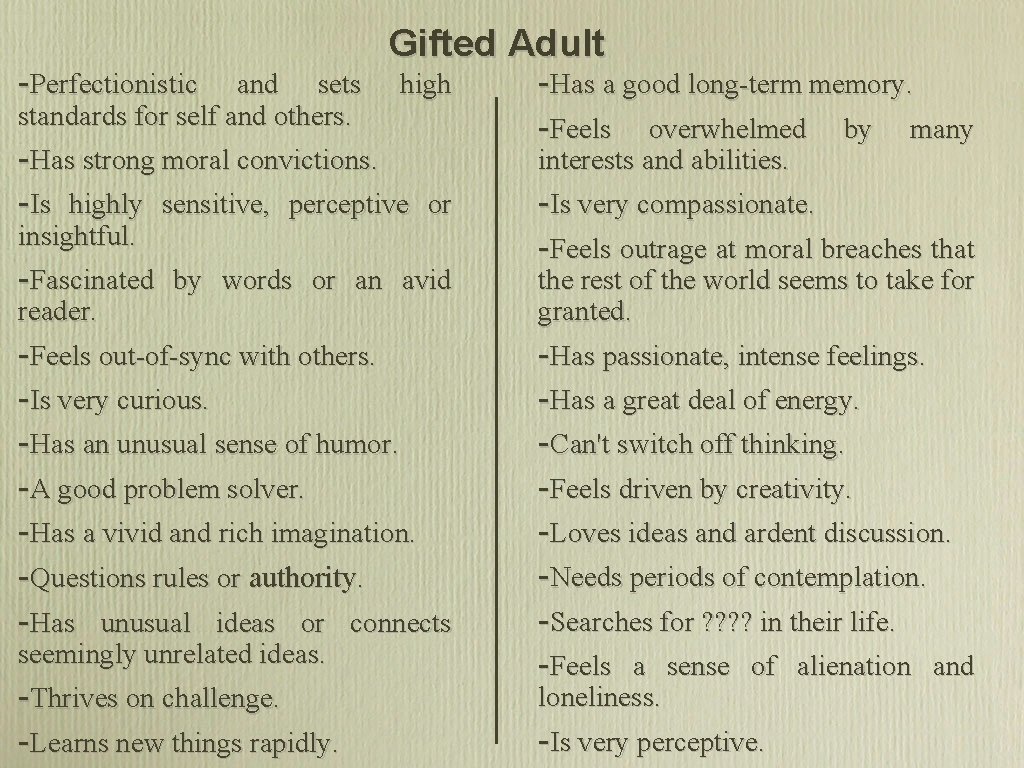
-Perfectionistic and sets standards for self and others. -Has strong moral convictions. Gifted Adult high -Has a good long-term memory. -Feels overwhelmed by many -Is highly sensitive, perceptive or insightful. -Fascinated by words or an avid reader. -Feels out-of-sync with others. -Is very curious. -Has an unusual sense of humor. -A good problem solver. -Has a vivid and rich imagination. -Questions rules or authority. -Has unusual ideas or connects seemingly unrelated ideas. -Thrives on challenge. -Learns new things rapidly. interests and abilities. -Is very compassionate. -Feels outrage at moral breaches that the rest of the world seems to take for granted. -Has passionate, intense feelings. -Has a great deal of energy. -Can't switch off thinking. -Feels driven by creativity. -Loves ideas and ardent discussion. -Needs periods of contemplation. -Searches for ? ? in their life. -Feels a sense of alienation and loneliness. -Is very perceptive.
The g-factor • Most general factor underlying intelligence • Measures “information processing efficiency” • Correlated with: • brain size • reaction/conduction/inspection speed • size of working memory • energy efficiency of brain

Neural Hypotheses about g • glia (support cells): more in Einstein’s brain • myelin: better insulation of neural connections (axons) • neural plasticity: easier formation of connections • metabolism: more efficient energy production
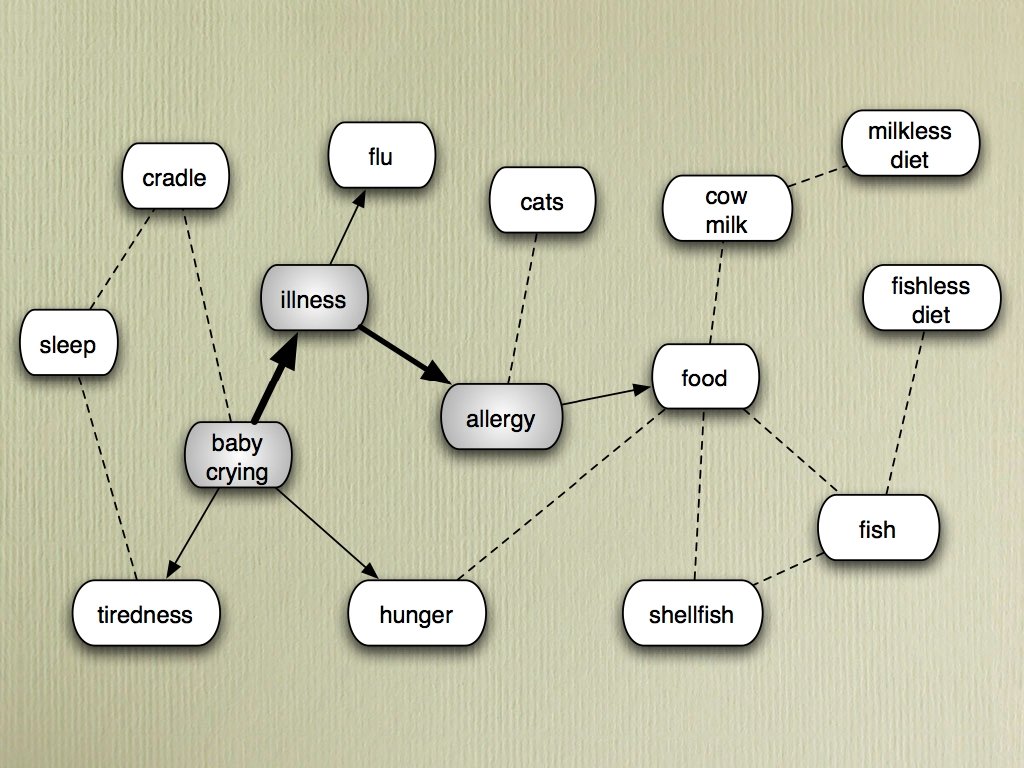
Neural Propagation Depth • Spreading activation: action potentials propagate from neuron to neuron across synapses • Process is: energy intensive, error-prone • -> activation weakens with each crossing • Propagation stops when activation drops below threshold • Average number of steps = propagation depth
Propagation depth D as function of decay factor c Activation: A(t) = c. A(t - 1), with c < 1
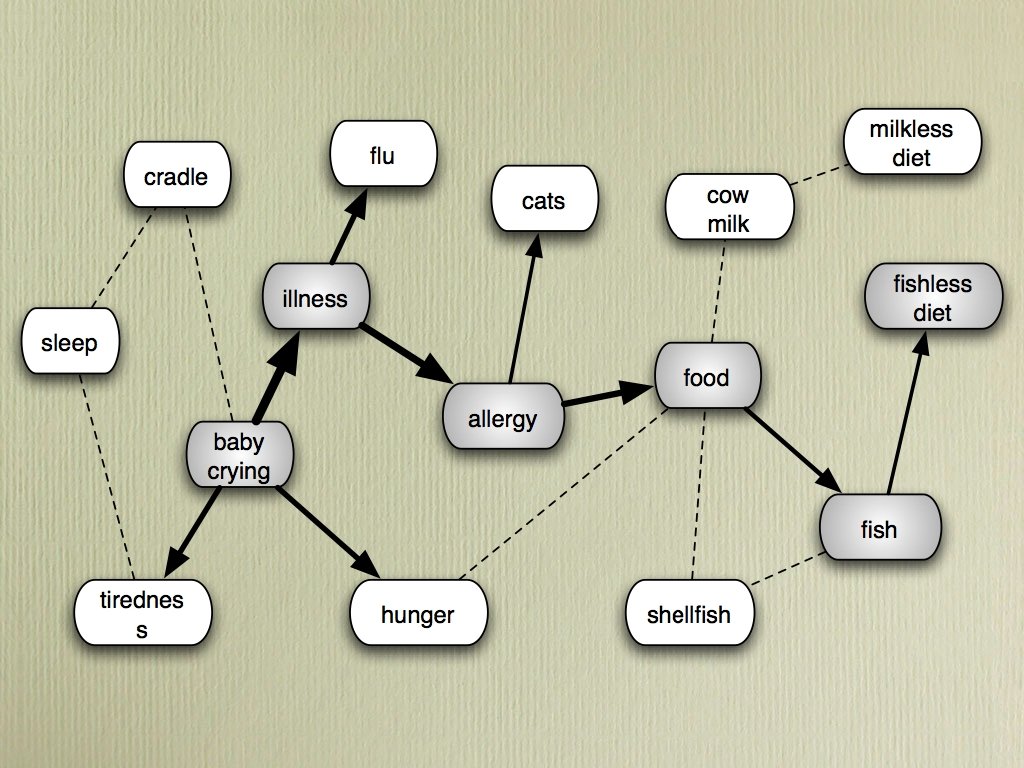
Problem-Solving • Problem= initial combination of concepts • Solution = final combination of concepts • Problem-solving = propagating activation along associations between concepts • Example Problem: baby cries ➡illness? ➡Intermediate step: allergy to fish ➡Solution: fishless diet
Implications for cognition • Giftedness ~ g ~ Propagation Depth D • Higher D: ‣ wider propagation of activation ‣ more problems can be solved ‣ larger working memory ‣ more “far-fetched” associations ‣ stronger co-activation of remote concepts ‣ faster Hebbian learning of
Imagination and Feeling • Perceptual sensitivity: stimuli propagate better from senses to consciousness • Emotional intensity: perceptions elicit stronger feelings • Vivid imagination: conceptions more easily activate perceptual memories
Social Feelings • Empathy: imagining/feeling oneself in the other’s place ‣ compassion • Morality or Sense of justice: • expanding compassion to remote people/situations • developing a comprehensive ethics
Flow Motivation • Csikszentmihalyi: people seek “flow” in activities • challenges = skills ‣ flow, happiness • challenges > skills ‣ too difficult, anxiety • challenges < skills ‣ too easy, boredom
Finding the right challenge as people become more skilled, they need to raise their challenges to remain satisfied
Gifted motivation • Skilled at problem-solving ‣ ambitious, seek difficult challenges ‣ perfectionist • Skilled at learning ‣ intense curiosity ‣ wide range of interests
Relations with others • Question authority/accepted wisdom • prefer to think for themselves • Are out of step: interaction GP - non GP • skills GP >> skills non GP ‣ anxiety for non GP ‣ or: boredom for GP ‣ e. g. hiking, Procession of Echternach
Social Problems of the Gifted • May not be recognized as gifted - too broad range of interests - don’t fit the “specialist” stereotype of - good at maths, chess, whizz-kid, . . . may be dismissed as crackpots • Others do not understand them • Others may fear them as competitors • Non-conformity can lead to ostracism • e. g. Giordano Bruno
Personal Problems of the Gifted • rarely recognize themselves as gifted • often feel lonely, misfit • tend to accept dismissive views of others • don’t know what to focus on • can be so perfectionist they never finish their work • have unrealistic expectations of others • can be too sensitive (e. g. compassionate)
Problems of Gifted Women • fit the stereotypes even less then men ‣ are more inclined to accept dismissive views • are pushed by society into nonintellectual functions • tend to be more socially sensitive, compassionate • cognition is more broad, contextsensitive ‣ have even more difficulty to focus
Testing theory • Neural propagation depth not directly observable • Indirect measurements, e. g. indirect priming ? • Simulation: spreading activation over network of associated concepts (with Marko Rodriguez) • solves IQ-test like questions • e. g. which word does not fit: cow, car*, bird, fish • number correct ~ propagation parameters • similar mistakes like real people?
- Slides: 24