
Characteristic of Gothic Literatu Subgenre of Romanticism 1800

Characteristic of Gothic Literatu Subgenre of Romanticism 1800 -1860

The Origin of Gothic Literature ü Gothic Literary tradition came to be in part from the Gothic architecture of the Middle Ages. ü Gothic cathedrals with irregularly placed towers, and high stained-glass windows were intended to inspire awe and fear in religious worshipers.
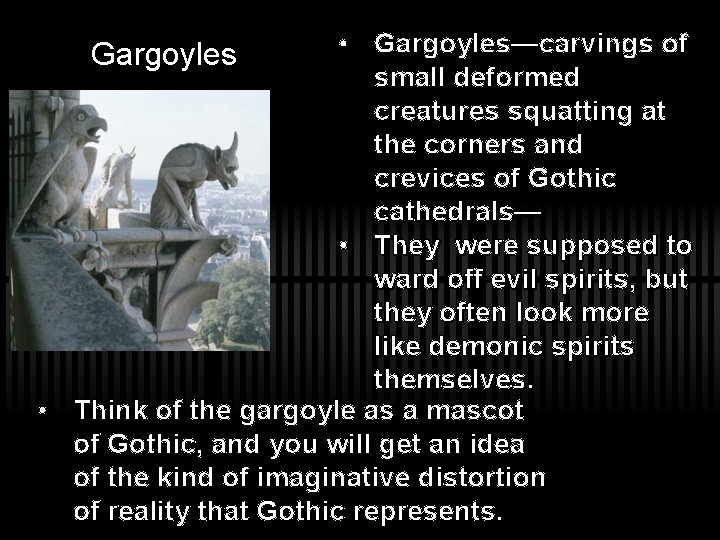
• Gargoyles—carvings of small deformed creatures squatting at the corners and crevices of Gothic cathedrals— • They were supposed to ward off evil spirits, but they often look more like demonic spirits themselves. • Think of the gargoyle as a mascot of Gothic, and you will get an idea of the kind of imaginative distortion of reality that Gothic represents. Gargoyles
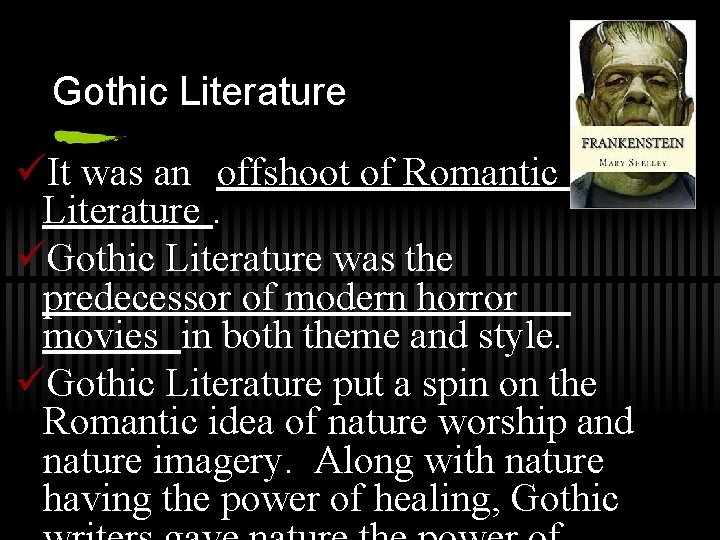
Gothic Literature üIt was an offshoot of Romantic Literature. üGothic Literature was the predecessor of modern horror movies in both theme and style. üGothic Literature put a spin on the Romantic idea of nature worship and nature imagery. Along with nature having the power of healing, Gothic

Gothic vs. Romanticism Gothic • Romantic writers celebrated the beauties of nature. • Gothic writers were peering into the darkness at the supernatural. Romanticism developed as a reaction against the rationalism of the Age of Reason. Gothic Literature is a subgenre of Romanticism. The romantics freed the imagination from the hold of reason so they could follow their imaginations where it might lead. For Gothic writers, the imagination led to the threshold of the unknown --the shadowy region where the fantastic, the demonic and the insane reside. For Romantics, When they looked at the individual, they saw hope. • When the Gothics saw the individual, they saw the potential of evil.
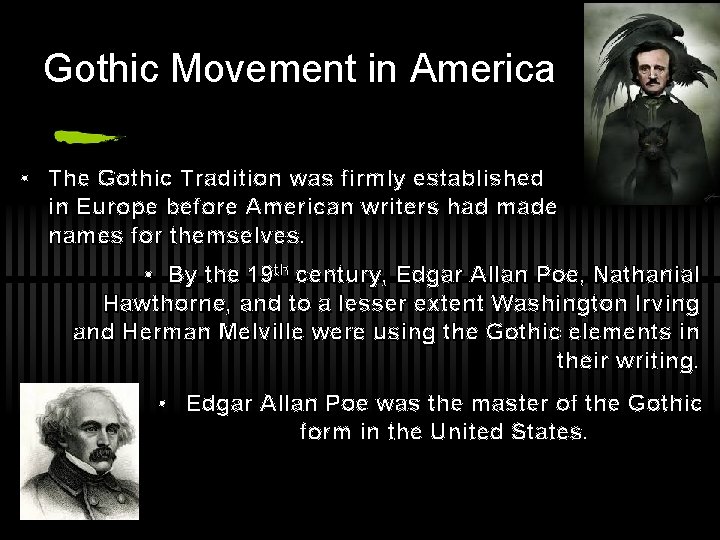
Gothic Movement in America • The Gothic Tradition was firmly established in Europe before American writers had made names for themselves. • By the 19 th century, Edgar Allan Poe, Nathanial Hawthorne, and to a lesser extent Washington Irving and Herman Melville were using the Gothic elements in their writing. • Edgar Allan Poe was the master of the Gothic form in the United States.
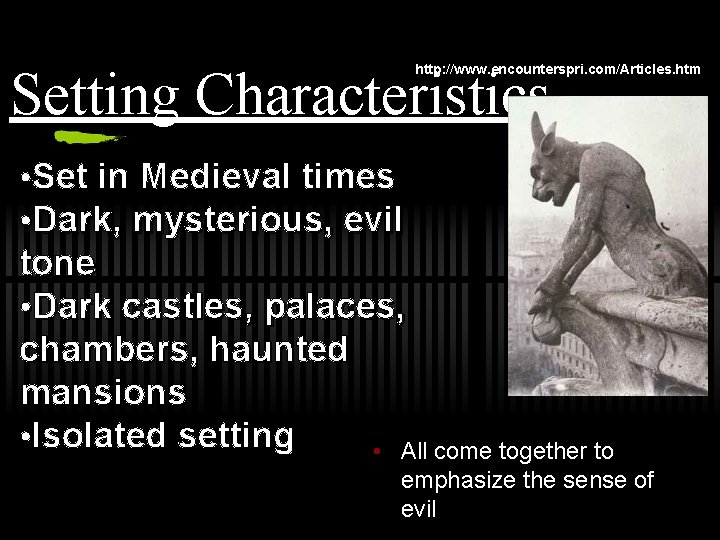
Setting Characteristics http: //www. encounterspri. com/Articles. htm • Set in Medieval times • Dark, mysterious, evil tone • Dark castles, palaces, chambers, haunted mansions • Isolated setting • All come together to emphasize the sense of evil

Importance of Setting ü The setting is greatly influential in Gothic novels. It not only evokes the atmosphere of horror and dread, but also portrays the deterioration of its world. ü The decaying, ruined scenery implies that at one time there was a thriving world. ü At one time the abbey, castle, or landscape was something treasured and appreciated. ü Now, all that lasts is the decaying shell of a once thriving dwelling.

Supernatural characteristics • Presence of ghosts, spirits, vampires, and other supernatural entities • Mysterious disappearances and reappearances • Religion, usually Christianity or at least spirituality, is confronted. http: //www. penelopesweb. com/gargoyles. html
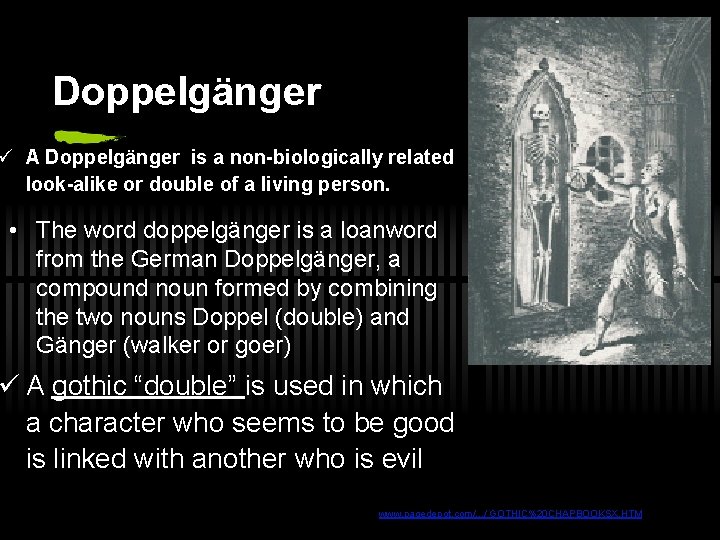
Doppelgänger ü A Doppelgänger is a non-biologically related look-alike or double of a living person. • The word doppelgänger is a loanword from the German Doppelgänger, a compound noun formed by combining the two nouns Doppel (double) and Gänger (walker or goer) ü A gothic “double” is used in which a character who seems to be good is linked with another who is evil www. pagedepot. com/. . . / GOTHIC%20 CHAPBOOKSX. HTM
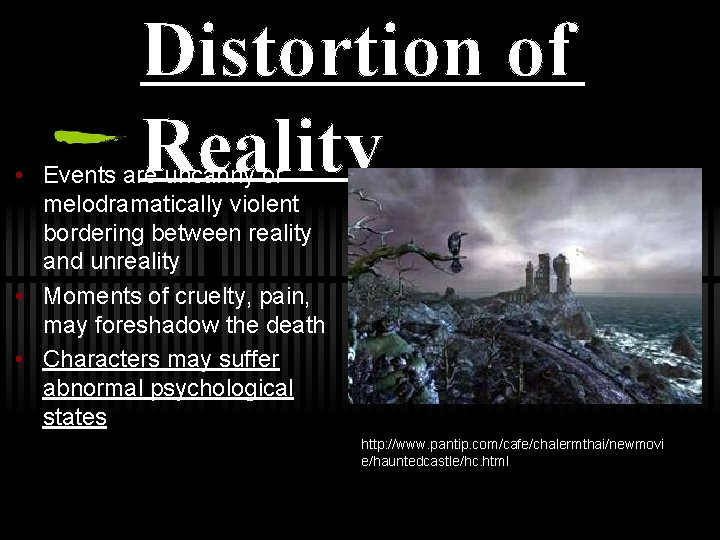
Distortion of Reality • Events are uncanny or melodramatically violent bordering between reality and unreality • Moments of cruelty, pain, may foreshadow the death • Characters may suffer abnormal psychological states http: //www. pantip. com/cafe/chalermthai/newmovi e/hauntedcastle/hc. html

Purpose of Gothic Literature • To evoke “terror” versus “horror” in the reader because of situations bordering reality/unreality • Often used to teach a message • May lack a Medieval setting but will develop an atmosphere of gloom and terror
Differentiating between Horror and Terror • Horror • “An awful apprehension” • Described distinctly • Something grotesque • So appalling, unrealistic • Depends on physical characteristics • Terror • “A sickening realization” • Suggestive of what will happen • Depends on reader’s imagination • Sense of uncertainty • Creates an “intangible atmosphere of spiritual psychic dread”
Basic Plot Structure for a Gothic Novel • Action in the Gothic novel tends to take place at night, or at least in a claustrophobic, sunless environment. • Ascent (up a mountain high staircase) • Descent (into a dungeon, cave, underground chambers or labyrinth) or falling off a precipice; secret passage; hidden doors; • Physical decay, skulls, cemeteries, and other images of death; ghosts; revenge; family curse; blood and gore; torture; the Doppelganger (evil twin or double), etc.
- Slides: 14